A sudden illness, a death, or a divorce filing can put a Texas business in a hard place fast. The payroll still runs. The clients still expect answers. The lender still wants comfort. If one founder, executive, or technical specialist carries too much of the company's knowledge or revenue, key person insurance is the cleanest way to keep a bad week from turning into a business-ending event.
Texas owners tend to think first about rent, taxes, and employees, then they worry about succession after it's already too late. That's the wrong order. If your business depends on one or two people, the risk is concentrated, and concentrated risk deserves a written plan. Industry data shows 71% of small businesses said they were highly dependent on one or two key people, but only 22% had key person life insurance in place, a gap that tells you how often owners recognize the danger without acting on it (III guide on life insurance for key employees).
For Texas families, this isn't just a business issue. It becomes a divorce issue when one spouse owns the company. It becomes an estate issue when that owner dies and the family needs liquidity. It becomes a custody issue when a family business funds the household and a disruption changes the entire financial picture. The right policy doesn't solve every problem, but it gives your lawyer, accountant, and family a real financial cushion to work with.

If you're trying to sort through the legal and financial fallout of a business dependency, an AI legal assistant for business owners can help organize the questions before you sit down with counsel.
Why Texas Business Owners Overlook Their Biggest Risk
A Houston contractor builds his company around his brother, who handles estimating, vendor relationships, and the bids that keep revenue moving. Then the brother has a stroke. The phones still ring, but nobody else knows the pricing history, the preferred suppliers, or the terms hidden in half the old jobs. The business is still open, but its center of gravity is gone.
That's why owners miss the core risk. They don't lose a company because a policy is missing on a spreadsheet. They lose it because a sudden absence breaks the chain between sales, operations, and cash flow. A founder's illness, a top salesperson's departure, or the death of a technical lead can hit payroll, client confidence, and the family's household income at the same time.
Practical rule: If the business would struggle to replace the person, replace the financial risk first.
Texas owners also overlook the human part. Nobody wants to buy insurance on the person everyone trusts most. But this is exactly the kind of planning responsible owners do when they understand that the company is bigger than any one individual. The policy doesn't predict tragedy. It prepares the business for it.
The market has clearly moved in that direction. One estimate placed the global key person insurance market at USD 14.8 billion in 2024, with a projection of USD 29.2 billion by 2033 at an 8.2% CAGR; another estimate projected USD 31.1 billion in 2024 to USD 45 billion by 2035 at 3.4% CAGR (market data). The exact figures vary by source, but the direction is clear. Businesses are treating continuity risk as a real balance-sheet issue, not a theoretical one.
For a family-owned company, that matters even more during divorce or succession. If the owner spouse is the key person, the value of the business can't be analyzed accurately without asking who would keep the lights on if that person disappeared. That's the right mindset before a dispute starts, not after.
How Key Person Insurance Works

Key person insurance is a business-owned safety net. The company buys the policy, pays the premium, and receives the benefit if the insured person dies. Life insurers generally require the insured person's written consent before coverage is issued (Guardian Life). That consent matters because the policy is not a private family asset. It is a risk-transfer tool owned by the business.
The ownership structure matters
The business is both the policy owner and the beneficiary. The proceeds belong to the company, not the insured person's spouse or children. For a Texas owner, that can make a real difference in a crisis because the funds can go to payroll, hiring, debt service, or keeping operations steady. It also means the policy has to be documented correctly in the company's books and in any buy-sell or operating agreement.
A cleaner way to frame it is this. The business is insuring the loss of an economic function, not the life of a person in the family sense. That distinction matters in family law and estate planning because the payment follows the business structure, not family expectations. In a divorce, that same structure can affect how a judge, appraiser, or opposing expert views the company's risk profile. For a broader look at that issue, review this discussion of business valuations in divorce.
Term and permanent coverage serve different jobs
Term coverage usually fits temporary risk, such as a loan period, a transition window, or a founder who plans to sell. Permanent coverage fits longer-term planning and can support more complicated succession goals. The right choice depends on how long the business needs protection, not on what sounds more advanced.
If your office already has strong call handling and intake systems, the policy still needs a human backstop. A firm that uses a call-answering model like how Eden serves insurance firms understands the same rule businesses learn here, continuity depends on process, not hope.
One more point. A Contested Divorce often turns on sharp disagreement over what a business is worth and who controls it. A key person policy does not end that fight, but it gives the company a real source of liquidity when the dispute starts.
Calculating the Right Coverage Amount for Your Business
Most owners ask the wrong first question. They ask, “How much can I afford?” The better question is, “How much would it cost us to survive losing this person?” That shift forces you to look beyond salary and into profit contribution, replacement time, and the hidden cost of lost relationships.
Use a business-driven method, not a guess
The practical sizing methods advisers use include formulas tied to earnings and profit contribution. Technical guidance commonly suggests up to 10× the key person's earnings for death cover, or methods based on the person's share of gross profit and net profit, including up to 2× the proportion of gross profit directly attributable to the key person, up to 5× the proportion of net profit directly attributable to the key person, or a payroll-based formula using (key person salary / total payroll) × gross profit × recovery period with a maximum five-year recovery period (Legal & General adviser guide).
That's the right direction because salary alone often understates the true exposure. A rainmaking partner in a Dallas firm may not have the highest paycheck, but that person may be the reason clients keep signing. A chief technician may not sell, but that person may be the only one who can keep the core product moving.
| Method | Formula | Best For |
|---|---|---|
| Earnings multiple | Up to 10× key person earnings | Straightforward death-benefit planning |
| Gross profit method | Up to 2× the share of gross profit tied to the person | Revenue-generating leaders |
| Net profit method | Up to 5× the share of net profit tied to the person | High-margin owners and partners |
| Recovery-period formula | (Key person salary / total payroll) × gross profit × recovery period, max five years | Businesses needing a bridge for transition time |
Replacement cost changes the number fast
Independent guidance notes that replacement cost for senior roles can run from $500,000 to $2 million before you even account for revenue loss (Aiden Risk guidance). That's why a simple salary multiple can leave a serious gap. Recruiting, training, delayed production, lost clients, and management time all cost money, and they rarely show up in a neat spreadsheet line.
Bottom line: If the person brings in revenue, protects institutional knowledge, or supports debt guarantees, don't size the policy off wages alone.
For a Texas business in divorce, this calculation gets even more important. The policy can affect valuation arguments because the existence of coverage may reduce the practical urgency of a cash crisis, but it doesn't erase the underlying dependence. Your lawyer should review the business records, the debt, and the succession plan together, not separately. For a deeper look at valuation issues, see business valuations in divorce.
Key Person Insurance in Texas Divorce and Estate Planning

Texas divorce law does not treat every business asset the same way, and that creates real problems for owners who assume the policy will sit outside the dispute. When a spouse owns a business and is also the key person, the policy and the company sit in the same financial system. The company's value, the cash available if something goes wrong, and the ownership structure all affect what can be divided fairly under the Texas Family Code.
Divorce changes the position
If the business-owning spouse is the key person, the other spouse may argue that the business should not be valued as if it were freely transferable. The company may depend on personal services, reputation, or client relationships that cannot be replaced quickly. A key person policy also shows that the owners recognized the risk and planned for it, which can cut both ways in a dispute because it confirms the business depends on one person.
The policy usually belongs to the business, not the individual spouse. That makes the ownership issue separate from the coverage issue. In a divorce, counsel needs to sort out ownership, any cash value, premium payments, and whether policy-related obligations affect the marital estate. The point is classification. Get the asset and the risk identified correctly under Texas property division rules.
For a closer look at what happens to a company in a marital case, review what happens to a business in a Texas divorce.
Estate planning is where the policy earns its keep
If the owner dies, the policy can give the family and the business liquidity at the same time. That matters because a family may need cash while the company needs stability. In Texas, that coordination often keeps the surviving spouse from being pushed into a fire sale, especially when there is debt, a partner buyout, or children who depend on business income.
A policy can also support succession planning by funding a buy-sell agreement or helping bridge the gap until management transitions. That overlap with Probate matters because probate administration and estate settlement in Texas can take time, and a business without continuity planning may lose value while the estate is still being resolved.
The planning lesson is straightforward. If the insured person is also the spouse, co-owner, or family anchor, the policy has to fit the family structure, not just the underwriting form. Coordinate the family law attorney, the estate planner, and the insurance adviser before a crisis hits. That is how you keep a business from becoming the center of a divorce fight and an estate dispute at the same time.
For broader planning, our discussion of estate planning for business owners covers the documents that should sit beside the policy, not after it.
Real Texas Scenarios Showing When Coverage Matters Most
In Houston, a family-owned manufacturing business loses its founder unexpectedly. The owner's spouse is the executor, the children are heirs, and the company still owes money on equipment and vendor accounts. Because the business had key person coverage, the company has immediate liquidity to keep payroll moving while the estate goes through probate and the family works through the succession question. Without that cash, the company would have had to make impossible choices between paying employees and preserving the estate's value.
The lesson from that Houston situation is not that insurance solves grief. It doesn't. It buys time, and time is what families need most when legal and financial systems are moving at different speeds. The policy gave the company breathing room to stabilize operations while the estate was settled.
Dallas tells the opposite story. A professional services firm goes into a contested divorce, and the business-owning spouse has no key person coverage. The other spouse's lawyer presses hard on valuation because the company is heavily dependent on the owner's personal relationships and daily client work. The lack of coverage makes every number harder to defend, because there's no sidecar liquidity and no obvious protection if the owner's time is split by litigation.
A business that depends on one person becomes harder to divide fairly when there's no policy in place.
The Dallas owner's mistake was not just failing to buy insurance. It was failing to see that business protection and divorce planning are connected. A company that lives or dies on one person should not go into a family law dispute without a continuity strategy, a clean ownership file, and a valuation plan that matches the actual operating reality. The same is true in estate planning. If the owner dies first, the family should not be trying to improvise the business's survival while probate is underway.
These scenarios point to one conclusion. Texas owners need to plan for the legal event they hope never happens, because the court system will not pause while the company figures out how to replace a central person.
Steps to Implement Key Person Insurance in Your Business
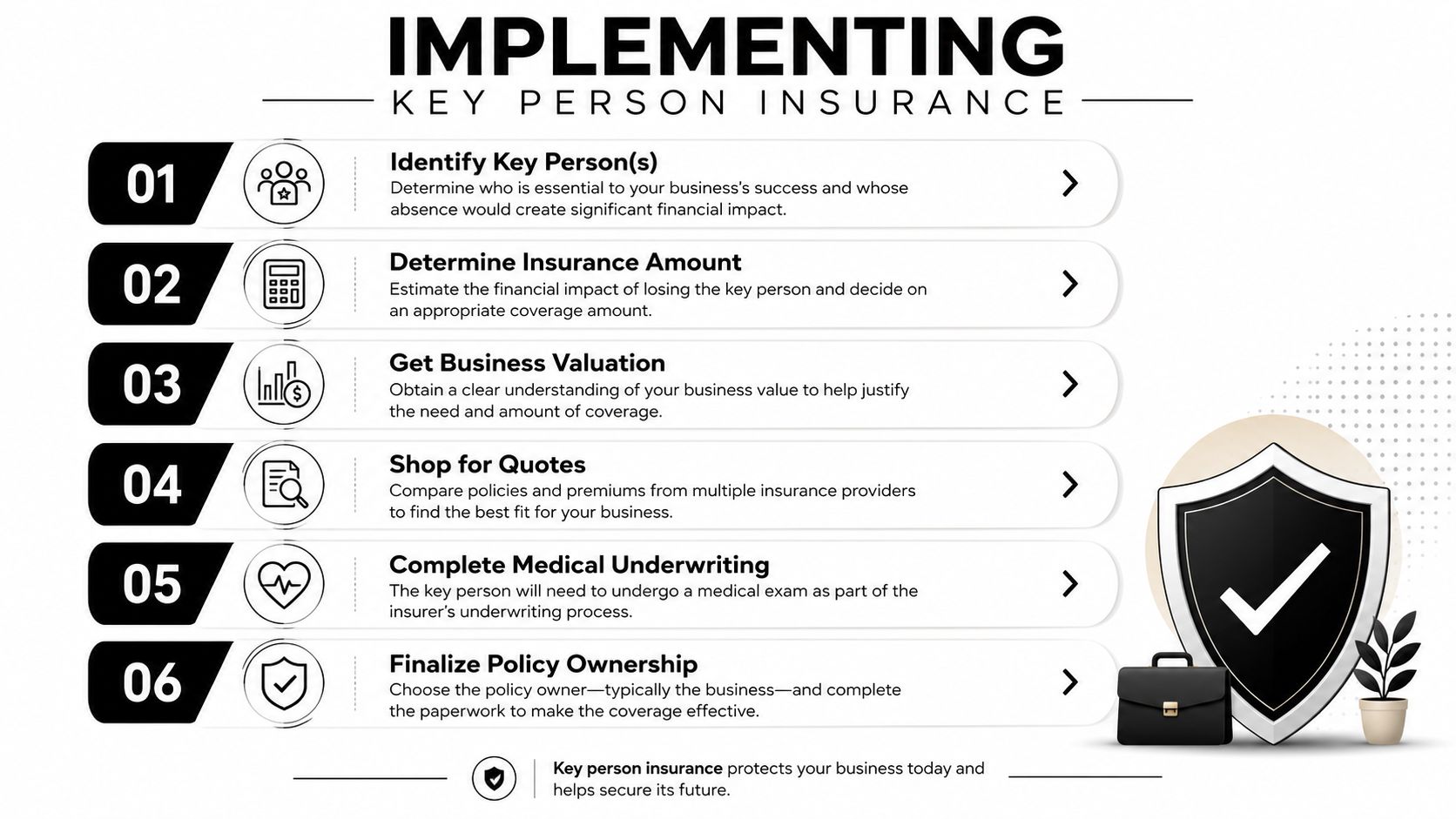
Start with the people, then build the policy around the business reality. Identify the founder, partner, seller, technician, or executive whose absence would hit revenue, operations, lending, or a future buyout the hardest. If you own a closely held Texas entity, get the business attorney, CPA, insurance broker, and, if divorce is already in play, a family law attorney who understands property division and business valuation.
Build the file before you shop
Gather the records that show how the business operates. Pull current financial statements, tax returns, debt documents, ownership records, and any buy-sell or operating agreement. If the policy will support a lender requirement or a succession clause, those documents should be reviewed together, because the insurance decision, the ownership structure, and the exit plan should match.
Ownership matters just as much as coverage. For an LLC, corporation, or partnership, the entity structure should control who owns the policy and who pays the premium. The policy has to fit the control structure of the business, not a convenient preference that ignores how the company is organized.
Keep reviewing the file after material changes. Revisit the coverage after growth, refinancing, a divorce, a partner buyout, or a major shift in client concentration. If the insured person leaves, retires, or becomes less central, reassess the policy quickly and decide whether the company still needs the same amount of protection.
- Identify the right person: Focus on the person whose absence would create the biggest operational or financial hole.
- Set the coverage amount: Use revenue, profit contribution, replacement cost, and debt exposure.
- Coordinate the documents: Align the policy with your operating agreement, buy-sell agreement, and estate planning for business owners.
- Collect written consent: The insured person has to agree before underwriting moves forward.
- Review after major changes: Ownership changes, divorce, and succession shifts should trigger a policy review.
If you want a broader planning checklist, our estate planning resource for business owners is a useful companion to this process.
Common Questions Texas Business Owners Ask About Key Person Insurance
Does Texas treat the premium like a business expense? Usually, owners view this as the cost of keeping the company steady, not a tax trick. The policy is there to protect the business from a loss that can hit operations, debt, valuation, and succession, especially when divorce or a dispute over control is already in the background.
Does the insured employee get control of the policy? No. The business owns the policy and receives the benefit if the insured person dies, and the insured person must give written consent before coverage is issued.
What if the key person quits? Then the company should review the policy right away. Key person insurance follows the person's role in the business, so if that role ends, the company needs to decide whether the coverage still fits the operation and any ownership or estate issues that may follow.
Is this the same as buy-sell funding? No. Buy-sell coverage is about ownership transfer. Key person insurance is about continuity after the loss of someone who drives revenue, client relationships, or management. In Texas, both tools often belong in the same plan because a divorce or succession fight can turn a missing leader into a valuation dispute.
Will lenders care? They often do. Coverage gives a lender a source of liquidity if the person driving the business dies, which can matter during a refinance, a buyout, or a divorce that puts pressure on the company's cash flow.
If cost is the concern, term coverage is the place to start, and the amount should match the risk the business is trying to cover. A healthy 35-year-old can pay about $50 to $70 per month for $1 million in coverage, while a 50-year-old may pay about $150 to $200 per month. Smokers at age 45 were estimated around $200 to $250 per month (MoneyGeek business insurance guide). That is a manageable tradeoff for many owners who need protection against a loss that could disrupt operations, settlement negotiations, or a succession plan.
What should Texas owners coordinate with the policy? The operating agreement, buy-sell agreement, and estate plan should all point in the same direction. If those documents conflict, the policy can become part of a fight instead of a solution, especially in divorce or after a death.
If you want a broader planning checklist, our estate planning resource for business owners is a useful companion to this process.