
Divorce can be one of life’s most difficult transitions, and when a family business is involved, the financial stakes become even higher. For many Texas couples, that business isn't just an asset; it represents years of shared sacrifice, hard work, and dreams for the future. Understanding your rights and the process for valuing that business under Texas law is critical to ensuring you receive a fair and just outcome.
This guide is designed to provide a clear, step-by-step explanation of one of the most crucial parts of this process: business valuations in divorce. We will walk you through why a proper valuation is essential under Texas community property law, explain the methods experts use to determine a business's worth, and offer practical guidance to help you protect your financial future with confidence.
Before we dive deep into valuations, it helps to understand the big picture. You can learn more about the initial steps and what to expect by reading our detailed article on how a couple-owned business is treated during divorce. Knowing your rights is always the first step toward building a stable new beginning.
Why is a Business Valuation Necessary in a Texas Divorce?
When you are going through a divorce in Texas, the concept of "community property" is central to how your assets are divided. Under the Texas Family Code § 7.001, all property acquired by either spouse during the marriage is presumed to be community property. The court's role is to divide this marital estate in a manner that is “just and right.”
If you or your spouse started or significantly grew a business while married, that business is often the most valuable—and most complex—asset you own together. Without a formal, professional business valuation, determining its true worth is simply guesswork. This can lead to a profoundly unfair outcome.
Scenario: Imagine a scenario where one spouse, who managed the family restaurant, convinces the other that the business is barely breaking even. Without a professional valuation, the other spouse might agree to a buyout for a small sum, only to discover later that the business was worth hundreds of thousands of dollars more. This kind of financial loss can be devastating and long-lasting.
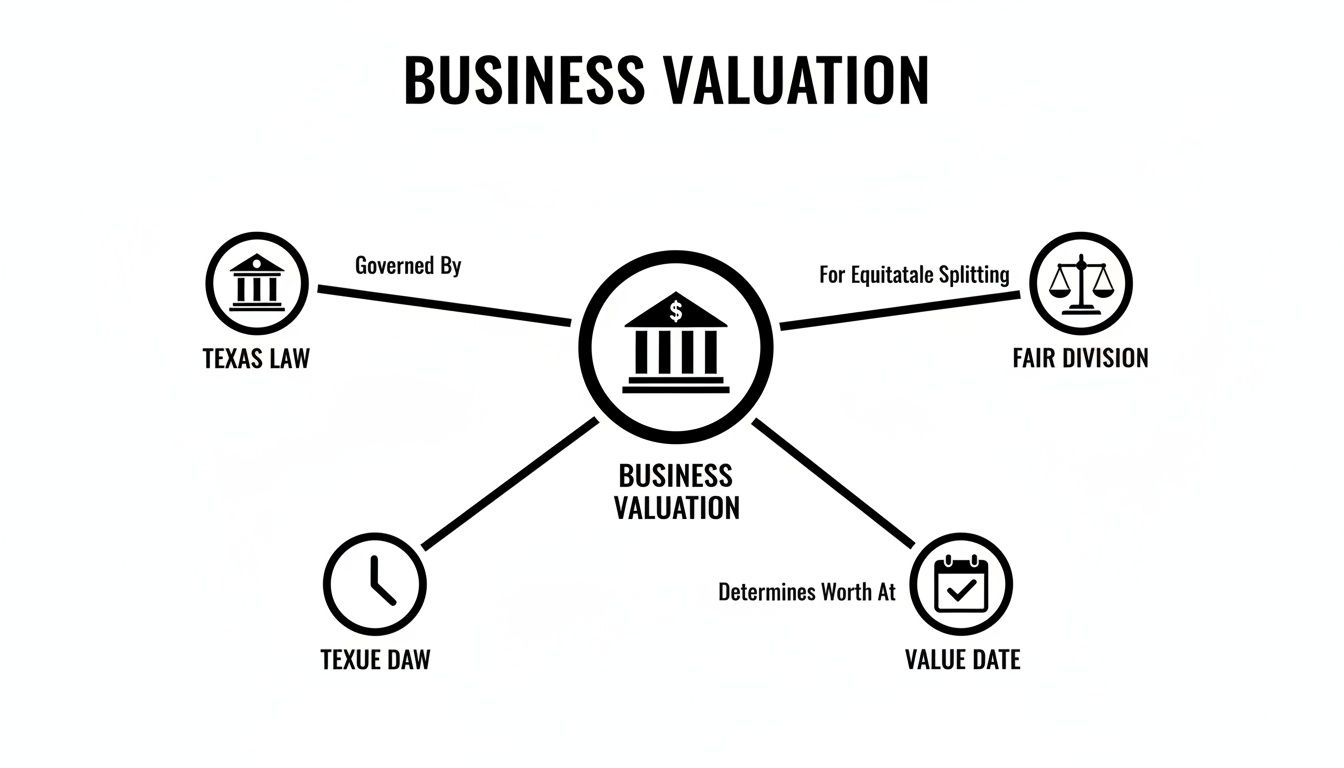
An independent valuation provides a clear, defensible number grounded in financial reality, not emotions or assumptions. It also establishes a valuation date, which freezes the business's value at a specific point in time. This is critical because it prevents future market fluctuations or one spouse's actions from unfairly influencing the property division.
Understanding the Three Main Business Valuation Methods
Figuring out what a business is worth is a detailed financial discipline, not a random guess. A valuation expert will typically use one or a combination of three standard methods to arrive at a fair and supportable number. Each approach offers a different perspective on the business's value.
Understanding these three methods will empower you to have informed conversations with your attorney and the valuation expert. This is particularly important when dealing with complex assets like those covered in our guide to startup company valuations in a Texas divorce.
H3 A Comparison of Business Valuation Methods
To help you understand how an expert will analyze your business, here is a side-by-side comparison of the primary valuation methods. The right approach—or combination of approaches—depends on the specific type of business being valued.
| Valuation Method | How It Works | Best For | Potential Pitfall in Divorce |
|---|---|---|---|
| Income Approach | Focuses on the business's capacity to generate future income. It calculates a value based on projected earnings, cash flow, or profits. | Service-based businesses, professional practices (like medical or law firms), and companies with a history of strong, predictable earnings. | This method can be manipulated if one spouse controls the finances and attempts to understate future income projections. |
| Market Approach | Compares the business to similar companies that have recently been sold. This is similar to using "comps" to value real estate. | Businesses in common industries where public sales data is available, such as restaurants, retail stores, or franchises. | Finding truly comparable businesses can be difficult, especially for unique or niche companies. A poor comparison can lead to an inaccurate value. |
| Asset-Based Approach | Calculates the net value of the company's tangible assets (what it owns) minus its liabilities (what it owes). This is often called a "book value" calculation. | Holding companies, real estate investment firms, or businesses where the value is primarily tied to physical assets rather than ongoing operations. | It often undervalues service businesses by ignoring "goodwill"—the intangible value of its reputation, customer base, and brand recognition. |
A skilled valuation expert will rarely rely on a single method. Instead, they typically use a blend of these approaches to arrive at a well-rounded, comprehensive, and defensible valuation that can withstand scrutiny in court.
The Critical Role of the Valuation Date

The valuation date is the specific day on which the business's value is determined for the purpose of your divorce. Think of it as a financial snapshot, capturing the company's worth at a single moment in time.
This date—often set near the date of separation or the date of trial—is crucial because a business's value is rarely static. It can fluctuate significantly due to market conditions, economic trends, or even actions taken by one spouse post-separation.
For example, a construction company's value might be much higher after securing a major contract than it was the month before. The valuation date locks in a specific financial picture, ensuring the property division is based on the business’s value as it existed during the marriage, not on what happens afterward. This prevents one party from being unfairly rewarded or penalized by events that occur after the marital partnership has ended. You can read more about how valuation dates impact divorce cases to see how courts handle these complex situations.
How to Choose and Work With a Valuation Expert

Selecting the right professional to value your business is one of the most important decisions you will make in your divorce. This is not a task for a general accountant. You need a specialist with specific credentials, such as a Certified Valuation Analyst (CVA) or an expert who is Accredited in Business Valuation (ABV). Crucially, they must also have extensive experience testifying in Texas divorce cases.
Should We Use One Expert or Two?
You and your spouse can either agree to hire a single, joint expert or each hire your own. A joint expert can be more cost-effective and may reduce conflict. However, retaining your own expert ensures you have a dedicated professional whose sole focus is advocating for your financial interests and presenting a valuation that reflects your perspective.
The Valuation Process: A Deep Dive
The valuation expert will conduct a thorough investigation into the business's finances. This includes analyzing financial statements, tax returns, and operational records. A key step in this process is "normalizing" earnings. This involves adjusting the financial records to account for personal expenses run through the business—such as company cars, personal travel, or salaries paid to family members who do little work—to reveal the company's true profitability.
This forensic analysis is why understanding the legal process of divorce discovery and expert witnesses is so vital. It is the mechanism through which your attorney ensures all relevant financial information is disclosed and the final valuation is both fair and accurate.
How the Valuation Impacts Your Final Divorce Settlement
Once the expert completes their analysis, you will have a final valuation number. How does this figure translate into your actual divorce settlement? An accurate valuation serves as the cornerstone for a fair outcome, ensuring all subsequent negotiations are based on solid financial ground.
There are several ways to divide a business asset:
- Buyout: One spouse buys out the other's share of the business. This is often accomplished by trading other community assets. For example, one spouse might receive the family home in exchange for their interest in the business.
- Co-ownership: Though less common and often complex, some former spouses may continue to own the business together. This requires a detailed operating agreement.
- Sale: The spouses agree to sell the business to a third party and divide the proceeds.
Understanding the long-term financial consequences of each option is crucial. A buyout, for example, can often be structured to be tax-free for the receiving spouse, while a sale to a third party will likely trigger capital gains taxes for both of you. An experienced attorney and valuation expert can help you navigate these important financial decisions. You can learn more about how experts approach these critical financial factors and how they can impact your future.
Take the Next Step to Protect Your Financial Future
Navigating a divorce that involves a business can feel overwhelming, but by seeking information, you have taken a powerful first step toward protecting your interests. You now have a foundational understanding of why a professional valuation is essential for a fair outcome under Texas law.
You do not have to navigate this complex process alone. Your next step should be to consult with an experienced family law attorney who understands the unique challenges of dividing a business in a Texas divorce. A knowledgeable lawyer will serve as your advocate, guiding you through selecting the right expert, ensuring a thorough valuation, and fighting for a settlement that achieves a truly "just and right" division of your community estate.
If you need help navigating divorce, custody, or estate planning in Texas, contact The Law Office of Bryan Fagan today for a free consultation.
Common Questions About Business Valuations in Divorce
When you’re facing a divorce that involves a business, it’s natural to have many questions. The process can seem complicated, but getting clear answers is the first step toward feeling more in control.
Here are straightforward answers to some of the questions we hear most frequently from clients about valuing a business during a Texas divorce.