 Skip to content

A Texas parent may receive a personal injury settlement and still have the same child support payment leave the bank account that month. At the kitchen table, the settlement documents, medical bills, attorney invoices, and support records can create an unsettling question: Does the settlement change child support, or can child support take the settlement?
The answer depends on what the recovery represents, how it's paid, whether support is current, and whether Texas law permits a modification or lien. This guide explains how a Texas personal injury settlement affects child support, using the Texas Family Code to separate support modification from collection of arrears and to show why careful documentation matters.
When a Settlement Meets Child Support in Texas
Consider a Texas father who has just resolved a serious injury claim. His settlement statement lists medical expenses, lost wages, legal fees, and compensation for pain and suffering. He's current on support, but he worries that the settlement might cause his monthly obligation to increase. Across town, the other parent may be looking at the same recovery and asking whether unpaid support can be collected from it.
Those concerns involve two different legal questions. First, a settlement might affect the paying parent's financial picture under the Texas net-resources framework. Second, unpaid child support may be enforceable against settlement proceeds under Texas Family Code Chapter 157.
Texas calculates child support from the obligor's net resources, not only from a paycheck. Family Code Section 154.062 identifies broad categories that may be relevant, including disability and workers' compensation benefits, interest income, gifts and prizes, spousal maintenance, and alimony. The legal issue after an injury settlement is whether some part of the recovery is available for support analysis, rather than whether every settlement dollar automatically becomes monthly income. See the Texas Family Code provisions on net resources for the statutory framework.
Practical rule: A settlement doesn't automatically rewrite an existing child support order. A court modification or enforcement process is still required.
The same dollar can therefore appear on opposite sides of a dispute. A paying parent may argue that medical reimbursement or future care funds shouldn't be treated as support income. A parent owed support may argue that lost earnings, periodic payments, or unrestricted proceeds show greater available resources. The settlement agreement, allocation letter, payment schedule, and financial records can shape that analysis.
How Texas Calculates Child Support
A settlement becomes relevant only after the court identifies the obligor's net monthly resources and applies the Texas guideline method. The settlement's label does not decide the result. Its purpose, availability, timing, and records may matter when the court determines what resources can support a child.
Step one identifies net resources
The court examines financial resources and applies the deductions and exclusions required by law. Net resources can include more than wages, so a parent should preserve the settlement agreement, allocation records, payment statements, and related financial documents. Those records help distinguish compensation for lost earnings from funds designated for medical care, future damages, or other purposes.
Texas guideline percentages are commonly applied to net resources:
| Number of Children | Percentage of Net Resources |
|---|---|
| 1 child | 20% |
| 2 children | 25% |
| 3 children | 30% |
| 4 children | 35% |
| 5 or more children | 40% |
The Texas child support guideline provisions describe this schedule. Texas also caps guideline calculations at $7,500 per month in net resources, although a court may exercise discretion above that amount under the circumstances. The statute and the financial evidence should be reviewed together.
Texas Family Code Section 154.125 provides a presumptive guideline application when monthly net resources are $6,000 or less, with the listed percentages for one through four children. The Texas child support resource for establishment, modification, and enforcement provides related family-law information.
Step two applies the percentage
If the court determines that an obligor has monthly net resources of $4,000 and one child, the guideline calculation produces a baseline of 20% of those resources. The example shows the arithmetic, not whether a particular settlement component belongs in the resource calculation. That separate question depends on the recovery's purpose and the evidence supporting its allocation.
A structured payment can also present a different picture from a lump sum because money arrives over time. The court still must apply the existing order and modification standards rather than automatically converting the entire recovery into monthly income.
Under Family Code Section 154.069, the court generally may not add a spouse's net resources to the obligor's or obligee's resources. It also may not subtract that spouse's needs or the needs of the spouse's dependents from the child-support calculation. A new marriage therefore does not automatically place a new spouse's income into the calculation.
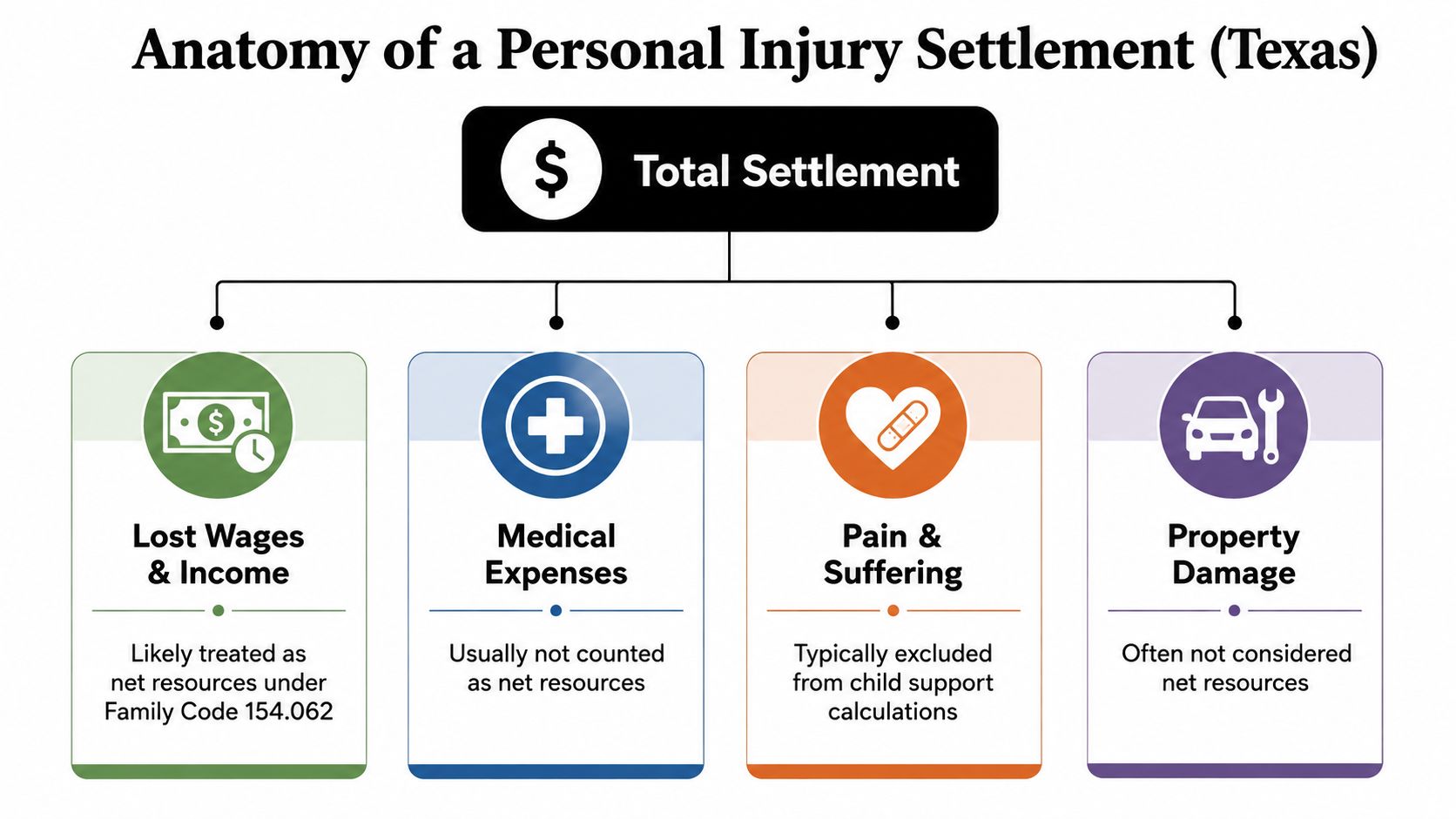
Anatomy of a Personal Injury Settlement
A settlement is usually a negotiated payment for several types of loss. The label attached to each part matters, but the court may examine the substance, documentation, and availability of the funds.
Lost wages and earning capacity
Amounts allocated to past lost wages resemble income because they replace earnings the parent would have received. Compensation for lost earning capacity can raise a similar question. If a settlement includes a clearly documented wage component, the parent should expect the other side to argue that it reflects available resources.
The timing still matters. A lump sum may not function exactly like ordinary monthly wages, and a court must decide how the recovery fits within the existing order and modification standards. A structured stream may present a different financial picture because payments arrive over time.
Medical expenses and future care
Past medical bills and properly documented future medical needs serve a different purpose. The parent may argue that these funds are restricted by the injury-related need they're intended to address, rather than available for ordinary household spending or child support.
That argument becomes stronger when the settlement statement, medical records, bills, release language, and account records tell the same story. It becomes harder when all proceeds are deposited into one account and spent without clear records.
Pain, suffering, consortium, and property damage
Pain and suffering, loss of consortium, and property damage don't replace a child's support needs in the same direct way as wages. Those categories may be argued to fall outside a monthly income calculation, but a court can still examine whether the money increased the parent's available assets or changed the overall financial circumstances.
Allocation language matters because a lump-sum release can obscure the purpose of the recovery. Parents should avoid informal descriptions that conflict with the signed settlement documents. The same discipline used when handling assets during Probate administration and estate settlement in Texas is useful here: preserve the records showing what each dollar was intended to accomplish.
Punitive damages
Punitive damages may generate especially strong arguments for modification because they aren't tied to ordinary medical reimbursement in the same way. Whether they affect support depends on the applicable Texas analysis, the order's terms, and the evidence presented.
Family Code Section 154.062 supplies the net-resources framework, but it doesn't provide a simple chart assigning every personal injury category to “counted” or “excluded.” That's why a settlement allocation should be prepared with both the injury case and possible family-law consequences in mind.
Lump Sum Versus Structured Settlements
The payment format can influence how a court sees the parent's financial circumstances, but neither format creates an automatic child support result.
A lump-sum settlement arrives at once. It may be placed in a single bank account, used to pay medical bills and legal expenses, or retained as an asset. If the parent owes back support, Texas law can allow a child-support lien to reach settlement proceeds. If the parent is current, the other parent may still seek a modification if the recovery materially changes the obligor's financial picture.
A structured settlement pays periodic amounts under an arrangement that may use an annuity. Regular payments can provide a clearer monthly income stream, while funds designated for future medical needs may remain tied to that purpose. The court still must determine how the payments fit within the Texas net-resources analysis and whether a modification standard has been met.

Questions to ask before choosing a payment format
- What does the settlement replace? Lost earnings may present a different support issue from medical reimbursement or property repair.
- Will funds be needed for future care? A structure can help preserve a payment stream for recurring injury-related needs.
- Are arrears already outstanding? A lump sum may provide a direct source for resolving an enforcement debt, subject to lien priority and legal review.
- How will records be preserved? Separate accounts, payment schedules, and written allocations reduce confusion.
- Could a modification be appropriate? A parent shouldn't assume that selecting a structure prevents review if the periodic payments materially affect resources.
A parent owed support may prefer prompt collection from available proceeds. An obligor may need to protect funds reserved for treatment while addressing valid arrears. The best choice depends on the settlement terms, the support order, the parent's current resources, and any government-benefit concerns.
When a Settlement Triggers a Modification
Receiving a settlement isn't, by itself, enough to change child support. Texas Family Code Section 156.401 permits modification when there has been a material and substantial change in circumstances. The statute also recognizes a timing-based path: after at least three years from the order or last modification, a new guideline amount must differ by 20% or $100 from the current amount for the statutory threshold described in the verified Texas source.
Texas Law Help identifies changes such as an increase or decrease in the obligor's income, a change in the child's medical insurance, or a change in the child's living arrangements as examples that may support modification. Its explanation of Texas legal standards in custody and support modification cases provides useful context for the change-in-circumstances analysis.
The practical process
- Gather the financial record. Preserve the settlement agreement, closing statement, allocation letter, proof of attorney fees, medical bills, payment schedule, and support payment history.
- Compare the current and proposed obligation. Determine whether the settlement changes net resources enough to support a new calculation.
- File the correct pleading. A parent may file a petition to modify the parent-child relationship. A motion for a new trial may be relevant in limited circumstances under Family Code Section 156.401(b), and strict deadlines can apply.
- Request temporary relief when justified. Temporary orders may address support or financial issues while the case is pending.
- Consider a written agreement. The parents may negotiate a Rule 11 agreement, but it should be documented and entered or enforced appropriately rather than treated as an informal promise.
The Office of the Attorney General may participate when it represents the obligee or provides child-support enforcement services. Service requirements and notice must be handled correctly. A court generally cannot modify an order because one parent believes the settlement is large.

A modification may be protective for an obligor when the settlement replaces income lost because of a permanent injury, creates periodic resources, or changes the parent's ability to pay. It may also increase support when the recovery gives the parent greater available resources. Retroactive relief is a separate issue, and a parent should speak with counsel before assuming that a favorable change reaches back to the settlement date.
Child Support Liens and Arrears
Texas treats unpaid child support as an enforcement debt that can reach property beyond wages. Under Chapter 157 of the Texas Family Code, a child-support lien can attach to non-exempt real and personal property, including proceeds from a claim for compensation, a settlement, or an award. A practical explanation of Texas child support liens against personal injury settlements describes how the lien may be satisfied before the injured parent receives the remaining proceeds.
How the settlement process can unfold
The parent owed support, the Office of the Attorney General, or another authorized entity may provide notice of the lien. The insurer, defendant, settlement administrator, or attorney handling the recovery may need to address the lien before distributing funds. Texas enforcement materials also describe matching and intercept systems that extend collection beyond ordinary paycheck withholding.
A settlement statement should identify deductions and competing claims. Attorney fees and certain medical or other superior liens may be addressed before the child-support claim, while the remaining proceeds may go toward arrears and then to the injured parent. The exact priority can depend on the governing statute, the type of lien, notice, and the facts of the claim.
| Priority | Claim Type | Source | Typical Treatment |
|---|---|---|---|
| 1 | Attorney fees | Settlement agreement and applicable law | Often deducted as a cost of recovery |
| 2 | Medical or superior liens | Applicable lien statutes and claim documents | May be addressed before child-support proceeds |
| 3 | Child support lien | Texas Family Code Chapter 157 | May reach settlement proceeds for arrears |
| 4 | Remaining client proceeds | Settlement documents and final accounting | Paid after valid claims are resolved |
This table is a practical overview, not a substitute for reviewing the actual lien notices and settlement documents. Medicare, Medicaid, hospital, and physician claims can involve separate rules and should be verified before funds are distributed.
Parents should also verify the arrears balance rather than relying on an old statement. If the amount is disputed, an obligor may need to request the appropriate hearing or relief under Chapter 157. A parent who is owed support may need enforcement tools beyond a lien, including a writ of withholding or turnover relief where legally available.
Two Real World Texas Scenarios
These examples show how the settlement's purpose, payment method, and support role can change the legal analysis. They illustrate possible questions, not guaranteed results in every Texas case.
Marcus is the paying parent
Marcus, a Harris County father, receives a $450,000 lump-sum settlement after a commercial vehicle crash. The allocation assigns $120,000 to past lost wages and $80,000 to future lost earnings. His existing child support order requires $850 per month.
The wage-related portions give Marcus a stronger basis to argue that his financial circumstances changed. If evidence shows that his available resources support a guideline amount of about $1,725 per month, the court could consider modification under Family Code Section 156.401, assuming the required legal threshold is met. The court would examine the settlement's components, including medical expenses, attorney fees, other deductions, and whether the future-earnings amount arrives at once or through scheduled payments.
The entire settlement does not automatically become monthly income. The allocation functions like labels on separate containers: money replacing wages may affect support differently from money assigned to pain, medical care, or future needs. Clear records help the court identify what each portion was intended to replace.
Lisa is owed support
Lisa, a Travis County mother, is owed $14,000 in arrears and receives a $200,000 structured settlement. Because the recovery is paid over time, there may be no single check containing the entire amount for immediate collection. Lisa can pursue enforcement under Chapter 157 and ask counsel to examine whether a lien, turnover remedy, or another available procedure can reach a particular payment or settlement interest.
If the structured annuity is bought out, the payment stream may become a lump sum, changing the collection analysis. A court may also consider security for ongoing support. Lisa should not assume that every future payment is immediately available to satisfy arrears.
| Factor | Marcus, Pays Support | Lisa, Receives Support |
|---|---|---|
| Settlement form | Lump sum | Structured payments |
| Primary concern | Possible modification | Collection of arrears |
| Key evidence | Wage allocation and current resources | Arrears history and settlement documents |
| Governing focus | Family Code Section 156.401 | Family Code Chapter 157 |
| Immediate result | Court review may be required | Lien or enforcement review may be available |
Marcus is asking whether his future obligation should change. Lisa is asking how an existing debt can be collected. Those questions connect the settlement to support in different ways, so each parent needs records matched to the specific legal remedy.
Steps to Protect Your Rights After a Settlement
Coordinate with your injury and family-law attorneys before the settlement proceeds are deposited. Once funds arrive, treat the settlement records and account history as evidence. They may matter in a later enforcement, lien, or support review.
Keep settlement proceeds traceable. Use a separate account for medical reserves, structured-payment deposits, and other specifically allocated funds. Do not mix those proceeds with ordinary household spending unless the transaction is recorded. Save the closing statement, release, allocation letter, settlement check, deposit confirmation, and disbursement sheet together.
Respond to lien notices promptly. A notice concerning child-support arrears is not the same as a final determination that every settlement dollar may be taken. Give the notice and settlement documents to counsel, confirm the balance claimed, and preserve proof of any payment or dispute. If funds are already subject to a court process, follow that process rather than transferring money to another account.
Protect records after payment begins. For a structured settlement, retain every payment statement and tax or accounting record. Match each deposit to the settlement allocation. For a lump sum, keep receipts for medical care, necessary recovery expenses, and other approved uses. A clear paper trail helps show what remains available and what replaced an injury-related loss.
Address benefit and interstate complications. SSI recipients should obtain advice before moving or spending settlement funds because federal benefit rules may affect eligibility. Self-employment income may require separate records showing business revenue, expenses, and personal access to funds. Different-state custody or support orders may bring interstate enforcement rules into the same dispute.
Preserve the settlement's purpose. Lost-wage proceeds may resemble income for support analysis, while pain-and-suffering or medical allocations may require a different explanation. Future-damage payments and punitive damages should remain identified as separate components. A structured payment can protect predictable cash flow, but its terms may affect how support or arrears are addressed. Do not rely on a private understanding when a court record or written documentation is needed.

A parent handling a substantial recovery may also review Estate Planning issues involving wills, trusts, and estate plans. The Law Office of Bryan Fagan, PLLC can review settlement records, support orders, arrears documentation, and enforcement concerns under Texas law. Visit Law Office of Bryan Fagan, PLLC to schedule a consultation before funds are distributed or records are lost.


