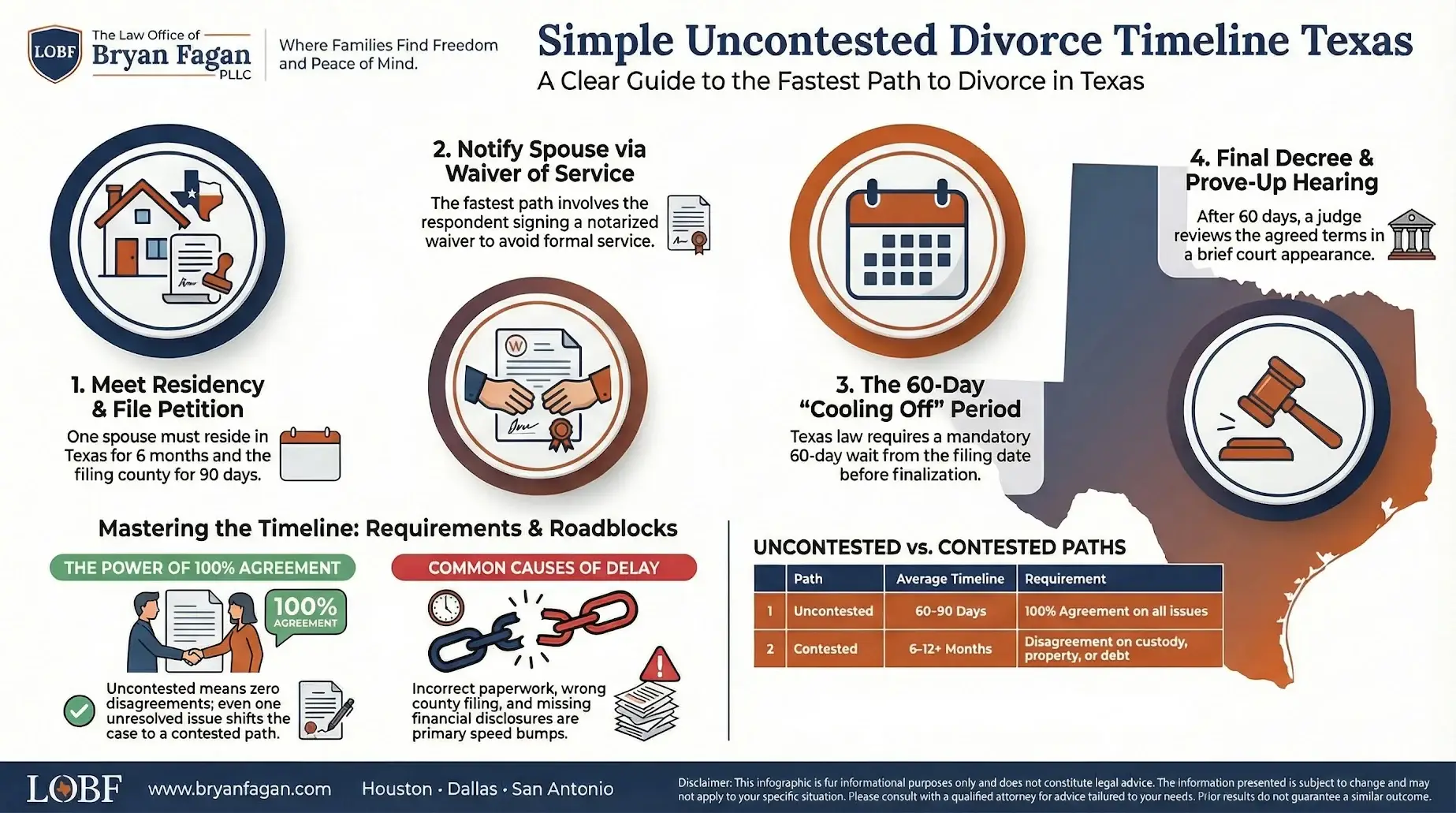

Have you ever found yourself standing in the kitchen after the kids are asleep, realizing that the hardest part of divorce isn’t the paperwork—it’s the uncertainty? The quiet questions. The “what happens next?” moments. For many Texas families, searching for Simple Uncontested Divorce Timeline Texas is really about finding clarity in the middle of emotional transition. The good news is this: when both spouses agree, Texas law provides a clear, structured path forward, including a mandatory 60-day waiting period under Texas Family Code §6.702 before a divorce can be finalized.
Not long ago, a couple came into our office who had already worked through the difficult conversations. They had divided their property, agreed on parenting time, and decided they wanted to move forward respectfully. What they did not want was prolonged conflict or legal confusion. They wanted predictability. They wanted to know how long the process would take, what steps were required, and how to avoid mistakes that could delay closure. Like many families, they weren’t fighting each other—they were trying to protect their peace.
At The Law Office of Bryan Fagan, PLLC, we understand that divorce is both a legal process and a deeply personal transition. Founded in 2012 by Bryan Joseph Fagan, a South Texas College of Law graduate and recognized authority on Texas divorce and custody law, our firm has helped thousands of families across Houston and throughout Texas navigate this moment with confidence. Texas courts operate under clear statutory guidelines, including the “best interest of the child” standard in Texas Family Code §153.002 and detailed conservatorship provisions under §153.134. Even in amicable cases, judges must ensure agreements are fair, legally sound, and protective of families.
Our mission is simple and intentional: to empower people to reclaim freedom and peace of mind during life’s hardest transitions. We do that by offering compassionate counsel, practical education, and legal solutions that simplify complexity. Divorce does not have to feel chaotic. When handled properly, it can be orderly, respectful, and forward-focused.
If you are considering an agreed divorce and want to understand the timeline, the procedural nuances, and how to move through the process without unnecessary stress, you are in the right place. Let’s walk through what Texas law requires—and how thoughtful planning can help you move toward clarity and stability.
Key Takeaways
- The minimum simple uncontested divorce timeline in Texas is 61 days due to the mandatory waiting period established by Texas Family Code §6.702
- Most uncontested divorces finalize within 61 to 90 days when both spouses cooperate and paperwork is accurate
- Only one spouse needs to meet Texas residency requirements (six months in Texas, 90 days in the filing county)
- Preparation during the waiting period—not after—is what determines how quickly your case reaches the final hearing
- Working with experienced family law attorneys prevents the paperwork errors and procedural mistakes that cause most delays

Your Family’s Future Starts Here
Don’t navigate your legal journey alone. Schedule a consultation now and get the clarity and support you deserve.
Simple Uncontested Divorce Timeline Texas: The Short Answer
Under Texas law, a divorce cannot be finalized until at least 60 days have passed from the date the Original Petition for Divorce is filed, as required by Texas Family Code §6.702. In practical terms, that means the earliest a court can grant a divorce is day 61—the mandatory waiting period plus the day the judge signs the Final Decree. This rule applies even in agreed cases and reflects the Legislature’s intent to provide a brief cooling-off period before a marriage is legally dissolved. For families researching the Simple Uncontested Divorce Timeline Texas, understanding this statutory minimum sets realistic expectations from the very beginning.
Although 61 days is the legal floor, most uncontested divorces across Texas are finalized within approximately 61 to 90 days when both spouses cooperate fully and paperwork is complete and accurate. Judges must still ensure the property division meets the “just and right” standard under Texas Family Code §7.001. If children are involved, courts apply the “best interest of the child” standard in §153.002 and review conservatorship orders under §153.134. Child support must comply with §154.125, including the updated net resource cap under §154.125(a-1). Even in amicable cases, courts do not simply “rubber stamp” agreements; they confirm compliance with current Texas law before approving the decree.
The Texas Family Code creates a framework that balances thoughtful decision-making with efficiency when mutual agreement exists. At the Law Office of Bryan Fagan, we emphasize that preparation during the waiting period—not rushing through it—is what determines how smoothly the process concludes. For a detailed breakdown of how timing works and what it means for your specific circumstances, you can review our comprehensive guide, Making Sense of Uncontested Divorce in Texas: The Timeline and What It Means for You, which expands on each procedural step.
If your case involves child support considerations, you may also find our Texas Child Support Review Process resource helpful in understanding how courts calculate and evaluate support obligations under current law. By combining clear legal guidance with compassionate communication, Bryan Fagan’s legal team continues to help Texas families move forward confidently, knowing their agreement aligns with both the law and their long-term goals.

Step 1: Confirm Residency Requirements
Before beginning the Simple Uncontested Divorce Timeline Texas process, it is essential to confirm that you meet Texas residency requirements. Texas Family Code §6.301 clearly outlines who may file for divorce in this state. At least one spouse must have lived in Texas for a continuous six-month period immediately before filing. In addition, that spouse must have resided in the county where the divorce is filed for at least 90 days. These residency requirements are jurisdictional, meaning the court must have proper authority over the case before it can proceed.
In practical terms, this means you cannot relocate to Texas and file for divorce right away. The law requires genuine residency before invoking the court’s authority. However, only one spouse needs to meet these requirements. If one spouse remains in Texas while the other has moved elsewhere, the Texas resident may still file here. If you recently moved within the state, you may need to wait until you satisfy the 90-day county requirement or consider filing in a county where residency has already been established.
These rules are more than procedural technicalities. If residency requirements are not met, the court may dismiss the case, requiring you to refile and restart the timeline. That setback can disrupt the overall Simple Uncontested Divorce Timeline Texas process and create unnecessary stress. At Bryan Fagan’s family law team, we carefully evaluate jurisdiction before filing to ensure your case begins on solid legal ground.
Understanding the broader steps involved in filing can provide added clarity. Families can explore our comprehensive overview of the Texas divorce process for a detailed explanation of how jurisdiction, filing, service, and finalization fit together within the statutory framework.
For additional insight into how timing and statutory requirements intersect, you may also find our Texas Child Support Review Process resource helpful, especially if children are involved and support calculations under §154.125 and §154.125(a-1) apply.
At the Law Office of Bryan Fagan, PLLC, our mission is to educate families and protect futures by ensuring every case begins correctly. Establishing proper residency is the first foundational step toward a smooth and predictable resolution within the Simple Uncontested Divorce Timeline Texas framework.
Step 2: File the Original Petition for Divorce
The divorce process begins when one spouse, called the petitioner, files an Original Petition for Divorce with the Texas district court in the appropriate county.
This document formally initiates your divorce case and must include essential information: both spouses’ names and addresses, marriage date and location, grounds for divorce (typically “insupportability” for uncontested cases), and an outline of how you intend to divide property and handle any child custody arrangements.
Most Texas courts now require or strongly encourage e-filing through approved electronic filing service providers. Filing fees vary by county but typically range from $250 to $400. If you cannot afford the filing fees, you may qualify for a fee waiver by demonstrating financial hardship.
Critical point: The 60 day waiting period begins the moment your petition is filed with the court. The filing date itself is not counted—Day One is the calendar day immediately following filing. This means strategic timing matters. Filing on a Monday starts your clock sooner than filing on a Friday.
Upon filing, the court clerk assigns a case number and issues a citation, which is the formal legal notice to your spouse that divorce proceedings have begun.
Step 3: Service of Process or Waiver of Service
After filing, Texas law requires that the other spouse receive legal notice of the divorce petition. In uncontested divorces where both parties agree, this step can be dramatically simplified.
Formal service of process involves hiring a process server or constable to personally deliver the divorce papers to your spouse. This method is necessary when a spouse is uncooperative or cannot be located, but it adds time and expense to agreed divorces.
Waiver of Service is the faster alternative for cooperative couples. When the other spouse signs a Waiver of Service, they acknowledge receipt of the divorce petition and agree to proceed without formal service. This document must be properly notarized to be valid.
For most uncontested divorces, the Waiver of Service is the preferred approach. It eliminates coordination delays, service fees, and the 20-day answer period that would otherwise apply. When your spouse signs and notarizes the waiver promptly, you avoid unnecessary delays in your divorce proceedings.
A word of caution: improper notarization is a common mistake that can invalidate the waiver entirely, forcing you back to formal service and adding weeks to your timeline.
Step 4: The Mandatory 60-Day Waiting Period
Texas Family Code §6.702 establishes a mandatory 60-day waiting period that applies to nearly every divorce filed in Texas, including those following the Simple Uncontested Divorce Timeline Texas process. No matter how cooperative the parties may be, a court cannot finalize a divorce until at least 60 days have passed from the date the Original Petition is filed. In practical terms, that means the earliest most couples can finalize is day 61. This statutory safeguard reflects the Legislature’s intent to ensure thoughtful decision-making before a marriage is legally dissolved.
Although the waiting period may feel like a delay, it serves an important legal purpose. Texas courts must confirm that property division satisfies the “just and right” standard under Texas Family Code §7.001. If children are involved, judges must also determine that conservatorship and possession orders meet the “best interest of the child” requirement under §153.002 and comply with the detailed framework in §153.134. Child support calculations must align with §154.125, including the updated net resource cap in §154.125(a-1). Even when spouses agree on everything, the court independently reviews the agreement before signing the Final Decree of Divorce. For a deeper explanation of how the timeline works and why the law requires this pause, you can review our guide on the Texas divorce waiting period, which outlines the statutory foundation and practical implications of the 60-day rule.
There are limited exceptions. Under §6.702(b), courts may waive the waiting period in cases involving documented family violence, but this requires specific findings and judicial approval. It is not available simply because both spouses want to move faster. The law prioritizes careful review, particularly where safety or child-related concerns may exist.
Rather than viewing these 60 days as idle time, the team at the Law Office of Bryan Fagan encourages clients to treat the period as strategic preparation. Use the time to carefully finalize the proposed decree, gather complete financial documentation, clarify conservatorship terms, and address real property transfers. If retirement accounts are involved, determine whether a Qualified Domestic Relations Order (QDRO) will be required. When children are part of the case, parents should ensure child support complies with current statutory guidelines, which are explained in greater detail in our Texas Child Support Review Process resource.
Families who navigate the Simple Uncontested Divorce Timeline Texas successfully are those who approach the waiting period with preparation rather than frustration. By combining precise legal guidance with compassionate communication, Bryan Fagan’s family law team continues to help Texas families move forward confidently, knowing their agreement is legally sound, carefully reviewed, and built to protect their future.

Step 5: Draft and Sign the Final Decree of Divorce
The Final Decree of Divorce is the authoritative legal document that officially dissolves your marriage. When the judge signs this document, your divorce becomes final and enforceable.
For the decree to be approved, it must address all essential issues: property division specifying which spouse receives which marital assets, debt allocation assigning responsibility for each obligation, child custody arrangements and conservatorship if minor children are involved, child support calculations, and any spousal maintenance provisions.
Precision matters enormously here. Vague language like “the parties will divide community property fairly” will be rejected. Your decree must specify exactly which property goes to which spouse, identify retirement accounts by account number, describe real property using legal descriptions, and list vehicles by VIN.
Both spouses must review and sign the Final Decree before it can be submitted to the court. In truly agreed divorces, this review process should be straightforward—but disagreements over specific language can cause delays even when parties agree in principle.
This is where working with a divorce lawyer pays dividends. Professional drafting ensures your decree is legally enforceable, complete, and unlikely to be rejected by the court.
Step 6: Prove-Up Hearing or Submission
Texas law requires at least one spouse to appear before the judge for a prove-up hearing, even in uncontested divorces. This brief hearing is the final step before your divorce decree becomes official.
During the prove-up hearing, the judge reviews your paperwork, asks questions to confirm both parties mutually agree to the divorce terms, and ensures the agreement meets legal standards. The petitioner typically testifies under oath, confirming the accuracy of statements in the petition and decree.
What judges review:
- Whether residency requirements were met
- That the waiting period has expired
- That all required documents are properly executed
- That the settlement appears fair to both parties
- That any child-related provisions serve the children’s best interests
The good news: most prove-up hearings for simple uncontested divorces last only 5 to 10 minutes. Only the petitioner is required to appear, though some judges prefer both parties attend.
Some Texas courts allow the final decree to be approved by submission (without an in-person hearing) if both parties consent in writing and the judge approves. However, this varies significantly by judge and county—don’t assume submission is available without confirming with your local court.
After the judge reviews and approves everything, they sign the Final Decree of Divorce. Your marriage is officially dissolved.
How Long Does a Simple Uncontested Divorce Actually Take?
The most straightforward answer: a simple uncontested divorce in Texas takes a minimum of 61 days and typically completes within 61 to 90 days.
This timeline assumes:
- Both spouses cooperate fully throughout the process
- All paperwork is accurate and complete on first submission
- The Waiver of Service is properly executed
- The Final Decree is prepared and signed before the waiting period expires
- Court scheduling allows a prompt prove-up hearing
Realistic timeline breakdown:
- Day 0: File Original Petition for Divorce
- Days 1-7: Obtain signed, notarized Waiver of Service
- Days 7-55: Prepare and finalize Final Decree of Divorce
- Day 60: Waiting period expires
- Days 61-90: Schedule and complete prove-up hearing
County-specific scheduling is often the variable that extends cases beyond 61 days. Urban counties with multiple family law judges may offer hearing dates within days of the waiting period expiring. Rural counties with limited judicial resources may require several weeks of waiting for an available court date.
What Can Delay a Simple Uncontested Divorce?
Even when both spouses agree on every major issue, the Simple Uncontested Divorce Timeline Texas process can still face delays that extend beyond 90 days. While Texas Family Code §6.702 establishes the mandatory 60-day waiting period, additional statutory requirements and court procedures often determine how smoothly a case proceeds. Understanding these potential obstacles allows families to plan strategically and avoid unnecessary setbacks.
One of the most common causes of delay is incomplete or inaccurate paperwork. Courts must ensure that property division complies with Texas Family Code §7.001, which requires a “just and right” division of community property. If a decree contains misspelled names, incorrect legal descriptions for real estate, mathematical miscalculations, or vague asset language, a judge may reject it for correction. Each rejection requires revision and resubmission, which can add days or weeks to the timeline. Careful drafting and thorough review significantly reduce this risk.
Improper service of process can also slow progress. When a spouse signs a Waiver of Service, it must be executed correctly and notarized in accordance with Texas procedural standards. Errors in the waiver may require formal service by a constable or process server, which can delay the case. Even in amicable divorces, courts strictly enforce service requirements to protect due process rights.
Incomplete financial disclosures create another frequent complication. Judges may require documentation verifying income, property ownership, and debt allocation before approving a Final Decree. Retirement accounts often require a Qualified Domestic Relations Order (QDRO) to properly divide benefits. Without sufficient documentation, the court may refuse to sign the decree until corrections are made. For a detailed walkthrough of each procedural step, families can review our guide, Uncontested Divorce Timeline in Texas: A Complete Step-by-Step Guide, which provides a clear roadmap for navigating the process.
When children are involved, courts apply heightened scrutiny. Under Texas Family Code §153.002, the child’s best interest governs all conservatorship decisions, and §153.134 outlines required elements for joint managing conservatorship orders. Child support must comply with §154.125, including the updated net resource cap under §154.125(a-1). If custody terms are unclear or support calculations do not align with statutory guidelines, judges may require revisions before approval. Parents who want a deeper understanding of child support calculations can consult our Texas Child Support Review Process resource for additional guidance grounded in current law.
Some delays stem from external factors such as court backlogs or limited hearing availability in certain counties. While these administrative realities are often beyond a couple’s control, proactive preparation can help minimize the impact.
Perhaps the most significant disruption occurs when one spouse changes position during the waiting period. A disagreement over property, conservatorship, or financial obligations can shift the case from uncontested to contested, introducing mediation or litigation into the process and substantially extending the timeline.
At the Law Office of Bryan Fagan, PLLC, we emphasize meticulous preparation and compassionate communication to help families avoid these pitfalls. By anticipating potential procedural hurdles and aligning agreements with current Texas Family Code requirements, Bryan Fagan’s legal team helps ensure the Simple Uncontested Divorce Timeline Texas process remains as efficient, predictable, and stress-free as possible.

What Makes a Divorce Truly “Simple”?
Not every uncontested divorce qualifies as “simple.” The term generally applies to cases with these characteristics:
- No minor children, or children involved with straightforward, fully-agreed custody matters
- Minimal marital assets that are easily divisible without professional valuation
- No significant retirement accounts requiring QDRO preparation
- No business interests or complex property division requiring appraisals
- Full mutual agreement on all issues without ambiguity
- No allegations of family violence or other contentious circumstances
- Both parties’ willingness to cooperate without emotional escalation
Cases involving the family home, substantial retirement funds, business ownership, or disputed child custody arrangements—even when technically uncontested—typically require more time due to additional documentation and judicial review.
The distinction matters because it sets realistic expectations. A truly simple divorce with minimal assets and no children will proceed faster than an agreed divorce involving complex property division.
Can You Make the Timeline Even Faster?
The honest answer: the 60-day waiting period cannot be shortened in standard uncontested cases. This is a firm legal requirement under Texas law requires.
However, you can ensure your case finalizes as close to day 61 as possible:
Front-load your preparation. Don’t wait until after filing to begin preparing your Final Decree. Have all documents drafted and ready before the waiting period expires.
Resolve all issues before filing. The original petition should reflect a complete agreement. Negotiating during the waiting period wastes time.
Use professional drafting. Decrees prepared by experienced family law attorneys are far less likely to be rejected for technical errors.
Coordinate with the court early. Contact the court coordinator before day 60 to understand scheduling availability and any county-specific requirements.
Ensure proper execution of all documents. Have your spouse sign and notarize the Waiver of Service immediately after filing. Prepare the Final Decree for signature well before the hearing.
How a Texas Divorce Attorney Speeds Up an Uncontested Divorce
Working with experienced family law counsel can significantly streamline the Simple Uncontested Divorce Timeline Texas process. While Texas Family Code §6.702 establishes the mandatory 60-day waiting period, the efficiency of everything surrounding that statutory requirement often depends on preparation and procedural accuracy. Couples who approach their divorce with professional guidance frequently avoid the avoidable delays that stem from technical errors, incomplete drafting, or misunderstandings of court expectations.
Accurate filing from the outset reduces the risk of clerk rejections or judicial corrections. Courts must ensure that property division complies with Texas Family Code §7.001, requiring a “just and right” division of community property. If children are involved, judges must confirm that conservatorship orders align with §153.002’s best interest standard and meet the structural requirements outlined in §153.134. Child support must be calculated under §154.125, including the updated statutory net resource cap under §154.125(a-1). When documents are drafted with precision and aligned with current statutory requirements, courts are far more likely to approve them without revision requests.
Proper coordination of service is another critical factor. Ensuring that a Waiver of Service is correctly prepared and notarized prevents the need for formal service, which can add weeks to the timeline. Professional decree drafting also ensures that retirement divisions are addressed properly and that any necessary Qualified Domestic Relations Orders (QDROs) are anticipated. These details may seem technical, but overlooking them can significantly disrupt an otherwise smooth case.
Procedural expertise also minimizes the mistakes commonly seen in self-represented divorces. Incomplete financial disclosures, vague property language, or omitted child-related provisions can trigger delays. At Bryan Fagan’s family law team, we focus on anticipating these issues before they become obstacles. Our approach blends legal precision with compassionate communication so families feel supported—not overwhelmed—throughout the process.
Efficient scheduling of the prove-up hearing also plays a role. Understanding local court procedures and coordinating with court staff helps ensure the case is finalized promptly once the waiting period expires. Families who want to see how timing unfolds in real-world cases can review our detailed analysis in Understanding How Long an Uncontested Divorce Takes in Texas Through Real Cases, which offers practical examples grounded in Texas court experience.
For additional clarity on financial obligations during divorce, parents may also benefit from our Texas Child Support Review Process resource, which explains current statutory guidelines and enforcement standards.
For couples seeking to move through the Simple Uncontested Divorce Timeline Texas process as efficiently and confidently as possible, thoughtful legal guidance remains the most reliable path. At the Law Office of Bryan Fagan, PLLC, our mission is to educate families and protect futures by ensuring that every agreement is not only efficient but legally sound and built to last.

Why Choose The Law Office of Bryan Fagan, PLLC
At the Law Office of Bryan Fagan, PLLC, our focus is not simply on completing paperwork—it is on guiding families through the Simple Uncontested Divorce Timeline Texas process with clarity, efficiency, and compassion. Texas Family Code §6.702 sets the mandatory 60-day waiting period, but what happens during that time often determines whether a case proceeds smoothly or becomes unnecessarily delayed. Our approach emphasizes proactive preparation, careful drafting, and open communication so clients understand both the legal requirements and the practical steps ahead.
We believe education reduces anxiety. That is why our team explains statutory standards in plain language, including the “just and right” property division requirement under §7.001 and the “best interest of the child” standard in §153.002. When children are involved, we ensure conservatorship orders comply with §153.134 and that child support aligns with §154.125, including the updated net resource cap under §154.125(a-1). By aligning every agreement with current Texas Family Code requirements, we help prevent rejections, revisions, and delays that can extend the timeline.
Flat-fee options are often available for straightforward uncontested matters, offering predictability during a financially sensitive time. Whether dividing retirement accounts, preparing necessary QDROs, or finalizing parenting plans, Bryan Fagan’s legal team prioritizes accuracy and transparency. Families who want a deeper understanding of how timing varies based on individual circumstances can explore our detailed guide, How Long Does an Uncontested Divorce Take in Texas? What to Consider for Your Situation.
For parents navigating support obligations, our Texas Child Support Review Process resource offers additional clarity grounded in current statutory updates and enforcement standards.
From Houston to Austin, Dallas to San Antonio, the firm provides statewide representation for uncontested divorce matters. We recognize that even amicable divorces carry emotional weight, and we approach each case with professionalism, respect, and empathy. By combining compassionate counsel with precise legal strategy, our mission remains consistent: to educate families, protect futures, and help Texans move forward confidently within the framework of the Simple Uncontested Divorce Timeline Texas process.
Actionable Checklist: Simple Uncontested Divorce Timeline Texas
Use this preparation checklist to keep your uncontested divorce on track:
- [ ] Verify residency requirements – Confirm one spouse meets six-month Texas residency and 90-day county residency
- [ ] Gather financial documentation – Collect statements for all bank accounts, retirement accounts, and debts
- [ ] List all marital assets and separate property – Document everything subject to property division
- [ ] Reach complete agreement – Resolve all issues with your spouse before filing
- [ ] Prepare the Waiver of Service – Have it ready for immediate execution after filing
- [ ] Draft the Final Decree – Work with an attorney to prepare during the waiting period
- [ ] Contact the court coordinator – Understand local scheduling procedures before day 60
- [ ] Obtain certified copies – Plan to request multiple copies of your final divorce decree for banks, employers, and government agencies
Conclusion
Divorce may begin with paperwork, but it ultimately ends with a new chapter. When handled thoughtfully, a simple uncontested divorce can provide clarity instead of chaos and structure instead of stress. The timeline matters, but what matters more is how you move through it—with intention, preparation, and a focus on protecting what truly counts.
If you are considering your next step, take a moment to ask yourself what peace of mind would look like six months from now. Would it mean fewer unanswered questions? A clearer parenting plan? A process that feels organized instead of overwhelming? The right guidance can make that difference. Working with an experienced Texas Family Law Attorney ensures that your agreement is not only efficient but legally sound, enforceable, and built to support long-term stability.
At The Law Office of Bryan Fagan, PLLC, we believe families deserve both information and compassion. We are here to educate, to simplify the legal process, and to help you move forward with confidence. If you are ready to take that next step, we invite you to schedule a consultation and start building a path toward clarity and peace of mind. Sometimes the strongest decision you can make is simply deciding to move forward—with the right support beside you.
Frequently Asked Questions
In Texas, an uncontested divorce cannot be finalized until at least 60 days after the Original Petition is filed, because the law requires a waiting period. That means the fastest possible finish is usually day 61, assuming your paperwork is complete and the court can get you on the calendar quickly. Many agreed divorces wrap up in about 61–90 days depending on the county, how quickly documents are signed, and court scheduling.
An uncontested divorce generally follows a predictable path: one spouse files the petition, the other spouse signs a Waiver of Service (or is formally served), both spouses finalize and sign the Final Decree and any required supporting documents, and then the court approves the divorce through a short prove-up hearing (or, in some places, a submission process). If children are involved, the judge will also review custody, possession, and child support terms to ensure they meet Texas requirements.
The least expensive divorce is usually a simple uncontested divorce where both spouses agree on everything and keep the process streamlined. Even then, you typically pay filing fees and may have costs for service, notarization, and certified copies. If you qualify based on income, you may be able to request a waiver of court costs. The main caution is that “cheap” can become expensive later if the decree is vague, incomplete, or not enforceable.
Yes. Many Texas counties use electronic filing, and many people file through an approved e-filing provider. Filing online does not remove the legal requirements, though—you still must meet residency rules, follow the mandatory waiting period, complete the correct forms, and receive a judge’s approval. Some steps may still require notarization and a hearing depending on the county and judge.
Avoid actions that create financial chaos or co-parenting conflict, such as hiding money, draining accounts, taking on major new debt, canceling insurance, violating standing orders, or sending angry messages you would not want a judge to read. Also be cautious on social media—posts can be misunderstood and used against you. If children are involved, avoid making sudden schedule changes or major moves without getting legal advice first.
The “10-10-10 rule” is not a Texas legal rule. It is a decision-making framework people use to evaluate choices by asking how they will feel about a decision in 10 days, 10 months, and 10 years. It can be helpful emotionally, but it does not change Texas law or court requirements. For decisions with real legal consequences—like moving out, agreeing to a parenting schedule, or dividing a retirement account—legal guidance matters.
The biggest disadvantage is that agreement does not always mean fairness or completeness. One spouse may not fully understand the finances, debts, or long-term consequences of the deal. Another risk is paperwork quality—if the decree is vague, missing key details, or poorly drafted, it can cause serious enforcement problems later. An uncontested divorce can be a great option, but it still needs careful structure.
You do not legally need two lawyers, but one lawyer cannot represent both spouses. Often, one spouse hires a lawyer to draft and file documents while the other spouse either remains self-represented or consults a separate lawyer for independent advice. When children, real estate, or retirement accounts are involved, having legal counsel can help ensure the final decree is accurate, enforceable, and protects everyone’s interests.
Moving out is not always a mistake, but doing it without a plan can create avoidable problems. It can disrupt the day-to-day parenting routine, create disputes about who has practical control of the home, and affect negotiations over temporary arrangements. If there are safety concerns, moving out may be necessary, but it is smart to talk with a Texas family law attorney first so you can protect yourself and avoid unintended legal consequences.