
On a quiet Sunday morning, James and Elena sat at opposite ends of their kitchen table, the same table where they once planned vacations, birthday parties, and holiday dinners. Now it held something entirely different: a mutual agreement that their marriage had run its course. There were no slammed doors, no bitter arguments—just two people who cared enough to end things peacefully and wanted to know what came next. It’s in moments like these that people begin searching for clarity about the Uncontested Divorce Timeline in Texas, hoping to understand how long the process will take and what steps they need to prepare for.
At The Law Office of Bryan Fagan, PLLC, we’ve guided countless Texas families through this exact moment. Led by Bryan Joseph Fagan, a South Texas College of Law graduate and respected authority in Texas divorce and custody law, our firm has built its reputation on providing calm, knowledgeable support when life feels anything but simple. Couples often ask how quickly an uncontested divorce can be finalized, what the 60-day waiting period really means under the Texas Family Code, and how they can move forward with dignity and confidence.
Our mission begins with a simple “why”: empowering people to reclaim freedom and peace of mind during life’s hardest transitions. We fulfill that purpose through compassionate counsel, clear education, and innovative legal solutions that take complicated processes and make them manageable. Ultimately, we provide family law services designed to protect what matters most—your stability, your future, and your well-being.
In this article, you’ll learn the exact steps of the uncontested divorce process in Texas, what affects the timeline, and how thoughtful planning can keep your transition smooth and predictable. Most importantly, you’ll see that you don’t have to navigate this alone; the right guidance can make all the difference as you begin your next chapter.
Key Takeaways
- Texas law requires a minimum 60-day waiting period before any divorce can be finalized, with no exceptions except in certain family violence cases
- Most uncontested divorces in Texas take between 60 and 90 days from filing to receiving the final decree, though court scheduling in some counties may extend this timeline
- Complete and accurate paperwork is the single most important factor in preventing delays during the divorce process
- County-specific procedures, court schedules, and local filing requirements directly affect when you can schedule your final hearing
- Working with experienced family law attorneys helps ensure proper filing, prevents technical errors, and accelerates the overall timeline

Your Family’s Future Starts Here
Don’t navigate your legal journey alone. Schedule a consultation now and get the clarity and support you deserve.
What Is an Uncontested Divorce in Texas?
An uncontested divorce in Texas offers a clear and efficient path for spouses who have already resolved every major issue before entering the legal process. When both parties agree on all essential terms, the case moves smoothly through the Uncontested Divorce Timeline in Texas, avoiding the lengthy hearings and disputes that often accompany contested litigation. Texas Family Code §6.702 (the 60-day waiting period), §7.001 (property division), and §153.002 (best interest of the child) still apply, but the court’s role becomes far more administrative than adjudicative.
To qualify as truly uncontested, spouses must reach full agreement on property division, debt allocation, conservatorship, visitation schedules, child support under the updated Texas Family Code §154.125, and any request for spousal maintenance consistent with §8.051. These agreements must be comprehensive and legally compliant, ensuring that nothing remains for a judge to decide. When these conditions are met, the legal process becomes not only faster but significantly less stressful and less expensive.
This cooperative approach allows uncontested divorces to finalize in as little as two to four months, a stark contrast to the six to twelve months—or more—typical of contested cases. Even simple situations benefit from this efficiency. For instance, a couple with no children who has already agreed to sell their home, divide proceeds equally, keep individual retirement accounts, and waive spousal maintenance can file, observe the mandatory waiting period, and finalize soon after. In many Texas counties, the only court appearance needed is a brief prove-up hearing, if required at all.
For families wanting a deeper breakdown of each stage, the Bryan Fagan legal team provides a comprehensive guide: Making Sense of Uncontested Divorce in Texas: The Timeline and What It Means for You. Additional resources on related issues—such as child support, conservatorship, and parenting plans—can be found throughout our educational library, including articles like the Texas Child Support Overview.
At The Law Office of Bryan Fagan, PLLC, our mission is to equip families with clarity, compassion, and legally reliable guidance. Whether referred to as the Bryan Fagan legal team or simply the firm, our purpose remains the same: to protect your future and help you move through the divorce process with dignity, confidence, and support.

Overview: Uncontested Divorce Timeline in Texas
Understanding the steps involved in an uncontested divorce is essential for anyone hoping to move efficiently through the Uncontested Divorce Timeline in Texas. While every family’s circumstances are different, the general structure of an agreed divorce follows a predictable sequence grounded in the Texas Family Code, particularly §6.301 (residency), §6.702 (the mandatory waiting period), and the updated requirements for child support and conservatorship found in §§153.002 and 154.125(a-1). Knowing what to expect at each stage helps families avoid unnecessary stress and prepare for the smoothest possible experience.
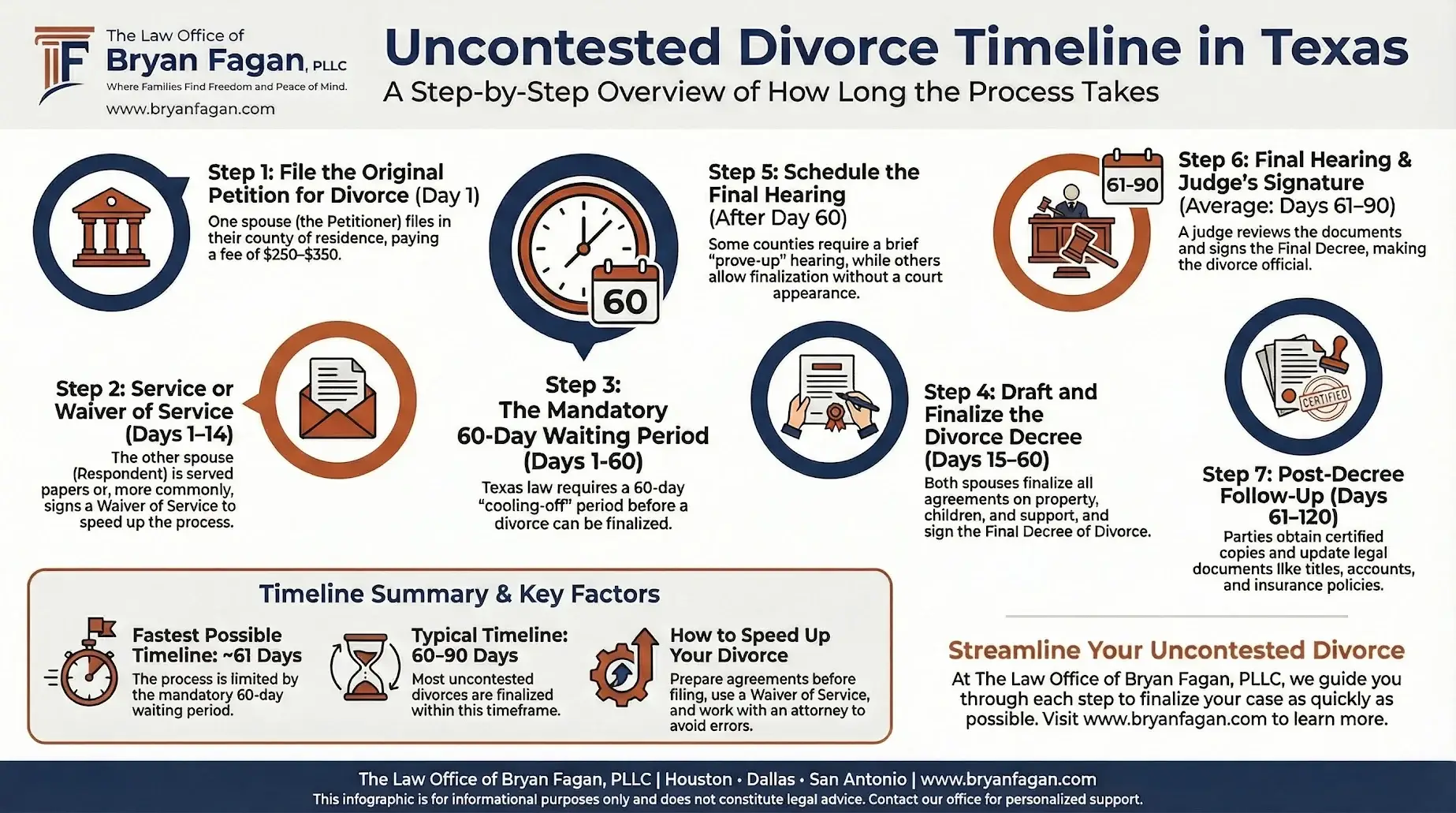
The process begins when one spouse files the Original Petition for Divorce with the appropriate district clerk. This filing date triggers the statutory waiting period under Texas Family Code §6.702, which prevents any divorce—contested or uncontested—from being finalized before Day 61. During the first two weeks, the other spouse must be formally served or may sign a Waiver of Service if they agree to proceed cooperatively. This step is crucial in uncontested cases, as skipping or mishandling service can extend the timeline by weeks.
While the waiting period continues, both spouses can finalize the essential documents that will ultimately form their Final Decree. This often includes agreed parenting plans that comply with the best-interest standard of §153.002, updated child support worksheets using the latest guidelines under §154.125(a-1), and detailed property division terms consistent with the “just and right” standard in §7.001. Once the documents are complete, families can request a prove-up hearing—typically between Days 45 and 75—depending on court availability and local procedures.
Most uncontested divorces in Texas conclude between Days 60 and 90, although some may take three to four months in counties with heavy dockets or stricter administrative requirements. The absolute minimum for finalization is 61 days: the mandatory waiting period plus the earliest available hearing date. The Bryan Fagan family law team regularly helps clients prepare early so they may finalize their divorce as close to Day 61 as possible, provided all documents meet statutory and county-specific standards.
For families wanting guidance on whether filing now or waiting makes more sense for their situation, the firm offers a deeper exploration in Uncontested Divorce in Texas: When Does Filing Make Sense?. Additional support is available through resources like the Texas Divorce Information Center, where individuals can learn more about timelines, procedures, and practical considerations as they prepare for each stage of the process.
As always, the goal of The Law Office of Bryan Fagan—sometimes referred to as the Bryan Fagan legal team—is to empower families with clarity, compassion, and legally sound guidance so they can move forward with confidence and protect what matters most.
Step-by-Step Breakdown of the Uncontested Divorce Timeline in Texas
Step 1: Filing the Original Petition for Divorce (Day 1)
The Texas divorce process officially begins when you file the Original Petition for Divorce with the district clerk in the appropriate county. This document initiates your case and immediately triggers the 60-day mandatory waiting period.
Residency Requirements
Before filing, you must confirm that you meet Texas law requirements for residency:
- At least one spouse must have been a domiciliary of Texas for at least six months immediately before filing
- At least one spouse must have been a resident of the specific county where you file for at least 90 days immediately before filing
Filing in the wrong county or before meeting these requirements can result in your case being dismissed, forcing you to start over and completely resetting your divorce timeline.
Filing Fees and Documentation
Filing fees vary by county but typically range from $250 to $400. You will need to bring:
- A completed Original Petition for Divorce
- Payment for filing fees (or a Statement of Inability to Afford Payment of Court Costs if you qualify)
- Identification
Many Texas courts now require or allow electronic filing, particularly for attorneys. Self-represented litigants may have the option to file in person or electronically depending on local court rules.
Step 2: Serving or Waiving Service (Days 1-14)
After filing, your spouse must be officially notified of the divorce proceedings. In an uncontested divorce, the fastest approach is obtaining a Waiver of Service.
Waiver of Service Option
When your spouse agrees to the divorce, they can sign a notarized Waiver of Service acknowledging receipt of the divorce petition and waiving their right to formal service. This document must be signed after the petition is filed and after the respondent has received a file-stamped copy.
Benefits of using a Waiver of Service include:
- Eliminates the cost of hiring a process server or constable
- Removes delays associated with locating and serving your spouse
- Keeps the Texas uncontested divorce process on the fastest possible track
Formal Service Requirements
If your spouse will not sign a waiver, you must arrange for formal service through a constable, sheriff, or private process server. The server will personally deliver the citation and a copy of the petition to your spouse, then file a Return of Service with the court. This process can add days or weeks to your timeline and increases costs.
Step 3: Mandatory 60-Day Waiting Period (Days 1-60)
Texas Family Code §6.702 establishes a mandatory 60-day waiting period for all divorce cases, including fully agreed matters, before a court may grant a Final Decree. This rule applies to nearly every case moving through the Uncontested Divorce Timeline in Texas, and it is one of the most important timing factors for families seeking a predictable path forward. Although many clients hope the waiting period can be waived, Texas law allows very limited exceptions. Under §6.702(b), a waiver may be granted only when there is documented family violence, such as a conviction or deferred adjudication for an offense against the petitioner, or when a qualifying protective order is in place. These exceptions are narrow, and most uncontested divorces must complete the full waiting period before finalization.
During this timeframe, couples are not powerless. The family-focused legal team at The Law Office of Bryan Fagan often encourages clients to treat the waiting period as a productive preparation window rather than a delay. Parents can use this time to finalize conservatorship arrangements that comply with Texas Family Code §153.002, complete updated child support calculations under §154.125(a-1), and ensure all required language for medical support, possession schedules, and rights and duties is fully accurate. This careful preparation helps families avoid last-minute corrections that could postpone a hearing date.
For cases involving property or retirement assets, the waiting period is also an opportunity to complete draft Qualified Domestic Relations Orders (QDROs) and ensure that the Final Decree reflects a clear and enforceable division consistent with Texas Family Code §7.001. Gathering signatures, reviewing financial disclosures, and confirming that every required exhibit is attached can make the difference between a smooth finalization and unnecessary delays once the 60-day mark arrives.
The most efficient uncontested divorces are those where every form, worksheet, and schedule is complete before the waiting period expires. When spouses enter Day 61 with a fully prepared file, they can schedule a prove-up or submission hearing at the earliest available date, keeping their case on track and minimizing stress. Families looking for real-life examples and detailed timelines can explore the firm’s in-depth resource, Understanding How Long an Uncontested Divorce Takes in Texas Through Real Cases, which walks through common scenarios and outcomes.
Additional guidance on divorce preparation, parenting plans, and support obligations can be found in our educational library, including articles like the Texas Child Support Overview. Whether referred to as the Bryan Fagan legal team or simply the firm, our commitment remains the same: helping families navigate the Texas divorce process with clarity, compassion, and confidence, so they can move into the next chapter of life with a sense of stability and readiness.

Step 4: Finalizing All Documents (Days 30-60)
Preparing complete and accurate documents is one of the most important steps in keeping your case on track within the Uncontested Divorce Timeline in Texas. Even small errors can cause delays, because judges must ensure that every term in your Final Decree complies with the Texas Family Code. Updated provisions—such as the 2025 adjustments to Texas Family Code §154.125(a-1) for child support calculations and the best-interest requirements in §153.002—mean that outdated forms or incorrect language can result in rejected filings or postponed hearings. Careful preparation protects families from unnecessary stress and helps ensure a smooth path to finalization.
An uncontested divorce typically requires several key documents. The Final Decree of Divorce must address all matters in a legally enforceable way, including the division of marital property under Texas Family Code §7.001, debt allocation, conservatorship terms, child support, possession schedules, and any spousal maintenance requested under §8.051. Parents must also complete a child support worksheet consistent with state guidelines and prepare a detailed parenting plan that outlines rights, duties, decision-making authority, and possession schedules. In cases involving retirement accounts, Qualified Domestic Relations Orders (QDROs) may be required to divide 401(k)s, pensions, or similar assets. Some spouses choose to sign a settlement agreement documenting their terms before incorporating those provisions into the Final Decree.
In addition to statewide requirements, many Texas counties require supplemental forms that must be filed before a judge will finalize the case. These may include the Bureau of Vital Statistics (BVS) form, a prove-up script or affidavit, acknowledgments of local standing orders, certificates of last known address, or civil case information sheets. Because each county follows different administrative procedures, ensuring that these forms are correct and submitted in the right order can significantly influence the timing of your divorce.
Any document that fails to meet legal or procedural standards can extend your timeline by weeks. A decree that lacks sufficient detail about property division, includes outdated child support language, or omits mandatory findings for custody may be returned for correction. These setbacks are avoidable with careful review and guidance from a legal team familiar with Texas courts. For families beginning their preparation, the firm’s comprehensive resource—Key Considerations Before Filing for an Uncontested Divorce in Texas—provides practical insights into what to expect.
If you are navigating child-related issues, you may also find the Texas Child Custody and Conservatorship Overview helpful as you prepare your documents. Whether referred to as The Law Office of Bryan Fagan or the Bryan Fagan family law team, our focus remains the same: educating families, protecting futures, and ensuring that every document reflects the care and precision needed to complete your divorce efficiently and with confidence.
Step 5: Setting the Final Hearing (Days 45-75)
Finalizing an uncontested divorce often depends on how efficiently you can schedule your prove-up hearing, and this step varies widely across Texas. Because the Uncontested Divorce Timeline in Texas is shaped not only by state law—such as the mandatory waiting period in Texas Family Code §6.702—but also by county-specific procedures, understanding how your local court operates is critical to avoiding unnecessary delays. Each county maintains its own scheduling systems, filing requirements, and docket availability, which means the path to a final hearing can differ significantly from one jurisdiction to another.
Some counties allow spouses to schedule their hearings online through a court website or e-hearing portal, while others require emailing or calling a court coordinator. Certain jurisdictions still maintain walk-in dockets for uncontested matters, and many Texas courts now offer Zoom hearings for agreed prove-ups. These differences often determine whether a hearing can be set shortly after the waiting period expires or whether families may need to wait several more weeks before appearing in front of a judge.
Multiple factors influence the availability of hearing dates. Smaller or rural counties may offer hearings soon after Day 60, while larger metropolitan courts—such as Harris, Dallas, Tarrant, or Bexar—often experience heavier dockets that push uncontested hearings further out. Seasonal changes, including summer breaks and holiday periods, may also tighten scheduling, and some counties continue to work through backlog from prior years. These variables highlight why timing can differ widely even when the case itself is straightforward and fully agreed.
Working with a family law attorney who practices regularly in your filing county can make a meaningful difference in how smoothly this stage unfolds. The Bryan Fagan legal team understands local rules, knows how far in advance to request hearing dates, and ensures that all required documents—such as the Final Decree, child support worksheets compliant with the latest updates to Texas Family Code §154.125(a-1), and any supporting affidavits—are prepared exactly as the court expects. This preparation helps families avoid rejected submissions, rescheduled hearings, and unnecessary stress.
For individuals wanting a broader overview of how divorce procedures unfold across Texas, the firm’s educational resource hub provides helpful guidance. A comprehensive starting point is The Divorce Process, which walks readers through every major step from filing to finalization. Additional insights into timelines, conservatorship, and support issues can be found in articles such as the Texas Child Custody and Conservatorship Overview. Whether referred to as The Law Office of Bryan Fagan or the Bryan Fagan family law team, the firm remains committed to guiding families through the legal process with clarity, compassion, and confidence.
Step 6: Final Hearing and Completion (Days 60-90)
he final step in the Uncontested Divorce Timeline in Texas is the prove-up hearing, a brief but essential moment where the court confirms that all legal requirements have been met. In most counties, this hearing lasts only a few minutes, yet it represents the point at which your divorce becomes eligible for judicial approval under Texas Family Code §6.701 and §6.702. During the prove-up, the petitioner—or their attorney—provides sworn testimony verifying core facts: the identity of the parties, satisfaction of residency requirements under Texas Family Code §6.301, the date of marriage and separation, and that the marriage has become insupportable with no reasonable expectation of reconciliation. If children are involved, the court will also confirm that the agreed parenting terms comply with the best-interest standard outlined in Texas Family Code §153.002.
Typically, only the filing spouse appears for the hearing, although some counties may require both parties, and many Texas courts now permit Zoom appearances for uncontested prove-ups. The Bryan Fagan legal team regularly helps clients prepare for this moment so the testimony is clear, accurate, and consistent with the Final Decree. The court will also ensure that both parties have signed the decree, all child support provisions comply with the updated guidelines under §154.125, and no disputed issues remain for judicial determination.
After testimony is complete, the judge reviews the Final Decree and accompanying documents. If everything aligns with Texas law and local procedural rules, the judge signs the decree in open court or shortly thereafter, officially dissolving the marriage on that date. Clients can then request certified copies from the district clerk for use in name changes, benefits updates, employer records, and financial institutions. This moment often brings both relief and closure, marking the end of the legal process and the beginning of a new chapter.
Families wanting a deeper look at how final hearings fit into the broader divorce timeline can explore the firm’s in-depth guide, What Everyone Gets Wrong About the Divorce Timeline in Texas. For related guidance—such as preparing for child support orders or understanding custody arrangements—resources like the Texas Child Custody and Conservatorship Overview provide valuable clarity rooted in current Texas law.
Whether referred to as The Law Office of Bryan Fagan, the Bryan Fagan family law team, or simply the firm, we remain committed to empowering Texans with knowledge, compassion, and legal strength. Our role is not just to complete your divorce but to help you move through the process with confidence, dignity, and the reassurance that your future is protected.

Factors That Can Delay the Uncontested Divorce Timeline
Even when both parties agree on everything, several factors can extend the Texas divorce timeline beyond the typical 60-90 days:
Incorrect or Incomplete Forms
Technical errors are the most common cause of delays:
- Missing signatures or improper notarization on the Final Decree
- Wrong county or court information on documents
- Decrees that fail to adequately describe property being awarded
- Omitted required forms such as BVS forms or child support worksheets
- Property division terms that are vague or legally insufficient
Each rejection or correction cycle can add weeks to your timeline.
Child Support Calculation Issues
Judges carefully scrutinize child support arrangements. Non-guideline child support orders require specific findings and justifications. Using incorrect net resources or failing to account for other children can prompt judicial questions and delay proceedings.
Residency Requirement Problems
Cases filed before meeting the six-month Texas residency or 90-day county residency requirements can be dismissed, forcing petitioners to refile later and completely restart the divorce timeline.
QDRO Preparation Delays
Dividing retirement accounts requires specialized Qualified Domestic Relations Orders. QDRO preparation is technical work, and plan administrators sometimes require pre-approval of language. If your court requires the QDRO at the time of divorce, waiting on its completion can delay proceedings.
Court Scheduling Backlogs
Heavily populated counties may have limited slots for uncontested hearings, particularly immediately after the 60-day mark. During busy seasons, scheduling delays can push finalization to three or four months after filing.
Disagreements Arise During the Process
Even couples who believe they agree on everything sometimes discover disagreements about specific details—holiday schedules, debt allocation, or the value of marital assets. If significant negotiation becomes necessary, or if the case shifts from uncontested to contested, the timeline can extend dramatically.
How to Speed Up the Uncontested Divorce Timeline in Texas
You can take several proactive steps to keep your divorce on the fastest possible track:
1. Use a Waiver of Service
Having your spouse voluntarily sign a notarized Waiver eliminates the need for formal service and can shave days or weeks off the process.
2. Agree on All Major Issues Before Filing
The fastest uncontested divorces are those where both spouses have already reached complete agreement before the petition is filed. Know who keeps the house, how you will handle the children’s schedule, and what child support amount you will use.
3. Prepare Documents Early
Draft your Final Decree, child support worksheets, and parenting plans before or shortly after filing. This allows you to use the waiting period for refinement rather than initial drafting.
4. Work with an Experienced Texas Divorce Attorney
A divorce attorney familiar with your county’s specific requirements can review all forms for compliance, preventing the technical errors that cause delays.
5. Submit Complete Document Packets
Before requesting your final hearing, ensure every required document is filed and accurate. Courts move fastest on cases that arrive as clean, complete packets.
6. Schedule Hearings Early
In counties that allow early scheduling, secure your hearing slot for shortly after Day 60 as soon as possible.
7. Respond Promptly to Court Communications
If the court coordinator requests additional documents or corrections, immediate responses prevent your case from being passed over.
Why an Attorney Helps Accelerate the Timeline
Although Texas law does not require spouses to hire an attorney for an uncontested divorce, working with an experienced family law team can significantly streamline the Uncontested Divorce Timeline in Texas. Even in agreed cases, accuracy matters. Every petition, decree, and supporting document must meet the requirements of the Texas Family Code—including the updated child support guidelines under §154.125(a-1), the conservatorship standards in §153.002, and the “just and right” property division standard in §7.001. When paperwork is incomplete or inconsistent with local rules, courts may reject filings or delay hearings. Legal guidance helps families avoid these setbacks and move through the process with confidence.
Because Texas has 254 counties, each with distinct procedures, standing orders, and documentation preferences, families often find that navigating county differences is more challenging than expected. A firm that handles uncontested divorces across the state understands how to tailor filings to meet each court’s expectations. This includes knowing when a county requires additional affidavits, how far in advance to schedule a prove-up hearing, and whether a court allows Zoom appearances for uncontested matters. These details can meaningfully influence timing and reduce stress for clients.
Experienced attorneys also help families avoid turning an agreed case into a contested one. Guidance rooted in the Texas Family Code ensures that proposed terms are realistic, legally enforceable, and likely to be approved by the court. By keeping discussions practical and focused, attorneys help prevent disagreements from escalating into disputes that could extend a two-month process into a year-long litigation experience. This support is especially important when parenting plans, financial disclosures, or retirement divisions are involved.
For families wanting to understand how attorney involvement affects real-world timelines, the Bryan Fagan legal team offers an in-depth resource: How Long Does an Uncontested Divorce Take in Texas: What to Consider for Your Situation. Those with questions about child-related issues may also benefit from educational guides such as the Texas Child Custody and Conservatorship Overview, which explains how courts apply best-interest standards in agreed cases.
At times referred to simply as the Bryan Fagan family law team, the firm approaches every uncontested divorce with efficiency, accuracy, and compassion. By combining precise document preparation with a deep understanding of Texas court procedures, we help families move forward quickly while protecting their rights and their future.

Actionable Checklist for Texas Uncontested Divorce Timeline
Use this checklist to track your progress through the uncontested divorce process:
- [ ] Confirm Texas residency requirements: Verify that at least one spouse has lived in Texas for six months and in your filing county for 90 days
- [ ] Reach complete agreement on all divorce terms: Property division, debts, child custody, child support, visitation schedules, and spousal support
- [ ] Gather required documents: Pay stubs, tax returns, retirement account statements, mortgage information, vehicle titles, and children’s school and medical records
- [ ] File the Original Petition for Divorce: Submit to the district clerk in the appropriate county and pay filing fees
- [ ] Obtain Waiver of Service: Have your spouse sign the notarized waiver, or arrange for formal service if necessary
- [ ] Complete all required forms during the waiting period: Final Decree, child support worksheet, parenting plan, QDROs, and county-specific forms
- [ ] Review all documents for accuracy: Check property descriptions, child support calculations, and custody terms against Texas requirements
- [ ] Schedule the final hearing: Contact the court coordinator or use online scheduling after Day 60 approaches
- [ ] Attend the prove-up hearing: Provide brief testimony confirming your agreement
- [ ] Receive your signed Final Decree: Request certified copies for your records
Conclusion
By now, you’ve seen that the process of moving through an uncontested divorce in Texas is not just a legal timeline—it’s a personal transition filled with questions, emotions, and a desire for steady ground. And while the steps may feel unfamiliar at first, the path becomes much clearer when you understand your options and have the right support behind you. That clarity alone can make a difficult season feel a little bit lighter.
If you’re standing at the beginning of this journey, know that you don’t have to navigate it on your own. Working with an experienced Texas family law attorney can turn confusion into confidence, helping you avoid delays, protect your interests, and move forward with peace of mind. At The Law Office of Bryan Fagan, PLLC, that’s exactly what we strive to offer—compassionate guidance, dependable answers, and a plan that respects both your needs and your future.
Every family deserves a path forward that feels steady and intentional. Whether you’re ready to take the next step or simply want to understand your options more clearly, we’re here to help you move toward your next chapter with confidence. And who knows—this moment of uncertainty may be the beginning of something stronger, calmer, and more aligned with the life you want to build. When you’re ready, we’re here.
Frequently Asked Questions About Uncontested Divorce in Texas
Most uncontested divorces in Texas take about 60 to 90 days. Because Texas law requires a mandatory 60-day waiting period, the exact timing depends on how quickly documents are prepared, whether the agreement is truly complete, and how busy your county’s court docket is. With proper preparation, many families finalize their divorce shortly after the 60-day mark.
The fastest possible divorce in Texas is an uncontested divorce where both spouses agree on all terms and all paperwork is correct and ready early. Even then, the earliest a divorce can be granted is day 61 due to the statutory waiting period. Working with an experienced attorney helps avoid mistakes that could delay this timeline.
In many Texas counties, the petitioner attends a brief “prove-up” hearing where the judge reviews and approves the agreement. Some courts allow prove-ups by Zoom or, in select cases, by affidavit without a live appearance. Requirements vary by county, so it’s helpful to confirm what your local court expects.
The six-month rule refers to residency requirements. To file for divorce, at least one spouse must have lived in Texas for at least six months and in the county of filing for at least 90 days. Filing before meeting these requirements can lead to dismissal and restart your timeline.
Avoid hiding or moving assets, violating standing orders, posting about your case online, involving children in conflict, or signing agreements you don’t fully understand. These missteps can damage your case, delay the process, and create long-term complications. When in doubt, pause and seek legal guidance.
An uncontested divorce can be a great option for cooperative spouses, but it has limits. If there is an imbalance of information or power, or if complex property or parenting issues exist, important rights may be unintentionally waived. Changing an unfair agreement later can be extremely difficult, which is why attorney review is valuable even in amicable cases.
Costs vary by county and by whether attorneys are involved. Filing fees typically range from a few hundred dollars, and attorney fees are generally much lower than in contested cases. Factors like real estate, retirement accounts, and custom parenting arrangements can affect overall cost. A consultation provides the most accurate estimate.
A divorce becomes final when the judge signs the Final Decree, which can happen as early as the 61st day after filing. Finalization depends on complete and accurate documents, proper service or waiver, and available hearing dates. Delays in paperwork or scheduling can add several weeks, but careful preparation helps keep the case on track.