
Divorce can be one of life’s most difficult transitions—but understanding your rights and the legal process under Texas law can make it feel less overwhelming. When you're facing a divorce, it feels like everything is spinning out of control. But understanding the actual timeline is the first step toward getting your feet back on solid ground. In Texas, the law has a built-in pause button for every divorce: a mandatory 60-day waiting period. This rule is laid out in Texas Family Code § 6.702, and it starts the day after your Original Petition for Divorce is officially filed.
Think of it as a required pause, put in place to ensure a life-changing decision like divorce isn't made in the heat of the moment. This guide will walk you through what this waiting period means, why it exists, and how you can use this time to prepare for the next chapter of your life.
Demystifying The Texas 60-Day Divorce Rule
Navigating a divorce is a journey, and in Texas, that journey has a very clear starting line. This mandatory 60-day waiting period is something many people misunderstand. It's not a penalty or just more bureaucratic red tape; the legislature designed it as a "cooling-off" period. The state recognizes that ending a marriage is a massive step, and this pause gives couples one final, structured opportunity for reflection—and maybe even reconciliation—before the decision becomes final.

This rule is a universal one here in Texas. It doesn't matter if your divorce is completely amicable and you and your spouse agree on every last detail. The 60-day waiting period is strictly enforced for everyone, with very few exceptions.
The clock officially starts ticking the day after the divorce petition is filed with the court. This means the absolute earliest a judge can sign off and finalize your case is on day 61. For example, if your petition is filed on January 1st, the soonest your divorce can be finalized is March 2nd (in a non-leap year). This gives you a predictable timeline from the very beginning. You can learn more about the final steps in our detailed guide on when your Texas divorce is truly final.
What This Waiting Period Means For You
So, what does this legal requirement actually mean for your case? First and foremost, it sets the absolute minimum time your divorce will take. No judge in Texas can sign your Final Decree of Divorce before this 60-day window has closed. Consider it your first major milestone in the process.
Let's break down the key components of this waiting period in a quick, scannable table so you know exactly what to expect.
The Texas 60-Day Waiting Period At A Glance
| Aspect of the Waiting Period | What It Means For You |
|---|---|
| It's Mandatory | This isn't optional. It applies to every Texas divorce, with very rare exceptions for documented family violence. |
| The Clock Starts After Filing | The 60 days don't begin when you hire an attorney or separate. The countdown starts the day after the court clerk officially accepts your divorce petition. |
| It's Preparation Time | This period is a critical window to get organized. It’s the perfect time to gather financial documents, negotiate terms, and prepare for a smoother resolution. |
This table gives you the basics, but the most important takeaway is this: that 60-day period isn't dead time. A good attorney will use it strategically.
Instead of just waiting, we use this time productively. It’s when we gather documents, draft proposals for property division and child custody, and open lines of negotiation. Understanding this initial phase is critical because it sets the foundation for everything that follows. It transforms a period of waiting into a period of productive preparation, putting you in a much stronger position once day 61 arrives.
Why The 60-Day Wait Is Just The Starting Point
While the 60-day waiting period is a clear legal minimum in Texas, it's critical to understand that for most couples, this is just the start of the race, not the finish line. One of the biggest misconceptions I see is people thinking the divorce waiting period in Texas is a guaranteed timeline.
In reality, the actual time it takes to finalize everything depends heavily on the unique circumstances of your marriage—specifically, how much you and your spouse can agree on.
Most divorces take longer than 61 days. The rule simply means a judge cannot sign your Final Decree of Divorce any sooner. What happens during those 60 days, and often for many months after, is what truly sets your personal timeline.
The Uncontested Divorce Path
An uncontested divorce is your fastest path to the finish line. This is the scenario where you and your spouse see eye-to-eye on every single issue. This includes the big stuff, like:
- Property and Debt Division: How every asset, from the house to retirement accounts, and every liability will be split.
- Child Custody and Visitation: A solid parenting plan that spells out rights, duties, and possession schedules.
- Child Support and Spousal Maintenance: A clear agreement on any financial support obligations.
Even with complete agreement, the process still takes time. During that 60-day window, your attorney gets to work drafting the detailed Final Decree of Divorce. This isn't just a simple form; it's a critical legal document that has to be meticulously prepared, reviewed, and signed by both of you before it ever sees a judge. An uncontested divorce can often wrap up shortly after the 60-day mark, but this only happens with proactive cooperation and preparation.
A common point of confusion is believing that an "agreed" divorce means the legal work is minimal. Even with 100% agreement, the Final Decree of Divorce is a complex, binding contract that must be drafted with precision to protect your rights for years to come.
The Contested Divorce Timeline
A contested divorce, where you and your spouse disagree on one or more key issues, follows a much longer and more structured path. The 60-day waiting period becomes just the initial phase of a much more extended process. This extra time isn't arbitrary; it's built into the system to ensure a fair and just outcome for everyone involved.
Several legally required steps can significantly stretch the timeline well beyond those initial 60 days:
- Discovery: This is the formal process of gathering information and evidence. It can involve exchanging financial documents, answering written questions under oath (known as interrogatories), and giving depositions. This phase alone can take several months.
- Mediation: Most Texas courts will require you and your spouse to attend mediation to try and hammer out your disputes before going to a final trial. It's a structured negotiation guided by a neutral third-party mediator.
- Temporary Orders Hearings: If you need immediate decisions on things like who stays in the house or what the temporary child custody schedule will be, a hearing might be necessary early on in the case.
- Court Hearings and Trial: If you can't reach an agreement in mediation, your case will eventually be scheduled for hearings or a final trial, which is completely dependent on the court's busy docket.
These steps, while time-consuming, are absolutely vital for protecting your interests, especially when you're dealing with complex assets or, most importantly, the well-being of your children. This period is less about waiting and more about building a solid legal foundation for your future.
Can You Ever Waive The Waiting Period?
"Can we just skip the 60-day waiting period?" It's a question we hear all the time, and it's completely understandable. People want to move on.
The short answer is: almost never. Texas law is very firm on this point. The waiting period is seen as a mandatory "cooling-off" period, a time for reflection before a marriage is officially dissolved. You and your spouse simply agreeing to skip it won't be enough to persuade a judge.
However, the law does carve out a very narrow, very serious exception.

This isn't some legal loophole for a quicker divorce. It's a critical protection designed for victims of family violence. Your safety is paramount, and the legal system provides this path to help protect you and your family from any further harm.
Grounds for a Waiver Due to Family Violence
Under the Texas Family Code, a judge has the power to waive the 60-day waiting period, but only in specific situations involving family violence. This is never an automatic green light; it requires presenting solid, convincing evidence to the court.
A judge might grant a waiver if there's proof that your spouse has been:
- Convicted of an offense involving family violence against you or a member of your household.
- Granted deferred adjudication for a family violence offense against you or someone in your household.
You can also ask for a waiver if you have an active Protective Order against your spouse, issued to protect yourself or another household member.
It's vital to understand that judges handle these requests with extreme seriousness. The goal of this exception is to provide an immediate route to legal safety, not to fast-track a standard divorce.
Seeking a Waiver Is a Serious Legal Step
If you are in a situation involving domestic abuse, requesting a waiver is a serious legal move that needs immediate and careful attention. It involves filing specific motions with the court and presenting evidence that meets a very strict legal standard.
This is a tough, emotional road to walk. Having an experienced family law attorney in your corner is absolutely essential. We can help you understand your rights, gather the necessary proof, and present your case to the court with the urgency and sensitivity it requires. Your well-being is the number one priority, and the law has this measure in place to help ensure it.
How To Make The Waiting Period Work For You
It's easy to look at the mandatory 60-day waiting period and see nothing but a frustrating delay. I get it. But from an experienced perspective, it’s far more productive to see it as a strategic opportunity. Think of these two months not as dead time, but as a critical head start. Using this period wisely can set the stage for a much smoother, faster, and more cost-effective resolution once day 61 finally arrives.
This is your chance to get organized and take back some control. When you take proactive steps now, you shift out of a reactive, stressed-out mindset and into one of preparation. It puts you in the strongest possible position to move forward with clarity and confidence.
Build Your Financial Foundation
The first, and arguably most critical, task is to start gathering every single relevant financial document you can get your hands on. This process, known in the legal world as "discovery," is a non-negotiable part of any divorce, so getting an early start is a massive advantage. Begin collecting all the paperwork that tells the financial story of your marriage.
Here’s a practical checklist of the key documents to start with:
- Income Information: Recent pay stubs, W-2s, and tax returns going back at least a few years.
- Banking Records: Statements for every checking, savings, and money market account.
- Retirement and Investment Accounts: Statements for 401(k)s, IRAs, pensions, and any brokerage accounts.
- Debt Statements: Records for your mortgage, car loans, credit cards, and any personal loans.
- Property Documents: Deeds to real estate, vehicle titles, and recent property tax appraisals.
Putting together a comprehensive list of all your assets and debts is an absolutely essential first step. For a more detailed roadmap on this crucial task, our guide on planning a divorce by making your list is a great resource. This financial inventory becomes the bedrock for all your property division negotiations.
Complete Necessary Requirements and Start Negotiations
Beyond just paperwork, this waiting period is the ideal time to knock out other requirements and even begin negotiations. For instance, if you have minor children, you can complete the court-required online parenting course. Getting this done early prevents any last-minute scramble that could delay your final hearing.
This is also the perfect window to engage in mediation. If you can resolve disputes over property, custody, and support during these 60 days, you can walk into court with a fully agreed-upon Final Decree of Divorce as soon as the waiting period is over.
Working with your attorney to draft the Final Decree of Divorce during this period is one of the most productive steps you can take. Having a signed decree ready to go on day 61 is the key to finalizing your divorce without any unnecessary and costly delays.
The 60-day divorce waiting period in Texas isn't just a legal hurdle; it’s also a practical buffer. While it sets a minimum timeline, the reality is that most divorces, especially those with disagreements or complex assets, take much longer—often six months to a year. By using this initial period for discovery, mediation, and document preparation, you can turn a frustrating wait into a much smarter, more streamlined outcome.
Comparing Contested And Uncontested Divorce Timelines
If you want to set realistic expectations for your divorce, you first need to understand the fundamental difference between a contested and an uncontested case. Every divorce in Texas starts with the same mandatory 60-day waiting period, but after that, the path splits dramatically based on one simple factor: agreement.
An uncontested divorce is the most straightforward path to dissolution. In this scenario, you and your spouse have already agreed on everything that matters—how to divide property and debts, and all the details related to your children. The goal here is to use the 60-day waiting period productively to draft and finalize a comprehensive Final Decree of Divorce. If you can get everything signed and settled, your divorce can often be finalized on day 61, or very shortly after.
On the flip side, a contested divorce means there’s a disagreement on at least one major issue. This is where things can get complicated. That single point of contention triggers a series of legal steps designed to resolve the conflict, and each of those steps adds more time to the clock.
The infographic below highlights the key preparation stages that can help make your divorce process more efficient, whether it's contested or not.
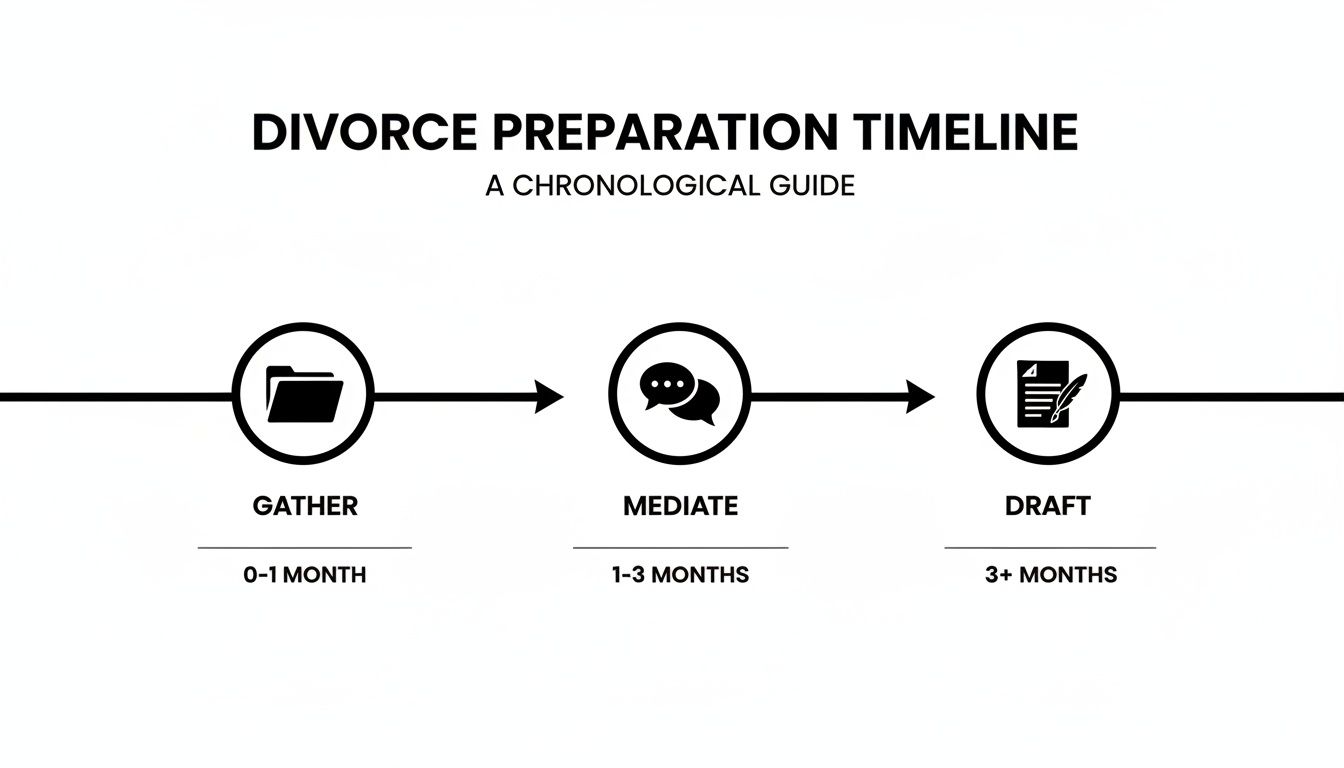
As you can see, proactively gathering your financial documents, being open to mediation, and working on a draft agreement are foundational steps for a smoother resolution.
How The Timelines Differ In Practice
For a contested case, that initial 60 days is just the starting line. From there, the timeline stretches to accommodate all the necessary legal procedures. This is where the real work—and the waiting—begins.
Here's what that often looks like:
- Temporary Orders Hearings: If you need immediate decisions on who stays in the house or a temporary custody schedule, the court has to hold a hearing. Just getting that on the judge’s calendar can take weeks.
- The Discovery Process: This is the formal phase for gathering evidence. It involves exchanging detailed financial documents, answering written questions under oath, and sometimes giving depositions. This step alone can easily eat up several months.
- Expert Valuations: If you own a business, have complex investments, or other unique property, you'll likely need experts to determine their value. That adds another layer of time and complexity.
- Mediation and Negotiation: While mediation is required in most Texas counties, getting to a "yes" can take multiple sessions spread out over weeks or even months.
The table below gives a clearer picture of how these timelines compare after the initial filing.
Uncontested Vs. Contested Divorce Timeline Comparison
| Divorce Stage | Uncontested Timeline | Contested Timeline |
|---|---|---|
| Initial Filing & Waiting Period | 60 days (Statutory) | 60 days (Statutory) |
| Final Decree Drafting | During the 60-day period | Months 3-9+ (after negotiations) |
| Discovery & Evidence Exchange | Not required | Months 2-6 |
| Temporary Orders Hearings | Not required | Month 2-3 |
| Mediation | Optional, often one session | Required, may take multiple sessions |
| Finalization (Prove-Up) | On or after day 61 | 6-12+ months after filing |
As you can see, the path for a contested case involves many more steps, each with its own timeline.
Historically, Texas's mandatory 60-day waiting period has always been there to provide a "cooling-off" period, ensuring no decree is issued before day 61. But in reality, most divorces, especially those with any level of dispute, go far beyond this minimum. The average contested divorce takes anywhere from six to twelve months, and highly complex cases can sometimes stretch on for years. The key is to use this time productively for negotiation and preparation, which we cover in our article about how to speed up your divorce in Texas.
The most significant factor extending a divorce timeline isn't necessarily anger—it's complexity. A high-asset case with a family business can take longer than a simple, acrimonious split because the legal and financial details require more time to resolve fairly.
Ultimately, while an uncontested divorce aims to be done and dusted right around the 61-day mark, a contested case requires preparing for a journey. Realistically, that journey can last a year or more, depending entirely on the issues at stake.
Common Questions About The Divorce Waiting Period
Going through a divorce brings a flood of questions, and it’s completely normal to want straightforward answers. We’ve put together some of the most common concerns we hear from clients about the divorce waiting period in Texas and what it means for their timeline. Our goal is to give you the clarity you need to move forward with confidence.
Can my spouse and I agree to skip the 60-day period?
This is probably the number one question we get, and the answer is a firm no. The 60-day waiting period in Texas is a mandatory requirement baked into state law. You and your spouse cannot simply agree to waive it.
Think of it as a state-mandated "cooling-off" period. Even if your divorce is completely amicable and you’ve agreed on every last detail, a judge legally cannot sign your Final Decree of Divorce until at least the 61st day after the initial petition was filed. The only possible exception, which is granted very rarely, involves specific, documented cases of family violence, and that still requires a judge’s approval.
When does the 60-day clock officially start?
The 60-day clock officially kicks off the day after your Original Petition for Divorce is successfully filed with the court clerk. Any time you spend meeting with an attorney, gathering documents, or negotiating before that filing date doesn't count toward this period.
For example, if your petition is filed and stamped by the court on May 1st, then May 2nd is Day 1. An experienced attorney makes sure the petition is filed correctly so the clock starts ticking without any procedural hiccups.
It's crucial to understand that the filing date is the official starting line. This legal technicality is why working with a professional is so important—to ensure every step is handled correctly from the very beginning.
What happens if we reconcile during the waiting period?
The waiting period exists in part to give couples a final moment to reflect and potentially reconcile. If you and your spouse decide to call off the divorce during these 60 days, you can file a document called a Notice of Nonsuit.
This notice effectively pulls the plug on the divorce petition and dismisses the entire case. Just keep in mind, if you change your minds again down the road, you have to start the whole process over. That means filing a new petition and starting a brand new 60-day waiting period.
Will my uncontested divorce be final on Day 61 automatically?
Finalizing your divorce on day 61 isn't automatic, but it's a very achievable goal if you've done your homework. To be in a position to finalize right after the waiting period ends, you need to have a few key things locked down.
This includes:
- A complete and total agreement on every single issue (property, custody, support).
- A professionally drafted Final Decree of Divorce that has been reviewed and signed by both you and your spouse.
- All other necessary court paperwork filled out and ready to go.
Once all these pieces are in place, your attorney can schedule a short court appearance, often called a "prove-up." This is where the judge quickly reviews the documents, asks a few standard questions, and signs off on the divorce. While a busy court schedule might cause a slight delay of a few days, diligent preparation makes hitting that 61-day mark a realistic target.
If you need help navigating divorce, custody, or estate planning in Texas, contact The Law Office of Bryan Fagan today for a free consultation.