
Have you ever watched a family routine fall apart in small, quiet ways—missed pickups, tense handoffs in a parking lot, conversations that feel heavier than they used to? Divorce rarely explodes all at once. More often, it unravels in moments like these, when parents are just trying to get through the day without making things harder for their children. When people search for a Sample Divorce Settlement Agreement, they are usually looking for certainty—a sense that at least something can be put in order while everything else feels uncertain.
At The Law Office of Bryan Fagan, PLLC, we meet families at this exact crossroads. Bryan Joseph Fagan, a South Texas College of Law graduate and recognized authority on Texas divorce and custody law, founded this firm on the belief that knowledge restores peace of mind. Under Texas Family Code §153.002, every decision in a divorce involving children must serve the child’s best interest. That standard reaches far beyond legal terminology. It touches daily life—who makes decisions, how transitions happen, and whether parents have a clear, enforceable plan instead of ongoing conflict. A well-drafted settlement agreement can reduce tension, create predictability, and give children the emotional space they need to feel secure during change.
This article will walk you through what a divorce settlement agreement in Texas really does, why relying on a generic sample can create long-term problems, and how compassionate, experienced legal guidance helps families move forward with clarity. Our goal is not just to explain the law, but to help you reclaim a sense of control and calm during one of life’s hardest transitions. As you continue reading, you’ll see how the right approach to a settlement agreement can protect your family’s future—and give everyone room to breathe again.
Key Takeaways
- A Sample Divorce Settlement Agreement is a helpful learning tool, but it must be customized to Texas law to be enforceable and effective.
- Texas courts focus on the best interest of the child under Texas Family Code §153.002, which makes clarity and stability in settlement terms essential.
- Vague or generic language can lead to enforcement problems, increased conflict, and costly court battles after the divorce is finalized.
- Well-drafted parenting plans, conservatorship terms, and support provisions reduce stress for parents and create predictability for children.
- Property division in Texas is generally final and non-modifiable, making careful drafting critical from the start.
- Mediation and uncontested divorces can work well, but agreements should still be reviewed to avoid hidden risks and long-term consequences.
- Experienced Texas family law guidance helps transform a settlement agreement from a template into a reliable roadmap for your family’s future.

Your Family’s Future Starts Here
Don’t navigate your legal journey alone. Schedule a consultation now and get the clarity and support you deserve.
What Is a Divorce Settlement Agreement?
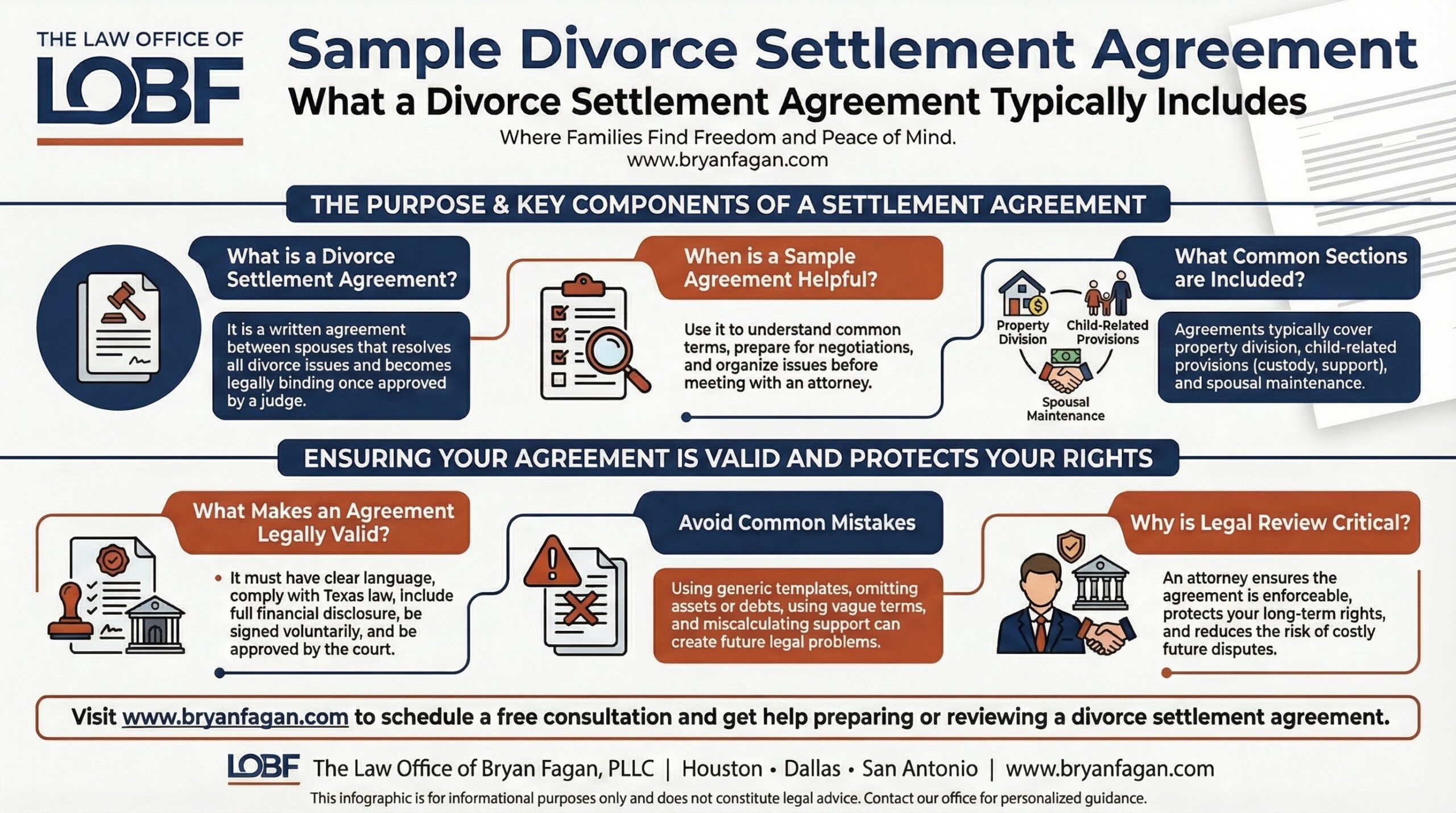
Before reviewing templates or examples, it is important to understand the role this document actually plays in a Texas divorce. A Sample Divorce Settlement Agreement is designed to show the structure and typical provisions of what Texas law refers to as a Marital Settlement Agreement (often called an MSA). This is a written contract in which spouses resolve the legal issues arising from their divorce, including property and debt division and, when applicable, matters involving children. The Texas Family Code, particularly §§6.602 and 7.006, recognizes and encourages negotiated agreements, but only when they meet specific statutory requirements and are suitable for court approval.
In real-world cases, this type of agreement forms the backbone of uncontested and negotiated divorces. Rather than asking a judge to decide every issue, spouses use the agreement to outline how their marriage will legally end and how responsibilities will be handled moving forward. Once signed and approved by the court, the agreement is incorporated into the Final Decree of Divorce and becomes a binding, enforceable court order. Even in agreed cases, judges review the terms for compliance with current Texas law, including updated provisions governing a “just and right” division of property and, when children are involved, the best-interest standard set out in Texas Family Code §153.002.
From the perspective of our Texas family law team, understanding this purpose helps families use samples appropriately—as educational references rather than finished legal solutions. Readers who want to better understand when example documents may be useful can explore our related resource, Sample Divorce Decree in Texas: When It Makes Sense to Use One, which explains how sample agreements and decrees fit into real Texas divorce proceedings. For additional insight into how courts evaluate child-related provisions, our Texas Child Custody and Best Interest of the Child Guide offers a deeper look grounded in the Texas Family Code.
Ultimately, while sample documents can clarify terminology and structure, a settlement agreement must reflect your specific circumstances and comply with Texas law as it exists today. Thoughtful legal guidance ensures that what begins as a sample becomes a clear, enforceable agreement that truly protects your rights and your family’s future.

What Is a Sample Divorce Settlement Agreement?
A Sample Divorce Settlement Agreement is best understood as an illustrative example rather than a finished legal document. These samples are designed to show the typical structure, common sections, and general legal language used when spouses resolve divorce-related issues by agreement. Texas law, particularly Texas Family Code §§6.602 and 7.006, recognizes negotiated settlement agreements, but it also requires that they be complete, voluntary, and legally sound before a court will approve them and incorporate them into a Final Decree of Divorce.
It is important to view these samples for what they are: educational references, not plug-and-play solutions. A template can help you understand what topics are usually addressed, such as property division, debt allocation, and child-related provisions, but it cannot substitute for careful legal drafting. Texas courts still review agreed settlements to ensure they comply with current statutory standards, including the requirement that child-related terms reflect the best interest of the child under Texas Family Code §153.002.
Every family’s situation is different, and no online sample can fully account for the details of your finances, your parenting arrangements, or the specific facts of your marriage. A sample may help you visualize how an agreement is organized, but Texas law requires customization based on your unique circumstances. Our Texas family law team often reminds clients that clarity and enforceability matter just as much as agreement itself. For a deeper, guided explanation of how example agreements are analyzed and adapted in real cases, you may find Walking Through a Sample Agreement With the Law helpful. You can also explore our Uncontested Divorce in Texas Guide for additional insight into how agreed divorces move through the Texas court system.
Ultimately, samples are most effective when they serve as a starting point for informed conversations rather than a final answer. With thoughtful legal guidance, what begins as a reference document can be transformed into a clear, enforceable agreement that complies with the Texas Family Code and protects your family’s future.
Key Sections Found in a Sample Divorce Settlement Agreement
If you look at a comprehensive marital settlement agreement sample, you will notice it is divided into several specific categories. For a Texas court to approve your settlement, the following provisions must be addressed in detail:
1. Identification of the Parties
This section establishes jurisdiction. It includes the legal names of both spouses, the dates of marriage and separation, and confirmation that at least one spouse has met the residency requirements for filing in Texas.
2. Property Division
Texas is a community property state. A valid agreement must clearly distinguish between community property (assets acquired during the marriage) and separate property. This section typically covers:
- Real Estate: Who keeps the house? Will it be sold? How is the equity split?
- Vehicles: Title transfers and debt responsibility.
- Financial Accounts: Division of bank accounts and investments.
- Retirement: This is often overlooked in generic samples. Dividing a 401(k) or pension usually requires a specific court order called a Qualified Domestic Relations Order (QDRO).
3. Debt Allocation
It is not enough to just divide assets; you must also divide liabilities. This section outlines who is responsible for credit card balances, personal loans, car notes, and mortgages. It should also include “hold harmless” provisions to protect one spouse if the other fails to pay an assigned debt.
4. Child-Related Provisions (If Applicable)
In Texas, we use specific terminology that generic forms often get wrong. Instead of “custody,” Texas uses Conservatorship.
- Conservatorship: Who has the right to make decisions (medical, educational, psychological) for the child?
- Possession and Access: The visitation schedule (e.g., Standard Possession Order vs. 50/50).
- Child Support: Calculations based on the net resources of the obligor.
- Medical Support: Who provides health and dental insurance?
5. Spousal Maintenance
If the couple has agreed to spousal support (alimony), the agreement must specify the amount, the duration, and the conditions under which payments will terminate.
When a Sample Divorce Settlement Agreement Can Be Helpful
While you should never file a raw template with the District Clerk, these documents can be genuinely useful when approached the right way. A Sample Divorce Settlement Agreement works best as an educational and planning tool, helping spouses understand the scope of issues Texas law requires them to resolve before a divorce can be finalized. Under Texas Family Code §§6.602 and 7.006, courts encourage voluntary settlement, but only when agreements are informed, complete, and capable of being enforced once incorporated into the Final Decree of Divorce.
Used thoughtfully, a sample agreement allows families to “learn the landscape” of divorce by seeing what a comprehensive settlement typically includes. This can make conversations with your spouse more productive and less emotionally charged, especially when you can identify issues like property division, debt allocation, and child-related provisions in advance. Texas courts still apply the statutory standards found throughout the Family Code, including the requirement that child-related terms align with the best interest of the child under §153.002, so understanding these components early can prevent surprises later in the process.
Samples are also valuable when preparing for mediation or a meeting with your attorney. Many parents use them as a checklist to clarify priorities, saying in effect, “We agree on the house, but we still have questions about retirement accounts or future expenses.” That kind of preparation often leads to more efficient negotiations and more focused legal advice. Our firm frequently sees better outcomes when clients arrive informed and organized rather than overwhelmed by unfamiliar terminology. For readers who find examples helpful in other areas of planning, our resource on Practical Samples of Living Wills: Real Examples and Key Elements to Include shows how sample documents can educate without replacing personalized legal guidance.
Finally, reviewing a sample agreement can help demystify the language commonly used in Texas family law, making the overall process feel more manageable. That sense of clarity aligns with the educational mission of our Texas family law team, which is to help families make informed decisions while protecting their futures. For additional context on how divorce agreements fit into the broader legal process, you may also find our Uncontested Divorce in Texas Guide helpful as you consider your next steps.

Risks of Using a Generic Sample Divorce Settlement Agreement
The appeal of a free or low-cost template is completely understandable, especially when families are trying to move through divorce as efficiently as possible. However, relying exclusively on a Sample Divorce Settlement Agreement without proper customization can create serious and costly problems down the road. Many online examples are drafted as national templates and fail to reflect the specific requirements of the Texas Family Code, including provisions found in §§6.602 and 7.006 that govern agreed settlements and their approval by the court.
One of the most common issues we see is vague or imprecise language. Terms like “reasonable visitation” or loosely defined financial responsibilities may sound cooperative, but they are often unenforceable. Texas courts require clarity so that obligations can be enforced if disputes arise later, particularly in cases involving children where the best interest standard under Texas Family Code §153.002 applies. When agreements lack detail, families may find themselves back in court trying to resolve issues they thought were already settled.
Generic samples also tend to overlook complex but critical provisions. Matters such as tax dependency exemptions, retirement division requiring a Qualified Domestic Relations Order, or detailed debt indemnification language are frequently missing. These omissions can have long-term financial consequences that are difficult or impossible to correct once the Final Decree of Divorce is signed. Our Texas family law team often compares this risk to other areas of law where compliance matters deeply, such as safety-related requirements in criminal cases, which we discuss in Ignition Interlock Devices: What You Should Know—a reminder that legal details are never optional.
Finally, Texas judges carefully review agreed settlements before approving them. If an agreement is incomplete or does not comply with current Texas law, the court may reject it outright. That rejection can force families to start over or hire an attorney to repair the agreement, often at a higher cost than having it drafted correctly from the beginning. For additional insight into how courts evaluate agreed cases, our Uncontested Divorce in Texas Guide explains what judges look for and why precision matters.
Used wisely, samples can educate and prepare families for meaningful discussions, but they should never replace informed legal guidance. Thoughtful drafting protects not only your rights today, but also your peace of mind in the years ahead.
How a Texas Divorce Attorney Improves a Sample Agreement
This is where experienced legal guidance helps bridge the gap between understanding and enforceability. After reviewing a Sample Divorce Settlement Agreement, many spouses know what they want to agree on but are unsure how to turn those ideas into a court-approved document. Our Texas family law team regularly helps families take agreed terms and translate them into a Final Decree of Divorce that complies with the Texas Family Code and reflects their real-life circumstances. Provisions governing agreed settlements under Texas Family Code §§6.602 and 7.006 require more than mutual consent—they demand precision, completeness, and legal accuracy before a judge will sign off.
Professional legal support ensures the agreement is fully customized to Texas law and your family dynamic, rather than relying on generic language. Clear drafting makes the decree enforceable if disputes arise later, which is especially important in light of the best interest of the child standard under Texas Family Code §153.002 and the “just and right” property division requirement in §7.001. Careful review also helps protect against unintentionally waiving rights to property, retirement benefits, or support that Texas law may otherwise allow.
Equally important, experienced guidance helps bring true closure. By ensuring the settlement terms align perfectly with the Final Decree of Divorce, families avoid unnecessary courthouse delays, rejected paperwork, or costly revisions after submission. For readers who want a broader view of how settlement agreements fit into the overall timeline, our resource The Divorce Process in Texas walks through each stage from filing to finalization. You may also find helpful background in our Uncontested Divorce in Texas Guide, which explains how agreed cases move efficiently through the courts.
Ultimately, a sample agreement should be a starting point for informed discussion, not the final answer. With thoughtful legal guidance, what begins as a reference document can become a clear, enforceable decree that protects your rights and allows you to move forward with confidence and peace of mind.
Why Choose The Law Office of Bryan Fagan PLLC?
Divorce does not have to be a battle, but it does require precision and a clear understanding of Texas law. When families turn to a Sample Divorce Settlement Agreement, the real benefit comes from combining that reference with experienced legal guidance that ensures every provision complies with the Texas Family Code. Sections such as Texas Family Code §§6.602 and 7.006 expressly recognize negotiated settlement agreements, but courts will only approve them when they are complete, legally sound, and suitable for incorporation into a Final Decree of Divorce.
Drawing on years of hands-on experience in Texas family courts, our attorneys understand what judges look for in both uncontested and negotiated cases. From achieving a “just and right” division of community property under Texas Family Code §7.001 to ensuring child-related provisions satisfy the best interest of the child standard set out in §153.002, careful drafting protects families from future disputes and enforcement problems. This judicial insight allows families to resolve divorce efficiently while safeguarding their financial security and parental rights.
Efficiency and affordability are also central to how our Texas family law team supports clients. Many amicable divorces can be finalized without unnecessary litigation when settlement terms are addressed correctly from the outset. Similar to how sample documents are used in estate planning to understand structure before tailoring them to individual needs, divorce samples can educate without replacing personalized legal advice. For readers interested in how examples function in other areas of planning, our article Living Will Sample: A Starting Point for Protecting Healthcare Wishes provides helpful context. You may also benefit from reviewing our Uncontested Divorce in Texas Guide, which explains how agreed divorces move through the Texas court system.
At the heart of this approach is a family-first philosophy. Whether the issue involves property, custody, or long-term stability, the goal is always to protect what matters most while helping clients move forward with confidence and peace of mind. Guided by compassionate counsel, customized legal drafting, and clear communication, our Texas family law attorneys work to ensure that what begins as a sample agreement becomes a reliable, enforceable plan for your family’s future.

Checklist: Using a Sample Divorce Settlement Agreement Properly
If you are looking at samples to prepare for your divorce, follow this checklist to stay on the right track:
- [ ] Confirm the Status: Ensure your divorce is truly uncontested (you and your spouse agree on everything).
- [ ] Inventory Assets: List all debts, properties, and accounts.
- [ ] Discuss Children: Agree on conservatorship and possession schedules.
- [ ] Review for Structure: Use the Sample Divorce Settlement Agreement to understand the format, not to copy the text.
- [ ] Customize for Texas: Ensure all terms comply with the Texas Family Code.
- [ ] Get Professional Review: Have a Texas divorce attorney review your terms to ensure they are legally binding.
- [ ] Finalize: Incorporate the approved terms into the Final Decree of Divorce for the judge to sign.
Conclusion
Divorce has a way of making everything feel uncertain, even for people who are usually confident decision-makers. When you’re trying to sort through big questions about your future, it’s tempting to look for shortcuts or simple answers. A sample agreement can be a helpful starting point, but real peace of mind comes from knowing your plan actually works in real life, not just on paper. The right guidance turns a stressful process into one that feels manageable and forward-looking.
At The Law Office of Bryan Fagan, PLLC, we believe families deserve more than generic solutions. They deserve clarity, compassion, and a legal strategy built around what truly matters to them. Working with an experienced Texas family law attorney helps ensure your agreement protects your rights, reduces conflict, and creates a foundation you can rely on as life moves forward. You do not have to navigate this process alone, and you should not feel unsure about decisions that affect your future.
If you’re considering a divorce settlement or have questions about whether an agreement really fits your situation, reaching out for professional guidance can be a powerful next step. Even a short conversation can bring clarity and relief. Sometimes, the most important part of moving forward is simply knowing you’re on solid ground—and having a trusted partner to help you get there.
Frequently Asked Questions About Divorce Settlement Agreements in Texas
Start by outlining every issue that must be resolved in your divorce, including property division, debt allocation, child-related terms, and any spousal maintenance. In Texas, the agreement must use clear, enforceable language that complies with the Texas Family Code, especially for conservatorship and possession schedules. While a template can help you organize your thoughts, it should never be used as a final document without customization and legal review.
A fair divorce settlement offer is one based on accurate financial information, Texas community property rules, and the practical realities of both spouses’ lives after divorce. Fair does not always mean an equal split of every asset. Instead, it means the overall outcome is “just and right” when considering income, debts, future earning capacity, and the needs of any children involved.
Rather than following a generic checklist, a wife should focus on securing a settlement that protects her legal rights and long-term stability. This often includes a clear division of community property and debts, full financial transparency, proper retirement account language, and detailed parenting provisions if children are involved. In some cases, spousal maintenance may also be appropriate under Texas law.
A settlement agreement for divorce is a written contract where spouses resolve all issues related to their divorce without asking a judge to decide them. In Texas, once the agreement is approved and incorporated into the Final Decree of Divorce, it becomes a binding and enforceable court order. The strength of the agreement depends on how clearly and specifically it is written.
The 10 10 10 rule is not a legal standard but a decision-making tool. It encourages people to consider how a choice will feel in 10 days, 10 months, and 10 years. In divorce negotiations, this perspective can help parents and spouses avoid short-term emotional decisions that may cause long-term financial or personal stress.
A typical divorce settlement agreement is divided into sections covering property division, debt responsibility, and—when children are involved—conservatorship, possession schedules, child support, and medical support. In Texas, the language must be detailed enough for enforcement, including deadlines, payment terms, and clearly defined rights and responsibilities.
Generally, separate property is not divided in a Texas divorce. This can include assets owned before marriage or received as a gift or inheritance. However, proving that property is truly separate often requires documentation and tracing, especially if funds were commingled. Many assets people assume are protected turn out to be partly community property.
One of the biggest mistakes is signing a settlement agreement without fully understanding it or relying on vague, generic language. Divorce documents are not just paperwork; they govern finances and parenting arrangements for years to come. Unclear or poorly drafted terms often lead to enforcement problems and ongoing conflict.
A practical way to think about the 3 C’s of divorce is Communication, Cooperation, and Clarity. Communication helps reduce misunderstandings, cooperation keeps conflict and costs down, and clarity ensures the final agreement can be enforced. Focusing on these three principles often leads to smoother negotiations and more durable outcomes.