
Divorce can be one of life’s most difficult transitions—but understanding your rights under Texas law can make it less overwhelming. You might feel like you’re trying to solve a complicated puzzle, suspecting your spouse is hiding half the pieces. The legal process known as discovery is how your attorney methodically finds and shares all those pieces, so everyone is working from the same complete picture.
Think of discovery as a court-supervised, mandatory “show and tell.” Both you and your spouse are required to lay all your financial cards on the table. No secrets, no surprises. This phase is absolutely critical for ensuring the final divorce decree is fair and based on the complete truth, not just one person’s version of it. At The Law Office of Bryan Fagan, we use this process to empower our clients with the information they need to protect their future.
What Is Discovery in a Texas Divorce?

In Texas, discovery isn’t just a casual exchange of documents. It’s the official, information-gathering phase of your divorce, governed by the Texas Rules of Civil Procedure. This is where each side can formally request and obtain evidence from the other, building a solid foundation of facts to prepare for settlement negotiations or, if necessary, trial.
The entire purpose of discovery is to level the playing field. Without it, one spouse could potentially hide assets, underreport income, or conceal significant debt, leading to a profoundly unjust outcome. The Texas family law system is designed so that judges make decisions with a full deck of cards, and discovery is the process that ensures all those cards are dealt fairly.
Why Discovery Is So Important
It’s easy to see discovery as just another procedural hoop, but the information unearthed during this phase will directly shape every major decision in your divorce. From how your property is divided to who has the right to determine the children’s residence, this process is the bedrock upon which your new life will be built.
Here’s a step-by-step breakdown of why it’s so crucial:
- Fair Property Division: Under the Texas Family Code, your marital estate must be divided in a “just and right” manner. Discovery is the practical tool we use to identify, value, and account for all community property—every asset and debt acquired during the marriage—so that a fair division is possible. For example, by requesting bank and investment statements, we can ensure a hidden account doesn’t go unaccounted for.
- Accurate Support Calculations: Child support and spousal maintenance are calculated based on specific financial data. Discovery allows us to obtain pay stubs, tax returns, and business records to verify both spouses’ true income and financial needs, ensuring support orders are based on facts, not guesswork.
- Informed Custody Decisions: Sometimes, discovery can bring to light information about a parent’s lifestyle, stability, or ability to provide a safe home. This evidence helps the court make custody decisions that are truly in the best interest of the children, which is the primary standard under Texas law. A scenario could involve requesting text messages or emails that show a parent’s work schedule makes it impossible for them to care for the children during their requested periods of possession.
- Prevents Future Disputes: By forcing a complete and honest disclosure upfront, discovery dramatically reduces the chances of post-divorce battles over surprise assets or hidden debts that surface years later.
Divorce is a reality for a significant number of people. In 2023, about 1.8 million Americans went through a divorce, and a third of all adults who have ever been married have experienced it. With so many cases moving through Texas’s family courts, a structured process like discovery is essential. You can read the full research about divorce trends from Pew Research for more context.
When you understand that discovery is ultimately about achieving clarity and fairness, it starts to feel less like a battle and more like a necessary step toward securing a stable future for you and your family.
The Five Essential Tools of Divorce Discovery
The word “discovery” can sound intimidating, but it’s simply the formal process of gathering information using a specific set of legal tools. Each tool is designed for a different job, from getting a big-picture overview to nailing down very specific facts.
In a Texas divorce, your attorney will select from five primary discovery tools to build the strongest possible case for you. Understanding what these tools are and how they work can remove much of the anxiety from the process. Let’s walk through them step-by-step.
1. Requests for Disclosure
Think of Requests for Disclosure as asking for the cast of characters and the basic plot of your spouse’s case. These are standard, state-approved questions that the other side must answer without objection. It is often the first, foundational step in the discovery process.
Under Rule 194 of the Texas Rules of Civil Procedure, these requests demand fundamental information, such as:
- The correct legal names of the parties involved.
- The names and contact information of potential witnesses they might call.
- The basic legal and factual arguments your spouse intends to make.
- The identity of any expert witnesses they have retained, such as a forensic accountant or child custody evaluator.
This tool ensures both sides start with the same basic information, preventing one party from hiding key witnesses or surprising the other with a new legal argument at trial. It’s a simple but powerful way to lay the groundwork.
2. Requests for Production of Documents
If Disclosures are the plot summary, then Requests for Production are how we obtain the script itself—the emails, bank statements, and property deeds. This tool is used to request physical documents and electronic evidence. Often, this is where the most important truths are revealed, as documents provide objective facts.
We can request a wide range of tangible items relevant to your divorce, including:
- Financial Records: Bank statements, credit card bills, W-2s, tax returns, and retirement account statements.
- Property Documents: Deeds to real estate, vehicle titles, and loan documents.
- Business Information: If a family business is involved, we request profit and loss statements, balance sheets, and other corporate records.
- Electronic Data: This can include specific emails, text message logs, or social media records that are pertinent to the case.
For example, if you suspect marital funds were used improperly, requesting credit card statements can provide clear proof. This tool is vital for tracing assets, verifying income, and getting a true picture of your community estate.
3. Interrogatories
Interrogatories are written questions sent to your spouse, which they must answer in writing and under oath. Think of them as a formal, written interview where they cannot evade the questions. While Disclosures cover the basics, Interrogatories allow us to dig much deeper into specific issues.
Your spouse is required to answer these questions truthfully and completely, typically within 30 days. We can use them to:
- Identify every bank account, including any you may not have been aware of.
- Obtain specific details about your spouse’s employment, income, bonuses, and benefits.
- Ask pointed questions about specific assets, debts, or financial transactions.
A common interrogatory might be: “Please list every financial account, including checking, savings, and investment accounts, in which you have held an interest over the past five years, and state the source of funds and current balance for each.” Their sworn answer locks them into a specific narrative that we can then verify with the documents obtained through Requests for Production.
4. Requests for Admission
Requests for Admission are a powerful tool for streamlining your case by narrowing down the issues that are actually in dispute. We send a series of written statements to your spouse, asking them to either “admit” or “deny” each one. They are essentially yes-or-no questions on paper that clarify what is agreed upon.
For instance, a request might state: “Admit that the 2022 Ford Explorer was purchased during the marriage with community funds.” If your spouse admits it, that fact is now legally established, and we don’t have to spend time or money proving it in court. If they deny it, we know it’s a point of contention that requires further evidence. This tool is excellent for simplifying the case and focusing resources where they matter most.
5. Depositions
A deposition is a formal interview that takes place out of court, but all parties are under oath. It is the closest you will get to trial testimony before entering the courtroom. During a deposition, your attorney can question your spouse directly, and a court reporter transcribes every word.
Depositions are incredibly valuable for several key reasons:
- Assessing Credibility: We can learn a great deal by observing how someone answers questions under pressure.
- Clarifying Information: We can ask immediate follow-up questions to dig into vague or evasive written discovery answers.
- Locking in Testimony: What is said in a deposition is sworn testimony. If your spouse attempts to change their story at trial, we can use the deposition transcript to challenge their credibility.
While not necessary in every divorce, depositions are an indispensable tool in complex or high-conflict cases, offering priceless insight into the other side’s strategy.
To help you keep track, here is a quick summary of these essential discovery tools and what they’re used for.
Key Discovery Tools in a Texas Divorce
| Discovery Tool | Purpose | Example Request |
|---|---|---|
| Requests for Disclosure | To get basic case information and identify key players. | “Please state the names and contact information for any person with knowledge of relevant facts.” |
| Requests for Production | To obtain physical or electronic documents and evidence. | “Produce all bank statements for any account held in your name for the last three years.” |
| Interrogatories | To ask specific, open-ended questions that must be answered under oath. | “Identify every source of income you have received since January 1, 2023.” |
| Requests for Admission | To confirm or deny specific facts and narrow down disputed issues. | “Admit that the property located at 123 Main Street is community property.” |
| Depositions | To conduct a live, sworn interview to assess credibility and lock in testimony. | A series of live questions from an attorney about financial records or parenting decisions. |
Understanding how your attorney can use these five tools is the first step toward feeling more in control of your divorce. It’s about methodically gathering the facts needed to protect your interests and secure the best possible outcome.
Understanding Key Timelines and Deadlines
In Texas family law, timing isn’t just important—it’s critical. The discovery process is not an open-ended investigation; it is a structured phase of your divorce governed by strict deadlines. Missing one of these deadlines can create unnecessary stress or even harm your case. Understanding the timeline, however, allows you to work proactively with your attorney to keep your case moving forward.
Once a divorce petition is filed and your spouse files an Answer, a critical clock starts ticking. For most written discovery requests, such as Interrogatories or Requests for Production, the Texas Rules of Civil Procedure give the receiving party 30 days to provide a complete, sworn response. That response must be formally served on the other party’s attorney.
The Discovery Control Plan
To keep every case organized, Texas courts implement a Discovery Control Plan. Think of this as the official rulebook and calendar for your divorce. This plan is established early in the case and sets the deadlines for all major discovery activities, including the final date by which all discovery must be completed. Adhering to this schedule is mandatory.
Staying organized is your best defense against procedural setbacks. While your attorney manages these deadlines, your cooperation is essential. Providing them with the documents and information they need in a timely manner is the only way to meet these deadlines without a last-minute scramble.
This image shows how the discovery process typically flows, starting with a basic exchange of information and becoming more detailed from there.
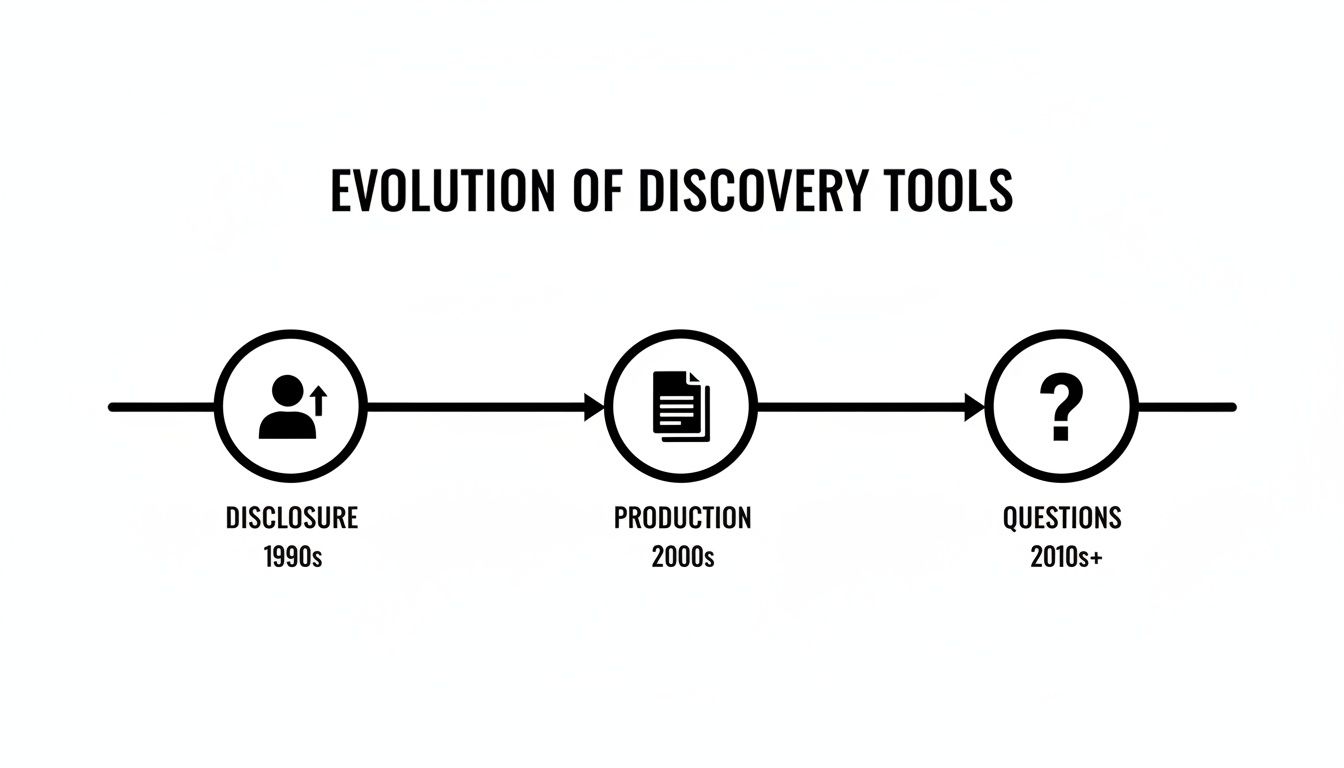
As you can see, the process is designed to be sequential, starting broad and then narrowing its focus to the specific facts and documents that are most important to your case.
What Happens If a Deadline Is Missed
So, what happens if your spouse ignores the 30-day deadline or provides incomplete answers? The Texas Rules of Civil Procedure provide your attorney with a powerful tool called a Motion to Compel. This is a formal request filed with the court, asking the judge to order your spouse to comply with the discovery request.
If a judge grants a Motion to Compel, they will set a new, firm deadline. Ignoring a court order to produce information can lead to serious penalties, known as sanctions, which we will discuss later.
This legal backstop is incredibly important. It ensures that one party cannot stall the entire process by refusing to follow the rules. It reinforces the core principle of discovery: both sides are entitled to the information needed to reach a fair resolution.
With projections showing that about 41% of first marriages may end in divorce in 2025, many involving complex financial or custody disputes, these timelines bring order to an emotionally charged process. Legal analysts have gathered more insights on these marriage statistics. The structured nature of discovery ensures that facts, not just emotions, guide the final outcome.
How to Handle Discovery Requests You Receive
Receiving a thick packet of discovery requests from your spouse’s attorney can feel overwhelming and invasive. This is often the moment the divorce feels intensely real and adversarial. It’s important to take a deep breath and remember that this is a standard part of the process. Knowing how to respond calmly and correctly is your best line of defense.
Your very first step should be to contact your attorney immediately. A 30-day clock starts ticking the moment those documents are received. Your legal team is there to help you understand what’s being asked, locate the necessary information, and develop a strategy for your responses.
Your Duty to Be Truthful and Thorough
When you answer discovery, you are under oath. This is a legal command, not just a suggestion to be honest. Providing false or misleading information can have severe consequences, including court sanctions and a complete loss of credibility with the judge.
It is equally important to be thorough. It can be tempting to provide partial answers, hoping the other side won’t notice what’s missing. This tactic rarely works and usually leads to more conflict and legal fees when the other side files a Motion to Compel. The most practical and effective approach is to work with your attorney to provide complete, accurate answers from the start.
Your Right to Make Objections
While you have a duty to be truthful, you do not have to answer every question asked. Texas law allows you to object to requests that are improper. Your attorney acts as your shield, protecting you from questions that are intrusive or legally out of bounds.
Here are some common objections:
- Irrelevant: The request has no bearing on the issues in your divorce. For example, a request for your high school transcripts is likely irrelevant to dividing your marital estate.
- Overly Broad or Unduly Burdensome: The request is so massive or vague that complying with it would be unreasonable. A classic example is a demand for “every email you’ve sent in the last ten years.”
- Seeks Privileged Information: The request asks for confidential communications, most commonly those between you and your attorney. This is known as the attorney-client privilege, and these communications are strongly protected from disclosure.
The Ongoing Duty to Supplement
Discovery is not a one-time event. The Texas Rules of Civil Procedure impose an ongoing duty to supplement your responses. This means if you later discover that an answer was incorrect or incomplete, or if new information becomes available, you must update your previous response.
For instance, if you receive an unexpected work bonus two months after answering questions about your income, you are legally required to supplement your response to include it. Keeping your information current maintains transparency and protects you from accusations of hiding information.
Juggling written questions and preparing for live testimony in a deposition can be stressful. To help you prepare, we’ve put together practical guidance on answering questions in a deposition that explains what to expect and how to remain calm under pressure.
Ultimately, handling discovery is a balancing act. You must be honest and provide what is required, but you also have the right to protect your privacy and push back against unreasonable demands. With an experienced family law attorney on your side, you can meet your legal obligations without feeling overwhelmed.
Using Discovery in Complex Divorce Cases

While discovery is a part of nearly every Texas divorce, its strategic power truly shines in complex cases. When you are dealing with significant assets, a family business, or a high-conflict custody battle, a meticulous discovery strategy is essential to protecting your future. It is often the only way to uncover hidden information and level what can feel like a very uneven playing field.
For many of our clients, discovery is the tool that makes a “just and right” property division possible. It’s how our attorneys methodically build a case based on hard evidence rather than relying on your spouse’s voluntary—and potentially incomplete—disclosures. The process is all about verification, ensuring every asset and debt is identified and accounted for.
Uncovering Hidden Assets and Financial Misconduct
One of the greatest fears in a high-asset divorce is that a spouse is hiding money. An experienced attorney uses discovery like a financial flashlight, shining a bright light into the dark corners of the marital estate you might not have even known existed.
Through carefully crafted Requests for Production and Interrogatories, we can demand years of financial records. This allows us to trace money trails, identify unusual transactions, and spot inconsistencies.
- Subpoenaing Third-Party Records: If your spouse is uncooperative, we don’t have to take their word for it. We can issue subpoenas directly to banks, credit card companies, and financial institutions to get records from the source.
- Analyzing Spending Habits: A detailed review of financial statements can reveal telling patterns, such as large sums of money being spent on undisclosed accounts or unexplained cash withdrawals that may point to hidden assets or the wasting of community funds.
- Following the Digital Trail: In today’s world, assets can exist as cryptocurrency or in other digital forms. Discovery can be used to request information about digital wallets and online trading accounts.
Think of it as a forensic investigation. By meticulously cross-referencing tax returns with bank statements and credit card bills, we can pinpoint discrepancies that demand an explanation. This is often how concealed assets are found.
Valuing a Family-Owned Business
When a family business is part of the marital estate, obtaining an accurate valuation is a critical challenge. The business-owning spouse may be tempted to downplay the company’s value to reduce the other spouse’s share. Discovery is the key to getting an honest, objective valuation.
We can request a wide range of financial documents to paint a complete picture of the business’s health:
- Profit and Loss Statements
- Balance Sheets and Tax Returns
- Shareholder Agreements and Client Lists
- Loan Applications and Bank Statements
This information is then provided to a forensic accountant or a business valuation expert. These specialists analyze the data to determine the true value of the business, including its goodwill. Our guide on using divorce discovery expert witnesses and subpoenas explains how critical these professionals are in complex cases. For matters this sensitive, ensuring the secure transmission of sensitive legal records is paramount to protecting everyone’s privacy.
Gathering Evidence in Contentious Custody Battles
Discovery is equally critical in a contentious custody dispute. A parent’s fitness and their ability to provide a safe, stable home are central to the court’s “best interest of the child” standard under the Texas Family Code. Discovery is how we gather the proof needed to show the court the reality of the situation.
We can request text messages, emails, and social media history that might reveal concerning behavior or instability. In some situations, a deposition is the ideal tool to question the other parent under oath about their parenting practices, work schedule, or any other issues that could impact the children.
Special Considerations for Military Divorces
Military divorces present unique challenges, particularly when dividing retirement benefits. Proper discovery is crucial for ensuring military pensions and other benefits are valued and divided correctly.
We use specific requests to obtain the service member’s Leave and Earning Statements (LES) and retirement point statements. These documents are essential for correctly calculating the community property share of military retired pay. Without this detailed discovery, a non-military spouse could easily be shortchanged on one of the most significant assets of the marriage.
When Your Spouse Will Not Cooperate with Discovery
One of the most frustrating aspects of a divorce is when your spouse refuses to play by the rules. What happens if they ignore discovery requests, hide documents, or provide vague, unhelpful answers? It can feel deeply unfair, but you are not without recourse. The Texas legal system has powerful tools designed specifically to handle this type of non-cooperation.
When your spouse misses a discovery deadline or provides incomplete responses, your attorney’s first step is typically to file a Motion to Compel. This is a formal request asking the judge to step in and order your spouse to comply. It officially notifies the court that your spouse is not cooperating and that you need judicial intervention to move the case forward.
Filing this motion usually results in a court hearing where your attorney will explain what was requested and how your spouse failed to respond properly. If the judge agrees that your requests were legitimate, they will sign a court order that compels your spouse to provide the information by a new, firm deadline.
The Power of Sanctions
Ignoring a direct court order is a serious mistake with real consequences. If your spouse still refuses to comply after a Motion to Compel is granted, your attorney can then file a Motion for Sanctions. This is where the court can impose penalties to punish the uncooperative behavior and compensate you for the wasted time and money.
Under the Texas Rules of Civil Procedure, judges have broad discretion in awarding sanctions. These penalties can include:
- Financial Penalties: The judge can order your spouse to pay the attorney’s fees you incurred to file the motions and attend the hearing.
- Exclusion of Evidence: The judge might rule that your spouse is prohibited from presenting any evidence at trial related to the information they refused to provide.
- Favorable Rulings: In more serious cases, the judge can make a legal ruling against them on a key issue—for example, by deeming a disputed asset to be your separate property.
The discovery process is built on a foundation of fairness. These legal remedies ensure that no one is above the rules. A spouse’s attempt to obstruct the process rarely succeeds and often ends up damaging their own case and credibility.
When dealing with high-value digital assets, it might also become necessary to explore strategies for cryptocurrency recovery if a spouse claims assets were suddenly “lost.” Obstruction like this can also be a red flag for other dishonest behavior. Our guide on spousal cyber spying can shed light on other potential issues that often surface in a contentious divorce.
Common Questions We Hear About Divorce Discovery
When you are going through a divorce, the discovery process can feel like learning a new language with its own set of confusing rules. It’s completely normal to have questions. Getting clear, practical answers can help you feel more in control.
Let’s walk through some of the most frequent questions we hear from clients to give you the clarity you need.
Can My Spouse Really Use My Social Media Posts in Our Divorce?
Absolutely. In a Texas divorce, anything you post on Facebook, Instagram, X (formerly Twitter), or any other platform can be considered fair game. If your posts, photos, or even “private” messages relate to issues like your parenting, spending habits, or social life, they can be requested in discovery and used as evidence.
Our practical guidance is always to be extremely cautious with your online activity as soon as divorce is a possibility. A single ill-advised post can create significant complications.
What’s This Discovery Process Going to Cost Me?
The cost of discovery can vary significantly based on the complexity of your case and the level of cooperation between you and your spouse.
If you and your spouse can exchange financial documents informally and transparently, the cost will be minimal. However, if your case involves multiple depositions, motions to compel, and subpoenas to third parties like banks and employers, the attorney’s fees will naturally be higher. One of the best ways to manage costs is to be organized and responsive—work with your attorney to gather your documents and answer questions as promptly as possible.
What if I Don’t Have a Document They’re Asking For?
This happens frequently. If you genuinely do not have a requested document, you simply need to state that truthfully in your sworn, written response.
The key legal term here is that the document is not in your possession, custody, or control. If you know where the document is located—for example, with your accountant or at your bank—your spouse’s attorney can then issue a subpoena directly to that third party to obtain it. The most important thing is to be honest.
We’re Having an Amicable Divorce. Do We Still Have to Do Discovery?
Yes, even in a straightforward, uncontested divorce, Texas law requires a fundamental level of discovery. Both you and your spouse have a legal duty to provide a full and honest disclosure of all your assets and liabilities.
In an amicable case, this is typically handled by completing and exchanging a sworn Inventory and Appraisement, which lists all community and separate property. While you may be able to skip more intensive tools like depositions, this foundational exchange of financial information is a non-negotiable step to ensure your divorce decree is fair, final, and legally sound.
If you need help navigating divorce, custody, or estate planning in Texas, contact The Law Office of Bryan Fagan today for a free consultation for tailored guidance.