
The moment often comes quietly. A late-night conversation at the kitchen table. A realization, after weeks or months of tension, that continuing the marriage as it is will only cause more harm than healing. For many Texas families, the hardest part isn’t deciding to divorce—it’s figuring out how to do it without tearing everything else apart. In those moments, understanding How to Create a Divorce Agreement becomes less about legal forms and more about preserving stability, dignity, and peace of mind for everyone involved.
At The Law Office of Bryan Fagan, PLLC, we have seen this moment play out countless times across Houston and surrounding communities. Parents walk through our doors carrying fear, guilt, and uncertainty, but also hope—hope that they can end a marriage responsibly and protect what matters most. Led by Bryan Joseph Fagan, a South Texas College of Law graduate and a recognized authority on Texas divorce and custody law, our firm brings decades of real-world experience navigating Texas Family Code requirements while never losing sight of the human side of divorce. Texas law, including Texas Family Code §153.002, centers every decision on the best interest of the child, but courts also expect parents to act thoughtfully, transparently, and fairly toward one another.
This article is designed to do exactly what our mission promises: empower you to reclaim freedom and peace of mind during one of life’s hardest transitions. You’ll learn how a properly crafted divorce agreement can reduce conflict, prevent future legal battles, and create a clear roadmap for life after divorce. Just as importantly, you’ll see how compassionate, informed planning—done the right way—can replace chaos with clarity and help families move forward with confidence.
If you’re standing at that kitchen table moment right now, unsure of your next step, this guide will walk with you. By the end, you’ll understand not just the legal mechanics of a Texas divorce agreement, but how intentional decisions today can protect your future and bring a sense of calm back into your life.
Key Takeaways
- A divorce agreement must address all issues—property division, debt allocation, child custody arrangements, child support, and spousal support—to be considered complete under Texas law
- Texas is a community property state, meaning marital property acquired during marriage is presumed jointly owned and must be divided fairly
- Generic divorce agreement templates frequently fail in Texas courts because they lack state-specific provisions required by the Texas Family Code
- Full financial disclosures are mandatory; incomplete or hidden information can invalidate your entire agreement and result in costly litigation
- Professional legal review significantly increases approval rates and prevents enforcement problems that cost thousands to fix later

Your Family’s Future Starts Here
Don’t navigate your legal journey alone. Schedule a consultation now and get the clarity and support you deserve.
What Is a Divorce Agreement?
A divorce agreement—commonly referred to in Texas as a marital settlement agreement—is a comprehensive written contract that allows spouses to resolve every legal issue connected to ending their marriage. This includes dividing property and debts under the “just and right” standard found in Texas Family Code §7.001, establishing parenting arrangements consistent with the child’s best interest under §153.002, calculating child support pursuant to Chapter 154, and determining whether spousal maintenance is appropriate under Chapter 8. While many people search online for How to Create a Divorce Agreement, Texas law requires far more than a fill-in-the-blank document. An enforceable agreement must be complete, tailored to your family’s circumstances, and compliant with current Texas statutes.
Once both spouses sign the agreement and a Texas judge approves it, the terms are incorporated into the Final Decree of Divorce and become a binding court order. At that point, the agreement carries the full force of the law. If one party fails to follow the terms—whether related to property transfers, child support, or possession schedules—the other spouse may pursue enforcement remedies available under the Texas Family Code. These remedies can include contempt proceedings, court-ordered compliance, or financial penalties, underscoring why careful drafting at the outset matters so much.
What truly distinguishes a marital settlement agreement from other divorce paperwork is its finality and its voluntary nature. Temporary orders govern behavior only while a divorce is pending, and a decree entered after trial reflects decisions imposed by a judge. By contrast, a divorce agreement reflects solutions the spouses themselves choose. Texas Family Code §6.602 governs these agreements in uncontested divorces and requires that they be entered into voluntarily and without coercion. Courts closely review them to ensure fairness, compliance with public policy, and adequate protection for children. For example, provisions that attempt to waive child support entirely or that are unconscionably one-sided are routinely rejected, even if both spouses initially agree.
From the perspective of seasoned Texas family law attorneys, properly executed divorce agreements resolve the vast majority of Texas divorces without the need for trial, saving families substantial time, expense, and emotional strain compared to contested litigation. That emphasis on education and informed decision-making is why our firm often encourages clients to understand how divorce agreements compare to other marital contracts. For a deeper explanation of how Texas courts evaluate voluntary marital agreements, you may find our discussion of common questions about Texas prenuptial and marital agreements helpful.
For families seeking clarity and peace of mind, working with experienced Texas divorce counsel can make the difference between an agreement that merely looks complete and one that truly protects your future. The team at the Law Office of Bryan Fagan, PLLC regularly helps clients move beyond generic templates by crafting agreements that align with both the Texas Family Code and the real-world needs of Texas families. If you would like additional guidance on what to expect as your case moves forward, our resource on the Texas divorce process offers practical insight to help you proceed with confidence.

When You Can Create a Divorce Agreement
Texas law allows couples to create divorce agreements in several situations, each with specific requirements and considerations.
Uncontested Divorces
The most straightforward scenario occurs when both spouses fully agree on all divorce terms from the beginning. Texas Family Code §6.602 establishes requirements for uncontested divorces, including a mandatory 60-day waiting period after filing. If your agreement addresses every issue and both parties agree, you may not need a contested hearing at all.
Contested Divorces That Settle
Many divorces begin with disagreement but reach resolution through negotiation or mediation before trial. Texas courts encourage Alternative Dispute Resolution under Texas Family Code Chapter 154, and mediation success rates exceed 70% in family courts according to state data. When parties agree through this process, their negotiated terms become their divorce settlement agreement.
Hybrid Situations
Some couples agree on certain issues—perhaps property division—while disputing others like child custody. In these cases, you can create partial agreements on resolved matters while allowing the court to decide remaining disputes.
Limitations on Agreements
Your divorce agreement cannot override Texas statutory requirements. The community property presumption under §3.003 applies unless you can prove certain assets are separate property through tracing. Child support guidelines in §154.125 establish minimum amounts based on the paying spouse’s net resources. Custody arrangements must serve the child’s best interest under §153.001. Agreements attempting to circumvent these protections will not survive judicial review.
Practical tip: If you and your spouse can communicate civilly and share basic information honestly, creating a divorce agreement saves substantial time and money compared to letting a court decide your family’s future.
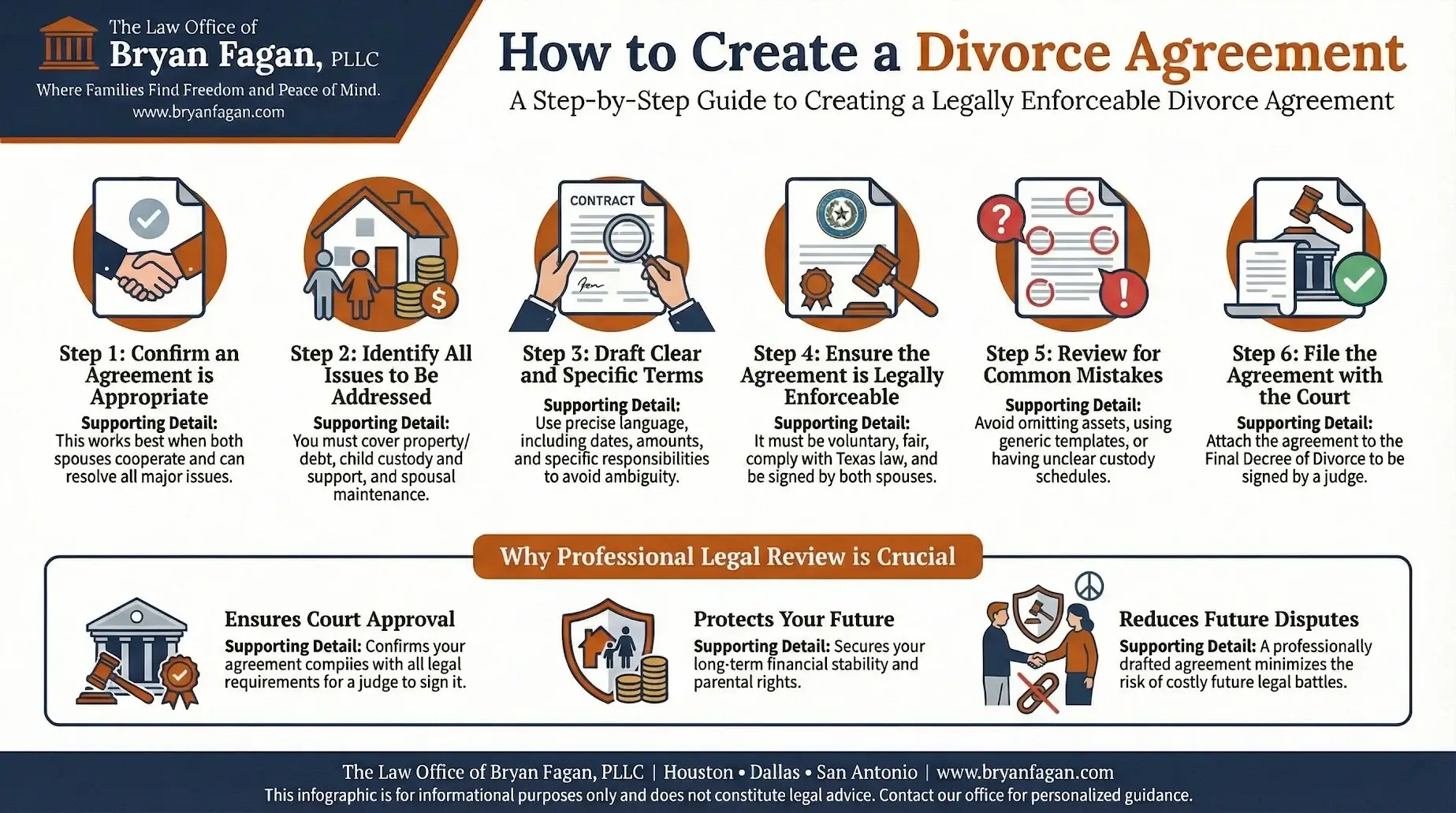
Step-by-Step Guide: How to Create a Divorce Agreement
Step 1: Identify All Issues That Must Be Resolved
Texas divorce agreements must address every issue related to ending a marriage because anything left unresolved will be decided by a judge under the “just and right” standard of Texas Family Code §7.001. When key details are missing, courts step in—and the outcome often surprises both spouses. This is why relying solely on How to Create a Divorce Agreement can be risky without understanding how Texas law actually works. A properly drafted agreement allows families to retain control over decisions instead of handing them to the court.
A complete divorce agreement should clearly divide all community and separate property, including real estate, bank accounts, retirement plans, vehicles, and investments, while also allocating responsibility for every marital debt. When children are involved, the agreement must establish conservatorship and possession arrangements consistent with Texas Family Code §§153.002 and 153.134, as well as child support and medical support obligations under Chapter 154. If spousal maintenance is an issue, eligibility and limits must comply with Chapter 8 of the Texas Family Code. Courts have repeatedly divided omitted assets equally when spouses fail to address them, as seen in cases such as Zisblatt v. Zisblatt, making thorough preparation essential.
From the perspective of seasoned Texas family law counsel, careful planning before negotiations begin is one of the most effective ways to avoid costly mistakes. Many of the same principles that apply to divorce agreements—voluntariness, fairness, and full disclosure—also apply to other marital contracts, such as those discussed in how to write a strong postnuptial agreement. Families looking for additional guidance may also find value in our overview of the Texas divorce process, which explains how thoughtful agreements can protect futures and provide peace of mind during a difficult transition.

Step 2: Gather Financial and Personal Information
Full financial disclosures form the foundation of any enforceable divorce agreement. Texas Rules of Civil Procedure 190-196 require sworn inventories detailing everything you own and owe.
Gather these important documents:
- Tax returns from the last three years
- Recent pay stubs and W-2 forms
- Bank account statements for all accounts
- Retirement account statements (401k, IRA, pension)
- Real estate deeds and recent appraisals
- Vehicle titles and loan documents
- Credit card statements showing current balances
- Mortgage statements
- Investment account records
- Business ownership documents if applicable
The average Texas household approaching divorce has approximately $150,000 in net worth requiring detailed valuation. Real estate appraisals typically cost $400-$600 but provide essential documentation for fair property division.
Consequences of incomplete disclosure are severe. In Jackson v. Jackson, courts sanctioned a spouse who hid assets, potentially striking pleadings entirely. Beyond legal penalties, undisclosed assets discovered later can invalidate your entire agreement and trigger expensive litigation.
Step 3: Agree on Fair and Legal Terms
As a community property state, Texas presumes all marital property acquired during marriage belongs equally to both spouses. However, you can negotiate divisions that deviate from 50/50 if both parties agree and the terms remain “just and right” under the law.
Property Considerations
You and your spouse must distinguish community property from separate property (assets owned before marriage, gifts, or inheritances). The parties agree on who receives specific items, with trade-offs creating overall fairness. For example, one spouse might keep the family home while the other spouse receives equivalent value in retirement accounts.
Child-Related Requirements
Texas Family Code Chapter 153 establishes strict requirements for custody and visitation arrangements. Your agreement must serve the child’s best interest, which courts evaluate using specific statutory factors. Child support follows guidelines: 20% of net resources for one child, scaling up to 40% for five or more minor children. The current maximum child support payment is approximately $1,800 per month based on the income cap.
Parenting plans should include specific possession schedules. The Standard Possession Order provides a framework: first, third, and fifth weekends, Thursday evenings, alternating holidays, and 30 days during summer. You can customize this schedule, but courts favor clarity over vague terms like “reasonable visitation.”
Spousal Support Limits
Texas spousal maintenance eligibility requires marriages lasting at least 10 years along with specific financial need criteria under §8.051. Payments are capped at $5,000 monthly or 20% of the paying spouse’s net resources, whichever is less. Duration typically ranges from 5-10 years depending on marriage length.
Step 4: Draft the Divorce Agreement in Writing
A divorce settlement agreement must be drafted with precise, unambiguous language so there is no confusion about who is responsible for what once the divorce is final. Every asset and every debt should be identified clearly and specifically. Vague statements like “one spouse gets the car” invite future disputes, while detailed provisions—listing the vehicle’s year, make, VIN, value, and timeline for transferring title—create clarity and enforceability. While some families begin with How to Create a Divorce Agreement, Texas courts expect agreements to reflect the level of detail required under current law, not generalized or fill-in-the-blank language.
Clear drafting extends beyond property. Each bank account should be identified by institution and account number, with specific dollar amounts assigned where possible. Temporary financial responsibilities during the transition period should also be spelled out to avoid confusion. Texas courts have repeatedly rejected agreements containing vague terms such as “reasonable visitation” or “shared expenses,” noting that ambiguity creates enforcement problems. In cases like Roberts v. Roberts, courts have voided provisions that failed to specify exact days, times, and amounts. Precision protects both parties and reduces the risk of costly post-divorce litigation.
Texas-specific requirements make careful drafting even more important. Parenting provisions must comply with Texas Family Code §153.134, including geographic restrictions and clear possession schedules. Child support calculations must follow Chapter 154, which now reflects the most recent statutory updates to guideline caps and medical support obligations. Retirement accounts require proper QDRO language, and property divisions must accurately reflect Texas community property principles under §7.001. Any spousal maintenance provisions must fall within the eligibility and duration limits of Chapter 8. Many of these same drafting principles also apply to other marital agreements, such as those discussed in what to include in a postnuptial agreement, where clarity and voluntariness are equally critical.
From the standpoint of experienced Texas family law counsel, careful attention to language is one of the simplest ways to protect your future. Notarization, while not always required, can further support enforceability by demonstrating voluntary execution. Families seeking additional guidance on structuring support obligations may also find value in our Texas child support resource, which explains how courts evaluate compliance with statutory guidelines. Thoughtful drafting does more than satisfy legal requirements—it helps families move forward with confidence, stability, and peace of mind.

Step 5: Review the Agreement for Legal Compliance
Texas judges must approve your divorce settlement agreement before it becomes enforceable. Courts review agreements for:
- Voluntariness: Neither spouse was forced or coerced into signing
- Fairness: Terms are not unconscionable or grossly one-sided
- Legal compliance: Provisions follow Texas Family Code requirements
- Public policy: Agreement doesn’t violate fundamental legal principles
Judges reject 5-10% of agreements at initial review according to Harris County district court statistics. Common rejection reasons include child support below guidelines without proper findings, custody arrangements that don’t serve children’s best interests, and property divisions that appear coerced.
Professional Legal Review
Having an experienced Texas family law attorney review your agreement identifies problems before filing. Attorneys catch issues like:
- Tax implications (alimony payments are no longer deductible post-2018)
- QDRO timing requirements for retirement account division
- Missing provisions required by local court rules
- Language that judges in your specific county find problematic
Agreements drafted or reviewed by legal counsel have 15-20% higher approval rates than those created without professional assistance.
Step 6: Incorporate the Agreement Into the Final Decree
After you and your spouse sign the marital settlement agreement, it must be incorporated into your final decree of divorce to become enforceable.
Filing Process
Submit your Original Petition for Divorce with the signed agreement attached. After the mandatory 60-day waiting period, schedule a prove-up hearing (sometimes called an uncontested hearing) where you present the agreement to the judge.
Court Procedures
At the hearing, the judge reviews your agreement and asks questions to confirm both parties understand and voluntarily accept all terms. The judge may ask whether you believe the division is fair and whether anyone pressured you into signing.
If approved, the judge signs the Final Decree of Divorce, which states the agreement is “approved and incorporated herein.” This language transforms your private contract into a court order under Texas Family Code §6.701.
Enforcement After Entry
Once incorporated, violations of your agreement constitute violations of a court order. Enforcement suits under Chapter 9 provide remedies including contempt findings, attorney fee awards, and potentially jail time for willful violations. This legal protection makes proper incorporation essential.
What Must Be Included in a Texas Divorce Agreement
Under Texas law, property division begins with the presumption that all assets acquired during the marriage are community property and belong to both spouses, regardless of whose name appears on a title or account. Texas Family Code §7.001 requires courts to divide community property in a manner that is “just and right,” making clarity in your divorce agreement essential. While some families look to How to Create a Divorce Agreement as a starting point, a legally sound agreement must clearly identify each asset and specify who receives what so the court does not step in and make those decisions for you.
A well-drafted agreement must also distinguish between community and separate property. Separate property generally includes assets owned before marriage, gifts received during the marriage, and inheritances, but those claims must be supported through proper tracing and documentation. Everything else acquired through either spouse’s efforts during the marriage is typically community property. These distinctions are especially important when real estate is involved. Your agreement should state whether the marital home will be sold, whether one spouse will buy out the other’s interest, or whether the home will be awarded to one spouse in exchange for other assets, along with provisions for executing special warranty deeds to complete the transfer. Additional guidance on how Texas courts approach these issues can be found in our overview of Texas property division laws.
Retirement accounts and personal property require the same level of care. Dividing retirement plans requires a Qualified Domestic Relations Order under Texas Family Code §7.003, which is a separate court order sent to the plan administrator after the divorce is finalized. Without proper QDRO language in your agreement, you risk losing your share of those benefits. Personal property should also be itemized in detail, identifying who receives furniture, vehicles, jewelry, electronics, and other valuables to prevent future disputes. Many of the same principles of planning and asset protection apply long before divorce, which is why some families explore agreements earlier in their relationships, as discussed in who needs a premarital agreement.
From the perspective of experienced Texas family law counsel, careful and detailed property division protects not only your financial future but also your peace of mind. When assets are clearly identified and properly divided in compliance with the Texas Family Code, families reduce the risk of post-divorce conflict and costly litigation. Thoughtful drafting allows you to move forward with confidence, knowing that what you built during your marriage has been addressed fairly and transparently.

Debt Allocation
Your agreement must assign responsibility for every joint debt. Simply agreeing that one spouse pays certain debts doesn’t release the other spouse from creditor claims if both names appear on the account.
Include indemnification language: “Husband shall pay the Visa account #5678 and shall indemnify and hold Wife harmless from any collection efforts, attorney fees, or damages resulting from his failure to pay.” This provides legal recourse if the responsible spouse defaults.
Address mortgages, car loans, credit cards, student loans, and any other obligations. Consider how refinancing might remove one spouse’s name from joint debts to provide complete protection.
Children (If Applicable)
Child-related provisions require particular care because courts retain authority to modify them based on children’s best interests.
Conservatorship
Texas law presumes Joint Managing Conservatorship unless evidence suggests otherwise. Your agreement should specify which parent has exclusive rights to determine primary residence, educational decisions, medical decisions, and other important matters. The non custodial parent typically retains equal rights to access school and medical records.
Possession and Access
Include a specific parenting time schedule. The Standard Possession Order under Texas Family Code §§153.3101-.317 provides geographic flexibility and detailed schedules. You can modify this template, but ensure your parenting plan covers regular weekends, weekday periods, holidays, summer possession, and procedures for exchanges.
Child Support
Calculate support using Texas guidelines. The child support worksheet determines amounts based on the paying spouse’s net monthly resources. Include provisions for:
- Monthly payment amounts and due dates
- Method of payment (wage withholding is standard)
- Duration (typically until age 18 or high school graduation)
- Health insurance coverage requirements
- Division of uninsured medical and dental expenses (usually 50/50)
Spousal Maintenance (If Applicable)
Texas spousal maintenance has strict eligibility requirements under §8.051. Qualifying factors include marriages lasting 10+ years combined with inability to meet minimum reasonable needs, disability, caring for a disabled child, or family violence.
Payment amounts cannot exceed $5,000 monthly or 20% of the paying spouse’s gross income. Duration depends on marriage length, typically capping at 5-10 years. Include provisions addressing modification, termination upon remarriage or cohabitation, and enforcement procedures.
Common Mistakes When Creating a Divorce Agreement
One of the most common pitfalls families encounter is relying on generic forms found online. While How to Create a Divorce Agreement may seem convenient, many of these documents fail to meet Texas-specific requirements under the Texas Family Code. They often omit mandatory geographic restrictions under §153.134, apply incorrect child support calculations contrary to Chapter 154, or lack proper community property language required by §7.001. Texas courts regularly reject these agreements, and rejection rates for generic templates can reach 40–50 percent, creating delays, added stress, and unnecessary legal expense.
Another frequent and costly mistake is failing to fully disclose or properly list all assets and debts. Forgetting to include an account, retirement plan, or loan does not make it disappear. Under Texas community property law, omitted assets may later be divided by the court, often equally, regardless of what either spouse intended. More serious still, intentionally hiding assets can constitute fraud and may allow a court to set aside parts of an agreement or impose sanctions. Precision matters just as much in language. Courts have consistently found that vague terms like “reasonable visitation” or “share expenses” are unenforceable, emphasizing that agreements must clearly spell out who is responsible for what, when obligations begin, and how much is owed.
Child support and retirement accounts are two areas where errors are especially damaging. Deviating from Texas child support guidelines requires specific findings to justify the departure, and agreements that simply list an unsupported amount are often rejected. Retirement plans, which are frequently among the largest marital assets, require careful handling and proper QDRO provisions under Texas Family Code §7.003. Ignoring these details can result in the permanent loss of retirement benefits. Families may also benefit from including dispute resolution provisions, such as mediation before litigation, because life changes are inevitable. Planning for future modifications can save substantial time and money, particularly when child support or possession schedules need adjustment.
From the standpoint of experienced Texas family law counsel, the cost of fixing mistakes after a divorce is almost always higher than getting it right the first time. Many families find themselves back in court within a few years due to poorly drafted agreements that could have been avoided with thoughtful planning. Similar principles of clarity and foresight apply to other marital agreements, including those discussed in amendments and revocations of postmarital agreements. For additional guidance on avoiding common pitfalls in support issues, our Texas child support resource offers practical insight into statutory requirements. Careful drafting protects not only your legal rights but also your peace of mind as you move forward.

Why Legal Guidance Matters
Understanding how to create a divorce agreement correctly from the start prevents costly problems later. An experienced Texas divorce attorney provides critical advantages:
Texas Family Code Compliance
Attorneys ensure every provision meets statutory requirements. They know which terms judges in your county routinely approve or reject, saving revision time and preventing delays.
Enforceable Language
Legal counsel drafts precise indemnity clauses, specific property descriptions, and clear custody terms that withstand future challenges. The difference between “Husband pays the mortgage” and properly drafted assumption language determines whether you have recourse if payments stop.
Financial and Parental Rights Protection
Attorneys identify issues you might miss—tax implications of asset transfers, pension valuation complexities, or custody provisions that inadvertently limit your rights. This protection proves especially valuable in high-asset divorces or complex custody situations.
Litigation Prevention
Properly drafted agreements prevent the disputes that lead to expensive post-divorce litigation. Unrepresented parties have 15-20% higher invalidation rates for their agreements, often discovering problems only after paying significant fees to fix them.
Why Choose the Law Office of Bryan Fagan PLLC
With more than two decades of experience guiding Texas families through divorce, the Law Office of Bryan Fagan, PLLC brings a deep understanding of both the legal process and the human realities that come with it. Our team works daily in courts across Harris County, Montgomery County, and surrounding areas, giving us firsthand insight into what local judges expect when reviewing divorce agreements under the Texas Family Code. That practical knowledge allows us to help families avoid unnecessary delays and ensure their agreements meet the fairness and voluntariness standards required by Texas Family Code §6.602 and the property division principles outlined in §7.001.
Our attorneys are particularly skilled in drafting clear, enforceable divorce agreements for complex situations, including high-asset estates, multiple retirement accounts requiring QDROs under §7.003, and cases involving detailed asset tracing. We also approach custody and possession issues with care and intention, always mindful that Texas Family Code §153.002 places the child’s best interest at the center of every decision. While some families initially explore How to Create a Divorce Agreement, we regularly see how customized drafting tailored to Texas law and a family’s specific needs provides far greater long-term protection.
Accessibility is a core part of our mission. We offer cost-effective options for uncontested and mediated divorces, often at a fraction of the cost of contested litigation, while still providing the legal safeguards that prevent future disputes. Thoughtful planning at the agreement stage can reduce the likelihood of enforcement actions or modifications later, saving families both emotional strain and financial resources. For those who want a clearer picture of how their case may unfold, our overview of the divorce process explains each stage in plain language and helps families know what to expect.
Above all, our firm believes that efficient, well-crafted resolutions help families reclaim stability and peace of mind during one of life’s most difficult transitions. Through compassionate counsel, precise legal drafting, and ongoing education, we support clients in making informed decisions that protect their futures. Whether preparing a divorce agreement, guiding an uncontested divorce, or addressing custody and child support concerns, our goal remains the same: to educate families and help them move forward with confidence.
Actionable Checklist: How to Create a Divorce Agreement
Use this checklist to guide your divorce settlement agreement process:
☐ Confirm uncontested or settled status: Verify both spouses agree on major issues or have reached settlement through negotiation or mediation
☐ Identify all assets and debts: Create comprehensive lists of everything owned and owed, including bank accounts, real property, vehicles, retirement plans, credit cards, and loans
☐ Address child-related terms: If you have minor children, establish conservatorship, possession schedules, child support amounts, and medical support provisions following Texas Family Code requirements
☐ Draft Texas-compliant agreement language: Use specific, unambiguous terms that address every asset and debt individually while following Texas community property and support guidelines
☐ Review with a Texas divorce attorney: Have legal counsel examine your agreement for compliance issues, missing provisions, and enforceability concerns before filing
☐ Incorporate into Final Decree: File the agreement with your divorce petition, complete the 60-day waiting period, and present the agreement at your prove-up hearing for judicial approval
Conclusion
Divorce is never just a legal event—it’s a turning point. The way you handle it can either prolong stress and uncertainty or create a sense of direction and relief that carries you forward. A thoughtfully prepared divorce agreement gives you something many families crave during this process: clarity. It replaces guesswork with structure, reduces conflict before it has a chance to grow, and allows everyone involved to begin the next chapter with fewer loose ends and fewer “what ifs.”
At The Law Office of Bryan Fagan, PLLC, we believe families deserve more than forms and fine print. They deserve guidance that is practical, compassionate, and grounded in real experience with Texas courts and real families. Working with an experienced Texas family law attorney helps ensure that the decisions you make today don’t become problems you’re forced to revisit tomorrow. Sometimes the most empowering step isn’t doing everything alone—it’s knowing when to ask for help.
If you’re considering divorce or already in the middle of it, take a moment to think about what peace of mind would look like for you six months from now. Fewer unanswered questions? Clear expectations? A plan you can rely on? Those outcomes are possible with the right approach and the right support. When you’re ready to talk through your options, our team is here to listen, educate, and help you move forward with confidence—no pressure, just clarity and honest guidance.
Frequently Asked Questions About Divorce Agreements
The 10-10-10 rule is not a legal rule in Texas but a mindset tool many people use when making big decisions during divorce. It asks you to consider how a decision will affect you in 10 days, 10 months, and 10 years. When creating a divorce agreement, this perspective can help you move past short-term emotions and focus on long-term stability, especially when decisions involve property division, custody, or financial support.
One of the biggest mistakes people make during a divorce is allowing emotions to drive permanent decisions. Anger, fear, or guilt can lead to agreements that feel satisfying in the moment but create serious problems later. In Texas, many divorce terms—especially property division—are difficult or impossible to change once finalized, which is why careful planning and legal guidance matter.
Texas does not recognize legal separation in the same way some states do. While spouses can create written agreements addressing finances or parenting while a divorce is pending, those agreements must comply with Texas law to be enforceable. A self-drafted agreement that overlooks legal requirements may not protect you if a dispute arises.
The “3 C’s” are commonly described as communication, cooperation, and compromise. These principles are especially important when negotiating a divorce agreement. Clear communication reduces misunderstandings, cooperation keeps costs down, and compromise helps both sides reach workable solutions without prolonged court battles.
Moving out of the marital home is not always a mistake, but doing so without legal advice can create unintended consequences. In custody cases, it can affect possession schedules and establish a new routine that influences court decisions. It may also limit access to property or documents. Before moving out, it’s wise to understand how the decision could affect your rights.
There is no universal answer. Divorce often increases expenses for both spouses because one household becomes two. In Texas, courts divide community property in a way they consider “just and right,” which may or may not be equal. Financial outcomes depend on income, debt, assets, and the quality of the divorce agreement itself.
Separate property generally cannot be awarded to the other spouse in a Texas divorce. This may include assets owned before marriage, inheritances, and certain gifts—if they can be properly traced and documented. Problems arise when separate and community funds are mixed, which can make some assets partially divisible.
Many people reference relationship research identifying criticism, contempt, defensiveness, and stonewalling as common destructive patterns. While not a legal standard, these behaviors often show up during divorce negotiations as well. Reducing conflict and improving communication can make reaching a fair divorce agreement far more achievable.
The 7-7-7 rule is a popular relationship concept that encourages couples to reconnect regularly: a date every 7 days, a short trip every 7 weeks, and a longer vacation every 7 months. While not legally relevant, it highlights how disconnection can lead to bigger issues. During divorce, maintaining respectful communication remains important—especially when children or shared finances are involved.