
The moment usually doesn’t happen in a courtroom. It happens in a quiet kitchen, late at night, when the house is finally still and the weight of the future settles in. A parent stares at their phone, rereading a text from the other side—another disagreement, another reminder that life is about to change. In that moment, the question isn’t about winning or losing. It’s about control, safety, and peace of mind. For many Texas parents, that question quickly becomes Joint Custody vs Sole Custody Texas, and the answer can shape daily life for years to come.
At The Law Office of Bryan Fagan, PLLC, we’ve walked alongside thousands of families facing this exact crossroads. Founded by Bryan Joseph Fagan, a South Texas College of Law graduate and a recognized authority on Texas divorce and custody law, our firm understands that custody decisions are deeply personal long before they are legal. Texas courts are guided by the “best interest of the child” standard under Texas Family Code §153.002, but behind that legal language are real concerns—Who will make medical decisions? Who sets boundaries? Who has the authority to act when the other parent disagrees?
This article is here to replace confusion with clarity. As you continue reading, you’ll learn how Texas law defines joint and sole custody, how judges decide between them, and why these decisions often determine a family’s sense of stability long after the divorce is final. Our goal is not just to explain the law, but to help you reclaim confidence and peace of mind by understanding your options—so you can move forward knowing you’re protecting what matters most.
Key Takeaways
- Texas law uses “conservatorship” rather than “custody”—Joint Managing Conservatorship means shared decision-making, while Sole Managing Conservatorship grants one parent exclusive authority over major decisions
- Joint custody does not automatically mean 50/50 parenting time; one parent typically has the exclusive right to designate the child’s primary residence
- Courts determine custody based on the best interests of the child standard, considering factors like parental stability, co-parenting ability, and any history of family violence or substance abuse
- Child support calculations depend on income and actual parenting time, not simply on whether custody is joint or sole
- Custody orders can be modified when material and substantial changes in circumstances occur

Your Family’s Future Starts Here
Don’t navigate your legal journey alone. Schedule a consultation now and get the clarity and support you deserve.
How Texas Law Defines Child Custody
Texas approaches custody differently than most states. The word “custody” does not appear in Texas statutes. Instead, the Texas Family Code organizes parental authority into three distinct components: conservatorship, possession, and access.
Conservatorship refers to decision-making authority over major aspects of your child’s life—education, healthcare, religious upbringing, and similar significant matters. Possession describes the physical time each parent spends with the child. Access encompasses visitation rights and the ability to maintain contact with your child.
This distinction matters because many parents assume custody decisions determine only where the child lives. In reality, determining child custody in Texas requires addressing both who makes major decisions and how parenting time is divided.
The foundational principle guiding every custody decision is the best interest of the child standard under Texas Family Code § 153.002. Courts evaluate each parent’s ability to meet the child’s physical, psychological, and emotional needs. No single factor controls the outcome—judges examine the complete picture of each family’s circumstances to reach decisions that protect the child’s welfare.
What Is Joint Custody in Texas?
In Texas, what many parents refer to as “joint custody” is legally defined as Joint Managing Conservatorship, a concept that lies at the center of many Joint Custody vs Sole Custody Texas discussions. Under this arrangement, both parents share the rights and duties of raising their child, even when the child primarily resides with one parent. Texas courts evaluate these cases using the “best interest of the child” standard set out in Texas Family Code §153.002, which continues to guide custody decisions statewide. As a starting point, judges generally presume that shared parental involvement benefits children, placing the burden on the parent seeking sole custody to demonstrate why joint decision-making would not be appropriate under the family’s specific circumstances.
This presumption is reflected throughout Chapter 153 of the Texas Family Code, including §§153.131 and 153.134, which explain how courts structure conservatorship and possession orders. Texas Family Code §153.132 further outlines the rights commonly held by joint managing conservators, such as receiving information about a child’s health, education, and general welfare, consulting with physicians and mental health professionals, and participating in major decisions that affect the child’s life. These provisions are intended to keep both parents meaningfully involved while giving courts flexibility to assign certain rights exclusively when needed to protect a child’s stability and safety. For parents who want a clearer understanding of when and why Texas courts depart from joint custody, our in-depth resource on navigating sole custody definitions in Texas law provides helpful legal context and practical insight.
In most Joint Managing Conservatorship arrangements, one parent is named the primary joint managing conservator and receives the exclusive right to determine the child’s primary residence, while the other parent is designated as a possessory conservator with court-ordered parenting time. Even so, both parents typically retain authority over major decisions unless the court assigns specific rights to one parent under Texas Family Code §153.134. At our Houston-based family law firm, we regularly guide parents through these distinctions, helping them understand how custody orders function beyond the legal language. If you are exploring how possession schedules and conservatorship work together, you may also find our guide on Texas child custody and possession orders useful as you evaluate your options and plan for your family’s future.

Common Misconceptions About Joint Custody
Joint custody doesn’t mean equal parenting time. Many parents assume joint managing conservatorship automatically creates a 50/50 possession schedule. This is incorrect. Most Texas courts apply the Standard Possession Order or Expanded Standard Possession Order, which typically allocates parenting time approximately 60/40 or 70/30. The joint custody designation reflects shared legal custody and decision-making authority—not necessarily equal physical custody.
Parents don’t need to agree on every decision. Joint managing conservators must consult and agree on major decisions about education, medical care, and religious upbringing. However, day-to-day parenting decisions—bedtime, meals, activities, household rules—fall within each parent’s authority during their parenting time. You don’t need your co-parent’s permission to choose what your child eats for dinner or which friends they play with during your possession periods.
Consider this practical scenario: Jennifer and Mark share joint managing conservatorship of their daughter Emma. Jennifer has the exclusive right to designate Emma’s primary residence, and Emma lives with her most weeknights. Mark sees Emma on alternating weekends, Thursday evenings, and during extended holiday periods. Both parents must agree on which school Emma attends and major medical decisions, but each parent makes routine parenting choices during their own time.
What Is Sole Custody in Texas?
In Joint Custody vs Sole Custody Texas matters, what many parents call “sole custody” is legally defined as Sole Managing Conservatorship. Under this arrangement, one parent is granted exclusive decision-making authority over major aspects of the child’s life, including education, medical care, and, when applicable, religious upbringing. Texas Family Code §§153.131 and 153.134 authorize courts to assign these rights exclusively when doing so better protects the child’s welfare. The sole managing conservator does not need to obtain agreement from the other parent before making these significant decisions, which can provide clarity and consistency in families where shared authority has proven unworkable.
Unlike joint managing conservatorship, which Texas courts often begin with as a presumption, sole managing conservatorship requires a higher evidentiary showing. Texas Family Code §153.002 establishes that the child’s best interest controls every custody decision, and the parent seeking sole custody bears the burden of demonstrating that shared parental authority would not serve that standard. Courts carefully examine the facts presented, including safety concerns, stability, and each parent’s ability to meet the child’s needs, before limiting one parent’s decision-making role. Parents looking for a deeper explanation of how Texas courts apply this analysis may find our detailed discussion on more information on sole custody in Texas helpful.
It is also important to understand what sole managing conservatorship does not automatically mean. While it concentrates decision-making authority with one parent, it does not necessarily eliminate the other parent’s right to spend time with the child. Under Texas Family Code §153.001 and related provisions, courts generally encourage a continuing parent-child relationship unless there are serious safety concerns that justify restricted or supervised visitation. At our Houston-based family law practice, we often help parents navigate these distinctions, ensuring they understand both the legal authority involved and the practical realities of custody orders. For additional context on how conservatorship and visitation work together, you may also want to review our overview of Texas child custody laws as you consider the best path forward for your family.
When Sole Custody Is More Likely
In Joint Custody vs Sole Custody Texas cases, Texas courts may appoint one parent as a sole managing conservator when the evidence shows that shared decision-making would place the child’s safety, stability, or well-being at risk. While Texas law generally favors continued involvement from both parents, the guiding principle remains the child’s best interest under Texas Family Code §153.002. When circumstances undermine that goal, judges have the authority under Texas Family Code §153.131 to limit decision-making rights in order to protect the child and reduce harmful conflict.
One of the most significant factors leading to sole managing conservatorship is a history of family violence or abuse. Texas Family Code §153.004 directs courts to consider evidence of domestic violence, child abuse, or neglect when determining conservatorship, and it can override the usual presumption in favor of joint custody. Similarly, substance abuse issues—particularly those that impair a parent’s ability to provide safe and consistent care—may justify awarding sole custody to the more stable parent. Courts also closely examine situations involving neglect or endangerment, where a parent has failed to meet a child’s basic needs or exposed the child to unsafe environments, as these patterns often demonstrate that shared authority is not workable.
Judges may also restrict conservatorship rights when a parent has been largely absent from the child’s life or is unable to parent due to incarceration or ongoing instability. In these cases, the court may determine that limiting decision-making authority better supports the child’s emotional and physical security. Severe and ongoing parental conflict can also play a role. When parents show a complete inability to communicate or cooperate, courts may conclude that sole custody reduces stress on the child more effectively than forcing collaboration that consistently leads to turmoil. For a deeper explanation of how Texas law defines and applies these standards, our firm’s resource on what sole custody means under Texas law provides additional insight grounded in current statutes and courtroom practice.
At our Houston-based family law practice, we help parents understand that these decisions are never about punishment or “winning,” but about creating a structure that allows children to thrive. Whether you are concerned about safety, long-term stability, or reducing conflict, working with experienced Texas family law counsel can clarify how courts apply the Texas Family Code to real-life situations. You may also find our discussion on Texas child custody laws and conservatorship helpful as you consider how different custody arrangements align with your family’s needs and your child’s future.

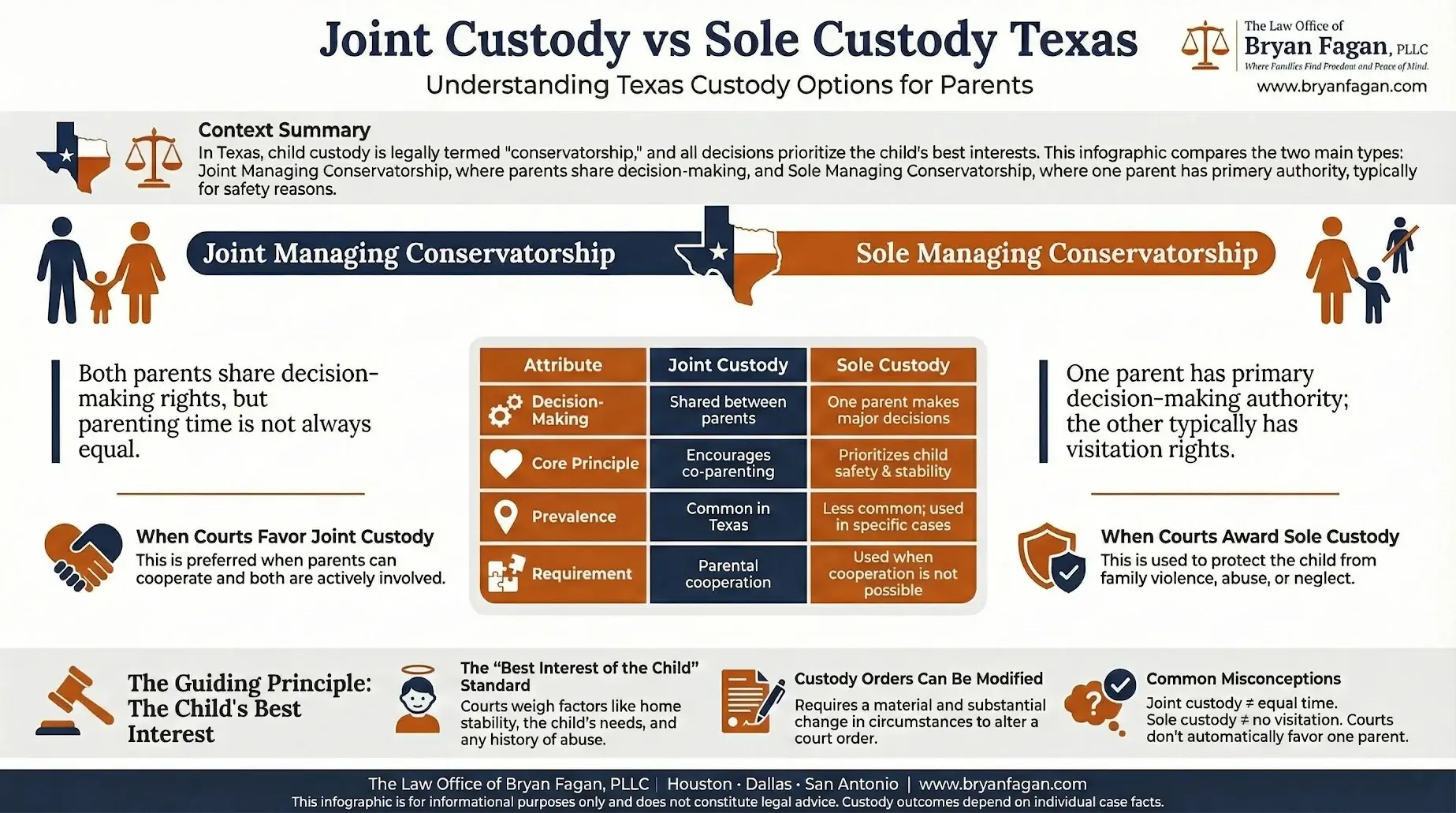
Joint Custody vs Sole Custody Texas: Key Differences
Understanding the practical differences between these custody arrangements helps you evaluate which approach serves your child’s needs.
| Factor | Joint Managing Conservatorship | Sole Managing Conservatorship |
|---|---|---|
| Decision-Making Authority | Both parents share equal authority over major decisions | One parent has exclusive authority |
| Consultation Required | Yes—parents must confer on education, healthcare, religious upbringing | No—sole conservator decides independently |
| Primary Residence | Usually one parent has exclusive right to designate | Sole conservator determines residence |
| Parenting Time | Follows Standard or Expanded Standard Possession Order | Non-custodial parent may have visitation rights |
| Child Support | May still apply based on income and time allocation | Calculated based on income and parenting time |
| Court Involvement | Lower for decision disputes if parents cooperate | Lower for decisions, potentially higher for modifications |
The fundamental difference concerns authority over your child’s upbringing. Under joint legal custody arrangements, neither parent can unilaterally decide which school your child attends, whether they receive certain medical treatments, or how they’re raised religiously. Under sole legal custody, the managing conservator makes these decisions without requiring the other parent’s agreement.
Custody type affects authority—not just time with the child. A parent with sole physical custody but limited legal rights faces different challenges than a parent with full legal authority but reduced possession time.
Factors Texas Courts Consider When Choosing Between Joint and Sole Custody
When courts are deciding Joint Custody vs Sole Custody Texas cases, they are required to look far beyond surface-level arguments and focus on the child’s overall well-being. Texas Family Code §153.002 makes clear that the best interest of the child is always the court’s primary consideration, and no single factor determines the outcome. Instead, judges evaluate the full context of a child’s life, weighing how each parent’s circumstances and behavior affect stability, safety, and long-term development.
One of the most important considerations is each parent’s ability to consistently prioritize the child’s needs above personal conflict. Courts closely observe whether a parent demonstrates emotional maturity, sound judgment, and a willingness to make decisions centered on the child rather than on winning disputes with the other parent. Alongside this, judges assess the stability of each parent’s home environment, including housing consistency, work schedules, and daily routines. Texas courts recognize that children benefit from predictability, and stable living conditions often support healthier emotional and developmental outcomes.
A parent’s history of caregiving also carries significant weight. Judges look at who has handled day-to-day responsibilities such as medical appointments, school involvement, and maintaining the parent-child bond. Established caregiving patterns often signal which parent can best meet the child’s ongoing needs. Equally important is the willingness to co-parent effectively. Under Texas Family Code §§153.131 and 153.134, joint managing conservatorship depends on the ability to communicate and collaborate. Parents who can set aside personal disagreements and work together responsibly are more likely to support a joint custody arrangement.
Safety-related concerns can shift the analysis entirely. Any history of family violence, neglect, or substance abuse is taken very seriously under Texas Family Code §153.004 and frequently leads courts to limit or concentrate decision-making authority with the safer parent. In appropriate cases, courts may also consider a child’s stated preference if the child is 12 years of age or older, as allowed by Texas Family Code §153.009, though judges retain discretion and do not automatically follow the child’s wishes if they appear influenced or contrary to the child’s best interests. Geographic proximity between parents is another practical factor, as distance affects parenting schedules and determines whether the Standard or Expanded Standard Possession Order applies.
At our Houston-area family law firm, we help parents understand how these factors interact in real custody cases and how courts balance them when deciding conservatorship. Families seeking more detailed guidance on situations where sole custody may be appropriate often benefit from reviewing resources like sole conservatorship lawyers in Houston, Texas, which explains how Texas law approaches concentrated decision-making authority. You may also find our broader overview of Texas child custody laws helpful as you consider how these legal standards apply to your family’s unique circumstances.
How Child Support Is Affected by Custody Type
Many parents misunderstand the relationship between custody labels and child support obligations. Here’s what you need to know:
Child support is calculated based on income and parenting arrangement—not custody type. Texas child support guidelines examine the obligor’s net monthly income and the percentage of parenting time. Whether you hold joint or sole conservatorship doesn’t determine support amounts; actual income and time allocation do.
Joint custody does not eliminate child support. Even when both parents are joint managing conservators, if one parent earns substantially more or has significantly less parenting time, that parent typically owes monthly support. Shared decision-making authority exists separately from financial support obligations.
Sole custody does not automatically mean higher support. A sole managing conservator doesn’t automatically receive maximum child support. If the non-custodial parent has substantial parenting time (35% or more), support calculations adjust accordingly.
Consider this example: David and Sarah share joint managing conservatorship, with Sarah designated as primary conservator. David earns $8,000 monthly; Sarah earns $4,000. Despite their equal legal custody status, David pays child support calculated under Texas guidelines based on his income and his parenting time percentage.
Common Myths About Joint Custody vs Sole Custody Texas
When parents are weighing Joint Custody vs Sole Custody Texas, misconceptions can add unnecessary fear and confusion to an already emotional process. At our Houston-based family law practice, we regularly see families make decisions based on myths rather than the realities of Texas law. The Texas Family Code is clear that custody determinations are not about outdated assumptions or parental labels, but about what arrangement best serves a child’s safety, stability, and long-term well-being under the best interest standard set out in Texas Family Code §153.002.
One common misunderstanding is the belief that mothers automatically receive sole custody. Texas law expressly rejects any gender-based preference in conservatorship decisions. Under Texas Family Code §§153.131 and 153.134, courts evaluate each parent on their individual merits, including caregiving history, stability, judgment, and ability to meet the child’s needs. Fathers are regularly appointed as primary or sole managing conservators when the evidence supports that outcome, reinforcing that parental fitness—not gender—drives these decisions.
Another persistent myth is that joint custody eliminates child support obligations. In reality, conservatorship and child support are governed by different sections of the Texas Family Code. Even when parents share joint managing conservatorship, child support may still be ordered based on income disparity and parenting time under the state’s child support guidelines. Parents seeking clarity on how conservatorship authority differs from financial responsibility often benefit from reviewing resources like Texas sole managing conservatorship explained, which breaks down how these roles function in practice.
Parents are also frequently surprised to learn that sole custody does not automatically mean the other parent loses visitation rights. Sole managing conservatorship primarily addresses decision-making authority, not access. Unless there are serious safety concerns such as abuse, neglect, or endangerment under Texas Family Code §153.004, courts typically preserve a meaningful parent-child relationship through possession and access orders. Our firm often encourages families to review educational materials like our guide on Texas child custody and conservatorship laws to better understand how courts balance parental rights with a child’s need for consistent relationships.
At The Law Office of Bryan Fagan, PLLC, we believe that replacing myths with accurate, compassionate education empowers parents to make decisions with confidence instead of fear. By understanding how Texas courts actually apply the Family Code, families can move forward with greater clarity, knowing that custody outcomes are shaped by evidence, stability, and a genuine focus on what protects their children’s futures.

Modifying Custody Orders in Texas
Custody orders are not permanent. Under Texas Family Code § 156.101, either parent may seek modification if there has been a material and substantial change in circumstances since the order was entered.
Courts require significant change—minor variations don’t justify modification. The parent seeking modification bears the burden of demonstrating that material changes have occurred and that modification serves the child’s best interests.
Examples of qualifying changes include:
- A parent’s relocation affecting the existing arrangement’s viability
- Development of substance abuse problems
- Documented parental alienation attempts
- Improvements in a previously unfit parent’s circumstances
- Changes in the child’s special needs
- Incarceration of the custodial parent
- The child’s expressed preference (if age appropriate)
Even when material change is established, the court order modification must serve the child’s best interests. Courts don’t automatically grant modifications simply because circumstances have changed.
How a Texas Child Custody Attorney Helps
Navigating child custody issues without experienced legal representation puts your parental rights at risk. A skilled Texas child custody attorney provides essential guidance:
Evaluates whether joint or sole custody is appropriate for your situation. An attorney assesses your family’s specific circumstances, considering the child’s needs, each parent’s capacity, and any safety concerns to develop a strategic approach.
Prepares evidence and comprehensive parenting plans. Effective custody advocacy requires organized documentation of caregiving history, parental involvement, and any factors supporting your position.
Advocates for parental rights in court proceedings. Whether negotiating settlements or presenting your case before a judge, experienced representation protects your interests while focusing on your child’s welfare.
Navigates complex court procedures and negotiations. Texas Family Code requirements and court procedures create potential pitfalls for unrepresented parents. An attorney handles procedural complexities while you focus on your family.
Protects the child’s long-term interests throughout the process. Strategic legal guidance ensures custody arrangements serve your child’s stability and well-being, not just immediate concerns.
Why Choose the Law Office of Bryan Fagan PLLC
When families are facing Joint Custody vs Sole Custody Texas decisions, working with a legal team that understands both the law and the human impact of those choices can make a meaningful difference. At our Houston-based family law firm, attorneys draw on extensive experience applying the Texas Family Code to real-world custody disputes, including the conservatorship standards set out in Texas Family Code §§153.002, 153.131, and 153.134. This depth of knowledge allows us to anticipate how judges evaluate shared versus exclusive decision-making authority and to guide parents toward strategies that align with the child’s best interests under current Texas law.
Rather than offering one-size-fits-all advice, the team focuses on child-centered, practical solutions tailored to each family’s unique circumstances. Clear communication and compassionate guidance are central to that approach, especially during emotionally charged moments in the divorce or custody process. By helping parents understand what the law requires and what courts realistically look for, our attorneys work to reduce uncertainty and empower families to make informed decisions. Parents who want a broader understanding of how custody fits into the overall legal journey may also find our resource on the Texas divorce process explained helpful as they navigate the steps ahead.
The firm represents mothers, fathers, and non-parent caregivers seeking custody or conservatorship rights, always with the goal of protecting children’s stability and long-term well-being. Whether advocating for joint managing conservatorship or sole managing conservatorship, the focus remains on solutions that genuinely serve a child’s best interests, not just short-term outcomes. For additional insight into how Texas courts approach custody issues, readers may also benefit from reviewing our overview of Texas child custody laws, which explains how conservatorship, possession, and access work together under the Texas Family Code.

Deciding Between Joint Custody vs Sole Custody Texas: Action Checklist
Use this checklist to prepare for custody decisions:
- [ ] Understand Texas custody terminology: Learn the difference between conservatorship, possession, and access
- [ ] Evaluate co-parenting ability honestly: Assess whether you and the other parent can communicate effectively about your child’s needs
- [ ] Consider your child’s needs and stability: Think about which arrangement best supports your child’s physical and emotional well-being
- [ ] Document caregiving history thoroughly: Gather evidence of your involvement in your child’s daily care, education, and medical needs
- [ ] Follow all existing court orders: Compliance demonstrates responsibility and respect for legal processes
- [ ] Consult an experienced Texas child custody attorney: Professional guidance helps you understand your options and develop effective strategy
Conclusion
Choosing between joint custody and sole custody isn’t really about legal labels—it’s about deciding what kind of daily life your child will wake up to once the dust settles. Texas law gives families structure, but it doesn’t live in your home or sit at your kitchen table. You do. The most successful custody arrangements are the ones that balance legal clarity with real-life needs, allowing children to feel safe, supported, and grounded even as family dynamics change.
If there’s one takeaway worth holding onto, it’s this: custody decisions don’t have to feel overwhelming or adversarial. With the right information and guidance, they can become a path toward stability rather than stress. Understanding how Texas courts approach joint and sole custody empowers you to make choices rooted in confidence instead of fear—and that alone can change the tone of the entire process.
If you’re standing at that crossroads and unsure which direction makes sense for your family, speaking with an experienced Texas family law attorney can bring immediate clarity. The Law Office of Bryan Fagan, PLLC exists to educate, guide, and advocate—so you don’t have to navigate these decisions alone. Sometimes the next right step isn’t having all the answers, but knowing who to call when the questions start keeping you up at night.
Frequently Asked Questions About Joint Custody vs Sole Custody in Texas
In Texas, the legal terms are Joint Managing Conservatorship and Sole Managing Conservatorship. Joint custody means both parents share decision-making authority over major issues such as education, healthcare, and psychological treatment. Sole custody gives one parent the exclusive right to make those major decisions. Importantly, either arrangement can still include visitation rights for the other parent, depending on what the court believes is in the child’s best interest.
Joint custody requires cooperation. When parents struggle to communicate, shared decision-making can turn routine issues into ongoing conflict. Disagreements over schedules, medical care, or discipline can create stress for children and lead to repeated court involvement. Joint custody works best when parents can separate personal conflict from parenting responsibilities.
To obtain sole custody, a parent generally must show that joint decision-making would not serve the child’s best interests. This often requires credible, documented evidence such as police reports, protective orders, medical or counseling records, school documentation, CPS involvement, or witness testimony. Courts look for patterns that demonstrate risk, instability, or harm—not isolated incidents.
One of the most damaging mistakes is focusing on attacking the other parent instead of demonstrating your own stability and parenting strengths. Judges want to see maturity, reliability, and child-focused decision-making. Emotional texts, social media posts, refusal to follow court orders, or involving children in adult conflict can quickly undermine credibility in court.
While sole custody can reduce conflict over decision-making, it can also place significant responsibility on one parent and increase tension with the other. In some cases, it may lead to future legal disputes if circumstances change. Texas courts generally prefer healthy involvement from both parents when it is safe, which is why sole custody is typically reserved for situations where it clearly benefits the child.
Sole custody can be challenging to obtain because Texas law starts with the presumption that shared parental involvement is in a child’s best interest. To overcome that presumption, a parent must present strong evidence showing that joint custody would be harmful or unworkable. Each case is highly fact-specific, and outcomes depend on evidence, credibility, and the child’s needs.
Courts often react negatively to behaviors that suggest poor judgment or instability. This can include missing visitation, refusing to follow court orders, substance abuse, hostile communication, posting about the case online, or exposing children to parental conflict. Judges tend to trust the parent who appears calm, cooperative, and focused on the child’s daily well-being.
Texas courts do not favor mothers or fathers. Custody decisions are based on the child’s best interest, including each parent’s caregiving history, stability, ability to meet the child’s needs, and willingness to support a healthy relationship with the other parent when appropriate. The parent who demonstrates consistency and child-centered planning often has a stronger case.
Toxic co-parenting is viewed as a risk to a child’s emotional health and stability. When conflict is constant, courts may impose structured orders, limit direct communication, or assign specific decision-making rights to reduce friction. Judges look favorably on parents who take steps to minimize conflict and create a calmer environment for their children.