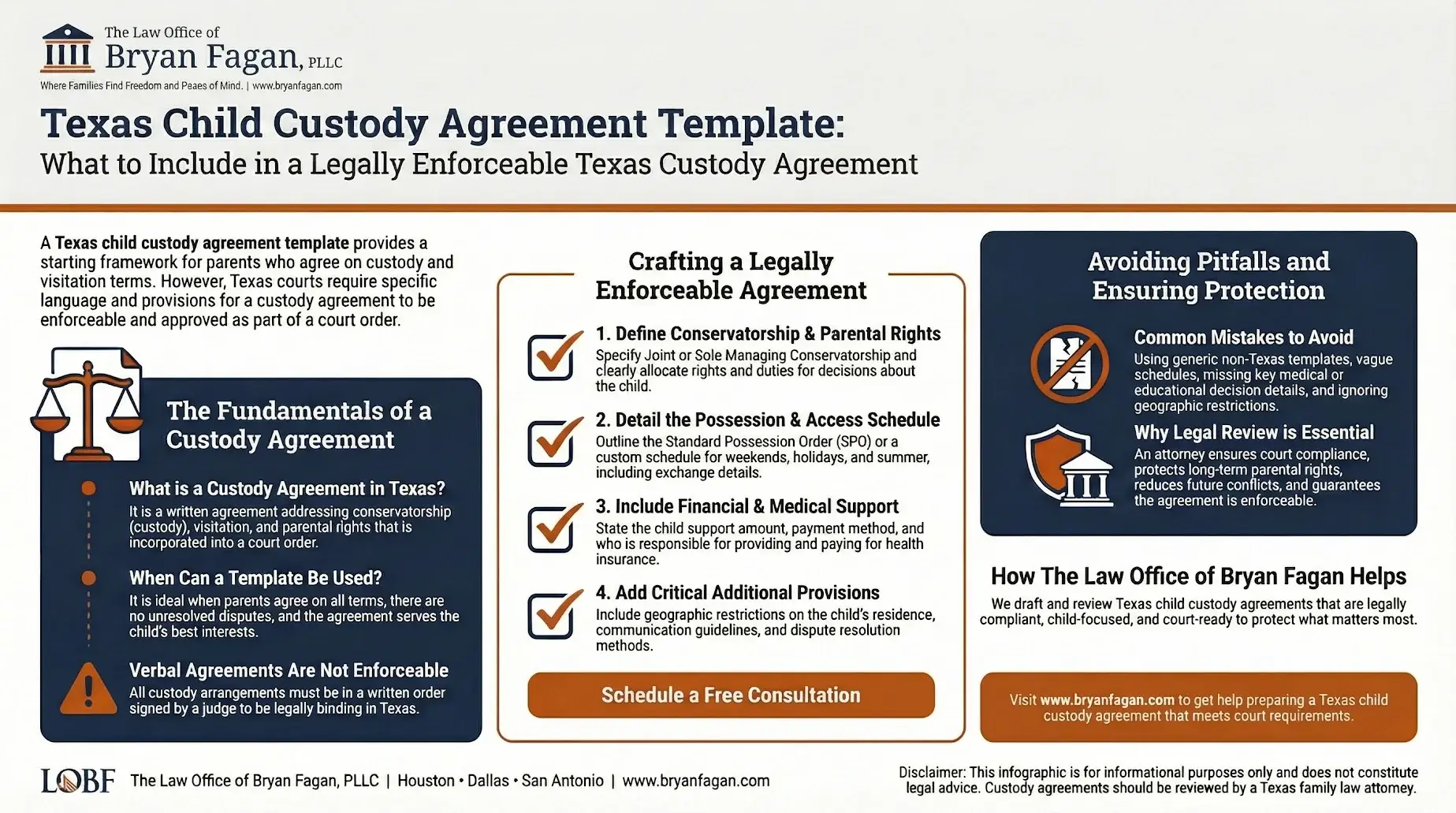

The moment a family realizes that “we’ll figure it out later” is no longer an option, everything feels heavier. The house feels quieter. Conversations feel more careful. Even simple decisions—weekends, holidays, bedtime routines—suddenly carry emotional weight. In those moments, parents aren’t thinking like lawyers; they’re thinking like moms and dads trying to hold their family together in a new way. That’s where a Texas Child Custody Agreement Template becomes more than a form—it becomes a starting point for restoring clarity, structure, and peace of mind during one of life’s hardest transitions.
At The Law Office of Bryan Fagan, PLLC, we sit across from Houston parents every day who are overwhelmed, exhausted, and worried about getting this wrong. Led by Bryan Joseph Fagan, a South Texas College of Law graduate and recognized authority on Texas divorce and custody law, our firm understands that custody decisions are not abstract legal exercises. They are deeply personal choices that shape daily life—where a child wakes up, who tucks them in at night, and how parents move forward without constant conflict. Texas law reflects this human reality. Under Texas Family Code §153.002, courts are required to place the child’s best interest at the center of every custody decision, prioritizing stability, safety, and emotional security.
In this article, we’ll walk you through how custody agreements work under Texas law, why templates must be carefully customized, and how the right legal guidance can help families move from uncertainty to confidence. If you’re searching for answers, reassurance, and a clear path forward, consider this your invitation to take the first steady step toward protecting what matters most.
Key Takeaways
- A properly structured Texas child custody agreement template streamlines the creation of legally compliant parenting plans that meet Texas Family Code requirements
- Templates must be customized to address conservatorship, possession schedules, and child support under specific Texas law terminology—not generic custody language
- Court approval transforms your agreement from a simple document into an enforceable final court order protecting your parental rights
- Professional legal review prevents costly mistakes that could undermine your custody arrangement or delay your family law case
- Detailed templates reduce future conflicts by addressing common parenting scenarios, communication boundaries, and dispute resolution procedures before problems arise

Your Family’s Future Starts Here
Don’t navigate your legal journey alone. Schedule a consultation now and get the clarity and support you deserve.
What is a Texas Child Custody Agreement Template Under Texas Law?
If you’ve searched online for custody forms, you may have noticed something confusing right away: Texas law doesn’t actually use the word “custody.” Understanding this distinction is critical if you want an agreement that Texas courts will accept and enforce. Under the Texas Family Code, what parents commonly call custody is legally defined as conservatorship, a system that governs parental rights and duties involving education, medical care, religious upbringing, and the child’s primary residence. These concepts are governed by Texas Family Code §§153.001–153.317, with courts required to prioritize the child’s best interest under §153.002, a principle that remains the cornerstone of Texas custody law today.
In practice, parents are usually appointed as joint managing conservators or, in more limited circumstances, a sole managing conservator under §§153.131 and 153.134 of the Texas Family Code. Joint managing conservatorship allows both parents to share decision-making authority, but it does not automatically mean equal parenting time. What many parents refer to as visitation is legally known as possession and access, which is governed by detailed statutory guidelines, including the Standard Possession Order found in §153.252 and related provisions. While the standard schedule provides a baseline, Texas courts regularly approve customized possession arrangements when they better serve a child’s stability and day-to-day needs.
This is where a Texas Child Custody Agreement Template becomes a helpful starting point. A properly designed template helps parents organize conservatorship rights, possession schedules, child support obligations under Texas Family Code Chapter 154, and communication expectations into a clear, structured plan. However, there is an important legal reality many parents overlook: a template, even when carefully completed, has no legal force on its own. A custody agreement only becomes enforceable after it is properly filed with the court, reviewed for compliance with current Texas law, and signed by a judge as a final order.
It can help to think of custody templates the same way you think about estate planning tools. Just as a living will must meet strict statutory requirements to be valid, parenting plans must comply with the Texas Family Code to protect your family. Parents often find it useful to review related planning resources, such as this guide on using a living will template in Texas, to better understand how legal documents work together to create long-term stability. For additional insight into how courts evaluate conservatorship and possession decisions, you may also find value in our related article on Texas child custody laws and parenting plans.
Throughout our educational resources, the team at the Law Office of Bryan Fagan, PLLC emphasizes one consistent truth: templates are blueprints, not finished structures. They help you visualize the outcome and avoid missing critical elements, but only careful legal review and court approval turn those plans into durable protections for your child and your future.

Who Can Use a Texas Child Custody Agreement Template?
Understanding who can file a suit affecting the parent child relationship (SAPCR) helps you determine whether a template approach fits your situation.
Married parents going through divorce will include custody provisions in their divorce decree. Your custody agreement template becomes part of this larger document, addressing how you’ll share responsibilities for your minor child after the marriage ends.
Unmarried parents file a SAPCR case independently of any divorce proceeding. This is increasingly common, and the process requires additional considerations. Most importantly, if you’re a father who was never married to your child’s mother, you must establish paternity before custody rights apply to you. Until you’re legally recognized as the child’s legal father through an acknowledgment of paternity or a paternity order, you cannot exercise parental rights regardless of what any informal agreement says.
Parents seeking modifications to existing custody and visitation orders can also use templates as starting points. However, modifications require proving a “material and substantial change” in circumstances—you can’t simply decide you want different terms.
One parent does not need the other parent’s permission to file for custody. You can initiate a SAPCR case on your own. However, for an agreed order based on your template to succeed, both parents must eventually sign the completed forms and present a unified plan to the court.
Grandparents and other relatives face more limited circumstances. They may pursue custody through SAPCR only when they can demonstrate parental unfitness or other specific conditions outlined in the Texas Family Code.
When You Need a Texas Child Custody Agreement Template
Several life circumstances make a formal custody agreement not just helpful, but legally necessary under Texas law. When parents understand why and when courts require these agreements, they are far better positioned to protect their children’s stability and avoid unnecessary conflict. This is exactly where a Texas Child Custody Agreement Template can serve as an educational starting point—helping families organize complex legal requirements before taking the next formal step.
When a divorce involves minor children, Texas courts will not sign a final decree unless issues of conservatorship, possession and access, and child support are fully addressed. Texas Family Code §§153.002 and 154.001 make clear that custody and support determinations must serve the child’s best interest and be clearly defined. A properly structured template allows parents to think through parenting schedules, decision-making authority, and financial responsibilities in advance, reducing delays and confusion during the divorce process. Families navigating both custody and divorce planning often find it helpful to review related resources such as this guide to affordable Texas divorce agreement templates for uncontested cases to better understand how these documents work together.
For unmarried parents, a formal custody order is often the first step in creating enforceable parental rights and responsibilities. Without a court order established through a Suit Affecting the Parent-Child Relationship (SAPCR), neither parent has clear legal authority under Texas law—even if they have successfully co-parented for years. Texas Family Code Chapter 160 (addressing parentage) and Chapter 153 (addressing conservatorship and possession) govern these cases, and courts require precise language to ensure both parents understand their rights and obligations. A custody template helps parents prepare for this process, but court approval is what ultimately creates legal protection.
Modifications to existing custody orders are another common reason parents turn to formal agreements. Texas Family Code §156.101 allows courts to modify conservatorship, possession, or support when there has been a material and substantial change in circumstances, such as relocation, safety concerns, or changes in a child’s developmental needs. Updating an agreement through the proper legal process ensures that the custody arrangement continues to reflect the child’s best interest as life evolves. For additional background on how Texas courts approach these decisions, readers may find this resource on Texas child custody laws and conservatorship helpful.
Finally, many parents pursue formal custody agreements as a form of conflict prevention. Verbal arrangements and informal understandings often work—until they don’t. When expectations are unclear, even well-intentioned co-parents can find themselves in escalating disputes. A court-approved custody order removes ambiguity, establishes clear boundaries, and provides enforcement mechanisms when disagreements arise. From the perspective of the team guiding families through these transitions, clarity today often prevents litigation tomorrow—protecting not just parental rights, but a child’s sense of stability and security.
Step-by-Step Guide: How to Use a Texas Child Custody Agreement Template
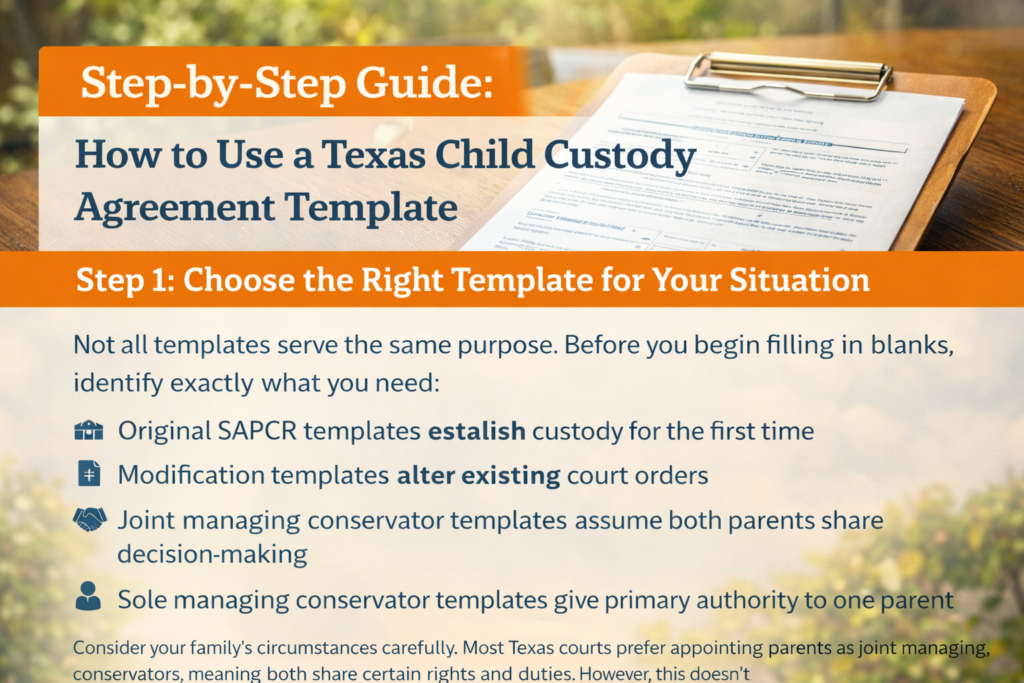
Step 1: Choose the Right Template for Your Situation
Not all templates serve the same purpose. Before you begin filling in blanks, identify exactly what you need:
- Original SAPCR templates establish custody for the first time
- Modification templates alter existing court orders
- Joint managing conservator templates assume both parents share decision-making
- Sole managing conservator templates give primary authority to one parent
Consider your family’s circumstances carefully. Most Texas courts prefer appointing parents as joint managing conservators, meaning both share certain rights and duties. However, this doesn’t necessarily mean equal possession time—it refers to decision-making authority.
Step 2: Complete Core Conservatorship Provisions
This section establishes who holds what rights regarding your child. You’ll need to designate:
Managing conservator appointments specifying whether one or both parents serve as managing conservators
Exclusive rights held by only one parent, such as determining the child’s primary residence (typically with geographic restrictions to a specific county or contiguous counties)
Joint rights both parents share, including decisions about education, non-emergency medical care, extracurricular activities, and religious upbringing
Independent rights each parent can exercise without the other’s consent, such as attending school activities or accessing medical records
Be specific. Vague language like “parents will share decisions” creates enforcement problems later. Instead, state exactly which parent holds which rights and how disagreements will be resolved.
Step 3: Detail Possession and Access Schedule
The possession schedule is one of the most important—and most scrutinized—parts of any custody agreement because it determines when each parent has physical time with the child. Under Texas Family Code §153.252, courts begin with the Standard Possession Order as a default framework, which generally provides the non-primary parent with first, third, and fifth weekends of each month, a midweek period such as Thursday evenings, extended summer possession, and alternating holidays. Texas judges rely on this structure because it offers predictability and consistency, two factors closely tied to a child’s sense of stability.
That said, Texas law also recognizes that no two families function the same way. Sections §153.253 and §153.317 of the Texas Family Code allow parents to customize possession schedules when a different arrangement better serves the child’s best interest. Many families ultimately adopt schedules that look very different from the standard order while still meeting legal requirements, particularly when parents live close to one another, share flexible work schedules, or want to minimize transitions for younger children. A carefully drafted Texas Child Custody Agreement Template helps parents think through these options in advance, rather than defaulting to a schedule that may not fit their daily reality.
To avoid confusion and future conflict, a custody agreement should spell out possession terms with precision. That means clearly defining regular weekday and weekend periods with exact start and end times, identifying each holiday and assigning possession in even and odd years, outlining summer possession with specific notice deadlines, addressing school breaks such as spring break and winter holidays, and detailing pickup and drop-off logistics, including locations and transportation responsibilities. Texas courts consistently emphasize enforceability, and vague language undermines that goal. Phrases like “reasonable visitation” or “as agreed” may sound cooperative, but they are unenforceable because a judge cannot measure compliance without clear standards.
Families are often surprised by how similar this level of detail is to other areas of planning. Just as estate planning documents require specificity to be effective, parenting plans must be clear to provide real protection. Parents who are already thinking about long-term planning sometimes benefit from reviewing related resources, such as this guide on what to include in a living will template and how to use it effectively, to better understand how clarity in legal documents reduces uncertainty during difficult moments. For additional insight into how Texas courts evaluate possession and access issues, you may also find it helpful to explore our resource on Texas custody and visitation schedules.
From the perspective of those who regularly guide parents through Texas custody cases, clarity is not about rigidity—it’s about peace of mind. When expectations are clearly written and legally enforceable, parents spend less time arguing over logistics and more time focusing on what truly matters: providing their child with a stable, predictable routine in both homes.

Step 4: Calculate and Include Child Support Provisions
Texas uses specific guidelines based on net resources to calculate child support. For one child, the guideline amount is 20% of the obligor’s net resources, increasing with additional children.
Your template should address:
- Monthly support amount calculated according to guidelines or explained deviation
- Payment method and schedule (wage withholding is standard)
- Health insurance responsibility designating which parent provides coverage
- Uninsured medical expenses division (typically 50/50 after a threshold)
- Extracurricular activity costs and how they’re shared
- Educational expenses beyond regular schooling
The child support obligation continues until the child turns 18, graduates high school (whichever is later), marries, or is otherwise emancipated. Include these termination conditions in your agreement.
Step 5: Add Communication and Dispute Resolution Clauses
Modern parenting plans should address how parents communicate—both with each other and with the child during the other parent’s possession time.
Parent-to-parent communication provisions might include:
- Required response time for non-emergency communications (e.g., 24 hours)
- Preferred communication methods (text, email, co-parenting app)
- Expectations about tone and content
Parent-to-child communication provisions should specify:
- Daily or regular phone/video call times
- Who initiates calls
- Duration expectations
- Technology requirements
Dispute resolution clauses help you avoid returning to court for every disagreement. Many Texas courts require mediation before allowing custody modifications. Your template might specify:
- Mediation as the first step for disputes
- How mediator selection works
- Cost sharing for mediation
- Timeline for attempting resolution before court intervention
Step 6: Customize for Your Family’s Unique Needs
Templates provide structure, but every family has unique circumstances. Consider whether you need provisions addressing:
- Geographic restrictions limiting where the primary parent can relocate
- Right of first refusal giving the other parent opportunity to care for the child before using babysitters
- Special needs accommodations for children requiring particular care
- Extracurricular activities and how decisions are made
- Extended family access including grandparent visitation
- Technology use during possession periods
- Introduction of new partners to the child
These customizations make your agreement work for your actual life rather than a generic family that doesn’t exist.
Step 7: Professional Review and Court Filing
Here’s where many parents make critical mistakes. Even the most carefully completed template means nothing without proper filing and court approval.
A family law attorney provides legal review that:
- Verifies compliance with current Texas Family Code requirements
- Identifies language that courts may find unenforceable
- Ensures your agreement addresses all mandatory elements
- Confirms proper jurisdiction (the case must be filed where the child has resided for the preceding six months)
Filing involves submitting your petition to the district clerk’s office, paying the filing fee (or requesting a waiver if you cannot afford payment), and serving the other parent with court papers. Service must be completed properly—typically through a constable or process server—before the court can proceed.
Only when the judge signs your agreed order does your custody agreement become a legally binding court order enforceable through Texas courts.
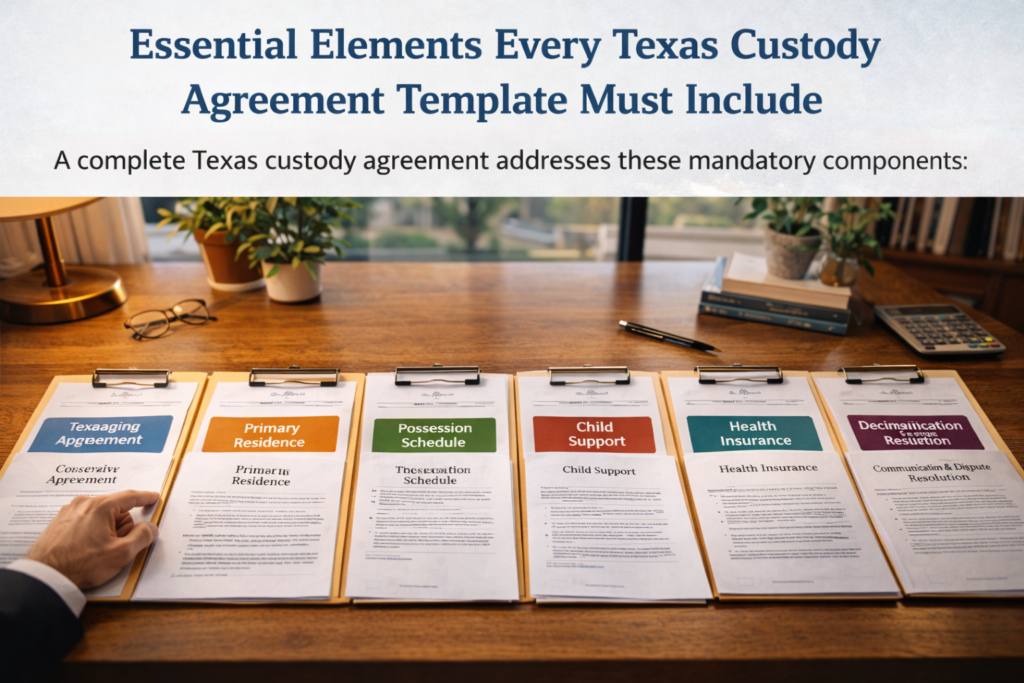
Essential Elements Every Texas Custody Agreement Template Must Include
A complete Texas custody agreement must address several mandatory components to meet court requirements and protect a child’s long-term stability. Under Texas Family Code §§153.002, 153.131, and 153.134, courts require clear conservatorship provisions identifying whether both parents are appointed as joint managing conservators or whether one parent is designated as the sole managing conservator. These sections reflect the Legislature’s continued emphasis on the child’s best interest, requiring courts to carefully define parental rights and duties rather than relying on assumptions or informal arrangements.
Another essential element is the designation of the child’s primary residence and any geographic restrictions tied to that designation. Texas courts frequently limit a child’s primary residence to a specific county or contiguous counties to preserve continuity in the child’s daily life, an approach grounded in Texas Family Code §153.134(b). Alongside residence provisions, a detailed possession and access schedule must be included, covering regular parenting time, holidays, summer periods, and special occasions with exact dates and times. These requirements align with the possession framework set out in Texas Family Code §§153.252–153.317, which stress predictability and enforceability as key components of a child-centered custody order.
Financial responsibilities are equally critical. Child support provisions must follow the statutory guidelines in Texas Family Code Chapter 154, including wage withholding requirements and payment methods. A well-drafted agreement also addresses health insurance coverage and the division of uninsured medical expenses, ensuring there is no confusion when healthcare needs arise. Decision-making authority should be clearly divided into exclusive, joint, and independent rights, allowing parents to understand who is responsible for choices involving education, medical care, and extracurricular activities. Communication guidelines between parents—and between each parent and the child—help reduce conflict, while dispute resolution clauses often require mediation before court intervention, reflecting modern Texas court practices. Finally, enforcement provisions clarify the consequences for violations, giving the agreement real legal weight if problems arise.
Using a Texas Child Custody Agreement Template can help parents organize all of these required elements into a coherent structure, but accuracy and completeness are what make the document effective. Much like estate planning tools, custody agreements work best when they are specific and tailored to the family’s circumstances. Parents who are already thinking about long-term planning often find value in reviewing related resources, such as this guide on what to include in the best template for a revocable living trust, to better understand how thoughtful legal documents create clarity and reduce future conflict. For additional insight into how Texas courts approach conservatorship, possession, and enforcement issues, you may also find our article on Texas child custody laws and conservatorship helpful.
From the perspective of those who regularly guide Texas families through custody matters, these components are not about legal formalities alone. They are about creating a clear, enforceable roadmap that reduces uncertainty, supports co-parenting, and protects a child’s sense of security. When custody agreements are drafted with care and grounded in current Texas law, they become powerful tools for protecting futures rather than sources of ongoing conflict.
Common Mistakes Parents Make With Custody Agreement Templates
Using Templates Without Customization
Generic templates address generic families. Your child has specific needs, your work schedules have particular demands, and your family dynamics have unique characteristics. Using a template without modification often results in an agreement that doesn’t actually work for your life.
Including Vague Language
Phrases like “reasonable visitation,” “timely communication,” or “as needed” seem flexible but create serious enforcement problems. If the other parent violates your agreement, how can you ask the court to hold them accountable for failing to meet an undefined standard?
Instead of “timely response to communications,” specify “within 24 hours for non-emergency matters.”
Failing to Address Specific Holidays
“Parents will share holidays” tells a judge nothing. Name each holiday—Thanksgiving, Christmas Eve, Christmas Day, Easter, July 4th, each parent’s birthday, the child’s birthday—and specify which parent has possession in even years versus odd years.
Omitting Dispute Resolution Procedures
Without a process for handling disagreements, every conflict potentially becomes a new court battle. Mediation requirements save time, money, and emotional energy while often producing better outcomes than judicial intervention.
Treating Informal Agreements as Legally Binding
You and your co-parent might agree to wonderful terms over coffee. You might even write them down and both sign. But until a judge signs your agreement as a final order, you have no enforceable rights. The other parent could change their mind tomorrow, and you’d have no legal recourse.
Not Having Attorney Review Before Filing
The court costs and delays caused by improper filings far exceed the cost of legal review. Attorneys catch problems before they derail your case—missing forms, incorrect jurisdiction, unenforceable language, and procedural errors that could result in your petition being rejected.

How a Texas Family Law Attorney Enhances Your Custody Agreement Template
While templates offer helpful structure, experienced legal guidance is what turns a starting point into a durable, court-enforceable agreement. A Texas Child Custody Agreement Template can organize ideas and options, but attorney involvement ensures the final document complies with the current Texas Family Code and reflects how judges actually apply the law in real cases. Texas Family Code §§153.002, 153.131, and 153.134 continue to require that conservatorship and possession orders serve the child’s best interest, and even small drafting errors or outdated language can undermine that goal if left unaddressed.
One of the most important benefits of working with a seasoned Texas family law attorney is compliance verification. Statutory requirements evolve, and provisions that may have passed muster years ago can now raise red flags with the court. Legal review ensures your agreement aligns with updated standards governing conservatorship, possession, and child support under Chapters 153 and 154 of the Texas Family Code. Strategic customization is equally critical. Attorneys regularly identify clauses that seem reasonable on paper but can create enforcement problems or unintended consequences later, then tailor alternatives that protect parental rights while advancing a child-centered outcome.
Enforceability is another area where professional insight makes a measurable difference. Courts can only enforce what is clearly written, and vague language invites conflict. Attorneys who practice regularly in Texas courts understand how local judges interpret possession schedules, geographic restrictions, and communication provisions, and they draft language accordingly. Procedural guidance further reduces risk by ensuring proper jurisdiction, service, and filing requirements are met, avoiding delays that can stall a case or force parents back to square one. When disagreements arise, negotiation support helps keep the case moving forward through productive discussions rather than escalating conflict, particularly in SAPCR matters governed by Texas Family Code Chapter 102.
Finally, thoughtful attorney involvement helps future-proof custody agreements. Life changes, and Texas Family Code §156.101 allows modifications when a material and substantial change occurs, but many disputes can be avoided with careful planning upfront. This long-term perspective mirrors other areas of family planning, where specificity and foresight reduce uncertainty. Parents who are thinking holistically about their family’s future sometimes benefit from reviewing related planning tools, such as the only revocable living trust template parents should consider, to see how clarity in legal documents creates stability across different stages of life. For additional insight into how Texas courts evaluate custody provisions and enforceability, you may also find our resource on Texas child custody laws and conservatorship helpful.
From the perspective of those who guide families through these transitions every day, attorney involvement is not about complicating the process—it’s about simplifying it in a way that lasts. When custody agreements are carefully drafted, legally compliant, and tailored to real family dynamics, they provide peace of mind today and reduce conflict tomorrow, fulfilling the deeper purpose of protecting futures rather than reacting to crises.
Making Your Template Legally Binding in Texas Courts
Your custody agreement becomes enforceable only through court approval. Here’s how that process works:
Filing the petition officially opens your case. You’ll file in the district court or county court at law where your child has resided for the preceding six months. This “home state” requirement under the UCCJEA prevents parents from forum-shopping across state lines.
Serving the other parent provides legal notice of the proceeding. Unless the other parent signs a waiver of service, you must arrange for a constable or process server to deliver court papers. Without proper service, your case cannot proceed.
Temporary orders may be necessary if you need immediate structure while your case progresses. These orders address interim custody and visitation, temporary child support, and sometimes temporary restraining orders or temporary injunctions in cases involving family violence or asset concerns.
Mediation or negotiation often resolves disagreements. Texas courts frequently require mediation attempts before proceeding to trial. Many cases—perhaps 70-80%—settle during this phase when parents use well-prepared templates as negotiation starting points.
Final hearing occurs once you’ve reached agreement or exhausted settlement options. If both parents agree to terms, the hearing is brief—the judge confirms the agreement serves the child’s best interest and signs the final custody order. If disputes remain, a trial allows the judge to decide based on evidence and testimony.
The judge’s signature transforms your parenting plan from a document into a court order. Violations become enforceable through contempt proceedings, giving your agreement real legal weight.
Why Choose The Law Office of Bryan Fagan PLLC for Your Custody Agreement
Navigating Texas custody law involves far more than filling out forms or paying filing fees. It requires a clear understanding of how local courts operate, what judges prioritize when applying the best-interest standard under Texas Family Code §153.002, and how conservatorship, possession, and support provisions must be presented to be approved and enforced. A Texas Child Custody Agreement Template can help organize your thoughts, but true progress comes from pairing that structure with insight into how Texas courts actually evaluate parenting plans.
The legal professionals guiding families through these matters bring experience across the full spectrum of Texas custody cases, from straightforward agreed orders to highly contested proceedings involving conservatorship disputes, modifications under Texas Family Code §156.101, and enforcement actions. Staying current with legislative updates and judicial interpretations is critical, particularly as courts continue to emphasize detailed, child-centered orders under Chapters 153 and 154 of the Texas Family Code. This depth of knowledge allows families to avoid common pitfalls and move through the process with greater confidence and efficiency.
A child-focused approach remains at the heart of effective custody planning. Texas law consistently places a child’s safety, stability, and emotional wellbeing at the forefront, and durable custody agreements reflect that priority. By balancing parental rights with practical, realistic schedules and clearly defined responsibilities, families are far more likely to create arrangements that reduce conflict rather than fuel it over time. For parents who are navigating custody as part of a larger divorce, it can also be helpful to understand how these issues fit into the broader legal timeline, which is why many readers explore our resource on the Texas divorce process.
Clear, consistent communication is another cornerstone of effective legal guidance. Custody cases are emotionally charged, and parents deserve explanations in plain language, timely responses to concerns, and transparency at every stage. Whether you are married or unmarried, filing an initial SAPCR, or seeking to modify an existing order, the right guidance transforms a template into a court-approved order that truly protects your family. For additional background on how Texas courts handle conservatorship and possession decisions, you may also find our article on Texas child custody laws helpful as you consider your next steps.
Take Action: Protect Your Family With a Proper Custody Agreement
Creating a Texas child custody agreement template is about more than legal paperwork—it’s about building a foundation for your child’s future. A well-crafted agreement provides stability during uncertain times, establishes clear expectations that reduce conflict, and ensures both parents understand their rights and responsibilities.
But templates alone aren’t enough. The difference between parents who struggle with ongoing custody disputes and those who co-parent effectively often comes down to how carefully their original agreement was prepared.
Investing in professional legal review now prevents costly problems later—rejected filings, unenforceable provisions, and modifications that could have been avoided with better initial drafting.
Your child deserves parents who prioritize getting this right. You deserve an agreement that protects your relationship with your child while setting realistic expectations for co-parenting.
If you’re ready to discuss your custody agreement needs, we invite you to contact The Law Office of Bryan Fagan PLLC for a free consultation. We’ll review your situation, answer your questions, and help you understand next steps for your family law case.
Conclusion:
At the end of the day, a custody agreement isn’t about winning or losing—it’s about creating a sense of calm where uncertainty once lived. When parents take the time to think through the details, ask the right questions, and put a clear plan in place, they give their child something invaluable: consistency. That stability becomes the quiet foundation that allows children to focus on being kids, even while their family is changing.
If you’re standing at the beginning of this process, know that you don’t have to navigate it alone or guess your way forward. Working with an experienced Texas family law attorney can help you turn good intentions into a custody arrangement that actually works in real life, not just on paper. Thoughtful legal guidance can prevent misunderstandings, reduce conflict, and protect your relationship with your child for years to come.
At The Law Office of Bryan Fagan, PLLC, our goal is to help families move forward with clarity and confidence—one steady step at a time. Whether you’re exploring your options, modifying an existing order, or simply trying to understand what Texas law expects, we’re here to educate, support, and advocate for what matters most. And if nothing else, take a moment to breathe—you’re doing the right thing by seeking information, and that’s often where real peace of mind begins.
Frequently Asked Questions About Texas Child Custody Agreements
The biggest mistake parents make in a custody battle is letting emotions control their actions instead of focusing on what a Texas judge actually cares about—the child’s best interest. Angry texts, social media posts, refusing reasonable cooperation, or using the child as leverage can seriously damage credibility in court. Judges tend to reward parents who remain calm, child-focused, and willing to co-parent, even under stress.
The most common arrangement in Texas is Joint Managing Conservatorship, where both parents share many rights and duties related to the child. This is usually paired with a Standard Possession Order, which outlines weekends, holidays, and summer time. Joint managing conservatorship does not automatically mean equal time; often one parent determines the child’s primary residence while the other follows a structured visitation schedule.
Parents often overlook the details that prevent future conflict. A custody agreement should clearly spell out possession times, exchange locations, holidays, summer schedules, communication rules, decision-making authority, health insurance responsibilities, and how disagreements will be resolved. Vague language like “as agreed” can create serious enforcement problems later.
Texas law does not favor mothers over fathers. Courts focus on what arrangement serves the child’s best interest. Many fathers are awarded equal or near-equal possession when they can show consistent involvement, a stable home environment, reliable transportation, and the ability to meet daily parenting responsibilities. If both parents agree to a 50/50 schedule and it works for the child, Texas courts often approve it.
Judges take a negative view of behavior that suggests instability or poor judgment. Missing visitations, refusing to follow temporary orders, exposing children to adult conflict, substance abuse issues, unsafe living conditions, or repeatedly involving law enforcement can all hurt a parent’s case. Courts generally favor parents who demonstrate maturity, consistency, and a willingness to support the child’s relationship with the other parent.
The “9-minute rule” is not a legal rule in Texas but a parenting concept. It refers to spending short, intentional periods of focused attention with a child during key moments of the day, such as right after waking up, after transitions, or before bedtime. These small but consistent moments of connection can help children feel secure, especially when navigating changes like divorce or co-parenting between two homes.
Judges apply the “best interest of the child” standard under Texas Family Code §153.002. They consider factors such as each parent’s ability to provide stability, meet the child’s daily needs, encourage a healthy relationship with the other parent, and maintain a safe environment. Courts also look at past caregiving roles, work schedules, housing stability, and any history of family violence or substance abuse. In some cases, a child’s preference may be considered once the child turns 12.
A 70/30 split typically means the child spends about 70% of overnights with one parent and 30% with the other. This often looks like the child living primarily with one parent during the week, while the other parent has alternating weekends plus a midweek overnight or extended evening time. The exact schedule depends on distance between homes and the child’s routine, but clarity and enforceability are key.
Without a court order, enforcement options are limited for either parent. If parents were married and no custody orders exist, both generally have parental rights, but police usually treat disputes as civil matters. If the parents were never married, the father typically must establish legal paternity before enforcing visitation or custody rights. If safety concerns exist, emergency court relief may be available, and speaking with a Texas family law attorney promptly is critical.