
The moment doesn’t always arrive with a dramatic argument or slammed door. Sometimes it’s a quiet realization late at night, when the house is finally still and the weight of an uncertain future settles in. You look at your child asleep and wonder what tomorrow will look like—where they’ll live, how often you’ll see them, and whether life will ever feel steady again. For many Texas parents standing at this crossroads, How to File for Child Custody Texas becomes the urgent question that follows that quiet fear, because the answers shape far more than a court case—they shape daily life.
At The Law Office of Bryan Fagan, PLLC, we understand that custody issues are not about “winning” or “losing.” They are about restoring a sense of control and peace when everything feels upended. Founded by Bryan Joseph Fagan, a South Texas College of Law graduate and a recognized authority on Texas divorce and custody law, our firm has guided families across Houston and throughout Texas through these deeply personal transitions. Texas Family Code §153.002 makes it clear that every custody decision must be guided by the best interest of the child, but what that really means in practice can feel confusing and overwhelming without clear guidance.
This article is here to replace uncertainty with understanding. You’ll learn what the child custody process in Texas actually looks like, what steps matter most early on, and how thoughtful legal planning can create stability for your child and peace of mind for you. Our purpose—the “Why” behind our work—is to empower families to reclaim clarity and confidence during life’s hardest moments. We do that by educating parents, simplifying complex legal rules, and offering compassionate solutions designed to protect what matters most.
If you’re feeling unsure about what comes next, you’re not alone. As you continue reading, you’ll find straightforward answers, practical insight, and reassurance that there is a steady path forward—and that you don’t have to walk it alone.
Key Takeaways
- Texas law uses “conservatorship” instead of “custody”—understanding this terminology is essential for navigating family law cases successfully
- Filing requires a Suit Affecting the Parent-Child Relationship (SAPCR) petition in the county where your child resides
- You do not need the other parent’s permission to file for custody, but fathers must establish paternity first
- Texas courts prioritize the child’s best interest above all other factors when making custody decisions
- Proper legal steps and careful preparation prevent costly delays—filing errors cause 15-20% of initial dismissals

Your Family’s Future Starts Here
Don’t navigate your legal journey alone. Schedule a consultation now and get the clarity and support you deserve.
Understanding Texas Child Custody Terminology
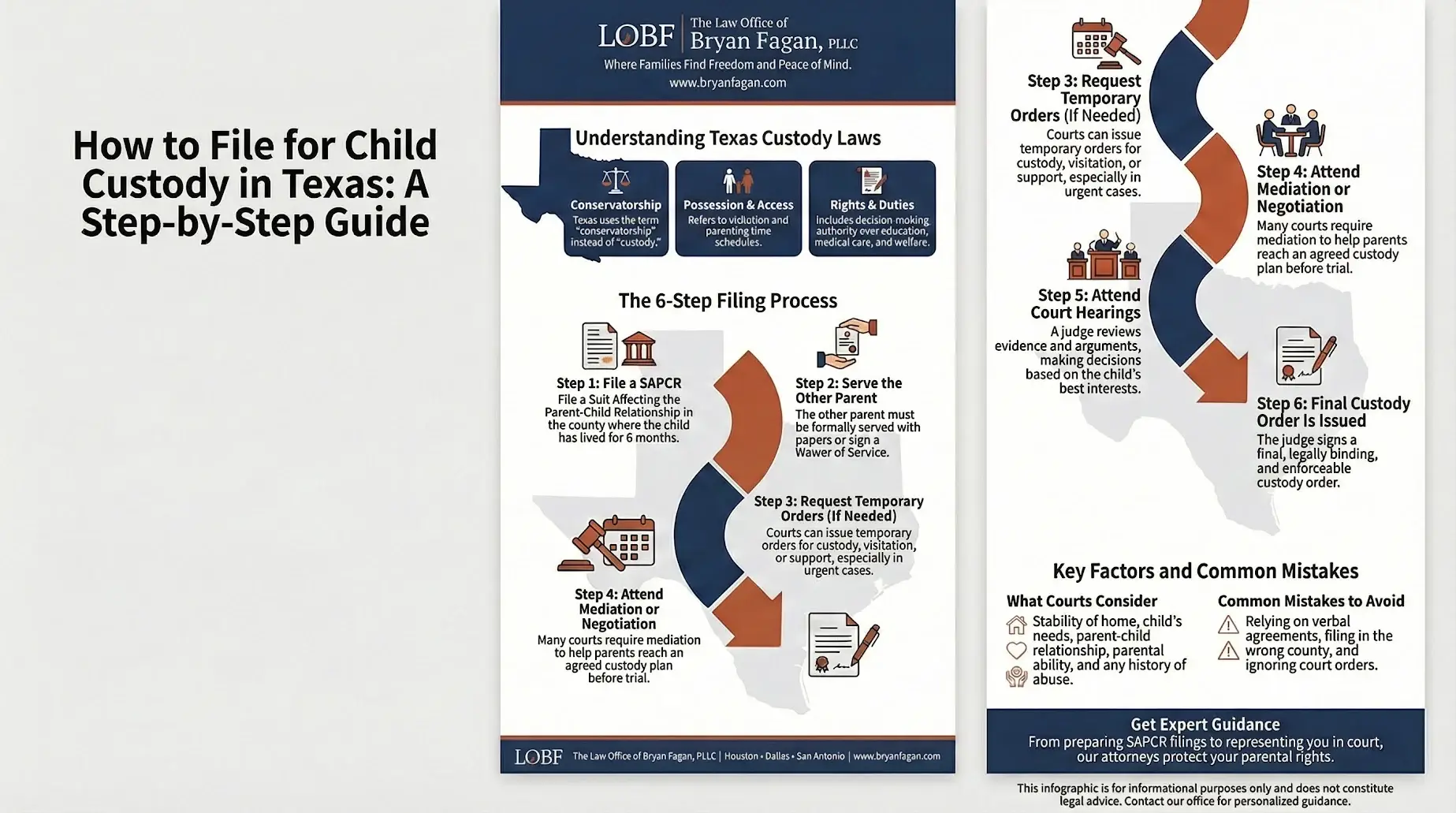
When parents begin researching How to File for Child Custody Texas, one of the first points of confusion is discovering that Texas law does not actually use the word “custody.” Instead, the Texas Family Code uses the term conservatorship to describe the legal relationship between a parent and child. This framework, set out primarily in Texas Family Code Chapter 153, reflects the Legislature’s and the courts’ strong preference for preserving meaningful involvement from both parents whenever it is safe and appropriate. At its core, every conservatorship decision must align with the child’s best interest, the guiding standard established by Texas Family Code §153.002.
Conservatorship is divided into two distinct but interconnected roles. Managing conservatorship governs who has the authority to make major decisions about a child’s life, including education, medical care, and general welfare, as outlined in Texas Family Code §§153.071–153.074 and §153.132. Possessory conservatorship, on the other hand, focuses on parenting time—when and how each parent has physical possession of the child. Understanding this distinction helps parents see that Texas courts are not simply allocating time, but carefully balancing decision-making authority with stability and consistency for the child.
Most Texas courts presume that joint managing conservatorship serves a child’s best interest, a presumption found in Texas Family Code §153.131. Under this arrangement, both parents typically share decision-making responsibilities, while one parent may be given the exclusive right to designate the child’s primary residence under §153.134. Sole managing conservatorship, which grants one parent broader exclusive rights, is usually reserved for cases involving family violence, abuse, substance misuse, or other serious safety concerns. For unmarried parents, these rights do not attach automatically. Fathers must first establish legal paternity before conservatorship can be awarded, a process explained in detail in the firm’s resource on how to establish paternity in Texas.
Possession and access determine the day-to-day parenting schedule and are governed by Texas Family Code §§153.251–153.317. In many cases, courts apply the Standard Possession Order (SPO), which provides a predictable structure that includes alternating weekends, midweek visitation, shared holidays, and extended summer time, with adjustments based on the parents’ geographic distance or the child’s age. While the SPO is often the default starting point, judges have discretion to tailor schedules when a different arrangement better serves the child’s needs. Parents seeking a broader understanding of how Texas courts approach these issues may find additional clarity in the firm’s Texas child custody overview.
By understanding how conservatorship and possession work together under the Texas Family Code, parents are better positioned to make informed decisions and avoid early missteps. The attorneys at The Law Office of Bryan Fagan, PLLC focus not just on explaining legal terminology, but on helping families create workable, enforceable arrangements that protect children and promote long-term stability during an otherwise uncertain chapter of life.

Who Can File for Child Custody in Texas
Understanding who has standing to file a custody case saves time and prevents procedural dismissals. The following individuals may file a suit affecting the parent-child relationship:
Parents have the clearest path to filing. This includes biological parents, adoptive parents, and legal fathers whose paternity has been established. If you’re the child’s parent, you can initiate custody proceedings without needing permission from the other parent.
Unmarried fathers face an additional requirement. Before custody and visitation rights attach, the child’s legal father must establish paternity. This happens through:
- An Acknowledgment of Paternity signed by both parents (often at the hospital after birth)
- A court order establishing paternity
- DNA testing through a paternity suit
The Texas Attorney General’s Office processes over 25,000 paternity suits annually. If your name isn’t on the child’s birth certificate and no paternity order exists, establishing paternity becomes your first legal step.
Legal guardians and certain non-parents may also file under limited circumstances. Under Texas Family Code §102.006, grandparents and other relatives may seek conservatorship if they’ve had primary care of the child for at least six months and the parents relinquished care. However, success rates for non-parent filings remain below 20% unless evidence shows clear parental unfitness or abuse.
When You Need to File for Child Custody in Texas
Several situations trigger the need to establish custody formally through Texas courts:
Divorce proceedings involving children represent about 50% of custody cases. When married parents separate, custody arrangements must be established as part of the divorce decree. The custody order becomes legally binding and enforceable.
Unmarried parents account for approximately 40% of family court dockets. Without a custody order, neither parent has legally defined rights to the child—even if both names appear on the birth certificate. Filing establishes each parent’s rights to physical custody and decision-making responsibilities.
Modifying existing custody orders becomes necessary when circumstances change significantly. Texas Family Code §156.101 requires a “material and substantial change” to justify modification. Common triggers include:
- Relocation of one parent more than 100 miles away
- Remarriage or new living arrangements affecting the child
- Safety concerns or changes in a parent’s stability
- The child reaching an age where their preference matters
Courts deny relocation requests in approximately 60% of contested cases when the move would disrupt the existing possession schedule.
Child custody emergency situations require immediate action. If you have genuine concerns about your child’s safety—such as abuse, neglect, or risk of abduction—you may seek emergency temporary orders. The court can act quickly to protect children from immediate harm.
Step-by-Step Guide: How to File for Child Custody Texas
Step 1: Determine the Proper Court and Jurisdiction
Before filing any paperwork, you must confirm that Texas courts have authority over your case. The Uniform Child Custody Jurisdiction and Enforcement Act (UCCJEA), codified in Texas Family Code Chapter 152, establishes the “home state” rule.
The home state rule means Texas has jurisdiction if your child has lived here for six consecutive months before filing (or since birth for children under six months). This prevents parents from forum-shopping by moving to different states seeking favorable rulings.
Custody cases file in either district court or county court at law with family jurisdiction, depending on your Texas county. Most metropolitan counties have dedicated family courts.
Practical example: Maria and her daughter lived in Travis County for four years. Maria’s ex-husband moved to Oklahoma six months ago and filed for custody there. Under the UCCJEA, Texas remains the home state because the child still resides here. Maria should file in Travis County, and any Oklahoma filing would likely be dismissed. Approximately 25% of custody cases face jurisdictional challenges—filing in the correct court from the start avoids these delays.
Step 2: Prepare Required Legal Documents
Accurate paperwork is one of the most important steps when learning How to File for Child Custody Texas, because the documents you submit create the legal framework for everything that follows. Texas courts rely heavily on these filings to determine jurisdiction, identify the parties, and understand what conservatorship and possession arrangements you are requesting under Texas Family Code Chapter 153. When forms are incomplete or inconsistent, cases are often delayed or dismissed, adding stress and uncertainty for families who are already navigating a difficult transition.
The foundation of most custody cases is the Original Petition in a Suit Affecting the Parent-Child Relationship (SAPCR). This document formally opens your case and must clearly identify the parents, the child, and the specific relief you are requesting, including managing conservatorship, possession schedules, and child support. Texas Family Code §102.008 outlines the basic requirements for a SAPCR, while §§153.131 and 153.134 guide how conservatorship and primary residence rights are addressed. In addition to the petition, parents must file a Civil Case Information Sheet for administrative purposes and an Affidavit of Status of the Child, which establishes the child’s residency history for the past five years as required by the Uniform Child Custody Jurisdiction and Enforcement Act (UCCJEA), codified in Texas Family Code Chapter 152.
Paternity documentation is another critical component when the parents are not married. If legal paternity has not already been established, the court cannot award conservatorship or possession rights to a father. Texas Family Code Chapters 160 and 161 govern parentage issues, and failing to address them early can result in months of delay. Families facing these questions often benefit from reviewing the firm’s guidance on paternity issues in a Texas family law case, which explains how paternity affects custody, visitation, and support rights. When immediate structure is needed, parents may also file a Motion for Temporary Orders to ask the court for short-term rules on possession, support, and decision-making while the case is pending.
Every custody petition should clearly state the type of conservatorship requested, outline a proposed possession schedule, and address child support in accordance with the current Texas child support guidelines found in Texas Family Code Chapter 154. As of the most recent updates, guideline support is still calculated as a percentage of net resources, subject to the statutory cap and court discretion. Parents seeking a deeper understanding of how support is calculated alongside custody issues may find helpful context in the firm’s Texas child support resource.
From the perspective of the attorneys at The Law Office of Bryan Fagan, PLLC, careful attention to detail at this stage is not just a procedural concern—it is a way to protect families from unnecessary setbacks. Studies and court data consistently show that a significant percentage of custody cases are delayed or dismissed due to avoidable filing errors. Taking the time to verify names, dates, addresses, and supporting documents can make the difference between a smooth path forward and months of frustration, allowing parents to focus on stability and peace of mind for their children.

Step 3: File Your Case With the Court Clerk
With your documents prepared, you’ll file them with the court clerk in the county where your child resides. This step officially opens your custody case and triggers important legal timelines.
Filing fees typically range from $250 to $400, depending on the county. If you cannot afford payment, you may request a fee waiver by filing a Statement of Inability to Afford Payment of Court Costs. Texas courts approve these waivers in approximately 70% of indigent cases.
Many larger Texas courts require e-filing rather than paper submissions. After filing, you’ll receive:
- A case number for tracking your case
- Your assigned court and judge
- A file-stamped copy of your petition
Keep copies of everything you file. These documents become part of the official court record.
Step 4: Serve the Other Parent
The other parent must receive legal notice of your custody filing before the court can proceed. This requirement protects due process rights and ensures both parents have an opportunity to respond.
Service methods include:
- Constable or sheriff’s deputy (fees typically $100-$150)
- Private process server
- Certified mail (primarily for out-of-state service)
The person serving papers completes a service form proving delivery, which you file with the court. Service must occur within 90 days of filing under Texas Family Code §102.009.
Waiver of service is possible if the other parent signs a notarized answer acknowledging receipt of the petition. This saves time and money when parents are cooperating.
Improper service voids proceedings in approximately 10% of cases. Make sure your process server follows local rules exactly—even small errors can force you to start over.
Step 5: Request Temporary Orders (If Necessary)
Custody cases often take months to resolve. Temporary orders establish rules that govern the family while the case is pending, covering:
- Temporary possession schedules (who has the child when)
- Temporary child support payments
- Temporary restraining orders or temporary injunctions preventing harmful actions
- Restrictions on relocating with the child
If you face a child custody emergency—such as immediate risk of abduction or abuse—you may seek ex parte temporary orders without the other parent present. However, the court must hold a hearing within 14 days to allow both sides to be heard.
Courts grant temporary orders in approximately 85% of requests when parents present supporting evidence. The average temporary child support order for two children is around $1,200 monthly, based on Texas child support guidelines.
Step 6: Attend Mediation or Negotiate Settlement
Texas courts strongly encourage parents to resolve custody disputes cooperatively rather than through prolonged courtroom battles, and this preference plays a significant role in How to File for Child Custody Texas. Under Texas Family Code §153.601, many counties require parents to attempt mediation before a judge will hear a contested custody trial. This approach reflects the court’s recognition that parents who reach agreements together are more likely to follow them and create a healthier long-term dynamic for their children.
Mediation offers several practical advantages for families navigating custody issues. It often leads to faster resolutions measured in weeks rather than months, reduces overall legal expenses, and allows parents to design flexible, customized parenting plans instead of relying on rigid court-imposed orders. Just as importantly, mediation tends to reduce conflict, which benefits children who are already adjusting to significant changes at home. Certified mediators typically charge between $200 and $500 per session, and settlement rates consistently show that a strong majority of parents are able to reach agreements when provided with structure and professional guidance.
During mediation, parents work through the details that shape everyday life for their child, including possession schedules, holiday and vacation arrangements, decision-making authority, and communication guidelines. When an agreement is reached and approved by the court, it becomes a binding and enforceable order. This process can be especially effective when both parents understand their legal rights and obligations, including how conservatorship and possession are addressed under Texas Family Code Chapter 153. Parents who want a broader overview of how these agreements fit into the larger custody process may find additional insight in the firm’s Texas child custody overview.
That said, mediation is not appropriate in every situation. Cases involving family violence, serious substance abuse, or extreme power imbalances may require direct court intervention to protect a parent or child. Texas Family Code §153.004 makes clear that the safety and welfare of the child are paramount, and judges will bypass mediation requirements when necessary. In situations where parentage issues also affect custody rights, understanding those legal foundations is critical. Families facing these questions may benefit from reviewing paternity issues in a Texas family law case, which explains how establishing paternity can directly impact mediation outcomes and final custody orders.
From the perspective of the team at The Law Office of Bryan Fagan, PLLC, mediation is often a powerful tool when used in the right circumstances. With the proper legal guidance and a focus on the child’s best interest, many families are able to move forward with workable agreements that provide stability, reduce stress, and protect futures—exactly the outcome Texas courts aim to achieve.

Step 7: Final Hearing or Trial
Your case concludes with either an agreed order or a contested hearing.
Agreed orders occur when parents reach settlement through mediation or negotiation. The judge reviews the agreement, confirms it serves the child’s best interest, and signs the final custody order. These “prove-up” hearings typically last 30 minutes or less.
Contested trials occur when parents cannot agree. Trials last 2-5 days, during which both sides present evidence, call witnesses, and make arguments. The judge then decides based on best interest factors.
When the judge signs the final order, it becomes legally binding and enforceable. Custody orders typically remain in effect until the child turns 18 unless modified by the court. Appeals are rare and succeed only about 5% of the time.
Factors Texas Courts Consider in Custody Decisions
Understanding what judges look for helps you build a stronger case. Texas Family Code §153.256 lists factors courts weigh when determining the child’s best interest:
Child’s emotional and physical needs: Courts examine which parent better understands and meets the child’s daily requirements, including school records, medical records, and involvement in the child’s life.
Each parent’s stability: Financial stability, housing consistency, and overall lifestyle stability influence custody decisions. The parent providing primary care receives primary designation in approximately 80% of cases.
Co-parenting ability: Courts favor parents who demonstrate willingness to support the child’s relationship with the other parent. Undermining that relationship damages your case.
History of family violence: Texas Family Code §153.004 creates a presumption against appointing a parent with a history of domestic violence as managing conservator. This factor heavily influences custody outcomes.
Substance abuse: If alleged, courts may order drug testing. Documented substance issues significantly impact custody arrangements.
Child’s preference: Children age 12 and older may express their preference to the judge. Courts follow the child’s preference in approximately 60% of cases, though it remains advisory rather than binding.
Geographic proximity: Parents living within 100 miles of each other more easily share joint managing conservatorship under standard visitation orders.
Common Mistakes That Damage Custody Cases
Avoiding common missteps can significantly improve your outcome when navigating How to File for Child Custody Texas, especially in the early stages of a case. One of the most frequent and costly errors is filing in the wrong county. Texas Family Code §103.001 requires custody cases to be filed in the county where the child resides, and jurisdictional mistakes account for a substantial percentage of dismissals. Filing in the correct venue from the outset helps prevent delays that can disrupt a child’s routine and prolong uncertainty for parents.
Another critical pitfall involves failing to establish legal paternity before seeking custody or visitation. Under Texas Family Code Chapter 160, a father’s rights do not legally attach until paternity is confirmed through acknowledgment or court order. Unmarried fathers who skip this step often face months of delay before the court can even consider conservatorship or possession. Parents confronting this issue can find helpful guidance in the firm’s resource on how to establish paternity in Texas, which explains how paternity directly impacts custody rights and responsibilities.
Violating existing court orders is another mistake that can seriously damage a custody case. Texas law treats repeated violations of possession and access orders with increasing severity, and enforcement actions under Texas Family Code Chapter 157 can lead to fines, make-up visitation, and even criminal consequences. Courts take compliance seriously because orders are designed to protect stability and predictability for children. Similarly, withholding visitation—even informally—often creates evidence supporting modification in favor of the other parent, as judges view interference with court-ordered access very negatively under the best interest standard in Texas Family Code §153.002.
Parents also undermine their cases by relying on informal or verbal agreements. While cooperation is encouraged, Texas courts can only enforce written orders signed by a judge. Without a formal order, there is little legal protection if one parent changes course. Poor documentation compounds these issues. Parents who cannot show consistent involvement through records, messages, photos, or medical documentation weaken their ability to demonstrate what arrangement truly serves the child’s best interest. For additional insight into how courts evaluate these factors, families may benefit from reviewing the firm’s Texas child custody overview.
From the perspective of the legal team guiding families through these challenges every day, nearly forty percent of unfavorable custody outcomes can be traced back to one or more of these preventable mistakes. By understanding the requirements of the Texas Family Code and approaching the process with care and preparation, parents place themselves in a far stronger position to protect their relationship with their child and move forward with greater confidence and peace of mind.

How a Texas Child Custody Attorney Helps Your Case
Having experienced legal representation can make a meaningful difference when navigating How to File for Child Custody Texas, particularly because Texas custody cases are governed by detailed jurisdictional and procedural rules. Texas Family Code §103.001 strictly controls where a custody case may be filed, and mistakes related to venue or jurisdiction remain a common reason cases are delayed or dismissed. An experienced family law attorney understands how these rules apply to your specific situation and can ensure the case is filed correctly from the outset, protecting both your time and your child’s stability.
Well-prepared legal documents are another critical advantage of working with counsel. Custody pleadings must clearly address conservatorship, possession, and support in compliance with Texas Family Code Chapters 153 and 154, and even small drafting errors can undermine requests for temporary or final orders. Attorneys who regularly handle custody matters know how to present these requests in a way that aligns with statutory requirements and local court expectations, significantly improving the likelihood of obtaining effective temporary orders while a case is pending.
Evidence development and strategy are equally important. Texas courts decide custody based on the child’s best interest under Texas Family Code §153.002, which often requires more than a parent’s testimony alone. Legal counsel can help gather and present supporting documentation, witness testimony, and, when appropriate, evaluations that give the court a clearer picture of what arrangement best serves the child. This preparation also strengthens a parent’s position during negotiation or mediation, where represented parents consistently achieve more favorable and durable outcomes.
Local court knowledge further sets experienced attorneys apart. Judges and counties may apply standing orders, local rules, or preferred practices that influence how custody cases proceed. Attorneys familiar with these nuances can tailor strategy accordingly, whether the case involves establishing conservatorship, modifying an existing order, or addressing parentage issues that affect custody rights. Families dealing with paternity concerns, for example, may benefit from learning more about working with an establishing paternity attorney in Katy, Texas, particularly when paternity must be resolved before conservatorship can be awarded under Texas Family Code Chapter 160.
From the perspective of the legal professionals guiding families through these challenges every day, effective representation is about more than winning arguments—it is about protecting rights and reducing uncertainty at every stage of the process. Parents seeking additional guidance on how custody cases are handled statewide may also find value in the firm’s Texas child custody overview, which explains how courts apply the Family Code in real-world cases. With knowledgeable counsel in your corner, the custody process becomes clearer, more manageable, and far more focused on safeguarding what matters most: your child’s future.
Why Choose The Law Office of Bryan Fagan PLLC
Families navigating How to File for Child Custody Texas benefit most from guidance grounded in both legal precision and real-world understanding. Serving parents across Montgomery County, Harris County, and surrounding communities, the team at The Law Office of Bryan Fagan, PLLC brings decades of hands-on experience applying the Texas Family Code to custody cases that impact children’s daily lives. From jurisdictional requirements under Texas Family Code §103.001 to conservatorship and possession standards outlined in Chapter 153, this depth of knowledge allows families to move through the process with greater clarity and fewer unnecessary delays.
The firm’s approach remains intentionally child-centered, reflecting the best-interest standard mandated by Texas Family Code §153.002. Rather than treating custody as a win-or-lose contest, the legal professionals guiding these cases focus on protecting a child’s relationship with both parents whenever it is safe and appropriate. That philosophy shapes everything from negotiation strategy to the development of parenting plans that address decision-making authority, possession schedules, and long-term stability. Parents going through divorce often find it helpful to understand how custody fits into the broader legal timeline, which is why many review the firm’s resource on the Texas divorce process for additional context.
Whether a parent is divorcing, separating, or establishing rights outside of marriage, the firm develops comprehensive parenting plans designed to reduce conflict and promote consistency for children. These plans are crafted to comply with the most recent updates to the Texas Family Code while remaining flexible enough to meet a family’s unique needs. For parents seeking a deeper understanding of how courts evaluate custody and visitation, the firm’s Texas child custody overview offers further insight into how statutory rules are applied in real cases.
Above all, the guidance provided reflects a commitment to educating families and protecting futures. By combining compassionate counsel with a thorough understanding of Texas family law, the attorneys supporting parents through custody matters aim to empower them with knowledge, confidence, and a clear path forward—so decisions made today help create stability and peace of mind for the years ahead.
Actionable Checklist: How to File for Child Custody Texas
Use this checklist to track your progress through the custody filing process:
- [ ] Confirm Texas has jurisdiction over your child (6 months residency)
- [ ] Determine whether paternity must be established (unmarried fathers)
- [ ] Gather required documents and supporting evidence
- [ ] Prepare Original Petition for SAPCR and supporting legal forms
- [ ] File your case with the correct county court clerk
- [ ] Pay filing fee or submit fee waiver request
- [ ] Serve the other parent properly through constable or private process server
- [ ] File proof of service with the court
- [ ] Request temporary orders if immediate arrangements are needed
- [ ] Participate in required mediation or negotiation
- [ ] Attend final hearing or prove-up
- [ ] Obtain signed final custody order from the court
Following this checklist reduces procedural errors by approximately 30%.

Conclusion
When you’re standing at the edge of a major life change, clarity matters just as much as courage. Child custody decisions shape everyday moments—mornings, weekends, holidays, and the sense of security your child feels as life moves forward. Understanding your options and the legal process gives you back something powerful: the ability to make thoughtful choices instead of reacting out of fear or pressure.
At The Law Office of Bryan Fagan, PLLC, we believe families deserve more than legal answers—they deserve guidance that helps them move forward with confidence. Whether you’re just beginning to explore your options or you’re already deep in a custody case, having an experienced Texas family law attorney in your corner can make the process clearer, calmer, and far less overwhelming. The right support doesn’t just help you file paperwork correctly; it helps you build a plan that protects your child and restores stability to your life.
If you’re feeling unsure about what the next step should be, consider this your permission to pause, ask questions, and get reliable guidance before making big decisions. Our team is here to educate, support, and advocate for families who want a better path forward. When you’re ready, reaching out for help can be the first step toward reclaiming peace of mind—and that’s something every parent deserves.
Frequently Asked Questions About Child Custody in Texas
Most custody cases begin by filing an Original Petition in a Suit Affecting the Parent-Child Relationship (SAPCR) or by addressing custody within a divorce case if you are married. The case must be filed in the county where your child lives. After filing, the other parent must be legally served and given the opportunity to respond. If immediate rules are needed for possession, support, or safety, you can ask the court for temporary orders while the case is pending.
Filing fees vary by county, but many parents pay several hundred dollars to open a custody case. Additional costs may include service of process, mediation, or court reporters if the case is contested. If you cannot afford court costs, Texas courts may allow you to request a fee waiver by filing a Statement of Inability to Afford Payment of Court Costs.
The strongest evidence usually shows stability, involvement, and sound judgment. This can include calendars showing parenting time, medical and school records, respectful co-parenting communications, proof of a safe living environment, and testimony from neutral third parties. Judges focus on what is in the child’s best interest, so evidence that demonstrates consistency and a willingness to support the child’s relationship with both parents is especially persuasive.
Yes, Texas allows parents to represent themselves in custody cases. Some counties offer self-help forms and resources. However, custody cases can become complicated quickly, especially when there are disputes about conservatorship rights, visitation schedules, relocation, or safety concerns. Working with an experienced Texas family law attorney can help you avoid costly mistakes and create clear, enforceable orders.
Without a court order, parental rights can be unclear, particularly for unmarried parents. In many situations, the safest and most effective way to protect everyone’s rights is to obtain a custody order that clearly defines conservatorship and possession. If there are legitimate safety concerns, emergency court relief may be available, but legal guidance is important to ensure actions are both protective and lawful.
One of the most common mistakes is letting conflict or emotions drive decisions instead of focusing on the child’s best interest. Courts tend to look favorably on parents who demonstrate maturity, cooperation, and a child-centered mindset. Actions such as withholding visitation, ignoring court rules, or sending hostile messages can seriously damage a custody case.
Typically, each parent pays their own attorney’s fees and related costs. Courts may order one parent to contribute to the other’s fees in certain circumstances, such as when one party acts unreasonably. Costs can include filing fees, service fees, mediation, evaluations, and other court-related expenses.
Texas judges focus on the child’s best interest, including each parent’s ability to provide a safe and stable home, meet the child’s needs, and encourage a positive relationship with the other parent. Judges also consider routines, past involvement, any history of family violence or substance abuse, and whether a workable parenting plan is in place.
Texas child support is based on a percentage of the paying parent’s net resources, not gross income. A weekly income of $1,000 may result in different support amounts depending on taxes, health insurance costs for the child, and other allowable deductions. As a general guideline, support is often around 20% of net resources for one child, 25% for two children, and 30% for three children, though the exact amount can vary based on the facts of your case.