
Navigating a divorce or separation can be one of life’s most difficult transitions, but understanding your rights and your child’s rights under Texas law can make the process less overwhelming. When your primary concern is ensuring your children are financially secure, the process of calculating child support can feel intimidating. In Texas, this isn’t an arbitrary number; it’s a specific, formula-based process grounded in the Texas Family Code. Getting the details right is crucial for a fair outcome that supports your children’s well-being.
Understanding How Child Support Works in Texas

A divorce or separation is tough, and it’s natural to feel uncertain about the future. However, knowing how the system works can remove much of that stress. It’s important to remember that Texas child support isn’t a punishment. It is a legal framework designed to provide your children with consistent and predictable financial support, ensuring their needs continue to be met even though their parents are no longer together.
The entire process is detailed in the Texas Family Code, which provides clear, guideline-based calculations. The goal is to make outcomes fair and consistent from one case to the next, removing much of the guesswork. In fact, a judge will almost always presume that the amount calculated using the guideline formula is in the child’s best interest.
The Core Principles of Texas Child Support
At its heart, the Texas system is built on a few straightforward principles. The law focuses on the non-custodial parent’s income to determine their child support obligation. This parent is required to pay a percentage of their net monthly resources to the custodial parent, who then uses those funds for the child’s care and daily expenses. If you want to explore the fundamentals further, our related article offers a helpful child support overview for Texas families.
Here’s what this means in practice:
- It’s Formula-Based: The calculation is standardized, giving everyone a clear and predictable starting point for negotiations or court orders.
- Focus on Net Income: The calculation is based on net resources, not gross pay. This acknowledges that deductions like taxes and health insurance premiums reduce actual take-home income.
- The Child’s Best Interest is Paramount: Every decision is guided by what will provide the most financial and emotional stability for the child.
Our goal is to pull back the curtain on this process. In the sections that follow, we’ll walk you through each step of the calculation—from identifying what counts as income to applying the correct percentages—so you can feel confident and prepared for the road ahead.
Identifying and Documenting All Income Sources
The journey to a fair child support amount begins with a critical first step: obtaining a complete and honest assessment of the non-custodial parent’s finances. Under Texas Family Code § 154.062, the court is required to consider all financial resources available to that parent. This isn’t just a glance at a recent pay stub; it’s a thorough review of every dollar coming in, regardless of the source.
Getting this right from the start is about more than just following the law. Full transparency prevents difficult disputes later and ensures the final calculation accurately reflects a parent’s ability to support their child. An incorrect assessment could lead to an unfair support order that requires a costly and stressful court process to correct.
What Counts as Income in Texas
When a Texas court examines income for child support, it casts a very wide net. You must be prepared to document every possible category of earnings. Don’t just think “salary”—think of it as a collection of all revenue streams.
Here’s a look at what the court typically considers income:
- Wages and Salary: This includes base pay, overtime, tips, and any other regular compensation from employment.
- Commissions and Bonuses: Because these amounts can fluctuate, the court usually averages them over a period of time to determine a predictable monthly figure.
- Self-Employment Income: For business owners, contractors, or freelancers, this is the business’s gross receipts minus the ordinary and necessary expenses required to run the company.
- Rental Income: Money generated from leasing property is counted after deducting expenses like mortgage interest, property taxes, and essential maintenance.
- Investment Returns: This covers dividends, interest, and capital gains from stocks, bonds, mutual funds, or other investments.
- Benefits and Other Payments: Social Security benefits, retirement distributions, disability payments, and even sources like gifts or lottery winnings can be included in a parent’s available resources.
The guiding principle is straightforward: if it’s a financial resource a parent can access, it’s likely on the table for child support purposes. The goal is to paint a complete and honest financial picture.
Gathering the Necessary Financial Documents
To calculate child support correctly, you need proof. This is no time for estimations. Organized, thorough documentation is your best tool for ensuring accuracy and fairness, and gathering these documents early will make the entire process smoother.
A great place to start is by understanding financial statements in family court, as this knowledge will help you identify what truly matters.
Consider this scenario: if a parent owns a small business, their personal pay stubs don’t tell the whole story. You will need to see the business’s profit and loss statements to understand its true earnings, which is the source of their personal income. A 1099 for freelance work is just as important as a W-2 from a traditional employer. To get the full picture, it can also be helpful to verify employment history and track past earnings.
Here is a practical checklist of the documents you will want to collect:
- Recent Pay Stubs: Gather at least two to three months’ worth to show a consistent earnings pattern.
- Tax Returns: You’ll need the last two years of federal income tax returns, including all attachments like W-2s, 1099s, and schedules.
- Profit and Loss Statements: These are absolutely crucial for any self-employed parent or business owner.
- Bank Statements: These can reveal deposits and income streams that might not appear elsewhere.
- Retirement or Investment Account Statements: Use these to document any dividends, interest, or other returns.
When you methodically gather this information, you build a clear, solid, and defensible foundation for the rest of the calculation. It cuts through ambiguity and helps ensure the final child support order is based on facts, not guesswork.
Calculating Monthly Net Resources for the Formula
Once you have a complete picture of the non-custodial parent’s gross income, the next step is to determine their monthly net resources. This is the single most important number in the entire process—it serves as the foundation for the official Texas child support calculation.
It’s not just take-home pay; it’s a specific legal term defined by the Texas Family Code, and calculating it correctly is non-negotiable. The law requires courts to base child support on this calculated net income, not the gross figure. A mistake at this stage can completely skew the final support order, leaving it unfairly high for the paying parent or insufficient for the child.
This infographic breaks down the primary income sources that feed into the initial gross income calculation.
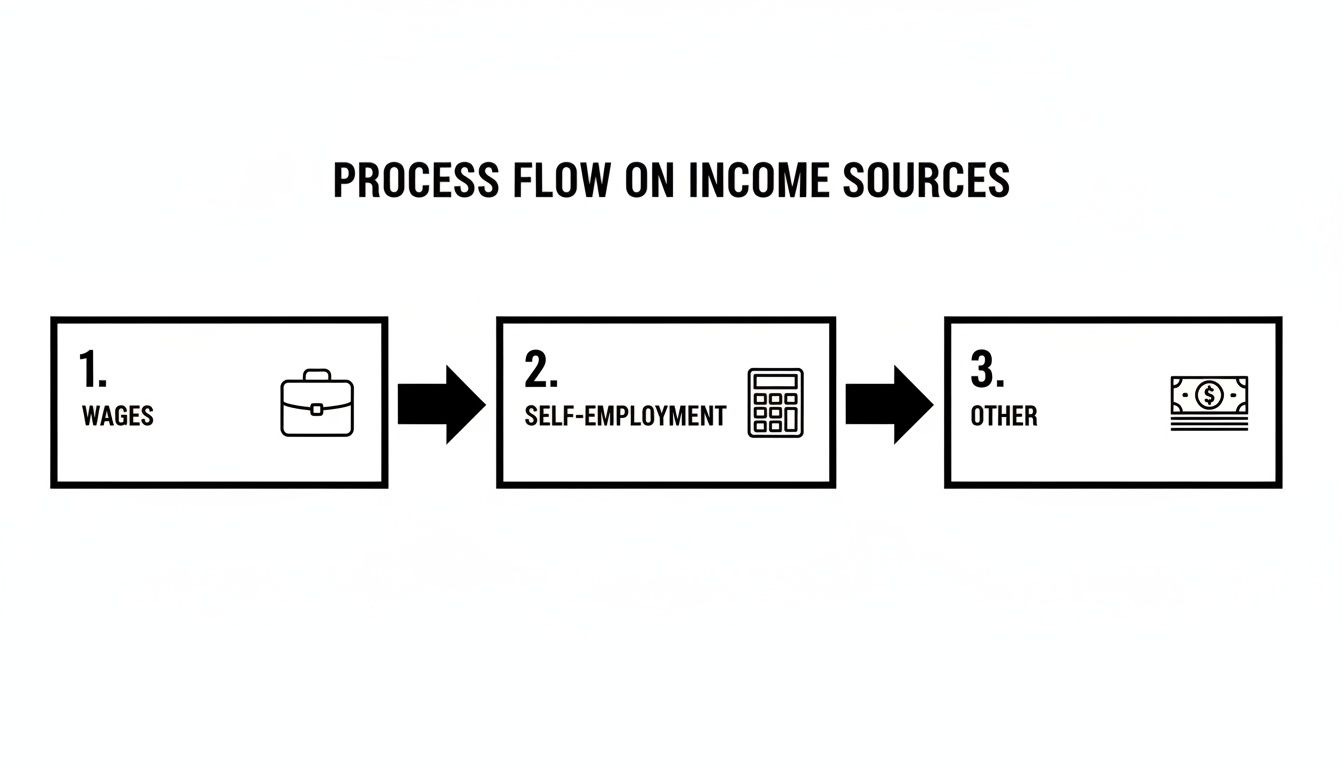
As you can see, Texas law demands a comprehensive look at all available financial streams—from traditional W-2 paychecks to business earnings—before any deductions are made.
What Deductions Are Allowed in Texas
The Texas Family Code is very specific about what can be subtracted from gross income to arrive at the all-important net resources figure. It’s a common mistake to think all of your real-world expenses count. Things like car payments, rent, or credit card bills are not on the list of allowable deductions.
Here are the primary deductions allowed under Texas law:
- Federal Income Taxes: This is not what appears on a paystub. It’s a standardized calculation based on the tax rate for a single person claiming one personal exemption and the standard deduction.
- Social Security and Medicare Taxes (FICA): These are the mandatory taxes withheld from a paycheck. For self-employed individuals, it’s the full self-employment tax.
- State Income Tax: Since Texas has no state income tax, this is not applicable here.
- Union Dues: If union membership is a mandatory condition of employment, these dues can be deducted.
- Health Insurance Premiums for the Child(ren): The actual amount the parent pays out-of-pocket to cover the child’s health and dental insurance is deductible.
The reason for the standardized tax calculation is to ensure fairness. It doesn’t matter how a parent chooses to file their taxes or what voluntary deductions they take from their paycheck; everyone begins on a level playing field.
A Real-World Calculation Example
Let’s walk through this with a practical scenario. Imagine a non-custodial parent, Alex, who earns a gross monthly income of $7,000. We need to apply the allowable deductions to determine Alex’s net resources.
To illustrate, let’s break down the math from Alex’s gross income to the final net resources number used for the child support calculation.
Sample Calculation from Gross Income to Net Resources
| Income or Deduction Item | Example Amount | Explanation |
|---|---|---|
| Gross Monthly Income | $7,000.00 | Alex’s total earnings before any deductions. |
| Federal Income Tax | ($850.00) | Based on a standardized rate (single, 1 exemption). |
| FICA Taxes (Soc. Sec. & Medicare) | ($535.50) | Mandatory payroll taxes on Alex’s earnings. |
| Health/Dental Insurance for Child | ($200.00) | The amount Alex pays for the child’s coverage. |
| Mandatory Union Dues | ($50.00) | Required for Alex’s employment. |
| Monthly Net Resources | $5,364.50 | The final number used for guideline support. |
After subtracting the allowable deductions ($7,000 – $850 – $535.50 – $200 – $50), we find Alex’s monthly net resources are $5,364.50. This is the figure that will be plugged into the Texas guidelines in the next step.
Understanding the Statutory Cap on Net Resources
Texas law includes a special rule that directly impacts high-income earners: the “statutory cap.” There is a maximum amount of net resources that is typically considered when applying the standard guideline formula.
As of the latest adjustments, this cap is set at $9,200 in monthly net resources. This means that, for most cases, the guideline percentages will be applied to the first $9,200 of net resources—even if the parent earns significantly more.
So, if a parent has net monthly resources of $15,000, the standard calculation will generally be based on the $9,200 cap, not the full $15,000. This is a critical detail in high-net-worth divorce cases, and it’s important to understand how Texas courts approach these situations. You can discover more about how high-income families are handled in child support determinations to see the broader legal context.
However, a judge is not strictly bound by this cap. They can order support above the guideline amount if there is clear evidence that the child’s proven needs justify it, such as private school tuition, specialized medical care, or extensive extracurricular activities. The cap serves as a baseline, not an absolute ceiling, to ensure the child’s lifestyle can be appropriately maintained.
Applying the Texas Guideline Percentages
Now that you have determined the monthly net resources figure, you have reached the heart of the Texas child support formula. This is where we take that number and apply the state’s official guideline percentages to calculate the baseline monthly support obligation. It is a straightforward, math-based step, but getting it right is absolutely critical.
The Texas Family Code provides a clear schedule of percentages based on the number of children the paying parent is responsible for in this specific case. The logic is simple: the more children involved, the higher the percentage of net resources that goes toward their care.
The Guideline Percentages for Child Support
The percentages are tiered, which creates a predictable and consistent framework for every family. In fact, Texas courts start with the presumption that applying these specific guidelines is in the best interest of the children.
Here is the standard breakdown:
- 1 Child: 20% of Net Resources
- 2 Children: 25% of Net Resources
- 3 Children: 30% of Net Resources
- 4 Children: 35% of Net Resources
- 5 Children: 40% of Net Resources
- 6 or More Children: At least 40% of Net Resources
This percentage-of-income model is the standard for Texas families. As laid out in Texas Family Code §154.125, these guidelines are a core component of Texas family law. You can read more about the framework behind these child support calculations if you’re interested in the policy behind the numbers.
Let’s return to our example. Alex has monthly net resources of $5,364.50. If Alex has two children with his former spouse, we simply apply the 25% guideline.
Calculation: $5,364.50 x 0.25 = $1,341.13
So, the baseline monthly child support obligation for Alex would be $1,341.13. This is the starting point before we factor in other key costs like health insurance.
How Other Children Affect the Calculation
Life is not always simple, and many parents have support obligations to children from different relationships. The Texas Family Code recognizes this reality and has a built-in mechanism to divide a parent’s resources fairly among all of their children.
If the paying parent is legally obligated to support another child who is not part of the current case, the percentage they pay is reduced. This isn’t a “discount”—it’s an adjustment to reflect their total responsibility. The court uses a different, slightly lower set of percentages for these situations.
This adjustment is only available if the parent is actually paying support for the other child, either through a court order or another formal agreement. Simply having another child does not automatically qualify you for the reduction.
For instance, let’s say Alex had one other child from a previous relationship for whom he was already paying court-ordered support. If he has two children in the current case, the guideline percentage would drop from 25% down to 22.50%.
New Calculation: $5,364.50 x 0.2250 = $1,207.01
This adjustment ensures the calculation is equitable when a parent is supporting multiple families. It prevents the system from demanding more than is reasonable from their income, ensuring all of their children receive support. Navigating these multi-family calculations can be complex, and working with an attorney can help ensure you apply the correct percentages for your unique circumstances.
Factoring In Health Insurance and Other Real-World Costs
The guideline amount we just calculated is the starting line, not the finish line. A proper Texas child support order must account for the actual, tangible costs of raising children, including significant expenses like health insurance and childcare.
These expenses are typically added on top of the base support amount. This is how Texas law ensures both parents contribute to necessities, which represent a large portion of the monthly budget for many families.

Health and Dental Insurance
The Texas Family Code is very clear: the court must ensure the children have medical and dental coverage. Usually, one parent is ordered to maintain the children on their insurance plan, typically whoever has the most affordable or comprehensive coverage available through their employer.
Here’s the important part: the parent paying the monthly insurance premium receives a credit. The amount they pay for the children’s portion of the premium is treated as a deduction from their gross income before the support percentage is applied. This prevents them from paying for insurance and then paying support on that same money. To get a general idea of typical expenses, you can look at average family health insurance costs for perspective.
Let’s go back to Alex. We calculated his baseline support at $1,341.13. The $200 he pays monthly for his children’s health insurance was already subtracted from his gross income when we calculated his net resources, ensuring he receives proper credit.
Splitting Necessary Childcare Costs
Daycare is another massive—and often non-negotiable—expense for working parents. If the custodial parent needs childcare to work or attend school, the court will almost always order that cost to be shared.
Here’s how that works in practice:
- The judge must first agree that the childcare is both reasonable and necessary.
- Most often, the cost is split 50/50.
- In some cases, a judge may divide it proportionally based on each parent’s income.
This shared cost is an additional payment on top of the base child support. If daycare costs $800 per month, the non-custodial parent might be ordered to pay their $400 share directly to the other parent or the daycare facility, completely separate from their regular monthly support payment.
Special Needs and Other Extraordinary Expenses
Sometimes, the standard guideline amount is insufficient. A child may have unique needs that come with significant costs. In these situations, Texas judges have the authority to order support above the standard guidelines to cover these “extraordinary expenses.”
This can include a wide range of needs, such as:
- Therapies or medical treatments for a child with a disability.
- Private school tuition, especially if the child was already attending.
- High-cost extracurriculars like competitive travel sports or specialized arts programs.
- Tutoring or other educational support for a child with learning challenges.
A word of caution: A judge will require proof. You need to come prepared with solid evidence—invoices, receipts, or letters from doctors and teachers—to show that these expenses are necessary and in your child’s best interest.
What About 50/50 Custody?
One of the most common questions we hear is, “If we have a 50/50 schedule, does that mean no one pays child support?” The short answer is no. Even with an equal possession schedule, a Texas court will still calculate child support based on the guideline formula.
However, a 50/50 schedule is a powerful reason for a judge to deviate from the standard guideline amount. If you can show that you are directly providing a home, meals, and other necessities for the child half of the time, a judge may reduce your support payment to reflect those contributions. It is not an automatic discount, but it is a strong argument for a more customized and fair support order.
When Judges Can Deviate from the Standard Formula
The Texas child support formula provides a solid, predictable baseline, but life is rarely one-size-fits-all. A judge in Texas has the authority to order child support that is either higher or lower than the guideline calculation. This occurs when the specific facts of a case make it clear that a different amount is truly in the child’s best interest. It is the court’s way of ensuring the final order is fair for the unique reality of your family.
This power is not used lightly. Texas Family Code § 154.123 outlines a specific list of factors a judge must consider before deviating from the guidelines. The parent requesting the change—whether an increase or decrease—must prove that the standard guideline amount would be “unjust or inappropriate” for their particular situation.
Factors a Judge Will Consider
When a judge is weighing whether to adjust the support amount, they will examine the details of your family’s life. Knowing what they look for can help you build a much stronger argument if you believe your case warrants an exception.
Here are some of the most common factors a judge will consider:
- The Age and Needs of the Child: A teenager involved in competitive sports or a toddler in full-time daycare costs significantly more than a self-sufficient elementary schooler. The court looks at real-world needs.
- The Parents’ Ability to Provide Support: The judge assesses the complete financial picture of both parents, including not just paychecks but also earning potential, assets, and debts.
- Time and Access to the Child: If the paying parent has the children for substantially more time than a standard schedule—like a true 50/50 split—a judge may lower the support amount because that parent is already covering more direct costs.
- Travel Costs for Visitation: When parents live far apart, the cost of flights or long drives for visitation can be substantial. A court may adjust the support to help offset that financial strain.
For instance, a child with a chronic illness requiring specialized medical equipment and frequent therapy is a classic example. In that case, a judge would almost certainly order support above the guideline amount to cover those proven, necessary expenses.
Proving the Need for a Different Amount
Simply asking for a different amount is not enough. You must support your request with hard evidence. If you believe your circumstances demand a deviation, you will need to come to court with financial records, receipts, logs, and clear testimony that directly supports your claim. For example, if you are arguing for lower support due to high travel costs, be prepared to show flight receipts and mileage logs to the judge.
The legal bar for deviating from the guideline amounts for child support is high because courts presume the formula is fair. However, with the right evidence and a clear explanation of your family’s circumstances, you can achieve an outcome that better reflects your reality.
Answering Your Top Texas Child Support Questions
When you’re trying to figure out child support, many specific questions arise. It’s completely normal. To provide some quick clarity, we have compiled answers to some of the most common questions we hear from parents in your situation.
How Long Does Child Support Last in Texas?
In Texas, the obligation to pay child support typically lasts until the child turns 18 or graduates from high school, whichever occurs last.
There is a significant exception: if a child has a disability requiring substantial care, a court can order support payments to continue indefinitely. This ensures they have the financial resources they need throughout their life.
What Happens If the Paying Parent Loses Their Job?
Life is unpredictable, and job loss is a real concern. It is important to know that losing a job does not automatically stop the child support obligation. The court-ordered amount remains legally due.
However, a job loss is considered a “material and substantial change in circumstances.” This is a valid reason to file a petition to modify the support order. The court can then adjust the payment amount to reflect the parent’s new, lower income. The key is to act quickly and file that modification request to prevent arrears from accumulating.
Is Child Support Taxable Income?
This is a common point of confusion, but the answer is straightforward. For the parent who receives the payments, child support is not considered taxable income by the IRS.
Conversely, the parent paying child support cannot deduct those payments from their taxes. It is best to think of it not as income, but as a transfer of funds designated for the child’s well-being.
Can We Just Agree on Our Own Child Support Amount?
Yes, parents can work together to agree on a child support amount that fits their unique situation, even if it differs from the state guidelines.
However, a judge must approve your agreement. The court’s primary concern is always what is in the best interest of the child. If your agreed-upon amount is significantly lower than the guideline calculation, the judge will require a compelling reason to approve it to ensure the child’s needs are adequately met.
If you need help navigating divorce, custody, or estate planning in Texas, contact The Law Office of Bryan Fagan, PLLC today for a free consultation at https://www.bryanfagan.com.