
Divorce can be one of life’s most difficult transitions—but understanding your rights under Texas law can make it less overwhelming. When you’re facing divorce in Texas, one of the first and most significant forks in the road is deciding whether your path will be contested or uncontested. This single choice dramatically shapes the entire experience, influencing everything from the timeline and cost to the emotional toll on your family.
Understanding Your Divorce Path: Contested vs. Uncontested
Divorce is an intensely personal journey, and understanding your options is the first step toward regaining a sense of control. The most fundamental choice you and your spouse will make is whether you can work together to resolve issues amicably or if you’ll need a judge to step in and make the decisions for you.

This decision boils down to your ability to reach a complete consensus on all key issues. Under the Texas Family Code, you both must agree on:
- Property Division: How will you split the community property—all assets and debts you accumulated during the marriage—in a way that is “just and right”?
- Child Custody and Visitation: Who will have the right to make major decisions for the children, and what will the possession schedule look like to ensure their stability?
- Child Support: What is the appropriate amount of financial support to ensure your children’s needs are met, following Texas guidelines?
- Spousal Support (Maintenance): Will one of you provide financial support to the other after the divorce is final, and if so, for how long?
If you can come to a mutual agreement on every single one of these points, you are on the path to an uncontested divorce. If even one issue remains a point of conflict, your case is considered contested, and it will proceed through the court system.
Key Differences At a Glance: Contested vs. Uncontested Divorce
To get a clearer picture of what each path entails, it helps to see them side-by-side. This table breaks down the practical implications of an agreed-upon divorce versus a disputed one.
| Factor | Uncontested Divorce (Agreed) | Contested Divorce (Disputed) |
|---|---|---|
| Decision-Making | You and your spouse retain control over every outcome. | A judge makes the final decisions on any unresolved issues. |
| Timeline | Much faster. Often finalized shortly after Texas’s mandatory 60-day waiting period. | Can extend for months, sometimes years, through litigation. |
| Cost | Significantly lower. Fewer legal fees and court costs. | Far more expensive due to discovery, multiple hearings, and a potential trial. |
| Emotional Impact | Generally less stressful and more amicable for the entire family. | Often becomes adversarial, leading to intense stress and conflict. |
| Privacy | Your financial details and personal agreements remain largely private. | Your personal and financial life can become part of the public court record. |
At the end of the day, this comparison highlights the practical realities of each choice.
The core distinction comes down to who holds the power to decide your family’s future. In an uncontested divorce, you and your spouse are the architects of your own settlement. In a contested divorce, you hand that power over to a judge who must rule based on Texas law.
Ultimately, the goal is to find a resolution that allows you and your family to move forward. For a deeper dive into the specific steps involved, you can learn more by navigating the divorce process in Texas. Understanding these initial steps is vital for making an informed decision.
The Uncontested Divorce: A Step-by-Step Guide
Deciding on an uncontested divorce means you and your spouse are choosing a path of cooperation over conflict. This approach puts you both in the driver’s seat, paving the way for a more predictable, peaceful, and cost-effective resolution. While it requires a full agreement on every issue, the process itself is structured and follows a clear legal map in Texas.

Think of this guide as your roadmap. We’ll demystify the legal journey and show you how working together can lead to a far less stressful outcome. Let’s walk through the essential stages, from that first filing to the final signature from the judge.
Step 1: Filing the Original Petition for Divorce
The uncontested divorce process officially begins when one spouse, known as the Petitioner, files an Original Petition for Divorce with the court. This foundational document informs the court about the basic facts of your marriage, your children (if any), and the legal grounds for the divorce.
Even when everything is agreed upon, one person has to initiate the case. The other spouse, the Respondent, must then be formally notified. To keep the process amicable and avoid having a constable “serve” papers, the Respondent can simply sign a Waiver of Service, acknowledging receipt of the petition and agreeing to participate in the case.
Step 2: The Mandatory 60-Day Waiting Period
Texas law includes a built-in pause. Under Texas Family Code § 6.702, a judge cannot grant a divorce until at least 60 days have passed since the Petition was filed.
This “cooling-off” period gives couples a final chance to reflect on their decision and be certain that reconciliation is not possible. It also provides the perfect window of time to finalize the details of your settlement.
During these two months, you and your spouse—ideally with your attorneys guiding you—will translate your verbal understandings into a formal, legally binding document.
Step 3: Drafting the Final Decree of Divorce
The Final Decree of Divorce is the single most important document in your case. It is a comprehensive legal order that outlines every detail of your settlement. Once a judge signs it, its terms become enforceable law.
This is where your agreements become concrete. Let’s look at a couple of real-world scenarios:
- Property Division Scenario: Imagine a couple agrees to split a 401(k). The Final Decree will specify the exact percentage each spouse receives. It will also include the necessary language for a Qualified Domestic Relations Order (QDRO), a separate legal instrument required to divide retirement funds without triggering significant tax penalties.
- Child Custody Scenario: Say parents agree on joint managing conservatorship, but one parent will have the exclusive right to determine the child’s primary residence. Their decree will lay out a detailed possession schedule—including specific drop-off times and holiday rotations—creating a clear and enforceable parenting plan.
Drafting a precise, thorough decree is non-negotiable. While it may seem tempting to handle this yourself to save money, it’s critical to understand the hidden risks of a DIY divorce in Texas. An improperly worded decree can lead to significant legal and financial problems down the road.
Step 4: The Final Prove-Up Hearing
Once the 60-day waiting period is over and both you and your spouse have signed the Final Decree, the last step is a brief, informal court appearance called a “prove-up” hearing. It’s much less intimidating than it sounds. Typically, only one spouse needs to attend with their attorney.
At this hearing, the attorney will ask a short series of standard questions to confirm for the record that all legal requirements have been met and that the settlement is fair. The judge will then review the decree, sign it, and at that moment, your divorce is officially final.
When you and your spouse cannot find common ground on critical issues—like who gets the house or how you’ll co-parent your children—the divorce becomes contested. This simply means the court system will need to intervene and make the final decisions for you.
While that path can sound intimidating, understanding the process can significantly reduce the anxiety. A contested divorce isn’t a personal failure; it’s a structured legal process designed to protect your rights and ensure a fair outcome when you can’t reach an agreement on your own.

Because it involves several formal legal stages, the journey of a contested divorce is more complex and takes longer. Each step exists to gather information, address immediate needs, and provide opportunities to settle before a trial becomes necessary. Here is what you can expect.
The Initial Filing and Discovery Phase
The process begins the same way as an uncontested case: one spouse files an Original Petition for Divorce. But since there’s no agreement, the other spouse will be formally served with the lawsuit and must file a legal response, known as an Answer. At this point, the case is officially contested. For a closer look at this first critical document, you can learn more about what an Original Petition for Divorce entails.
Next, the case moves into the discovery phase. This is the formal information-gathering stage where you and your spouse, through your attorneys, exchange evidence related to the disputed issues. This formal legal process can include:
- Requests for Production: Asking the other party for financial documents like bank statements, tax returns, and property deeds.
- Interrogatories: Sending written questions that must be answered under oath.
- Depositions: Conducting formal, in-person interviews under oath with your spouse or other key witnesses.
Discovery ensures both sides have the same set of facts, preventing surprises at trial and often laying the groundwork for a settlement once all information is on the table.
Temporary Orders and Mediation
Contested divorces can take many months, sometimes longer, but life doesn’t pause. Who pays the mortgage? Where will the children stay during the week? A Temporary Orders Hearing addresses these urgent questions.
A judge can issue temporary orders that establish rules for the duration of the divorce. These orders can cover who remains in the family home, a temporary child custody schedule, and the payment of temporary child or spousal support, creating stability while the case proceeds.
A common misconception is that a contested divorce always ends in a dramatic courtroom trial. In reality, Texas courts require couples to attend mediation before a final trial date can even be set.
Mediation is a confidential meeting where a neutral third-party mediator helps you and your spouse negotiate a settlement. It is an incredibly effective tool. The vast majority of contested cases are resolved either during mediation or shortly thereafter, saving everyone the immense cost and emotional drain of a trial.
How Judges Make Decisions in a Contested Case
If mediation is unsuccessful and you cannot reach an agreement, a judge will make the final decisions based on Texas law. They are bound by specific legal standards designed to ensure a fair outcome.
- Property Division: The Texas Family Code requires a judge to divide your community property in a manner that is “just and right.” This does not always mean a 50/50 split. A judge will consider factors like fault in the breakup of the marriage, each spouse’s earning capacity, and the children’s needs when determining a fair division.
- Child Custody: When it comes to children, the judge’s sole guiding principle is the “best interest of the child” (Texas Family Code § 153.002). They will weigh numerous factors—the child’s emotional and physical needs, each parent’s stability, and any history of family violence—to create a parenting plan they believe serves that best interest.
Ultimately, a contested divorce places the power to decide your family’s future in a judge’s hands, which is why working toward an agreement is so valuable whenever possible.
The Real Costs of a Texas Divorce: Money, Time, and Peace of Mind
The path you choose—contested or uncontested—doesn’t just change a few legal steps; it completely reshapes the divorce experience for you and your family. The differences impact your wallet, your calendar, and your emotional well-being in profoundly different ways. Understanding these real-world consequences is one of the most important things you can do as you decide how to move forward.
The Financial Fallout: Predictable vs. Unpredictable Costs
The bottom line is often the starkest difference. An uncontested divorce is financially predictable. Because you and your spouse have already negotiated the terms, the legal work is primarily about drafting paperwork correctly and following Texas procedures. This often allows for a more controlled, flat-fee arrangement with your attorney.
A contested divorce, on the other hand, is a financial wild card. Costs can escalate quickly. Every disagreement that requires a formal motion, every discovery request, and every hour your attorney spends preparing for a hearing adds to the final invoice.
The expenses in a contested case often extend beyond attorney’s fees. When you cannot agree on major issues, you may need to hire outside experts to build your case, including:
- Forensic Accountants: Essential for tracing hidden assets or valuing a complex family business.
- Property Appraisers: Needed to determine the fair market value of your home or other significant assets.
- Custody Evaluators: A neutral professional appointed by the court to investigate the family situation and recommend a custody arrangement that is in the children’s best interest.
These experts can add thousands, or even tens of thousands, of dollars to your total cost. The gap between the two paths is massive. According to recent family law statistics, the average uncontested divorce in Texas costs around $4,100. A contested divorce averages $12,900—more than three times as much. Tellingly, over 95% of divorces eventually settle as uncontested, which shows that most couples find a way to agree before enduring a full trial. You can explore more family law statistics and trends to see the full picture.
The Timeline: A Sprint vs. a Marathon
Time is another resource spent very differently. An uncontested divorce is designed for efficiency.
After you file the initial petition, Texas law mandates a 60-day waiting period. If you have your Final Decree of Divorce signed and ready on day 61, your divorce can be finalized then and there. Most uncontested cases conclude within 60 to 90 days.
A contested divorce operates on a much longer clock. Its timeline is dictated by crowded court dockets, legal strategy, and the complexity of litigation. It’s not unusual for a contested divorce to last 12 to 18 months, and some can extend even longer if the conflict is particularly high.
This prolonged timeline can leave your life in limbo, making it incredibly difficult to heal and move forward.
The Unspoken Cost: The Emotional Toll
This may be the most important difference of all. While never easy, an uncontested divorce is founded on cooperation. It allows you and your spouse to end your marriage with dignity and respect, which is absolutely critical if you will be co-parenting for years to come.
A contested divorce is, by its nature, an adversarial process. It can feel like a public battle, pitting you against your spouse in a system designed for conflict. The stress, uncertainty, and constant fighting can leave deep, lasting emotional scars on everyone involved—especially the children.
Choosing the path that minimizes this conflict is often the greatest gift you can give yourself and your children during one of life’s most challenging transitions.
How Each Path Shapes Your Future: Property and Children
Your divorce decree isn’t just a legal document—it’s the blueprint for your family’s future. The choices made about your finances and children will resonate for years. The path you take to get there, contested or uncontested, fundamentally changes who gets to make those choices.
The heart of the matter comes down to one simple word: control. One path lets you and your spouse keep control, while the other forces you to hand it over to a judge.
Property Division: Your Agreement vs. a Judge’s Order
In an uncontested divorce, you and your spouse are the architects of your new financial lives. You work together to create a property settlement that you both can live with—one that is fair and practical for your specific situation.
This approach allows for a level of creativity and personal consideration that a courtroom cannot match. For example:
- Keeping the Family Home: You might agree that one spouse keeps the house, perhaps in exchange for a larger share of a retirement account. This is a common solution focused on providing stability for the children.
- Dividing a Business: Instead of a court-ordered sale, you could create a buyout plan over several years, preserving a family business that you both built.
- Splitting Personal Items: You can divide sentimental items like art, photos, or family heirlooms based on personal meaning rather than their market value.
That control vanishes in a contested divorce. A Texas judge is required to divide your community estate in a way that is “just and right,” but their interpretation of that standard might be vastly different from yours. A judge doesn’t know your family’s history, your priorities, or the story behind your most cherished possessions.
This can easily lead to outcomes neither of you wanted. A judge might view the family home as just another asset on a spreadsheet and order it sold, with the proceeds split—even if both of you hoped one parent could remain there with the children.
Child Custody: Who Defines Your Children’s Best Interests?
Nowhere is the loss of control more painful than in decisions about your children. The Texas Family Code is clear: all custody decisions must be made in the “best interest of the child” (Texas Family Code § 153.002). In an uncontested divorce, you and your co-parent define what that means for your family.
You know your children’s personalities, schedules, and needs better than anyone. This allows you to create a detailed Parenting Plan that works for your real lives. You can build in specific, flexible arrangements for things like:
- Unique work schedules for nurses, firefighters, or anyone working shifts.
- Clear agreements on paying for extracurriculars and planning vacations.
- A thoughtful plan for how and when to introduce new significant others to the children.
When a judge must make these decisions in a contested case, you often end up with a standardized Standard Possession Order. While designed to be fair, it is generic by nature. It may not fit your family’s unique rhythm, which can lead to constant friction and the need to return to court for modifications.
The adversarial process of a contested custody fight can also be incredibly damaging. As you consider the effects of divorce on children, it’s critical to remember that the significant impact of parent-child relationships on a child’s mental health is well-documented.
Ultimately, the uncontested path empowers you to shield your children from courtroom conflict and build a stable co-parenting relationship from day one. It puts cooperation ahead of conflict, setting a healthier tone for your family’s next chapter. While it isn’t always possible, retaining control over these life-altering decisions is one of the biggest reasons to work toward a full agreement.
If you need help navigating divorce, custody, or estate planning in Texas, contact The Law Office of Bryan Fagan today for a free consultation.
Choosing the Right Path for Your Situation
Deciding how to move forward with your divorce is one of the biggest choices you’ll make during this life transition. It’s more than just a legal question; it’s a strategic decision that will shape your family’s future. The right path for you depends entirely on your unique circumstances, the communication dynamics with your spouse, and the level of trust that still exists between you.
An uncontested divorce is the ideal route when you and your spouse are on the same page and can work together respectfully. If you can communicate openly and agree on all the major issues—from property division to parenting plans—this collaborative approach is faster, more affordable, and far less stressful. It keeps you in the driver’s seat.
When a Contested Divorce is Necessary
The reality, however, is that cooperation isn’t always possible or even safe. In high-conflict situations, a contested divorce becomes essential to protect your rights and your children’s well-being.
You should seriously consider the contested path if your situation involves any of the following:
- Hidden Assets: You suspect your spouse isn’t being honest about their finances or is actively hiding money.
- Domestic Violence: Your safety and your children’s safety must come first, which often requires court intervention.
- Substance Abuse: Addiction issues could endanger your children or create serious financial instability.
- Major Disagreements: There are deep, unresolvable conflicts over child custody, spousal support, or who gets to keep the family home.
This flowchart helps visualize the core difference. In an uncontested divorce, you and your spouse hold the power to decide. In a contested case, that power is handed over to a judge.
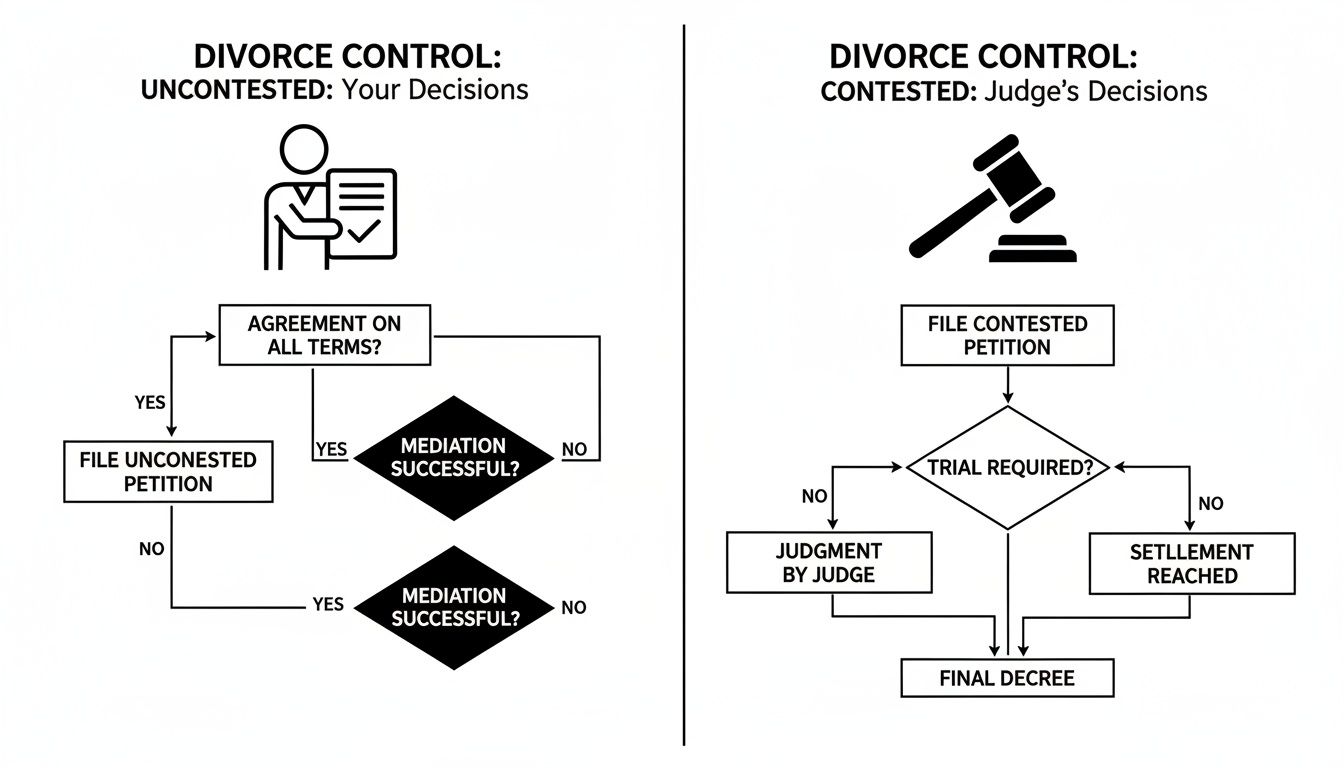
As the graphic shows, the primary distinction is who ultimately makes the final, life-altering decisions for your family.
It’s crucial to understand that starting on the contested path doesn’t mean you’re destined for a trial. In Texas, mediation is a required step, and the vast majority of contested cases reach a settlement before ever seeing the inside of a courtroom.
Going the contested route simply provides the legal framework needed to get to a fair outcome when you can’t get there on your own. It gives you the tools to demand financial transparency and protect your family’s best interests.
If you need help navigating divorce, custody, or estate planning in Texas, contact The Law Office of Bryan Fagan today for a free consultation.
Your Top Questions About Divorce in Texas
When you’re facing a divorce in Texas, questions can pile up quickly. We hear many of the same concerns from people just like you, so we want to provide clarity on a few of the most common ones to help you move forward with confidence.
Can a Contested Divorce Become Uncontested?
Absolutely, and it happens all the time. A divorce might begin as contested due to one or two major disagreements, but that doesn’t mean you are destined for a courtroom battle.
Most couples, through negotiations between their attorneys or during the mandatory mediation process, find common ground. Once you have reached an agreement on every single issue, the case can shift gears and proceed as an uncontested divorce. This pivot saves everyone a significant amount of time, money, and emotional energy.
What Is a Default Divorce?
A default divorce occurs when one spouse files the Original Petition for Divorce and properly serves the other spouse (the Respondent), but the Respondent fails to file a formal answer with the court within the legally required time.
If the other party does not respond, the Petitioner can ask the judge to finalize the divorce based on the terms requested in the petition. While this is technically a type of uncontested divorce, it requires strict adherence to legal procedure. It is not something you should attempt without experienced legal guidance.
Do I Still Need a Lawyer for an Uncontested Divorce?
While you can legally represent yourself, we strongly advise against it. Think of it this way: a Final Decree of Divorce is not just a form to fill out; it’s a powerful, legally binding contract that dictates the future of your property, your finances, and your children.
An experienced family law attorney ensures that the decree is drafted without loopholes, that your rights are fully protected, and that you are not making a costly mistake that you will have to pay another lawyer to fix down the road. That professional guidance provides peace of mind, knowing your agreement is final and will hold up in court.
If you need help figuring out the best path forward—whether it’s a contested or uncontested divorce, a custody issue, or estate planning—contact The Law Office of Bryan Fagan, PLLC today. We offer a free consultation to discuss your specific situation.