Planning for your family’s future can feel like an immense responsibility, but you’re taking a vital first step just by exploring your options. At The Law Office of Bryan Fagan, we understand that you want to protect what you’ve worked so hard to build. In Texas, setting up a trust is one of the most effective strategies you can use to protect your assets, provide for your loved ones, and ensure your wishes are carried out exactly as you intend—often without ever needing to go to court.
Why a Texas Trust Is a Cornerstone of Modern Estate Planning
Thinking about the future naturally brings up many questions. The clients we work with often worry about what will happen to their home, their savings, and most importantly, their family. A well-structured Texas trust is much more than just a legal document; it’s a powerful tool that offers security, control, and genuine peace of mind during uncertain times.

Unlike a will, which must go through the public and often painfully slow probate process, a trust allows for a private and efficient transfer of your assets. This is a significant advantage for families in Houston, Dallas, and across Texas who value their privacy and want to spare their loved ones unnecessary stress during an already difficult time.
The Core Benefits of a Trust
A trust is built to fit your unique family situation, offering protections that a simple will cannot match. It provides a clear, actionable framework for managing your legacy.
Here’s a practical look at the key benefits:
- Avoiding Probate: A properly funded trust keeps your estate out of the Texas probate courts, a process governed by the Texas Estates Code. This saves your family significant time, money, and administrative headaches.
- Maintaining Family Privacy: Once a will is filed for probate, it becomes a public record. A trust is a private document, keeping your financial affairs and family matters confidential.
- Protecting Your Beneficiaries: You set the rules. You can specify exactly how and when assets are distributed, which is ideal for safeguarding inheritances for minor children or loved ones who may not be ready to manage a large sum of money.
- Planning for Incapacity: Life is unpredictable. If you become unable to manage your own finances, your chosen successor trustee can step in seamlessly, avoiding the need for a court-appointed guardianship.
Long-Term Asset Protection
Beyond these immediate benefits, a trust acts as a critical shield for your hard-earned assets. For many Texas families, a primary motivation for creating a trust is protecting assets from nursing home costs. This ensures your legacy is preserved for the next generation rather than being depleted by long-term care expenses.
An irrevocable trust, for example, can be structured to protect assets from creditors and other financial threats. It offers a layer of security that is simply not available with a will, making it an empowering and achievable way to secure your family’s future.
Texas Trust vs. Will: A Quick Comparison
So, what is the real difference between a trust and a will in Texas? While both are key estate planning tools, they function very differently. This table breaks down why a trust often provides a more robust and private solution for your family.
| Feature | How a Trust Handles It | Why It Matters in Texas |
|---|---|---|
| Asset Transfer | Assets pass to beneficiaries privately and outside of court. | Avoids the lengthy and public Texas probate process. |
| Privacy | The terms of the trust are completely confidential. | Keeps your family’s financial details out of public records. |
| Incapacity | A successor trustee can manage assets if you become unable. | Prevents the need for a costly court-ordered guardianship. |
| Control | You set specific conditions for when and how assets are distributed. | Protects young beneficiaries or those not ready for a large inheritance. |
| Asset Protection | Certain trusts can shield assets from creditors or long-term care costs. | Helps preserve your legacy for future generations. |
Ultimately, a trust gives you far more control and flexibility, ensuring your assets are managed and distributed exactly on your terms, without the public scrutiny and delays of the probate court.
Choosing the Right Type of Trust for Your Goals
When most people hear the word “trust,” they might imagine complicated legal documents meant only for the very wealthy. The reality is much simpler. A trust is a flexible tool designed to meet a wide range of family needs.
Think of it less like a rigid legal box and more like a custom-built container you design to protect your assets and your loved ones. The most important step is choosing the right type of container for your specific situation.
For most Texas families we work with, the first major decision is choosing between a revocable and an irrevocable trust. They each offer very different benefits, and understanding that difference is the first practical step in building an estate plan that truly works for you.
The Flexible Revocable Living Trust
By far, the most common type of trust we help clients establish is the Revocable Living Trust. Its primary advantage is its flexibility. As long as you are alive and have capacity, you retain total control.
You can serve as your own trustee, manage the assets just as you always have, and—most importantly—you can change or even completely dissolve the trust whenever you wish.
This makes it an incredibly practical tool in a few key situations:
- Avoiding Probate: When a revocable trust is properly funded, your assets can pass directly to your beneficiaries. This completely bypasses the public, often slow, and expensive Texas probate process.
- Planning for Incapacity: If you ever become unable to manage your own finances, the successor trustee you named can step in immediately. This avoids the need for a court to get involved and appoint a guardian.
- Maintaining Privacy: Because the trust keeps your estate out of probate court, all of its terms—and the assets it holds—remain a private family matter.
Let’s consider a relatable scenario. A Houston couple owns their home and several investment accounts. They want to ensure their two college-aged children inherit everything without any hassle. By placing those assets into a revocable living trust, they continue managing everything as usual. If one spouse passes away, the other continues managing the trust without interruption. When both have passed, their chosen successor trustee simply distributes the assets according to their written instructions, all without ever stepping foot in a courtroom.
The Protective Irrevocable Trust
On the other side is the Irrevocable Trust. This trust is permanent. Once you transfer assets into it, you generally cannot change the terms or retrieve the assets.
So, why would anyone give up that much control? The simple answer is powerful asset protection.
When you relinquish control, you legally remove those assets from your personal estate. This strategic move, guided by the Texas Estates Code, can shield those assets from creditors, lawsuits, and the staggering costs of long-term nursing home care.
For many families, the purpose of an irrevocable trust is to protect a legacy. It’s about ensuring that hard-earned assets are preserved for the next generation, instead of being wiped out by a lawsuit or long-term care bills.
Specialized Trusts for Unique Family Needs
Beyond these two main types, Texas law also allows for more specialized trusts. These are designed to solve very specific family challenges, from protecting vulnerable loved ones to preserving assets under unique circumstances.
Here are two of the most essential examples we encounter in our practice:
- Special Needs Trust (SNT): If you have a child or another loved one with a disability who depends on government benefits like Medicaid or SSI, an SNT is absolutely critical. Leaving them an inheritance directly could disqualify them from those vital programs. An SNT allows you to set aside funds for their quality of life—such as therapy, education, or recreation—without jeopardizing their benefits.
- Spendthrift Trust: This is the perfect tool for a beneficiary who might not be skilled at managing money. If you’re worried an heir might quickly spend their inheritance or lose it to creditors or in a divorce, a spendthrift trust puts a layer of protection in place. You appoint a trustee to manage the assets and make distributions according to your rules, which shields the inheritance from the beneficiary’s own financial troubles.
Choosing the right trust structure is the bedrock of your entire estate plan. The best choice depends entirely on your goals—whether you need flexibility day-to-day, ironclad asset protection for the future, or a specialized plan for a loved one.
How Texas Community Property Law Affects Your Trust
When you’re putting together an estate plan to protect your family, you have to work with the laws of your state, not against them. Here in Texas, one of the biggest legal principles that will shape your trust is our status as a community property state. This isn’t just a piece of legal trivia; it’s a foundational rule under the Texas Family Code that has a massive impact on how married couples must approach setting up a trust.
First, let’s clarify what this really means. Under Texas law, almost any asset, piece of property, or income earned by either spouse during the marriage is considered community property. This creates an equal, undivided ownership interest for both spouses in those assets—it doesn’t matter whose name is on the title or who earned the paycheck.
This concept of shared ownership becomes incredibly important when you start moving assets into a trust, especially an irrevocable one. You simply cannot transfer community property into a trust by yourself.
The Critical Role of Spousal Consent
Let me share a scenario we have seen before. A husband wants to do the right thing and sets up an irrevocable trust to protect the family home and a large investment account for their children. He signs all the paperwork and moves the titles into the trust’s name, believing he has secured his family’s legacy. But there’s a huge problem: because those assets were acquired and funded during the marriage, they are community property.
If he did all of this without getting his wife’s explicit, written consent, he has created a legal minefield. Legally, his wife still owns half of those assets. This kind of unilateral move could be viewed as a “fraud on the community,” which could lead to the trust being challenged—or even completely invalidated—down the road in a divorce or after his death. The very assets he was trying to protect are now at risk.
This is one of the most common and costly mistakes we see. A trust built on the shaky ground of improperly transferred community property is vulnerable from day one. Getting spousal consent isn’t just a good idea; it’s a legal requirement to ensure your trust is valid and will actually work when your family needs it to.
Distinguishing Separate from Community Property
So, how do you avoid this major pitfall? The key is to carefully and meticulously classify your assets before you fund the trust. This means clearly identifying what is considered separate property versus what is community property.
- Separate Property: This category typically includes anything you owned before the marriage. It also covers property you received during the marriage as a specific gift to you or an inheritance left only to you.
- Community Property: This is the default category for almost everything else acquired from the date of marriage until a divorce or death.
Making this distinction is absolutely crucial. You have the freedom to place your separate property into a trust without needing your spouse’s consent. But for any asset that falls into the community property category, getting that consent is non-negotiable. The principles are the same ones that apply in a divorce; for a deeper dive, you can learn more about the community property essentials for Texas divorces.
Setting up a trust in Texas demands a sharp understanding of these community property laws. They profoundly affect how assets are handled, a major consideration for the many high-net-worth individuals and families in Houston and the Dallas-Fort Worth area. If a spouse moves community assets into an irrevocable trust without consent, it can trigger disputes that put the entire plan at risk.
Ensuring your trust is legally sound from the very beginning starts with respecting these fundamental property rights.
Creating and Funding Your Trust: A Practical Walkthrough
Once you’ve settled on the right type of trust for your family and worked through the nuances of Texas community property law, it’s time to bring that trust to life. This is where legal theory meets practical action. Creating and funding a trust isn’t just about signing a document; it’s a deliberate process to make sure the structure you’ve designed will actually work when your family needs it most.
This part of the journey breaks down into two major phases: drafting the legal document and then giving it power by funding it with your assets.
Drafting the Trust Document with an Experienced Attorney
It can be tempting to use a generic template online, but setting up a trust in Texas is far too important for a one-size-fits-all solution. A trust is a sophisticated legal instrument that has to be drafted with absolute precision to be effective. An experienced estate planning attorney is key to translating your specific wishes into clear, legally enforceable language that holds up under the Texas Estates Code.
During this stage, you and your attorney will sit down and define several key elements:
- The Grantor: That’s you—the person creating the trust.
- The Trustee: The individual or institution you choose to manage the trust. You’ll also need to name a successor trustee to take over if you pass away or become incapacitated.
- The Beneficiaries: These are the loved ones who will ultimately receive the assets from the trust.
- The Distribution Terms: Here, you get to decide exactly how and when your beneficiaries receive their inheritance. You can set up distributions to happen at certain ages, upon hitting milestones like graduating college, or you can provide for ongoing support over time.
This document becomes the official rulebook for your legacy. Any vague language or legal errors can easily lead to confusion and family conflict, undermining the very peace of mind you were trying to create. Working with a professional ensures every detail is handled correctly.
This diagram gives you a simple overview of the main steps in the trust creation process, from identifying your property to funding the final document.
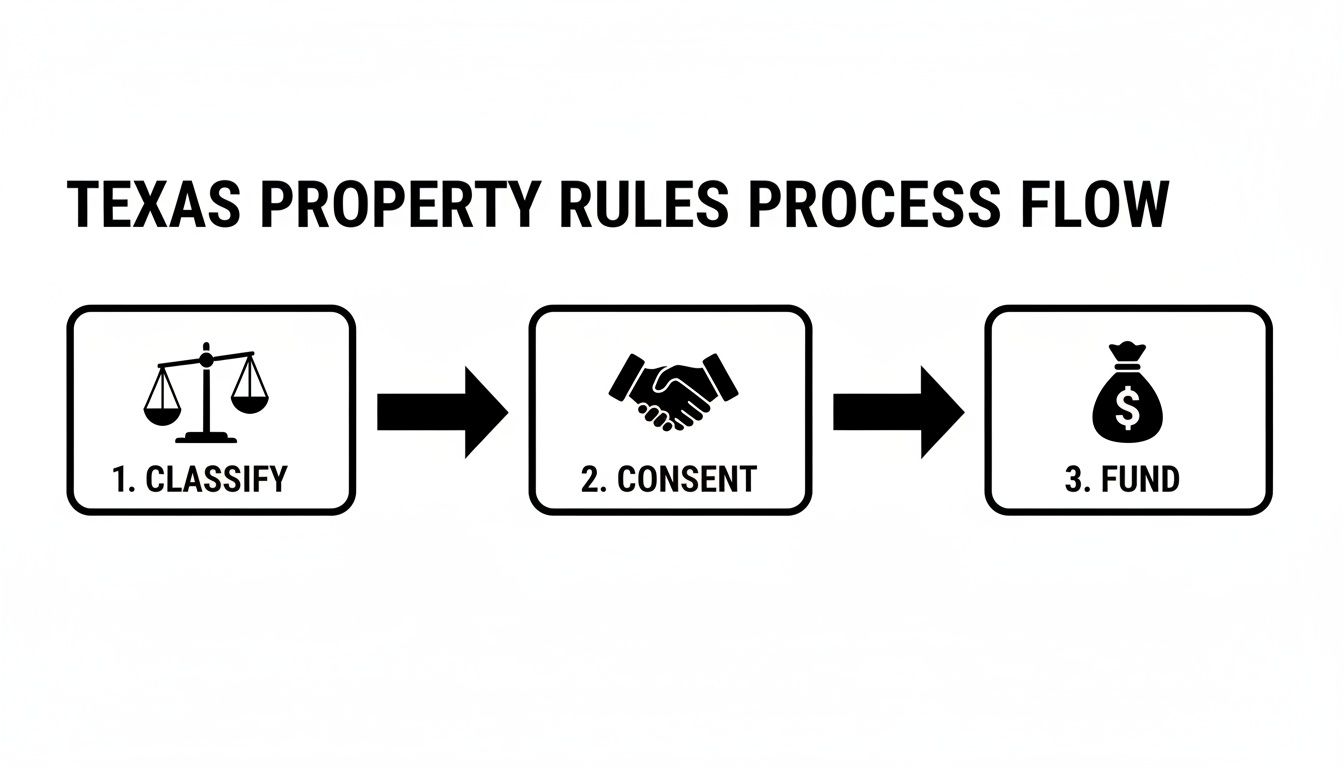
As you can see, each step—classifying your assets, getting your spouse’s consent for community property, and properly funding the trust—is absolutely essential for a legally sound and effective estate plan.
The Critical Step of Funding Your Trust
Here’s a hard truth we see far too often in our practice: an unfunded trust is nothing more than an expensive piece of paper. The trust document itself doesn’t automatically protect your assets. To make it work, you have to legally transfer your assets into the trust’s ownership. This process is called funding the trust, and it is without a doubt the single most important part of this whole process.
Think of your trust as a brand-new, empty box. Your job is to fill that box with all the assets you want it to protect. If you leave assets outside the box—still titled in your individual name—they will almost certainly have to go through the public probate process. This completely defeats one of the main reasons for creating the trust in the first place. These properly funded assets become non-probate transfers, which are assets that bypass the will and probate court.
It’s a common and heartbreaking mistake: a family believes they are protected by a trust, only to discover after a loved one’s death that the house or the main bank account was never actually moved into it. This simple oversight can force the family right back into the probate court system they tried so hard to avoid.
A Checklist for Funding Your Texas Trust
Funding requires changing the legal title of your assets from your name to the name of the trust. This looks a little different for various types of assets:
- Real Estate: You’ll need to sign a new deed that transfers ownership of your home or other properties from your name to the trust.
- Bank Accounts: You can either open brand-new accounts in the trust’s name or simply retitle your existing accounts.
- Investment Accounts: Your financial advisor can help you change the ownership of stocks, bonds, and mutual funds over to the trust.
- Business Interests: If you own a business, you’ll need to transfer your ownership interest—like LLC membership units or corporate stock—into the trust.
- Personal Property: For valuable personal items like art or jewelry, you can use a document called an “assignment of property” to formally transfer them to the trust.
This process demands meticulous attention to detail. Every single asset has to be correctly retitled to make sure it’s covered by the trust’s protections. A successful journey from creation to funding is what turns your trust into a powerful and reliable tool for your family’s future.
Selecting a Trustee and Their Fiduciary Duties
Of all the decisions you’ll make when setting up a trust, choosing the person or institution to manage it is easily one of the most important. This isn’t just an administrative role you’re filling. Your trustee is the guardian of your legacy, the one you’re empowering to carry out your exact wishes and protect your beneficiaries. It’s a profound responsibility, and the choice should not be made lightly.

Whoever you select needs a unique blend of integrity, financial common sense, and unwavering dedication. They are legally bound to act in the best interests of your beneficiaries, a duty that demands both diligence and a rock-solid moral compass.
Family Member vs. Corporate Trustee
It’s natural for most people to first consider naming a trusted family member—a responsible sibling, an adult child, or a lifelong friend. This can be a wonderful option. After all, they already have a deep, personal understanding of your family dynamics and your intentions for the trust.
However, you have to be realistic about what the job entails. Being a trustee involves a surprising amount of administrative work, from managing investments and property to filing taxes and keeping meticulous records. It can also place a loved one in a difficult position, forcing them to make financial decisions that might create tension with other family members.
The other route is to name a corporate trustee, such as a bank or a dedicated trust company.
- Pros: They bring professional expertise, complete impartiality, and a structured process for handling every aspect of the trust.
- Cons: They charge fees for their services, and you won’t have the same personal connection to your family that a loved one provides.
Sometimes, the best solution is a hybrid approach. You can appoint a family member and a corporate trustee to serve as co-trustees, which gives you the best of both worlds: personal insight combined with professional management.
The Fiduciary Duties of a Texas Trustee
Under the Texas Property Code, a trustee has a fiduciary duty to the trust and its beneficiaries. This is the single highest standard of care recognized by our legal system. It’s not a guideline—it’s a legally enforceable obligation to act with absolute loyalty and good faith.
A trustee’s actions are held to an incredibly high standard. They must put the interests of the beneficiaries above their own, manage assets prudently, and communicate transparently. Any failure to do so can result in personal liability.
Their core responsibilities are extensive and share common ground with the duties of an executor of a will in Texas. Key obligations include:
- Duty of Loyalty: The trustee must act solely in the best interest of the beneficiaries, without exception.
- Prudent Investor Rule: They are legally required to manage and invest the trust’s assets as a cautious, prudent investor would.
- Duty to Account: They have to keep detailed records of every transaction and provide regular, clear accountings to the beneficiaries.
- Duty to Distribute: They are required to distribute trust assets to the beneficiaries exactly as you specified in the trust document.
- Tax Responsibilities: The trustee is personally responsible for filing the trust’s tax returns each year.
The legal landscape in Texas makes this selection critical. State laws impose strict requirements that, if ignored, can undermine even well-intentioned plans. Trustees must meet age and residency standards for validity, while common errors like underfunding—seen in cases where less than 100% of intended assets are transferred—can cripple a trust’s purpose. Documentation lapses can lead to court challenges in 25-40% of disputes. For a comprehensive look at the obligations that follow, this guide details trustee responsibilities after death.
Common Mistakes to Avoid When Creating a Texas Trust
Creating a trust is a powerful, loving act to protect your family’s future. It’s a sign of foresight and care. But this process is also full of small details where a simple oversight can cause significant problems down the line. Knowing where others have stumbled is the best way to build a trust that is resilient, effective, and actually does what you want it to do.
One of the most frequent and damaging errors we see is people turning to generic, do-it-yourself trust templates they find online. We understand the temptation—they seem like a cheap and easy fix. But these one-size-fits-all documents are not built to handle the specifics of Texas law, especially our unique community property rules. Using a template is like trying to use a generic key for a custom-built lock; it simply won’t work and can leave your assets dangerously exposed.
The Critical Failure of Improper Funding
By far, the most heartbreaking mistake is failing to properly fund the trust. You can have a perfectly drafted legal document, meticulously prepared by a skilled attorney, but if you don’t legally transfer your assets into it, it’s just an empty shell. Your home, bank accounts, and investments must be legally retitled in the name of the trust.
An unfunded trust provides zero protection. It won’t help your family avoid the probate process you were trying to sidestep in the first place.
This isn’t a rare problem. Improper funding plagues countless DIY trusts in Texas. Anecdotal legal reports suggest that underfunding affects roughly 30% of these attempts, gutting any potential benefits like asset protection or Medicaid planning. With the business environment booming in Texas, as shown in recent U.S. Census Bureau data, more families have complex assets that need precise handling to avoid severe consequences in a divorce or estate dispute.
Vague Language and Outdated Plans
Another common pitfall is using unclear or ambiguous language in the trust document. If your instructions on how and when to distribute assets are vague, it’s a recipe for confusion and arguments among your beneficiaries. Your intentions should be spelled out with absolute clarity so your loved ones are not left guessing what you wanted.
Finally, a trust is not a “set it and forget it” document. Your life changes, and your trust should evolve right along with it.
A trust that was perfect for you five years ago may be completely inadequate today. Failing to update your plan after major life events is a silent mistake that can have loud consequences.
Certain life events should always trigger a trust review:
- A marriage or divorce
- The birth or adoption of a child or grandchild
- A significant change in your financial situation
- The death of a named beneficiary or trustee
Avoiding these common mistakes is absolutely essential when setting up a trust in Texas. Making sure your trust is professionally drafted, fully funded, and regularly updated is the only way to guarantee it provides the lasting protection and peace of mind your family deserves.
If you need help navigating divorce, custody, or estate planning in Texas, contact The Law Office of Bryan Fagan today for a free consultation.
Your Top Questions About Texas Trusts, Answered
When you start looking into estate planning, it’s natural for many questions to arise. Getting clear, straightforward answers is the first step toward feeling confident about your decisions. Here are some of the most common questions we hear from Texas families just like yours.
How Much Does It Cost to Set Up a Trust in Texas?
This is a very practical question. The honest answer is: it depends. The cost is directly tied to the complexity of your financial life and what you want the trust to accomplish. However, it helps to reframe the question—think of it not as a cost, but as an investment in your family’s future security.
For perspective, the expense of having a professional create your trust is usually a small fraction of what your family could end up paying in legal fees and court costs during the Texas probate process. Probate can easily consume 3-7% of an estate’s total value. Setting up a trust now is a wise decision to ensure more of your legacy goes to your loved ones, not to the courthouse.
Can I Create a Trust Myself Without a Lawyer?
Legally, Texas law does not prevent you from creating a trust on your own. But from a practical standpoint, it is a significant risk. Setting up a trust in Texas isn’t just about downloading a template and filling in the blanks. You are creating a powerful legal document that must function perfectly within the complex framework of Texas law, especially our intricate community property rules.
We have seen it happen too many times: a small mistake in the trust’s wording or a failure to properly fund it—a classic DIY blunder—can render the entire document worthless. This completely undoes the very protection and peace of mind you were trying to create in the first place.
Do I Need a Lot of Assets to Justify a Trust?
This is perhaps the biggest myth about trusts. They are not just for the ultra-wealthy. If you own a home in Texas, have some savings, or simply want to ensure your family can skip the public, expensive, and often lengthy probate process, a trust can be an incredibly valuable tool.
It’s about control, privacy, and peace of mind. A trust offers a smooth, private transition for your beneficiaries, regardless of the size of your estate.
If you need help navigating divorce, custody, or estate planning in Texas, contact The Law Office of Bryan Fagan, PLLC today for a free consultation. https://www.bryanfagan.com