The flowers are still on the kitchen table when the first insurance adjuster calls. Someone in the family asks the question that shapes everything that follows: do we have to open probate before anyone can sue over this death?
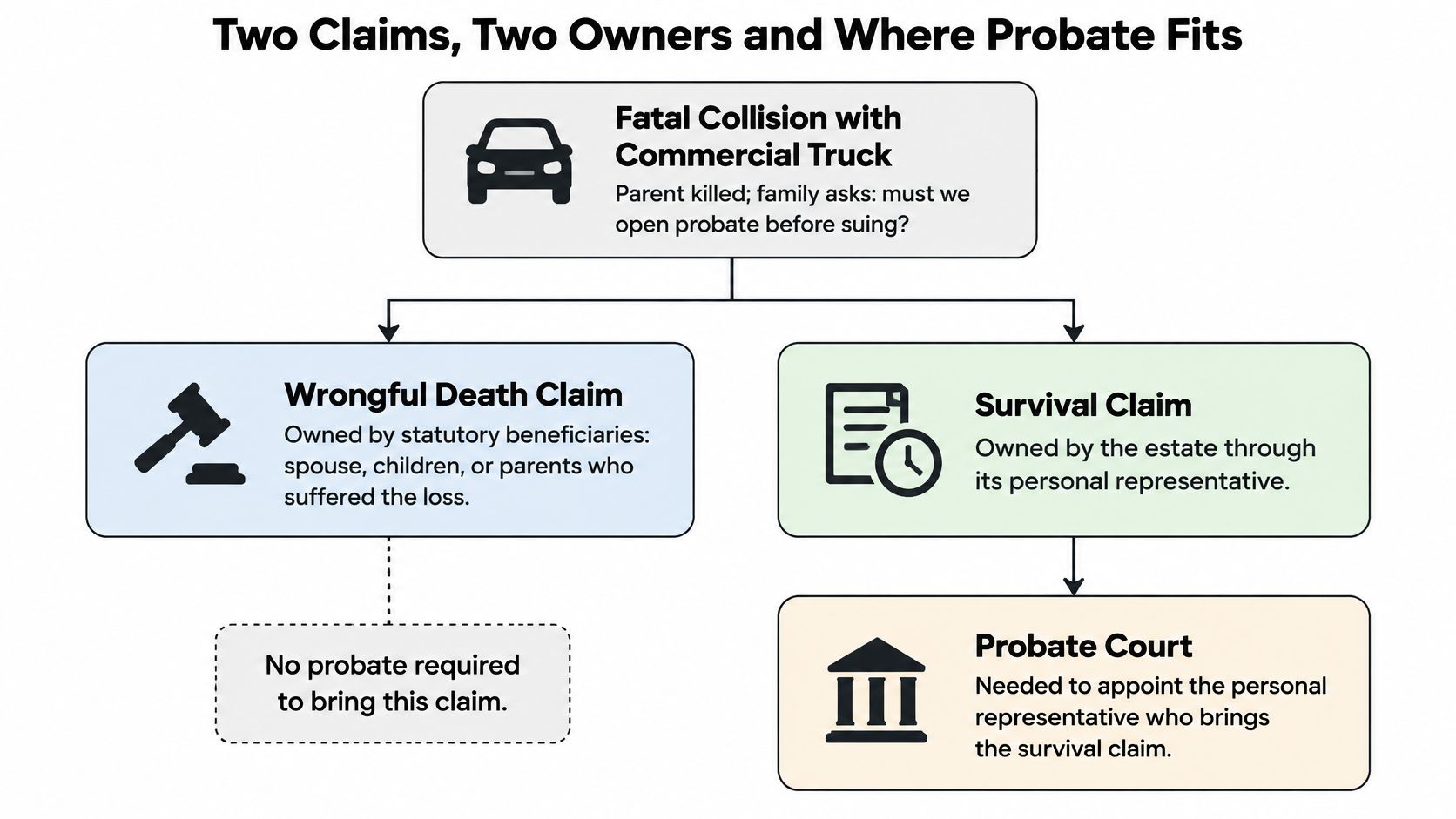
The answer isn't yes or no. It depends on which claim you mean, because a fatal injury in Texas produces two claims with two different owners. One belongs to the surviving family in their own right. The other belongs to the estate. Understanding how a Texas probate handles a wrongful death claim starts with that split, since it decides who signs the pleadings, who controls settlement talks, and which deadlines will not wait for a probate judge.
Two Claims, Two Owners and Where Probate Fits
A parent is killed when a commercial truck crosses the center line. Two weeks later the family is in a conference room with a crash report, a stack of hospital bills, and one decision that has to come before any filing: which claim is whose.
The family claim is a wrongful-death action. Texas Civil Practice and Remedies Code §71.004 names the surviving spouse, children, and parents as the beneficiaries entitled to bring it. The recovery pays their losses, not the decedent's: mental anguish, loss of companionship and guidance, lost financial support, lost household services. Those relatives own that claim personally. They sue in their own names. Letters are not a prerequisite, and the filing period does not pause while the family decides whether to open an estate.
The claim that does belong to the estate
The second claim is a survival action, and the owner is different. Under Texas Civil Practice and Remedies Code §71.021, the personal-injury claim the deceased could have filed had they lived continues for the benefit of the heirs, legal representatives, and estate. Medical bills run up before death, conscious pain and suffering, wages lost between injury and death, and damage to the vehicle all sit in that bucket.
Only this second claim needs someone standing in the decedent's shoes. Probate is the step that produces a person with legal authority to sign the survival pleadings and to receive money that belongs to the estate. A will in a drawer does not do that. Letters do.
Probate does not turn a family's wrongful-death claim into estate property.
Where Probate Enters the Picture
Eligible relatives file the family claim on their own statutory rights, in their own names. The statute still sets a representative trigger. If no eligible beneficiary has filed within three months after the death, the executor or administrator may generally bring the wrongful-death action, unless a surviving beneficiary expressly asks that it not be filed (Texas Civil Practice and Remedies Code §71.004). The deadlines table sets that window against the rest of the calendar. The trap is practical: the representative can step in only if letters already exist.
Probate becomes central in three situations. An executor or administrator is the one prosecuting a claim. The estate holds a survival claim. Or a court order is needed to manage settlement proceeds and other estate assets. Texas statutory probate courts also hold concurrent jurisdiction with district courts over personal-injury, survival, and wrongful-death actions brought by or against a person acting as a personal representative. That rule ties the estate file to the litigation file when a representative is a party. The relatives keep the damages the statute gave them.
The flowchart below maps the two branches a fatal commercial-truck collision creates.
| Claim type | Who owns and controls it | Damages covered | Treatment in probate | Court approval before payment |
|---|---|---|---|---|
| Wrongful-death claim | Surviving spouse, children and parents under Tex. Civ. Prac. & Rem. Code 71.004 | Mental anguish, loss of companionship, lost support and services to the named beneficiaries | Not automatically estate property; representative may bring it only after the three-month window | Often filed as a petition for approval and distribution of the settlement |
| Survival claim | Decedent's estate, heirs and legal representatives under Tex. Civ. Prac. & Rem. Code 71.021 | Medical expenses, pain and suffering before death, lost earnings, property damage | Estate asset subject to administration | Yes, approval of settlement and fees under Tex. Estates Code 355.101 |
| Funeral and burial expenses | Family and estate | Reasonable costs paid by whoever advances them | Creditor claim when pursuing reimbursement | Yes when paid from estate funds |
| Loss of consortium for spouse | Surviving spouse | Companionship and marital relationship loss | Treated with the wrongful-death claim | Usually part of the same approval petition |
The table teaches one practical rule. Name the statutory beneficiary for the family claim, inventory the estate for the survival claim, and expect funeral expenses and lost wages to touch both.
If you're still sorting out which relatives count before you call anyone, the Lawyer in Martin County wrongful death guide works through standing from a slightly different angle and pairs well with the statute.
I would name both claims in the first conversation with counsel. Families that say "wrongful death" and stop there are the ones who later learn a survival claim was never preserved.
The Deadlines and the Sequence That Follows
Every date in a fatal-injury case runs from one event, and it isn't the crash. It's the date of death. Texas Civil Practice and Remedies Code §16.003(b) requires an action for injury resulting in death to be filed no later than two years after the cause of action accrues, and the statute pegs accrual to the injured person's death. The funeral, the day letters issue, and the day the crash report is finally ready all happen inside that window. None of them moves it.
That deadline is indifferent to your week. You can be appointing an administrator, collecting account statements, waiting on the medical examiner, and the clock keeps ticking. Probate administration does not extend the wrongful-death limitations period. A representative may still prosecute the action without ancillary letters in some nonresident-decedent cases where the foreign personal representative has complied with Texas Estates Code Chapter 503, but that's a narrow accommodation, not a general extension.
One timing wrinkle is worth knowing before you build a calendar. Texas Civil Practice and Remedies Code §16.062 suspends the limitations period for 12 months after the death of a person in whose favor a claim exists, and if an executor or administrator qualifies before that period expires, the limitations period begins running when the representative qualifies. Read that carefully: qualifying early can start a clock that was paused. It is not a free extension, and it is not something to schedule by guesswork.
The timeline graphic below is the version I would draw on a whiteboard in the first meeting, before anyone mentions filing fees.
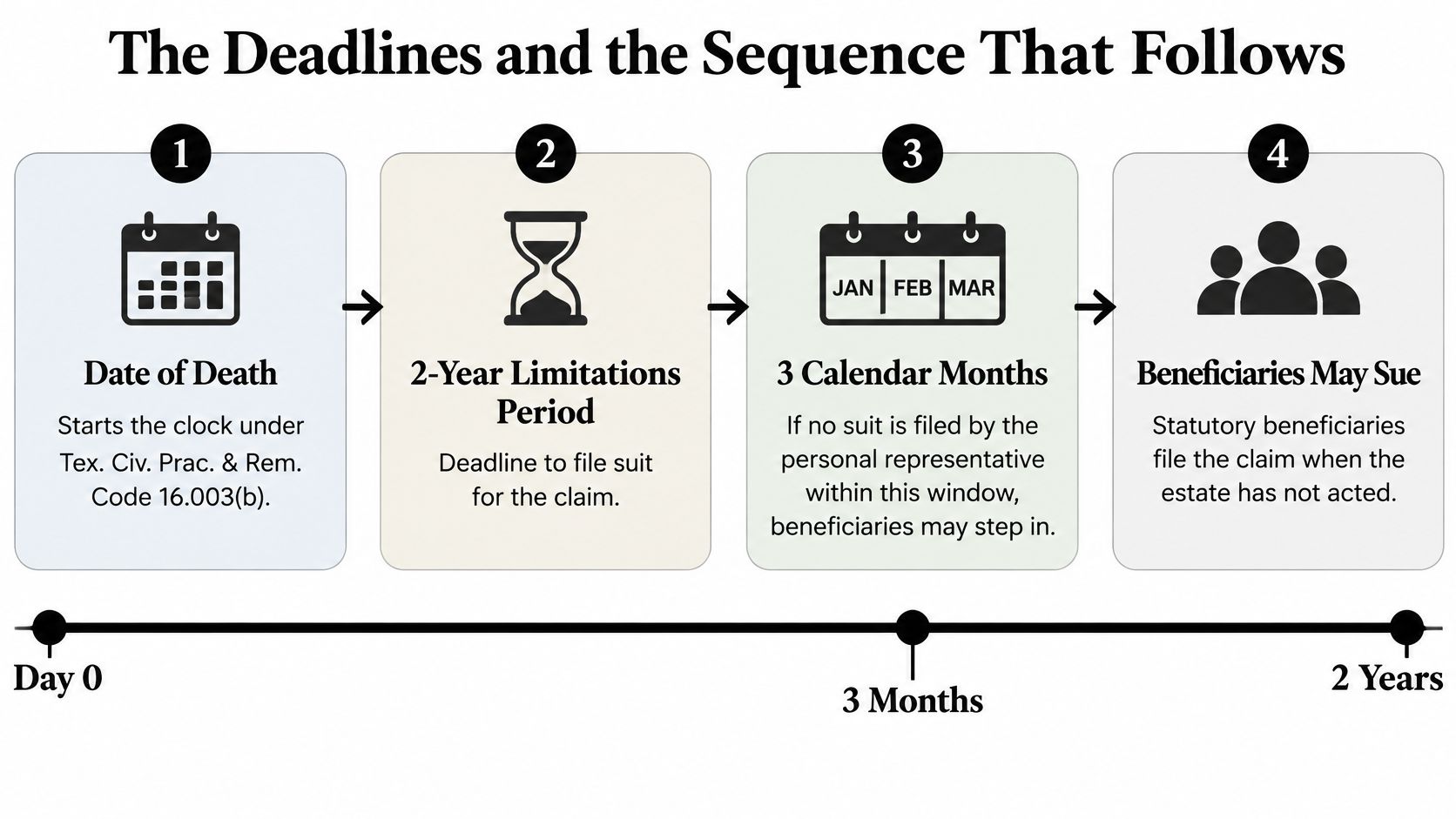
Use the table as a fill-in worksheet. Write your family's real dates in the margin, because each row answers a different practical question about who can sign what.
| Date | What it decides for your family | Source |
|---|---|---|
| Date of death | Fixes every other entry on this table; a wrong date here poisons the whole file | Tex. Civ. Prac. & Rem. Code 16.003(b) |
| Three calendar months after death | Whether the beneficiaries still hold exclusive control of the family claim, or the representative can now file it too | Tex. Civ. Prac. & Rem. Code 71.004 |
| 12 months after death | Whether the Section 16.062 suspension is still protecting you or a qualified representative has restarted the clock | Tex. Civ. Prac. & Rem. Code 16.062 |
| 24 months after death | The outer wall for both claims, and no probate order moves it | Tex. Civ. Prac. & Rem. Code 16.003(b) |
If a video explanation helps get two family members onto the same page, this walkthrough covers the ground in plain language.
The sequence that works
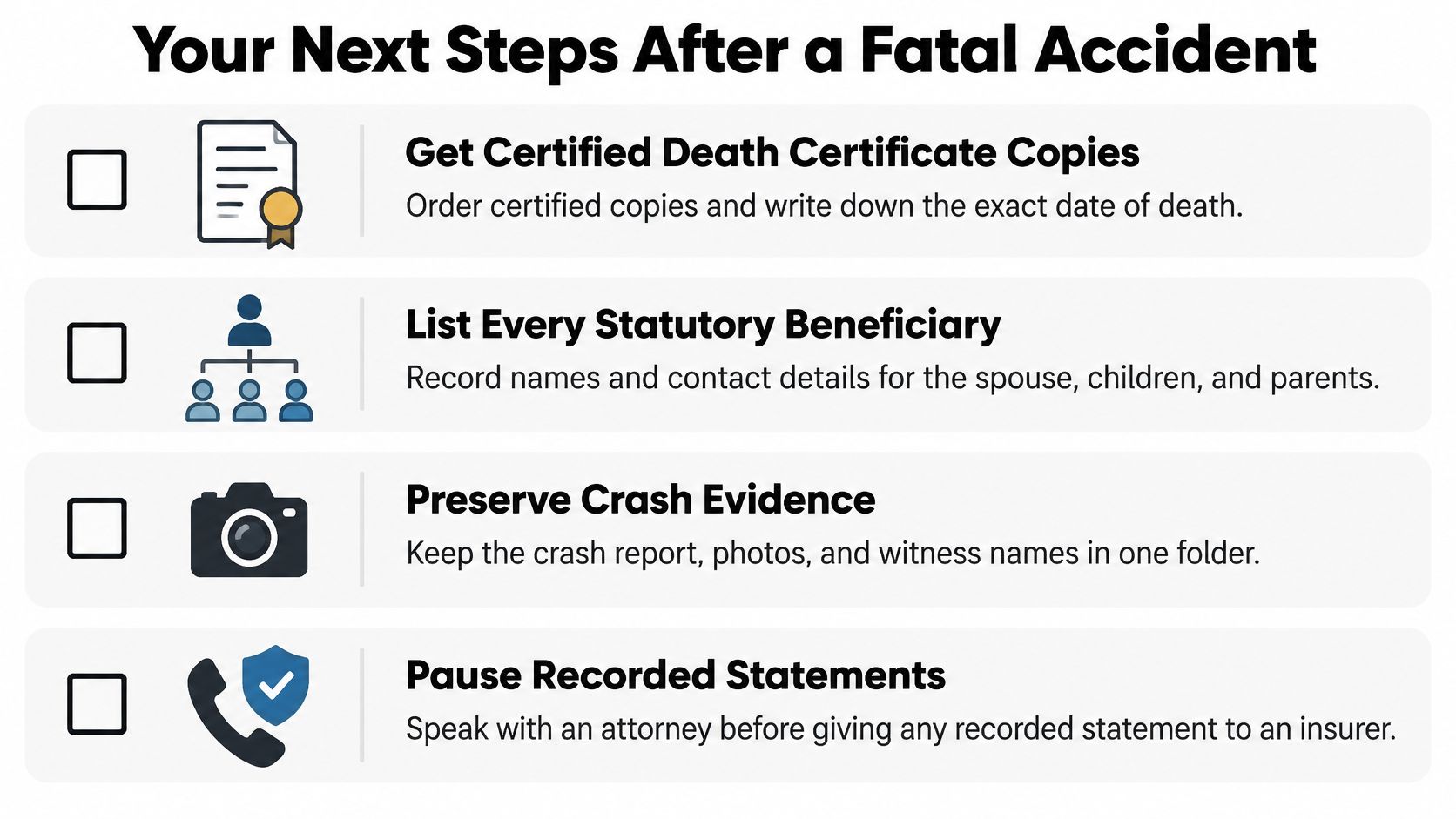
- Calendar the date of death before anything else. Every other date is computed from it, and this is the one step that requires no letters, no court order, and no one's permission.
- Order certified death certificates and preserve evidence while it still exists. The crash report, recorded crash data from a commercial vehicle, medical records requested in writing, witness names and phone numbers, the vehicle and phone themselves, and the insurance declarations page. Within the first month, all of this is still available. None of it requires probate.
- Take a beneficiary census. Which spouse, which children, which parents are living, and which of them intends to file. Include adult children from an earlier marriage. They are statutory beneficiaries whether or not anyone in the room likes it.
- Decide the appointment question early, ideally within the first 90 days. Letters testamentary if there's a will, administration with heirs determined if there isn't. The appointment names the person with legal authority to sign survival pleadings, and until it happens the estate's claim has no one to carry it.
- File in the right name. The family claim goes in the beneficiaries' names and needs no letters at all. The estate claim goes through the representative once appointed. Misfiling costs months you won't get back.
- Have suit on file well before day 730. Filed, with a cause number, in the correct court. Settlement talks in progress do not stop the clock, and neither does an open probate file.
When you're weighing letters testamentary against a dependent administration, our Probate page describes the administration and settlement process in Texas.
The mistakes that bar otherwise good claims
Two slip-ups account for most of the heartbreak. The first is assuming probate buys time. It doesn't, and no order signed in the probate court restores a limitations period that has already run. The second is waiting for letters before filing the family claim, which is a bet that the court will move faster than the calendar. The beneficiaries never needed letters in the first place, so that bet buys nothing.
Say a family spends four months probating a will, sorting a house, and negotiating with a lienholder, and never contacts a litigator until the estate file is closed. The probate work may be flawless. The tort claim is still barred, and that outcome turns on a calendar, not on the strength of the facts. The reverse mistake happens too: a family files the wrongful-death suit promptly, then discovers the survival claim was never pleaded because no one had qualified to bring it. Both mistakes are calendar problems, and both are avoidable in the first 90 days.
When the Case Stays in District Court
There's a stubborn belief that opening an estate drags the injury case onto the probate docket. The Texas Supreme Court addressed that head-on. In Seay v. Hall, the court held that wrongful-death and survival causes of action were not automatically matters incident to an estate for jurisdictional purposes, and it concluded that the proper forum was generally the state district court absent a legislative mandate.
The statute has since caught up to the holding. Texas law now gives statutory probate courts concurrent jurisdiction with district courts over a personal-injury, survival, or wrongful-death action brought by or against a person acting as a personal representative. Concurrent means both can hear it. It does not mean both must.
Three filing postures look similar on paper and behave very differently.
- Beneficiaries in their own right. The spouse, children, or parents file the family claim in district court. No letters, no probate cause number, no estate. This is the cleanest posture available, and it's the one available immediately.
- A representative in a representative capacity. The administrator pleads the survival claim for the estate. Here two courts have authority, and the filing decision becomes a strategic one about speed, familiarity, and the judge who will eventually approve the settlement.
- A distribution dispute inside the probate case. Whether the split is fair, whether fees are reasonable, whether a minor's share is protected. That's a probate question and stays there.
Geography matters more than families expect. In a county with statutory probate courts, such as Harris County, a representative's survival claim can land in either forum. In a smaller county where the constitutional county court or a county court at law handles probate, the practical answer is different, and the two judges' dockets will set the pace of your case.
Ask before the first petition: "If we file in district court, which judge approves the settlement, and what does that judge want to see in the allocation?"
Common Family Scenarios with Wills and Without
A driver dies in a Harris County collision. His will names his sister as executor. She has the original will, a spouse who wants the case started, and two adult children from an earlier marriage who want someone else in charge. The will tells her she may apply for letters testamentary. It does not file the survival claim, and it does not settle the argument over who controls the family's own damages.
A will names an executor. The sister applies to probate the will and for letters testamentary, then pleads the survival claim in that capacity. On the family claim, she may file the wrongful-death action after the three-month window if no spouse, child, or parent has sued, unless those beneficiaries have told her not to. The first filing is the application for probate of the will and issuance of letters testamentary. The common mistake is treating the will as the lawsuit plan. It governs estate property. It does not measure the spouse's mental anguish.
There is no will. The heirs agree on an administrator, or the court appoints one. Once letters issue, that person can bring the estate's claim, but the fight over who serves can burn weeks. Adult children from different marriages often disagree about who should hold the pen. The first filing is an application for letters of administration, with heirship determined before anyone can say how the estate share will pass. Where the probate estate itself is small, a small-estate affidavit may fit, which is the situation covered in our post on probate without a will.
The beneficiaries disagree. A surviving spouse and adult children from a prior marriage argue over the split of the family claim. The representative may petition the court for approval and distribution, and the court can set what the family would not. Fiduciary duties run to the people entitled to the money, even when those dollars are not sitting in an estate account.
The decedent lived out of state. Use the same crash, but put the driver's home and will in Louisiana. A Louisiana appointment does not let that executor sign a Texas survival pleading or deposit a Texas recovery into a Texas account. A family member opens an ancillary administration in the Texas county where the claim or property sits: file authenticated copies of the foreign will and letters, ask the Texas court to appoint a local administrator, and limit that appointment to Texas assets and the survival claim. The useful question is who qualifies here, not who already qualified there. I would file that Texas application as soon as the survival claim is identified. Waiting on the home-state court does not move the Texas case.
Probate still comes up when the family is ready to sue in their own names. Usually someone must plead the survival claim, or a court has to receive and hold settlement funds until the shares are fixed.
Settling and Distributing the Recovery
An executor or administrator cannot write checks from a settlement. Texas Estates Code §355.101 provides that a claim, or part of a claim, for money against an estate may not be paid until it has been approved by the court or established by a judgment from a court with competent jurisdiction. Probate courts routinely act on an application or petition seeking approval of a wrongful-death and survival settlement and authorization for distribution.
What the petition should actually show
The court's review protects the estate and the people legally entitled to the proceeds. That review is only as good as the paperwork in front of the judge.
- Every claimant and beneficiary, named, with the relationship stated and the proposed share for each.
- The split between the family claim and the estate claim, itemized, not summarized as a single global number.
- Documentation for attorney fees and expenses, including whether litigation counsel and probate counsel are being paid from separate portions of the recovery.
- The proposed order, drafted so the judge can sign distribution authority rather than ask for a supplement.
If a minor is a beneficiary, the analysis changes again. A guardianship of the estate or a court-approved settlement structure is often required before the child's share moves anywhere, and the mechanics overlap heavily with estate planning for minors, which is why I point families to how a Texas probate handles a minor beneficiary of life insurance when they need the parallel rules.
When beneficiaries pull in different directions
The representative owes fiduciary duties to those entitled to the money. Those duties get uncomfortable when the family claim and the estate claim point at different people. A spouse may want a fast global number. Adult children may want the survival damages valued separately because the estate's creditors will take a share. Both positions can be reasonable, and the representative cannot side with the louder one.
Practical rule: Allocate before you negotiate. Once a single lump sum is on the table, every later conversation about who owns which dollar becomes an argument about credibility.
Families also get hurt by treating settlement money as ordinary estate cash. Depositing a wrongful-death recovery into the estate account before allocation invites creditor claims and confusion that a clean petition would have avoided entirely.
Keep four documents in one place: the executed settlement agreement, the fee statement, the medical bills supporting the survival claim, and the probate order authorizing distribution. If a dispute surfaces two years later, those four files answer almost every question.
Your Next Steps After a Fatal Accident
The morning after the funeral, a folder usually sits on the kitchen table, and nobody is sure which paper starts the case. The death date, the beneficiary list, the three-month call, and the document bundle are already laid out with the deadlines. What is left is narrower: who has the legal right to act, and which part of the recovery can move without a probate court at all.
Two claims sit side by side. The family claim belongs to the statutory beneficiaries. The estate claim belongs to the estate, and only a person with authority can sign for it. A surviving spouse can move the family claim while the estate still has no representative. The estate claim waits on an executor or an administrator, or on a small-estate affidavit when the assets fit that path. Letters are the court paper that lets that person sue, settle, and sign the estate's share. The family claim does not wait on them. Neither claim waits on the family to finish arguing.
I would spend the first meeting on three questions that sequence does not settle:
- Does anyone already hold letters, or does the estate still need an executor or an administrator? If a will names a person who will serve, probate is how that person gets letters. If there is no will, the court appoints an administrator before the estate can file or release its claim.
- Do the assets require a full probate, or will a small-estate affidavit cover them? The injury case and the estate administration are related. They are not the same filing. A modest estate can still sit beside a large survival claim.
- How will any recovery be split between the family claim and the estate claim, and must a court order come before any of it moves? Write the split down before money changes hands. One undifferentiated check is how a later fight starts over dollars that were never the estate's.
The Law Office of Bryan Fagan, PLLC handles wills, trusts, probate, and guardianship, and the practice also includes personal injury, so the probate filing and the injury case can stay with one firm. The firm has offices across Texas and represents clients statewide. Before you call, the estate administration lawyer page sets out what administration involves, including when letters are the step that has to happen.
Call with those three questions while you still set the order. Ask whether letters are required on your facts, or whether the family claim can move while probate catches up.
If you need help with divorce, custody, or estate planning in Texas, contact The Law Office of Bryan Fagan today for a free consultation. Our attorneys help Texas families with wills, trusts, probate, guardianship, and the family law matters that often arrive at the same time, and we can walk you through how a Texas probate handles a wrongful death claim. Visit Law Office of Bryan Fagan, PLLC to schedule your free consultation.