 Skip to content
A family meeting with a Texas probate attorney often begins with a simple but unsettling discovery. A grandparent's will leaves money to a grandchild, a parent dies without a will and leaves one minor child, or a life insurance policy names a child as beneficiary. The family expects the inheritance to be transferred. Instead, the court asks who will protect and manage property that the child cannot handle personally.
That's the central issue in a Texas probate when an heir is a minor. The Texas Estates Code treats the child's inheritance as property requiring safeguards, not as money an adult may collect and use. The estate must be administered, while the child's share may need separate protection through a guardianship of the estate or another legally permitted arrangement. The additional steps can feel frustrating during grief, but they exist to preserve the child's property and create accountability.
When a Child Stands to Inherit in Texas
Consider a Houston family whose grandfather's will leaves a specific cash gift to his eight-year-old granddaughter. The family knows exactly what he wanted. There's no disagreement about the beneficiary, and everyone trusts the child's surviving parent. Even so, the child can't sign a receipt, endorse a check, or direct an adult to spend the money.
A different family may face the issue after a parent dies intestate, meaning without a valid will. The child may be one of the people entitled to inherit under Texas law, but the family still must establish the estate's heirs and determine how the child's share will be held. A life insurance policy or financial account naming a child can create a similar management problem, even when that asset passes outside ordinary probate.
The Texas Estates Code supplies the governing framework. Texas venue rules for a guardianship proceeding generally depend on where the parents live. If both parents are deceased, the case is filed where the last surviving parent lived. If both parents died in a common disaster, venue is where the parents resided at the time of death. Texas also treats administration of a minor's estate as a single in rem proceeding from filing until the guardianship is settled and closed, reflecting continuing court oversight of the child's property. Texas Estates Code provisions on venue, guardianship, and administration explain these principles.
The two legal tracks
The estate case and the child-protection case are related, but they aren't the same proceeding.
- Estate administration: A personal representative identifies assets, handles valid debts and taxes, addresses title issues, and prepares the estate for distribution.
- Protection of the minor's property: A guardian of the estate, blocked account, custodial arrangement, or trust holds and manages the child's share under legally controlled terms.
Texas law generally prefers the surviving parent to serve as guardian of a minor's estate. A parent may also name a guardian through a will or written declaration, and that designation receives priority unless the named person is disqualified, deceased, refuses, or isn't in the child's best interests. The court still must act.
The family isn't being punished for having a child heir. The court is trying to ensure that the inheritance remains the child's property, whether the amount is modest, a bank account, real estate, or proceeds from a sale.
Why a Minor Cannot Simply Receive an Inheritance
The first question is capacity. A child under 18 generally can't independently manage inherited property, enter binding arrangements involving that property, or make legally effective decisions about its transfer. If an estate issues a check to a minor, the child can't handle the transaction as an adult beneficiary would.
A useful analogy is a court-controlled safety deposit box. The inheritance goes into the protected box, and an approved adult receives the key. That keyholder can't treat the contents as personal money. The adult must follow the court's rules, preserve the assets, and explain how the property is managed.
Person and estate guardianship are different
Texas families often use the word “guardian” to describe several roles. The distinction matters:
- Guardian of the person: Handles personal care, living arrangements, education, and medical decisions when appointed or required.
- Guardian of the estate: Manages the child's money, property, investments, and other assets.
- Natural guardian: A parent may have recognized authority over the child's care, but that doesn't automatically give the parent unrestricted control of inherited property.
The surviving parent may be the child's caregiver and may be the preferred person to manage the estate. Those facts don't eliminate the need for a court appointment when the child owns protected assets. The court must evaluate the arrangement and issue the authority needed to manage the inheritance.

Why informal family handling creates risk
Giving the money to the surviving parent may seem practical. The parent may need funds for housing, food, school expenses, or medical care. But the parent's good intentions don't change the child's ownership. Mixing the child's money with household funds can make it difficult to prove what belongs to the child and may expose the adult to claims of misuse.
Practical rule: Treat the child's inheritance as separate property from the moment the family learns the child will receive it.
A formal guardianship can operate like a financial boundary. The guardian keeps records, separates the assets, and seeks authorization when a transaction requires court approval. Texas county probate courts are authorized to appoint guardians of minors, issue letters of guardianship, and oversee settlement, partition, and distribution of estates under guardianship. Texas probate provisions concerning guardianship and estate administration describe that protective structure.
The law does recognize alternatives in particular situations. A small estate affidavit, a custodial transfer, a restricted account, or a trust may provide a lawful way to hold the property. Each option has conditions, and none should be selected only because it appears faster.
Texas Tools That Hold and Protect a Child's Inheritance
Texas probate cases don't all use the same protective device. The right choice depends on the asset, the estate's value, whether a will exists, and whether the court can approve the proposed transfer.
Dependent administration places the estate under continuing court supervision. The court reviews important actions and distributions. By contrast, independent administration gives the personal representative greater freedom to handle estate business without seeking approval for every routine step. Texas Estates Code Chapter 401 provides the framework for independent administration, but the presence of a minor can make that route unavailable or require additional safeguards. County guidance states that an independent administration generally won't be granted in an intestate estate when heirs are minors and administration is needed. Dallas County guidance also states that, except in special circumstances, a minor distributee or heir-at-law usually prevents independent administration, and a bond may be required if the court allows it. Dallas probate guidance regarding minors and independent administration addresses this concern.
A small estate affidavit may simplify matters in limited cases. For real-property transfers, TexasLawHelp describes a threshold of under $75,000 excluding the homestead, along with other requirements, including no valid will, assets exceeding debts, and inheritance going to a surviving spouse or minor child under 18. TexasLawHelp's small estate affidavit guidance explains the conditions. Montgomery County adds that it won't approve a small estate affidavit with a minor heir unless the assets the child will inherit can be placed in the court registry until the child turns 18.
A Texas Uniform Transfers to Minors Act custodial arrangement can work for certain financial assets. A custodian manages the property for the child, but authority is limited and the arrangement may not solve title problems involving land or a house. A restricted or blocked account may be more suitable when the court wants the funds preserved and withdrawals controlled.
A trust named in a will can provide another path. A properly drafted testamentary trust may allow a trustee to manage the child's inheritance without creating the same guardianship structure. Families comparing a testamentary trust with other trust arrangements can review testamentary trusts and living trusts before meeting with counsel.
| Tool | Best Use Case | Key Limitation |
|---|---|---|
| Dependent administration | Estates needing court-supervised handling | More approvals and ongoing procedure |
| Small estate affidavit | Qualifying small estates with limited assets | Strict conditions, especially when a minor or real property is involved |
| UTMA custodianship | Certain financial assets suitable for custodial management | Limited authority and poor fit for many real-estate transfers |
| Blocked or restricted account | Preserving cash or financial proceeds | Withdrawals may require documentation or court approval |
| Testamentary trust | A will that plans for a child's future inheritance | Must be created correctly and funded or directed under the estate plan |
Probate is the Texas process for estate administration and settlement. A minor heir can change which version of that process is available.
How the Personal Representative and Guardian of the Estate Work Together
A Texas parent dies owning a bank account, a vehicle, a house, and a ten-year-old child's inheritance. Two fiduciary tracks begin. The personal representative handles the deceased person's estate. A guardian of the estate protects the child's property after the child's share is identified. Keeping those tracks separate helps explain why a minor heir can change the usual probate process.
The personal representative gathers assets, addresses valid debts and taxes, protects homestead and exempt property as applicable, keeps records, prepares an inventory, and proposes a lawful distribution. The guardian has a different assignment: receiving and managing the child's share under court supervision. The guardian may be the surviving parent, but the court must approve the appointment. The personal representative cannot hand cash to the child or sign a deed over to the child.
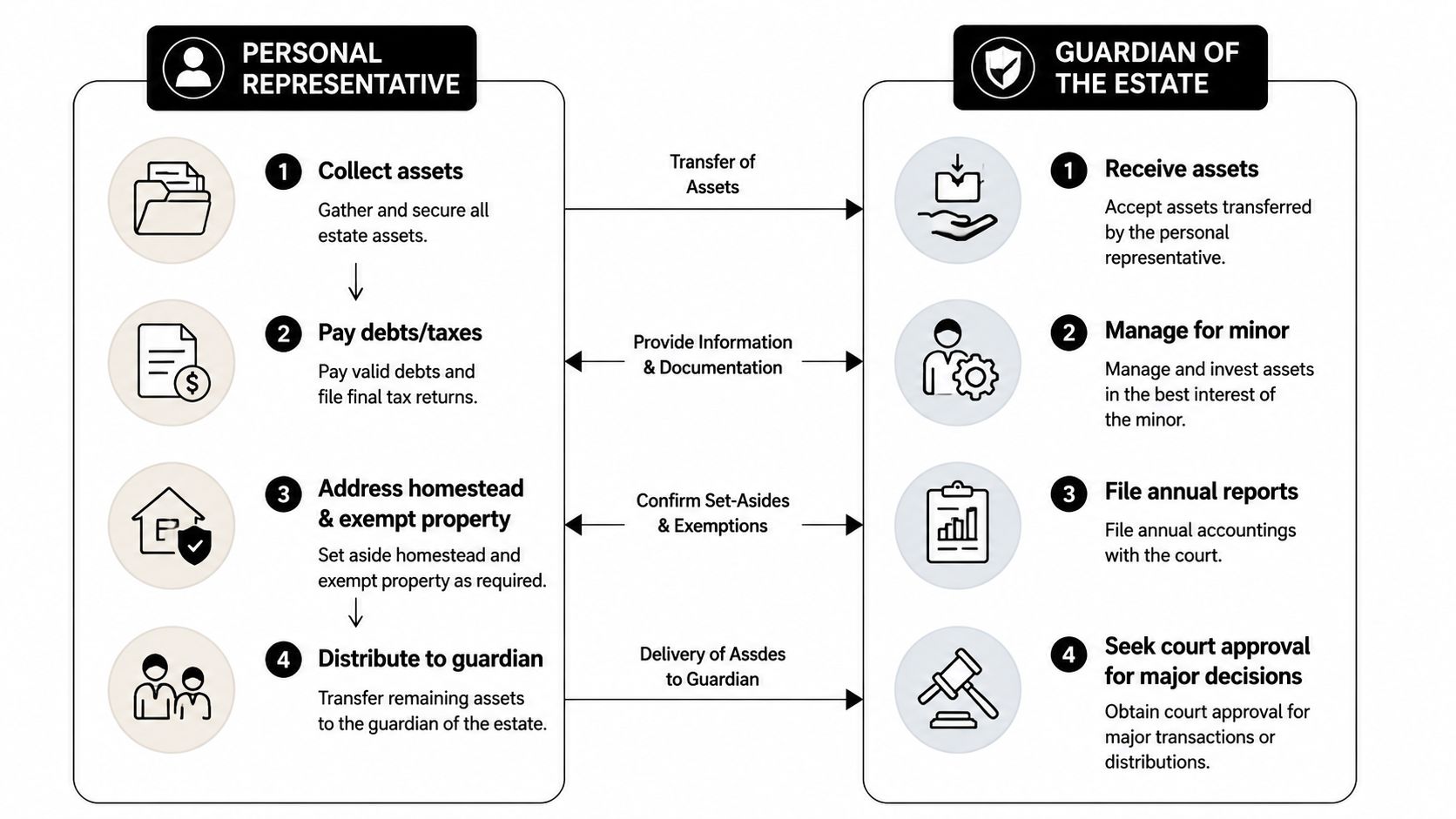
One estate, two fiduciary roles
The same adult might serve in both roles, but the legal duties remain distinct.
- The personal representative settles the decedent's estate. This means collecting property, paying valid obligations, and determining what remains for distribution.
- The guardian protects the child's property. The guardian keeps inherited assets separate, acts prudently, avoids self-dealing, and follows court restrictions.
- The court connects the two stages. The judge may approve the guardianship, require a bond, review an inventory of the child's property, examine accountings, and authorize particular distributions.
Depending on the assets and court orders, the inheritance may enter a blocked account, custodial account, or guardianship estate. A guardian may need approval before using funds for an identified need, such as education, health care, or support. Real estate and other significant property require careful documentation and court direction.
The personal representative closes the deceased person's financial affairs. The guardian carries the child's property forward.
That division also explains why independent administration may no longer be available in its ordinary form. The estate may need court involvement to protect the minor's interest, and notice and consent requirements can delay a proposed agreement or distribution. Families can prepare by reviewing the essential forms and filing requirements for guardianship in Texas before filing.
The guardian's work does not end when the distribution order is signed. Texas-focused guidance notes that letters of guardianship expire after 16 months and must be renewed. Texas guardianship provisions concerning continuing authority show why continuing compliance matters after appointment. Families comparing broader protection for children and future beneficiaries can also review Estate Planning. The structure should match the property and family circumstances.
Two Scenarios That Show How a Texas Probate Unfolds
In the first scenario, a valid will names an executor and identifies an adult who should serve as guardian for the minor. The creditors are limited and undisputed. The family still must file the proper applications, provide notice, attend required hearings or obtain appropriate uncontested orders, and address any attorney ad litem appointment required by the proceeding.
The estate representative prepares the inventory and resolves debts and expenses. The child's remaining share may then go into a blocked account or custodial account, with withdrawals limited to approved purposes. The case may be orderly, but “orderly” doesn't mean immediate. Service, court review, bond requirements, and documentation still matter.

The second scenario is more difficult. A parent dies without a will, the child's share is substantial, and a relative challenges the proposed guardian or the estate's administration. The court must identify the heirs, and service may need to go through the child's parent, guardian, conservator, or another qualified person under the applicable statute.
Why notice becomes a turning point
Texas probate guidance states that minors from 12 through 18 must be personally served or attend an heirship hearing, and they can't waive service. Another Texas county guide states that minors under 16 can't waive citation themselves, so a parent, managing conservator, guardian, attorney ad litem, or guardian ad litem may need to act for them. Texas Estates Code Section 258.002 discusses the notice and waiver issue.
A dispute over heirship, the proposed guardian's suitability, asset values, or a distribution can lead to additional pleadings and hearings. Attorney ad litem involvement may also differ between a contested and noncontested appointment, which affects the case's cost profile. Families should also understand that the county where the case is filed matters. Venue for a guardianship generally follows the parents' residence rules described earlier.
This educational video provides general background on probate concepts:
A family dealing with intestacy can also review probate without a will in Texas before deciding what documents and witnesses to gather.
Common Assumptions That Get Texas Families Into Trouble
A surviving parent may be the natural guardian of the child's person, but that doesn't mean the parent automatically controls money inherited outright by the child. Daily care and management of separate property are different responsibilities. The parent may need a guardianship of the estate or another authorized arrangement before managing the inheritance.

The will does not answer every procedural question
A will may name an executor or express a preference for a guardian. That language is important, but it doesn't authorize adults to skip court requirements. Texas law allows a parent to designate a guardian by will or written declaration, subject to statutory qualifications and the child's best interests. The court still must issue the authority needed to manage the estate.
Another common assumption is that independent administration will work because the will requests it. Texas probate guidance indicates that a minor heir can prevent independent administration in an intestate estate, and courts generally restrict that route when a guardianship of the estate is anticipated. A will's language can't erase the court's protective duties.
Real estate and restricted accounts require discipline
A house or tract of land can't be treated like a check. A minor's ownership interest raises questions about title, insurance, taxes, maintenance, sale authority, and the handling of proceeds. Transferring real property without a court-approved plan can create title problems and expose the adults involved to avoidable disputes.
A blocked account also isn't ordinary family money. Deposits are restricted, and withdrawals require documentation and, in some circumstances, prior court approval. The safer practice is to identify the minor's share early, provide legally correct notice, inventory the assets, separate the property, select a suitable guardian, and document management decisions.
The small estate affidavit rules reinforce that paper trail. When a distributee is a minor, the affidavit must be sworn not only by the required disinterested witnesses and legally capable distributees, but, when warranted, by the minor's natural guardian or next of kin. It must list known assets and liabilities, distributees' names and addresses, and the family-history facts supporting each inheritance claim. Texas Estates Code Section 205.002 provides the statutory reference.
Practical Next Steps for Texas Families Facing a Minor Heir
The first weeks after a death are emotionally heavy, so use a written checklist. Start with the documents that reveal the estate's structure and the child's likely share.
- Locate the will and trusts: Look for the original will, codicils, trust documents, and written guardian designations.
- Obtain the certified death certificate: Courts, financial institutions, and insurers may require certified copies.
- Gather financial records: Collect the most recent three years of asset statements, along with deeds, vehicle titles, retirement records, and loan information.
- Review beneficiary designations: Find life insurance, payable-on-death, transfer-on-death, and retirement beneficiary forms.
- Estimate the child's share: Separate assets that pass by beneficiary designation from property requiring probate, and identify possible debts.
Questions for the first consultation
Contact a Texas probate attorney early, especially when guardianship of the estate appears likely. A probate lawyer can evaluate county venue, heirship, administration type, asset ownership, and the correct protective arrangement before the family takes an irreversible step.
Bring these questions:
- Which Texas county should receive the probate and guardianship filings?
- Is independent administration available, or will dependent administration be required?
- Who is legally and practically suitable to serve as guardian of the estate?
- Will the court require an attorney ad litem, a bond, or a restricted account?
- How will attorney ad litem fees and other case expenses be handled?
A practical working timeline may look like this:
- First 30 days: Locate documents, secure assets, obtain the death certificate, and schedule legal advice.
- By 60 days: Identify heirs, evaluate venue and administration, prepare filings, and address notice requirements.
- By 90 days: Attend required proceedings, pursue appointment of the appropriate fiduciary, and establish the approved method for holding the child's property.
Those are planning milestones, not guaranteed deadlines. Missing information, disputes, service problems, or real-property issues can change the sequence.
Texas Probate With a Minor Heir Frequently Asked Questions
What if the named guardian cannot or should not serve?
The named person does not automatically receive authority to manage the child's inheritance. If that person is unable or unsuitable, the court can consider another qualified guardian of the estate or an authorized alternative. The court's focus is protecting the child's property, not following a family preference. A parent, relative, or other proposed fiduciary may need to provide information about suitability, conflicts, and the child's assets.
Can real property pass to a minor through a small estate affidavit?
Sometimes, but only when the statutory requirements are met. TexasLawHelp describes the under $75,000 excluding the homestead threshold and other conditions. Montgomery County also requires a minor's inheritable assets to be placed in the court registry until the child turns 18. Because a deed, house, or land interest can create title and management issues, a Texas probate attorney should review the property before any transfer.
How much will the process cost?
Expenses depend on the county, asset types, administration method, guardianship requirements, disputes, attorney ad litem involvement, bond premiums, and accounting work. Bond amounts can rise with the value of the protected inheritance. A lawyer can identify likely expense categories for the family's circumstances rather than promise one universal figure.
What happens when the child turns 18?
The court determines how and when protected funds or property are released under the applicable order and account structure. The young adult may then receive control of the remaining inheritance, although final accounting, closing documents, and title steps may still be required. A trust or custodial arrangement can produce a different result because its governing terms control distribution.
If your child may inherit money, real estate, or other property in Texas, The Law Office of Bryan Fagan, PLLC can evaluate probate administration, guardianship of the estate, notice requirements, and protective options. Visit Law Office of Bryan Fagan, PLLC to schedule a free consultation.


