
Divorce can be one of life’s most difficult transitions—but understanding your rights under Texas law can make it less overwhelming. It doesn't have to end in a bitter, public courtroom battle. In Texas, divorce mediation offers a more collaborative and dignified path forward, giving you and your spouse the power to design your family's new chapter yourselves.
What Is Divorce Mediation and Why Do Texas Courts Prefer It?
Imagine sitting down in a private, neutral space with a trained professional guiding the conversation. This is the heart of mediation. Instead of a judge, who only sees a small snapshot of your life, making permanent decisions for you, a mediator helps you and your spouse talk through the tough issues and find common ground.
The Mediator’s Role: A Guide, Not a Judge
It's crucial to understand that a mediator is fundamentally different from a judge. They don't take sides, give legal advice, or issue rulings. Their job is to:
- Open Lines of Communication: A good mediator creates a safe, productive environment where both of you can speak honestly about your needs and fears without the conversation spiraling into an argument.
- Clarify the Issues: They help you organize the chaos by pinpointing the specific topics you need to resolve, like how to divide your property, create a parenting plan, or handle financial support.
- Explore Creative Solutions: The mediator guides you in brainstorming solutions that a court simply can't order. This allows for a truly custom-fit agreement that works for your unique family.
- Stay Completely Neutral: Their goal is to keep the process fair and balanced, ensuring both you and your spouse have an equal voice at the table.
This entire process keeps the decision-making power exactly where it belongs: in your hands. You and your spouse, with support from your respective attorneys, are the ones who control the final outcome.
Why Texas Courts Champion Mediation
Here in Texas, especially in major counties like Harris, Fort Bend, and Montgomery, courts don't just encourage mediation—they often require it before you can even get on the schedule for a contested final trial. This isn't just a suggestion; it's a core part of how our family law system operates.
This preference is deeply rooted in the Texas Family Code, which prioritizes the peaceful settlement of disputes. Judges know from experience that when people create their own agreements, they are far more likely to stick to them than when a stranger in a black robe imposes orders upon them.
The core philosophy is simple: families are better equipped to create lasting solutions for themselves than a judge who only has a limited snapshot of their lives. Mediation honors this by giving you the tools to build a durable post-divorce future.
The numbers back this up. Divorce mediation in Texas has an incredible 85% success rate for reaching a full agreement. It also resolves disputes three times faster than dragging things through court and can slash the total cost by an average of 60%.
Ultimately, Texas courts favor mediation because it works. It clears up congested court dockets, dramatically lowers the emotional and financial toll on families, and produces customized agreements built to last. For a more detailed look at how this process fits into the bigger picture, check out our guide on mediation in a Texas family law case.
The Texas Divorce Mediation Process Step by Step
The idea of mediation can sound intimidating, but once you understand the process, it becomes much less mysterious. Knowing what to expect transforms uncertainty into a feeling of control. Let's walk through the journey, from the first step to the last, so you can approach your mediation with confidence.
While every family's situation is different, the process itself follows a structured, logical path designed to start with the big picture and narrow down to a specific, final agreement that you helped create.
Selecting the Right Mediator
Your journey begins by choosing a qualified, neutral third-party mediator. This is a collaborative decision; you and your attorney will work with your spouse and their attorney to find a professional that both sides can trust. A strong mediator not only possesses skilled negotiation abilities but also has a deep understanding of Texas family law, which is essential for keeping the conversation productive and legally sound.
You might even select a mediator based on their specific experience, whether that’s with complex property division or navigating high-conflict custody disputes. This first choice sets the tone for everything that follows.
The Initial Joint Session and Caucusing
On the day of the mediation, the process usually begins with a brief joint session. Everyone meets, the mediator introduces themselves, explains the ground rules of confidentiality, and outlines the goals for the day. This is a key moment for establishing a respectful and cooperative atmosphere.
After that brief meeting, you and your attorney will go to a private room, and your spouse and their attorney will go to another. The mediator then starts moving between these rooms in a process called caucusing. This setup is incredibly valuable because it gives you a confidential space to speak freely with the mediator. You can share your real concerns, your ultimate goals, and your bottom-line positions without the tension of negotiating face-to-face with your spouse. It lowers the emotional temperature and encourages honest communication.
To see just how different this structured approach is from a courtroom battle, take a look at the graphic below. It compares the streamlined path of mediation to the long road of traditional litigation.
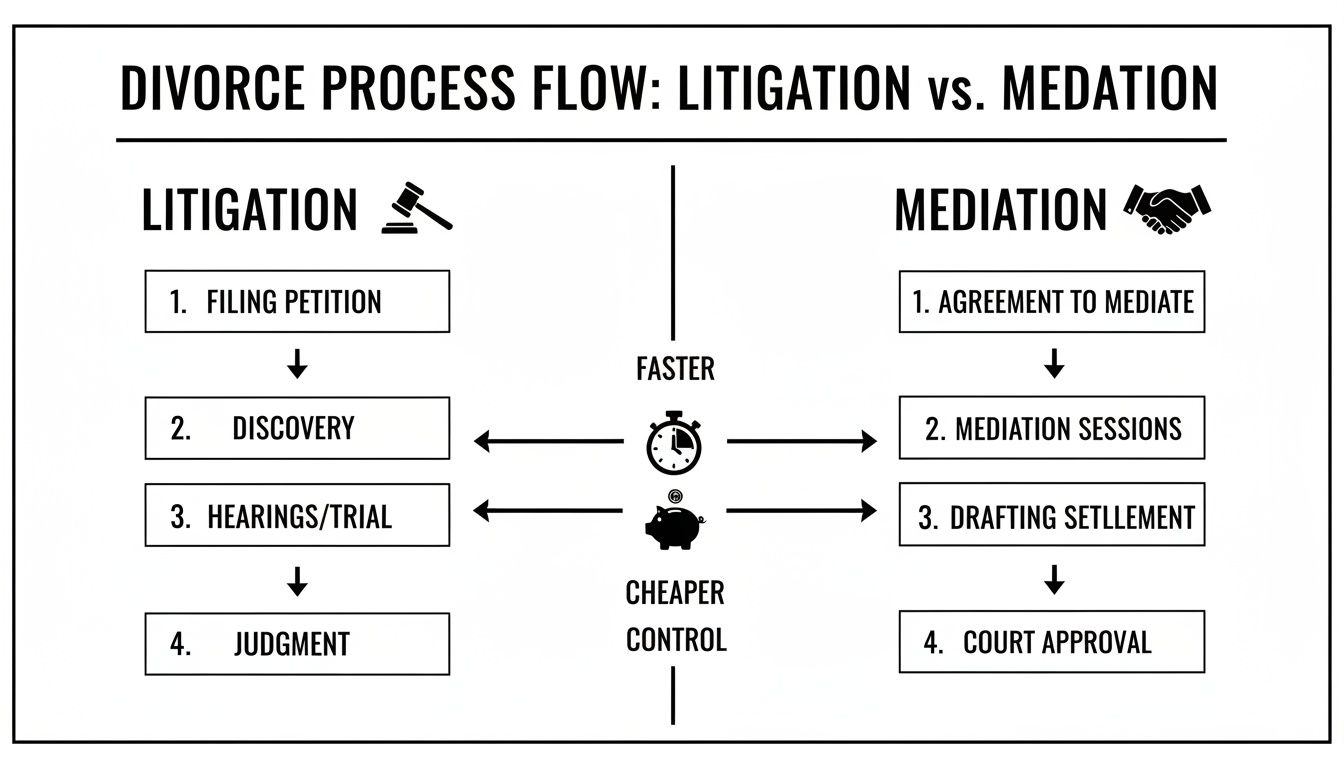
As you can see, mediation is intentionally designed to be a faster, more cost-effective process that leaves you with far more control over the final outcome of your divorce.
Negotiation and Reaching an Agreement
This is the heart of the process. The mediator acts as a go-between, carrying offers and counter-offers from one room to the other. They are skilled at helping both sides see the strengths and weaknesses of their own positions. Your attorney's role here is absolutely vital. We’re by your side to provide legal counsel, analyze every proposal, and help you craft responses that protect your interests.
This back-and-forth continues until you find common ground on every single issue, from who gets the house and how debts are split to the fine details of a parenting plan and support. The mediator's job is to help bridge gaps and find creative solutions that a judge might not even have the authority to order. Technology has also made this step more flexible than ever, as you can learn more about how virtual mediations in a post-COVID-19 world have opened up new possibilities.
Finalizing the Mediated Settlement Agreement
Once a verbal agreement has been reached on all points, the mediator drafts the Mediated Settlement Agreement (MSA). This is, without a doubt, the single most important document to come out of the entire mediation.
Under Texas Family Code §6.602, a properly drafted and signed MSA is binding on both parties. Once it's signed, you are entitled to a judgment based on that agreement. It is typically irrevocable—meaning you can’t wake up the next day and change your mind.
Before you even think about signing, your attorney from The Law Office of Bryan Fagan, PLLC, will review every single word of that MSA with you. We make absolutely certain it accurately reflects the agreements you made and that you understand the long-term legal consequences of every term. Signing this document provides the finality and closure needed to move forward and have the court grant your divorce.
Resolving Key Issues in Your Texas Divorce Mediation
This is where the most critical, life-altering decisions of your divorce get hammered out. Mediation is the forum where you, your spouse, your attorneys, and a neutral third-party mediator work together to build the blueprint for your family's new reality. The entire process boils down to two central pillars: your property and your children.
Let's walk through the core issues you'll be tackling, grounded in how Texas law works.

Dividing Your Community Property and Debts
Texas is a community property state. What does this mean for you? According to the Texas Family Code §3.002, almost anything you or your spouse acquired during the marriage belongs to the marital estate. This includes the family home, retirement funds, cars, and even debts like mortgages and credit card balances.
If you let a judge decide this in court, they are legally bound to divide everything in a "just and right" manner. More often than not, this translates to a 50/50 split, which can feel arbitrary and impractical.
Mediation, on the other hand, gives you incredible flexibility. For example, a court might order the family home to be sold. In mediation, one spouse might keep the house so the kids don't have to move, in exchange for the other spouse receiving a larger share of a 401(k). You're in the driver's seat. It's vital, however, to think through the long-term financial consequences, including taxes. Getting a handle on understanding the tax implications of divorce can save you from major headaches down the road.
Crafting a Custom Parenting Plan
When you have children, nothing matters more than creating a stable, supportive environment for them after the divorce. This is where mediation truly shines. It allows you to build a detailed Parenting Plan specifically for your children's needs, rather than being handed a generic, one-size-fits-all court order.
During your divorce mediation in Texas, you’ll iron out the crucial parts of your parenting agreement:
- Conservatorship: This is the legal term for who gets to make the big decisions for your kids—things like where they go to school, major medical choices, and religious upbringing.
- Possession and Access: This is the detailed calendar. It outlines exactly when the children will be with each parent, covering everything from regular school weeks and weekends to holidays and summer breaks.
- Geographic Restrictions: You can agree to a specific boundary (like a county or school district) where the primary parent must live. This ensures the other parent can maintain consistent and easy access to the kids.
The ultimate goal here is to create a predictable schedule that your children can rely on, while also being realistic for both parents' work lives and commitments.
Determining Child Support and Spousal Maintenance
Money is always a tough conversation, but mediation provides a structured space to address financial support with a focus on fairness and your family's actual needs.
In Texas, Child Support usually begins with a formula based on the non-primary parent's net income. While those state guidelines are the baseline, mediation lets you find creative solutions. You might agree that one parent will cover the kids' health insurance premiums and soccer fees directly, instead of just paying a higher monthly check. We explore this in more detail in our article about whether you can negotiate child support during mediation.
Spousal Maintenance (what most people call alimony) isn't a given in Texas; there are very strict rules to qualify for it in court. But in mediation, you and your spouse have the freedom to agree on contractual alimony for a set period. This can be a lifeline for a lower-earning spouse, giving them the support they need to get back on their feet, even if a judge would have said no.
This flexibility is a game-changer for families. By customizing these incredibly personal agreements about your children and your finances, you can create a stable foundation for everyone's future.
If you need help navigating divorce, custody, or estate planning in Texas, contact The Law Office of Bryan Fagan today for a free consultation.
How Much Will Mediation Cost and How Long Will It Take?
If you're facing a divorce, two questions are probably front and center in your mind: "How much is this going to cost?" and "How long is this going to take?" When your future feels uncertain, these practical, real-world concerns are not just valid—they're essential.
The good news is that divorce mediation in Texas provides a much clearer, more manageable, and significantly less expensive path than a traditional courtroom fight. Unlike litigation where legal fees can spiral out of control for months or even years, mediation offers a predictable and efficient way forward. Think of it as an investment in a faster, more peaceful resolution for your family.
Breaking Down the Financial Investment
In Texas, mediators usually charge by the hour or offer half-day and full-day rates. A huge benefit is that this cost is almost always split right down the middle between you and your spouse, which immediately cuts your personal expense in half.
While rates vary depending on the mediator's experience and your location, a typical full-day mediation might run anywhere from $1,500 to $5,000 or more. Each spouse would then pay a portion of that total.
Several things can affect the final price tag:
- The Complexity of Your Estate: A straightforward case with just a few assets will naturally cost less to mediate than one involving a family business, several properties, or complicated retirement accounts.
- The Level of Conflict: This is a big one. The more you and your spouse can find common ground on before walking into the room, the less time you'll need with the mediator. Less time means lower costs.
- How Many Sessions You Need: Many divorces are settled in a single, full-day session. But if your situation is particularly complex, you might need a second day, which would adjust the total expense.
Even with these variables, the total cost is just a fraction of what you’d spend on a contested trial. One of the greatest strengths of mediation is its efficiency. Recent Texas family law statistics show that while divorce rates fluctuate, the core benefits of mediation hold steady: it has a high success rate, offers huge cost savings, and is often three times faster than litigation. You can discover more about the factors influencing mediation costs in Texas to get a clearer picture of what to expect.
A Tale of Two Timelines: Mediation vs. Litigation
The difference in how long mediation takes versus litigation is dramatic. It’s like the difference between taking a direct flight to your destination and embarking on a winding road trip with unexpected detours and delays.
A court battle can easily drag on for a year, and sometimes much, much longer. The process is bogged down with filing motions, discovery, depositions, and then waiting months just to get on a busy judge's calendar. Every single step adds more time to the clock and more money to your legal bills.
Mediation, on the other hand, is built for speed. Most mediated divorces are completely wrapped up in just a few sessions, often scheduled over a few weeks or a couple of months. You get to work on your own schedule, not the court's.
This quicker timeline does more than just save you money. It provides emotional closure much sooner, allowing you and your family to start healing and move on with your lives. By choosing divorce mediation in Texas, you’re not just picking a more peaceful process—you're choosing a faster, more direct route to your new beginning.
If you need help navigating divorce, custody, or estate planning in Texas, contact The Law Office of Bryan Fagan today for a free consultation.
Why Your Attorney Is Your Greatest Ally in Mediation
It’s a common misconception that if you choose mediation, you don't really need a lawyer. After all, the whole point is to be less adversarial, right? But going into mediation without your own legal advocate is like trying to navigate a dense forest without a compass. Having a dedicated lawyer from The Law Office of Bryan Fagan, PLLC, by your side isn’t just a good idea—it’s essential for protecting your rights and ensuring the final agreement is truly fair.
Understanding the Mediator’s Neutrality
First, it is critical to understand the mediator's role. The mediator is a neutral third party. Their job is to facilitate the conversation, keep things productive, and help you and your spouse find a path to an agreement. They are not there to be your advisor.
In fact, they are ethically barred from giving legal advice to either of you. This means if your spouse proposes a settlement that looks okay on the surface but has disastrous long-term tax consequences, the mediator cannot warn you. Their goal is to help you reach an agreement, not to make sure it's the best agreement for you. That is your attorney's job.
Your Attorney Is Your Personal Advocate
While the mediator walks the tightrope of neutrality, your attorney has one job: to advocate for your best interests. We are your strategic partner, your legal sounding board, and your steadfast protector from start to finish. Our role is active and supportive at every single stage of the mediation.
This partnership means you never have to make a monumental decision alone or in the dark. We provide the legal context, strategic insight, and objective counsel you need to make choices with confidence.
Your attorney is the only person in the room whose entire professional and ethical duty is to you and you alone. They are your shield, ensuring your rights are protected and your voice is heard, from the first offer to the final signature.
How We Support You Before, During, and After Mediation
Our support isn't just about showing up on the day of mediation. It’s a comprehensive process designed to set you up for success long before you walk through the door.
1. Before the Session: Strategy and Preparation
Success in mediation is built on thorough preparation. We work hand-in-hand with you to:
- Gather and Organize: We’ll help you pull together all the necessary financial documents—tax returns, bank statements, property deeds, and retirement account information. A clear financial picture is non-negotiable.
- Define Clear Goals: We'll have frank discussions about your priorities. What's most important to you regarding property, your children, and financial support? We help you establish clear, realistic goals.
- Anticipate Challenges: With years of experience, we can often see the sticking points coming. We'll help you anticipate potential conflicts and develop a game plan to address them proactively.
2. During the Session: Real-Time Counsel
When offers and counter-offers are flying back and forth, things can get intense and move quickly. Having us by your side gives you immediate, on-the-spot legal guidance. We will:
- Analyze Proposals: We carefully dissect every offer from a legal and financial standpoint, explaining the immediate and long-term consequences in plain English.
- Protect Your Rights: If a proposal is unfair or legally questionable, we'll advise you immediately and help you craft a strategic counter-offer.
- Manage Emotions: Mediation can be emotional. We act as a calm, objective buffer, allowing you to focus on making logical decisions instead of reacting emotionally to a tense situation.
3. After the Session: Meticulous Review
Once you reach a verbal agreement, the mediator drafts the Mediated Settlement Agreement (MSA). This document is legally binding and, under Texas law, typically irrevocable once signed. Before you sign anything, we will meticulously review every sentence to ensure it perfectly reflects your agreement and contains no loopholes or vague language that could harm you later. This final review is your ultimate safeguard.
How to Prepare for a Successful Divorce Mediation
Confidence in mediation isn’t something you just hope for—it's something you build through solid preparation. Walking into that room feeling organized, clear-headed, and in control can completely change the dynamic of the day. Think of it as studying for an important exam; the more groundwork you do, the less stressful the actual event will be.

A successful divorce mediation in Texas is built on a foundation of knowing your financial reality, understanding your goals, and being mentally ready to find common ground.
Gather Your Key Financial Documents
Before you can discuss dividing assets and debts, you need a crystal-clear picture of your financial life. Vague estimates won't suffice. Your attorney will guide you in pulling together the essential paperwork that forms the bedrock of every negotiation.
Start gathering these critical items:
- Proof of Income: Recent pay stubs for both you and your spouse, along with your tax returns from the last two or three years.
- Property Documents: Deeds for any real estate, titles for vehicles, and the most recent mortgage statements.
- Account Statements: Statements from all bank accounts (checking and savings), retirement accounts like 401(k)s and IRAs, and any investment portfolio reports.
- Debt Information: Credit card statements, documents for any loans (car, personal, student), and records of any other outstanding debts.
Having all this on hand does more than just prevent delays. It ensures every discussion is grounded in hard facts, not guesswork, which is a massive step toward building trust in the process.
Outline Your Goals and Priorities
Mediation is a series of structured negotiations. To negotiate effectively, you have to know what you’re aiming for and, just as importantly, what you’re willing to compromise on. This is where you and your attorney will map out your preferred outcomes for the big-ticket items.
Think through these key areas:
- Community Property Division: First, make a complete list of all assets and debts acquired during the marriage. Then, start thinking about what an ideal division looks like to you. Is keeping the family home the top priority, or would you rather have a larger portion of retirement funds for your future?
- Parenting Plan: If you have children, detail the possession schedule you want, thinking through holidays, summer breaks, and decision-making authority for school and healthcare. The focus should always be on what provides the most stability for your children.
- Financial Support: Create a realistic budget for what your life will look like after the divorce. This is how you'll determine what you genuinely need in child support or spousal maintenance to maintain financial stability.
Defining your "wants" versus your "needs" is one of the most powerful preparation steps you can take. It gives you a clear roadmap for negotiation and helps you stay focused on what truly matters for your future.
To help you get organized, we've put together a simple checklist. Use this table as your guide to gather the documents and information you'll need for a productive mediation session.
Your Essential Mediation Preparation Checklist
| Category | Items to Prepare |
|---|---|
| Income & Employment | Last 2-3 years of tax returns, recent pay stubs for both spouses, W-2s/1099s. |
| Real Estate | Deeds, mortgage statements, property tax statements, recent appraisals. |
| Bank Accounts | Statements for all checking, savings, and money market accounts for the last 12 months. |
| Investments | Statements for brokerage accounts, stocks, bonds, and mutual funds. |
| Retirement | Statements for 401(k)s, IRAs, pensions, and any other retirement plans. |
| Vehicles | Titles for cars, boats, RVs; loan statements and Kelley Blue Book values. |
| Debts & Liabilities | Credit card statements, student loan documents, car loan statements, personal loan info. |
| Personal Property | An inventory of significant items (art, jewelry, furniture) with estimated values. |
| Insurance | Life, health, and disability insurance policy documents. |
| Children's Information | School records, medical records, list of extracurricular activity costs. |
| Personal Goals | A written list of your top 3-5 priorities and potential areas for compromise. |
Having these items ready will not only make the process smoother but also show that you're prepared and serious about reaching a fair agreement.
Adopt the Right Mindset for Success
Finally, your attitude can be your greatest asset. Mediation isn’t a battle to be won or a chance to air every grievance from the past. The entire point is to find a path forward that both of you can live with.
Embrace an approach centered on:
- Compromise: Be ready to give and take. You won't get 100% of what you want, and neither will your spouse. The goal is a fair agreement, not a total victory.
- Future-Focus: Keep the conversation pointed toward building a stable future. Getting stuck on past arguments will only derail the process.
- Open Communication: Listen to what your spouse is saying, even if you don't agree. Understanding their priorities might unlock a creative solution you hadn't considered.
By getting your documents in order, clarifying what you need, and entering with a constructive mindset, you shift from being a passive participant to an empowered architect of your new beginning.
Common Questions About Divorce Mediation in Texas
To wrap things up, let's tackle some of the most frequent questions we hear from clients about mediation. Our goal here is to clear up any lingering concerns you might have so you can feel confident about whether this path is right for your divorce.
What Happens If We Cannot Agree on Everything?
Reaching a partial agreement is still a significant win. If you can resolve most of the issues, you have dramatically narrowed the scope of what needs to be decided in court. This saves you a substantial amount of time, money, and stress.
For example, if you agree on the property division but can't finalize the parenting schedule, your attorney will simply prepare to litigate that one remaining issue. That said, with an 85% success rate for mediation in Texas, the vast majority of couples find a way to a complete agreement.
Is Mediation Required for All Divorces in Texas?
While it is not automatically required for every divorce filed, the reality is that nearly all Texas judges in contested cases will order you to mediate before they will grant you a final trial. It has become a standard and highly effective step in the family court process.
The main exception is for cases involving documented family violence. In those situations, a judge can waive the mediation requirement to protect a party’s safety.
Can I Change My Mind After Signing the Settlement Agreement?
This is a critical point: under the Texas Family Code, a properly signed Mediated Settlement Agreement (MSA) is binding and irrevocable. Once you sign that document, it is a done deal. This finality is intentional; it provides closure and certainty so you can move forward.
Because you can't easily undo an MSA, it is absolutely essential that you and your attorney carefully review every single term in the document before you sign. It's also worth noting that many official documents in legal proceedings, especially those involving international elements, might require certified translation services to be valid in Texas courts. Given the binding nature of an MSA, you must be 100% sure you understand and agree with everything it contains.
If you need help navigating divorce, custody, or estate planning in Texas, contact The Law Office of Bryan Fagan, PLLC today for a free consultation at https://www.bryanfagan.com.



