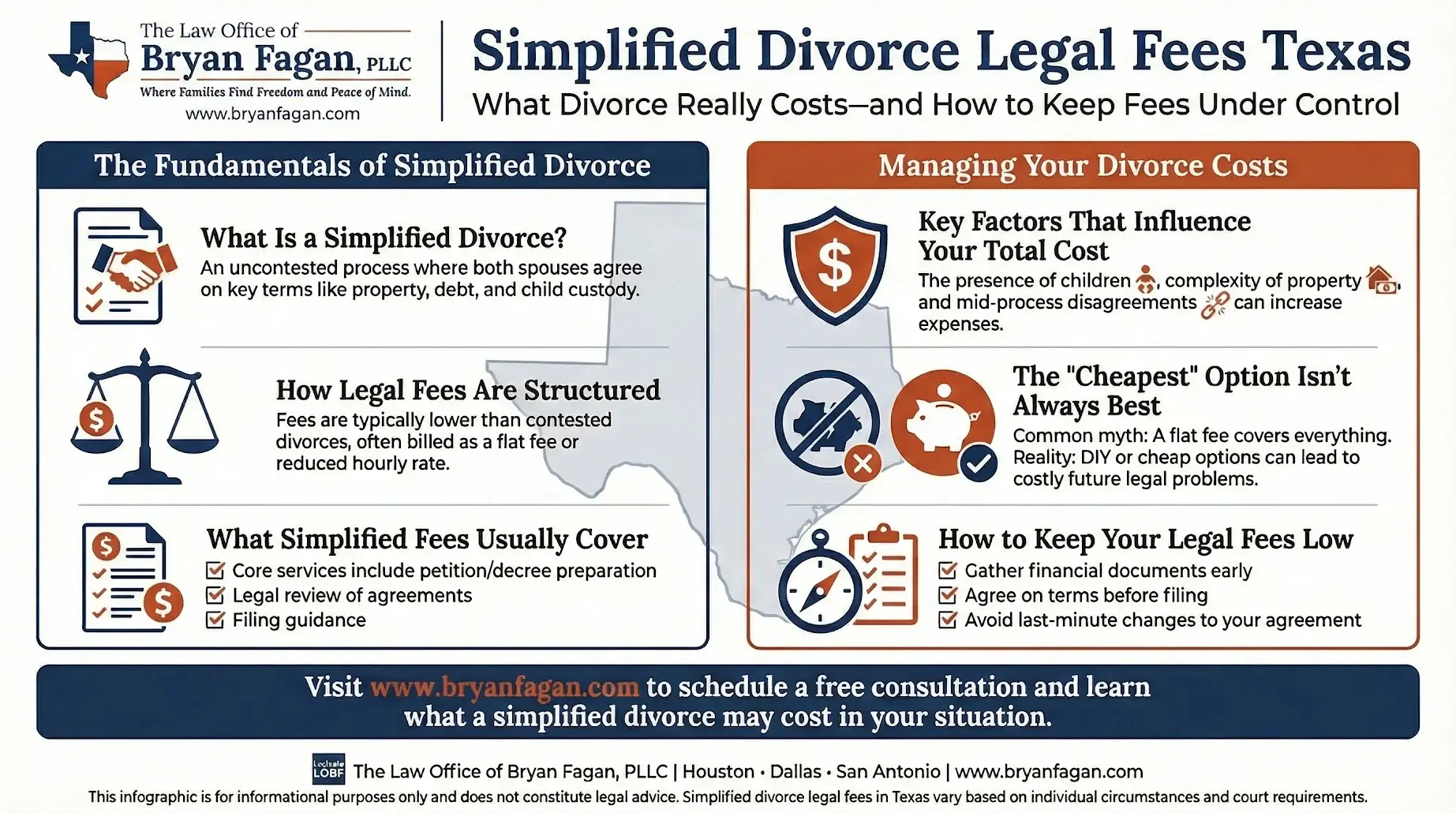

The moment you and your spouse agree that divorce is unavoidable, the questions come fast and heavy. How much will this cost? How long will it take? Will this turn into a fight we never wanted? For many Texas families, the hope is simple: end the marriage with dignity, avoid unnecessary conflict, and move forward without burning everything down along the way. That’s where Simplified Divorce Legal Fees Texas families encounter become more than a budget line item—they become a signal of how peacefully, or painfully, this transition may unfold.
At The Law Office of Bryan Fagan, PLLC, we often meet people who start their divorce journey believing that “simple” means informal or hands-off. In reality, even uncontested divorces carry legal weight and long-term consequences. Texas law requires that every divorce follow specific rules, and courts expect clear, enforceable agreements that truly resolve the marriage. When those details are handled correctly, costs stay predictable and stress stays manageable. When they aren’t, what begins as a simplified divorce can quickly spiral into something far more expensive—financially and emotionally.
Led by Bryan Joseph Fagan, a South Texas College of Law graduate and a recognized authority on Texas divorce and custody law, our firm exists for one reason: to help families reclaim peace of mind during life’s hardest transitions. In this guide, we’ll explain what simplified divorce legal fees in Texas really cover, why they matter beyond the dollar amount, and how thoughtful legal planning can protect your future instead of complicating it. If you’re looking for clarity, confidence, and a path forward that feels steady rather than overwhelming, you’re in the right place.
Key Takeaways
- Simplified divorce in Texas typically costs $4,500–$5,400 total with an attorney, including flat legal fees of $4,500–$5,000 plus court filing fees of $300–$400.
- Filing fees are always separate from attorney fees and vary by county, ranging from $250–$400 across Texas.
- Children, retirement accounts, and real estate are the three biggest factors that can increase simplified divorce costs beyond the baseline.
- DIY divorces may cost only $300–$700 upfront but carry significant risks of errors that lead to expensive post-divorce legal problems.
- Prevention is cheaper than correction—an experienced family law attorney helps you avoid mistakes that create long-term financial burden.

Your Family’s Future Starts Here
Don’t navigate your legal journey alone. Schedule a consultation now and get the clarity and support you deserve.
Simplified Divorce Legal Fees Texas: The Big Picture
Simplified Divorce Legal Fees Texas families encounter are generally predictable when both spouses are committed to cooperation and careful planning. In most uncontested cases, attorney representation typically ranges from $4,500 to $5,000, with court filing fees adding another $300–$400 depending on the county. That places the total cost for a properly handled simplified divorce at approximately $4,800–$5,400. While cost is often the first concern, the real value comes from ensuring the divorce is completed correctly under current Texas law, with enforceable orders that prevent costly disputes later.
When people use the term “simplified divorce” in Texas, they are usually referring to an uncontested divorce rather than a separate legal classification. Texas law does not create a formal category for simplified divorces, but it does recognize that when spouses agree on all major issues—property division, child custody, child support, and spousal maintenance—the process requires less attorney time and fewer court appearances. This reduced complexity lowers legal fees while still requiring compliance with the Texas Family Code, including the community property rules in Chapter 7 and the best interest of the child standard under Texas Family Code §153.002.
It is critical to understand that “simplified” does not mean informal or optional. Every Texas divorce still requires proper pleadings, a carefully drafted Final Decree of Divorce, and judicial approval. Property division must meet the “just and right” standard under Texas Family Code §7.001, and mistakes involving significant assets—especially the marital home—can lead to expensive post-divorce litigation. Our attorneys often encourage clients to review resources like how Texas courts decide who keeps the house in a divorce to better understand how early planning can keep a simplified divorce from becoming financially complicated.
Even in the most cooperative situations, Texas imposes mandatory procedural safeguards. Under Texas Family Code §6.702, divorces are subject to a required 60-day waiting period after filing, with only narrow exceptions. What distinguishes a simplified divorce from a contested one is not the law itself, but the amount of legal work needed to reach a final, court-approved decree. By working with experienced Texas family law counsel—such as the team at The Law Office of Bryan Fagan, PLLC—families can navigate simplified divorce legal fees with clarity and confidence, knowing their agreement is legally sound and designed to protect their future rather than create new uncertainty.

What Makes a Divorce “Simplified” in Texas
A divorce is considered simplified or uncontested in Texas when both spouses reach agreement on every material issue either before filing or very early in the process. For families evaluating Simplified Divorce Legal Fees Texas, this distinction matters because agreement dramatically reduces both cost and stress. A truly uncontested divorce means the spouses agree on property division, child custody and child support if minor children are involved, any spousal maintenance issues, and the legal grounds for divorce, most commonly “insupportability,” Texas’s no-fault ground recognized under Texas Family Code §6.001.
In practice, simplified Texas divorces share several defining characteristics. Both spouses consent to the divorce and its grounds, all community property is divided in a manner that meets the “just and right” standard required by Texas Family Code §7.001, and there are no disputes over conservatorship or child support calculations governed by Texas Family Code Chapters 153 and 154. Court involvement is limited to required filings and final approval, with no need for temporary orders, extensive discovery, or trial preparation. When these elements are present, the process is more predictable, allowing families to plan financially and emotionally with far greater confidence.
When everything aligns, Texas district courts can move efficiently toward final resolution. One spouse files the Original Petition for Divorce, the other spouse is formally served or signs a waiver of service, and the case proceeds through the mandatory 60-day waiting period set out in Texas Family Code §6.702. After that period expires, the court typically conducts a brief prove-up hearing to review and approve the Final Decree of Divorce, provided the agreement complies with current statutory requirements. This streamlined path is what keeps simplified divorce fees significantly lower than contested cases.
The contrast with contested divorces is substantial. When spouses disagree over custody, property division, or support, the process expands to include temporary orders hearings, discovery requests, mediation, and sometimes trial, each stage adding thousands of dollars in legal fees and months of uncertainty. That is why many families seek cost-conscious solutions early, including structured fee options that make representation more accessible. Resources like Texas divorce fee payment plans that make quality representation more affordable can help families understand how legal guidance fits into a realistic budget.
From the perspective of the attorneys at The Law Office of Bryan Fagan, PLLC, the goal is always to help families understand when a simplified divorce is truly appropriate and how to keep it that way. By educating clients on the legal standards set by the Texas Family Code and offering clear, compassionate guidance throughout the process, the firm helps families move through divorce efficiently while protecting their finances and their future.
Typical Simplified Divorce Legal Fees Texas
For uncontested divorces with attorney representation, Texas couples should expect to pay between $4,500 and $5,000 in flat attorney fees. This is the minimum for competent legal representation on a simplified divorce case.
Here’s how simplified divorce costs compare to contested cases:
| Divorce Type | Typical Legal Fees | Filing Fees | Total Cost Range |
|---|---|---|---|
| DIY/No attorney | $0–$200 (document services) | $300–$400 | $300–$700 |
| Simplified with attorney | $4,500–$5,000 | $300–$400 | $4,800–$5,400 |
| Contested (limited disputes) | $11,000–$13,000 | $300–$400 | $11,300–$13,400 |
| Contested with custody trial | $13,000–$23,000+ | $300–$400 | $13,300–$23,400+ |
The cost savings of simplified divorces are substantial. By choosing agreement over litigation, Texas couples save between $6,500 and $18,000 compared to contested divorce proceedings.
Most Texas divorce attorneys offer flat-fee arrangements for uncontested divorces, providing cost certainty upfront. This is preferable to hourly billing, where attorney costs can escalate if the case becomes complicated or requires additional negotiation.
Costs Included vs. Not Included in Simplified Divorce Fees
A flat-fee arrangement is often the foundation of Simplified Divorce Legal Fees Texas families rely on when they want predictability and peace of mind. In an uncontested divorce, a typical flat-fee package usually covers preparation of the Original Petition for Divorce, drafting of the Final Decree of Divorce, limited settlement negotiations, communication with the opposing spouse or counsel, and representation at the informal prove-up hearing. These services are designed to meet the procedural requirements of the Texas Family Code while keeping the process efficient, compliant, and focused on resolution rather than conflict.
It is important to understand what those attorney fees generally do and do not include. While core legal drafting and court appearances are usually covered, certain costs are required by law or arise only in specific situations and are therefore billed separately. Court filing fees, which vary by county and typically range from $250 to $400, must be paid to the district clerk regardless of whether you have an attorney. Service of process fees may apply if a waiver is not used, and additional expenses can arise if retirement accounts, real estate valuation, or mediation are necessary to finalize an agreement that complies with Texas Family Code Chapter 7 governing community property division and Texas Family Code §6.701–§6.702 governing divorce procedure.
One frequently overlooked expense involves retirement accounts. When community property includes a 401(k), pension, or similar plan, the Texas Family Code requires the division to be carried out through a Qualified Domestic Relations Order, often referred to as a QDRO. Preparing a QDRO is a highly technical task that usually costs several hundred dollars or more and is rarely included in basic flat-fee divorce packages. Failing to address this step properly can lead to enforcement problems long after the divorce is finalized, which is why experienced Texas family law counsel emphasize addressing these details early. Our team often encourages clients to explore additional guidance on local representation, such as the resource on divorce attorneys serving Odessa and West Texas communities, to better understand how regional practices can affect both cost and efficiency.
Because filing fees and ancillary costs differ across counties, working with knowledgeable counsel helps families avoid surprises and ensure compliance with the most current Texas Family Code provisions. The attorneys at The Law Office of Bryan Fagan, PLLC focus on educating clients about what is included, what is not, and why those distinctions matter. By understanding the full scope of simplified divorce legal fees—and how Texas law governs each step—families are better equipped to make informed decisions that protect their financial stability and long-term peace of mind.

Factors That Increase Simplified Divorce Legal Fees Texas
Several factors can cause Simplified Divorce Legal Fees Texas families expect to rise beyond the baseline, even when both spouses intend to keep the process uncontested. The most significant drivers tend to be children, complex assets, and incomplete or unstable agreements. Understanding these pressure points ahead of time allows families to plan realistically and avoid surprises that undermine both budgets and peace of mind.
When minor children are involved, divorce costs almost always increase. Even in fully agreed cases, Texas courts require detailed findings related to conservatorship, possession, and child support under the Texas Family Code. Custody determinations must satisfy the best interest of the child standard in §153.002, and child support calculations must comply with the statutory guidelines in Chapter 154, including the updated guideline caps now in effect. As a result, uncontested divorces involving children often cost more than childless divorces because the required legal drafting and court scrutiny are more extensive. If disagreements arise over schedules or decision-making authority, what began as a simplified case can quickly move into a higher-cost category.
Complex property division is another major cost factor. Texas is a community property state, and under Texas Family Code §7.001, courts must approve a division that is “just and right.” Retirement accounts, pensions, investment portfolios, and multiple real estate properties require additional documentation and, in many cases, specialized orders such as Qualified Domestic Relations Orders. These added steps increase attorney time and outside professional costs, which is why divorces involving complex assets rarely remain inexpensive, even when the spouses are cooperative. For families seeking a broader understanding of how these financial variables affect overall divorce pricing, resources like what influences the price of divorce in Texas can provide helpful context.
Costs also rise when agreements are incomplete or cooperation breaks down. Delays caused by missing financial information, shifting positions, or last-minute disputes require additional attorney involvement, even if the case never becomes formally contested. Each round of clarification or renegotiation adds time and expense, reinforcing why clarity and full disclosure at the outset are so important. County-specific rules can also play a role, as some Texas courts require parenting courses or mediation in certain cases, creating additional mandatory expenses beyond standard attorney fees.
From the perspective of the legal team at The Law Office of Bryan Fagan, PLLC, these cost drivers all point to the same lesson: thoughtful preparation and informed guidance keep simplified divorces from becoming unexpectedly expensive. By understanding how children, assets, cooperation, and local court requirements affect simplified divorce legal fees, families are better equipped to make decisions that protect their finances and support a smoother transition forward.
Filing Fees and Court Costs in Simplified Texas Divorces
Court filing fees in Texas range from $250–$400 depending on the county, with most counties charging around $300. These fees are paid directly to the court clerk when the divorce petition is filed and are entirely separate from any attorney costs.
| Major Texas County | Filing Fee Range |
|---|---|
| Dallas County | $350–$400 |
| Harris County (Houston) | $300–$350 |
| Bexar County (San Antonio) | $300–$350 |
| Travis County (Austin) | $300–$350 |
| Tarrant County (Fort Worth) | $300–$350 |
Beyond the initial filing fee, you may incur additional court costs such as process server fees for serving your spouse with divorce papers (unless your spouse waives service), certified copy fees for official documents, and fees for recording the divorce decree.
For low-income individuals, Texas offers fee waivers for court costs. If you cannot afford filing fees, you can file an Affidavit of Indigency with the court. Eligibility depends on your income and assets—check your local court’s website for specific requirements.
Common Mistakes That Make a Simplified Divorce More Expensive
One of the most costly misconceptions we see with Simplified Divorce Legal Fees Texas cases is the belief that “simple” means casual or low-risk. In reality, the mistakes made during an uncontested divorce often create post-divorce problems that are far more expensive to resolve than obtaining proper legal guidance at the outset. Texas divorces result in binding court orders, and errors in drafting or procedure can linger for years, affecting finances, enforcement rights, and peace of mind.
Relying on generic online divorce services without a clear understanding of Texas law is particularly risky. While these services may assist with filling out forms, they cannot evaluate whether a Final Decree of Divorce complies with the Texas Family Code or adequately protects your interests. Texas courts expect decrees to meet statutory requirements, including proper jurisdiction under Chapter 6 and a “just and right” division of community property under Texas Family Code §7.001. A poorly drafted decree may be difficult—or impossible—to enforce, leaving families exposed to future litigation.
Another common and expensive mistake is failing to address all marital assets and debts in the divorce decree. Texas is a community property state, which means most property acquired during the marriage must be divided at divorce. When retirement accounts, investment accounts, or outstanding debts are overlooked, former spouses often find themselves forced back into court to clarify ownership or seek partition, driving up costs long after the divorce should have been finished. This issue is especially common with retirement accounts, where Texas law requires a separate Qualified Domestic Relations Order to divide plans like 401(k)s or pensions. Preparing a QDRO after the divorce is finalized is often more complicated and more expensive than handling it correctly during the initial process.
Enforcement is another area where shortcuts lead to regret. Settlement language that feels fair but lacks specificity can make it difficult to hold a former spouse accountable. Texas courts enforce what is written, not what was intended, and vague provisions often require enforcement actions that add thousands of dollars in attorney fees. Likewise, overlooking the tax consequences of property division, spousal maintenance under Texas Family Code Chapter 8, or child support under Chapter 154 can result in unpleasant financial surprises after the ink is dry.
From the perspective of the attorneys at The Law Office of Bryan Fagan, PLLC, these issues highlight why education and careful planning matter so much in uncontested divorces. Families are often encouraged to review resources like a step-by-step overview of the legal steps to divorce in Texas to better understand where mistakes commonly occur and how to avoid them. Taking the time to get informed legal guidance upfront helps ensure that a simplified divorce truly stays simplified—financially, legally, and emotionally—long after the case is closed.
Is a Simplified Divorce Without a Lawyer Really Cheaper?
At first glance, handling a divorce on your own can seem like the cheapest option, especially when filing fees and basic document preparation may total only a few hundred dollars. But when families compare those short-term savings to Simplified Divorce Legal Fees Texas attorneys typically charge, the comparison often changes. Texas divorce orders are permanent court judgments governed by strict statutory requirements, and even small drafting errors can create serious legal and financial consequences later. What looks affordable upfront can quickly become far more expensive once mistakes surface.
Data consistently shows that couples who proceed without legal guidance often spend more than they expect. While direct out-of-pocket costs may appear low at first, problems arise when a decree fails to comply with Texas Family Code provisions governing property division under §7.001 or child support and custody orders under Title 5 of the Code. Enforcement actions, modification lawsuits, or the need to reopen property division issues can easily cost $5,000 to $15,000 or more. These disputes commonly involve overlooked retirement accounts, improperly divided assets, or child support calculations that do not meet statutory guidelines, all of which Texas courts take seriously.
For many families, a balanced alternative is limited-scope legal assistance, sometimes referred to as unbundled services. This approach allows a Texas family law attorney to review settlement terms, correct drafting issues, and ensure the Final Decree of Divorce complies with the most current Texas Family Code requirements, including the mandatory 60-day waiting period under §6.702. Costs for this type of support are often far lower than full litigation, yet significantly reduce the risk of future enforcement or modification problems. Families considering regional guidance may also find it helpful to review resources like how divorce cases are handled in San Antonio and surrounding areas to understand how local practices affect outcomes.
From the perspective of the attorneys at The Law Office of Bryan Fagan, PLLC, the guiding principle is simple: prevention is almost always less expensive than correction. Investing in experienced legal review at the outset helps ensure that agreements are enforceable, compliant, and tailored to your family’s needs. Whether through full representation or targeted guidance, working with knowledgeable Texas family law counsel allows families to move forward with confidence, knowing their divorce decree protects their future rather than creating new uncertainty.

How a Texas Divorce Attorney Keeps Simplified Divorce Fees Low
The real value of working with a skilled attorney in an uncontested divorce is not adding layers of complexity, but removing risk before it becomes expensive. When families are evaluating Simplified Divorce Legal Fees Texas, it helps to understand that experienced legal guidance often lowers long-term costs by spotting issues early, drafting enforceable documents, and preventing mistakes that quietly turn “simple” divorces into years of follow-up litigation. In Texas, a divorce decree is a final court order, and getting it right the first time matters far more than shaving a few dollars off the upfront price.
Texas family law attorneys help keep simplified divorce costs predictable by focusing on prevention. Under Texas Family Code §7.001, all community property must be divided in a manner that is “just and right,” and overlooking assets such as retirement accounts, pensions, or deferred compensation can expose families to future claims long after the divorce is finalized. We routinely see situations where one spouse believes an asset was settled, only to discover years later that it was never properly addressed. Articles like whether an ex-spouse can claim a pension years after divorce highlight why careful drafting and complete disclosure are essential to truly closing the door on marital property disputes.
Effective legal representation also centers on drafting decrees that actually work in the real world. Texas courts enforce what is written, not what the parties intended, which is why precise language matters when addressing child support under Texas Family Code Chapter 154, conservatorship under §153.002, and spousal maintenance under Chapter 8. Clear, enforceable orders reduce the likelihood of post-divorce enforcement actions or modification suits, both of which can cost far more than the original uncontested divorce itself.
Transparency is another critical factor. Many Texas family law practices, including the attorneys at The Law Office of Bryan Fagan, PLLC, offer flat-fee structures for uncontested divorces so families know what to expect financially. Just as important, experienced counsel manages timelines and expectations, ensuring the case moves efficiently through the mandatory waiting period in Texas Family Code §6.702 without unnecessary delays that drive up costs. When families understand how simplified divorce legal fees work and why professional guidance matters, they are better positioned to choose representation that balances affordability with long-term protection and peace of mind.
Why Choose The Law Office of Bryan Fagan, PLLC
Guidance from a seasoned Texas family law team can make all the difference when families are weighing Simplified Divorce Legal Fees Texas and deciding how to move forward. Attorneys at The Law Office of Bryan Fagan, PLLC have extensive experience handling simplified and uncontested divorces across the state, and they understand that most clients want to end their marriage efficiently, affordably, and correctly—without cutting corners that could jeopardize their future. That balance between efficiency and protection is central to the firm’s mission of educating families and safeguarding what matters most.
A core part of this approach is transparency. Cost-conscious and flat-fee options for uncontested divorces allow families to understand their financial commitment before the process begins, which helps reduce stress during an already emotional time. Each case is handled with careful, detail-oriented drafting that complies with the Texas Family Code, including the “just and right” property division requirement under §7.001 and the child-focused standards found in Chapters 153 and 154 when children are involved. By addressing retirement accounts, real property, support obligations, and parenting provisions thoroughly from the outset, the firm helps clients avoid enforcement actions or costly modifications later.
Clear communication and compassionate guidance are equally important. Divorce is more than a legal transaction; it is a major life transition that deserves respect and empathy. The legal professionals guiding families through this process prioritize timely updates, realistic expectations, and education at every step, including explanations of mandatory procedures like the 60-day waiting period required by Texas Family Code §6.702. Clients who want a broader overview of what to expect often benefit from resources such as a step-by-step explanation of the Texas divorce process, which reinforces understanding and confidence.
With statewide reach and deep familiarity with Texas courts, the team supporting families at The Law Office of Bryan Fagan, PLLC helps clients navigate simplified divorces with clarity and assurance. By combining legal precision with genuine care, the firm positions itself not just as a service provider, but as a trusted partner in helping families move forward with stability, dignity, and peace of mind.
Actionable Checklist: Simplified Divorce Legal Fees Texas
Managing Simplified Divorce Legal Fees Texas families face becomes far more achievable when you approach the process with intention and preparation rather than assumptions. One of the most important first steps is confirming that your divorce is truly uncontested. Both spouses must agree on the division of property, any child custody and support arrangements, potential spousal maintenance, and the legal grounds for divorce. Without full agreement, costs can escalate quickly as the case moves beyond the streamlined procedures allowed under the Texas Family Code.
Cost clarity is another critical piece. Families are well served by asking attorneys about flat-fee options and obtaining written explanations of what those fees include and what expenses may be separate. Court filing fees, which typically range from $300 to $400 depending on the county, are mandated by law and should always be budgeted independently from attorney fees. Preparing financially for these required costs helps avoid stress and delays once the case is filed under the procedural rules in Texas Family Code Chapter 6.
Thorough financial preparation also plays a major role in keeping costs down. Gathering complete documentation for all assets and debts allows the divorce decree to comply with the “just and right” property division standard required by Texas Family Code §7.001. Retirement accounts deserve special attention, as they often require a Qualified Domestic Relations Order to divide properly. Failing to address these accounts during the divorce can lead to future claims and litigation, which is why many families find it helpful to review guidance such as how pensions are divided in a Texas divorce before finalizing an agreement.
Finally, even in the most cooperative cases, consulting with a Texas divorce attorney before filing can prevent costly mistakes. An experienced legal professional can identify issues related to enforceability, tax consequences, and compliance with the latest Texas Family Code updates, including requirements affecting child-related orders under Chapters 153 and 154. From the perspective of the team at The Law Office of Bryan Fagan, PLLC, thoughtful preparation and informed guidance are the most effective tools families have to keep simplified divorce costs manageable while protecting their long-term financial and legal security.
Conclusion
Divorce may change the shape of your life, but it doesn’t have to unravel your sense of stability or control. When you understand how simplified divorce legal fees in Texas really work—and what those costs are meant to prevent—you’re in a much stronger position to make choices that protect your peace of mind, your finances, and your family’s future. Clarity has a way of lowering stress, and informed decisions tend to create smoother outcomes.
At The Law Office of Bryan Fagan, PLLC, we believe families deserve more than legal paperwork. They deserve guidance that feels steady, honest, and human. Working with an experienced Texas family law attorney can help keep a divorce from becoming more complicated—or more expensive—than it needs to be, while ensuring the legal details are handled correctly the first time. Sometimes the smartest move isn’t rushing to the finish line, but taking the right steps early so you don’t have to circle back later.
If you’re standing at the edge of this decision and wondering what comes next, consider this your reminder that you don’t have to figure it all out alone. Asking the right questions, getting clear answers, and having the right support can make this transition feel less overwhelming and more manageable. And if nothing else, remember this: a divorce handled with care today can save you a lot of stress tomorrow—and that’s a future worth protecting.
Frequently Asked Questions
A simple or uncontested divorce in Texas can be relatively affordable when both spouses agree on all major issues. At a minimum, you’ll need to pay the court filing fee, which typically ranges from a few hundred dollars depending on the county. When an attorney is involved, many uncontested divorces are handled for a flat fee that reflects the simplicity of the case. Costs increase when children, real estate, or retirement accounts must be addressed, but agreement between spouses keeps expenses far lower than in contested cases.
Retainer fees vary widely across Texas and depend on whether a divorce is contested. In cases involving disputes over custody or property, retainers are often several thousand dollars. For simplified or uncontested divorces, many attorneys do not require a traditional retainer and instead offer flat-fee pricing because the work involved is more predictable. A consultation with a Texas family law attorney is the best way to understand what fee structure fits your situation.
The “10 year rule” commonly refers to eligibility for spousal maintenance. If a marriage lasted at least ten years, a spouse may qualify for spousal maintenance under Texas law if other requirements are met. This rule does not guarantee alimony and does not automatically affect how property is divided. Texas courts focus on a “just and right” division of community property based on the facts of each case.
In many divorces, each spouse pays their own attorney fees. However, Texas courts can order one spouse to contribute to the other’s fees in certain circumstances, such as when there is a significant imbalance in financial resources or when fees relate to enforcing court orders. In uncontested divorces, spouses may also agree on how attorney fees will be handled as part of their settlement.
The easiest and least expensive way to divorce in Texas is typically through an uncontested divorce where both spouses agree on all terms before filing. Using a waiver of service and submitting a properly drafted final decree after the required waiting period can reduce costs significantly. While doing everything yourself may appear cheaper, many people choose limited legal guidance to avoid mistakes that can create costly problems later.
During a divorce, it’s important not to hide assets, drain bank accounts, or run up unusual debt. Ignoring court orders, missing deadlines, or relying on generic online forms without understanding Texas law can also cause serious problems. Keeping communication calm, finances transparent, and paperwork accurate often saves both time and money.
There is no universal answer to who loses more financially. In some cases, the lower-earning spouse feels the immediate impact, while in others the higher-earning spouse bears long-term obligations like child support or spousal maintenance. Financial losses are often greatest when conflict leads to prolonged litigation. Clear agreements and cooperative problem-solving tend to reduce long-term financial strain for both parties.
If hiring a lawyer feels out of reach, you may still have options. Some people qualify for court fee waivers that reduce filing costs. Others use limited-scope legal services, document review, or payment plans to manage expenses. Even brief legal guidance can help prevent costly errors, especially when children or significant assets are involved.
Texas law requires a minimum 60-day waiting period from the date a divorce is filed before it can be finalized, with limited exceptions. Uncontested divorces often conclude shortly after that waiting period if all paperwork is in order. Contested divorces, particularly those involving custody or property disputes, can take many months or longer depending on the complexity of the case.