
At The Law Office of Bryan Fagan, PLLC, we know that divorce is not just about paperwork or court dates. As a Houston-based family law firm led by Bryan Joseph Fagan, a South Texas College of Law graduate and recognized authority on Texas divorce and custody law, our focus has always been on helping families move through uncertainty with clarity and confidence. Texas law centers every custody decision on the best interest of the child under Texas Family Code §153.002, which means judges look closely at stability, routines, and a child’s emotional environment—not just legal technicalities. When parents choose an uncontested divorce, they are often choosing cooperation over conflict, a decision that can protect both their finances and their children’s sense of security.
This article is designed to help you understand how uncontested divorce costs in Texas connect to the real-life realities families face during separation. You will learn what drives divorce costs up or down, how custody and parenting plans can reduce stress on children, and why thoughtful legal planning often saves families money and emotional strain in the long run. Our goal is to educate and empower you, so you can make informed decisions that align with your values and protect what matters most.
If you are standing at the beginning of this process feeling overwhelmed, uncertain, or simply exhausted, you are not alone. Understanding Uncontested Divorce Costs Texas is not just about budgeting—it is about reclaiming peace of mind and building a more stable path forward for you and your family.
Key Takeaways
- Uncontested divorce costs in Texas typically range from $300 to $5,000, depending on whether you handle the process yourself or work with an attorney.
- Court filing fees alone cost $250 to $400 depending on your county, and additional costs include service of process, certified copies, and document preparation.
- Cases involving minor children cost 20-50% more due to mandatory parenting plans and child support calculations required under Texas law.
- Hiring an experienced divorce attorney can actually reduce total costs by preventing costly mistakes that turn simple uncontested divorces into expensive contested proceedings.
- Fee waivers are available for qualifying low-income parties, potentially reducing court costs to zero.

Your Family’s Future Starts Here
Don’t navigate your legal journey alone. Schedule a consultation now and get the clarity and support you deserve.
Uncontested Divorce Costs Texas: The Big Picture
An uncontested divorce in Texas is typically far less expensive than a contested case because both spouses choose cooperation over conflict from the outset. When couples resolve property division, child custody, child support, spousal maintenance, and debt allocation before filing, they avoid the most costly stages of litigation. Under Texas Family Code Chapter 6, this agreement-driven process eliminates the need for discovery disputes, temporary orders hearings, and trials. Understanding Uncontested Divorce Costs Texas begins with recognizing that early collaboration is not just emotionally healthier—it is financially strategic.
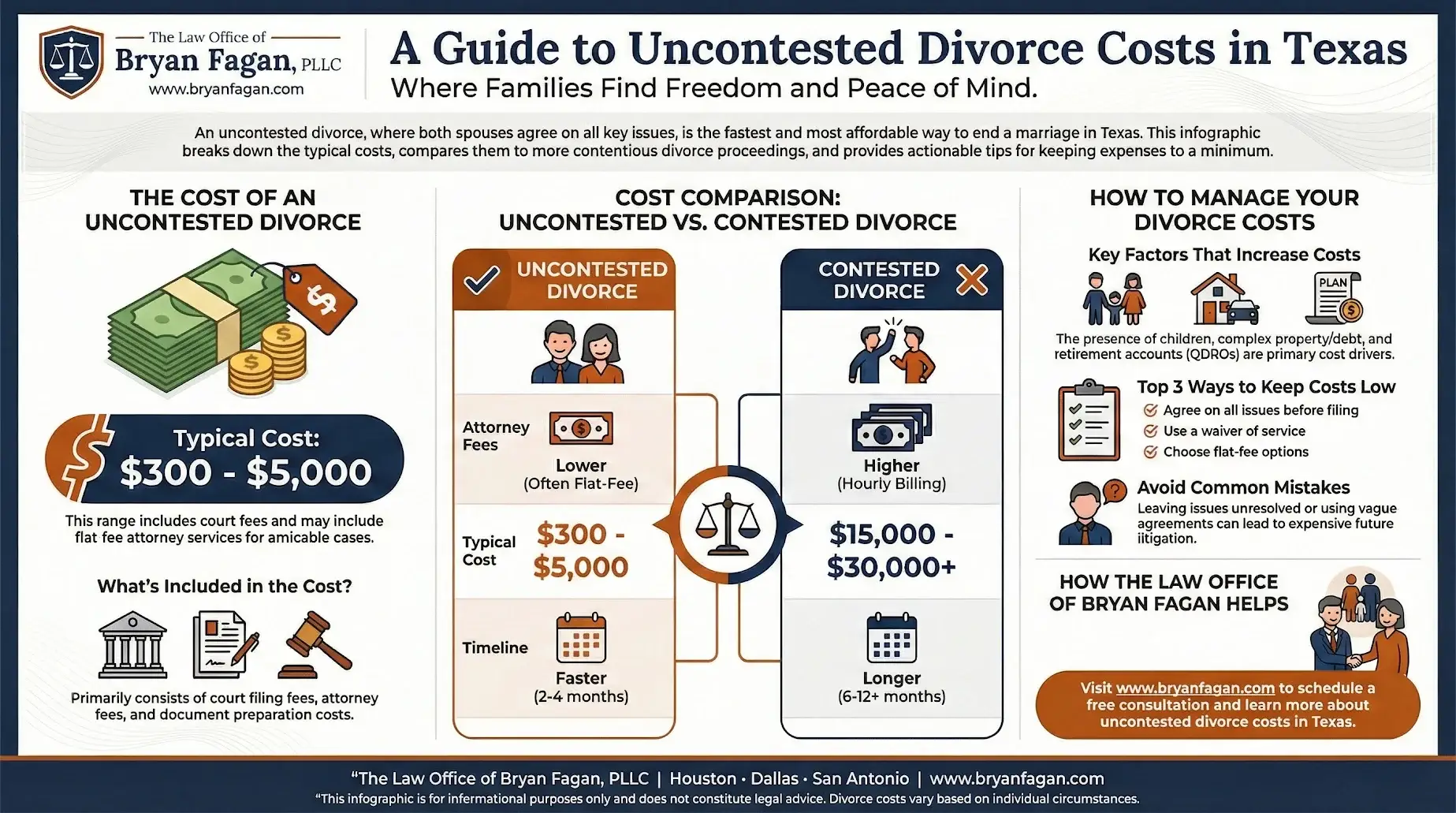
The financial contrast between uncontested and contested divorces is substantial. In most cases, uncontested divorce costs in Texas range from $1,500 to $5,000 when working with an attorney, and may be even lower for very simple cases without children or complex assets. Contested divorces, on the other hand, frequently exceed $15,000 to $30,000, particularly when disputes arise over child custody or allegations of hidden property. Families who work with experienced Texas family law counsel often find that reducing conflict upfront is the most effective way to preserve both financial stability and peace of mind. Timing also plays an important role in managing expectations, and readers can explore this further in the firm’s detailed resource on how long an uncontested divorce takes in Texas and what to consider for your situation.
Texas is also a no-fault divorce state, meaning neither spouse must prove wrongdoing to legally end a marriage. Under Texas Family Code §6.001, a court may grant a divorce when the marriage has become “insupportable” due to discord or conflict that destroys the legitimate ends of the marital relationship. This modern legal framework, combined with mutual agreement, creates a pathway for an amicable divorce that minimizes emotional strain while protecting long-term financial security. Many families benefit from learning more about this process through the firm’s comprehensive guide to uncontested divorce in Texas, which explains how thoughtful planning and informed legal guidance can help safeguard both your future and what matters most.

Typical Costs Included in an Uncontested Texas Divorce
The standard expenses associated with Uncontested Divorce Costs Texas tend to fall into a few predictable categories, and understanding each one allows families to plan realistically while avoiding last-minute surprises. Texas law provides a clear framework for uncontested cases under Texas Family Code Chapter 6, but the practical costs still depend on how the case is handled and whether both spouses remain cooperative throughout the process.
Court filing fees are unavoidable in every divorce case. Texas district courts set these fees under Texas Government Code §51.317, and the exact amount varies by county. Most counties charge between $250 and $400 to file an Original Petition for Divorce, with larger metropolitan areas such as Harris County and Dallas County typically near the higher end of that range. These fees are paid at the time of filing and apply regardless of whether the divorce is contested or uncontested, making them a foundational part of any divorce budget.
Service of process is another potential cost, though it can often be avoided in uncontested cases. If the responding spouse signs a Waiver of Service acknowledging receipt of the divorce paperwork and consenting to the court’s jurisdiction, there is no charge for service. When a waiver is not used, Texas Rules of Civil Procedure require formal service by a constable, sheriff, or private process server, which typically costs between $50 and $150. Many families choose waivers specifically to keep costs and conflict to a minimum.
Attorney fees usually represent the largest portion of uncontested divorce expenses. Flat-fee representation for uncontested divorces commonly ranges from $1,500 to $5,000, depending on complexity. These fees often cover preparation of all required documents, filing with the court, monitoring the mandatory 60-day waiting period under Texas Family Code §6.702, and representation at the final prove-up hearing. Families who want a deeper cost breakdown may find helpful guidance in how much an uncontested divorce costs in Texas and key considerations before filing, which explains how different factors influence overall expenses.
After a divorce is finalized, certified copies of the Final Decree are often needed for practical follow-up steps such as name changes, asset transfers, or updating financial accounts. Certified copies generally cost between $20 and $30 each, and most people request two or three copies, resulting in a modest but important post-divorce expense.
Mediation is sometimes mentioned as part of divorce costs, but it is optional in uncontested cases. When spouses agree on all terms, mediation is usually unnecessary. If limited issues remain unresolved, mediation costs can range from $500 to $2,500, depending on the mediator and the time involved. In truly uncontested divorces, however, families often avoid this expense entirely by finalizing agreements in advance.
Attorneys at the Law Office of Bryan Fagan, PLLC frequently help families identify which of these costs apply to their situation and which can be minimized or avoided altogether. Additional education is available through the firm’s resource on uncontested divorce in Texas, where families can learn how informed planning and cooperative decision-making help protect both financial stability and future peace of mind.
| Expense Category | Typical Cost Range |
|---|---|
| Court Filing Fees | $250 – $400 |
| Service of Process | $0 – $150 |
| Attorney Fees (Flat Fee) | $1,500 – $5,000 |
| Certified Copies | $40 – $90 |
| Optional Mediation | $500 – $2,500 |
| Total Range | $300 – $5,000+ |
How Attorney Fees Work in Uncontested Texas Divorces
Attorney fees are often the largest variable in Uncontested Divorce Costs Texas, which is why understanding how pricing structures work can make a meaningful difference for families trying to plan responsibly. When spouses agree on the major issues and approach the process thoughtfully, legal fees tend to stay predictable and proportionate to the work required. Texas divorce law under Texas Family Code Chapter 6 encourages resolution by agreement, and when cases remain uncontested, attorneys can focus on accurate drafting, compliance with statutory requirements, and guiding families efficiently through the process rather than managing conflict.
Flat-fee pricing is the most common structure for uncontested divorces and is often preferred because it offers clarity and peace of mind. With a flat fee, clients pay one agreed-upon amount that typically covers the initial consultation, preparation of the Original Petition for Divorce and Final Decree, monitoring the mandatory 60-day waiting period required by Texas Family Code §6.702, and representation at the final prove-up hearing. For many straightforward cases, flat fees in Texas commonly fall within the $1,500 to $3,500 range, depending on complexity. This approach allows families to budget confidently without worrying that every email or phone call will increase their bill.
Hourly billing, which often ranges from $200 to $400 per hour, is less common in truly uncontested matters but may apply if complications arise after filing. Some attorneys offer hybrid arrangements that include a base flat fee with hourly charges for work outside the original scope. These situations can develop when disagreements surface mid-process, when retirement accounts require Qualified Domestic Relations Orders, or when cases involve children and must comply with detailed conservatorship and possession requirements under Texas Family Code §§153.002 and 153.134. Each added layer of complexity increases the time required to ensure court approval and enforceable orders.
Working with experienced Texas family law counsel helps families anticipate these issues before they drive costs higher. The team at the Law Office of Bryan Fagan, PLLC regularly helps clients evaluate whether an uncontested divorce truly fits their circumstances and financial goals. Readers who want deeper insight into whether this approach is appropriate can explore when an uncontested divorce in Texas makes sense for your situation, which explains the practical and legal considerations involved. Additional guidance is also available through the firm’s comprehensive overview of uncontested divorce in Texas, a resource designed to educate families while protecting their futures through informed, compassionate legal planning.

Factors That Increase or Reduce Uncontested Divorce Costs Texas
The primary cost drivers in uncontested divorces relate to complexity, children, and cooperation. Understanding these factors helps you anticipate expenses and take steps to minimize them.
Cost-Increasing Factors
Child Custody and Support Requirements Cases involving minor children typically cost 20-50% more than childless divorces. Texas Family Code Section 153 requires detailed parenting plans specifying conservatorship, possession schedules, and geographic restrictions. Child support calculations under Section 154 must follow specific guidelines based on the obligor’s net resources. These requirements add drafting time and may require additional documentation, pushing costs to the $2,000-$5,500 range.
Property Division Complexity Dividing community property straightforwardly costs less than navigating retirement benefits, business interests, or significant assets requiring valuation. Qualified Domestic Relations Orders (QDROs) for retirement accounts add $300 to $1,000 to your total. Real property transfers require specialized deed preparation. Hidden assets or disputes about separate property versus community property can quickly escalate expenses.
Poor Cooperation or Communication When one spouse becomes unresponsive, fails to sign documents promptly, or changes positions on agreed terms, costs rise through additional attorney time, service fees, and potential procedural delays.
Documentation Errors Inaccurate financial disclosures, non-compliant decree language, or forms missing required information lead to amendments costing $300 to $800 each. These costly mistakes are entirely preventable with proper preparation.
Cost-Reducing Strategies
Complete Pre-Filing Agreement Finalizing your settlement agreement on every issue before filing eliminates back-and-forth negotiations that incur additional costs. When you and your spouse agree on property division, custody arrangements, and support obligations upfront, your attorney can draft final documents immediately.
Waiver of Service Having your spouse sign a Waiver of Service saves $75 to $150 in process server fees. This simple document confirms your spouse received the divorce papers and agrees to participate in the legal process.
Organization and Responsiveness Preparing complete financial documentation, responding promptly to attorney requests, and staying engaged throughout the divorce proceedings reduces attorney time and keeps your case on the most affordable track.
Experienced Legal Guidance Working with a divorce attorney who handles uncontested Texas divorces efficiently often costs less than a DIY approach that encounters problems requiring professional correction.
Court Fees and Waivers in Texas Uncontested Divorces
Court filing fees are a required part of Uncontested Divorce Costs Texas, and understanding how they work helps families avoid surprises at the courthouse. Texas district courts set divorce filing fees under Texas Government Code §51.317, which allows each county to establish its own fee schedule. As a result, costs vary depending on where you file. In most counties, filing fees fall between $250 and $400, with large metropolitan areas such as Harris, Dallas, and Tarrant counties typically charging toward the higher end of that range. While these fees may seem straightforward, they are mandatory unless a court-approved waiver applies, making them an important factor in any realistic divorce budget.
For Texans who cannot afford court costs, the law does provide relief. Texas Rules of Civil Procedure Rule 145 allows qualifying individuals to request a waiver of filing fees by submitting an Affidavit of Inability to Pay Court Costs, sometimes referred to as a Statement of Inability to Afford Payment of Court Costs. You may qualify if you receive government benefits such as SNAP or Medicaid, meet eligibility requirements for legal aid, or cannot pay court fees without sacrificing basic living expenses. For families already under financial strain, this process can significantly reduce the upfront burden associated with filing for divorce.
Requesting a fee waiver requires careful attention to detail. The affidavit must be completed accurately, include thorough financial information, and be filed at the same time as the divorce petition. The court clerk or judge will review the affidavit and either approve the waiver or request additional information. If approved, the case may proceed without payment of filing fees. If denied, the court can require payment later, sometimes retroactively, which is why accuracy and completeness are critical from the beginning.
Common mistakes in the fee waiver process include leaving sections of the affidavit incomplete, failing to attach proof of government benefits, or misunderstanding income thresholds, which are often tied to percentages of the federal poverty guidelines. Families navigating these issues often benefit from legal guidance to ensure compliance with court requirements and avoid delays. Those seeking a deeper breakdown of overall costs may find clarity in the firm’s detailed resource on how much an uncontested divorce costs in Texas and what you should know before filing, which explains how filing fees, waivers, and attorney costs fit together.
The attorneys at the Law Office of Bryan Fagan, PLLC routinely help clients evaluate whether a fee waiver is appropriate and ensure that all paperwork meets current court standards. Additional guidance is also available through the firm’s educational overview of uncontested divorce in Texas, a resource designed to help families move forward with clarity, confidence, and a realistic understanding of both their rights and their responsibilities.

Uncontested Divorce Costs Texas With and Without Children
The presence of minor children significantly impacts uncontested divorce costs because Texas law mandates additional requirements to protect children’s interests.
| Case Type | Typical Cost Range | Key Differences |
|---|---|---|
| Without Children | $300 – $2,500 | Simpler documentation, faster process |
| With Children | $2,000 – $5,500 | Parenting plans, child support calculations, additional court requirements |
Cases without children focus primarily on property division under Texas Family Code Section 7.001, which requires a “just and right” division of community property. This streamlined focus enables lower costs and faster resolution, making DIY divorce or document preparation services more viable options.
Cases with children require detailed Standard Possession Order schedules or customized arrangements, child support calculations following Texas Family Code Section 154 guidelines, provisions for health insurance and medical support, and decisions about conservatorship rights and decision-making authority. These requirements add complexity that benefits from professional legal guidance to ensure enforceable, compliant orders that protect your children’s wellbeing.
Common Mistakes That Turn Uncontested Divorces Into Costly Ones
Even when spouses begin the process in full agreement, Uncontested Divorce Costs Texas can rise quickly due to avoidable missteps. From the perspective of experienced Texas family law practitioners, most cost overruns are not caused by bad intentions but by gaps in planning or misunderstandings about what Texas courts actually require. Knowing where these problems tend to arise empowers families to protect both their finances and their peace of mind.
One of the most common issues is an incomplete agreement. When divorcing spouses fail to address every required topic—including debt allocation, tax consequences, or future contingencies—courts often require amendments after filing. Each revision adds delay and additional legal expense. Texas Family Code §6.701 and §7.001 require clarity and finality in divorce decrees, particularly when dividing community property in a manner the court considers “just and right.” When agreements fall short of these standards, the cost of correcting them can quickly outweigh any initial savings.
Poorly drafted final decrees are another frequent and expensive problem. Divorce orders that do not comply with Texas Family Code requirements risk rejection by the court or, worse, approval followed by future enforcement issues. A decree that lacks enforceable language regarding property division, conservatorship, or support may require refiling and additional court fees, along with renewed attorney involvement. These outcomes are entirely preventable when documents are prepared with an understanding of how Texas judges review uncontested cases.
Families also run into trouble when retirement assets and tax implications are overlooked. Texas Family Code §7.003 and related provisions governing retirement benefits require careful handling, particularly when Qualified Domestic Relations Orders are necessary. Ignoring retirement accounts, spousal maintenance eligibility under Texas Family Code §8.051, or tax consequences tied to property transfers can result in post-divorce disputes and costly modification proceedings that undermine the very purpose of choosing an uncontested divorce.
Procedural missteps further compound expenses. Missing deadlines, failing to properly serve documents, or not responding within required timeframes can cause an uncontested case to derail. Under Texas procedural rules, these errors may push a case into contested territory, triggering discovery requirements and significantly increasing legal fees. Even delays caused by slow document signing or missed appointments can extend the mandatory 60-day waiting period under Texas Family Code §6.702, increasing attorney involvement and overall costs.
These issues illustrate why preparation matters. A divorce that could have remained affordable can easily escalate into a far more expensive process when errors stack up. Families seeking a deeper understanding of cost drivers may benefit from reviewing factors that influence the cost of an uncontested divorce in Texas, which explains how complexity, cooperation, and compliance shape outcomes. Additional guidance is available through the firm’s educational resource on uncontested divorce in Texas, where families can learn how thoughtful planning and informed legal support help keep the process efficient, enforceable, and focused on protecting their future.

Ways to Keep Uncontested Divorce Costs Texas as Low as Possible
Practical strategies can help you maintain the lowest possible expenses while still obtaining a legally valid, enforceable divorce decree.
Finalize All Terms Before Filing Work with your spouse to reach complete agreement on every issue—property, debts, children, support—before either of you files for divorce. This eliminates negotiation costs and ensures your attorney can draft final documents immediately.
Prepare Documentation in Advance Gather complete financial records including bank statements, retirement account information, property deeds, debt statements, and income documentation. For cases with children, prepare proposed parenting schedules and child support worksheets. Organization reduces attorney time reviewing documents and asking clarifying questions.
Use Waiver of Service Avoid process server fees by having your spouse sign and file a Waiver of Service confirming receipt of divorce papers.
Respond Promptly When your attorney requests signatures, information, or decisions, respond quickly. Delays create follow-up work that increases fees.
Consider Limited-Scope Representation If you are comfortable handling some tasks yourself, ask about limited-scope options where an attorney reviews your documents and provides legal guidance without handling every aspect of your case. This hybrid approach can save money while ensuring legal accuracy.
Work With an Experienced Texas Divorce Attorney This may seem counterintuitive, but studies show attorney involvement prevents approximately 80% of errors that convert uncontested cases into costly contested proceedings. The investment in proper legal representation often pays for itself in avoided mistakes.
How a Texas Divorce Attorney Helps Control Uncontested Divorce Costs
A skilled divorce attorney does not merely add expense—they help control your total costs by preventing errors, ensuring compliance, and streamlining the legal process.
Attorneys draft legally enforceable agreements that comply with Texas Family Code requirements, eliminating the risk of unenforceable orders that require expensive modifications. They identify issues you might overlook, such as retirement account division requiring QDROs or spousal maintenance considerations under Texas law.
Flat-fee and limited-scope service options provide cost certainty while ensuring professional oversight of your case. Rather than billing hourly for every phone call and email, these arrangements let you know exactly what you will pay upfront.
Experienced attorneys also guide you through Texas district court requirements efficiently, avoiding procedural missteps that delay your case or create additional costs. Their familiarity with the divorce process means fewer corrections, fewer filings, and faster resolution.
Why Choose The Law Office of Bryan Fagan, PLLC
With decades of experience guiding families through uncontested divorces across Texas, the team at The Law Office of Bryan Fagan, PLLC focuses on clarity, education, and cost transparency from day one. Rather than leaving families guessing, the firm emphasizes upfront explanations so clients fully understand their Uncontested Divorce Costs Texas before making important decisions. This approach aligns with the structure set out in Texas Family Code Chapter 6, which encourages resolution by agreement and allows families to avoid unnecessary litigation when both spouses are prepared to cooperate.
Clients are offered flat-fee and cost-conscious service options tailored to their circumstances, whether the case involves no children and minimal assets or includes retirement accounts, real property, and detailed parenting plans. Careful legal drafting is especially important under Texas Family Code §§6.701 and 7.001, which require divorce decrees to be final, clear, and enforceable. When documents are prepared correctly the first time, families reduce the risk of rejected orders, future disputes, or costly modifications that undermine the financial benefits of an uncontested divorce.
Just as important as legal precision is the way clients are supported throughout the process. The attorneys and staff pride themselves on clear communication and compassionate guidance, recognizing that even amicable divorces carry emotional weight. By explaining each step, including timelines governed by Texas Family Code §6.702 and court procedures, families are better equipped to move forward with confidence. Readers who want a broader overview of what to expect may find helpful context in the Texas divorce process explained step by step, a resource designed to educate and reduce uncertainty.
With the ability to represent clients statewide, the firm remains committed to helping Texas families navigate divorce in a way that protects both their future and their peace of mind. Additional insight into cooperative divorce options is also available through the firm’s guide on uncontested divorce in Texas, where practical legal guidance is paired with a deep respect for the personal challenges families face during this transition.
Actionable Checklist: Uncontested Divorce Costs Texas
Before Filing:
- ☐ Confirm complete agreement with your spouse on all issues including property division, debts, custody, and support
- ☐ Gather complete financial documentation including bank statements, retirement account information, and property records
- ☐ Research flat-fee attorney options and request quotes from experienced Texas divorce attorneys
- ☐ Determine eligibility for court filing fee waivers if applicable
- ☐ Prepare proposed parenting schedules if you have minor children
During the Process:
- ☐ Use Waiver of Service to avoid process server costs
- ☐ Respond promptly to all attorney requests and court requirements
- ☐ Stay engaged and communicative throughout the 60-day waiting period
- ☐ Review all documents carefully before signing
- ☐ Order 2-3 certified copies of your final divorce decree
Conclusion
Divorce has a way of making even the most organized people feel uncertain, and that is completely normal. When you are weighing Uncontested Divorce Costs Texas, you are really trying to answer a bigger question: how do I move forward in a way that protects my family, my peace of mind, and my future? Understanding the legal process, the financial implications, and the impact your choices can have on your children gives you something powerful in an otherwise overwhelming moment—clarity.
The families who tend to navigate divorce with the least regret are not the ones who rush to the cheapest option or avoid asking questions. They are the ones who pause, get informed, and choose a path that balances cost, cooperation, and long-term stability. A well-handled uncontested divorce can be an opportunity to close one chapter thoughtfully and begin the next with fewer financial surprises and far less emotional strain.
If you are considering an uncontested divorce in Texas, speaking with an experienced Texas family law attorney can help you see the full picture before you make decisions that are difficult to undo. At The Law Office of Bryan Fagan, PLLC, our focus is on educating and empowering families so they can move forward with confidence, not fear. Sometimes the most important step is simply having a conversation that replaces uncertainty with understanding.
And if nothing else, remember this: choosing a calmer, more informed approach to divorce is not a sign of weakness—it is often one of the strongest decisions a parent or partner can make.
Frequently Asked Questions About Uncontested Divorce in Texas
The cost of an uncontested divorce in Texas usually includes the court filing fee, which is often a few hundred dollars, plus any additional expenses for document preparation, service, or attorney assistance. If both spouses agree on all terms and one signs a waiver of service, costs tend to stay on the lower end. Expenses increase when children, property division, or retirement accounts require more detailed legal drafting to meet Texas court requirements.
Texas law requires a mandatory 60-day waiting period from the date the divorce petition is filed before most divorces can be finalized. Many uncontested divorces are completed shortly after that period ends, assuming paperwork is complete and both spouses remain cooperative. Delays usually happen when documents are rejected by the court or when one party is slow to respond.
In most cases, at least one spouse must attend a brief prove-up hearing so a judge can officially finalize the divorce. Some courts allow remote appearances or affidavits in limited situations, but this varies by county and judge. An experienced Texas family law attorney can explain what your local court typically requires and help make the process as smooth as possible.
The quickest and most affordable approach is usually an uncontested divorce where both spouses agree on all issues before filing, use a waiver of service, and submit a properly drafted Final Decree of Divorce. While the 60-day waiting period still applies in most cases, careful preparation helps avoid delays that make a simple case more expensive than necessary.
The “10-year rule” most often refers to eligibility for spousal maintenance in Texas. A marriage lasting 10 years or more may allow a spouse to request maintenance, but it does not guarantee it. Courts still consider whether the requesting spouse can meet basic needs and whether other statutory requirements are met under Texas law.
The fastest path is reaching a complete agreement on property, debts, custody, and support before filing, then submitting accurate paperwork that complies with local court rules. Prompt communication, quick document signing, and using a waiver of service all help avoid unnecessary delays. While you usually cannot bypass the waiting period, you can prevent issues that extend the case beyond it.
A judge may refuse to finalize an uncontested divorce if paperwork is incomplete, required legal language is missing, jurisdiction is unclear, or child-related provisions do not meet Texas standards. In cases involving children, courts are especially careful to ensure the agreement is clear, enforceable, and in the child’s best interest. Most denials can be resolved with proper revisions.
The “10-10-10 rule” is not an official Texas legal rule. It is often used as a personal decision-making concept or misunderstood as a legal standard. If you hear this phrase in connection with a Texas divorce, it is wise to clarify its meaning with a qualified family law attorney before relying on it.
Avoid actions that increase conflict or create legal problems, such as hiding assets, draining accounts, violating court orders, involving children in adult disputes, or posting inflammatory content on social media. Verbal agreements that are never written into court orders are also risky. A calm, documented, and child-focused approach usually protects both your legal position and your peace of mind.