
The moment divorce becomes real, it rarely arrives with legal questions first. It shows up in quieter ways. A late-night conversation at the kitchen table. A look exchanged when bills are spread out and no one is sure how they will all get paid. A parent wondering whether they can keep the family home, maintain routines, or simply breathe without constant financial anxiety. In Texas, those worries often center on one confusing question: Spousal Support vs Alimony Texas—and what that distinction actually means for life after divorce.
At The Law Office of Bryan Fagan, PLLC, we regularly meet parents who assumed alimony worked one way, only to discover Texas law plays by very different rules. One spouse may have stepped back from a career to support the family. Another may be carrying the full financial load for years. When separation happens, both are suddenly faced with uncertainty about income, stability, and the ability to provide a steady home for their children. Texas law addresses these concerns through spousal maintenance and contractual alimony, but understanding the difference is critical before expectations—and futures—are set.
Texas courts approach these issues with a clear guiding principle. Under Texas Family Code §153.002, the best interest of the child is always paramount. While that statute is most often discussed in custody cases, it influences financial decisions as well. Judges understand that children thrive when their parents are stable, secure, and able to meet basic needs without constant stress. Financial arrangements after divorce are not just about fairness between adults; they are about preserving a sense of normalcy and peace for the entire family.
Led by Bryan Joseph Fagan, a South Texas College of Law graduate and recognized authority on Texas divorce and custody law, our firm is grounded in one purpose: empowering families to reclaim freedom and peace of mind during life’s hardest transitions. We do that by educating clients, simplifying complex legal rules, and crafting solutions that protect what matters most. When parents understand how spousal support works in Texas—and how it differs from what they may have heard elsewhere—they are better equipped to make decisions that support both their own stability and their children’s well-being.
In the sections that follow, we will break down how spousal support and alimony function under Texas law, how judges actually evaluate these issues, and why getting it right can shape your family’s future long after the divorce decree is signed. If you are looking for clarity, confidence, and compassionate guidance during an uncertain time, this is where that understanding begins.
Key Takeaways
- Texas does not award traditional alimony. Court-ordered financial support is called spousal maintenance and has strict eligibility requirements under Texas Family Code Chapter 8.
- Contractual alimony exists through private agreements. Divorcing spouses can negotiate their own support arrangements, which offer more flexibility but different enforcement mechanisms.
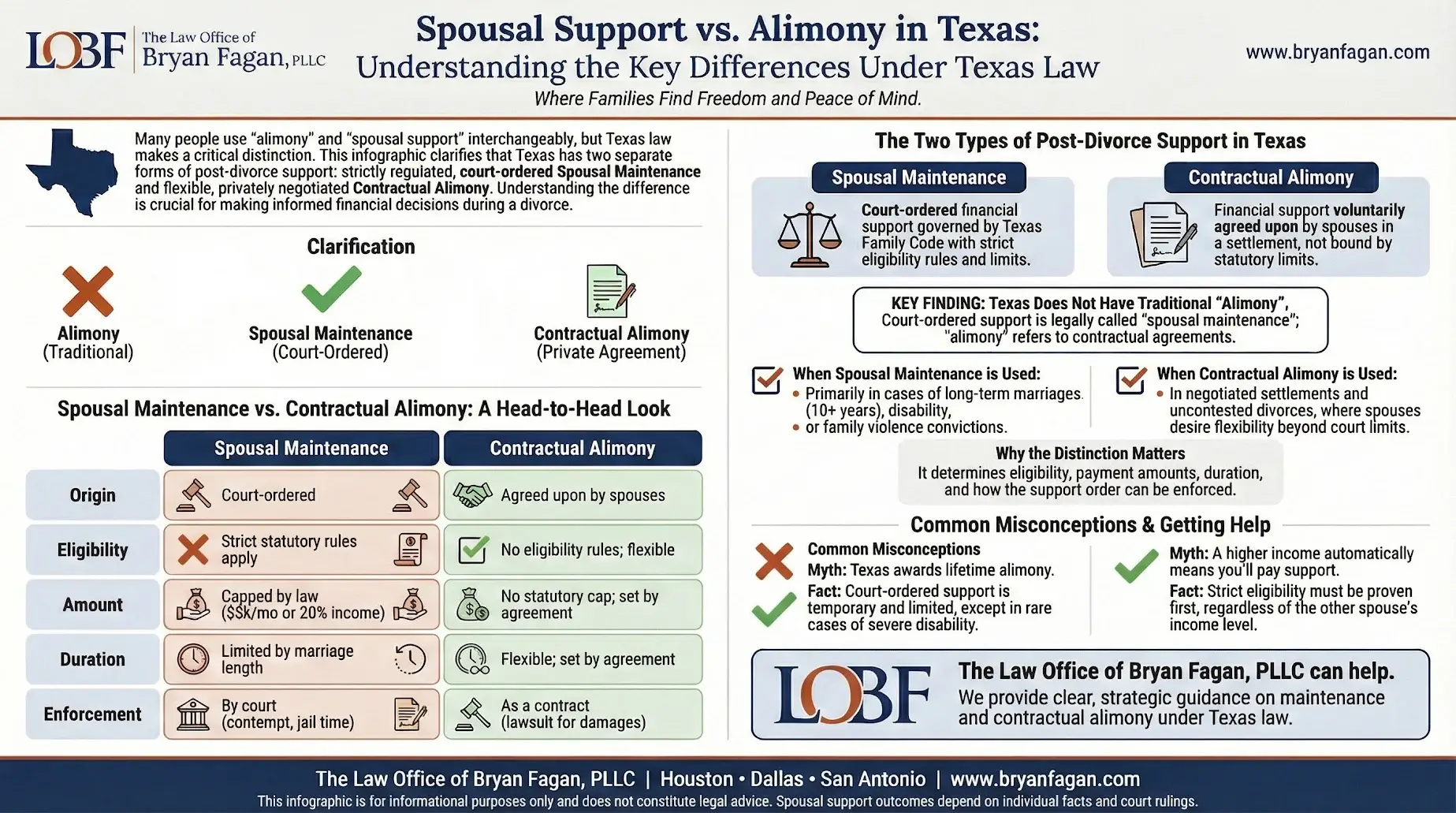
- Spousal maintenance is limited by law. Courts cannot award more than $5,000 monthly or 20% of the paying spouse’s gross income, and duration depends on how long the marriage lasted.
- Enforcement differs significantly between the two. Spousal maintenance violations can result in contempt of court, while contractual alimony disputes require breach of contract claims.
- Working with a family law attorney is essential. The complexity of Texas support laws makes professional guidance critical for protecting your financial future.

Your Family’s Future Starts Here
Don’t navigate your legal journey alone. Schedule a consultation now and get the clarity and support you deserve.
Spousal Support vs Alimony Texas: The Key Difference
Under Texas law, the idea of traditional, long-term alimony—often seen in other states—does not apply. Instead, families navigating divorce must understand the legal framework behind Spousal Support vs Alimony Texas, which centers on two distinct forms of post-divorce financial support: court-ordered spousal maintenance and privately negotiated contractual alimony. This distinction reflects Texas’s policy preference for post-divorce self-sufficiency, while still offering limited protections for spouses who cannot meet their basic financial needs.
Court-ordered spousal maintenance is governed by Texas Family Code Chapter 8, including §§8.051 through 8.054, which outline eligibility requirements, statutory caps, and duration limits. To qualify, a spouse must show that they lack sufficient property to meet their minimum reasonable needs and fall within a narrowly defined category, such as a long-term marriage paired with limited earning capacity, a physical or mental disability, responsibility for a disabled child, or certain findings of family violence. Even when maintenance is awarded, courts are constrained by current statutory limits—generally the lesser of $5,000 per month or 20 percent of the paying spouse’s average gross monthly income—and by durations designed to be rehabilitative rather than permanent.
Contractual alimony, by contrast, is created through agreement rather than court order. When spouses negotiate a divorce settlement, they may agree to support terms that exceed what a judge could impose under Chapter 8, including longer durations or higher monthly payments. These agreements become part of the final divorce decree but are enforced under contract law, not through contempt powers. For readers seeking a deeper breakdown of how these two forms of support differ in real-world application, the firm’s educational article provides a clear explanation of the legal and practical consequences, which can be accessed through the firm’s resource on the difference between spousal maintenance and alimony in Texas.
This distinction carries real weight because the type of support involved affects enforcement options, modification rights, and long-term financial planning. Lawyers at the Law Office of Bryan Fagan frequently advise clients that understanding these differences early in the process helps set realistic expectations and creates leverage during negotiations. Families looking to understand how support issues fit into the broader divorce landscape may also find value in the firm’s Texas divorce process resource, which explains how courts approach property division, support, and post-divorce obligations. By combining up-to-date legal guidance with compassionate communication, the firm continues to help Texas families make informed decisions that protect stability today and peace of mind for the future.

What Is Spousal Maintenance Under Texas Law?
Spousal maintenance is the only form of financial support that Texas courts can order one spouse to pay to the other spouse after divorce. Under the Texas Family Code, this support exists to provide temporary assistance to a spouse who lacks sufficient property or income to meet their basic needs.
The eligibility requirements under Texas law are remarkably strict. A spouse seeking spousal maintenance must demonstrate that they will lack sufficient property after dividing assets to provide for their minimum reasonable needs. Additionally, they must show they cannot earn sufficient income to meet those needs through employment.
Eligibility Requirements for Court-Ordered Spousal Maintenance
Understanding eligibility is one of the most important—and often misunderstood—parts of Spousal Support vs Alimony Texas. Under Texas Family Code §8.051, a spouse requesting court-ordered spousal maintenance must first prove they lack sufficient property to meet their minimum reasonable needs after divorce and then demonstrate that one of several narrowly defined circumstances applies. These include a marriage lasting at least ten years combined with limited earning ability, a history of family violence resulting in a conviction or deferred adjudication during the marriage or divorce, a physical or mental disability that prevents self-support, or serving as the primary caregiver for a child whose disability requires substantial personal care and supervision. Texas courts apply these standards strictly, reflecting the state’s policy that spousal maintenance should be the exception rather than the rule.
Even when a spouse meets the eligibility threshold, Texas law imposes firm limits on what a court may award. Under Texas Family Code §8.055, spousal maintenance payments are capped at the lesser of $5,000 per month or 20 percent of the paying spouse’s average gross monthly income, consistent with the most recent statutory updates. Duration is also closely tied to the length of the marriage, with maximum periods generally limited to five years for marriages of ten to twenty years, seven years for marriages lasting twenty to thirty years, and ten years for marriages exceeding thirty years. These limits are designed to encourage financial independence rather than long-term reliance on post-divorce support.
Courts also presume that spousal maintenance is not appropriate unless the requesting spouse can show diligent efforts to develop job skills or education during the divorce process, as outlined in Texas Family Code §8.053. This requirement often becomes a decisive factor in contested cases, particularly when one spouse believes maintenance should continue indefinitely. Because of these restrictions, many families explore alternatives outside court-ordered maintenance. Negotiated solutions, such as contractual alimony, can provide flexibility that Texas judges are not permitted to impose on their own. Readers interested in how these agreements are structured may find helpful insight in the firm’s resource on how contractual alimony can be obtained in a Texas divorce, which explains how voluntary agreements can expand support options beyond Chapter 8.
Attorneys at the Law Office of Bryan Fagan regularly guide clients through these eligibility rules with an eye toward both legal precision and long-term stability. For families seeking a broader understanding of how support fits into the overall divorce framework, the firm’s Texas divorce process overview offers additional context on how courts balance statutory limits with practical realities. By combining clear education, up-to-date knowledge of the Texas Family Code, and compassionate advocacy, the firm continues its mission of helping Texas families protect their futures with confidence and clarity.
What Is Alimony in Texas (and Why the Term Is Misleading)?
Under Texas law, the term “alimony” is often used casually, but it does not appear anywhere in the Texas Family Code. This is where confusion surrounding Spousal Support vs Alimony Texas frequently begins. Many people assume Texas courts award the same type of long-term or lifetime alimony seen in other states, especially after lengthy marriages. In reality, Texas has intentionally chosen a more limited framework that focuses on short-term support and post-divorce self-sufficiency rather than permanent financial dependence.
What Texas law does permit is court-ordered spousal maintenance and privately negotiated contractual alimony, each governed by very different rules. Spousal maintenance is strictly regulated under Texas Family Code Chapter 8, including §§8.051 through 8.055, which outline who may qualify, how much can be awarded, and how long payments may last. Even with the most recent statutory updates, courts remain bound by firm limits—generally the lesser of $5,000 per month or 20 percent of the paying spouse’s average gross monthly income—and durations designed to help a spouse meet minimum reasonable needs while working toward independence.
Contractual alimony, by contrast, is created entirely through agreement between divorcing spouses. Because it is not imposed by a judge, it is not subject to Chapter 8’s caps or time restrictions. This allows spouses to negotiate support arrangements that better reflect their unique financial realities, including higher payments or longer durations than a court could ever order. For families looking to understand how Texas defines and applies alimony concepts, the firm’s resource your guide to alimony under Texas law offers a clear explanation of how these agreements work and when they may be appropriate.
To see how this distinction plays out, imagine a twelve-year marriage in which one spouse stepped away from a career to support the household and children. A Texas court might award only limited spousal maintenance under Chapter 8. However, through informed negotiation, the spouses could agree to contractual alimony of $6,000 per month for fifteen years—an arrangement that exceeds statutory limits but becomes fully enforceable once incorporated into the divorce decree. Because courts cannot force contractual alimony on either party, negotiation leverage tied to property division, child support, or other financial issues often becomes the deciding factor.
Attorneys with the Law Office of Bryan Fagan regularly help clients evaluate whether contractual alimony or spousal maintenance best fits their circumstances, drawing on deep familiarity with Texas divorce law and current Family Code requirements. Readers who want a broader understanding of how support issues fit into the overall legal process may also benefit from the firm’s Texas divorce overview, which explains how courts balance fairness, financial realities, and long-term stability. Through education, practical strategy, and compassionate guidance, the firm remains committed to helping Texas families protect their futures with clarity and confidence.

Eligibility: Spousal Support vs Alimony Texas
When families compare Spousal Support vs Alimony Texas, eligibility is often the first and most stressful question. Texas law sets a deliberately high bar before a court may even consider ordering spousal maintenance, reflecting the Legislature’s strong preference for post-divorce self-sufficiency. Under Texas Family Code §8.051, the spouse requesting maintenance must first prove they lack sufficient property, after the division of the marital estate, to meet their minimum reasonable needs. Courts evaluate this carefully by reviewing separate property, community property awards, retirement benefits, and whether the spouse has the present or potential ability to earn enough income to become financially independent.
Marriage length plays a critical role in this analysis. Absent a qualifying disability or family violence, the marriage must generally have lasted at least ten years before spousal maintenance is even an option. Judges also consider additional statutory factors found in Texas Family Code §8.052, such as the spouse’s age, employment history, education level, and any contributions made to the other spouse’s career or education during the marriage. These factors help courts determine whether temporary financial support is truly necessary or whether the requesting spouse can reasonably support themselves following the divorce.
Contractual alimony follows a very different path. Because it arises from voluntary agreement rather than court order, the strict eligibility requirements imposed by Chapter 8 do not apply. Either spouse may agree to pay contractual alimony regardless of marriage length, income disparity, or statutory eligibility. This flexibility often becomes a powerful negotiation tool, particularly in cases where one spouse does not technically qualify for spousal maintenance but still faces legitimate financial challenges after divorce. For families wondering whether support obligations may apply in their own situation, the firm’s resource on whether you may owe your spouse alimony after a Texas divorce offers additional clarity on how courts and agreements differ.
This distinction creates meaningful opportunities for strategic problem-solving. In higher-asset divorces, contractual alimony is frequently used to achieve outcomes that courts are legally prohibited from ordering, such as longer support durations or customized payment structures tied to property division. Attorneys with the Law Office of Bryan Fagan regularly guide clients through these decisions, helping them understand not only what a judge could order under Texas law, but also what may be achieved through thoughtful negotiation. For readers seeking broader context on how spousal support fits into the divorce process as a whole, the firm’s Texas divorce process overview provides valuable insight into how courts balance financial realities, statutory limits, and long-term stability.
By pairing precise knowledge of the Texas Family Code with compassionate, practical guidance, the firm helps families move forward with realistic expectations and informed confidence. Understanding both eligibility rules and negotiation possibilities allows spouses to make decisions that protect their financial future while preserving dignity and peace of mind during a difficult transition.
Payment Amounts and Duration Compared
Spousal Maintenance Limits
Texas law imposes firm caps on spousal maintenance payments. Courts cannot award more than $5,000 per month or 20% of the paying spouse’s average gross income, whichever is less. This means even high-earning spouses face strict limits on what they might owe.
Duration is equally constrained. The maximum periods are:
- Five years for marriages lasting at least ten years but fewer than twenty years
- Seven years for marriages lasting at least twenty years but fewer than thirty years
- Ten years for marriages lasting thirty years or longer
- Indefinite duration only when the spouse seeking maintenance has a permanent physical or mental disability or cares for a disabled child requiring substantial supervision
These limits reflect Texas’s view that spousal maintenance should be rehabilitative—helping a spouse transition to independence rather than providing permanent support.
Contractual Alimony Flexibility
Contractual alimony faces no statutory limits. Spouses can agree to any amount, any duration, and virtually any payment structure. Some couples agree to lifetime alimony payments, lump sum payments, or even property transfers in lieu of periodic payments.
However, this flexibility comes with important caveats. If contractual alimony terms exceed Chapter 8 limits—for example, payments lasting more than ten years—enforcement after the statutory period would shift from contempt powers to contract remedies. Understanding this enforcement distinction is essential when negotiating terms.
Enforcement Differences Between Spousal Support and Alimony
Court-ordered spousal maintenance comes with some of the strongest enforcement tools available under Texas law, and that difference is central to understanding Spousal Support vs Alimony Texas. Under Texas Family Code Chapter 8, particularly §§8.059 and 8.061, a spouse who fails to comply with a maintenance order can face enforcement through contempt of court. These remedies may include income withholding, liens on property, fines, and, in cases of willful nonpayment, even confinement. Texas courts treat spousal maintenance as a serious court obligation, not a private promise, which gives the receiving spouse meaningful leverage if payments fall behind.
Contractual alimony, however, operates under an entirely different enforcement framework. Because it is created by agreement rather than imposed by a judge, enforcement relies on contract law instead of contempt powers. If the paying spouse stops making payments, the receiving spouse must pursue a breach of contract claim, typically seeking monetary damages rather than punitive sanctions. This distinction is critical and is explained in greater detail in the firm’s educational resource on contractual alimony as a form of spousal support, which outlines how these agreements function once incorporated into a divorce decree.
The practical impact of this difference becomes clear in longer-term agreements. For example, if spouses agree to contractual alimony lasting fifteen years, enforcement options may change over time. During the period in which payments mirror what a court could have ordered under Chapter 8, enforcement may still include contempt-based remedies. Once those statutory limits are exceeded, however, enforcement typically shifts entirely to contract remedies, meaning the receiving spouse must rely on civil litigation if payments stop. This transition can significantly affect both the speed and effectiveness of enforcement.
Because enforcement options directly affect financial security, they should play a central role in negotiation strategy. Attorneys at the Law Office of Bryan Fagan regularly counsel clients to weigh the flexibility of contractual alimony against the stronger enforcement protections associated with court-ordered maintenance. For readers looking to understand how these support issues fit into the broader divorce process, the firm’s Texas divorce overview provides helpful context on how courts balance fairness, enforceability, and long-term stability. By combining clear legal education with compassionate guidance, the firm helps Texas families make informed decisions that protect their futures with confidence and peace of mind.

Modification and Termination Rules
Spousal Maintenance Modification
Texas courts can modify spousal maintenance when material and substantial changes in circumstances occur. If the paying spouse loses income or the receiving spouse gains earning ability, either party can request modification.
Certain events trigger automatic termination of spousal maintenance:
- Remarriage of the receiving spouse
- Cohabitation in a dating relationship resembling marriage
- Death of either spouse
These termination provisions apply regardless of what the original order stated. Courts cannot contract around automatic termination for spousal maintenance.
Contractual Alimony Changes
Contractual alimony typically cannot be modified unless both parties agree or the original agreement specifically allows modifications. Many couples include non-modifiable clauses in their agreements, which provides certainty but creates risk if circumstances change unexpectedly.
This inflexibility cuts both ways. The paying spouse cannot reduce payments if income decreases, but the receiving spouse cannot increase payments if needs grow. Careful drafting at the outset is essential to protect both parties’ interests through various factors that might arise later.
Common Myths About Spousal Support vs Alimony Texas
Myth: Texas awards lifetime alimony. Under Texas law, court-ordered spousal maintenance is always temporary, with ten years being the absolute maximum except in cases involving permanent disability. Lifetime support only exists through contractual alimony agreements.
Myth: Spousal support equalizes incomes after divorce. Texas courts do not attempt to equalize spousal incomes. Spousal maintenance addresses only the minimum reasonable needs of the receiving spouse, not lifestyle maintenance or income balancing.
Myth: Fault guarantees alimony payments. While family violence can affect eligibility and courts may consider marital misconduct, Texas primarily operates as a no-fault divorce state. Fault alone does not guarantee support awards.
Myth: Alimony is automatic in long marriages. Even marriages lasting thirty years do not guarantee spousal maintenance. The spouse seeking maintenance must still prove eligibility, demonstrate need, and show diligent efforts toward self-sufficiency.
The complexity of Texas alimony laws makes working with an experienced family law attorney essential. An attorney helps by setting realistic expectations about what courts can and cannot order, then developing strategies to achieve your goals.
For a spouse seeking spousal maintenance, an attorney evaluates eligibility, documents need, and builds the case for awarding spousal maintenance under Chapter 8. For someone seeking more than maintenance could provide, an attorney identifies negotiation leverage and structures contractual alimony to maximize enforceability.
Proper drafting protects both parties. Vague or poorly written agreements create modification and enforcement problems that could affect your financial future for years. A family law attorney ensures agreements are legally sound and practically enforceable.
Why Choose The Law Office of Bryan Fagan, PLLC
Families navigating divorce often need more than technical legal answers—they need clarity, reassurance, and a plan that protects their future. When weighing Spousal Support vs Alimony Texas, experience and precision matter, particularly given the strict statutory framework Texas courts must follow. Attorneys with the Law Office of Bryan Fagan draw on extensive experience handling spousal maintenance and contractual alimony cases, guided by a deep understanding of Texas Family Code Chapter 8, including §§8.051–8.055. This familiarity allows the firm to anticipate how judges apply eligibility standards, statutory caps, and duration limits under the most current version of the law.
Rather than applying generic solutions, the firm focuses on practical, financially informed strategies tailored to each client’s unique circumstances. Whether a spouse is seeking court-ordered spousal maintenance or negotiating contractual alimony beyond what a judge could order, legal guidance is grounded in long-term stability and realistic expectations. Understanding how these support issues fit into the larger picture of divorce is essential, and many families benefit from reviewing the Texas divorce process guide, which explains how financial support decisions interact with property division, custody arrangements, and post-divorce obligations throughout the case.
Clear communication and compassionate guidance remain central to the firm’s approach. Complex concepts—such as eligibility thresholds, statutory limits, and enforcement options—are explained in plain language so clients can make informed decisions during an emotionally difficult time. With statewide Texas representation and a longstanding commitment to education and advocacy, the team continues to help families navigate divorce with confidence, peace of mind, and a stronger foundation for the future.

Checklist: Spousal Support vs Alimony Texas
- ☐ Determine whether you meet eligibility requirements for spousal maintenance
- ☐ Understand statutory limits on court-ordered support amounts and duration
- ☐ Evaluate whether contractual alimony better serves your needs
- ☐ Clarify enforcement mechanisms for each support type
- ☐ Assess modification risks based on your specific circumstances
- ☐ Consult with a Texas divorce attorney before agreeing to any support terms
Conclusion
Divorce has a way of turning simple questions into heavy ones, especially when finances and family stability are involved. Understanding how spousal support and alimony work in Texas is not about memorizing legal terms—it is about knowing what options exist so you can make decisions with confidence instead of fear. When expectations are clear, the path forward feels less overwhelming, and families are better positioned to regain a sense of balance during a difficult transition.
If you are facing these issues right now, take a moment to remind yourself that uncertainty does not mean you are doing something wrong. It simply means you are at a crossroads. With the right information and the right guidance, that crossroads can become a turning point toward peace of mind, not prolonged stress. Many parents find that once they understand how Texas law actually works, the emotional weight of “what if” begins to lift.
Working with an experienced Texas family law attorney can make all the difference. A knowledgeable advocate does more than explain the law—they help you see how financial decisions today can shape stability, security, and opportunity for your family tomorrow. At The Law Office of Bryan Fagan, PLLC, our focus has always been on education, compassion, and practical solutions that protect what matters most.
If you are ready to move forward with clarity instead of guesswork, consider reaching out for guidance tailored to your situation. Even a single conversation can help replace uncertainty with direction. And if nothing else, remember this: asking the right questions now is often the first step toward rebuilding confidence, calm, and control over your future.
Frequently Asked Questions About Spousal Support and Alimony in Texas
Spousal support in Texas—often called spousal maintenance—has strict eligibility requirements. A court typically looks for a spouse who cannot meet their minimum reasonable needs after divorce and who also fits one of the legal criteria. Common qualifying situations include a marriage lasting at least ten years with limited earning ability, a physical or mental disability, caring for a disabled child, or certain family violence circumstances. Even then, the judge considers whether the requesting spouse has made reasonable efforts to become self-supporting.
Texas is a community property state, but not everything is automatically divided. Separate property is generally protected and includes assets owned before marriage, inheritances, and gifts given specifically to one spouse. However, “untouchable” property can become complicated if it is mixed with community funds or used for marital purposes. Proper documentation and tracing are often critical to preserving separate property claims.
No, Texas law does not automatically require one spouse to support the other after divorce. Spousal maintenance is only ordered if specific legal requirements are met and the requesting spouse demonstrates financial need. In many cases, there is no post-divorce spousal support at all. Some couples choose to agree to contractual alimony during settlement negotiations, but that is voluntary and based on mutual agreement.
In everyday conversation, people often use the word “alimony,” but Texas law generally refers to court-ordered support as spousal maintenance. Spousal maintenance is limited by statute in both amount and duration. Alimony, in many Texas divorces, refers to contractual alimony—payments agreed upon by the spouses rather than ordered by a judge. These agreements offer more flexibility but follow different enforcement and modification rules.
Court-ordered spousal maintenance in Texas is usually temporary and tied to the length of the marriage and the reason maintenance is awarded. The goal is often to help a spouse become financially independent. Contractual alimony, however, can last longer if both spouses agree to those terms. The specific duration depends heavily on the facts of the case and the structure of the divorce settlement.
Texas law does not base divorce outcomes on gender. Instead, courts focus on dividing community property in a manner that is “just and right.” This may include income earned during the marriage, retirement benefits accrued during the marriage, and other community assets. Spousal maintenance is a separate issue and is not guaranteed. Entitlements depend on property classification, financial circumstances, and the overall facts of the marriage.
The so-called “10-10-10 rule” is not an official legal rule in Texas. It is often used informally to describe how certain time thresholds—especially a ten-year marriage—can affect spousal maintenance eligibility. While the ten-year mark can be relevant under Texas law, it does not guarantee spousal support. These shorthand phrases can be misleading and should never replace personalized legal advice.
Moving out is not always the wrong choice, but doing so without legal guidance can create problems. It may affect temporary custody arrangements, financial responsibilities, or how a judge views possession of the marital home. When children are involved, moving out can also disrupt routines and weaken a parent’s position in custody discussions. Timing and strategy matter, which is why legal advice before moving is often critical.
In most divorces, both spouses feel some financial strain because one household becomes two. The lower-earning spouse may face immediate income challenges, while the higher-earning spouse may shoulder support obligations and increased expenses. Texas courts aim for a fair—not necessarily equal—division of property. Careful planning, realistic expectations, and informed negotiation can help reduce long-term financial harm for everyone involved.