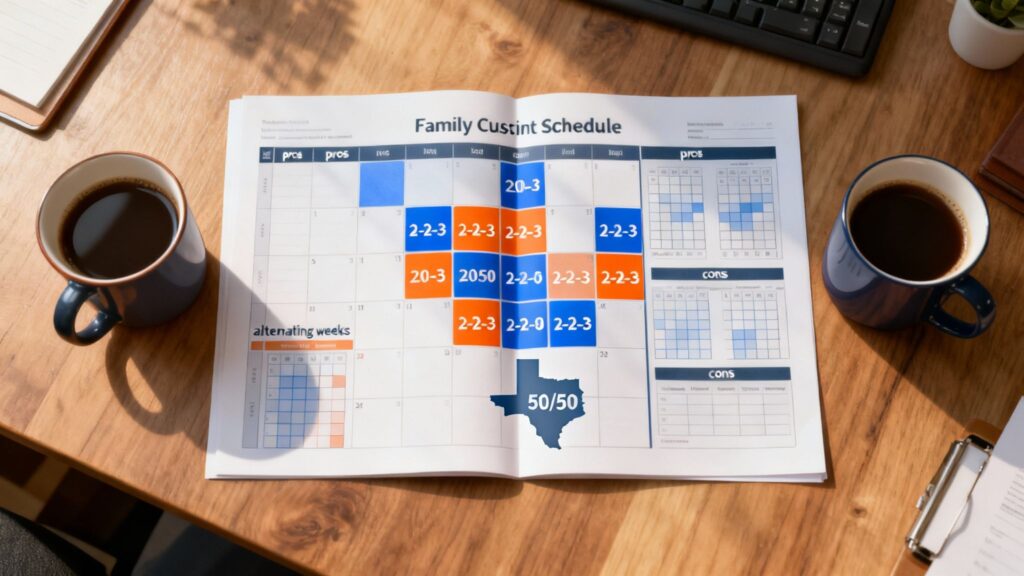
Navigating a divorce or separation can be one of life’s most difficult transitions, but understanding your rights and options under Texas law can make the path forward less overwhelming. When children are involved, creating a stable, predictable, and loving environment across two homes becomes the highest priority. A well-structured possession order, also known as a custody schedule, is the foundation of successful co-parenting and a critical component of your final divorce decree.
In Texas, family courts often start with the presumption that it is in a child’s best interest for both parents to be involved in their life. While a 50/50 possession schedule is a common goal, it is not a one-size-fits-all solution. The best arrangement depends on your children’s ages, your work schedules, and the distance between your homes. Understanding the different 50 50 custody schedules examples can empower you to create or advocate for an arrangement that truly works for your children and respects both parents’ vital roles.
This guide provides a practical breakdown of common 50/50 custody schedules used by Texas families. We will explore the logistics of each schedule, analyze their pros and cons, and offer actionable guidance to help you determine the best fit. Beyond the specific schedule, developing a strong framework for decision-making and communication is crucial. For further insights, consider this comprehensive guide to crafting an effective parenting plan and mastering time-sharing. Our goal is to provide you with clear examples and strategic advice, helping you feel more prepared as you build your family’s new future.
1. Week-On/Week-Off Schedule (7-7 Rotation)
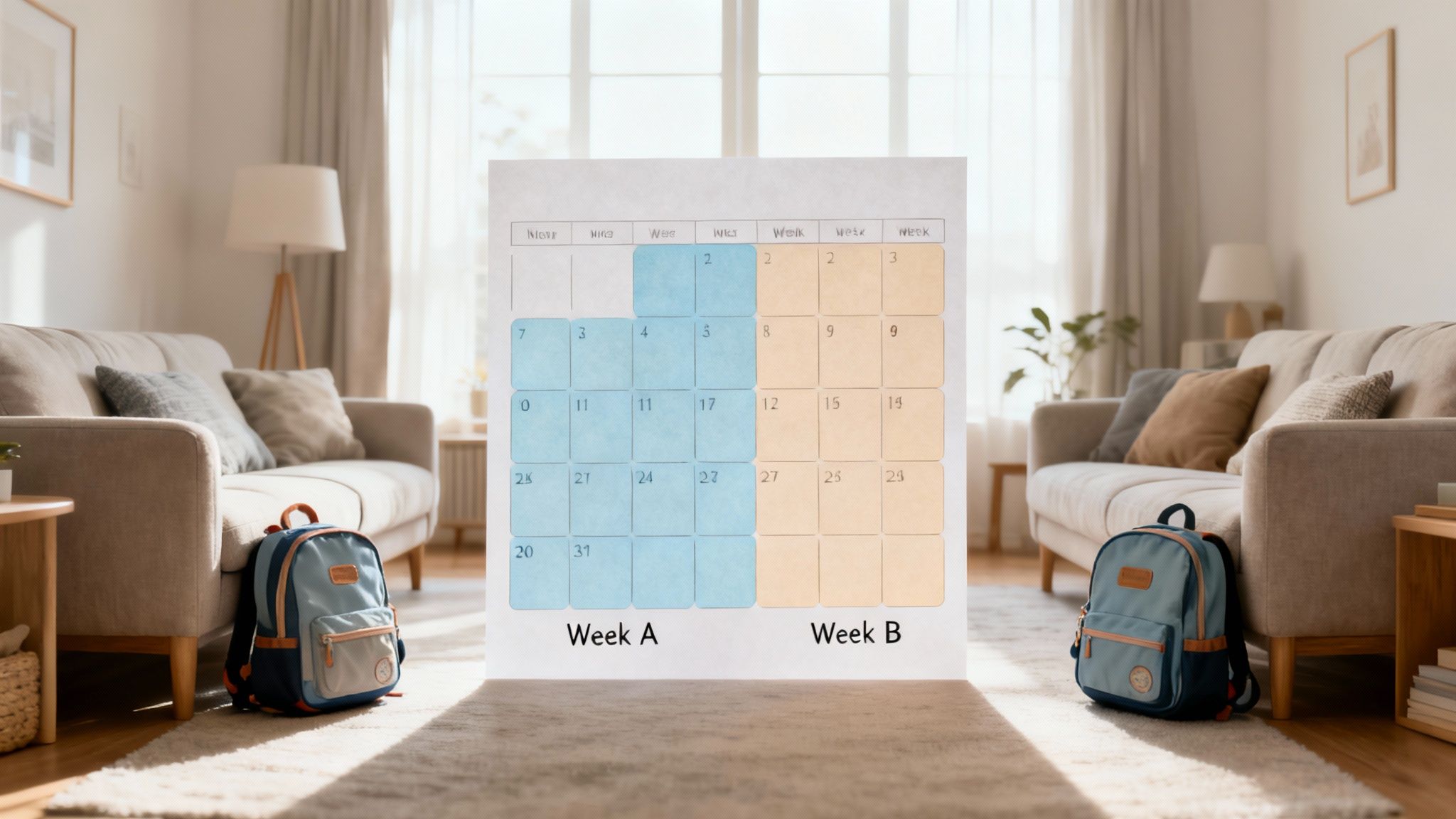
The week-on/week-off schedule is one of the most straightforward 50 50 custody schedules examples. In this arrangement, your child lives with one parent for seven consecutive days and then transitions to the other parent’s home for the next seven days. This simple, predictable routine is easy for children, especially older ones, to follow.
This schedule minimizes the number of exchanges between parents, which can reduce conflict and logistical stress. The extended time with each parent allows for more meaningful, day-to-day involvement in the child’s life, from schoolwork and doctor’s appointments to weekend activities. It provides a deep sense of normalcy and stability within each household.
Strategic Breakdown
This schedule’s primary strength is its simplicity. The consistent weekly rotation allows both parents to function as the “primary caregiver” during their designated week, handling all aspects of the child’s life. It establishes two distinct home environments where children can settle in, reducing the feeling of constantly being in transit.
Key Insight: A full week away from one parent can be challenging for very young children who may have difficulty with longer separations. This schedule also requires parents to live in close proximity, ideally within the same school district, to maintain stability in the child’s academic and social life.
Practical Guidance for Readers
- Establish a Consistent Exchange Protocol: Designate a specific day, time, and neutral location for the handoff (e.g., after school on Fridays or Sunday evenings). This predictability minimizes confusion and potential conflict.
- Utilize a Shared Calendar: Use a co-parenting app to document the schedule, upcoming appointments, and extracurricular activities. This ensures both parents are always informed.
- Ideal for Older Children: This schedule is often most successful for school-aged children and teenagers (typically ages 10 and up) who are better equipped to handle a week-long separation from a parent.
- Texas Legal Context: Per the Texas Family Code, judges prioritize schedules that provide children with regular and continuous contact with both parents. For parents seeking an equal possession order, the week-on/week-off schedule is a strong and frequently approved option, provided it serves the child’s best interest.
2. 2-2-5-5 Schedule (Two Days/Two Days/Five Days)
The 2-2-5-5 schedule is another popular 50/50 custody schedule example that balances frequent contact with longer periods of stability. This arrangement splits a two-week period into a repeating pattern: your child spends two days with Parent A, then two days with Parent B, followed by a five-day block with Parent A, and a final five-day block with Parent B. For example, Parent A might have Monday and Tuesday, Parent B has Wednesday and Thursday, and then Parent A has the long weekend from Friday to Sunday. The following week, the pattern flips.
This schedule is designed to ensure a child never goes too long without seeing either parent, addressing a common concern with the week-on/week-off rotation. It offers more frequent contact than a 7-7 split but provides longer, more stable periods than other short-rotation schedules.

Strategic Breakdown
The 2-2-5-5 schedule’s strength lies in its hybrid nature. It provides mid-week contact that many children and parents crave while also giving each parent a full five-day stretch that includes a weekend. This longer period allows for relaxed family time and participation in weekend activities without interruption.
Key Insight: The rotating nature of this schedule can be more complex to track. It requires diligent organization and clear communication between parents to avoid confusion, especially as the schedule flips each week.
Practical Guidance for Readers
- Create a Visual Calendar: Use a color-coded calendar in a shared digital space or a physical one in the child’s room. This helps everyone visualize the upcoming rotation.
- Establish Firm Exchange Times: Set consistent pickup times to minimize confusion. For example, exchanges could always occur after school on the transition day or at a set time like 6:00 PM.
- Position the 5-Day Block Strategically: Most families find it works best to have the five-day period include a weekend, ensuring each parent gets a full weekend with the child during their longer block.
- Texas Legal Context: The Texas Family Code prioritizes the “best interest of the child,” and schedules like the 2-2-5-5 that provide frequent and continuing contact are often viewed favorably. This schedule is a strong option for parents who want more contact than a 7-7 schedule allows and can demonstrate to a judge that they can manage the logistics effectively. For more strategies, you can explore various co-parenting tools, systems, and helpful knowledge.
3. 3-4-4-3 Schedule
The 3-4-4-3 schedule is a well-balanced 50/50 custody schedule example that provides frequent contact with both parents. This rotation works on a two-week cycle: the child spends three days with Parent A, then four days with Parent B. The following week, the schedule flips: the child spends four days with Parent A and then three days with Parent B.
This arrangement offers more stability than a 2-2-5-5 schedule but shorter separation periods than a week-on/week-off rotation. It allows each parent to have a mix of both weekday and weekend time over the two-week cycle, ensuring no parent goes more than four days without seeing their child.
Strategic Breakdown
The core strength of the 3-4-4-3 schedule is its blend of consistency and frequent parent-child contact. It’s particularly effective for school-aged children who are old enough to manage mid-week transitions but still benefit from not being away from either parent for a full week. It helps each parent stay actively involved in the child’s weekly school routine and weekend activities.
Key Insight: The main challenge is the number of transitions. With two exchanges required each week, it demands excellent communication and cooperation. This schedule works best when parents live relatively close to one another, minimizing travel time.
Practical Guidance for Readers
- Master the Calendar: Create a shared digital calendar that maps out the rotation several months in advance to help everyone anticipate the schedule and plan accordingly.
- Streamline Exchanges: Designate exchange days and times that align with school. For example, one parent drops the child off at school in the morning, and the other parent picks them up in the afternoon.
- Duplicate Essentials: To reduce the stress of packing, keep a set of essential items like school supplies, toiletries, and clothing at both homes.
- Texas Legal Context: Texas courts favor schedules that allow for frequent and continuing contact with both parents, as outlined in the Texas Family Code. The 3-4-4-3 rotation is a strong option to present in a possession order as it clearly demonstrates a commitment to shared parenting duties.
4. 2-3-2-2 Schedule (Alternating Two, Three, Two Days)
The 2-3-2-2 schedule is a less common but highly effective 50/50 custody schedule example designed for maximum parent-child contact. This arrangement splits the weeks unevenly, but the rotation ensures an equal division of time over a two-week period. In week one, Parent A has the child for two days, and Parent B has them for the next five. In week two, the schedule flips.
This structure ensures a child never goes more than five days without seeing a parent, which can be beneficial for younger children. It provides a mix of shorter and longer blocks of parenting time, allowing for both quick check-ins and more extended periods.
Strategic Breakdown
The core strength of the 2-3-2-2 schedule is its balance between frequent contact and longer stays. It avoids the long separations of a week-on/week-off plan while also preventing daily handoffs. This makes it a strong middle-ground option for parents who live very close to one another and can manage a more intricate calendar.
Key Insight: The schedule’s complexity can be a significant drawback. The constantly shifting days can be confusing for children and parents alike without rigorous calendar management. It is most successful when parents have flexible work arrangements and a shared commitment to making transitions smooth.
Practical Guidance for Readers
- Implement a Detailed Co-Parenting App: A schedule this complex demands a digital solution. Use an app that clearly displays the rotation to avoid any confusion.
- Establish Consistent Transition Times: With frequent exchanges, it’s crucial to set fixed times for every handoff, such as 6:00 PM on the designated day, to build routine.
- Best for Younger Children: This model is often ideal for toddlers and young elementary-aged children (under 8) who benefit from seeing both parents frequently.
- Texas Legal Context: While less common, a 2-3-2-2 schedule can be incorporated into a possession order if both parents agree it is workable and beneficial for their child. It demonstrates a commitment to shared parenting, which judges often view favorably under the Texas Family Code.
5. Alternating Weekends with Mid-Week Visitation
The Alternating Weekends with Mid-Week Visitation schedule is often used as a transitional arrangement. In its basic form, this schedule is not a true 50/50 split, often falling closer to a 60/40 or 70/30 division. The non-primary parent has the child on alternating weekends and for a brief visit or overnight during the week, typically on a Wednesday or Thursday.
This setup prioritizes stability in one primary residence, which can be beneficial if one parent has a more demanding work schedule or lives farther from the child’s school. It provides the child with a clear “home base” during the school week while ensuring they maintain consistent contact with the other parent.
Strategic Breakdown
This schedule’s strength lies in its ability to offer structure and routine centered around one home. The mid-week visit is crucial as it breaks up the long stretch of time the child would otherwise spend away from the other parent.
Key Insight: While not inherently a 50/50 schedule, this arrangement is highly adaptable. By extending the mid-week visit to two or three overnights, it can be easily modified to achieve a true 50/50 possession time, making it a flexible starting point.
Practical Guidance for Readers
- Define Exchanges Clearly: Your possession order must specify exact start and end times for both weekend and mid-week visits (e.g., Friday at 6:00 PM until Sunday at 6:00 PM).
- Establish Communication Protocols: Ensure both parents are on all school and medical contact lists. A shared calendar can help track extracurriculars and appointments.
- Scale Up to 50/50: If the goal is equal possession, propose expanding the mid-week visit. For instance, possession every Wednesday and Thursday night transforms the schedule into a more balanced arrangement.
- Texas Legal Context: In Texas, this schedule can be a practical compromise when parents live in different school districts or one parent travels frequently for work. A judge may approve this as a step toward an eventual 50/50 schedule, provided it is in the child’s best interest according to the Texas Family Code.
6. Month-On/Month-Off Schedule (Extended Block Rotation)
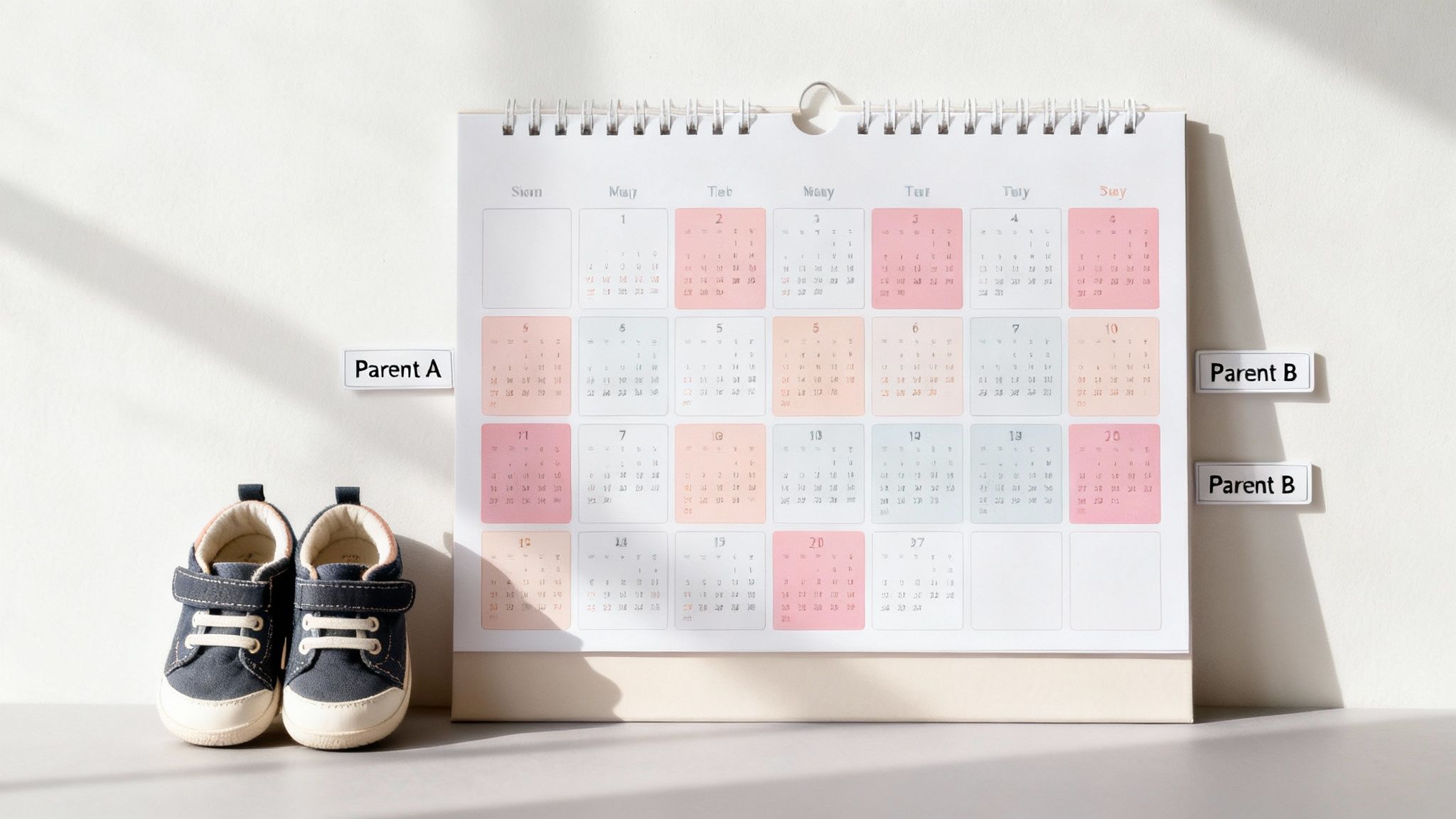
The month-on/month-off schedule is a specialized 50/50 custody arrangement that provides the longest possible uninterrupted blocks of parenting time. The child resides with one parent for an entire month before transitioning to the other parent for the following month.
This extended block rotation is less common but highly effective for families in specific situations, such as those with significant geographical distance between them. It minimizes travel-related disruptions and costs while allowing each parent a substantial and immersive period of time with the child. It is best suited for scenarios where frequent exchanges are impractical.
Strategic Breakdown
The core strength of this schedule is its ability to accommodate long-distance co-parenting. It makes a 50/50 arrangement feasible for parents living in different states or even countries. This schedule can also be beneficial for military families, where one parent may be deployed for extended periods.
Key Insight: This extended separation is generally not appropriate for younger children who need more frequent contact. It requires exceptionally mature, low-conflict co-parents and older, resilient children (typically teenagers) who can manage a month away from one parent.
Practical Guidance for Readers
- Define Holiday and Summer Schedules: Your possession order must explicitly detail how major holidays and summer vacation will be handled, as they will inevitably fall within one parent’s month. These periods often supersede the standard rotation.
- Establish Robust Communication Protocols: Mandate regular, scheduled video calls during the off-month to help the child stay connected. This should be clearly outlined in your parenting plan.
- Create a Detailed Handoff Procedure: Plan for the seamless transfer of school records, medical information, and other belongings to maintain consistency.
- Texas Legal Context: While not standard, a judge may approve a month-on/month-off schedule under the Texas Family Code if both parents agree and can prove it is in the child’s best interest, especially in long-distance or military custody cases.
7. Two-Week-On/Two-Week-Off Schedule (Bi-Weekly Rotation)
The two-week-on/two-week-off schedule expands the alternating week concept into two-week blocks. Under this bi-weekly rotation, the child lives with one parent for fourteen consecutive days and then transitions to the other parent’s home for the next fourteen days. This arrangement is another of the 50 50 custody schedules examples designed to maximize stability while minimizing exchanges.
This schedule is particularly effective for parents who live a significant distance from each other, making weekly exchanges impractical. It also suits parents with non-traditional work schedules, like those in medicine or law enforcement. The extended parenting blocks allow for deep, uninterrupted time, fostering a strong sense of routine.
Strategic Breakdown
The strength of this schedule lies in its ability to provide long, stable periods of parenting time, which can be highly beneficial for older children and teenagers. It significantly reduces the stress of frequent handoffs, allowing families to settle into a rhythm for two full weeks at a time.
Key Insight: The major drawback is the prolonged separation. Two weeks can feel like a very long time for younger children. This schedule demands a high level of communication to ensure the off-duty parent remains involved and informed.
Practical Guidance for Readers
- Create a Detailed Annual Calendar: Given the longer rotations, map out the entire year in advance. Anchor transition dates to specific calendar days to create a predictable pattern.
- Establish Robust Communication Protocols: Implement a clear plan for staying in touch. Schedule regular video calls and ensure both parents have access to school portals and teacher communications.
- Ideal for Teenagers and Geographic Distance: This schedule is most suitable for mature teenagers who can handle longer separations and for families where parents live too far apart for more frequent exchanges.
- Texas Legal Context: In Texas, any proposed 50/50 schedule must be proven to be in the child’s best interest. A bi-weekly rotation can be approved by a court if parents can demonstrate that it provides stability, especially in cases involving distance or unique employment.
8. 3-3-4-4 Schedule (Overlapping Weekends)
The 3-3-4-4 schedule is a dynamic 50/50 custody schedule example that offers more frequent contact than a weekly rotation. This arrangement divides a two-week period into four blocks: three days with one parent, three days with the other, then four days with the first parent, and four days with the second. This cycle ensures children are never away from a parent for more than four days and alternates weekends.
This schedule is designed for parents who want a blend of consistency and frequent contact. The shorter, repeating blocks can be beneficial for younger school-aged children who may struggle with week-long separations. It requires a high degree of cooperation to manage the more frequent transitions.
Strategic Breakdown
The strength of the 3-3-4-4 schedule lies in its balance. It combines the stability of having set days during the week with the benefit of alternating weekends, giving each parent a mix of school-night responsibilities and weekend leisure time. This frequent contact helps maintain strong bonds.
Key Insight: The multiple mid-week exchanges can be disruptive if not managed well. It demands that parents are highly organized and can communicate effectively about homework, school projects, and extracurricular activities.
Practical Guidance for Readers
- Establish Precise Transition Times: With multiple exchanges, clarity is crucial. Designate specific times and places for each transition, such as “after school on Wednesday.”
- Create Fully Equipped Homes: To minimize the burden of packing, ensure both homes are fully stocked with the child’s essentials. This makes each house feel like a true home.
- Utilize Co-Parenting Apps: Tools like OurFamilyWizard are invaluable for managing this schedule. Use them to track the rotation and coordinate logistics for activities.
- Texas Legal Context: Per the Texas Family Code, courts prioritize the child’s best interest. The 3-3-4-4 schedule is a viable option that can be presented in a possession order, especially when parents can demonstrate their ability to cooperate and maintain stability for the child.
8 50/50 Custody Schedule Examples
| Schedule | Complexity 🔄 | Resources & Logistics ⚡ | Expected Outcomes 📊⭐ | Ideal Use Cases 💡 | Key Advantages ⭐ |
|---|---|---|---|---|---|
| Week-On/Week-Off (7-7) | Low — simple weekly rotation 🔄 | Moderate — 1 exchange/week; duplicate basics recommended ⚡ | Stable routines; long weekly separations may stress young kids 📊 | Same school district, older children, predictable work weeks 💡 | Extended bonding, easy to administer ⭐ |
| 2-2-5-5 | High — four transitions per 2-week cycle 🔄 | High — frequent exchanges, duplicate supplies, scheduling apps ⚡ | Strong parent-child contact; more mid-week disruption possible 📊 | School-age children, nearby parents with flexible schedules 💡 | Balanced time with frequent involvement ⭐ |
| 3-4-4-3 | High — four transitions weekly 🔄 | High — close proximity, duplicate school items, coordination ⚡ | Mix of routine stability and frequent contact; some mid-week impact 📊 | Parents within short drive, school-age kids, working weekdays 💡 | Alternating weekends and routine stability ⭐ |
| 2-3-2-2 (9-day) | Very high — complex 9-day cycle 🔄 | Very high — intense coordination, full duplicate homes ⚡ | Very frequent contact; may confuse or unsettle some children 📊 | Very close residences, young children needing frequent contact, highly cooperative parents 💡 | Maximizes parental involvement and contact ⭐ |
| Alternating Weekends + Mid‑Week | Low — few predictable exchanges 🔄 | Low — minimal duplication; clear weekend/midweek handoffs ⚡ | Strong weekday stability for primary parent; limited secondary time 📊 | Primary-custody setups, distant or inflexible parents, transitional arrangements 💡 | Stable weekday home, simple court-friendly format ⭐ |
| Month-On/Month-Off | Low — simple monthly rotation 🔄 | Low–Moderate — long stays require planning; handoff logistics ⚡ | Deep bonding during month; long separations risk attachment issues 📊 | Long-distance parents, deployments, older teens 💡 | Minimal transitions, long uninterrupted parenting blocks ⭐ |
| Two-Week-On/Two-Week-Off | Low–Medium — semi-monthly switches 🔄 | Moderate — duplicate items, calendar planning, aligned dates ⚡ | Stable multi-week routines; moderate separation effects for young kids 📊 | Bi-weekly workers, moderate-distance parents, older children 💡 | Substantial custody blocks with fewer exchanges than weekly ⭐ |
| 3-3-4-4 | High — four transitions per week with overlapping weekends 🔄 | High — close proximity, strong coordination, duplicates ⚡ | Frequent contact and shared weekends; routine adjustments required 📊 | Active co-parents in same district, school-age children 💡 | Regular weekend sharing and balanced involvement ⭐ |
Choosing the Right Schedule: A Texas Legal Perspective
Understanding the structure behind various 50 50 custody schedules examples provides a powerful starting point for your family. We have explored a wide array of options, from the consistent rhythm of the Week-On/Week-Off schedule to the frequent exchanges of shorter rotations. Each example offers a unique framework designed to fit different family dynamics.
The core takeaway is that there is no single “best” 50/50 schedule. The optimal choice is the one that best serves the unique needs of your children and aligns with your family’s practical realities. A schedule that works for a toddler might feel disruptive to a teenager with a packed extracurricular schedule.
Step-by-Step Guidance Under Texas Law
The journey from selecting a schedule on paper to implementing it successfully requires a strategic approach grounded in Texas law. The Texas Family Code § 153.002 mandates that all custody decisions must be made in the “best interest of the child.” This is the legal standard against which any proposed schedule is measured.
Here are practical steps to take:
- Prioritize Your Child’s Needs: Always frame your decisions around your child’s developmental stage, emotional well-being, and daily routine. Consider their temperament, school location, and social life.
- Assess Parental Practicality: Be honest about your work schedule, living situation, and ability to communicate effectively with your co-parent. A schedule that creates constant stress and conflict is not sustainable.
- Formalize Your Agreement: An informal agreement is a recipe for future disputes. Your chosen schedule must be detailed in a formal, written Possession Order signed by a judge. This document provides clarity and legal enforceability.
- Plan for the Future: Your Possession Order should be a comprehensive guide. It needs to account for holidays, summer vacations, and birthdays, and create a clear process for handling disagreements or necessary modifications as your children grow.
A well-crafted custody schedule provides children with the stability, predictability, and meaningful contact with both parents that they need to thrive after a separation. It lays the foundation for a healthier co-parenting relationship, reducing conflict and allowing you to focus on what truly matters: raising happy and resilient children. Think of these 50 50 custody schedules examples as tools in a toolbox. Your task now is to select the right tool to build a stable and supportive future for your family.
If you need help navigating divorce, custody, or estate planning in Texas, contact The Law Office of Bryan Fagan today for a free consultation. Our experienced attorneys can help you understand your options, draft a Possession Order tailored to your family’s needs, and advocate for your child’s best interests. Schedule your free, no-obligation consultation to gain the clarity you need to move forward with confidence.