
Spousal Support for Stay-at-Home Parents Texas often becomes real in a quiet, unexpected moment—standing alone in the kitchen after the kids are asleep, staring at bills that were never yours to worry about before, and realizing that the life you held together for years is suddenly shifting beneath your feet. You didn’t just pause a career. You built a home, carried the mental load, managed the chaos, and made it possible for someone else to succeed. Now, as divorce enters the picture, the question isn’t just “Will I be okay?” It’s “How do I keep life steady for my family when everything feels uncertain?”
At The Law Office of Bryan Fagan, PLLC, this is where most conversations truly begin—not with statutes or spreadsheets, but with fear, responsibility, and the weight of starting over later in life. Texas law does not automatically reward sacrifice, but it does recognize it when presented clearly and correctly. Under Texas Family Code Chapter 8, courts look at whether a stay-at-home parent can meet their minimum reasonable needs after divorce, and whether temporary financial support is necessary to help them regain independence without destabilizing the family as a whole.
Led by Bryan Joseph Fagan, a South Texas College of Law graduate and a recognized authority on Texas divorce and custody law, our firm has guided thousands of parents through this exact crossroads. Our approach is rooted in one core belief: when people understand their options, they reclaim peace of mind. This article will help you understand how spousal support works for stay-at-home parents in Texas, how it intersects with child support and property division, and why thoughtful legal planning can protect not just your finances, but your sense of stability and control during one of life’s hardest transitions.
If you’re searching for clarity, reassurance, and a path forward that honors both your sacrifices and your future, you’re in the right place.
Key Takeaways
- Stay-at-home parents in Texas can receive spousal maintenance, but it requires meeting specific legal criteria under Texas Family Code Chapter 8—caregiving alone doesn’t guarantee eligibility
- Marriage length plays a significant role, with a general 10-year threshold for standard eligibility, though exceptions exist for circumstances involving domestic violence or disability
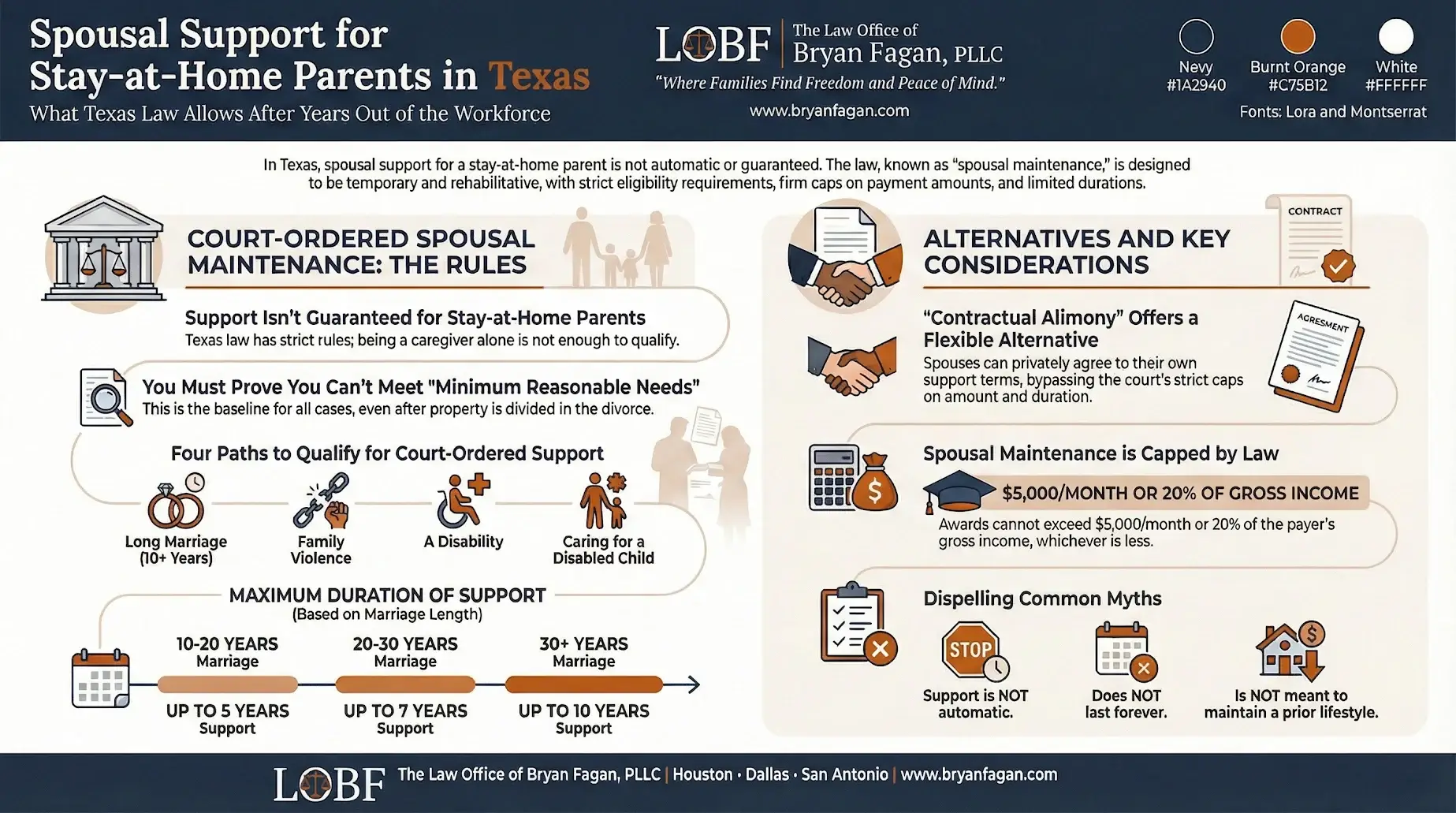
- Support amounts are capped at $5,000 monthly or 20% of the paying spouse’s gross income, whichever is less, and duration depends on how long your marriage lasted
- Contractual alimony negotiated during divorce settlement offers more flexibility than court-ordered maintenance and may better serve stay-at-home parents’ long-term needs
- Early consultation with a knowledgeable attorney significantly improves outcomes—studies show legal representation can boost maintenance awards by 35% or more

Your Family’s Future Starts Here
Don’t navigate your legal journey alone. Schedule a consultation now and get the clarity and support you deserve.
Spousal Support for Stay-at-Home Parents Texas: The Big Picture
Under Texas law, what many people casually refer to as “alimony” is formally known as spousal maintenance, and it is governed by Texas Family Code Chapter 8. The Legislature has been clear about its purpose: Spousal Support for Stay-at-Home Parents Texas is meant to provide a temporary financial bridge, not a lifetime guarantee. The intent is to help a spouse regain stability and move toward self-sufficiency after divorce, rather than to permanently preserve the lifestyle that existed during the marriage.
Spousal maintenance in Texas is therefore rehabilitative by design. Texas Family Code §§ 8.051 and 8.052 instruct courts to focus on whether a spouse lacks sufficient property, including their share of the community estate, to meet their minimum reasonable needs and whether they have the present ability to earn enough income to support themselves. Judges are directed to evaluate practical factors such as education, employment history, time spent out of the workforce, and the non-financial contributions made as a homemaker or caregiver. The guiding principle is not punishment or reward, but realism—what support is reasonably necessary while a spouse rebuilds earning capacity.
For stay-at-home parents, this framework creates both opportunity and limitation. Texas courts do recognize the economic value of raising children and maintaining a household, and Section 8.052 expressly allows judges to consider sacrifices like delayed careers and lost earning potential when deciding whether maintenance is appropriate. At the same time, the law makes it clear that staying home with children, by itself, does not automatically qualify someone for support. The analysis always returns to demonstrated financial need and the realistic ability to become self-supporting within a reasonable period of time.
As attorneys at the Law Office of Bryan Fagan frequently explain, the most important question courts ask is a practical one: after property division, can you meet your minimum reasonable needs, and if not, do you currently lack the earning capacity to close that gap on your own? That same focus on practical impact is reflected in broader family law discussions, including how government actions affect households, as explored in Harris County’s Stay-at-Home Order and Its Impact on Families. Understanding how courts think about stability, resources, and household function is critical when planning for divorce as a stay-at-home parent.
For those looking to better understand how maintenance fits into a comprehensive divorce strategy, the firm’s resource on Texas spousal maintenance and alimony provides additional guidance. With clear education and informed planning, stay-at-home parents can approach divorce with greater confidence, protecting both their financial footing and their future.

Are Stay-at-Home Parents Eligible for Spousal Support in Texas?
Eligibility for spousal maintenance requires demonstrating genuine financial need—not simply that you didn’t work during your marriage. Under Texas Family Code Section 8.051, you must prove you lack sufficient property and resources to meet your minimum reasonable needs.
The “minimum reasonable needs” standard is key here. This refers to basic living expenses like housing, food, utilities, and healthcare—not maintaining your marital lifestyle. Texas courts evaluate what you genuinely need to get by, then examine whether the property division in your divorce covers those needs.
Here’s where many stay-at-home parents face unexpected hurdles: Texas is a community property state, meaning marital property typically gets divided fairly between spouses. If your share of the marital assets—including retirement accounts, real estate equity, and other assets—provides enough financial resources to support yourself, courts may determine you don’t qualify for ongoing support payments.
Consider this scenario: Maria stayed home for 15 years raising three children while her husband built a successful business. In the divorce, she received $400,000 in marital assets plus $2,500 monthly in child support. The court determined that with careful management of her property and the child support payments, Maria could meet her basic needs without additional spousal maintenance—despite having no recent work history.
This doesn’t mean stay-at-home parents can’t receive support. It means you’ll need to demonstrate that even after equitable division of marital property, you genuinely cannot meet your minimum reasonable needs and lack the earning capacity to bridge that gap quickly.
Marriage Length and Stay-at-Home Parenting Roles
The length of your marriage significantly impacts eligibility and duration of spousal maintenance. Under Texas Family Code Section 8.054, courts generally require at least a 10-year marriage for standard eligibility, though important exceptions exist.
For marriages lasting 10-20 years, the maximum support duration is 5 years. For marriages of 20-30 years, that extends to 7 years. Only marriages exceeding 30 years qualify for the maximum 10-year support period under standard provisions.
Long-term stay-at-home parenting strengthens eligibility in several ways. When you’ve been out of the workforce for 15 or more years, courts recognize that your earning capacity has likely diminished substantially. Skills become outdated. Professional networks disappear. Industry knowledge fades. These realities matter when Texas courts evaluate whether you can become self-supporting.
What about shorter marriages? Specific circumstances can qualify you even if your marriage lasted less than 10 years:
- Domestic violence: If your spouse was convicted of or received deferred adjudication for family violence within two years of the divorce filing
- Physical or mental disability: If you have a disability that prevents you from earning sufficient income
- Caring for a disabled child: If your child from the marriage has a physical or mental disability requiring substantial care
These exceptions recognize that the standard rules don’t fit every family’s situation.
Caregiving Responsibilities and Employment Barriers
Texas courts expressly recognize that caregiving for young children can be a real and legitimate barrier to employment when evaluating spousal support requests. Under Texas Family Code § 8.055, judges are required to consider how a spouse’s role as a primary caregiver affects their ability to earn income, particularly when that role has required stepping away from education or employment for an extended period. This legal framework is especially important in Spousal Support for Stay-at-Home Parents Texas, where courts must balance a parent’s past sacrifices with realistic expectations for future self-sufficiency.
When assessing a stay-at-home parent’s circumstances, courts look closely at practical realities rather than assumptions. Judges evaluate gaps in education or training, whether job skills have become outdated during years of caregiving, and the true cost of childcare compared to potential earnings. Children’s ages matter as well, since younger children often require more hands-on supervision, and health considerations—both for the parent and the child—can further limit employment options. These factors help courts determine whether a parent can reasonably meet their minimum reasonable needs without support, as contemplated by Texas Family Code §§ 8.051 and 8.052.
Evidence plays a critical role in these determinations. Thorough documentation of caregiving responsibilities can help courts understand the full scope of what a stay-at-home parent has been managing day to day. Records showing medical appointments, therapy schedules, childcare availability, and daily care routines can demonstrate why immediate full-time employment may not be feasible. The attorneys at the Law Office of Bryan Fagan regularly emphasize that financial planning and documentation go hand in hand, a point also explored in Approaching Your Texas Divorce from a Financial Perspective, which highlights how preparation can shape better outcomes during divorce.
Real-world outcomes often turn on how clearly these barriers are presented. For example, a stay-at-home parent who spent more than a decade out of the workforce may be able to show that childcare costs would consume the majority of any entry-level income they could realistically earn, especially when combined with expert testimony regarding re-entry challenges for older workers. In cases like these, courts may award temporary spousal maintenance to allow time for retraining or gradual workforce reentry, consistent with the rehabilitative purpose of Chapter 8 of the Texas Family Code.
At the same time, courts also evaluate a parent’s good-faith efforts to become employable. If a judge believes a spouse has made no reasonable attempt to pursue education, training, or job opportunities, income may be imputed—meaning support is calculated as though the parent were already earning what the court believes they reasonably could. This is why experienced guidance matters. Resources such as the firm’s Texas spousal maintenance and alimony overview can help stay-at-home parents understand both their rights and their responsibilities, empowering them to move forward with clarity and confidence while protecting their long-term stability.

Disability or Special-Needs Children and Spousal Support
Caring for a child with special needs fundamentally reshapes how courts evaluate Spousal Support for Stay-at-Home Parents Texas. Texas Family Code § 8.054 specifically recognizes that when a child’s physical or mental disability requires substantial personal supervision, and that level of care prevents a parent from working outside the home, traditional time limits on spousal maintenance may not apply. In these situations, courts are permitted to order extended—and in some cases ongoing—support because the barrier to employment is not temporary or speculative, but real and continuing.
This provision reflects a reality many Texas families live every day. Unlike typical parenting responsibilities that change as children grow older and more independent, caring for a special-needs child often becomes more demanding over time. Medical appointments, therapy schedules, and daily supervision can intensify rather than ease. Texas courts understand that asking a primary caregiver in this situation to quickly reenter the workforce may be unrealistic and inconsistent with the rehabilitative purpose of Chapter 8, which is to balance self-sufficiency with fairness and family stability.
Strong documentation is essential in these cases. Judges rely on concrete evidence to determine whether extended maintenance is justified, including medical records establishing the child’s diagnosis and care requirements, physician statements explaining the level of supervision needed, therapy and treatment histories, and detailed financial records showing disability-related expenses. Expert testimony addressing long-term caregiving demands can further clarify why employment outside the home is not feasible. Without this evidence, even legitimate needs can be difficult to translate into a legally sustainable award.
Texas Health and Human Services data shows that a meaningful percentage of Texas divorces involve children with special needs, and courts consistently grant extended support to primary caregivers at higher rates than in standard cases when the evidence supports it. Broader discussions about how public health crises and caregiving demands affect custody and family stability, such as those explored in COVID-19 and Child Custody Access in Texas, highlight why flexibility in family law remains critical during periods of heightened vulnerability.
It is also important to note that a parent’s own physical or mental disability can independently qualify them for spousal maintenance under Texas Family Code § 8.051, regardless of the length of the marriage. When combined with the responsibility of caring for a disabled child, these factors can significantly strengthen a request for support. Additional guidance on how custody, support, and special circumstances intersect can be found in the firm’s Texas child custody resource. With informed advocacy and compassionate planning, families facing extraordinary caregiving responsibilities can pursue solutions that protect both their financial stability and their long-term well-being.
How Texas Courts Calculate Support for Stay-at-Home Parents
Texas law caps spousal maintenance at the lesser of $5,000 monthly or 20% of the paying spouse’s average gross monthly income. This statutory ceiling applies regardless of how much one spouse earned during the marriage.
The calculation process considers several factors:
- Payer’s gross income: The paying spouse’s total income before taxes
- Existing obligations: Child support and other legal obligations reduce available resources
- Recipient’s earning capacity: What the stay-at-home parent could reasonably earn
- Minimum reasonable needs: The actual cost of basic living expenses
For a stay-at-home parent whose spouse earns $12,000 monthly, the maximum maintenance would be $2,400 (20%). If your minimum reasonable needs total $2,800 monthly and you have no earning capacity, you’d receive $2,400—the cap limits recovery even when needs exceed that amount.
Duration follows marriage length as outlined earlier, with courts aiming for the shortest period allowing you to become self-supporting. Realistic outcomes from 2024 Texas judicial data show average maintenance awards for stay-at-home parents ranging from $1,200 to $2,500 monthly, with the rehabilitative focus ending support once self-sufficiency is demonstrated.
Contractual Alimony as an Option for Stay-at-Home Parents
Contractual alimony offers an alternative path that often serves stay-at-home parents better than court-ordered maintenance. Under Texas Family Code Section 8.006, spouses can agree to support terms that bypass statutory caps and duration limits.
The advantages for stay-at-home parents are significant:
- Higher amounts: No $5,000 monthly cap
- Longer duration: Not limited by marriage-length formulas
- Flexible terms: Can include provisions like support until your youngest child graduates high school
- Creative structures: Lump-sum payments, step-down schedules, or lifetime support
Approximately 40% of Texas divorces include some form of contractual alimony, according to State Bar data. For stay-at-home parents, negotiating during the divorce process often yields better results than relying on what a court might order.
However, contractual alimony carries different risks. Unlike court-ordered maintenance, it’s enforced as a contract rather than a court order. Modification requires mutual agreement—meaning if your circumstances change dramatically, you can’t easily adjust the terms. Tax implications also differ from spousal maintenance, requiring careful planning with a financial professional.
A 2024 mediation case illustrates the potential: a 14-year stay-at-home mom negotiated $3,000 monthly for 10 years through contractual alimony—far exceeding what statutory maintenance would have provided.
Common Myths About Spousal Support for Stay-at-Home Parents Texas
There are several persistent myths surrounding Spousal Support for Stay-at-Home Parents Texas, and believing them can lead families to make decisions based on fear or misinformation rather than facts. One common misunderstanding is the belief that stay-at-home parents automatically receive alimony after divorce. In reality, Texas Family Code § 8.051 sets strict eligibility requirements, and only a small percentage of contested divorces involving long-term homemakers result in court-ordered spousal maintenance. Caregiving history matters, but it must be paired with proof that the spouse cannot meet their minimum reasonable needs after property division and lacks the current ability to become self-supporting.
Another widespread myth is that spousal support lasts until children turn eighteen. Texas law draws a clear distinction between child support and spousal maintenance. Under Texas Family Code § 8.054, the duration of maintenance is tied to the length of the marriage and specific qualifying circumstances, not the age of the children. Child support obligations are governed separately under Chapter 154 of the Texas Family Code, and spousal maintenance often ends years before a child reaches adulthood. Understanding this separation is critical when planning for financial stability after divorce, especially in households where one parent has been out of the workforce for an extended period.
Many people also assume that courts will maintain the lifestyle enjoyed during the marriage. Texas courts do not approach spousal maintenance as a lifestyle guarantee. Instead, Chapter 8 of the Texas Family Code limits awards to what is necessary to meet a spouse’s minimum reasonable needs, focusing on essentials like housing, utilities, and basic living expenses. Luxury items and discretionary spending are not part of the legal analysis. This practical approach reflects the state’s emphasis on rehabilitation and independence rather than long-term dependency.
Finally, there is the myth that being a homemaker guarantees lifetime support. Even in long-term marriages, Texas law caps statutory spousal maintenance at a maximum of ten years in most cases, as outlined in Texas Family Code § 8.054. Courts expect supported spouses to use that time to develop earning capacity through education, training, or workforce reentry. As the attorneys at the Law Office of Bryan Fagan often explain, maintenance is intended to provide a runway, not a permanent landing spot.
Understanding how myths diverge from reality can be especially important in families facing heightened stress or safety concerns. Broader discussions about household dynamics and legal protections, including issues that arise when families are confined at home, are explored in Child Abuse and Texas Stay-at-Home Orders, which highlights how Texas law responds to family vulnerability during periods of disruption. For those seeking a clearer picture of how support and custody intersect, the firm’s Texas child support overview offers additional guidance. By separating myth from law, stay-at-home parents can approach divorce with clearer expectations, informed choices, and greater confidence in their path forward.

How a Texas Divorce Attorney Helps Stay-at-Home Parents
Legal representation plays a decisive role in outcomes involving Spousal Support for Stay-at-Home Parents Texas, and the difference is rarely subtle. Stay-at-home parents who work with experienced Texas family law counsel are consistently better positioned to secure meaningful financial support because their cases are framed within the precise requirements of Texas Family Code Chapter 8. Courts are bound by statutes such as §§ 8.051, 8.052, and 8.055, but how those statutes are applied depends heavily on the evidence presented and the legal strategy used to tell the client’s story.
An experienced attorney helps translate lived experience into legally persuasive proof. This begins with a thorough eligibility evaluation under Texas Family Code § 8.051, assessing whether a stay-at-home parent truly lacks sufficient property to meet minimum reasonable needs and whether barriers to employment are realistic and well-documented. From there, counsel assists with gathering evidence that demonstrates caregiving contributions, time out of the workforce, childcare realities, and financial needs, all of which judges are required to consider under § 8.052. When earning capacity is disputed, attorneys can coordinate vocational experts to address re-entry challenges, skill atrophy, and realistic wage expectations rather than hypothetical income.
Strategic negotiation is another critical advantage. While Texas law places statutory caps on court-ordered maintenance, skilled counsel can often pursue contractual alimony that provides greater flexibility in amount and duration, tailored to the family’s actual needs. This strategy is most effective when spousal support planning is coordinated with property division, ensuring that cash flow, asset distribution, and long-term stability work together rather than against each other. Resources such as the firm’s Texas spousal maintenance and alimony guide offer additional insight into how these pieces fit together.
Early consultation is especially valuable for stay-at-home parents because timing shapes outcomes. Understanding your rights and obligations before filing allows for proactive planning instead of reactive decision-making, particularly during periods of heightened uncertainty. Broader discussions about how government orders and household restrictions affect family dynamics and legal rights, including those addressed in How Stay-at-Home Orders Affect Parents and Families in Texas, underscore why informed guidance matters. By working with a knowledgeable Texas family law attorney from the outset, stay-at-home parents can approach divorce with clarity, confidence, and a stronger foundation for financial stability moving forward.
Why Choose The Law Office of Bryan Fagan, PLLC
Representing families across Texas, the attorneys at this firm bring extensive experience advocating for stay-at-home parents navigating divorce and Spousal Support for Stay-at-Home Parents Texas. With a detailed command of Texas Family Code Chapter 8, including §§ 8.051 through 8.055, the legal team understands how to clearly present caregiving contributions, employment barriers, and financial realities in a way that aligns with how judges actually evaluate spousal maintenance requests. This statutory knowledge, combined with practical courtroom insight, allows for strategies focused on long-term stability rather than short-term fixes.
What sets this firm apart is an understanding that divorce after years spent as a stay-at-home parent is never just a legal event. It is a deeply personal transition that affects confidence, security, and family dynamics. Texas law emphasizes the best interest of the child and financial fairness between spouses, but achieving those outcomes requires thoughtful guidance and empathy. By combining precise legal analysis with compassionate communication, the firm helps parents protect their well-being while also safeguarding their children’s future during a period of significant change.
Clients are supported through every stage of the process, whether their case is resolved through negotiation, collaborative divorce, or litigation when necessary. Guidance is always tailored to the individual family, informed by both the Texas Family Code and a clear understanding of how divorce unfolds step by step. For those seeking a clearer roadmap, the firm’s resource on The Texas Divorce Process Explained offers valuable insight into what to expect and how to prepare. With statewide reach and a commitment to education, this firm stands ready to help families across Texas move forward with clarity, confidence, and peace of mind.
Checklist: Spousal Support for Stay-at-Home Parents Texas
- [ ] Review your marriage length and determine which eligibility pathway applies
- [ ] Calculate your monthly minimum reasonable needs (housing expenses, utilities, food, healthcare)
- [ ] Assess whether sufficient property from the divorce will cover those needs
- [ ] Document all caregiving responsibilities with specific examples and records
- [ ] Gather your education history, work experience, and current skills inventory
- [ ] Research childcare costs and other employment obstacles in your area
- [ ] Consider both statutory maintenance and contractual alimony options
- [ ] Consult with an experienced Texas family law attorney early in the process
Conclusion
If you’ve made it this far, one thing is probably clear: divorce for a stay-at-home parent is about far more than legal definitions or dollar amounts. It’s about stability, dignity, and the ability to move forward without feeling like the ground is constantly shifting under your feet. Texas law may set limits, but within those boundaries there is real room for strategy, protection, and thoughtful planning when the right guidance is in place.
You don’t have to have every answer today. What matters is knowing that your years of contribution to your family do count—and that there are legal tools designed to help you transition without sacrificing your well-being or your peace of mind. Many parents are surprised to learn how much difference preparation, timing, and advocacy can make in spousal support outcomes.
If you’re standing at that uncertain crossroads, speaking with an experienced Texas family law attorney can bring clarity where there’s confusion and calm where there’s fear. The Law Office of Bryan Fagan, PLLC is built on the belief that informed families make stronger decisions, and that no one should feel alone while navigating one of life’s biggest transitions.
And if nothing else, take this with you: asking questions and seeking support isn’t a sign of weakness—it’s a sign that you’re protecting what matters most.
Frequently Asked Questions
Sometimes, but it is not automatic. Texas does not guarantee spousal support simply because someone stayed home during the marriage. A stay-at-home mom must meet specific legal requirements under Texas Family Code Chapter 8, including showing that she cannot meet her minimum reasonable needs after the divorce. Many parents receive support through negotiated contractual alimony rather than court-ordered spousal maintenance, which often allows for more flexible and practical arrangements.
A stay-at-home mom is entitled to a just and right share of the community property, regardless of who earned the income. If she is the primary conservator of the children, she may also receive child support. Spousal support depends on eligibility and financial need, but the law does recognize the value of non-financial contributions like homemaking, caregiving, and supporting a spouse’s career.
Several factors can prevent or end spousal support. These include receiving enough property in the divorce to meet your basic needs, failing to qualify under Texas Family Code Chapter 8, or being able to earn sufficient income on your own. After divorce, remarriage typically ends spousal maintenance, and living with a romantic partner can also lead to termination. Courts may also deny support if they believe a spouse is intentionally unemployed or not making reasonable efforts toward self-sufficiency.
Legally, the process is the same as for any spouse, but the financial planning is different. Courts and attorneys spend more time evaluating income gaps, earning capacity, and the transition back into the workforce. Many stay-at-home moms negotiate a combination of property, child support, and spousal support or contractual alimony to create stability while adjusting to post-divorce life.
In Texas, separate property generally cannot be awarded to the other spouse. This can include assets owned before marriage, gifts given specifically to one spouse, and inheritances, as long as they were not commingled with community funds. Proving something is separate property often requires documentation and tracing, which is why early legal advice is important when significant assets are involved.
There is no true average because every case is different. For court-ordered spousal maintenance, Texas law caps the amount at the lesser of $5,000 per month or 20% of the paying spouse’s average gross monthly income. Actual amounts depend on need, income, and eligibility, and many families reach customized agreements through settlement rather than relying on a judge’s order.
Divorce still involves property division, custody decisions, and support determinations, but a stay-at-home mom often needs more detailed financial planning. Temporary orders may be critical early on to cover household expenses. The long-term focus is usually on creating a realistic plan that balances parenting responsibilities, financial support, and a gradual return to work when appropriate.
Moving out of the marital home can affect custody dynamics, access to property, and the overall narrative of the case. It may unintentionally signal a reduced role in daily family life. While there are situations where moving out is necessary or safer, it is generally a decision that should be made with legal guidance to avoid weakening your position in custody or support negotiations.
The 10-10-10 rule is not a legal rule in Texas, but a decision-making tool. It asks you to consider how you will feel about a choice in 10 days, 10 months, and 10 years. In divorce, this perspective can help slow emotional reactions and encourage decisions that protect your long-term stability. When combined with sound legal advice, it can be a powerful way to stay focused on what truly matters.