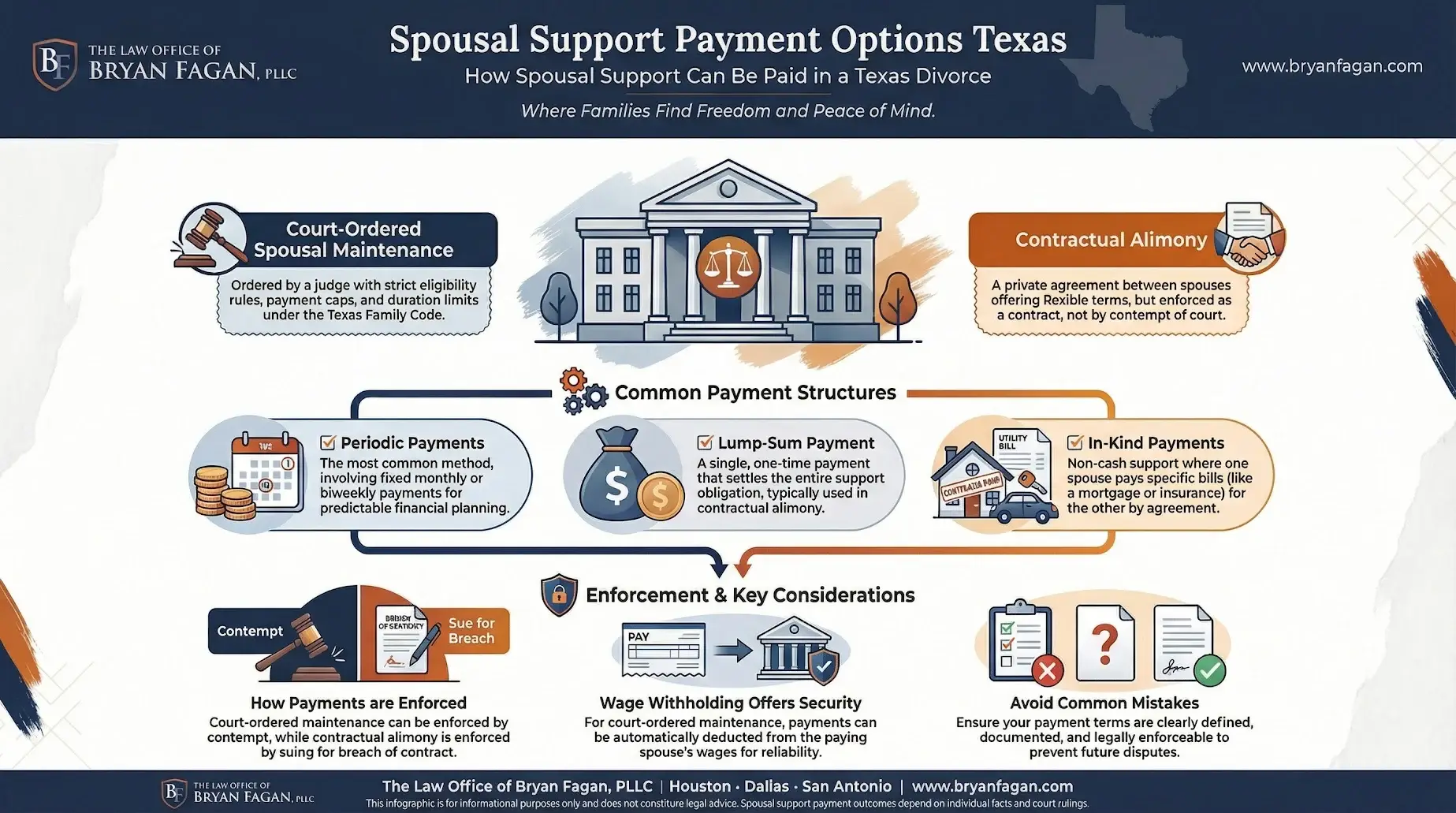

Spousal Support Payment Options Texas rarely feel important on the day you’re packing boxes or signing final divorce papers—until the first month passes and the payment doesn’t arrive the way you expected. One Houston parent we recently spoke with described it perfectly: the divorce was finalized, emotions were still raw, and then a simple but terrifying realization set in—“I don’t actually know how this support is supposed to be paid, or what happens if it isn’t.” That moment, more than the courtroom hearing itself, made the divorce feel real.
At The Law Office of Bryan Fagan, PLLC, we know that spousal support is not just a line item in a decree. It is the difference between stability and constant stress during one of life’s hardest transitions. Texas law allows several ways for spousal support to be paid, enforced, and modified, but not all payment methods offer the same level of reliability or peace of mind. Under Texas Family Code §153.002, courts are required to prioritize the best interest of the child, and while spousal support is paid between adults, its reliability often determines whether a household can function calmly or live in a state of financial uncertainty.
Led by Bryan Joseph Fagan, a South Texas College of Law graduate and recognized authority on Texas divorce and custody law, our firm has guided Texas families through these decisions for more than a decade. In this article, you will learn how spousal support is actually paid under Texas law, what happens when payments are late or stop altogether, and how the right payment structure can reduce conflict, protect your family’s sense of security, and help everyone move forward with greater clarity and peace of mind.
Key Takeaways
- Texas spousal support can be paid through periodic monthly payments, wage withholding, lump-sum payments, or direct payment arrangements, each with different enforcement mechanisms and modification implications.
- Wage withholding provides the most reliable payment method because employers are legally obligated to withhold and remit payments, removing reliance on the paying spouse’s willingness to comply.
- Contractual alimony offers more payment flexibility than court-ordered spousal maintenance, including creative options like step-down payments or escalating payments tied to income changes.
- Documentation of all payments is critical for enforcement—informal cash payments without records create significant proof problems if disputes arise.
- Payment structure affects tax treatment and future modifications, making early strategic planning with a Texas divorce attorney essential for long-term financial protection.

Your Family’s Future Starts Here
Don’t navigate your legal journey alone. Schedule a consultation now and get the clarity and support you deserve.
Spousal Support Payment Options Texas: An Overview
Under Texas law, Spousal Support Payment Options Texas include several legally recognized methods, such as periodic monthly payments, wage withholding, lump-sum payments, and direct payment arrangements between former spouses. Which option applies depends on whether the obligation is court-ordered spousal maintenance under Texas Family Code Chapter 8 or contractual alimony negotiated as part of a divorce settlement. Texas courts and experienced practitioners focus not only on eligibility, but also on selecting a payment structure that is practical, enforceable, and capable of supporting long-term stability after divorce.
Court-ordered spousal maintenance is governed by strict statutory limits. Under Texas Family Code §§8.054 and 8.055, monthly maintenance is capped at the lesser of $5,000 or 20% of the paying spouse’s average gross monthly income, reflecting the Legislature’s continued emphasis on limited, rehabilitative support rather than permanent dependency. Duration is also tightly controlled and tied to the length of the marriage, with current law allowing up to five years of support for marriages lasting at least 10 but less than 20 years, up to seven years for marriages of 20 to 30 years, and up to ten years for marriages exceeding 30 years. These statutory caps directly influence how payment schedules are designed and why courts often favor structured, reliable collection methods.
Contractual alimony operates outside these statutory constraints. Because it is based on a private agreement rather than a court mandate, contractual alimony is not subject to the Chapter 8 caps on amount or duration. This flexibility allows divorcing spouses to craft creative payment terms tailored to their financial realities, including higher payments or alternative schedules. However, as attorneys at the Law Office of Bryan Fagan frequently advise, this flexibility comes with different enforcement consequences. Unlike court-ordered maintenance, contractual alimony is generally enforced through breach-of-contract remedies rather than contempt of court, which can make enforcement slower and more complex if disputes arise.
The payment method chosen affects far more than convenience. It shapes how easily payments can be enforced, whether modifications are feasible if circumstances change, and what documentation exists if disagreements surface later. Wage withholding, authorized in part by Texas Family Code Chapter 158, is often the most reliable option for court-ordered maintenance because it removes guesswork and reduces conflict. Families seeking a deeper understanding of this process can review the firm’s resource on federally mandated income withholding for support in Texas, which explains how withholding orders work in real cases. For broader context, readers may also find it helpful to explore the firm’s guide on Texas spousal maintenance and alimony laws, which outlines how thoughtful planning around payment methods can prevent enforcement problems before they begin.

Periodic Monthly Spousal Support Payments
Periodic monthly payments are the default and most common payment structure for Texas spousal maintenance. Under this arrangement, the paying spouse provides a fixed amount each month throughout the court-ordered duration, creating a predictable income stream for the receiving spouse.
Courts commonly order periodic payments because they align naturally with the statutory framework. When a Texas court determines that a spouse requesting support meets the eligibility requirements—lacking sufficient property to meet minimum reasonable needs and satisfying one of four statutory conditions—monthly payments allow for ongoing support while circumstances evolve.
Advantages of periodic payments include:
- Predictable income timing for budgeting and financial planning
- Easier tracking of compliance and payment history
- Flexibility to seek modification if the paying spouse’s financial resources change
- Clear connection between payment obligations and duration of the marriage
Disadvantages include:
- Ongoing payment relationship with a former spouse
- Continued dependency on the paying spouse’s willingness and ability to pay
- Risk that the paying spouse refuses to comply, requiring enforcement action
- Potential disputes about payment timing or amounts
Consider a practical example: Sarah receives court-ordered spousal maintenance of $4,000 per month for seven years following a 25-year marriage. Her husband David has sufficient income from his engineering position to make payments. Monthly periodic payments work well here because David’s employment is stable, payments are predictable, and if his circumstances change significantly, either party can seek modification through the Texas court.
Wage Withholding for Spousal Support in Texas
Wage withholding is widely regarded as the most dependable of the Spousal Support Payment Options Texas courts rely on because it removes uncertainty and minimizes conflict between former spouses. Under Texas Family Code Chapter 158, judges have the authority to order employers to deduct spousal maintenance directly from a paying spouse’s wages and remit those funds to the receiving spouse or through the court registry. This structure reflects the Legislature’s continued focus on predictability and enforceability in support cases governed by Texas Family Code Chapter 8.
Wage withholding operates through a formal Income Withholding Order served on the paying spouse’s employer. Once that order is in place, the employer is legally required to withhold the specified amount from each paycheck, send payments on time to the designated recipient, and continue doing so until the court issues a termination or modification order. Employers who fail to comply can face liability under the Texas Family Code, which further reinforces why courts view withholding as a reliable enforcement mechanism rather than a discretionary arrangement.
The practical benefits of wage withholding are significant. Payments are made automatically, eliminating the risk that a paying spouse will forget, delay, or dispute monthly obligations. Support arrives on a predictable schedule tied to payroll cycles, not personal dynamics between former spouses. Just as important, if payments suddenly stop, the receiving spouse is alerted immediately that employment circumstances may have changed, allowing faster intervention and enforcement. Families seeking clarity on how courts distinguish between different forms of support may find helpful context in the firm’s explanation of the difference between spousal maintenance and contractual alimony, which outlines why wage withholding typically applies only to court-ordered maintenance.
That said, wage withholding is not a one-size-fits-all solution. It works best when the paying spouse has steady, W-2 employment. Self-employed individuals, business owners, and those with irregular income streams often cannot be subject to traditional employer withholding, which requires attorneys to explore alternative payment structures. In those situations, experienced Texas family law counsel helps tailor solutions that still prioritize documentation and enforceability, a topic discussed further in this overview of Texas spousal maintenance and alimony laws.
A real-world example illustrates why courts favor this approach. When a paying spouse works for a large company with consistent payroll, wage withholding ensures that support payments are deducted automatically and delivered on schedule. The receiving spouse does not have to request payment or monitor compliance, and both parties benefit from reduced friction and clearer financial expectations. For families navigating divorce, this level of structure often makes wage withholding one of the most effective tools available within the broader landscape of Spousal Support Payment Options Texas.
Lump-Sum Spousal Support Payments
A lump-sum spousal support payment is one of the more strategic Spousal Support Payment Options Texas families may consider when long-term certainty and finality are priorities. Rather than spreading payments over months or years, a lump-sum arrangement satisfies the entire support obligation in a single transaction. Under current Texas law, these arrangements are most often accomplished through contractual alimony instead of court-ordered spousal maintenance under Texas Family Code Chapter 8, which continues to emphasize limited, rehabilitative support rather than ongoing dependency.
It is critical to understand that lump-sum spousal support is legally distinct from property division. Property division falls under Texas Family Code Chapter 7 and allocates marital assets between spouses, while spousal support—whether paid monthly or in a lump sum—is intended to address ongoing financial needs after divorce. This distinction affects enforcement, modification rights, and tax planning, which is why lawyers at The Law Office of Bryan Fagan, PLLC consistently stress careful drafting and clear intent in the divorce decree.
For the right situation, lump-sum support can offer meaningful benefits. It creates a clean financial break between former spouses, provides certainty as to the total amount owed, and eliminates the risk of future non-payment or enforcement disputes. Financial planning also becomes more straightforward because both parties know exactly what resources are available. At the same time, lump-sum arrangements carry real risks. They are generally not modifiable if the receiving spouse’s circumstances worsen, require significant upfront liquidity from the paying spouse, and shift investment and management responsibility to the recipient. Poor financial decisions or unexpected tax consequences can undermine the stability the arrangement was meant to provide.
Calculating a lump-sum amount typically begins with the anticipated monthly support multiplied by the remaining duration of support, followed by a discount to reflect present value. For example, if a spouse would otherwise receive $4,000 per month for 60 months, the starting figure would be $240,000, with adjustments made to account for immediate payment. Because Texas courts do not supervise contractual alimony the way they oversee statutory maintenance, precision in drafting is essential to avoid future disputes.
Even though lump-sum support does not rely on ongoing wage withholding, understanding enforcement mechanisms remains important when evaluating all Spousal Support Payment Options Texas. Families who want to better understand how withholding works in other support contexts may find it helpful to review and the firm’s explanation of how income withholding orders work in Texas. For additional perspective on how Texas courts approach support obligations and long-term planning, readers may also benefit from this overview of Texas spousal maintenance and alimony laws, which explains how thoughtful structuring can protect financial stability well after a divorce is finalized.

Direct Payment Methods and Agreed Payment Structures
When wage withholding isn’t ordered or isn’t feasible, Texas spouses must arrange direct payments through bank transfers, checks, or electronic payment platforms. The critical factor in any direct payment arrangement is documentation.
Recommended direct payment methods:
- Automatic bank transfers with clear memo lines identifying payments as spousal support
- Checks mailed or delivered with payment purpose clearly noted
- Electronic payment platforms (Zelle, Venmo, PayPal) with descriptive payment notes
- Court registry payments that provide neutral third-party records
Methods to avoid:
- Cash payments with no documentation
- Informal arrangements without written terms
- Payments mixed with other transfers (child support, reimbursements)
- Verbal agreements about payment timing or amounts
The divorce decree should specify payment method, due dates, and consequences for late payment. Clear decree language prevents disputes about whether payments were made, when they were due, and what happens when the paying spouse is late.
Consider James and Patricia’s divorce. Their decree requires James to pay $2,500 monthly by the 5th of each month via direct bank transfer. James sets up automatic transfers and keeps bank statements showing every payment. When Patricia later claims he missed payments, James produces complete records proving compliance. Without that documentation, proving payment would have been difficult.
Payment Options in Contractual Alimony Agreements
Contractual alimony—spousal support agreed upon by the parties rather than ordered by the court—offers significantly more flexibility in payment structures than court-ordered spousal maintenance. Because contractual alimony is a private contract, the parties can design creative payment arrangements tailored to their specific circumstances.
Creative payment options include:
- Step-down payments: Starting at a higher amount and decreasing over time (e.g., $5,000 per month for years 1-3, then $3,000 for years 4-5)
- Escalating payments: Increasing payments tied to the paying spouse’s income growth
- Milestone-based adjustments: Payments that change when specific events occur (receiving spouse completes education or training, children reach certain ages)
- Seasonal variations: Higher payments during months when the receiving spouse has reduced earning ability
The trade-off for this flexibility is enforcement. Contractual alimony may not be enforceable through contempt of court like court-ordered maintenance. Instead, the receiving spouse may need to pursue breach of contract remedies, which can be slower and more expensive.
Careful drafting is essential. The contract should specify:
- Exact payment amounts and timing
- What triggers adjustments or termination
- How disputes will be resolved
- What remedies are available for non-payment
Tax Considerations Related to Spousal Support Payments
Since the Tax Cuts and Jobs Act of 2017 took effect for divorces finalized after December 31, 2018, the federal tax treatment of spousal support has changed significantly. Under current law, spousal support payments are not deductible by the paying spouse and not taxable income to the receiving spouse.
This change affects payment structure decisions differently than before. Previously, the paying spouse could deduct payments, creating incentive for higher periodic payments. Now, without that deduction, the paying spouse’s after-tax cost is the full payment amount.
Despite losing deductibility, payment structure still matters for tax purposes:
- Distinguishing spousal support from property division remains important for IRS classification
- Lump-sum payments may have different tax implications than periodic payments
- Careful documentation in the divorce decree prevents characterization disputes
Texas has no state income tax, which simplifies some tax planning compared to other states. However, federal tax implications still require attention.
Both paying and receiving spouses should consult a tax professional before finalizing payment structures. The intersection of divorce law and tax law creates complexities that affect your taxable income and financial well being for years.
Enforcement of Spousal Support Payments in Texas
When a paying spouse refuses to comply with a court order, Texas law provides strong enforcement mechanisms that underscore why structure matters when evaluating Spousal Support Payment Options Texas. Court-ordered spousal maintenance is governed by Texas Family Code Chapter 8, and enforcement authority flows from that statutory framework. Texas courts expect maintenance orders to be taken seriously, and judges are empowered to act quickly when payments stop or fall behind.
For court-ordered maintenance, enforcement tools are both direct and effective. Under Texas Family Code §§8.059 and 157.001, a receiving spouse may file an enforcement action asking the court to hold the paying spouse in contempt for violating a valid maintenance order. Contempt can carry serious consequences, including fines, confinement in county jail, or both. Courts may also order wage withholding if it was not included originally, using the authority found in Texas Family Code Chapter 158 to collect current support and arrears directly from the paying spouse’s income. In more severe cases, judges may authorize bank account levies or property execution, allowing assets to be seized or sold to satisfy unpaid support obligations.
Contractual alimony is enforced differently. Because it arises from a private agreement rather than a court mandate, contractual alimony typically cannot be enforced through contempt. Instead, enforcement usually requires a breach-of-contract lawsuit, which can be slower and more expensive, even though courts may still award damages and attorney’s fees. Attorneys at the Law Office of Bryan Fagan regularly counsel clients on this distinction so families understand the trade-offs between flexibility and enforcement power before finalizing an agreement.
Wage withholding remains one of the most reliable enforcement tools available for court-ordered support, and families seeking a clearer understanding of how this process works can review the firm’s educational resource. For a deeper explanation of the mechanics and legal authority behind this process, readers may also find value in this related guide on how income withholding orders work in Texas. Additional context on support enforcement and long-term planning is available through the firm’s overview of Texas spousal maintenance and alimony laws, which explains how thoughtful drafting can prevent enforcement disputes before they arise.
The takeaway for both paying and receiving spouses is simple but critical: clarity prevents conflict. Decrees that specify exact amounts, firm due dates, and approved payment methods are far easier to enforce than orders relying on vague language or informal expectations. By prioritizing precision and enforceability from the outset, families reduce uncertainty and protect the financial stability Texas courts expect spousal support to provide.

How a Texas Divorce Attorney Helps Structure Spousal Support Payments
A seasoned Texas divorce attorney plays a critical role in helping families evaluate and structure Spousal Support Payment Options Texas in a way that protects long-term financial stability. This process goes far beyond completing paperwork. It involves strategic planning grounded in the Texas Family Code, an understanding of enforcement realities, and a clear-eyed assessment of how payment structures perform when life inevitably changes after divorce.
Attorneys experienced in Texas family law help clients determine whether court-ordered spousal maintenance under Texas Family Code Chapter 8 or contractual alimony better fits their circumstances. They advise on payment methods that balance reliability with enforceability, draft precise decree language that minimizes ambiguity, and anticipate enforcement challenges before they arise. This guidance also includes explaining how payment structure can affect tax consequences, modification rights under Texas Family Code §8.057, and the practical collection tools available if payments fall behind.
Payment strategy becomes especially important when income is irregular or employment circumstances are complex. If a paying spouse is self-employed or works on commission, legal counsel may recommend structured periodic payments timed to high-income months, a security deposit, or a lump-sum arrangement designed to provide certainty. When a spouse has steady employment, wage withholding is often the most dependable option, authorized under Texas Family Code Chapter 158. Employers themselves may raise questions about whether withholding applies in certain situations, and those issues are addressed through procedures outlined in resources such as employer motions regarding the applicability of income withholding for support.
Attorneys at our firm regularly help clients navigate these decisions with clarity and compassion, drawing on years of courtroom experience across Texas. Families seeking broader context may also find it helpful to review this overview of Texas spousal maintenance and alimony laws, which explains how statutory limits and enforcement tools work together in real cases. Understanding the full range of Spousal Support Payment Options Texas is far easier with guidance from professionals who have seen firsthand how thoughtful planning can prevent costly disputes and protect financial peace of mind for years to come.
Why Choose The Law Office of Bryan Fagan, PLLC
Families navigating divorce benefit most from guidance that looks beyond forms and court dates and focuses on long-term stability. Attorneys at our firm bring extensive experience helping clients evaluate and implement Spousal Support Payment Options Texas in a way that aligns with both the Texas Family Code and real-life financial needs. Payment structure is not a technical afterthought under Texas Family Code Chapter 8; it is a foundational decision that directly affects enforcement, modification rights, and post-divorce peace of mind.
Drawing on deep knowledge of Texas Family Code §§8.051 through 8.059 and Chapter 158 wage withholding provisions, our legal team develops financially informed strategies tailored to each family’s circumstances. That includes helping clients decide whether court-ordered spousal maintenance or contractual alimony is the better fit, selecting payment methods that balance reliability with flexibility, and drafting decree language that leaves little room for future disputes. Clear communication is central to this process, especially when explaining how payment decisions made during divorce can affect taxes, enforcement options, and financial security years later.
Compassionate guidance also means helping clients understand where spousal support fits within the broader divorce timeline. For those seeking a clearer picture of what to expect from start to finish, the firm’s overview of the Texas divorce process provides helpful context on how support decisions intersect with custody, property division, and final orders. Additional insight into statutory limits and enforcement tools is available through this resource on Texas spousal maintenance and alimony laws, which explains how thoughtful planning can prevent avoidable conflict.
This proactive approach is designed to prevent problems before they arise. By choosing appropriate payment methods, anticipating enforcement challenges, and anchoring every recommendation in the Texas Family Code, the Law Office of Bryan Fagan, PLLC helps families move through divorce with clarity and confidence. When spousal support is structured carefully and communicated clearly, clients are better positioned to protect their financial future and focus on rebuilding life after divorce.

Checklist: Spousal Support Payment Options Texas
Use this checklist when planning your spousal support payment structure:
- [ ] Identify whether support is court-ordered maintenance or contractual alimony (this determines available options and enforcement mechanisms)
- [ ] Choose a payment method that supports compliance (wage withholding for employed spouses, documented transfers for others)
- [ ] Address wage withholding appropriately (determine whether it’s mandatory, beneficial, or impractical for your situation)
- [ ] Document all payments clearly (use payment methods that create automatic records)
- [ ] Specify payment terms in the decree (exact amounts, due dates, methods, and late-payment consequences)
- [ ] Understand tax implications (consult a tax professional about your specific situation)
- [ ] Plan for enforcement (know your remedies if payments stop)
- [ ] Have a Texas divorce attorney review payment terms before finalizing any agreement
Conclusion
Divorce has a way of turning ordinary decisions into emotional ones, and spousal support is a perfect example. How support is paid, enforced, and planned isn’t just a technical detail—it shapes how stable life feels on the other side of divorce. When payments are reliable and clearly structured, families gain something invaluable: breathing room. That space allows parents to focus less on conflict and uncertainty and more on rebuilding routines, confidence, and peace of mind.
The good news is that Texas law gives families options, and with the right guidance, those options can be used to create predictability instead of stress. Whether you are receiving support or responsible for paying it, understanding how payment methods work—and how they hold up when life changes—puts you back in control of the process. Thoughtful legal planning doesn’t eliminate every challenge, but it can prevent many of the avoidable ones.
If you find yourself reading this and thinking, “I just want to get this right the first time,” you’re not alone. Working with an experienced Texas family law attorney can make the difference between ongoing frustration and a smoother path forward. At The Law Office of Bryan Fagan, PLLC, our focus is on educating families, protecting futures, and helping people move through transition with clarity rather than confusion. When you’re ready to talk through your situation, we’re here to help—because peace of mind shouldn’t be the hardest part of your next chapter.
Frequently Asked Questions About Spousal Support in Texas
In Texas, spousal support—often referred to as spousal maintenance or contractual alimony—is usually paid in monthly installments. Payments can be made through wage withholding, direct bank transfers, checks, electronic payment platforms, or sometimes through the court registry. Wage withholding is often the most reliable option because payments are sent automatically, but it may not work for self-employed individuals. The best payment method is one that is clearly documented and easy to enforce if problems arise.
Certain assets are considered separate property and generally cannot be awarded to the other spouse in a Texas divorce. This often includes property owned before the marriage, gifts or inheritances given specifically to one spouse, and some personal injury recoveries. However, these assets must be clearly proven as separate. If separate funds are mixed with marital funds, they can become much harder to protect.
A person may be disqualified from court-ordered spousal maintenance if they can meet their minimum reasonable needs through property awarded in the divorce or through their own earning capacity. Texas law also requires specific qualifying circumstances for maintenance, and failing to meet one of those statutory requirements can prevent an award. Each situation is fact-specific, which is why legal guidance is often essential.
The “10-year rule” refers to one possible threshold for eligibility to request court-ordered spousal maintenance. A marriage lasting at least 10 years allows the court to consider maintenance, but it does not guarantee support. The requesting spouse must still show they lack sufficient property and meet other legal requirements. It’s a starting point for analysis, not an automatic entitlement.
For court-ordered spousal maintenance, Texas law limits how long payments can last, usually based on the length of the marriage and the reason support is awarded. Contractual alimony, which is agreed upon by the spouses, can last longer if both parties consent and the agreement is drafted carefully. Duration should always be evaluated alongside payment reliability and enforcement options.
Fairness in Texas typically means an amount that helps the receiving spouse meet minimum reasonable needs while staying within legal limits. Courts consider income, earning ability, health, expenses, and the history of the marriage. In negotiated cases, fairness also includes choosing a payment structure that is realistic and enforceable, because even a fair amount does little good if it isn’t consistently paid.
The so-called “10-10-10 rule” is not an official Texas divorce law. It is more of an informal phrase sometimes used online to talk about long marriages and support issues. Texas courts do not apply a single formula like this. Decisions about spousal support are based on specific facts, not generalized rules found on the internet.
Moving out of the marital home can sometimes weaken a spouse’s position in custody, property, or support negotiations by changing the existing status quo. It can also create immediate financial strain if temporary support arrangements are not in place. That said, there are situations where moving out is necessary for safety or peace. The key is making that decision with legal advice and a clear plan.
Financial impact varies from case to case. Often, both spouses feel the strain because one household becomes two, increasing overall expenses. The lower-earning spouse may experience more immediate hardship, while the higher-earning spouse may face ongoing support obligations. Careful planning, especially around spousal support payment options, can help reduce long-term financial damage for everyone involved.