
Saturday morning sunlight spilled across the kitchen as Megan and David quietly sorted through the mail—bank statements, a reminder for the dog’s vet visit, and a brochure from their favorite Hill Country cabin where they once spent anniversaries. They weren’t fighting, but the silence between them said everything. After months of drifting apart, they finally agreed it was time to end their marriage with honesty and respect, not courtroom battles. What they needed now was clarity—a way to move forward without destroying the peace they were trying to preserve. It’s moments like this that lead many Texans to search for answers, beginning with one essential question: How to File Uncontested Divorce in Texas.
For families standing at this crossroads, uncontested divorce isn’t just a legal strategy; it’s a conscious choice to protect dignity, reduce conflict, and create a calmer transition for everyone involved. At The Law Office of Bryan Fagan, PLLC—led by Bryan Joseph Fagan, a South Texas College of Law graduate and widely recognized authority on Texas divorce and custody law—we understand the weight of that decision. Families come to us not only for legal expertise grounded in the Texas Family Code, but for guidance shaped by compassion and real experience walking thousands of Texans through the same emotional terrain.
Texas law offers a clear path forward. Under provisions like Texas Family Code §153.002, courts are required to make decisions rooted in the best interests of the family, and choosing an uncontested divorce often supports that goal by reducing stress, lowering cost, and preventing the scars that litigation can leave behind. But “uncontested” does not mean simple. It requires cooperation, accurate documents, full agreement on every term, and a steady hand to guide the process.
This is where our firm’s mission comes alive. Our “Why” is simple: to empower people to reclaim freedom and peace of mind during life’s hardest transitions. We do that by offering compassionate counsel, practical education, and innovative legal solutions that make even the most complex situations feel manageable. In this guide, you’ll learn exactly how uncontested divorce works in Texas, what the process requires, and how smart planning can protect your future long after the decree is signed.
If you’re ready to move forward with clarity, confidence, and support rooted in both legal expertise and genuine human understanding, you’re in the right place. Let’s begin this journey together—one step at a time.
Key Takeaways
- An uncontested divorce in Texas works best when both spouses fully agree on property division, parenting arrangements, child support, and all financial terms before filing.
- The process is simpler and more peaceful, but it still requires precise paperwork, Texas-specific legal language, and compliance with Family Code requirements.
- Texas law imposes a mandatory 60-day waiting period, meaning even the fastest uncontested divorce cannot be completed sooner than about two months.
- Judges prioritize the best interests of the family, and choosing an uncontested path can reduce conflict, stress, and long-term emotional strain.
- Properly drafted documents—including the Final Decree of Divorce, parenting plan, and support provisions—help prevent future disputes or costly modifications.
- Working with an experienced Texas family law attorney ensures accuracy, strengthens legal protection, and gives families confidence as they move toward a healthier, more stable future.

Your Family’s Future Starts Here
Don’t navigate your legal journey alone. Schedule a consultation now and get the clarity and support you deserve.
What an Uncontested Divorce Really Means in Texas
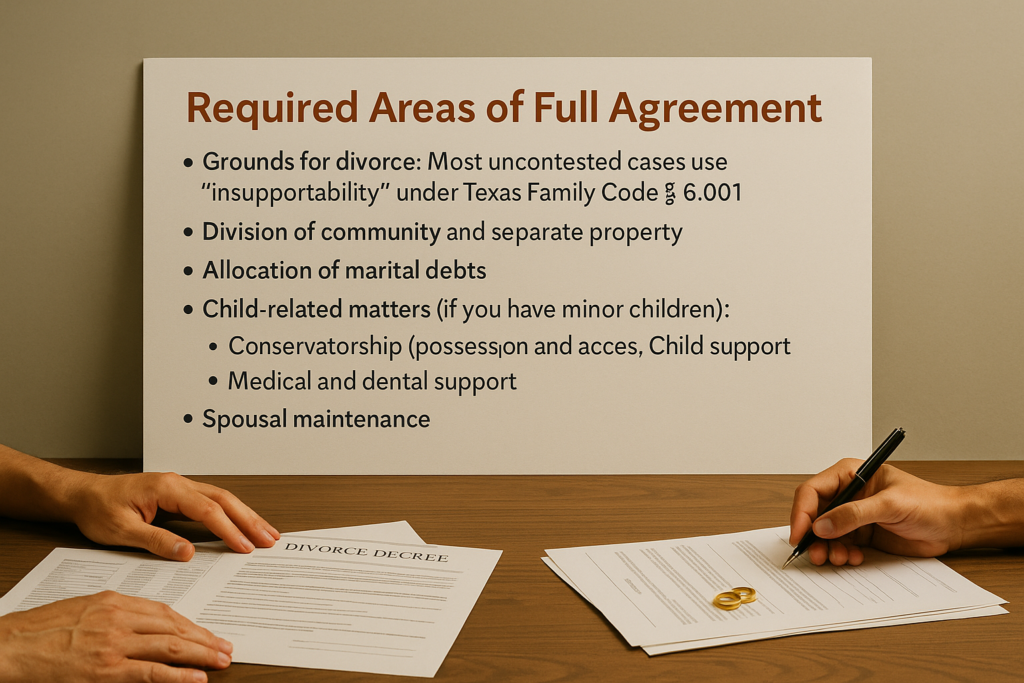
For a divorce to remain truly uncontested in Texas, both spouses must agree on every issue the court is required to address. When learning How to File Uncontested Divorce in Texas, it’s important to understand that Texas law—beginning with the no-fault ground of “insupportability” under Texas Family Code § 6.001—requires a clear, shared basis for ending the marriage. Couples preparing for this process can also review key considerations in this guide to ensure they meet all requirements before filing.
Property and debt division must also be resolved in full. Under Texas Family Code § 7.001, community property must be divided in a “just and right” manner, which means spouses must agree on who will retain the home, vehicles, bank accounts, retirement assets, business interests, and personal belongings. They must also decide how to allocate all marital debts—including mortgages, credit cards, and loans—while understanding that a Final Decree does not prevent third-party creditors from pursuing either spouse on jointly held accounts.
If minor children are involved, Texas Family Code Chapters 153 and 154 require parents to clearly outline conservatorship, possession schedules, child support, and medical support. Judges rely on the “best interest of the child” standard in § 153.002 when reviewing these agreements, so parents must define decision-making rights, holiday and summer schedules, and transportation responsibilities. Child support calculations must follow updated guideline percentages under § 154.125, and parents must specify who will maintain health and dental insurance and how uninsured expenses will be divided.
Spousal maintenance is another area requiring agreement. Under Chapter 8, Texas law limits when maintenance may be ordered, generally requiring factors such as a long marriage, disability, or a history of family violence. If spouses decide maintenance is appropriate, they must agree on the amount, duration, and conditions. Reaching clear decisions in advance helps avoid delays during the court’s prove-up hearing and ensures the Final Decree contains enforceable terms.
By resolving all these issues before filing, spouses create a smoother, more predictable uncontested process. Whether you are finalizing property spreadsheets or drafting parenting plans, understanding the legal framework—and partnering with a supportive Texas family law team—helps protect your rights while reducing stress. Families wanting additional guidance can explore the firm’s educational resources, including Texas child custody information, to feel more confident as they move forward.
Agreed vs. Default Divorce Procedures
When learning How to File Uncontested Divorce in Texas, it’s important to understand that the state recognizes two different paths for an uncontested proceeding, each with its own benefits and potential risks. The first and most stable option is an agreed divorce, where both spouses participate fully, sign the necessary documents—including a Waiver of Service and the Final Decree of Divorce—and confirm their consent to all terms. This cooperative approach aligns with the goal of uncontested divorce and supports a smoother review by the court, particularly when the agreement complies with the Texas Family Code and reflects recent updates to custody, child support, and property division requirements. Families exploring whether this process fits their circumstances may find additional insight in this guide on uncontested divorce timelines.
Texas also allows uncontested cases to proceed by default when one spouse files and properly serves the other, but the respondent never files an Answer or appears in court. While this method can technically meet the definition of “uncontested,” it carries more legal risk. If the respondent later shows that service was improper or that they were not given adequate notice—requirements rooted in due process and reinforced across the Family Code—they may challenge the final judgment. For that reason, many Texans choose an agreed divorce whenever cooperation is possible, ensuring greater finality and fewer opportunities for future disputes.
Real-world situations often illustrate why agreement matters. Consider a couple who initially disagrees over the value of a vacation home or a spring break schedule for their child. With mediation—a tool strongly supported by Texas courts—they may reach a balanced resolution, such as trading property interests for debt responsibility or crafting a detailed parenting calendar. Once every issue is settled, their case becomes eligible to proceed as a true uncontested divorce, helping them avoid the time, expense, and emotional strain associated with contested litigation. Families seeking additional guidance on parenting matters can review the firm’s helpful Texas child custody resources.
Under the Texas Family Code, even a single unresolved detail—like disagreement over a credit card balance or a holiday visitation period—removes the case from the uncontested category. Any dispute that requires judicial intervention transforms the matter into a contested divorce, subject to negotiation, discovery, or potentially a trial. This distinction underscores why careful preparation and early alignment are essential for couples pursuing an uncontested path.
Whether spouses are amending financial spreadsheets, revising parenting plans, or confirming service procedures, working with a knowledgeable Texas family law firm helps ensure compliance with statutory requirements and prevents small issues from derailing an otherwise cooperative process. With the right support, families can move forward confidently, knowing their uncontested divorce reflects both legal accuracy and shared respect for one another’s future.
Are You Eligible? Requirements for Filing an Uncontested Divorce in Texas
Before beginning any paperwork, you must confirm that you meet Texas-specific legal requirements. Courts will reject cases that don’t satisfy these fundamental prerequisites, regardless of how well you and your spouse get along.
Texas Residency and Where to File
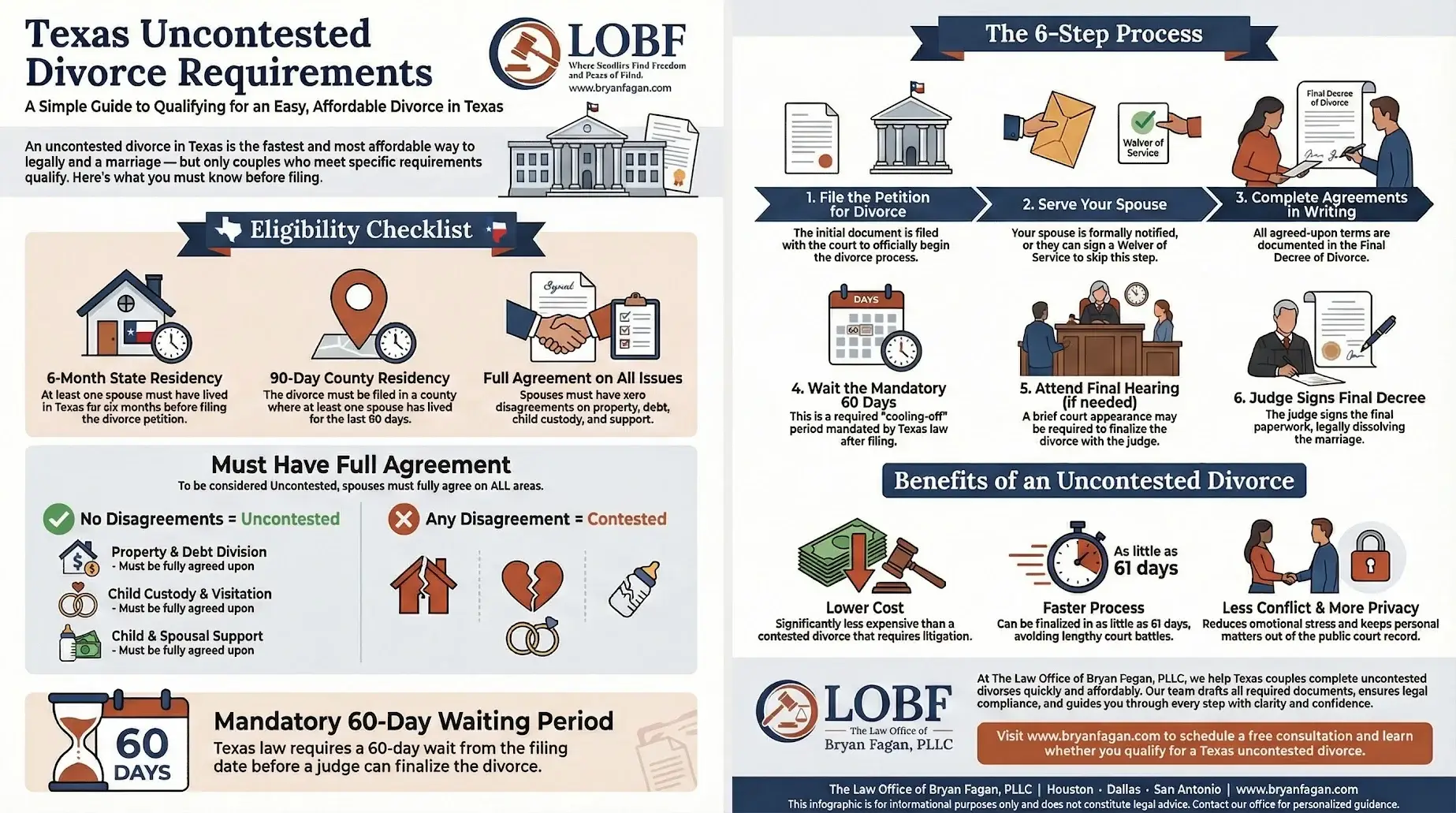
Texas residency rules play a crucial role in understanding How to File Uncontested Divorce in Texas, because a court cannot grant a divorce unless at least one spouse meets the jurisdictional requirements outlined in Texas Family Code § 6.301. These rules ensure the court has proper authority over your case and determine which county is the correct place to file. For families preparing for an uncontested divorce—whether in Houston, Conroe, or anywhere in Southeast Texas—meeting these residency thresholds is the first step toward a smooth legal process. You can also explore additional local guidance in this resource on uncontested divorce in Conroe, Texas.
Under § 6.301, at least one spouse must have lived in Texas for a minimum of six months before filing. In addition, one spouse must have lived in the county of filing for at least 90 days. These requirements apply regardless of whether the spouses still live together. For example, if you recently moved to Harris County from another state and have only lived there for four months, you would need to wait until the six-month mark before filing. By contrast, if your spouse has lived in Montgomery County for several years while you were temporarily stationed elsewhere for military service, the law allows you to file in Montgomery County as long as Texas has remained your legal domicile.
Texas law also protects the rights of service members and non-citizens. Military personnel stationed outside the state may still file in Texas if Texas is their home of record, and immigration status does not prevent a court from granting a divorce as long as residency standards are met. These provisions ensure that Texas families—including those navigating relocation, deployment, or international backgrounds—can access the courts when they need them most. For additional practical support in preparing your case, you may find the firm’s educational guides, such as the Texas Divorce Planning resource, helpful as you gather documents and confirm eligibility.
Because residency determines whether your case can even begin, confirming these requirements early prevents delays and frustration later in the process. Families often turn to the attorneys at The Law Office of Bryan Fagan, PLLC for guidance because they not only understand the statute but also the real-world complexities behind residency questions—especially when a move, deployment, or temporary assignment overlaps with a divorce filing. Taking time to assess your eligibility now helps ensure that your uncontested divorce proceeds efficiently and in full compliance with Texas law, giving you a clearer path forward.

Agreement on All Terms Before You File
For an uncontested divorce, you and your spouse should reach at least basic agreement on major issues before filing, though you can finalize details during the mandatory 60-day waiting period.
Essential areas requiring consensus include:
Property division strategy: How will you handle the marital home – will one spouse keep it, will you sell it, or will you continue joint ownership temporarily? What about vehicles, bank accounts, retirement funds, and personal property?
Debt responsibility: Who will pay the mortgage, credit cards, car loans, and other marital debts after divorce? Include plans for refinancing or paying off joint obligations.
Parenting arrangements: If you have children, you’ll need detailed agreements about primary residence, regular visitation schedules, holiday and vacation time, school and medical decision-making authority, and geographic restrictions.
Financial support: Calculate child support using Texas guidelines, determine who will maintain health insurance for the children, and decide how you’ll split uninsured medical expenses. Also address whether either spouse needs spousal maintenance.
Remember that these agreements don’t need to be formal contracts initially, but they should eventually be reduced to precise written terms in your Final Decree of Divorce. Many couples find that mediation helps them work through remaining details while keeping their case uncontested.
When an Uncontested Divorce Is Not Appropriate
Certain circumstances typically require a contested approach or, at minimum, intensive legal representation to protect your rights:
Safety concerns: Any history of domestic violence, coercive control, stalking, or fear of retaliation makes a truly “voluntary” agreement questionable. Courts scrutinize such agreements carefully, and victims may need protective orders or supervised proceedings.
Hidden or complex assets: If you suspect your spouse is concealing income, business interests, foreign accounts, or other assets, an uncontested approach is risky. These cases often require formal discovery, forensic accounting, and expert valuations.
High-conflict custody situations: Fundamental disagreements about primary custody, geographic relocation, or children’s safety typically cannot be resolved through simple agreement and may require custody evaluations, guardians ad litem, or extensive litigation.
Significant power imbalances: Cases involving mental health crises, language barriers, lack of financial sophistication, or where one spouse controls all information and decision-making may not produce truly voluntary agreements.
If any of these red flags apply to your situation, consider treating your case as contested from the beginning and seek immediate legal counsel rather than attempting an uncontested approach that could leave you vulnerable.
Required Texas Forms and Documents for an Uncontested Divorce
Using correct Texas-specific forms and completing them accurately is absolutely critical. Texas family court judges frequently reject incomplete or improperly drafted decrees, causing delays and additional court appearances.
The specific forms you’ll need depend on whether you have minor children and whether you own real estate, but certain core documents are required in virtually every Texas divorce case.
Core Divorce Forms Most Cases Will Need
Original Petition for Divorce: This document officially starts your case under Texas Family Code Chapter 6. It identifies both spouses, states when and where you married, lists any children, establishes residency and venue, specifies grounds for divorce (usually “insupportability”), and provides a general outline of requested relief. The petitioner is the spouse who files; the respondent is the other spouse.
Waiver of Service or Return of Service: If your spouse is cooperative, they can sign a notarized Waiver of Service after you file the petition, acknowledging receipt and waiving their right to formal service. If they won’t sign a waiver, you must have them formally served by a constable or private process server, who then files a Return of Service proving proper notice was given.
Final Decree of Divorce: This is the controlling court order that actually dissolves your marriage and establishes all ongoing rights and obligations. It must include detailed findings about residency and grounds, comprehensive property and debt division, complete child custody and support orders (if applicable), and any spousal maintenance arrangements. The decree supersedes your original petition and becomes the enforceable court order governing your post-divorce relationship.
Child-related documents (when you have minor children):
- Standard or customized parenting plan detailing conservatorship rights and possession schedules
- Child Support Worksheet calculating guideline support under Texas Family Code § 154.125
- Medical Support Order specifying health insurance responsibility and uninsured expense allocation
Marital Settlement Agreement: While not always required, a separate written agreement clarifying property division terms and incorporated into your decree provides additional contract-based enforceability and can be especially valuable for complex asset division.
Additional Supporting Documents
When exploring How to File Uncontested Divorce in Texas, it’s important to remember that each county may require additional documents beyond the standard petition and decree. These supplemental forms ensure the court has the information it needs to process your case accurately and in compliance with the Texas Family Code. Depending on your circumstances, you may need to complete a Civil Case Information Sheet, an Information on Suit Affecting the Family Relationship form in cases involving children, or a Statement of Inability to Afford Court Costs if you qualify for a fee waiver under Texas Rules of Civil Procedure. Families with retirement assets may also need to prepare a proposed Qualified Domestic Relations Order (QDRO) to divide certain ERISA-governed retirement plans in accordance with Texas Family Code provisions related to marital property and post-divorce implementation.
Your county may also require documents or procedural steps tailored to local rules. Some counties mandate parenting classes for cases involving minor children, while others specify unique language for medical support orders or name changes to ensure the decree complies with Texas Family Code Chapter 154 and recent statutory updates. Courts may also ask for a prove-up affidavit or testimony outline to support your final hearing, especially if one spouse cannot attend in person. These county-level variations underscore why it’s helpful to work with a family law team familiar with the nuances of courts throughout Texas, including Harris, Montgomery, Fort Bend, and surrounding areas.
If you’re unsure which forms apply to your situation, the attorneys at The Law Office of Bryan Fagan, PLLC routinely help clients navigate county-specific requirements and avoid delays caused by missing or incomplete paperwork. Their guidance is especially valuable in uncontested divorces, where accuracy and compliance help preserve the cooperative nature of the process. For a deeper look at when this streamlined approach is appropriate, you may find this article on when uncontested divorce makes sense helpful as you evaluate your next steps.
Every uncontested divorce benefits from thoughtful preparation, and staying informed about local procedures helps families move forward with confidence. For additional support as you prepare your documents, explore the firm’s educational resources such as the Texas Divorce Information Center, which offers guidance on forms, timelines, and best practices tailored to Texas families.

Step-by-Step Guide: How to File Uncontested Divorce in Texas
This section provides a comprehensive walkthrough of the complete uncontested divorce process, from initial preparation through your final court hearing, with specific focus on Texas procedures and requirements.
Step 1: Prepare Your Forms and Information
Before filing anything with the court, gather essential information and begin drafting your core documents:
Collect key information:
- Exact dates of marriage and separation
- Complete list of all assets: real estate, vehicles, bank accounts, retirement accounts, business interests, personal property with significant value
- Complete list of all debts: mortgages, car loans, credit cards, personal loans, medical debt, student loans
- Children’s full names, dates of birth, Social Security numbers, and residence history for the past 5 years (required for UCCJEA jurisdiction)
Draft essential forms:
- Original Petition for Divorce using insupportability (no-fault) as grounds for most uncontested cases
- Preliminary version of your Final Decree of Divorce so both spouses understand proposed terms before filing
- Child support calculations and parenting plan details if you have children
- Marital settlement agreement outlining property and debt division
Accuracy in names, dates, addresses, and property descriptions is crucial. Courts often reject decrees with inconsistent information, vague property descriptions (like “the car” instead of specific make/model/VIN), or missing statutory language for child support and custody.
Consider having a Texas family law attorney review your drafted documents before filing to ensure compliance with current statutes and local court preferences.
Step 2: File the Original Petition for Divorce
Where to file: Submit your Original Petition for Divorce to the district clerk’s office in the county where you meet the 90-day residency requirement. Most Texas counties allow both in-person filing and electronic filing through the statewide eFileTexas system.
Filing fees and costs: Court filing fees typically range from $250 to $400 depending on the county and whether children are involved. If you cannot afford the filing fee, you can request a fee waiver by completing and filing a Statement of Inability to Afford Payment of Court Costs. The judge will review your financial information and may approve or deny the waiver request.
Legal effect of filing: Once filed, your petition officially starts the divorce case and triggers the mandatory 60-day waiting period under Texas Family Code § 6.702. The earliest possible date for finalizing your divorce is generally day 61 after filing, assuming all other requirements are met and the court’s calendar allows.
The clerk will assign a unique cause number to your case and designate which court will handle your divorce. Keep this information carefully as you’ll need it on all subsequent filings.
Step 3: Notify (Serve) Your Spouse
Even in uncontested cases, Texas law requires that your spouse receive proper legal notice of the divorce proceedings. This is a fundamental due process requirement that cannot be skipped.
Option 1 – Waiver of Service: If your spouse is cooperative and doesn’t want the expense and formality of process service, they can sign a Waiver of Service. Important requirements:
- The waiver must be signed after the petition is filed (never before)
- It should be notarized or sworn before an authorized officer
- Use the official Texas waiver forms to ensure all required language is included
- File the signed waiver with the court clerk as proof that proper notice was provided
Option 2 – Formal Service: If your spouse won’t sign a waiver, or if you have any concerns about cooperation, arrange formal service through:
- County sheriff or constable
- Licensed private process server
- Certified mail (in limited circumstances allowed by the court)
The process server will complete a Return of Service form and file it with the court, providing legal proof that your spouse was properly served with citation and a copy of the petition.
Response deadline and default: Generally, the respondent has until 10:00 a.m. on the Monday following 20 days from the date of service to file an Answer. If they don’t respond and you have proof of proper service, you can seek a default judgment after the 60-day waiting period expires. However, default proceedings carry more risk than agreed divorces because the non-participating spouse might later challenge the judgment.
Step 4: Finalize the Agreement and Draft the Final Decree
After service or waiver, work with your spouse to finalize all written terms that will become your court-ordered divorce decree:
Property and debt division: Specify exactly who gets what assets and who pays which debts. Include vehicle identification numbers, account numbers, property addresses, and timelines for transfers or refinancing. Add indemnification language requiring each spouse to hold the other harmless for debts assigned to them.
Parenting plan details: For cases involving minor children, create a comprehensive plan addressing:
- Joint or sole managing conservatorship and specific decision-making rights
- Detailed possession schedule including regular periods, holidays, summer vacation, and transportation arrangements
- Geographic restrictions on the children’s primary residence
- Procedures for resolving future disputes about the children
Support calculations: Calculate monthly child support using Texas guidelines (generally 20% of net resources for one child, 25% for two children, etc.). Specify payment method, start date, and termination conditions. Address medical and dental support including insurance premiums and uninsured expenses.
Implementation provisions: Include deadlines and procedures for signing over vehicle titles, transferring real estate, submitting QDROs to retirement plan administrators, and any other necessary post-divorce actions.
The Final Decree of Divorce must use precise, enforceable language. Vague terms like “the parties will work out holiday schedules later” or “furniture will be divided fairly” create enforcement problems and future litigation risks.

Step 5: Observe the Mandatory 60-Day Waiting Period
Texas Family Code § 6.702 requires at least 60 days to pass between filing your petition and obtaining a final divorce decree. This “cooling off” period applies to contested and uncontested cases alike.
Calculating the waiting period: Count from the date you filed your original petition (day 1) through day 60. Your final hearing can be scheduled on day 61 or later.
Limited exceptions: Courts can waive or shorten the waiting period in specific family violence situations, such as when the respondent has been convicted of family violence against the petitioner or children, or when an active protective order exists. These waivers require formal request and supporting evidence – they’re not automatic.
Productive use of waiting time:
- Finalize any remaining agreement details
- Complete required parenting classes if your county mandates them
- Gather documents needed for your final hearing
- Begin preparation of property transfer documents (deeds, title transfers, QDRO drafts)
Most agreed divorces with straightforward circumstances are finalized within 2-4 months total from filing, depending on court scheduling and document complexity.
Step 6: Attend the Final Hearing (Prove-Up)
Texas courts typically require at least a brief hearing before granting any divorce, even when both parties fully agree on all terms.
Hearing format: The final hearing, commonly called a “prove-up,” is usually brief (5-15 minutes) and focuses on confirming that all legal requirements have been met. Many counties now allow prove-up hearings via Zoom or other video conferencing platforms.
Who must attend: At minimum, the petitioner (filing spouse) must appear to give sworn testimony. Some courts prefer both spouses to attend, especially when children are involved or property division is complex.
What to bring:
- Photo identification
- Signed Final Decree of Divorce (executed by both spouses)
- Any additional orders requiring the judge’s signature (QDROs, medical support orders, etc.)
- County-specific forms or checklists
Typical testimony: The judge will ask the petitioner to confirm:
- Their identity and current residence
- Satisfaction of residency and waiting period requirements
- Date and place of marriage and separation
- That the marriage has become insupportable with no reasonable expectation of reconciliation
- That any custody arrangements are in the children’s best interest
- That property division is fair and complies with Texas law
Finalization: Once the judge signs the Final Decree of Divorce and the clerk files it, your divorce is legally final and binding. Order certified copies immediately for name changes, property transfers, and financial account updates.
Timeline Overview: How Long an Uncontested Divorce in Texas Takes
Understanding realistic timelines helps you plan effectively and set appropriate expectations for your uncontested divorce process.
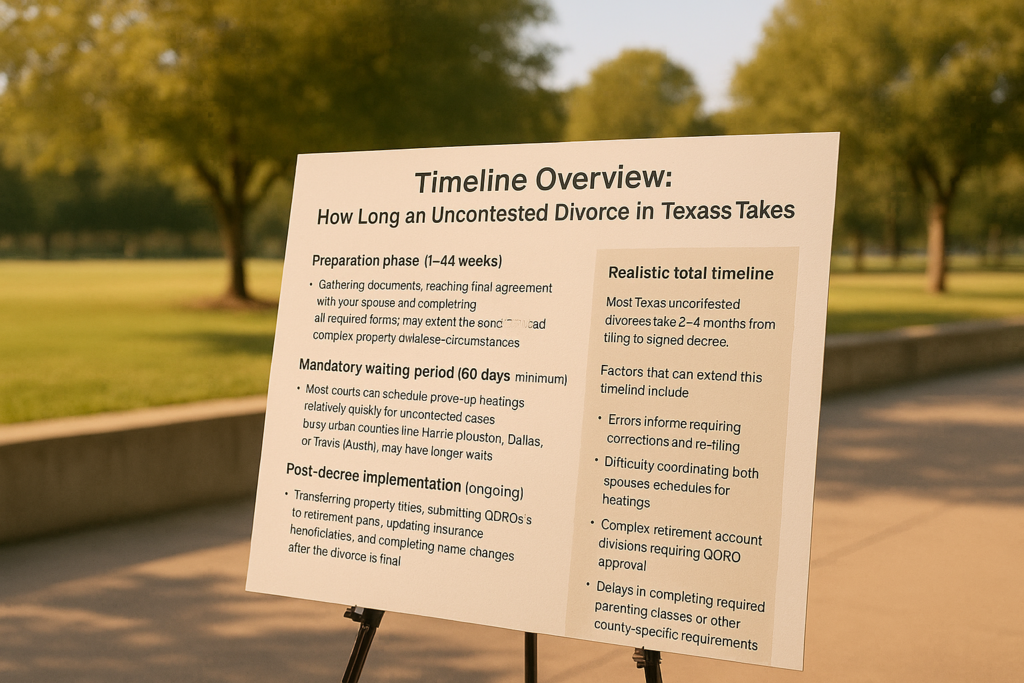
Preparation phase (1-4 weeks): Gathering documents, reaching final agreement with your spouse, and completing all required forms. Complex property division or detailed parenting plans may extend this phase.
Mandatory waiting period (60 days minimum): Required by Texas law from the date you file your original petition. No exceptions except for specific family violence circumstances.
Court scheduling (additional 1-4 weeks): Most courts can schedule prove-up hearings relatively quickly for uncontested cases, but busy urban counties like Harris (Houston), Dallas, or Travis (Austin) may have longer waits.
Post-decree implementation (ongoing): Transferring property titles, submitting QDROs to retirement plans, updating insurance beneficiaries, and completing name changes happens after your divorce is final.
Realistic total timeline: Most Texas uncontested divorces take 2-4 months from filing to signed decree. Factors that can extend this timeline include:
- Errors in forms requiring corrections and re-filing
- Difficulty coordinating both spouses’ schedules for hearings
- Complex retirement account divisions requiring QDRO approval
- Delays in completing required parenting classes or other county-specific requirements
Remember that while 60 days is the legal minimum, trying to rush the process often leads to mistakes that cause longer delays than taking time to do it correctly from the start.
Common Mistakes to Avoid in a Texas Uncontested Divorce
Even cooperative couples can make technical errors that result in rejected decrees, costly delays, or future legal disputes. Understanding these pitfalls helps you avoid expensive problems down the road.
Retirement Account Division Errors
Failing to identify all retirement plans: Many couples forget to list 401(k) accounts, pension plans, IRAs, or other retirement benefits that accumulated during marriage. Even if you agree one spouse keeps their own account, community property interests may still exist.
Inadequate QDRO preparation: Employer-sponsored retirement plans governed by ERISA typically require a Qualified Domestic Relations Order to implement any division. A vague decree stating “Wife gets 50% of Husband’s 401(k)” may be unenforceable without a properly drafted QDRO that the plan administrator will accept.
Tax consequence oversight: Retirement distributions, Roth vs. traditional IRA divisions, and early withdrawal penalties can create unexpected tax liabilities that weren’t considered in the original agreement.
Child Support and Custody Mistakes
Incorrect guideline calculations: Texas child support is generally based on percentages of the paying parent’s net resources (20% for one child, 25% for two, etc.), but many people use gross income instead of properly calculated net resources or fail to include overtime, bonuses, and other income.
Missing medical support requirements: Texas law requires detailed provisions for children’s health insurance and uninsured medical expenses. Leaving these provisions incomplete or vague often causes decree rejection.
Unenforceable custody language: Using phrases like “reasonable visitation” or “as the parties agree” instead of specific schedules makes future enforcement difficult and increases conflict potential.
Form and Procedural Errors
Using non-Texas forms: Generic online divorce forms often fail to comply with Texas Family Code requirements, use terminology from other states, or omit mandatory statutory language for child support and custody orders.
Incomplete debt division: Not specifying who pays which debts, failing to include hold-harmless provisions, or misunderstanding that divorce decrees don’t bind third-party creditors who can still pursue either spouse on joint debts.
Vague property descriptions: Courts reject decrees that don’t clearly identify assets being divided. “The house” should include full street address and legal description; “the car” should include year, make, model, and VIN.
Long-Term Planning Oversights
Beneficiary designation failures: Forgetting to update life insurance, retirement account, and payable-on-death beneficiaries can result in ex-spouses receiving benefits intended for new partners or children.
Tax planning gaps: Not considering capital gains on property sales, dependency exemption agreements, or alimony tax treatment (especially for post-2018 federal law changes) can create expensive surprises.
Implementation deadline problems: Setting unrealistic timelines for refinancing, property sales, or account transfers often leads to default and enforcement disputes.
Small drafting errors and oversights in uncontested divorces often become major problems later and typically cost far more to fix than doing it correctly initially with professional guidance.

Why Legal Representation Still Matters in an Uncontested Divorce
Many couples pursue uncontested divorce to save money and reduce conflict, but experienced legal guidance can actually enhance these benefits while providing crucial protection for your future.
Quality Control and Legal Compliance
A Texas family law attorney ensures that your divorce paperwork meets all current requirements:
Form accuracy and completeness: Attorneys stay current with changes to Texas Family Code requirements, local court rules, and preferred language for various orders. They catch inconsistencies, missing information, and potential enforcement problems before you file.
Local court knowledge: Each county has specific procedures, standing orders, and judicial preferences. Experienced practitioners understand what Judge Smith requires differently than Judge Jones, which forms work best in Harris County vs. Montgomery County, and how to avoid common rejection reasons.
Technical precision: Complex issues like retirement account division, child support calculations with irregular income, or multi-state property require specialized knowledge to draft correctly.
Substantive Protection and Issue Identification
Attorneys provide strategic guidance that protects your long-term interests:
Hidden asset discovery: Experienced lawyers know what questions to ask and what documents to review to identify overlooked assets like stock options, business interests, pending legal claims, or unreported income.
Tax and financial planning: Understanding the tax implications of property division, retirement distributions, alimony arrangements, and sale of marital assets helps structure agreements that minimize future tax liabilities.
Realistic enforceability: Attorneys can spot agreements that look good on paper but won’t work in real life, such as unrealistic refinancing timelines, unworkable custody schedules, or inadequate support amounts.
Risk assessment: Lawyers help identify when an apparently “amicable” agreement might actually be unfair due to power imbalances, incomplete information, or emotional pressure.
Process Efficiency and Risk Reduction
Professional guidance often makes uncontested divorce faster and more reliable:
Avoiding delays: Getting documents right the first time prevents rejected filings, missed deadlines, and repeated court appearances that delay finalization.
Implementation planning: Attorneys coordinate property transfers, QDRO submissions, and other post-decree requirements to ensure smooth transition.
Future modification planning: Properly drafted initial orders make future modifications (when children’s needs change or circumstances evolve) more straightforward and less costly.
The Law Office of Bryan Fagan PLLC Advantage
Choosing the right guidance is one of the most important steps when learning How to File Uncontested Divorce in Texas, especially because even amicable divorces must follow the requirements of the Texas Family Code. Many families turn to the attorneys at The Law Office of Bryan Fagan, PLLC for support because they want a process that is not only efficient, but also legally accurate and emotionally grounded. For those considering whether an uncontested approach is the right fit, this resource on the benefits of uncontested divorce offers a deeper look at why so many Texans choose this path.
A key advantage of working with a knowledgeable Texas family law team is precise document preparation and review. From the Original Petition to the Final Decree of Divorce, every form must reflect current statutory language, including updates to child support guidelines under Texas Family Code § 154.125 and parenting provisions under Chapter 153. Ensuring accuracy helps avoid rejected filings, enforcement issues, or future modifications that arise when agreements are unclear or incomplete.
The firm also provides strategic counseling tailored to long-term stability. Even in uncontested cases, decisions about property division, parenting time, and medical support have lasting implications. With guidance rooted in Chapters 7 and 154 of the Texas Family Code, clients receive advice designed to protect their rights, reduce conflict, and promote their family’s future well-being. Many also explore related educational resources such as the Texas Divorce Information Center to better understand the legal landscape.
Process management is another area where clients find meaningful relief. Coordinating filing deadlines, handling service requirements, tracking the mandatory waiting period under § 6.702, and preparing for the final prove-up hearing can feel overwhelming without support. The firm streamlines these steps so clients can move through the process with clarity rather than confusion, maintaining the cooperative spirit that makes uncontested divorce so effective.
Most importantly, working with experienced counsel does not turn an uncontested case into a conflict. In fact, many families complete their divorces more peacefully because they feel supported, informed, and confident that their agreements will hold up under Texas law. With compassionate education and thoughtful legal guidance, couples can finalize a low-stress uncontested divorce while preserving dignity, stability, and the foundation for a healthier future.
The Law Office of Bryan Fagan PLLC: Our “Golden Circle” for Texas Families
Our approach to uncontested divorce grows directly from our firm’s core mission and values, which guide every client relationship and case strategy.
Why We Do This Work
To empower Texas families with clarity, confidence, and legal protection during major life transitions. Divorce represents one of life’s most significant changes, affecting not just your legal status but your financial security, parenting relationship, and emotional wellbeing. We believe that understanding your options and having skilled guidance can transform a potentially destructive process into an opportunity for positive new beginnings.
How We Deliver This Mission
Through compassionate education, personalized guidance, and efficient legal solutions. We start by listening carefully to your specific situation, concerns, and goals. Then we provide clear explanations of Texas law, realistic assessments of your options, and strategic recommendations tailored to your family’s needs. Our efficient case management systems and experienced staff ensure smooth execution without unnecessary delays or complications.
What Services We Provide
Comprehensive legal support for uncontested divorces, contested divorces, custody modifications, child support matters, and all aspects of Texas family law. Whether your case remains simple and cooperative or develops unexpected complications, we have the experience and resources to protect your interests effectively.
Specific uncontested divorce services include:
- Complete document preparation using current Texas forms and statutory language
- Strategic review of proposed agreements to identify potential problems
- Court filing, service coordination, and hearing management
- QDRO drafting and retirement account division assistance
- Property transfer coordination including real estate deeds and vehicle titles
- Post-decree implementation support and modification planning
Free consultations: We offer complimentary initial consultations (in-person, phone, or video) to review your situation, assess whether uncontested divorce is appropriate for your circumstances, and explain how our services can help you achieve your goals safely and efficiently.
Our goal is to provide the professional guidance and protection you need while preserving the speed, cost-effectiveness, and reduced conflict that make uncontested divorce attractive in the first place.
Actionable Checklist: How to File Uncontested Divorce in Texas
Use this comprehensive checklist to ensure you complete every essential step in the uncontested divorce process:
Pre-Filing Requirements ☐ Confirm that you or your spouse meet the 6-month Texas and 90-day county residency requirements
☐ Reach complete agreement with your spouse on grounds, property division, debt allocation, parenting arrangements, child support, and any spousal maintenance
☐ Verify that no safety issues, hidden assets, or complex custody disputes make your case unsuitable for uncontested proceedings
Document Preparation
☐ Gather essential documents: pay stubs, tax returns, mortgage statements, retirement account statements, debt statements, and children’s information
☐ Complete all required Texas divorce forms specific to your situation (with/without children, with/without real property)
☐ Draft a comprehensive Final Decree of Divorce with precise, enforceable language for all property, debt, and parenting arrangements
☐ Prepare child support calculations using Texas guidelines and medical support provisions if applicable
Filing and Service
☐ File the Original Petition for Divorce with the correct county district clerk and obtain your case number
☐ Pay required filing fees or submit fee waiver application if eligible
☐ Arrange for your spouse to sign a Waiver of Service OR coordinate formal service through a process server
☐ File proof of service or signed waiver with the court clerk
Finalization Process
☐ Allow the mandatory 60-day waiting period to pass (with limited exceptions for family violence cases)
☐ Schedule your final prove-up hearing with the court coordinator
☐ Prepare required documents for the final hearing including signed Final Decree and any supporting orders
☐ Attend the prove-up hearing and provide required testimony to the judge
Post-Decree Implementation
☐ Obtain certified copies of your signed Final Decree of Divorce from the court clerk
☐ Complete property transfers including real estate deeds, vehicle title transfers, and bank account changes
☐ Submit QDROs to retirement plan administrators for approval and implementation
☐ Update insurance beneficiaries, Social Security records (if name change), and other personal accounts
Conclusion: Moving Forward with Clarity and Confidence
Reaching the end of this guide means you’ve already done something important—you’ve taken a clear, thoughtful step toward understanding your options and creating a smoother path forward. Whether you’re hoping to keep the process cooperative, protect your peace, or simply avoid unnecessary conflict, an uncontested divorce can be a meaningful way to close one chapter while preparing for the next with confidence.
No one expects to navigate these decisions, but you don’t have to navigate them alone. Working with an experienced Texas family law attorney ensures that your forms are accurate, your agreements are enforceable, and your future is protected long after the paperwork is filed. At The Law Office of Bryan Fagan, PLLC, our team is here to offer clarity, compassion, and the kind of practical guidance that makes hard transitions feel a little less overwhelming.
If you’re feeling ready for the next step—or even if you just want to talk through what this could look like for your family—we’re here to help. A simple conversation can bring tremendous peace of mind. And who knows? This moment, challenging as it may be, could be the beginning of something steadier, healthier, and more hopeful than you imagined.
Whenever you’re ready, we’re here.
Texas Uncontested Divorce FAQs
To file an uncontested divorce in Texas, both spouses must agree on every major issue—property division, debts, child custody, child support, and any spousal maintenance. Once those agreements are in place, one spouse files an Original Petition for Divorce in the correct county, and the other either signs a Waiver of Service or is served formally. During the mandatory 60-day waiting period, you finalize your terms and prepare a detailed Final Decree of Divorce. A brief hearing, often called a “prove-up,” typically completes the process. Having a Texas family law attorney review your documents ensures they meet all legal requirements and prevents delays.
Costs vary by county and complexity, but most families spend a few hundred dollars in filing fees, plus any costs for service of process or certified copies. If you prepare everything yourself, your lowest expense will be court fees; however, mistakes in the paperwork can lead to higher long-term costs. Many families prefer an attorney-assisted uncontested divorce for accuracy, peace of mind, and smoother processing.
Even the fastest uncontested divorce cannot be completed in less than 60 days due to Texas’s mandatory waiting period. Realistically, most uncontested divorces finish within two to four months, depending on how quickly spouses reach agreements, how busy the court is, and whether retirement accounts, real estate, or children’s issues require additional documents.
In most counties, at least one spouse still needs to appear briefly—often by Zoom—for a short prove-up hearing. Some courts occasionally accept written testimony or affidavits for simple cases, but this is not guaranteed statewide. A family law attorney can tell you exactly what your county requires and help make the appearance as quick and smooth as possible.
The most efficient and affordable route is a true uncontested divorce where both spouses are cooperative, transparent, and in agreement from the beginning. DIY forms may seem inexpensive, but errors frequently delay finalization or create future problems. Many couples choose to work with a lawyer while keeping the process uncontested, which balances affordability with accuracy and legal protection.
In Texas, uncontested divorces typically take two to four months. The 60-day waiting period sets the earliest possible finish line, but real-life timing depends on how quickly documents are prepared, how complex the couple’s finances are, and court availability. Having organized records and a well-drafted decree can accelerate the process significantly.
The “10-year rule” refers to one pathway to qualify for spousal maintenance. If a marriage lasted at least ten years, a spouse who cannot meet their basic needs may be eligible for support if they meet certain legal criteria. It is not automatic—Texas judges consider factors like work history, health, education, and the overall division of property. Other situations, such as family violence or disability, may also qualify someone for maintenance even without ten years of marriage.