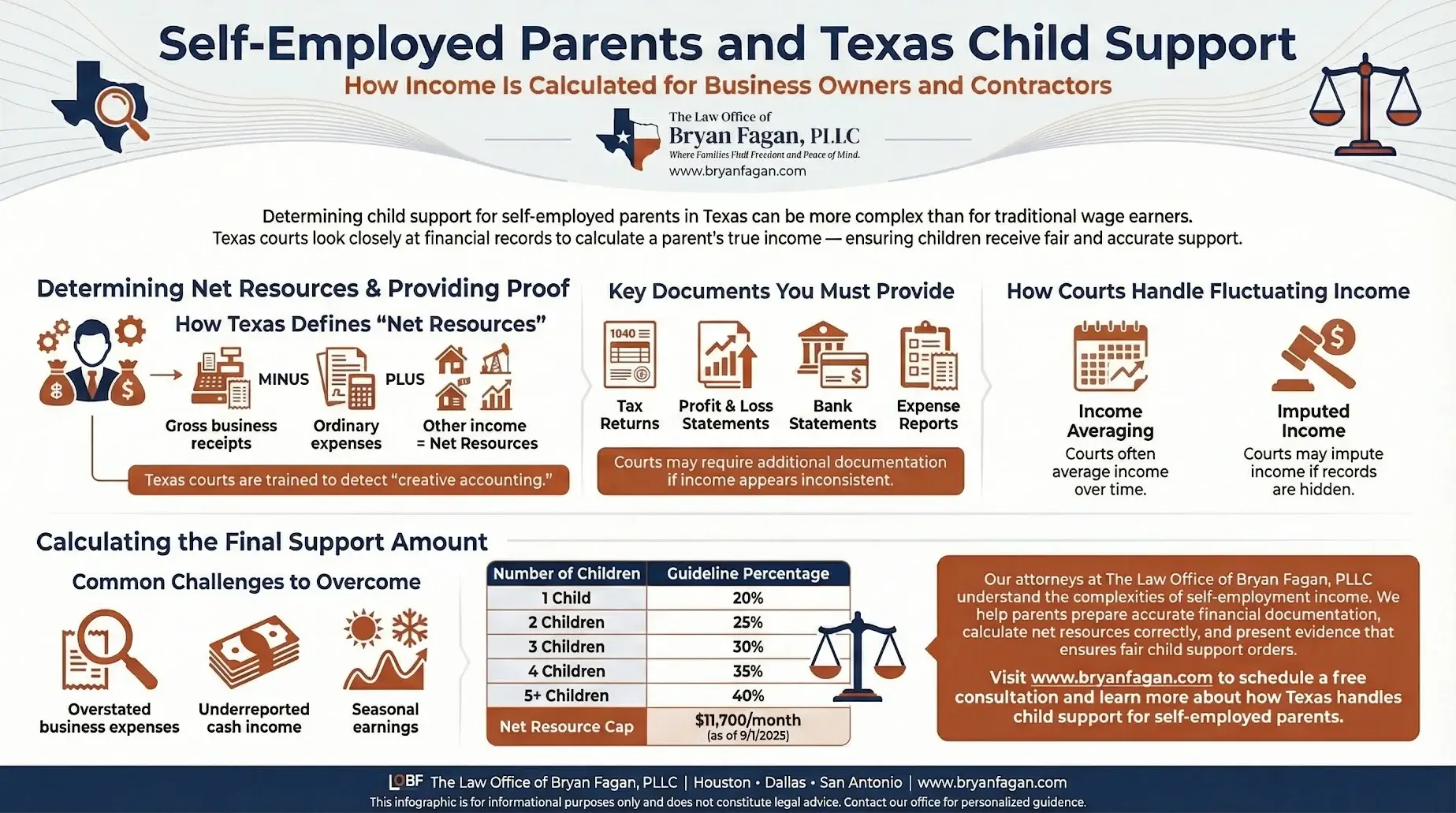

Have you ever noticed how a child’s whole world can shift the moment their parents begin navigating divorce or custody changes—grades slip, backpacks get forgotten, teachers start calling more often? For many Texas families, especially those who run their own businesses or freelance for a living, these academic struggles often collide with the financial realities of calculating Self-Employed Parents and Texas Child Support in a system that doesn’t always feel built for the unpredictability of self-employment. At The Law Office of Bryan Fagan, PLLC, we understand that every number on a worksheet represents a real child, a real home, and a parent trying to create stability during an incredibly stressful transition.
As one of Texas’s leading family law firms—founded by Bryan Joseph Fagan, a South Texas College of Law graduate and trusted authority on divorce and custody—we’ve guided thousands of parents through these moments. Our purpose, at its core, is simple: to empower families to reclaim freedom and peace of mind during life’s hardest transitions. We do that through compassionate counsel, practical education, and innovative legal solutions that simplify the complexities of Texas Family Code provisions like §153.002, which centers every decision on the best interest of the child.
In this article, you’ll learn how Texas courts evaluate income when parents are self-employed, why academic stability matters so deeply in custody decisions, and how the right legal strategy can protect both your child’s educational success and your financial future. Most importantly, you’ll feel supported, understood, and equipped with the clarity you need to move forward with confidence.
Let’s take a closer look at how to protect what matters most—your child’s stability, your peace of mind, and your family’s future.
Key Takeaways
Before diving into the details, here are the most important points every self-employed parent in Texas needs to understand about child support:
- Texas child support for self-employed parents is based on “monthly net resources,” which means gross business income minus only reasonable and necessary business expenses—not simply what appears as taxable income on your tax return.
- Courts routinely review 12 to 36 months of income, bank statements, and business documents to average out good and bad months and arrive at a stable figure that reflects your true earning capacity.
- Poor recordkeeping, suspicious write-offs, or a lifestyle that doesn’t match your reported income can lead judges to “impute” higher income based on your work history, education, and visible spending patterns.
- Both paying and receiving parents benefit from gathering thorough documentation early and working with an experienced family law attorney who understands how Texas child support calculations work for business owners and freelancers.
- Never assume that what the IRS allows as a deduction will automatically reduce your child support obligation—Texas courts apply their own standards focused on your real ability to pay.

Your Family’s Future Starts Here
Don’t navigate your legal journey alone. Schedule a consultation now and get the clarity and support you deserve.
Self-Employed Parents and Texas Child Support: The Short Answer
If you’re navigating a child support case as a business owner, contractor, or freelancer, understanding how Self-Employed Parents and Texas Child Support laws apply to you is essential. Texas does not rely on the adjusted gross income shown on your tax return. Instead, child support is calculated using “monthly net resources,” a broader and more realistic measure of your financial capacity. Under Texas Family Code §154.062, net resources include your gross business income minus only those ordinary and necessary business expenses that are truly required to produce that income.
Courts take this analysis seriously. Under §154.065, judges have wide discretion to determine what constitutes legitimate business expenses versus personal costs that have been routed through the company. This means the court won’t stop at your Schedule C or K-1. Your bank deposits, merchant processing statements, credit card activity, spending habits, and even lifestyle indicators may all be reviewed to ensure child support is based on your actual financial situation rather than what is reported to the IRS.
A key concept in Texas child support law is “actual earning ability.” If your tax return shows minimal profit but your financial records suggest a more comfortable lifestyle—such as new vehicles, significant travel, or discretionary spending—the court may conclude that your true income is higher. When documentation is incomplete or unreliable, judges can estimate income based on your education, work history, marketable skills, and what similarly situated professionals typically earn in your field.
For parents experiencing fluctuating or reduced income, especially in gig-based or seasonal industries, it may be helpful to review the firm’s resource on unemployment benefits for self-employed workers, which provides additional context on how financial changes may affect family law matters. You can also explore related guides in the firm’s online library, such as the Texas Child Support Resource Center, to better understand your rights and obligations.
As one of the most trusted family law teams in Texas, the attorneys at The Law Office of Bryan Fagan are committed to educating families and protecting futures with clarity, compassion, and deep legal experience. Whether your income is steady, seasonal, or unpredictable, the firm is here to help you move forward confidently and in full compliance with Texas child support laws.

How Texas Defines “Income” for Self-Employed Parents
Understanding what Texas considers “income” is one of the most important steps for anyone navigating Self-Employed Parents and Texas Child Support issues. Under Texas Family Code §154.062, the definition of “net resources” is intentionally broad so courts can capture a parent’s true financial capacity—not just what appears on a tax return. This matters even more after the 2025 guideline updates, which reinforce the need for accurate, transparent income reporting when determining support obligations. For many self-employed parents, multiple income streams flow through different business structures, platforms, or accounts, all of which may be included in the calculation.
Texas courts look at a wide range of income sources when determining net resources. This includes gross receipts from sole proprietorships, contract work, and gig platforms such as Uber, DoorDash, Upwork, or Etsy. Revenue from LLCs, S-corps, partnerships, and K-1 distributions is also included, even if the distribution was not taken as cash. Judges evaluate commissions, bonuses, referral fees, and 1099 payments, along with rental income, royalties, and earnings from online stores or intellectual property. Owner draws, distributions, capital gains, interest income, trust income, and even retirement benefits may also be counted. Spousal maintenance received from a prior marriage is considered as well. All of these sources are evaluated before subtracting allowable business expenses to determine net resources.
Certain income, however, is excluded under the statute—such as temporary assistance under TANF, foster care payments, and Social Security benefits received on behalf of a child. But exclusion does not mean the court ignores financial activity. Parents should never assume that deposits into their accounts will escape scrutiny. Judges frequently compare bank statements, merchant deposits, and financial habits to ensure income is accurately reported, consistent with both statutory requirements and the child’s best interest under Texas Family Code §153.002.
For parents wanting to better understand what typical support amounts look like, or how different income types affect calculation, the firm’s guide on the average amount of child support per child in Texas offers helpful insight. Additional resources and educational articles can also be found in the Texas Child Support Resource Center, which provides in-depth explanations of income, guideline percentages, and recent updates to Texas law.
As a trusted advocate for Texas families, the attorneys at The Law Office of Bryan Fagan remain committed to helping parents understand how net resources are calculated and how income from self-employment is treated, ensuring families move forward with clarity, confidence, and protection for their future.
Actual Earning Ability vs. Tax Return Numbers
One of the most common misunderstandings among parents navigating Self-Employed Parents and Texas Child Support cases is the belief that their IRS tax returns fully define their income. In reality, Texas courts use tax filings only as a starting point. Under Texas Family Code §154.062, judges are required to calculate support based on “net resources,” a broader measure that reflects a parent’s true financial capacity rather than what appears on a Schedule C or K-1. This means the court will carefully examine whether reported deductions genuinely reflect business necessity or whether they obscure income that should be considered in the child support calculation.
Take, for example, a Houston barber who reports $20,000 in net income after deducting expenses for supplies, equipment, and travel. That same parent may live in a $2,500-per-month apartment, drive a luxury vehicle, and take regular family vacations. When the lifestyle displayed does not match the income claimed, the court is permitted to question the accuracy of the reported numbers. Under Texas Family Code §154.065, judges may adjust income upward based on evidence of additional earnings, inconsistent spending, or personal expenses run through the business.
In situations like these, courts may rely on several tools to determine a parent’s actual earning ability. They may review industry-standard income for similar professions in the local market, analyze prior years’ tax returns to identify stable earning patterns, or consider testimony about cash transactions, tips, or unreported work—an issue that is especially common in service-based and gig-economy professions. When a reported income drop appears conveniently timed right before a child support proceeding, judges may treat it with skepticism and instead assess earning capacity based on historical performance.
For parents facing irregular income or financial fluctuations, reviewing helpful firm resources—such as the guide on unemployment benefits for self-employed workers—can offer additional clarity on how Texas courts evaluate financial hardship and changing income. Parents can also explore broader educational materials through the Texas Child Support Resource Center, which explains how courts apply the latest updates to the Texas Family Code.
As a trusted resource for families across Texas, the dedicated team at The Law Office of Bryan Fagan remains committed to helping self-employed parents understand the realities of child support calculations and protect their futures with confidence, accuracy, and compassionate legal guidance.

Deductible vs. Non-Deductible Business Expenses in Texas Child Support Cases
Texas only allows “ordinary and necessary” business expenses when computing self-employment income for child support purposes. This standard comes from Texas Family Code section 154.065, which gives courts discretion to determine which deductions actually reflect costs required to generate income versus expenses that primarily benefit the parent personally.
What the IRS allows for federal income tax law purposes is not always what a Texas family court will accept when determining your obligor’s net resources for child support. This distinction catches many self-employed parents off guard.
Examples of Allowable Business Deductions
Courts generally accept expenses that are directly necessary to produce income. These typically include:
- Cost of goods sold for inventory-based businesses like retail shops, online stores, or food vendors
- Reasonable office rent, utilities, and business internet or phone service necessary for operations
- Payroll and payroll taxes for legitimate employees performing work for the business
- Business insurance including general liability, professional malpractice, and workers’ compensation
- Equipment, tools, and software essential to your work, such as cameras for a photographer, roofing tools for a contractor, or design software for a graphic designer
- Reasonable vehicle expenses for documented business use, supported by mileage logs or clear allocations between personal and business driving
| Typical IRS Expense | How Court May Treat It for Child Support |
|---|---|
| Home office deduction | May accept if clearly documented and proportional |
| Vehicle depreciation | Often added back if excessive or primarily personal use |
| Meals and entertainment | Usually disallowed or reduced significantly |
| Travel expenses | Scrutinized closely; personal trips denied |
| Equipment depreciation | May add back accelerated depreciation not reflecting cash spent |
Expenses Courts May Add Back or Disallow
Some deductions reduce your taxes but do not reduce the money realistically available to support your child. Courts watch carefully for these problem expenses:
- Personal living costs run through the business, such as family vacations coded as business travel, groceries on a business credit card, or children’s sports fees paid from the company account
- Luxury vehicle payments or leases far beyond what’s needed for your type of work—a landscaper doesn’t need a $90,000 truck
- Large depreciation and accelerated write-offs that lower taxable income but don’t involve any current cash outflow
- Unusual “consulting” fees paid to relatives, friends, or shell entities without clear business justification
- Excessive entertainment deductions inconsistent with your industry norms
When a judge identifies these issues, they can add the expenses back into your income, increasing the net resources used for calculating child support payments.
Consider a Fort Worth general contractor who claimed $40,000 in truck expenses and $25,000 for “home improvements” on his tax return. At the child support hearing, the judge examined his receipts and discovered the truck was primarily used for personal errands and family trips, while the home improvements were actually renovations to his personal residence. The court added both expenses back to his income, resulting in a child support obligation significantly higher than he expected.
Documentation Required for Self-Employed Parents in Texas Child Support Cases
Documentation is often the single most important factor in determining whether a self-employed parent receives a fair child support order or an unfavorable one based on imputed income. Under Texas law and local court practice, judges and the Attorney General typically require substantially more financial records from self-employed parents than from W-2 employees.
Core Financial Documents Courts Expect
When you’re self-employed, expect the court to request at least two to three years of the following documents:
- Federal income tax returns (Form 1040) with all schedules, especially Schedule C for sole proprietors, Schedule E for rental income, and K-1 forms for partnerships, S-corps, or LLCs
- Business tax returns for your LLC, S-corporation, or partnership (Forms 1065, 1120, or 1120S)
- 1099 forms from every client, platform, or company that paid you, plus any W-2s if you also draw a salary from your own company
- Profit-and-loss statements and balance sheets for each business, ideally prepared monthly or quarterly
- Personal and business bank statements covering 12 to 24 months, showing all deposits and withdrawals
- Merchant account statements from Square, Stripe, PayPal, Venmo, Cash App, or Zelle for cashless payments
- Invoices, contracts, and receipts supporting major income transactions and expense claims
- Letters or reports from accountants or bookkeepers explaining your business structure and financial statements
Missing or inconsistent records make it far easier for the court to impute income rather than rely on your claimed numbers. If you can’t prove what you earned and spent, the judge will make assumptions—and those assumptions often favor the party with better documentation.
How Judges Use Documentation to Estimate Net Resources
When evaluating income in Self-Employed Parents and Texas Child Support cases, courts take a comprehensive approach to ensure financial accuracy and fairness for the child. Under Texas Family Code §154.062, judges must identify a parent’s “net resources,” which often requires looking far beyond tax returns. For self-employed individuals, this means the court will reconstruct income by comparing business and personal account deposits, reviewing year-over-year revenue trends, and examining spending behaviors to determine whether reported income aligns with a parent’s actual lifestyle. These methods are especially important given the 2025 updates to Texas child support guidelines, which reinforce the need for accurate financial reporting when determining support obligations.
Courts may also use patterns in cash withdrawals, merchant deposits, or irregular revenue to identify unreported income. When documentation is incomplete or inconsistent, judges have the authority under §154.065 to impute income based on the financial evidence available. This happened to one Cypress home-based business owner whose inconsistent bookkeeping created significant discrepancies between her tax returns and her bank deposits. Unable to provide clear explanations for the gaps, she saw her child support obligation calculated using the higher deposit amounts rather than her reported income—an outcome that surprised her but reflected the court’s responsibility to ensure financial transparency in support cases.
To avoid this kind of situation, it is essential to work with a knowledgeable Texas family law attorney early in the process. Organizing receipts, maintaining accurate financial statements, and documenting legitimate expenses help parents demonstrate reliability and avoid the appearance of hiding income. For additional guidance on best practices for financial documentation, parents can review resources such as the firm’s article on what to do as a self-employed taxpayer, which offers practical steps for staying compliant and prepared. You may also find helpful information within the firm’s broader Texas Child Support Resource Center, which covers income verification, guideline changes, and evolving expectations for self-employed parents.
As a trusted advocate for Texas families, the legal team at The Law Office of Bryan Fagan remains committed to helping parents protect their futures by ensuring their financial story is presented clearly, accurately, and in accordance with Texas law.

How Texas Courts Handle Fluctuating or Inconsistent Self-Employment Income
Many Texas parents—contractors, oilfield workers, real estate agents, online sellers, and seasonal business owners—have income that swings dramatically from month to month or year to year. Courts recognize this reality and aim to avoid basing child support on a single unusually good or bad month.
Averaging Income Over Time
When self employment income varies significantly, judges typically average your earnings over 12, 24, or even 36 months to calculate a stable monthly net resource figure. This approach smooths out the highs and lows to arrive at a number that reflects your true earning capacity.
For example:
- A real estate agent who earns large commissions on a few sales per year might have the court average her income over 24 months, capturing both strong and slow periods
- An oilfield consultant whose income crashed during the 2020 downturn but rebounded by 2022 might see the court use a multi-year average rather than relying solely on the most recent year
Texas Family Code section 154.066 addresses intentional unemployment or underemployment, which becomes relevant if the court believes your income fluctuations are partly voluntary or designed to reduce your child support obligation.
Imputing Income Based on Capacity and Lifestyle
Sometimes a court concludes that your reported income simply doesn’t reflect what you’re capable of earning. When this happens, the judge may “impute” income—essentially saying, “Based on your background and circumstances, I believe you can earn X amount each month, even if you’re not currently earning it.”
Factors courts consider when imputing income include:
- Past earnings over several years of work history
- Education, licenses, and professional skills that indicate earning potential
- Evidence of voluntary reduction in work or turning down jobs to lower child support
- Lifestyle inconsistencies such as a new boat, private school tuition for other children, frequent travel, or a home that doesn’t match reported income
Consider a Katy contractor who reported drastically lower income right after his divorce case began. His bank statements showed a sudden drop in deposits, but his Facebook page featured photos of a new fishing boat and a family trip to Colorado. The court imputed income based on his previous two-year average, concluding that the income drop was strategic rather than genuine.
When a Self-Employed Parent Is Hiding or Underreporting Income
One of the most common concerns for receiving parents is that the self-employed parent’s business operates as a “black box” where true income is impossible to verify. Texas judges see these patterns regularly and have developed tools to uncover hidden resources.
Common Red Flags Courts Look For
Judges watch for specific warning signs that suggest a parent may be underreporting self employment income:
- Sudden sharp drop in reported income immediately before or during divorce or child support litigation
- High personal expenses like rent, vehicles, vacations, or children’s activities paid directly from business accounts
- All-cash businesses with minimal deposit history despite visible activity—busy restaurants, barbershops, mechanic shops, or landscaping companies
- Conveniently missing invoices, receipts, or years of tax returns
- Unusually large business deductions that seem inconsistent with industry norms or the nature of the business
These red flags trigger closer scrutiny and may lead to discovery requests, forensic analysis, or testimony from financial experts.
Legal Tools to Uncover True Income
When one parent suspects the other is hiding income, Texas law provides several procedural tools:
- Written discovery including requests for production of documents and interrogatories demanding complete business and personal financial records
- Subpoenas to banks, credit card companies, payment processors, and clients or employers who paid the self-employed parent
- Depositions where the self-employed parent, their bookkeeper, or their CPA testifies under oath about the business’s true financial condition
- Forensic accountants who reconstruct income from deposit patterns, cash flow analysis, and spending patterns
If a court finds intentional underreporting, consequences can be severe:
- Higher child support based on reconstructed income
- Back child support (arrears) with 6% annual interest under the Texas Family Code
- Enforcement actions including license suspension, passport holds, bank levies, and contempt of court
Modifying Texas Child Support for Self-Employed Parents
Self-employment income can change quickly—a major client leaves, the economy shifts, or your business suddenly takes off. These swings make modifications especially important for business owners and freelancers who may need to adjust their child support order as circumstances change.
Texas Family Code section 156.401 governs modifications of child support orders and establishes the requirements for requesting a change.
When You Can Ask to Modify Support
There are two main paths to modification:
- Material and substantial change in circumstances, such as a significant income drop or increase, serious illness or disability, or major changes in custody arrangements
- The “3-year / 20% / $100 rule”: At least three years have passed since the last order, and applying current guidelines would result in a monthly amount that differs by 20% or at least $100 from the existing order
Examples relevant to self-employed parents include:
- A Houston food truck owner loses her primary location and sees revenue drop 40% for over a year
- An online seller’s business grows from $60,000 net to $150,000 net, making the old child support amount far too low
- A parent becomes disabled and can no longer work full-time in their trade
- A custody change means one parent now has the children significantly more time
Critical warning: Never simply stop paying or reduce your child support payments on your own, even if your income has genuinely dropped. You must file a motion with the court and obtain a modified support order. Until the court changes the order, the original amount remains legally binding.
Evidence Needed for a Successful Modification
When income changes significantly—as is often the case for business owners, freelancers, and gig-economy earners—understanding how modifications work in Self-Employed Parents and Texas Child Support cases becomes essential. Texas law allows a parent to request a modification when there has been a “material and substantial change in circumstances,” as outlined in Texas Family Code §156.401. To support this kind of request, courts expect clear, well-organized documentation that demonstrates how your financial situation has shifted over time and why the change is genuine rather than temporary or strategic.
Parents seeking a modification should gather updated tax returns, profit-and-loss statements, and several months of business and personal bank statements that show reduced or increased revenue. Merchant processor records—such as payments from Square, Stripe, or PayPal—can also provide powerful evidence of actual income trends. If a health condition limits your ability to work, medical records can help establish how that impacts your earning capacity. Additionally, any new custody orders or changes in possession schedules should be included, since they may affect the child support calculation under the updated guidelines that took effect in 2025.
Texas courts are cautious when reviewing sudden income drops, especially if they appear right before a hearing. Judges look for consistent, sustained changes over multiple months before determining whether a modification is justified. This protection ensures that both the child’s needs and each parent’s financial reality are balanced fairly. For parents concerned about how these standards apply to their situation, the firm’s resource on how a Southlake child support lawyer can protect your financial future offers additional insight into navigating income fluctuations and legal expectations.
Families seeking more information can also explore the detailed guides available in the Texas Child Support Resource Center, which covers child support calculations, modifications, and enforcement considerations. As a trusted advocate for Texas families, the attorneys at The Law Office of Bryan Fagan remain committed to helping parents present strong, well-documented cases that protect their children and their financial futures.

Mistakes Self-Employed Parents Commonly Make in Texas Child Support Cases
Many self-employed parents don’t intentionally do anything wrong—they simply don’t understand how Texas child support income rules differ from tax rules or what courts expect.
Financial and Recordkeeping Pitfalls
Common errors include:
- Mixing business and personal expenses in the same bank account, making it impossible to cleanly separate legitimate business costs from personal spending
- Failing to keep detailed receipts or mileage logs, forcing the court to guess at what is legitimate—and guessing rarely favors the disorganized party
- Not reporting cash income from tips, side jobs, or unrecorded sales, which can lead to imputed income if deposits don’t match reported revenue
- Assuming IRS deductions equal child support deductions, when in fact courts routinely disallow expenses that are perfectly legal for tax purposes
Each of these mistakes increases the likelihood of a higher imputed income number and damages your credibility with the judge.
Legal and Strategic Missteps
Beyond recordkeeping, self-employed parents frequently make legal mistakes:
- Waiting too long to request a modification after a major business downturn, allowing arrears to accumulate
- Quitting or drastically cutting back work out of frustration with the child support process, which courts may view as voluntary underemployment
- Reaching a “handshake deal” with the other parent to pay more or less than the court order requires, without getting it signed and approved by the court—these informal agreements aren’t enforceable and can lead to enforcement problems
- Ignoring enforcement letters from the Texas Attorney General or court notices until license suspension or contempt proceedings are already underway
Consequences under the Texas Family Code include arrears with 6% interest, driver’s license and professional license suspension, passport holds, bank levies on personal and business accounts, and even jail time for contempt.
Why Legal Representation Is Essential for Self-Employed Parents
Texas child support cases often become far more complicated when a parent is self-employed, managing multiple revenue streams, or relying on business deductions that don’t neatly translate into personal income. For families navigating Self-Employed Parents and Texas Child Support situations, this complexity can feel overwhelming without knowledgeable legal guidance. Because courts must calculate support based on “net resources” as defined in Texas Family Code §154.062, even small misunderstandings in financial documentation can lead to inaccurate child support amounts. The 2025 updates to the Texas Family Code further emphasize transparency, accurate income reporting, and careful evaluation of business expenses—making it more important than ever to have experienced advocates on your side.
This is where working with a seasoned Texas family law attorney becomes invaluable. A legal team familiar with self-employment cases can review your business and tax records to ensure your income is calculated fairly and accurately, rather than inflated by disallowed deductions or assumptions about lifestyle. Attorneys from the firm can identify which expenses align with §154.065 guidelines, prepare clear explanations for gray areas, and collaborate with CPAs or forensic accountants when deeper investigation is necessary. These steps help present a complete and credible financial picture that withstands scrutiny in court.
An experienced attorney can also challenge the other parent’s claimed income if it appears inconsistent with their spending habits or business activity—an issue that arises frequently in cases involving cash-heavy or gig-based industries. Skilled negotiation is equally important. With legal support, parents can pursue temporary and final orders that reflect realistic and sustainable payment amounts for their household. And when enforcement or modification hearings arise, having an advocate who understands the nuances of self-employment is critical to preventing unfair imputed income or overly burdensome obligations.
For parents who may be interacting with the Texas Office of the Attorney General, additional support is available in the firm’s guide on how the OAG handles child support cases, which offers insight into the agency’s role, limitations, and procedures. Families can also learn more about income calculation, enforcement, and financial documentation through the Texas Child Support Resource Center, a comprehensive library maintained to help parents make informed decisions.
Across Houston and the surrounding regions, the attorneys at The Law Office of Bryan Fagan have earned a reputation for helping entrepreneurs, contractors, gig workers, and business owners protect their children and their financial futures. By combining practical legal strategy with compassionate, personalized support, the firm remains committed to guiding Texas families through even the most complex child support challenges with clarity and confidence.

The Law Office of Bryan Fagan PLLC Golden Circle: Why, How, and What
Understanding our firm’s approach is essential for parents navigating Self-Employed Parents and Texas Child Support matters, especially when income varies, business expenses complicate financial records, or multiple revenue streams make the calculation of net resources more complex. At The Law Office of Bryan Fagan, PLLC, our mission has always been to educate families and protect futures. That mission is reflected in every child support case we handle, particularly those involving self-employment—cases that require both legal precision and meaningful compassion.
Why we do this work is simple: Texas children deserve support orders that reflect their parents’ true financial abilities while honoring the financial stability of both households. When support orders accurately represent “net resources” as defined under Texas Family Code §154.062, families experience fewer disputes, more predictability, and far greater peace of mind. Fair and accurate calculations reduce conflict and help parents remain focused on raising their children rather than repeatedly returning to court. Updated Texas guidelines—including the 2025 cap adjustments—reinforce the importance of clarity and transparency in these determinations.
How we serve self-employed parents and their families begins with listening. No two businesses look alike, and no two income patterns tell the same story. Our team takes time to understand your business structure, revenue fluctuations, deductible expenses under §154.065, and long-term financial goals. We break down complex financial concepts and Texas Family Code provisions into plain, actionable guidance so you understand each step of the process. When a case involves layered business structures—LLCs, S-corps, partnerships, or gig-based income—we collaborate with CPAs and forensic professionals to ensure your financial picture is presented clearly, accurately, and persuasively in court.
What we offer in Texas child support cases extends beyond legal paperwork. For families dealing with the unique challenges of self-employment, our services include establishing initial child support orders, modifying outdated orders when income changes materially, and enforcing existing orders when hidden income or inconsistent reporting becomes an issue. We also provide personalized strategy sessions and free initial consultations so parents can understand their options before making decisions that affect their children. For a deeper understanding of how Texas calculates support obligations, parents can review our comprehensive Texas Child Support Guide, a resource designed to help families navigate both legal requirements and financial realities.
Across Houston and throughout Texas, the attorneys at the firm remain committed to helping parents move forward with clarity, confidence, and a strong foundation of legal and financial knowledge. By blending compassionate advocacy with a deep understanding of Texas child support laws, we help families build a future that protects their children and their peace of mind.
Actionable Checklist for Self-Employed Parents Facing Texas Child Support
Use this checklist to prepare for your child support case:
- [ ] Gather at least 2–3 years of personal and business tax returns, including all schedules (Schedule C, Schedule E, K-1 forms)
- [ ] Print or download 12–24 months of personal and business bank statements, plus statements from merchant processors (Square, Stripe, PayPal, Venmo)
- [ ] Prepare basic profit-and-loss statements and a complete list of recurring business expenses with supporting documentation
- [ ] Separate business and personal accounts immediately if they’re currently mixed, and start tracking business mileage and keeping receipts
- [ ] Make a comprehensive list of all income sources—contracts, platforms, rental units, side gigs—even if some involve cash
- [ ] Review the Texas child support guidelines using the Attorney General’s online calculator to get a rough estimate, keeping in mind this may not fully account for self-employment complexity
- [ ] Schedule a free consultation with The Law Office of Bryan Fagan PLLC to review your documents before you file or attend a hearing
Conclusion: Moving Forward With Confidence
Navigating child support, custody questions, or the everyday realities of co-parenting can feel overwhelming—especially when self-employment adds new layers of uncertainty. But here’s the truth: you’re not expected to figure all of this out alone. The biggest takeaway from everything you’ve read is that clarity, stability, and a plan tailored to your family’s needs can make an enormous difference, not just legally, but in your child’s emotional and academic well-being.
At The Law Office of Bryan Fagan, PLLC, our role is to stand with you during these transitions—to educate, to guide, and to help protect what matters most as you move forward. Whether you’re trying to understand how Texas calculates income for self-employed parents or you’re working to support a child who’s adjusting to big changes at home, having an experienced Texas family law attorney in your corner can turn a stressful process into a more manageable, even empowering one.
If you’re feeling the weight of next steps, consider this a gentle nudge: reach out, ask your questions, and get the personalized guidance your family deserves. And as you keep making decisions for your children’s future, don’t forget to give yourself a bit of grace. Parenting through transition isn’t easy—but with the right support, it becomes a path toward peace, stability, and a stronger tomorrow.
Whenever you’re ready, we’re here to help you take that next step with confidence.
Frequently Asked Questions
Texas calculates child support for self-employed parents based on “net resources,” not just what appears on a tax return. Courts look at gross business income and subtract only reasonable and necessary business expenses to determine true earning capacity. Judges usually review tax returns, bank statements, 1099s, and lifestyle patterns to confirm accuracy. Because self-employment income often fluctuates, they may average 12 to 36 months of financial records to create a fair monthly figure.
If you’re self-employed, the court expects detailed documentation. You may need tax returns, profit-and-loss statements, and personal and business bank statements. After determining your average monthly income, the court applies Texas guideline percentages. Clear, organized records can help prevent misunderstandings and protect you from inflated support calculations.
Yes. Even though taxes aren’t withheld from 1099 income, the court can still issue an income withholding order. Companies paying you can be directed to withhold child support, and the Attorney General can enforce payment through bank levies, liens, and license suspensions if support is not paid consistently.
When you own a business, the court looks beyond your paycheck. It may consider your salary, owner draws, distributions, business-paid personal expenses, or even retained earnings if they appear to suppress income artificially. Personal expenses run through the business can be added back to your resources for child support purposes.
In 2025, Texas raises the cap on net monthly resources used for guideline calculations to $11,700. This means parents with higher incomes may owe more support because the guideline percentages—such as 20% for one child—can be applied to a larger income base.
A weekly income of $1,000 translates to roughly $4,333 a month before deductions. Texas calculates support based on net resources after taxes and certain allowable expenses. Once net income is determined, guideline percentages apply. Because every situation is different, an attorney or the Attorney General’s calculator can help estimate your exact amount.
The best proof includes organized records: tax returns, 1099s, P&L statements, and several months of personal and business bank statements. Merchant processor statements (Square, Stripe, PayPal, Zelle) are also important. Keeping business and personal finances separate makes it much easier to show accurate income and prevent imputed earnings.
One of the most damaging mistakes is prioritizing conflict over the child’s best interest. Texas courts under Family Code §153.002 look closely at which parent promotes stability, supports the child’s relationship with the other parent, and maintains consistent involvement in school and medical needs. Negative behavior—like badmouthing the other parent or ignoring school responsibilities—can seriously hurt a case.
If a father is unemployed, the court may still order child support. Judges can base support on past earnings, job skills, or at least full-time work at minimum wage if they believe a parent can work but isn’t doing so. When unemployment is truly involuntary, the court may consider this, but the parent must request a modification; unpaid support continues to accrue with interest until the order is changed.