
Have you ever sat at your kitchen table after the kids are asleep, staring at a stack of bills and wondering how you’re supposed to rebuild a life that suddenly looks nothing like the one you planned? For many Texas parents navigating divorce, that moment hits hard—the mix of uncertainty, fear, and the hope that somehow everything will settle into something stable again. It’s often during these quiet, overwhelming moments that understanding How Does Texas Determine Child Support Payment Amounts for Different Income Levels becomes essential to finding clarity and reclaiming peace of mind.
At The Law Office of Bryan Fagan, PLLC, we’ve walked beside countless parents who are trying to balance new household budgets, shifting routines, and the emotional strain of major life change. Texas law may feel intimidating, but its structure provides predictability during the chaos, using clear guidelines and statutory principles—like the best-interest standard in Texas Family Code §153.002—to ensure children remain supported even when family circumstances shift. Knowing how child support is calculated empowers you to make informed decisions, negotiate confidently, and avoid financial surprises.
Led by Bryan Joseph Fagan, a South Texas College of Law graduate and trusted authority in Texas family law, our firm exists to help people navigate these transitions with compassion, education, and innovative legal solutions that simplify the complex. Everything we do reflects our core belief: families deserve stability, clarity, and the freedom to move forward with confidence.
In this guide, you’ll discover how Texas determines child support at different income levels, how those calculations impact daily life, and how our team helps families rebuild with strength and peace of mind. Let’s walk through this together—one clear, empowering step at a time.
Key Takeaways
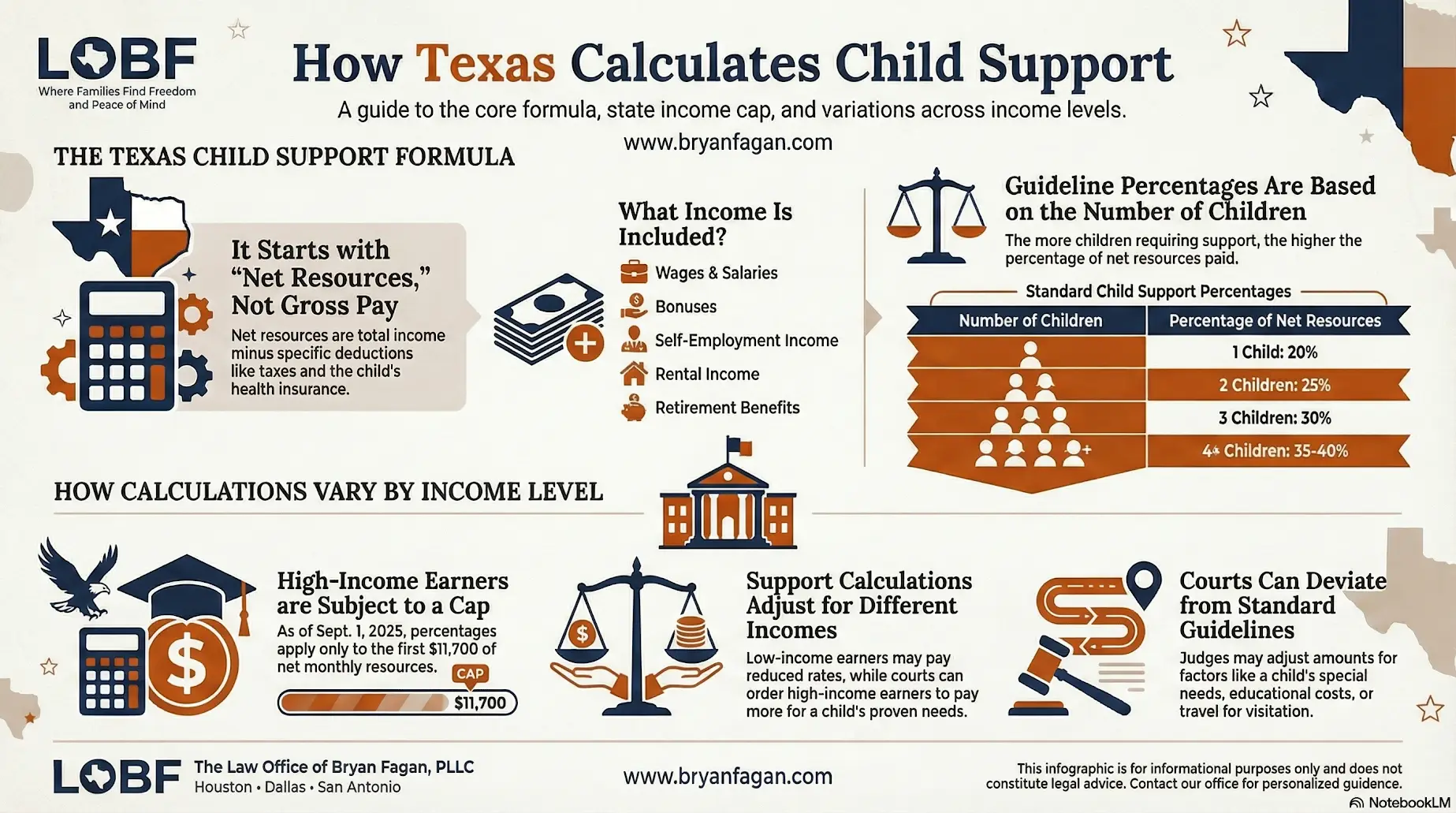
- Texas calculates child support based on a parent’s net resources, not gross income, using guideline percentages tied to the number of children.
- The 2025 Texas update increased the child support cap from $9,200 to $11,700 in net monthly resources, impacting higher-income support calculations.
- Income used in child support includes wages, bonuses, commissions, self-employment earnings, rental income, retirement income, and certain benefits.
- Even with high incomes, guideline percentages only apply to the first $11,700, but courts may order more if a child’s proven needs justify it.
- Guideline percentages are typically 20% for one child, 25% for two, 30% for three, and increase with additional children.
- Support amounts can be modified if there is a material and substantial change in circumstances or if the three-year review rule applies.
- Child support does not automatically increase with income—a modification request must be filed to adjust the order.
- Courts may impute income if a parent is intentionally unemployed or underemployed.
- Child support usually ends when a child turns 18 or graduates high school, whichever comes later, but may continue for adult children with disabilities.
- Working with an experienced Texas family law attorney helps ensure accurate calculations, enforceable orders, and fair results that protect the child’s best interests.

Your Family’s Future Starts Here
Don’t navigate your legal journey alone. Schedule a consultation now and get the clarity and support you deserve.
How Texas Calculates Child Support Based on Income Levels
When parents start exploring How Does Texas Determine Child Support Payment Amounts for Different Income Levels, one of the first things they notice is that Texas does not apply a flat percentage to every family. Instead, Texas Family Code §154.125 creates an income-tiered system that reflects the financial realities of both lower-income and higher-income households. This approach recognizes that a parent earning $800 per month faces different challenges than one earning $8,000, and it ensures that support obligations remain fair while still protecting the child’s best interests under §153.002.
The three-tier structure is central to understanding how guideline amounts are calculated. Low-income guidelines apply when monthly net resources are below $1,000. Standard guidelines cover resources between $1,000 and the updated $11,700 cap, a historic increase from the previous $9,200 limit that took effect in 2025. Anything above the $11,700 threshold falls into the high-income category, where guideline percentages apply only to the capped amount unless a child’s proven needs justify more support under Texas Family Code §154.126. These tiers create predictability while also allowing courts flexibility when a child requires additional resources.
Regardless of income tier, Texas applies consistent guideline percentages: 20% for one child, 25% for two, 30% for three, 35% for four, and 40% for five or more. What varies is how these percentages are applied to a parent’s “net resources,” a term defined by Texas Family Code §154.062. To help parents understand what counts as income—and what does not—the firm offers a detailed breakdown in this net resources guide. Accurately determining net resources is essential because it dictates which income tier applies and prevents miscalculations that could unfairly increase or decrease support obligations.
For parents who want a deeper look at guideline ranges and how Texas courts apply them in real-world cases, the attorneys at the Law Office of Bryan Fagan provide additional tools such as the firm’s Texas Child Support Information Center. By offering clear education and compassionate, practical guidance, the firm remains committed to helping families understand their rights, anticipate their responsibilities, and move forward with confidence and stability.
Understanding Net Resources vs. Gross Income
Many parents are surprised to learn that How Does Texas Determine Child Support Payment Amounts for Different Income Levels is based not on take-home pay but on “net resources,” a term defined in Texas Family Code §154.062. This statute forms the backbone of every guideline child support calculation in Texas, and understanding it is essential—especially with the recent updates outlined in this 2025 guideline resource.
Under §154.062(b), Texas considers nearly all recurring income as part of a parent’s gross resources. This includes wages, salary, overtime, commissions, bonuses, self-employment income (after reasonable business expenses), severance, retirement income, Social Security benefits, unemployment, disability income, rental profits, royalties, dividends, interest, and capital gains. In short, if money consistently comes into your household, Texas law will likely count it as income for determining support.
Once gross income is identified, the court applies specific deductions outlined in §154.062(d). These include federal income tax, Social Security or Medicare taxes, mandatory retirement contributions, union dues, and the cost of health insurance or medical support for the child. Personal financial decisions—such as voluntary retirement contributions, life insurance premiums, or credit card payments—cannot reduce net resources, even if they significantly impact a parent’s monthly budget.
A practical example helps illustrate the calculation. A parent earning $5,000 in gross monthly income may have net resources of approximately $3,800 after required deductions such as federal taxes, Social Security, and the child’s health insurance premium. It is this $3,800—not the original $5,000—that Texas uses when applying the guideline percentages in §154.125, including the updated 2025 income cap now in effect.
For families wanting additional clarity, the attorneys at the Law Office of Bryan Fagan offer educational tools such as the firm’s Texas child support resource page. By breaking down complex financial rules into practical guidance, the firm remains committed to protecting futures, empowering parents, and helping families navigate child support obligations with confidence and compassion.

Low-Income Child Support Guidelines (Under $1,000 Monthly Net Resources)
When parents begin learning How Does Texas Determine Child Support Payment Amounts for Different Income Levels, one of the most important distinctions to understand is how Texas treats low-income cases. Texas Family Code §154.125 acknowledges that parents with monthly net resources below $1,000 face significantly different financial realities than higher-earning parents. Instead of applying standard guideline percentages that could create unmanageable obligations, Texas uses low-income guidelines designed to protect a parent’s basic living needs while still ensuring that children receive meaningful financial support.
For parents in this income bracket, the law applies stepped-down percentages that better reflect their financial capacity. This structure recognizes that someone earning $900 per month cannot reasonably contribute the same percentage of their income as someone earning $3,000 or more. These reduced guidelines create a balanced approach—supporting the child while avoiding unrealistic burdens on the parent. For a deeper look at how these percentages are calculated, the firm provides a detailed breakdown in this comprehensive guide to the Texas child support formula.
A practical example helps illustrate how the law works. A parent with $900 in monthly net resources and two children would pay approximately $180 under the low-income formula. Although the standard percentage for two children is typically 25%, low-income guidelines apply a 20% rate instead to prevent the parent from falling below subsistence level. This ensures that child support remains fair, stable, and consistent with the parent’s actual ability to contribute, while still fulfilling the statutory requirement to support their children under Texas Family Code §154.001.
Texas Family Code §154.127 further provides protections for low-income parents when children age out of support. The statute helps ensure that when one child reaches adulthood or graduates from high school, the transition to a new support amount does not create sudden financial hardship for the paying parent or disrupt stability for the remaining minor children. Parents interested in exploring how these transitions work or whether they may qualify for a modification can visit the firm’s Texas Child Support Resource Center for additional guidance.
By helping families understand how low-income guidelines function within the broader support system, the Law Office of Bryan Fagan continues its mission of educating families and protecting futures. These tailored guidelines ensure that support obligations remain both fair and humane, giving parents a clearer path forward during an already challenging season of life.
Standard Income Child Support Calculations ($1,000 – $11,700 Monthly Net Resources)
Most Texas child support cases fall within the standard guidelines covering monthly net resources from $1,000 to $11,700. These cases apply the familiar percentage rates: 20% for one child, 25% for two children, 30% for three children, 35% for four children, and 40% for five children or more.
Consider a middle-income parent with $4,000 monthly net resources and two children. Their monthly child support obligation equals 25% of $4,000, resulting in $1,000 monthly child support payments. This calculation assumes the parent paying child support has no other children to support in different households and that the custodial parent has primary custody.
Medical support and dental support factor into these calculations as additional obligations beyond guideline child support. The noncustodial parent typically maintains health insurance coverage for the children and may also be ordered to pay cash medical support or contribute to uninsured medical expenses. Dental insurance and orthodontic care often create separate obligations that supplement basic child support amounts.
Courts may deviate from standard guidelines when evidence demonstrates that the child’s best interests require different amounts. Factors include the child’s special needs, educational expenses, extracurricular activities, travel costs for visitation, and either parent’s unusual financial circumstances. However, guideline amounts remain the presumptive starting point for most cases.
High-Income Child Support Considerations (Above $11,700 Monthly Net Resources)
When monthly net resources exceed $11,700, Texas child support calculations become more nuanced. The standard percentages apply only to the first $11,700 in net resources, creating a ceiling on automatic guideline child support. This child support cap recognizes that extremely high earners might otherwise face disproportionate obligations.
The $11,700 monthly cap increased from $9,200 effective September 1, 2025, affecting thousands of Texas families. This change means guideline child support for high earners increased substantially. For example, a parent with one child now pays 20% of $11,700 ($2,340 monthly) rather than 20% of $9,200 ($1,840 monthly) under the previous cap.
For a parent earning $15,000 monthly net resources with three children, the calculation works as follows: 30% applies only to the first $11,700, resulting in $3,510 monthly guideline child support. The remaining $3,300 in monthly income doesn’t automatically generate additional child support obligations unless the custodial parent proves the child’s specific needs justify support above guideline amounts.
Courts may order support above the cap when evidence demonstrates the child’s proven needs exceed guideline amounts. Private school tuition, special medical needs, extensive extracurricular activities, international travel for visitation, and maintaining the child’s accustomed standard of living can justify higher support. However, the burden falls on the parent seeking additional support to present compelling evidence of these enhanced needs.
Sample Calculations for Different Income Levels
Understanding How Does Texas Determine Child Support Payment Amounts for Different Income Levels becomes much easier when parents can see how Texas Family Code §154.062 (net resources) and §154.125 (guideline percentages) operate in real-life financial situations. These examples reflect the latest 2025 updates to the Texas Family Code, including the increased cap on net monthly resources. For parents wanting an even deeper comparison of real-world obligations, the firm’s guide on average child support for one child in Texas offers additional insight into how these numbers play out across the state.
Consider a low-income scenario. A parent earning $1,200 in gross monthly income may end up with approximately $800 in net resources after deducting federal income tax, Social Security, and other mandatory expenses permitted under §154.062(d). Under Texas low-income guidelines, which are designed to avoid pushing vulnerable parents below subsistence levels, that parent would pay around 20% of their net resources—approximately $160 each month for one child. This ensures financial support for the child while still allowing the parent to meet basic living needs.
A middle-income example highlights how standard guideline percentages apply for most Texas families. A parent with $5,000 in gross monthly income might have net resources of about $3,500 after subtracting taxes, insurance premiums, and other authorized deductions. Under §154.125, the guideline amount for two children is 25%, resulting in a monthly support obligation of $875. Resources like the firm’s Texas child support page help parents understand how these calculations apply to their own financial landscape.
Texas law treats high-income cases differently because of the statutory cap on net resources. With gross monthly income of $18,000, a parent may still have approximately $13,000 in net resources after allowable deductions. However, because the 2025 updated cap is $11,700, guideline percentages apply only to that capped amount. For three children, this means support is calculated at 30% of $11,700—resulting in a guideline payment of $3,510. Any request to exceed this amount must be supported by evidence of the children’s proven needs, as required under §154.126.
These scenarios show how Texas uses consistent percentage guidelines while adjusting for different income levels to maintain fairness and predictability. By understanding how net resources, statutory caps, and guideline percentages work together, parents can better anticipate their financial responsibilities and make informed decisions for their children. As always, the child-focused legal team at the Law Office of Bryan Fagan is committed to helping families navigate these calculations with clarity, compassion, and confidence.
When Income Changes Trigger Modification Eligibility
Income fluctuations frequently create situations where existing child support orders no longer reflect current financial realities. Texas law provides specific standards for when these changes justify modifying child support amounts, but timing and documentation prove crucial for successful modifications.
The “material and substantial change” standard under Texas law encompasses significant shifts in either parent’s income, the child’s needs, custody arrangements, or other circumstances affecting the child’s best interests. However, Texas also provides more specific modification triggers: when recalculated child support differs from the current order by either 20% or $100 monthly, whichever is less.
For example, if your current order requires $1,000 monthly child support but recalculation based on current income yields $1,250 monthly, the $250 increase exceeds the 20% threshold ($200), making modification likely. Similarly, if recalculation shows $850 monthly support, the $150 decrease exceeds both the $100 and 20% thresholds, supporting downward modification.
The critical timing factor cannot be overstated: modifications are never retroactive to before the filing date of the modification petition. This means parents who experience income drops but delay filing continue owing the full ordered amount, potentially creating substantial arrears. Conversely, custodial parents whose ex-spouses receive raises lose months or years of higher support by delaying modification requests.
Smart parents monitor their situations and act quickly when substantial changes occur. Job promotions, layoffs, disability, business success or failure, and other major income shifts warrant immediate evaluation for potential modification eligibility.
How a Child Support Attorney Helps with Income-Based Calculations
Navigating Texas child support calculations requires precision and legal expertise that extends far beyond simple percentage mathematics. Child support attorneys provide essential services across multiple phases of the process, from initial calculations through complex modifications and enforcement actions.
Accurate Net Resource Calculation
Determining net monthly resources involves more complexity than most parents anticipate. Attorneys ensure all income sources are properly identified and calculated, including wages, bonuses, self employment income, rental properties, investment returns, and other financial streams that might be overlooked or undervalued.
For self-employed parents, attorneys help document legitimate business expenses while preventing artificial income reduction through questionable deductions. They understand which business expenses courts typically accept and which appear suspiciously personal. This expertise protects honest business owners while preventing gaming of the system.
Variable income earners like sales professionals, contractors, and seasonal workers benefit from attorney assistance in establishing fair average income calculations. Rather than using one unusually high or low year, experienced attorneys develop multi-year analyses that reflect true earning capacity and seasonal variations.
Negotiating Fair Support for High-Income or Variable-Income Cases
When monthly net resources exceed the $11,700 cap, strategic negotiation becomes essential. Attorneys representing custodial parents build compelling cases for support above guideline amounts by documenting children’s actual needs, educational expenses, medical requirements, and lifestyle factors.
Conversely, attorneys representing high-income noncustodial parents ensure that requests for above-guideline support are truly justified by children’s proven needs rather than custodial parents’ desired lifestyle upgrades. They challenge unsupported claims and negotiate reasonable settlements that serve children’s interests without creating excessive burdens.
Variable income cases require specialized handling. Attorneys structure orders that include base amounts plus percentage shares of bonuses, commissions, or seasonal income. These arrangements provide stability for children while ensuring support reflects actual earning capacity during high-income periods.
Filing for Modifications When Income Changes
Prompt modification filing protects clients from retroactive payment issues while ensuring support amounts remain appropriate for current circumstances. Attorneys evaluate whether income changes meet modification standards, gather necessary documentation, and file petitions quickly to establish the earliest possible effective dates.
They also handle complex discovery processes when former spouses dispute income changes. This might involve subpoenaing employment records, bank statements, business documents, or other financial information to establish accurate current income levels.
Ensuring Texas Family Code Compliance
Child support laws evolve through legislative changes, appellate court decisions, and regulatory updates. Attorneys stay current with these developments, ensuring their clients’ orders comply with current requirements and take advantage of beneficial changes like the 2025 cap increase.
They also ensure proper application of special provisions like multiple family adjustments when parents support children in different households, medical support requirements, and other statutory obligations that supplement basic child support payments.
About the Law Office of Bryan Fagan PLLC
Families navigating How Does Texas Determine Child Support Payment Amounts for Different Income Levels deserve clear guidance and compassionate support, and that is exactly what the team at the Law Office of Bryan Fagan strives to provide. Our firm is deeply committed to protecting Texas families by ensuring that every child support calculation—whether under low-income guidelines, standard guideline ranges, or high-income cases exceeding statutory caps—reflects both the child’s needs and the parent’s financial reality. Texas Family Code §§154.062, 154.125, and 154.126 form the backbone of these calculations, and our attorneys stay current on all legislative changes, including the updated 2025 child support caps, so families receive legally accurate and practical advice.
Because modern family finances often involve more than just a single paycheck, our attorneys are experienced in handling cases that require advanced financial analysis. We routinely guide parents through issues involving self-employment income, business ownership, fluctuating commissions or bonuses, multi-state or international income sources, and situations where courts may need to determine whether support above guideline amounts is necessary under Texas Family Code §154.126. For parents who want to explore these concepts further, we offer an in-depth overview through our Texas child support guide.
Our mission extends far beyond courtroom advocacy. We believe that informed parents make better long-term decisions for their families, whether negotiating a workable child support agreement, planning a post-divorce budget, or evaluating whether a modification is warranted under Texas Family Code §156.401. That is why we devote significant time to educating families about their rights and obligations under Texas law and providing clear explanations of how guideline calculations apply to their unique circumstances.
Every parent deserves a child support order that is fair, accurate, and aligned with the realities of their financial situation. From negotiation and mediation to litigation when necessary, the attorneys at the Law Office of Bryan Fagan are dedicated to helping families secure stable, legally sound outcomes that protect their children’s futures. By combining legal precision with compassionate, relationship-focused guidance, our firm continues to stand as a trusted ally for Texas families navigating child support and the broader challenges of family law.
Actionable Checklist for Understanding Texas Child Support Amounts
When parents begin evaluating How Does Texas Determine Child Support Payment Amounts for Different Income Levels, one of the most helpful steps is reviewing the financial information that drives the calculation. Texas Family Code §154.062 requires parents to identify all income sources that count as “net resources,” subtracting only those deductions the law permits—such as federal income tax, Social Security taxes, union dues, and the cost of health insurance for the child. Understanding this definition is essential, especially with the 2025 guideline updates outlined in this detailed resource.
After determining net resources, parents must place themselves into the correct income tier. Under Texas Family Code §154.125, low-income guidelines apply below $1,000 in monthly net resources, standard guidelines apply from $1,000 to the newly updated $11,700 cap, and high-income considerations begin above that amount. These tiers ensure fairness across different financial circumstances while preventing unrealistic obligations for parents with limited income and ensuring adequate support for children when resources permit. For a deeper understanding of guideline percentages, the firm’s Texas Child Support Resource provides a clear breakdown.
Once net resources and the appropriate income tier are determined, guideline percentages can be applied. Texas law generally requires 20% for one child, 25% for two children, 30% for three, and increasing percentages for larger families. Parents should also document any major income changes since their last child support order—job loss, promotions, business fluctuations, or new employment—because Texas Family Code §156.401 allows modifications when there has been a material and substantial change or when the guideline amount differs from the current order by at least 20% or $100.
Parents should also assess whether any unique circumstances justify deviating from standard guidelines. Courts may consider a child’s medical needs, therapy costs, educational expenses, or significant extracurricular commitments under Texas Family Code §154.123. Reviewing the effective date of an existing order is equally important, as many older orders still use the pre-2025 $9,200 cap instead of the updated $11,700 figure now in effect, which can significantly change a parent’s obligation.
Working through these steps provides a strong foundation for understanding your current child support obligations or potential entitlements, but every family’s situation carries its own complexities. When income varies, when multiple households are involved, or when support may need to exceed the statutory cap, guidance from an experienced Texas child support attorney becomes invaluable. The team at The Law Office of Bryan Fagan takes pride in helping parents navigate these calculations with clarity and compassion, ensuring compliance with the Texas Family Code and protecting the financial stability of the children they love.

Conclusion
When you’re navigating child support, custody, or any major family transition, it’s completely normal to feel like you’re trying to piece together a puzzle without the picture on the box. But understanding how Texas determines child support across different income levels gives you something priceless: clarity. And clarity is often the first step toward confidence, stability, and a future that feels manageable again.
If you’re reading this and thinking, “I just want to make the right decisions for my family,” you’re already on the right path. The law may be complex, but you don’t have to face it alone. Working with an experienced Texas family law attorney can help you protect your rights, avoid missteps, and build a plan that truly supports your family’s needs—financially, emotionally, and practically.
And if you’re still weighing your next move, here’s a gentle thought to sit with: your future doesn’t have to look like your past. Every informed step you take now is a step toward steadier ground for you and your children.
The team at The Law Office of Bryan Fagan, PLLC is here to walk that path with you. If you’re ready for guidance, ready for answers, or simply ready to breathe a little easier, we’re here when you need us.
Texas Child Support FAQs
Texas calculates child support based on the paying parent’s “net resources,” which include most types of income such as wages, bonuses, commissions, and self-employment earnings. After subtracting allowed deductions—like federal income tax, Social Security, and the child’s health insurance costs—the court applies guideline percentages: typically 20% of net resources for one child, 25% for two, 30% for three, and so on. Courts may adjust these amounts when special circumstances justify a deviation, such as a child’s specific needs or the parent supporting children in other households.
In 2025, the most significant update was the increase to the statutory cap on net monthly resources. The cap rose from $9,200 to $11,700, meaning guideline percentages now apply to a larger income amount. For higher-earning parents, this can increase the total guideline child support payment, though deviations still depend on the child’s proven needs and the court’s discretion.
Texas begins with gross income, which includes wages, salary, overtime, tips, commissions, bonuses, rental income, self-employment income, unemployment benefits, disability benefits, retirement income, and other similar sources. After subtracting allowed deductions, the result is a parent’s “net resources,” and this figure is used to calculate child support obligations.
There’s no limit on how much a parent can earn, but there is a limit on how much of that income is automatically considered for guideline support. As of 2025, Texas applies guideline percentages only to the first $11,700 of net monthly resources. Parents earning above that amount may still pay more than guideline support if the child’s proven needs justify it.
There’s no universal amount because child support depends entirely on income and the number of children. Generally, a parent paying for one child pays 20% of net resources; two children is 25%; three children is 30%; and the percentage increases with additional children. Courts may adjust these numbers depending on circumstances such as other children in different households or special needs.
Courts calculate net resources by reviewing all sources of income and subtracting certain expenses allowed by law. They then apply the appropriate guideline percentage based on the number of children. The court may deviate from the guideline if it determines that doing so is in the child’s best interest. If the court believes a parent is intentionally unemployed or underemployed, it may impute income based on earning potential rather than actual earnings.
Child support does not automatically increase when income goes up, but a parent can request a modification based on a “material and substantial change” in circumstances. A significant salary increase typically qualifies. Additionally, the three-year review rule allows modification if the difference between the current order and updated guideline calculations is at least $100 or 20%.
The maximum guideline amount is calculated by applying the relevant percentage to the statutory cap of $11,700 in net monthly resources. Courts may order higher amounts if the child’s proven needs exceed guideline support, but this is determined case by case. Wage withholding laws also cap how much can be deducted from a paycheck, though child support generally receives priority.
Child support typically ends when the child turns 18 or graduates from high school, whichever comes later, as long as the child is attending school regularly. Support may end earlier if the child becomes emancipated through marriage, court order, or military enlistment. For children with disabilities, support may continue into adulthood. Any unpaid arrears remain enforceable even after the current support obligation ends.