Uncontested Divorce in Conroe Texas: Your Complete Guide to a Smooth, Efficient Process

One evening, after the kids were asleep, Amanda and Chris sat across from each other at the kitchen table in their Conroe home. The house was quiet, but the weight of the conversation ahead felt heavy. They both knew their marriage had reached its end. What they did not want was a courtroom battle, months of hostility, or a process that would drain their savings and their energy. They wanted a dignified path forward—and for many families, Uncontested Divorce in Conroe Texas provides exactly that kind of steady, respectful transition.
Divorce is rarely easy, but it does not have to be destructive. Under Texas Family Code §6.702, every divorce carries a mandatory 60-day waiting period, and under §153.002, courts must always prioritize the best interest of the child when custody is involved. Those laws create structure, but structure alone does not create peace. That comes from informed decisions, thoughtful agreements, and legal guidance grounded in both experience and compassion.
At The Law Office of Bryan Fagan, PLLC, we believe families deserve more than just paperwork—they deserve clarity. Bryan Joseph Fagan, a South Texas College of Law graduate and recognized authority in Texas divorce and custody law, has built a practice centered on helping Texans navigate life’s hardest transitions with confidence. Our purpose is simple: to empower people to reclaim freedom and peace of mind during uncertain times. We do that through education, practical solutions, and a steady legal hand that simplifies complexity instead of adding to it.
If you are considering divorce and hoping to avoid unnecessary conflict, you are not alone. Many couples in Montgomery County want an efficient process that protects their finances, preserves dignity, and allows both spouses to move forward without prolonged litigation. In the sections ahead, you will learn how an agreed approach works under Texas law, when it makes sense, what pitfalls to avoid, and how experienced legal guidance can help you close one chapter of your life while protecting everything that still matters.
Key Takeaways
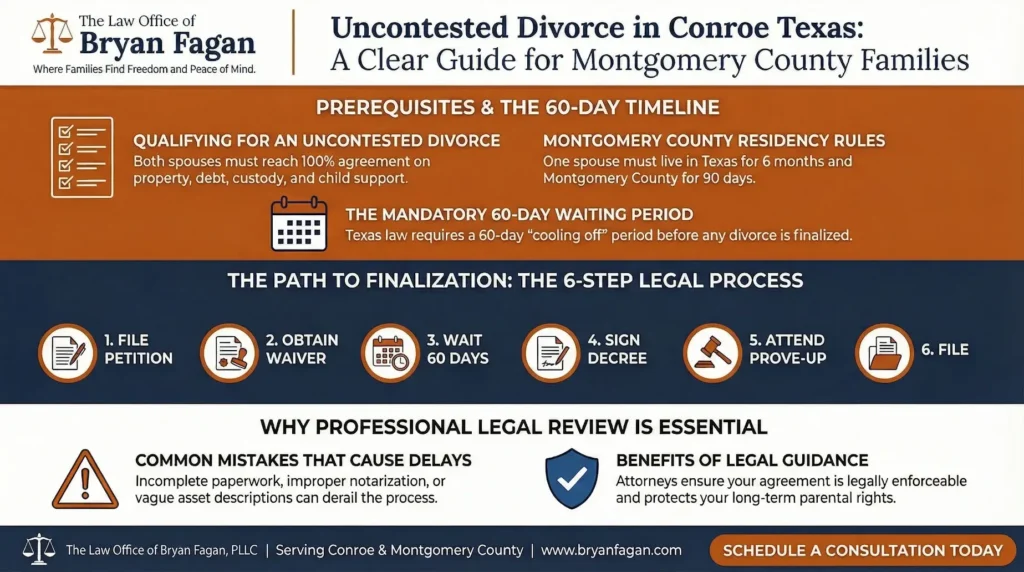
- Minimum 60-day timeline: Under Texas Family Code §6.702, no divorce can finalize before day 61 after filing the Original Petition for Divorce.
- Both spouses must agree: An uncontested divorce requires mutual agreement on all major issues—property division, debt division, child custody, child support, and spousal support.
- Residency matters: At least one spouse must have lived in Texas for six months and in Montgomery County for 90 days before filing.
- Preparation prevents delays: Most uncontested divorces in Montgomery County finalize within 61–90 days when paperwork is complete and accurate.
- Local legal guidance helps: An experienced uncontested divorce attorney familiar with Montgomery County courts can prevent rejected filings and protect the enforceability of your agreement.
We offer comprehensive family law and estate planning services including but not limited to the following:
Residency Requirements
Uncontested Divorce in Conroe Texas: The Short Answer
An Uncontested Divorce in Conroe Texas begins with clarity and mutual agreement. Both spouses must resolve every significant issue before the court will finalize the case, including division of community property under Texas Family Code §7.001, allocation of debts, conservatorship and possession schedules pursuant to §153.002, guideline child support under §154.125 (including the 2025 net resource cap increase to $11,700), and any request for spousal maintenance governed by Chapter 8 of the Texas Family Code. When disputes are resolved in advance, the court’s involvement is streamlined to reviewing and approving the Final Decree rather than litigating contested matters, allowing families to move forward with less stress and more predictability.
Texas law also requires a mandatory 60-day waiting period before a divorce may be finalized, as set forth in Texas Family Code §6.702. In most cases, that timeline cannot be waived. Although day 61 is technically the earliest a divorce can be granted, most uncontested cases in Montgomery County conclude within 61–90 days when documentation is prepared accurately and hearings are scheduled efficiently. Judges in Conroe focus heavily on compliance with statutory requirements—especially where children are involved—because the “best interest of the child” standard in §153.002 remains the guiding principle in all custody determinations.
For families considering relocation before filing, residency matters. Texas Family Code §6.301 requires that at least one spouse reside in Texas for six months and in the filing county for 90 days before initiating divorce proceedings. If you are planning a move, our resource on moving to Conroe, Texas explains what to expect when establishing residency in Montgomery County and how proper timing can prevent delays in your case.
Even when both parties agree, precision still matters. Property must be properly characterized as community or separate. Retirement accounts may require a Qualified Domestic Relations Order to divide benefits correctly. Child support must align with statutory guidelines unless there is a legally supported reason for deviation. Our attorneys routinely help families prepare enforceable decrees that comply with the most current updates to the Texas Family Code, reducing the risk of rejection by the clerk or complications later. For additional insight into how courts calculate support, we recommend reviewing our detailed Texas Child Support Review Process guide.
Choosing cooperation does not mean compromising protection. An uncontested approach allows spouses to retain control over outcomes while still benefiting from experienced legal oversight. By combining statutory compliance, careful drafting, and compassionate counsel, our Montgomery County family law team helps ensure that your agreement is efficient, enforceable, and built to protect your future long after the paperwork is signed.

Residency Requirements in Montgomery County
If you are considering an Uncontested Divorce in Conroe Texas, the first legal step is confirming that residency requirements are satisfied. Texas Family Code §6.301 governs jurisdiction and requires that at least one spouse has lived in Texas for a minimum of six months and in the county of filing for at least 90 days before submitting a divorce petition. These residency rules are not optional technicalities—they establish the court’s authority to hear and finalize your case.
In practical terms, this means one spouse must have maintained Texas residency for the six months immediately preceding filing and must have lived in Montgomery County for at least 90 days. Only one spouse must meet these requirements. If you have lived in Conroe or anywhere within Montgomery County for that period, you may file your divorce locally, even if your spouse has relocated out of state. This flexibility is particularly helpful in agreed cases where both parties want an efficient resolution without unnecessary procedural complications.
Establishing residency properly protects your timeline and prevents dismissal or transfer of your case. Our Montgomery County family law team regularly assists clients in confirming eligibility before filing, ensuring full compliance with §6.301 and related jurisdictional statutes. During this planning stage, families often need access to community support services, especially when children are involved or healthcare transitions are necessary. Our resource on medical resources in Conroe, TX can help families identify local providers and support systems during this period of transition.
Beyond residency, uncontested divorces must still comply with the broader framework of the Texas Family Code. Property division must meet the “just and right” standard under §7.001, conservatorship decisions must reflect the best interest of the child under §153.002, and child support must align with §154.125, including the updated 2025 guideline cap of $11,700 in monthly net resources. We encourage families to review our detailed explanation of the Texas divorce process to better understand how each statutory requirement fits into the larger picture.
Our firm’s mission is to educate families while protecting their futures. By confirming residency early and ensuring compliance with current Texas law, you position your case for a smooth start and a confident conclusion. With thoughtful preparation and experienced guidance, you can move forward knowing your divorce is grounded in both legal accuracy and compassionate support.
Step 1: Filing the Original Petition in Conroe
The divorce process officially begins when you file your Original Petition for Divorce with the Montgomery County district court. This document initiates your case and starts the mandatory 60-day waiting period.
Filing can be completed through electronic filing (e-filing) or in person at the Montgomery County courthouse. Most attorneys and self-represented parties use e-filing for efficiency.
The Original Petition must include:
- Basic information about the marriage
- Grounds for divorce (typically “insupportability” in Texas)
- Desired terms for property division, custody, and support
- A complete inventory of marital estate assets and debts
Filing fees typically range from $200 to $400 in Montgomery County. Fee waivers may be available for those demonstrating financial hardship.
Once the court accepts your filing, you receive a case number and the 60-day clock begins. This date matters—your divorce cannot be finalized until day 61 at the earliest.
Step 2: Service of Process or Waiver of Service
After filing, your spouse must receive formal notice of the divorce petition. In contested cases, this requires service of process through a constable or process server.
In uncontested cases, however, your spouse typically signs a Waiver of Service. This document acknowledges receipt of the divorce papers and confirms agreement to proceed without formal service.
The Waiver of Service must be:
- Signed by the responding spouse
- Notarized properly
- Signed no earlier than one day after the Original Petition is filed (per Texas Family Code §6.4035)
Using a waiver saves time and money. Formal service can cost $100–$300 and add weeks to your timeline. When your spouse signs the waiver promptly, your uncontested case moves forward without delay.
For example: If you file on Monday, your spouse can sign and notarize the waiver as early as Tuesday. Once filed with the court, service requirements are satisfied.
Step 3: The 60-Day Waiting Period
In an Uncontested Divorce in Conroe Texas, timing matters just as much as agreement. Texas Family Code §6.702 requires a mandatory 60-day waiting period before any divorce may be finalized. Even when both spouses agree on every issue, the court cannot grant the divorce until at least day 61 after filing. This statutory safeguard reflects the Legislature’s intent to provide families with a brief period for reflection and to ensure that all legal requirements are properly satisfied before a marriage is dissolved.
This waiting period is not simply procedural—it is practical. It allows spouses to confirm that property division complies with Texas Family Code §7.001, which requires a “just and right” division of community property. It also provides time to ensure conservatorship and possession arrangements align with the best interest of the child standard under §153.002. For parents, this includes verifying that child support calculations comply with §154.125, including the updated 2025 net resource cap of $11,700 per month. Courts in Montgomery County expect careful drafting, and incomplete or inaccurate paperwork can delay finalization well beyond the minimum timeline.
During these 60 days, couples should thoughtfully review the proposed Final Decree of Divorce for clarity and enforceability, confirm that financial disclosures are complete and transparent, finalize custody and visitation schedules if children are involved, gather documentation related to retirement accounts and real property, and prepare for the prove-up hearing. Qualified Domestic Relations Orders may also need to be drafted if retirement benefits are being divided. Addressing these details early prevents avoidable setbacks and ensures the decree is ready for judicial approval as soon as the waiting period expires.
Our Montgomery County family law attorneys often remind clients that preparation during this period creates confidence later. Understanding local filing procedures, clerk requirements, and court scheduling practices can make the difference between a smooth conclusion and frustrating delays. Families may also benefit from reviewing local support resources through our guide to government resources in Conroe, which highlights helpful community services available during times of transition.
For additional insight into how timelines and statutory requirements impact your case, we encourage reviewing our detailed overview of the Texas divorce process. By using the 60-day period wisely and working with experienced counsel who understands both the Texas Family Code and Montgomery County court expectations, you position yourself to finalize your divorce efficiently and with confidence—protecting your future while moving forward with clarity and peace of mind.

Step 4: Drafting the Final Decree of Divorce
The Final Decree of Divorce is the comprehensive legal document that formalizes your divorce. It becomes the enforceable court order governing all post-divorce rights and obligations.
This document must address:
- Property division: Which assets each spouse receives
- Debt division: Which debts each spouse assumes
- Child custody: Conservatorship arrangements and visitation schedules
- Child support: Payment amounts and terms following Texas guidelines
- Spousal support: Any maintenance payments, if applicable
Both spouses must review and sign the Final Decree before it goes to the judge. Accuracy is critical. Vague or incomplete language can create enforcement problems later.
For instance, simply stating “husband keeps the house” is insufficient. The decree should include the property’s legal description, provisions for refinancing, and deadline for removing the other spouse’s name from the mortgage.
An experienced uncontested divorce lawyer ensures your decree is drafted with precision that protects enforceability for years to come.
Step 5: Prove-Up Hearing in Montgomery County
After the 60-day waiting period expires and your Final Decree is complete, you schedule a prove-up hearing before a Montgomery County district judge.
This hearing is typically brief—often lasting only a few minutes. The judge reviews your paperwork, asks a few questions to confirm both parties genuinely agree to the terms, and ensures the agreement is fair.
Under Texas law, at least one spouse must appear before the judge for this final hearing. In Montgomery County courts, the petitioner’s attendance is typically required, though the responding spouse may be excused if all documents are properly signed.
Once the judge signs the Final Decree of Divorce, your divorce is legally final. At that point, request multiple certified copies from the court clerk—you will need them for name changes, financial account updates, and other administrative matters.
How Long Does an Uncontested Divorce Take in Conroe?
An uncontested divorce in Conroe Texas typically finalizes within 61–90 days in ideal cases. This assumes all paperwork is completed correctly, no errors require correction, and the prove-up hearing is scheduled promptly after the waiting period expires.
The absolute minimum timeline is 61 days (the 60-day waiting period plus one day for the final hearing).
More realistic expectations account for:
- Montgomery County court scheduling availability
- Time needed to finalize and review documents (often 2–3 weeks)
- Administrative processing by the clerk’s office
When handled by an experienced divorce lawyer familiar with Montgomery County procedures, most uncontested divorces resolve within 75–90 days. Delays beyond 90 days typically result from paperwork errors, incomplete disclosures, or scheduling conflicts.
What Can Delay an Uncontested Divorce in Conroe Texas?
Even in an Uncontested Divorce in Conroe Texas, careful attention to detail is essential. While agreed cases are designed to be efficient, several avoidable mistakes can extend your timeline and create unnecessary stress. Texas courts require strict compliance with procedural rules, and small errors can delay finalization well beyond the statutory minimum waiting period outlined in Texas Family Code §6.702.
One of the most common issues involves improper service. Under Texas Family Code §6.4035, a Waiver of Service must be signed after the Original Petition is filed and properly notarized. If it is signed too early or completed incorrectly, the court cannot proceed. In those situations, formal service may become necessary, adding time and expense. Missing signatures on the Final Decree of Divorce can also halt progress, as judges will not sign an incomplete order.
Errors in drafting are another frequent source of delay. Texas Family Code §7.001 requires a “just and right” division of community property, and courts expect precise legal descriptions for real property and accurate characterization of assets. Incomplete financial disclosures or vague language regarding debts can result in rejection by the Montgomery County district clerk. When children are involved, the stakes are even higher. Custody and possession provisions must align with the best interest standard in §153.002, and child support must comply with §154.125, including the updated 2025 net resource cap of $11,700 per month. Disagreements over conservatorship or guideline support can quickly transform an agreed case into contested litigation.
Retirement accounts present another technical hurdle. Dividing 401(k)s, pensions, or similar benefits often requires a Qualified Domestic Relations Order. If the QDRO is drafted improperly, plan administrators may reject it, forcing revisions and delaying completion. Similarly, heavy court dockets in Montgomery County can push prove-up hearings beyond the ideal timeline if documents are not submitted correctly the first time.
For parents navigating divorce while prioritizing their children’s stability, understanding local resources can make a meaningful difference. Our guide to education and school resources in Conroe highlights valuable community support systems available during this transition. We also encourage families to review our in-depth explanation of the Texas Child Support Review Process to better understand how statutory guidelines may affect their case.
The attorneys at our firm approach every uncontested matter with precision and empathy. By ensuring compliance with the most current provisions of the Texas Family Code and anticipating potential procedural obstacles, we help families minimize delays and move forward with confidence. Careful preparation today protects your timeline, your agreement, and your family’s future tomorrow.

When an Uncontested Divorce Becomes Contested
An uncontested divorce must remain uncontested throughout the entire process. If either party changes their mind or disputes arise, the case transforms into a contested proceeding with dramatically different requirements.
This can happen when:
- One spouse refuses to sign the Waiver of Service
- Disputes emerge over property division or custody arrangements
- Changed circumstances (job loss, new relationship, relocation) prompt one party to seek modified terms
- One spouse files a formal answer contesting the divorce
Once a contested answer is filed, the case requires discovery, temporary orders hearings, mediation sessions, and potentially trial preparation. These procedures extend timelines by months and substantially increase costs.
The key takeaway: maintain clear communication with your spouse throughout the process. If disagreements emerge, address them promptly before they escalate into contested litigation.
Benefits of Hiring a Local Conroe Divorce Attorney
While uncontested divorces are simpler than contested cases, legal representation helps prevent costly mistakes that can delay finalization or create post-divorce complications.
Familiarity with Montgomery County Judges: A local divorce lawyer in Conroe understands specific judges’ preferences and procedural requirements, enabling efficient navigation of local court systems.
Preventing Rejected Filings: Local attorneys know Montgomery County district clerk requirements, ensuring documents are properly completed before filing.
Efficient Scheduling: Established relationships with court scheduling staff often enable faster prove-up hearing scheduling.
Protecting Enforceability: An experienced uncontested divorce attorney drafts your Final Decree with precision, ensuring it is enforceable post-divorce without requiring additional litigation.
Handling Complex Property Issues: Retirement account division, real property transfers, and debt allocation require technical expertise that protects your financial interests.
Long-Term Cost Savings: While attorney fees represent an upfront cost, they typically save substantially in the long term by preventing post-divorce disputes and enforcement proceedings.
Why Choose The Law Office of Bryan Fagan, PLLC in Conroe
When pursuing an Uncontested Divorce in Conroe Texas, experience with Montgomery County courts can make a meaningful difference in both efficiency and peace of mind. Our family law team regularly appears before local district courts and understands the procedural expectations, scheduling realities, and drafting standards that affect how quickly a case moves from filing to finalization. Texas Family Code §6.702 establishes the mandatory 60-day waiting period, but careful preparation during that time often determines whether your divorce is finalized promptly on day 61 or delayed by avoidable technical issues.
The attorneys at our firm approach uncontested cases with precision and transparency. We ensure that property division complies with Texas Family Code §7.001’s “just and right” standard, that conservatorship provisions reflect the best interest of the child under §153.002, and that child support calculations follow the most current guidelines in §154.125, including the updated 2025 net resource cap of $11,700 per month. By aligning every agreement with the latest provisions of the Texas Family Code, we reduce the risk of rejection by the clerk or complications after the decree is signed.
Clients also benefit from predictable flat-fee structures, consistent communication, and practical guidance at every stage. From reviewing Final Decrees to preparing for prove-up hearings, we focus on clarity so you always understand where your case stands and what happens next. For those navigating day-to-day logistics during divorce, our guide to transportation in Conroe can help families plan around court appearances, exchanges, and scheduling adjustments while maintaining stability.
When more complex issues arise—such as retirement account division requiring a Qualified Domestic Relations Order or modifications related to custody—our broader statewide resources ensure comprehensive support. We also encourage families to review our detailed overview of the Texas divorce process to better understand how statutory requirements shape each stage of a case.
Our mission remains simple and consistent: to help you complete your divorce correctly, efficiently, and with minimal stress so you can move forward with confidence. Through compassionate counsel and careful legal strategy, we work to protect your future while empowering you to begin your next chapter with clarity and peace of mind.

Actionable Checklist: Uncontested Divorce in Conroe Texas
Use this checklist to prepare for your uncontested divorce:
- [ ] Confirm residency requirements: Verify six-month Texas and 90-day Montgomery County residency
- [ ] Reach complete agreement with your spouse: Confirm mutual agreement on property division, debt division, custody, child support, and spousal support
- [ ] Gather financial documents: Collect bank statements, retirement account statements, tax returns, and pay stubs
- [ ] Inventory marital estate: Create complete lists of all assets and debts with current values
- [ ] Prepare identification and residency proof: Gather driver’s licenses, utility bills, or lease agreements demonstrating residency
- [ ] Draft marital settlement agreement: Document all agreed terms in writing
- [ ] File Original Petition: Submit to Montgomery County district court
- [ ] Obtain signed Waiver of Service: Have your spouse sign and notarize (no earlier than one day after filing)
- [ ] Finalize and review Final Decree: Ensure accuracy before prove-up hearing
- [ ] Schedule prove-up hearing: Coordinate with Montgomery County court after day 60
Conclusion
Divorce may change the structure of your family, but it does not have to shake its foundation. When handled thoughtfully, with cooperation and clarity, this transition can become a turning point rather than a breaking point. The decisions you make now—about parenting, communication, and stability—can shape the tone of your family’s future for years to come.
At The Law Office of Bryan Fagan, PLLC, we have walked beside thousands of Texas families during moments just like this. We know the legal rules, the courtroom procedures, and the fine print of the Texas Family Code—but we also understand the late-night worries and the quiet questions parents carry. Working with an experienced Texas Family Law Attorney means you do not have to navigate those uncertainties alone. You gain an advocate who sees both the legal details and the human story behind them.
If you are considering your next steps, we invite you to schedule a consultation with our team. Ask your questions. Share your concerns. Let’s talk through what a steady, respectful path forward could look like for you and your family. The right plan can restore clarity, reduce conflict, and help you reclaim the peace of mind you deserve.
Transitions are never easy—but with the right guidance, they can lead somewhere better. When you are ready, we are here to help you protect what matters most and move forward with confidence.
Frequently Asked Questions About Uncontested Divorce in Texas
The cost of an uncontested divorce in Texas typically includes court filing fees and, if you hire an attorney, legal fees. Filing fees vary by county but are usually a few hundred dollars. Additional costs may apply if you need certified copies, service of process, or specialized documents like a Qualified Domestic Relations Order (QDRO) to divide retirement accounts. Many families choose a flat-fee structure for predictability and peace of mind.
Texas law requires a mandatory 60-day waiting period in most divorce cases. That means the earliest a divorce can typically be finalized is on day 61 after filing. In practice, uncontested divorces often take between 61 and 90 days, depending on how quickly paperwork is completed and how soon the court schedules the final hearing.
Yes, Texas allows individuals to file their own uncontested divorce if both spouses agree on all issues and residency requirements are met. However, the challenge is ensuring the paperwork is completed correctly and that the Final Decree is legally enforceable. Mistakes in property division, custody language, or retirement account provisions can create costly problems later.
The fastest way is full agreement before filing and properly prepared documents from the start. Using a Waiver of Service (when appropriate), drafting the Final Decree during the 60-day waiting period, and scheduling the prove-up hearing promptly can keep the case moving. Delays usually happen because of incomplete paperwork or unresolved issues.
Not necessarily. In many uncontested divorces, one attorney represents the filing spouse and prepares the documents. The other spouse may sign as an unrepresented party, though they always have the right to consult their own attorney for independent advice. The most important factor is that both parties freely and knowingly agree to the terms.
Avoid hiding assets, draining accounts, creating new debt, or making major financial changes without legal advice. If children are involved, avoid using them as messengers or speaking negatively about the other parent. Also be mindful of social media—posts and messages can become evidence in court.
An uncontested divorce is usually the fastest option when both spouses agree on all major issues. Even then, Texas law still requires the 60-day waiting period in most cases. Efficiency comes from preparation, cooperation, and accurate documentation rather than rushing the legal process.
The “6 month rule” refers to Texas residency requirements for filing divorce. Generally, at least one spouse must have lived in Texas for at least six months before filing and in the county of filing for at least 90 days. Without meeting these requirements, the court may not have jurisdiction over the case.
Texas does not recognize automatic divorce based solely on separation. You must file a divorce petition and complete the legal process for a marriage to be legally dissolved. Living apart may be relevant in certain circumstances, but separation alone does not finalize a divorce in Texas.