
Property Division Attorneys in Conroe Texas: Your Complete Guide to Protecting Your Assets in Montgomery County Divorce

The night after the argument, the house felt different. The dishes were still in the sink. The television was on, but no one was watching. One parent sat at the kitchen table staring at a stack of mortgage statements and retirement account printouts, wondering how life became paperwork so quickly. If you are searching for Property Division Attorneys in Conroe Texas, chances are you are not just thinking about assets—you are thinking about stability, dignity, and what your family’s next chapter will look like.
Divorce has a way of turning ordinary routines into heavy questions. Who stays in the home? How will bills get paid? What happens to the business you built together? Under Texas Family Code §7.001, courts divide community property in a manner that is “just and right,” but that phrase can feel abstract when your future is on the line. The truth is this: preparation, clarity, and thoughtful legal strategy make a measurable difference in both financial outcomes and family stability.
At The Law Office of Bryan Fagan, PLLC, we see firsthand how property division is never just about numbers. It is about restoring peace of mind during one of life’s most difficult transitions. Bryan Joseph Fagan, a South Texas College of Law graduate and recognized authority on Texas divorce and custody law, founded this firm on a simple belief—families deserve both strong legal advocacy and compassionate guidance. Our mission is to empower people to reclaim freedom and confidence by simplifying complex legal problems and protecting what matters most.
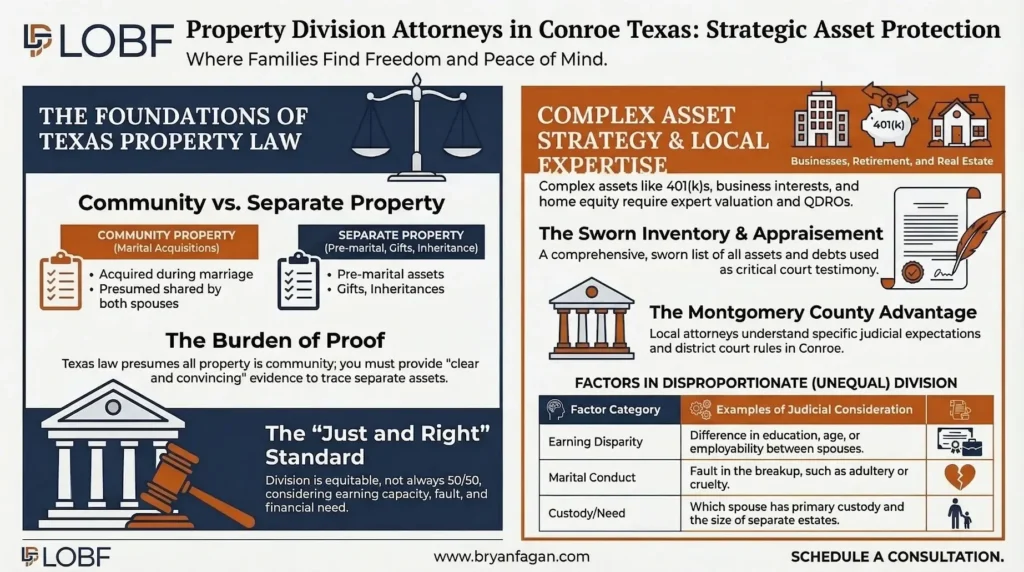
Texas law presumes that property acquired during marriage is community property under §3.002, while separate property—such as inheritances or premarital assets—must be proven with clear evidence under §3.001. These legal distinctions may seem technical, but they directly affect whether you keep your retirement savings, business interests, or family home. The earlier you understand your rights and obligations, the stronger your position becomes.
If you are standing at your own kitchen table tonight, unsure of what tomorrow holds, you are not alone. In the sections that follow, you will learn how property division works in Montgomery County, how courts approach complex financial issues, and how experienced legal counsel can help you move forward with clarity instead of confusion. Divorce may close one chapter, but with the right strategy and support, it can also open the door to a more stable and secure future.
Key Takeaways
- Texas is a community property state, but courts divide marital assets in a “just and right” manner—not automatically 50/50
- Separate property (gifts, inheritances, premarital assets) stays with its original owner, but you must prove it through documentation and tracing
- The marital home, retirement accounts, and business valuations represent the most contentious aspects of Conroe divorces
- Gathering financial documents early strengthens your position whether you settle through mediation or proceed to court
- An experienced attorney in Conroe understands Montgomery County procedures and can protect your long-term financial stability

Your Family’s Future Starts Here
Don’t navigate your legal journey alone. Schedule a consultation now and get the clarity and support you deserve.
We offer comprehensive family law and estate planning services, including but not limited to the following:
Trust us to help you with your Family case in Conroe, Texas. Call 281-562-7344 or contact us online today at to schedule a free consultation with your Family Law Attorneys in Conroe, Texas.
Property Division Attorneys in Conroe Texas: The Short Answer
Property Division Attorneys in Conroe Texas play a critical role in helping families navigate the financial complexities of divorce while protecting what legally belongs to them. Under Texas Family Code §7.001, courts must divide community property in a manner that is “just and right,” considering the rights of each spouse and any children of the marriage. That standard does not automatically mean an equal split. It requires careful legal analysis, proper valuation, and strong documentation. Separate property—defined under §3.001 as assets owned before marriage or acquired by gift or inheritance—must be clearly proven. Meanwhile, §3.002 establishes the presumption that property acquired during marriage is community property unless rebutted by evidence. Understanding these distinctions can significantly affect whether you retain your retirement savings, business interests, or real estate.
At The Law Office of Bryan Fagan, PLLC, our attorneys begin with a comprehensive financial review. We analyze bank accounts, retirement plans, executive compensation, real estate holdings, and business interests. When necessary, we pursue reimbursement claims under Texas Family Code §3.401, particularly in cases involving commingled assets or separate property contributions to community debts. Recent legislative updates and clarifications within the Texas Family Code continue to emphasize accurate tracing and detailed financial inventories, especially in complex financial divorces. Our approach is deliberate and strategy-driven because small oversights in documentation can have lasting financial consequences.
Whether your divorce is resolved through negotiation or contested litigation in Montgomery County district court, precise decree drafting is essential. Vague language creates enforcement problems later. Our firm ensures final orders clearly outline transfer procedures, deadlines, and compliance standards. Familiarity with local court procedures, mediation requirements, and temporary order standards can make a meaningful difference in both timing and outcome.
Families considering relocation during or after divorce may also benefit from understanding the Conroe community and its legal landscape. Our resource on moving to Conroe provides helpful guidance for those establishing a new chapter in Montgomery County. We also encourage readers to explore our detailed Texas Child Support Review Process guide to better understand how financial support obligations intersect with broader property division strategy.
The Law Office of Bryan Fagan believes that informed clients make confident decisions. By combining legal precision with compassionate communication, we help families transition from uncertainty to clarity. Property division is not simply about dividing numbers on a spreadsheet—it is about protecting your future, preserving your financial stability, and ensuring that the outcome reflects both Texas law and your unique circumstances. When you work with experienced counsel who understands the Texas Family Code and the realities of divorce in Conroe, you move forward with greater peace of mind and a stronger foundation for what comes next.

How Property Division Works in Texas (The Big Picture)
Property Division Attorneys in Conroe Texas regularly explain one important truth to families: Texas is a community property state, but that does not mean everything is split 50/50. Under Texas Family Code §7.001, courts must divide the marital estate in a manner that is “just and right,” giving judges discretion to consider factors such as each spouse’s earning capacity, health, fault in the breakup of the marriage, and contributions to the community estate. This flexible standard allows courts to craft equitable outcomes, particularly in cases involving complex financial or personal circumstances.
Texas Family Code §3.002 establishes the presumption that property acquired during marriage is community property. This typically includes wages earned during the marriage, retirement contributions, equity accumulated in the marital home, investment growth, and vehicles purchased after the wedding date. Unless proven otherwise, courts assume these assets belong to both spouses. In recent years, continued statutory clarifications have reinforced the importance of sworn inventories and accurate financial disclosure, ensuring transparency in the division process. Understanding this presumption is essential because it shifts the burden of proof to the spouse claiming that an asset is separate rather than community.
Separate property, as defined in §3.001, includes assets owned before marriage, gifts and inheritances received during marriage, and certain personal injury recoveries (excluding portions tied to lost wages). However, the protection of separate property depends on documentation and tracing. If separate funds are commingled with community funds and cannot be clearly traced, Texas courts may classify the asset as community property. This is where strategic preparation becomes critical. Our firm carefully analyzes financial records, reimbursement claims under §3.401, and valuation evidence to protect what legally belongs to you.
At The Law Office of Bryan Fagan, PLLC, we combine legal precision with compassionate guidance. Divorce can intersect with health concerns, financial uncertainty, and major life transitions. For families navigating medical needs during divorce, we provide helpful local information through resources such as medical resources in Conroe. We also encourage clients to explore our comprehensive Texas Child Support Review Process guide to better understand how financial obligations and statutory updates—such as recent guideline adjustments—interact with broader property division strategy.
The attorneys at our firm believe that education empowers families. When you understand how Texas courts apply §§3.001, 3.002, and 7.001, you are better equipped to make informed decisions about your future. Property division is not simply a legal formality—it is a foundational step in rebuilding stability and protecting what matters most. With experienced counsel and clear communication, you can approach this process with confidence rather than confusion.
Community Property vs Separate Property: What’s At Stake
The classification of assets as community or separate property determines whether something gets divided in your divorce case. This distinction affects everything from your retirement accounts to the inheritance your grandmother left you.
| Category | Common Examples | Typical Proof/Documents | Common Disputes | Practical Notes |
|---|---|---|---|---|
| Community Property | Wages earned during marriage, retirement contributions during marriage, house equity built during marriage, joint bank accounts, vehicles purchased after wedding | Pay stubs, account statements, purchase records, mortgage documents | Whether premarital contributions can be traced out, how to value business growth, determining debt responsibility | Presumed community unless proven otherwise |
| Separate Property | Premarital assets, gifts from third parties, inheritances, personal injury settlements (excluding lost wages) | Pre-marriage account statements, gift letters, inheritance documents, segregated account records | Commingling with community funds, tracing challenges, proving gift intent | Must prove by clear and convincing evidence |
When separate property gets mixed with community funds—depositing an inheritance into a joint account, for example—tracing becomes essential. Texas courts require documented proof showing the direct lineage of separate funds to their premarital or gifted source.
The Biggest Conroe Divorce Property Issues: What People Fight About
The most contentious aspects of Conroe property division typically involve high value assets: the marital home, retirement accounts, businesses, and accumulated debts. Understanding what’s at stake helps you prepare effectively.
The Marital Home represents the most emotionally charged asset in most divorces. Options include one spouse buying out the other’s equity through refinancing, selling the property and dividing proceeds, or deferring sale until children reach a certain age. Montgomery County courts consider homestead protections under Texas law when evaluating these arrangements.
Retirement Accounts and Pensions require careful handling. Community portions of employer-sponsored retirement must be divided through Qualified Domestic Relations Orders (QDROs) to avoid tax penalties. This legal process ensures IRS-compliant transfers. Valuing pensions often requires actuarial analysis to distinguish marital accrual from premarital balances.
Business Interests present complex valuation challenges. Whether you own a professional practice, family business, or partnership interest, experts typically employ income, market, or asset-based approaches. Disputes often center on goodwill valuation and whether one spouse contributed to business growth.
Debt Division follows similar community property principles. Credit cards used for family expenses, joint tax liabilities, and loans taken during marriage typically constitute community debts acquired by both parties. Courts may assign disproportionate burdens when one spouse wasted marital assets or accumulated secret debt.
Valuation: How Courts and Settlements Decide What Something Is Worth
Property Division Attorneys in Conroe Texas know that when it comes to divorce, value is determined by evidence—not emotion. Under Texas Family Code §7.001, courts divide community property in a manner that is “just and right,” which requires accurate identification and valuation of every asset and debt. While a home may carry memories and a business may represent years of hard work, Texas courts focus on fair market value—what a willing buyer would pay a willing seller in an arm’s-length transaction. This objective standard ensures that division is grounded in financial reality rather than personal attachment.
Real estate is typically valued through licensed appraisers who rely on comparable market sales. Retirement accounts are assessed using current statements, and pensions often require actuarial calculations to determine the present value of the community portion. Business interests may require forensic accountants or valuation experts who understand industry-specific financial metrics and goodwill analysis. Texas Family Code §§3.001 and 3.002 establish the framework for distinguishing separate property from community property, while §3.401 governs reimbursement claims when one estate benefits another. Courts also require sworn inventories under §6.502 to promote transparency and prevent asset concealment. These statutory provisions—refined through ongoing legislative updates—underscore the importance of precise financial documentation and strategic preparation.
The timing of valuation can significantly impact the final division. Courts may consider the value of assets at filing or at trial, and fluctuations between those dates can alter outcomes. A retirement account valued at $200,000 when the divorce is filed may increase or decrease substantially by the time of final hearing. Proactive negotiation around valuation dates during mediation can prevent surprises and strengthen your position.
At The Law Office of Bryan Fagan, PLLC, we combine financial analysis with compassionate counsel. We understand that property division is not simply about spreadsheets—it is about securing stability for your future. For families concerned about how divorce-related financial decisions may affect their children’s educational continuity, we offer guidance through our resource on education and school resources in Conroe. We also encourage clients to review our detailed Texas Child Support Review Process guide to better understand how property division and financial support obligations intersect under current Texas law, including recent updates to statutory guideline caps.
Our firm believes that education creates empowerment. When clients understand how Texas courts evaluate property under the Family Code, how valuation dates influence outcomes, and how strategic documentation protects their interests, they gain confidence during an otherwise uncertain time. With experienced legal guidance and a clear financial strategy, you can move forward knowing your future is built on clarity, preparation, and informed decision-making.

Reimbursement and “Waste” Arguments: When Money Gets Complicated
Reimbursement claims arise when one estate benefits another unjustly. Under Texas Family Code §3.401, when separate property funds pay down community debt principal or community funds significantly improve separate property, the contributing estate may recover that value.
For example, if you used inheritance money to pay down the mortgage on your marital home, you may have a reimbursement claim for those principal payments. Similarly, if community funds built an addition on property your spouse owned before marriage, the community estate may seek reimbursement.
Waste or dissipation arguments come into play when one spouse squanders marital assets inappropriately—gambling losses, gifts to romantic partners, or hiding money in undisclosed accounts. Texas Family Code §7.007 allows courts to consider economic dissipation when dividing assets. Documenting these claims requires detailed bank statements and financial records, which is why attorneys recommend gathering 24 months of financial history early in the process.
The Step-by-Step Property Division Process
| Step | What Happens | What to Gather | Common Pitfalls |
|---|---|---|---|
| 1. Identify Assets & Debts | Create comprehensive inventory of everything owned and owed | Bank statements, credit card statements, loan documents, titles, deeds | Forgetting retirement accounts, missing debts, overlooking digital assets |
| 2. Characterize Property | Determine what’s community vs separate | Pre-marriage records, gift letters, inheritance documents, tracing analysis | Failing to prove separate property, missing commingling issues |
| 3. Value Everything | Establish fair market values | Appraisals, account statements, business financials, expert valuations | Using outdated values, ignoring tax implications, emotional pricing |
| 4. Negotiate Division | Work toward settlement through mediation or direct negotiation | Proposed budgets, priorities list, realistic expectations | Refusing to compromise, focusing on “winning” over practical outcomes |
| 5. Draft Decree | Create legally enforceable court order specifying all transfers | Precise legal descriptions, account numbers, deadlines | Vague language, missing transfer mechanics, no enforcement provisions |
| 6. Implement Transfers | Execute deeds, QDROs, title changes, account distributions | Signed documents, court orders, financial institution forms | Missing QDRO deadlines, forgetting beneficiary changes, title errors |
Mediation and Settlement: How Most Property Divisions Are Finalized
Most Texas divorces—over 90% according to judicial statistics—settle without trial. Mediation represents the primary settlement mechanism in Montgomery County, where court-appointed neutrals or private facilitators help parties reach binding agreements.
Mediation works because both parties control the outcome rather than leaving decisions to a judge. A skilled divorce attorney prepares you for mediation by clarifying your priorities, understanding realistic outcomes, and identifying negotiation leverage. When mediation produces a signed agreement, that agreement becomes enforceable as a court order.
The importance of detailed decree language cannot be overstated. Vague terms like “husband shall pay wife her share of retirement” create enforcement nightmares. Effective decrees specify exact account numbers, transfer mechanisms, deadlines, and consequences for non-compliance. Implementation steps—executing deeds, filing QDROs, changing vehicle titles—require coordination to ensure nothing falls through the cracks.
What to Expect in Montgomery County If Property Division Is Contested
When settlement efforts do not resolve property disputes, Property Division Attorneys in Conroe Texas guide clients through the structured litigation process in Montgomery County district courts. Texas Family Code §7.001 requires judges to divide community property in a manner that is “just and right,” and when negotiations break down, the court becomes the decision-maker. Early in contested cases, judges often issue temporary orders under Texas Family Code §§6.501–6.502 to stabilize finances, allocate bill payment responsibilities, and prevent either spouse from transferring, concealing, or dissipating marital assets. These safeguards are designed to protect both parties—and any children involved—while the case proceeds.
Discovery is a critical phase of contested litigation. Under §6.502, courts may require sworn inventories and appraisements to ensure full financial transparency. Parties may request bank statements, tax returns, retirement account records, and business documentation to verify the character and value of property under §§3.001 and 3.002. These procedures reflect the Legislature’s continued emphasis on financial disclosure and accountability within divorce proceedings. Accurate and timely compliance with discovery requirements strengthens your case and minimizes unnecessary delays.
In Montgomery County, contested divorces typically span 12 to 18 months from filing to final hearing, depending on complexity and court scheduling. Bench trials—where a judge decides the issues rather than a jury—are standard in family law cases. Familiarity with local court practices, mediation requirements, and temporary order standards can significantly influence both timeline and outcome. Our legal team understands how each Montgomery County court approaches contested matters, which allows us to craft strategies tailored to the specific judge and procedural environment.
Divorce litigation can also raise practical questions about daily life and logistics during separation. For families navigating new commuting arrangements or adjusting transportation responsibilities, we offer helpful community guidance through our resource on transportation in Conroe. We also encourage clients to review our comprehensive Texas Child Support Review Process guide to better understand how property division and financial obligations intersect under current Texas law, including recent updates to statutory income caps and guideline calculations.
At The Law Office of Bryan Fagan, PLLC, we recognize that litigation can feel overwhelming. Our mission is to provide clarity and confidence even when the courtroom becomes necessary. By combining careful preparation, detailed financial analysis, and compassionate communication, we help clients navigate contested property division with strength and informed decision-making. When settlement is not possible, experienced advocacy ensures your rights are protected and your future remains secure.

Common Mistakes That Cost People Money in Property Division
The most costly errors in Conroe property division stem from poor preparation and vague agreements. Leaving accounts “as is” without formal division creates confusion about ownership. Not tracing separate property results in assets being divided that should have remained yours alone.
Ignoring tax implications causes problems years later. Dividing a $200,000 retirement account and a $200,000 brokerage account equally sounds fair—until you realize the retirement account carries deferred taxes while the brokerage account doesn’t. The after-tax values differ substantially.
Agreeing to vague decree terms—“parties shall divide personal property fairly”—invites enforcement disputes. Forgetting retirement transfer steps means QDROs don’t get filed, leaving retirement divisions unimplemented years after divorce. Not documenting debt responsibility or reimbursement claims waives potentially significant recovery rights.
Listen to Our Texas Family Law Podcast
Prefer listening? In this episode, we discuss property division in Conroe, Texas, including how assets and debts are divided, what courts consider, and how to protect your financial interests during divorce.
How Property Division Attorneys in Conroe Texas Help Protect Your Future
Property division attorneys in Conroe Texas protect your financial interests through strategic planning, proper documentation, and experienced negotiation. An attorney develops a comprehensive inventory strategy, identifies separate property claims worth pursuing, and builds the evidentiary foundation needed to support your position.
Proper valuation matters because undervaluing assets means accepting less than your fair share. Your attorney coordinates appraisals, reviews business valuations critically, and ensures retirement accounts are properly analyzed. Negotiation leverage comes from preparation—knowing what you can prove gives you confidence in settlement discussions.
Drafting enforceable orders prevents post-divorce headaches. Your attorney ensures decree language specifies exactly how transfers occur, who bears responsibility for each debt, and what happens if either party fails to comply. Coordinating QDROs with retirement plan administrators ensures retirement transfers happen correctly and avoid unnecessary tax consequences.
Why Choose The Law Office of Bryan Fagan, PLLC
When families search for Property Division Attorneys in Conroe Texas, they are often looking for more than technical legal help—they are seeking clarity, stability, and a path forward. At The Law Office of Bryan Fagan, PLLC, we bring extensive experience handling complex financial divorces across Texas, with particular focus on Conroe and Montgomery County. Under Texas Family Code §7.001, courts must divide community property in a manner that is “just and right,” and that standard demands careful preparation, accurate valuation, and strategic advocacy. We understand that property division decisions today will affect retirement security, housing stability, and financial independence for years to come.
Our approach is rooted in education and transparency. Texas law presumes that property acquired during marriage is community property under §3.002, while separate property—defined in §3.001—must be proven with clear and convincing evidence. Reimbursement claims under §3.401 and sworn inventories required by §6.502 further reinforce the importance of detailed documentation and financial accuracy. Recent legislative updates to the Texas Family Code, including adjustments affecting related financial obligations such as child support guideline caps, highlight the need for experienced counsel who stays current with evolving statutory standards. We explain these legal frameworks in plain English, set realistic expectations, and keep you informed at every stage of the process.
Strategy-first planning defines our representation. Whether your case involves the marital home, retirement accounts divided through a Qualified Domestic Relations Order, closely held business interests, or high-value assets requiring forensic analysis, we develop customized solutions designed to protect your long-term financial interests. If litigation becomes necessary, our familiarity with Montgomery County courts allows us to navigate procedural nuances effectively while maintaining a steady focus on achieving a fair outcome under Texas law.
We also recognize that divorce often requires coordination beyond the courtroom. Families may need access to reliable local services during transition. For that reason, we provide helpful community guidance through resources such as government resources in Conroe. Additionally, clients can review our comprehensive Texas Child Support Review Process guide to better understand how property division and support obligations intersect under current Texas law.
The attorneys at our firm believe that informed families are empowered families. By combining technical precision with compassionate communication, we help clients move from uncertainty to confidence. Property division is not simply a financial transaction—it is a foundational step toward rebuilding your future. With experienced guidance grounded in the Texas Family Code and a deep commitment to protecting what matters most, you can move forward knowing your interests are in capable hands.

Checklist: Property Division Attorneys in Conroe Texas
- [ ] Pull 12-24 months of bank statements and credit card statements for all accounts
- [ ] Obtain retirement plan statements including plan names, account numbers, and current values
- [ ] Create comprehensive inventory of all assets and debts with estimated values
- [ ] Collect deeds, mortgage statements, and any real estate appraisals
- [ ] Gather the last three years of tax returns and current pay stubs
- [ ] Save business financial statements, partnership agreements, and ownership documents if applicable
- [ ] Identify separate property claims early and locate supporting documentation
- [ ] Document any reimbursement claims with specific dates and amounts
- [ ] Prepare a realistic post-divorce budget based on anticipated income and expenses
- [ ] Contact a property division attorney to discuss your circumstances and options
Conclusion
Divorce may change the shape of your household, but it does not have to shake the foundation your children stand on. When financial decisions are handled with clarity and care, parents are better positioned to create stability at home—and stability is what allows children to keep growing, learning, and moving forward with confidence. Property division is not just about spreadsheets and statutes; it is about building a secure platform for the next chapter of your family’s life.
If you are facing these decisions in Conroe or Montgomery County, know that you do not have to navigate them alone. Working with an experienced Texas Family Law Attorney can help you understand your rights under the Texas Family Code, anticipate challenges before they arise, and craft solutions that protect both your financial future and your child’s well-being. The right guidance turns uncertainty into strategy and anxiety into action.
At The Law Office of Bryan Fagan, PLLC, we believe informed families make empowered choices. Our team is here to answer your questions, explain your options in plain English, and help you move forward with a clear plan. If you are ready to take the next step, consider scheduling a consultation to discuss your circumstances and goals. Sometimes the most powerful decision you can make is simply reaching out and starting the conversation.
Your future—and your child’s future—deserves thoughtful planning, steady support, and experienced advocacy. When you are ready, we are here to help you protect what matters most and move ahead with confidence.
Frequently Asked Questions
In Texas, the assets that are generally “untouchable” in divorce are classified as separate property. This typically includes property you owned before marriage, gifts given specifically to you, and inheritances you received during the marriage. Certain personal injury settlements may also qualify as separate property, though portions related to lost wages can be treated as community property. The key is documentation. If you cannot clearly trace and prove the asset’s separate character, a court may presume it is community property and subject to division.
Texas is a community property state, but that does not mean everything is automatically split 50/50. Courts divide community property in a manner that is “just and right” under the Texas Family Code. The process usually involves identifying all assets and debts, classifying them as community or separate property, determining their value, and then negotiating a division. Many cases resolve in mediation, while others may require a judge to decide based on the specific facts and financial circumstances of each spouse.
The “10 year rule” most often refers to spousal maintenance eligibility. In Texas, a marriage lasting 10 years or longer can be one factor that allows a court to consider awarding spousal maintenance, provided certain legal requirements are met. It does not guarantee maintenance, nor does it automatically impact property division. It simply opens the door for a court to analyze whether support is appropriate based on income, earning capacity, and other statutory factors.
Separate property generally cannot be divided by the court. This includes premarital property, inheritances, and gifts specifically given to one spouse. However, if separate property becomes commingled with community property—such as depositing inherited funds into a joint account—it may require tracing to preserve its separate status. Without proper proof, a judge may treat the asset as community property.
One of the biggest mistakes people make in divorce is letting emotions drive financial decisions. Rushing to settle, failing to gather complete documentation, overlooking tax consequences, or agreeing to vague language in a final decree can lead to costly problems later. Careful preparation, clear valuation of assets, and precise legal drafting are essential to protecting your long-term financial stability.
Not necessarily. In Texas, the portion of your 401(k) earned during the marriage is typically considered community property and may be divided. However, contributions made before marriage are often separate property if you can prove and trace them. Division of retirement accounts is commonly handled through a Qualified Domestic Relations Order (QDRO), which allows the account to be divided without triggering early withdrawal penalties or taxes.
There is no automatic rule that a spouse receives exactly half of a 401(k). Courts divide community property in a manner they consider fair and equitable. While many cases result in something close to a 50/50 division of the marital portion, outcomes vary depending on the overall property division, debts, earning capacity, and other circumstances.
The “6 month rule” typically refers to Texas residency requirements for filing for divorce. In general, at least one spouse must have lived in Texas for the previous six months and in the county of filing for at least 90 days. If these residency requirements are not met, the court may not have jurisdiction to grant the divorce.
The “3 C’s” of divorce are often described as Communication, Cooperation, and Clarity. Clear communication reduces misunderstandings, cooperation can minimize conflict and cost, and clarity—especially in legal documents and financial disclosures—helps prevent future disputes. While divorce is rarely easy, focusing on these principles can create a more stable and predictable path forward.
