
Domestic Violence Attorneys in Conroe Texas: Your Guide to Protection Orders, Custody, and Legal Defense

The house felt different after the police left. The front door was still slightly open, a chair knocked over in the kitchen, and two parents standing in separate corners of the same room—both stunned, both unsure what would happen next. In moments like these, families often search for answers fast, and that’s when Domestic Violence Attorneys in Conroe Texas become more than just legal representatives—they become guides through uncertainty, fear, and life-altering decisions. When allegations of family violence surface during a divorce or custody dispute, the legal system moves quickly, and what you do in those first days matters.
One client once told us, “I don’t even know what I’m supposed to do tomorrow.” That question is more common than you might think. Protective orders, possible criminal charges under Texas Penal Code §22.01, emergency custody decisions, and temporary hearings can unfold almost overnight. Texas courts, guided by Texas Family Code §153.002, focus on the best interest of the child, while also weighing safety concerns under §153.004 when family violence is alleged. These statutes are not just words in a book—they shape who remains in the home, who sees the children, and how daily life will function moving forward.
At The Law Office of Bryan Fagan, PLLC, we understand that the most overwhelming part of family conflict is often the uncertainty. Founded by Bryan Joseph Fagan, a South Texas College of Law graduate and recognized authority on Texas divorce and custody law, our firm has helped thousands of Texas families navigate these critical moments with clarity and confidence. We believe in empowering people to reclaim freedom and peace of mind during life’s hardest transitions. That means explaining what happens after an arrest, how Magistrate’s Emergency Protective Orders work, what temporary ex parte hearings involve, and how courts determine safe and workable custody arrangements.
When everything feels unstable, information restores control. When fear clouds judgment, steady legal guidance brings focus. In the pages ahead, we will break down how family violence allegations intersect with divorce and custody proceedings in Texas, what protective orders really mean, and how thoughtful legal strategy can protect your rights while restoring stability for your family.
Key Takeaways
- Texas Family Code §71.004 defines “family violence” specifically—understanding this legal definition matters more than everyday labels when seeking or responding to protective orders.
- Protective orders in Texas can include contact restrictions, residence provisions, firearm limitations, and child-related protections; they require evidence that family violence has occurred.
- Family violence allegations significantly impact custody decisions under Texas Family Code §153.004, potentially limiting conservatorship rights and requiring supervised visitation.
- Evidence preservation is critical—written communications, medical records, witness statements, and documentation of patterns can strengthen or weaken a case.
- Whether you need protection or face accusations, compliance with court orders and working with an experienced domestic violence attorney in Montgomery County helps protect your rights and your family’s stability.

Your Family’s Future Starts Here
Don’t navigate your legal journey alone. Schedule a consultation now and get the clarity and support you deserve.
We offer comprehensive family law and estate planning services, including but not limited to the following:
Trust us to help you with your Family case in Conroe, Texas. Call 281-562-7344 or contact us online today to schedule a free consultation with your Family Law Attorneys in Conroe, Texas.
Domestic Violence Attorneys in Conroe Texas: The Short Answer
Domestic Violence Attorneys in Conroe Texas serve families at one of the most critical intersections of family law and personal safety. When allegations of family violence arise, Texas law provides specific remedies and safeguards under Texas Family Code §§71.004 and 85.001, which define family violence and govern the issuance of protective orders. Whether you are seeking protection or responding to allegations, these proceedings often move quickly and can directly affect divorce, conservatorship, and possession rights under §§153.002 and 153.004. Courts must prioritize the best interest of the child, and credible findings of family violence can limit joint managing conservatorship, restrict possession schedules, or require supervised visitation.
At The Law Office of Bryan Fagan, PLLC, our legal team carefully evaluates your circumstances, organizes evidence, and develops a coordinated strategy that addresses both immediate safety concerns and long-term family stability. Protective orders may include contact restrictions, residence provisions, and child-related protections, and recent updates to the Texas Family Code continue to refine how courts handle enforcement and modifications under Chapters 85 and 156. If criminal charges are involved, we ensure that the family court strategy accounts for bond conditions, emergency protective orders, and any overlapping custody implications. If you are facing allegations, we help you respond lawfully, preserve critical evidence, and avoid actions that could unintentionally jeopardize your rights.
Families navigating these situations often feel overwhelmed by uncertainty. Our firm believes education restores confidence. By explaining how Texas statutes apply to your case and outlining realistic expectations, we help you make informed decisions rather than reactive ones. You can learn more about how Texas courts approach these matters through our detailed Texas Domestic Violence Resource Guide and related articles within our family law practice section.
Outcomes in family violence cases depend on the evidence presented and the application of Texas law. No lawyer can promise a specific result, but clear communication, strategic advocacy, and a steady understanding of the Family Code make a meaningful difference. The attorneys at The Law Office of Bryan Fagan, PLLC remain committed to protecting families, safeguarding children, and helping clients reclaim stability during life’s most difficult transitions.

What Counts as “Family Violence” in Texas?
Under Texas law, “family violence” is a defined legal term, not simply a description of conflict or emotional distress. Texas Family Code §71.004 sets out the statutory definition, explaining that family violence includes an act by a member of a family or household intended to result in physical harm, bodily injury, assault, or sexual assault, or a threat that reasonably places another person in fear of imminent physical harm. The statute also encompasses abuse of a child by a family or household member and dating violence between individuals in a romantic relationship, even if they do not live together. This precise language matters because courts base protective order decisions and custody rulings on whether conduct meets the legal definition—not on how the situation subjectively felt.
In practical terms, if a spouse brandishes a weapon and threatens harm, that conduct can qualify under §71.004. If a partner strikes another and causes bodily injury, it may satisfy the statutory elements. By contrast, harsh language alone, without a credible threat or reasonable fear of imminent harm, may not meet the threshold required for a protective order under Texas Family Code Chapter 85. Understanding these distinctions is critical when seeking relief or responding to allegations, because judges must evaluate evidence against the statutory framework rather than personal interpretations of the relationship.
The implications extend beyond protective orders. Under Texas Family Code §153.004, credible evidence of family violence directly impacts conservatorship decisions, and courts must weigh those findings when determining what arrangement serves the best interest of the child under §153.002. Recent updates to the Family Code continue to refine enforcement procedures and protective order provisions, reinforcing the Legislature’s intent to prioritize safety while maintaining procedural safeguards. Families often need guidance navigating these complex intersections of law and daily life, and local government services can also play a role in support and compliance. You can explore community-based assistance options through our overview of government resources in Conroe.
Individuals seeking clarity frequently consult Domestic Violence Attorneys in Conroe Texas to ensure their case is evaluated through the proper legal lens. The legal team at The Law Office of Bryan Fagan, PLLC carefully reviews facts, documents relevant communications, and prepares evidence in alignment with statutory standards. For additional insight into how Texas courts address these matters, you may review our comprehensive Texas Domestic Violence resource page.
Clear definitions create clearer decisions. By grounding each case in the language of the Texas Family Code and pairing that knowledge with compassionate guidance, our firm remains committed to educating families, protecting futures, and helping clients move forward with informed confidence.
Protective Orders in Texas: What They Are and What They Can Do
A protective order under Texas law is a civil court remedy designed to create immediate, enforceable boundaries when family violence has occurred. Under Texas Family Code §85.001, a court may issue a protective order upon finding that family violence, as defined in §71.004, has taken place. The law does not require proof that violence will happen again—evidence of a past qualifying act can be sufficient. For families facing urgent safety concerns, this distinction is critical. It allows courts to intervene quickly while still preserving procedural fairness for both parties.
Protective orders can include detailed restrictions tailored to protect safety and stability. Courts may prohibit the respondent from going near a residence, workplace, or school; forbid direct or indirect contact; order the surrender of firearms consistent with state and federal law; remove a person from a shared home; and establish temporary conservatorship or possession terms affecting children. Because Texas Family Code §153.002 requires courts to act in the best interest of the child, and §153.004 mandates careful evaluation of family violence in custody determinations, these orders often directly impact parenting arrangements. Judges may also include provisions protecting pets and addressing other household safety concerns, reflecting the Legislature’s continued focus on comprehensive family protection.
Temporary ex parte protective orders may be granted swiftly when sworn testimony demonstrates a clear and present danger. These emergency orders generally remain in effect until a full hearing, often set within approximately two weeks. At that hearing, both sides have the opportunity to present evidence and testimony. If the court determines that family violence occurred and is likely to occur again, it may issue a final protective order lasting up to two years, with longer durations permitted in cases involving serious bodily injury, use of a deadly weapon, or repeated violations under Chapter 85. Enforcement provisions under Chapter 157 further ensure that violations carry meaningful legal consequences.
Families often turn to Domestic Violence Attorneys in Conroe Texas for guidance on how these statutes apply in real-world situations. The attorneys at The Law Office of Bryan Fagan, PLLC carefully review the facts, organize documentation, and explain what to expect at each stage of the process. For those considering relocation during or after a protective order proceeding, jurisdictional and modification issues may arise. Helpful insights about community planning and legal considerations can be found in our guide to moving to Conroe. Readers seeking a deeper understanding of how protective orders interact with divorce and custody proceedings may also review our comprehensive Texas Domestic Violence resource page.
Protective orders are not simply forms filed with the court; they are structured legal protections designed to restore safety and stability. Every case depends on its unique facts and the court’s application of the Texas Family Code. By combining clear communication with a thorough understanding of current Texas law, our firm remains committed to educating families, protecting futures, and helping clients move forward with confidence during challenging times.

Table #1: Protective Order vs Restraining Order vs Criminal No-Contact Order
| Type of Order | What It Is | Who Issues It | Typical Duration | Enforcement Implications |
|---|---|---|---|---|
| Protective Order | Civil order under Texas Family Code to prevent family violence between family members, household members, or dating partners | District court or county court after hearing or ex parte application | Temporary: ~20 days until hearing; Final: up to 2 years (longer in severe cases) | Violations can result in criminal charges, contempt, and affect custody; enforced by law enforcement |
| Restraining Order | General term often used interchangeably with protective order; not a distinct category under Texas Family Code | Varies—typically refers to civil protective orders or temporary orders in other contexts | Similar to protective orders when properly issued | Depends on specific legal issuance; must be properly ordered to be enforceable |
| Criminal No-Contact Order / Magistrate’s Emergency Protection Order | Order issued after arrest in criminal proceedings, restricting contact pending case resolution | Magistrate or criminal court under Code of Criminal Procedure | Approximately 31-61 days; 61-91 days if serious bodily injury or deadly weapon involved | Violation is criminal offense; can lead to arrest, additional criminal charges, and impact civil proceedings |
Note: Actual duration depends on case facts, judicial discretion, and nature of the alleged violence.
How Domestic Violence Allegations Affect Divorce and Child Custody in Texas
Family violence allegations can significantly affect custody and visitation decisions in Texas divorce and custody proceedings. Texas courts prioritize the best interests of the child above all else.
Under Texas Family Code §153.004, courts must consider evidence of intentional abusive physical force or sexual abuse when making conservatorship decisions. If credible evidence exists, the court may not appoint joint managing conservatorship. If a parent with a history of family violence is appointed conservator, there’s a rebuttable presumption that granting that parent the exclusive right to designate the child’s residence is not in the child’s best interest.
Texas Family Code §153.002 establishes that the child’s best interest is the primary standard for all custody decisions. Courts examine factors including:
- The emotional and physical needs of the child
- Each parent’s ability to meet those needs
- Past conduct of each parent
- Stability of each home environment
- Any history of family violence
When family violence is alleged or proven, courts may order supervised visitation, restrict possession schedules, require monitored exchanges, or limit a parent’s access entirely. These decisions focus on protecting children from physical harm and emotional trauma.
If you’re involved in a custody dispute where domestic violence is a factor—whether as an alleged victim or accused person—understanding these legal standards helps you prepare appropriate evidence and realistic expectations.
What Evidence Matters in Protective Order and Custody Hearings
Evidence can make or break a protective order application or custody modification. Courts weigh evidence under a preponderance of the evidence standard in civil protective order hearings.
Helpful evidence includes:
- Written communications (texts, emails, social media messages) showing threats or admissions
- Phone call logs and recorded voicemails
- Photographs of injuries, damaged property, or relevant scenes
- Medical records documenting injuries
- Police reports and incident reports
- Witness statements from neighbors, friends, family members, or coworkers
- Prior protective orders or criminal charges
- Therapy or counseling records (when relevant and obtainable)
- Documentation of patterns over time
Preserve evidence carefully. Do not alter messages or create evidence that doesn’t exist. Courts and opposing counsel will scrutinize authenticity, and manipulated evidence destroys credibility.
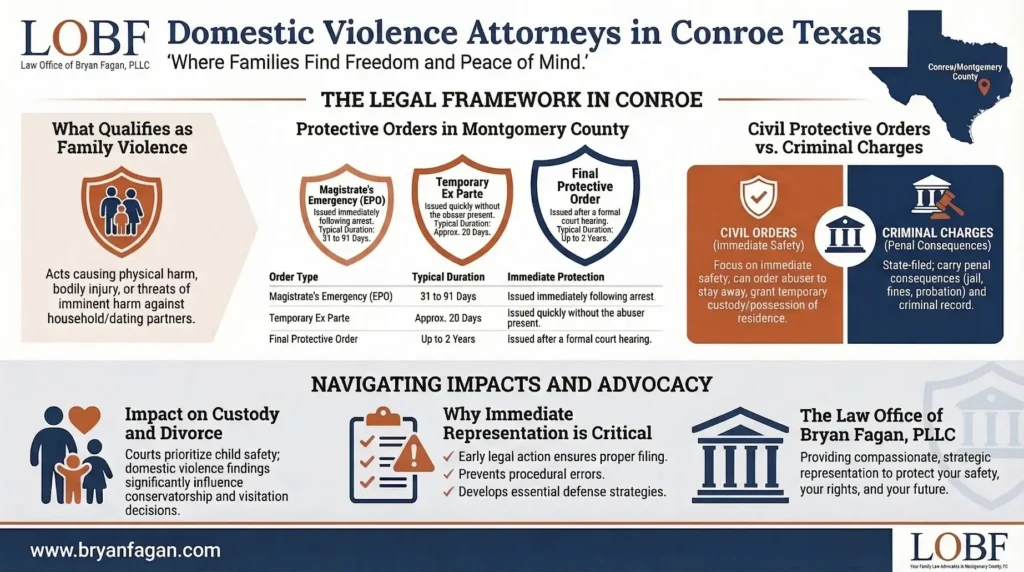
Table #2: Evidence Map (Helpful Evidence vs Pitfalls)
| Issue | Helpful Evidence | Common Mistakes/Pitfalls | Safer Alternative |
|---|---|---|---|
| Threats or harassment | Screenshots with timestamps, call logs, voicemails | Angry response texts, engaging in mutual escalation | Save communications without responding; document and share with attorney |
| Physical incidents | Photos taken promptly, medical records, police reports | Delayed documentation, vague descriptions | Photograph injuries immediately, seek medical attention, file police report |
| Stalking-like behavior | Location logs, witness statements, security footage | Social media posts that reveal your location | Document incidents contemporaneously, vary routines, involve law enforcement |
| Child-related concerns | School records, counselor reports, children’s statements to professionals | Coaching children or making accusations without basis | Let professionals interview children, document concerns factually |
| Pattern of abuse | Timeline with dates and descriptions, witness corroboration | Relying on memory alone, isolated incidents without context | Keep a written log with dates, times, and details as events occur |
If You Need Protection Now: Safety-First, Lawful Steps
If you are in immediate danger, call 911. Your safety—and the safety of your children—must come first. Law enforcement can respond quickly, and Texas law provides emergency remedies designed to protect individuals facing family violence. Under Texas Family Code §83.001 and §85.001, courts may issue temporary ex parte protective orders when there is a clear and present danger of family violence, allowing swift legal intervention even before a full hearing is held.
After immediate safety concerns are addressed, thoughtful preparation can make a meaningful difference. Creating a safety plan is often the next step. Identify a secure place to go, a trusted friend or family member who understands your situation, and gather essential documents such as identification, children’s birth certificates, financial records, and school information. Preserving communications is equally important. Save text messages, emails, voicemails, and take screenshots with visible timestamps. Documentation matters because courts rely on evidence when determining whether family violence occurred under §71.004 and when evaluating conservatorship issues under §153.004.
Writing down a clear timeline of events while details are fresh can help your attorney present your case effectively. Dates, locations, witnesses, and descriptions of incidents provide structure to your testimony. If children are involved, courts must prioritize their best interest under Texas Family Code §153.002. That means evidence of safety concerns, emotional impact, and stability can influence both protective order proceedings and custody determinations. Parents who want to better understand how local schools and community resources support children during difficult transitions may find helpful information in our guide to education and school resources in Conroe.
Connecting with local advocacy organizations, such as the Montgomery County Women’s Center, can provide court accompaniment and support services. At the same time, consulting with experienced Domestic Violence Attorneys in Conroe Texas ensures that you understand whether your circumstances meet the statutory definition of family violence and what legal remedies are available. The legal team at The Law Office of Bryan Fagan, PLLC can guide you through filing for a temporary protective order, preparing for a final hearing, and addressing related custody or divorce matters. For a deeper overview of how these cases unfold in Texas courts, you may review our comprehensive Texas Domestic Violence resource page.
Protective orders are not merely paperwork; they are enforceable court directives that can restrict contact, address residence concerns, and establish temporary parenting arrangements. Your safety matters, and taking deliberate, lawful steps creates a stronger foundation for legal protection. With clear information, careful documentation, and steady legal guidance, families can move from crisis toward stability while safeguarding what matters most.

If You’ve Been Accused: How to Respond Without Making It Worse
Being accused of family violence or served with a protective order application can feel overwhelming and deeply unsettling. The first days after receiving notice are critical. Under Texas Family Code Chapter 85, courts may issue temporary ex parte protective orders when there is a finding of clear and present danger, and a full hearing will typically follow soon after. Even if you believe the allegations are unfounded, it is essential to take the matter seriously. Failing to respond, ignoring court paperwork, or missing a hearing can result in a default protective order that carries significant legal consequences, including restrictions on contact, possession of children, and firearm rights.
If a temporary protective order or criminal no-contact order has been issued, strict compliance is not optional. Violating a court order can lead to arrest, additional charges, and enforcement proceedings under Texas Family Code Chapter 157. Courts also consider compliance history when evaluating conservatorship under §153.004 and determining what arrangement serves the best interest of the child under §153.002. Judges in Montgomery County treat allegations of family violence with seriousness, and credibility matters at every stage.
Avoid direct contact with the other party unless expressly permitted by court order. Even a well-meaning message can be interpreted as harassment or intimidation. If children are involved and logistical communication is necessary, consult your attorney about approved communication platforms or court-authorized methods. Preserving evidence is equally important. Save text messages, emails, call logs, and identify witnesses who can speak to relevant events. If medical attention was sought by any party, documentation from healthcare providers may become part of the evidentiary record. For individuals seeking local care or documentation support, information about available facilities can be found through our guide to medical resources in Conroe, TX.
Many individuals consult Domestic Violence Attorneys in Conroe Texas to ensure their response aligns with the statutory framework set forth in Texas Family Code §§71.004 and 85.001. The legal team at The Law Office of Bryan Fagan, PLLC carefully reviews the allegations, evaluates available evidence, and prepares a clear, fact-based defense strategy. Appearing at every hearing with counsel provides structure and professionalism in what can otherwise feel like an emotional process. For a broader understanding of how these cases unfold in Texas courts, you may review our comprehensive Texas Domestic Violence resource page.
Staying calm and measured is one of the most powerful steps you can take. Emotional reactions—whether in person, through text, or on social media—can undermine your position. Focus instead on lawful, evidence-driven responses and consistent compliance with court directives. With careful preparation and experienced legal guidance, even frightening accusations can be addressed through the structured protections and due process provided under Texas law.
Listen to Our Texas Family Law Podcast
Prefer listening? In this episode, we discuss domestic violence in Conroe, Texas, including your legal rights, available protective measures, and the options you have to stay safe and take action.
How Domestic Violence Attorneys Help in Conroe and Montgomery County
Domestic violence attorneys in Conroe and Montgomery County provide critical guidance at a stressful time. They help by:
- Assessing your situation quickly. Whether you need protection or face accusations, an experienced attorney evaluates the facts against Texas law and identifies your strongest options.
- Organizing evidence effectively. Courts respond to well-documented, clearly presented evidence. Attorneys help you gather, preserve, and present what matters.
- Coordinating strategy across proceedings. Family violence issues often overlap with divorce, custody, and criminal matters. A strategic approach addresses protective orders, custody implications, and criminal charges together rather than in isolation.
- Navigating Montgomery County procedures. Local knowledge matters. Montgomery County district courts have their own schedules, practices, and expectations. An attorney familiar with local procedures helps your case move efficiently.
- Drafting enforceable orders. Whether seeking or negotiating protective order terms, precise language reduces future ambiguity and conflict.
Montgomery County’s Domestic Violence Unit handles both misdemeanor and felony family violence cases. The Montgomery County Attorney’s Office processes protective order applications. Working with an attorney who understands these local systems helps you present evidence effectively and meet procedural requirements.
Why Choose The Law Office of Bryan Fagan, PLLC
When families face protective orders or custody disputes involving allegations of family violence, experience matters. The attorneys at The Law Office of Bryan Fagan, PLLC have extensive experience handling these complex cases in Texas courts, including matters governed by Texas Family Code Chapters 71 and 85, which define family violence and outline the procedures for protective orders. We also work closely with the statutory framework in Chapters 153, 156, and 157, which address conservatorship, modification of custody orders, and enforcement. These laws are not abstract provisions; they directly determine who may remain in a residence, how parenting time is structured, and what legal protections are available when safety concerns arise.
Families seeking guidance from Domestic Violence Attorneys in Conroe Texas often need more than legal answers—they need clarity, reassurance, and a strategic plan. Under Texas Family Code §153.002, courts must act in the best interest of the child, and §153.004 requires judges to carefully evaluate any history of family violence when making conservatorship decisions. Recent legislative updates continue to refine enforcement mechanisms and protective order procedures, reinforcing the importance of precise legal advocacy. Our legal team translates these evolving standards into practical advice you can understand and apply.
Clear communication is at the heart of our approach. We believe clients deserve to know what to expect at each stage of the process, whether that involves an emergency ex parte hearing, a final protective order proceeding, or a custody modification under §156.101. Compassionate guidance is equally essential. Family violence cases often involve trauma, uncertainty, and urgent logistical concerns such as safe exchanges and transportation arrangements for children. Parents navigating possession schedules and community logistics can find helpful local information in our guide to transportation in Conroe, which can assist in planning safe and compliant exchanges.
Strategic advocacy completes the foundation of effective representation. Whether presenting evidence in Montgomery County courts or coordinating broader custody strategy across Texas, our firm focuses on outcomes that protect safety and long-term stability. Clients who want to better understand how protective orders function within the larger family law system may also review our comprehensive Texas Domestic Violence resource page.
The Law Office of Bryan Fagan, PLLC represents clients throughout Texas and offers consultations designed to provide clarity and direction. By combining statutory knowledge, practical planning, and empathetic client communication, we remain committed to educating families, protecting futures, and guiding clients toward stronger and more secure outcomes.

Actionable Checklist: Domestic Violence Attorneys in Conroe Texas
- [ ] Write down a timeline with dates, locations, and descriptions of what happened
- [ ] Save relevant text messages, emails, and call logs (do not alter anything)
- [ ] Gather any existing police reports, medical records, or photographs
- [ ] Identify witnesses who observed relevant incidents
- [ ] Follow any temporary orders exactly—no exceptions
- [ ] Avoid social media posts and reactive messaging about your situation
- [ ] Prepare a list of child-focused safety concerns if custody is involved
- [ ] Bring identification and key documents to every court appearance
- [ ] Ask an attorney about protective order options and custody implications
- [ ] Create a short safety plan with a safe location and trusted contact
Conclusion
Family conflict can feel loud, chaotic, and deeply personal—but the legal path forward does not have to be. When domestic violence allegations intersect with divorce or custody issues, the stakes are high and the emotions even higher. Yet clarity is possible. With the right structure, the right information, and the right legal guidance, families can move from reaction to intention. That shift alone can change everything.
What matters most is this: you do not have to navigate these decisions blindly. Texas law provides tools designed to protect safety, preserve parental rights when appropriate, and prioritize the best interest of your children. The key is knowing how to use those tools wisely. An experienced Texas Family Law Attorney understands not only the statutes and courtroom procedures, but also the human side of these cases—the sleepless nights, the uncertainty, and the desire to protect your family’s future.
At The Law Office of Bryan Fagan, PLLC, our mission is to empower families with knowledge and steady guidance so they can reclaim peace of mind during life’s hardest transitions. Whether you are seeking protection, responding to allegations, or working to build a stable co-parenting plan, thoughtful legal strategy makes a meaningful difference.
If you are facing questions about domestic violence, custody, or divorce in Conroe or Montgomery County, consider taking the next step. Schedule a consultation, ask your questions, and get clear answers tailored to your situation. Even one informed conversation can replace anxiety with direction.
And as you think about what comes next, remember this: strong families are not defined by conflict, but by how they move through it. With the right support, you can move forward with confidence—and build a safer, steadier future for the people who matter most.
Frequently Asked Questions About Domestic Violence in Texas
In Texas, domestic violence is generally addressed under both the Texas Family Code and the Texas Penal Code. The Family Code defines “family violence” in §71.004 and governs protective orders that restrict contact, establish safety provisions, and may affect custody. On the criminal side, offenses such as Assault–Family Violence are often prosecuted under Texas Penal Code §22.01. Depending on the facts, cases can involve emergency protective orders, bond conditions, and long-term consequences that impact custody and parental rights. Because family and criminal courts often overlap in these cases, it is important to understand how both systems may apply to your situation.
Domestic abuse is commonly described in four categories: physical abuse, sexual abuse, emotional or psychological abuse, and financial or economic abuse. While Texas law focuses primarily on conduct involving physical harm or credible threats of imminent harm, courts may also consider patterns of control, intimidation, or coercion—especially when children are involved. Even if behavior does not result in physical injury, it can still play a role in custody decisions or protective order proceedings.
There is no single, universal “3 year rule” that applies to all domestic violence cases in Texas. The phrase is often used informally and may refer to specific legal timelines or eligibility requirements in certain contexts. Because the meaning varies depending on the situation, it is important to clarify what legal issue is being referenced. A Texas family law attorney can review your case and explain whether any time-based rule actually applies to your circumstances.
In Texas, people sometimes use the phrase “3rd degree domestic violence” to describe a third-degree felony offense involving family violence. Whether a case is charged as a misdemeanor or felony depends on the conduct alleged and the accused person’s prior history. Certain repeat allegations or specific acts can elevate charges. The classification significantly affects potential penalties, bond conditions, and how the case may impact custody or divorce proceedings.
The amount of time someone stays in jail depends on several factors, including the specific charge, bond eligibility, and court scheduling. Many individuals are released once bond is posted, but certain cases may involve stricter bond conditions or temporary holds. Violating bond conditions or protective orders can result in additional charges and further detention. Because outcomes vary widely, immediate legal guidance is critical after an arrest or formal accusation.
Domestic violence laws can change through updates to Texas statutes or federal legislation. There is no single “new act” that universally governs all cases. Legislative changes may affect protective order procedures, firearm restrictions, or criminal penalties. If you are dealing with an active case, it is important to consult an attorney who is familiar with current Texas law to ensure your strategy reflects the most recent legal standards.
Common signs of emotional abuse include persistent humiliation or insults, isolation from friends or family, threats or intimidation, extreme jealousy, controlling communication or movement, blaming the victim for the abuser’s behavior, and gaslighting—where a person denies reality to make someone doubt their own memory or perception. While emotional abuse may not always involve physical harm, it can significantly affect children and may influence custody determinations if it impacts safety or well-being.
The “10 4 rule” is not a recognized legal term in Texas domestic violence law. The phrase is sometimes used in informal discussions or online content, but it does not correspond to a specific statute or enforceable rule. If you encounter this term in research, it is important to verify its legal relevance. An experienced Texas family law attorney can clarify whether the underlying concept has any impact on your case.
Punishment depends on the specific offense and circumstances. Consequences may include jail or prison time, fines, probation, mandatory counseling programs, firearm restrictions, and protective orders. In family court, a finding of family violence can affect conservatorship, visitation, and decision-making rights regarding children. Because penalties can extend beyond criminal court into custody and divorce proceedings, understanding the full legal landscape is essential before making decisions about how to proceed.
