
Parental Alienation in Conroe Texas: A Complete Guide for Parents in Montgomery County

It often starts small. Your child hesitates before getting in the car. They repeat phrases that sound rehearsed. They look at you with confusion instead of comfort. If you are facing Parental Alienation in Conroe Texas, you may feel like your relationship with your child is quietly shifting—and you do not fully understand why. What once felt natural now feels strained. Conversations are shorter. Affection feels guarded. And the bond you worked so hard to build suddenly feels fragile.
Texas courts recognize that when a child’s relationship with a parent begins to erode without a legitimate safety reason, something deeper may be happening. Under Texas Family Code §153.002, judges are required to base custody decisions on the best interest of the child. That includes protecting the child’s emotional stability and preserving meaningful relationships with both parents. When one parent’s actions interfere with that bond, courts take notice.
At The Law Office of Bryan Fagan, PLLC, we understand how devastating this experience can be. Founded by Bryan Joseph Fagan, a South Texas College of Law graduate and recognized authority in Texas divorce and custody law, our firm has worked with families across Houston and Montgomery County who are navigating high-conflict custody disputes. Many parents come to us feeling confused, frustrated, and heartbroken. They are not looking to “win” against the other parent. They simply want their child to feel safe loving them again.
Our mission is rooted in something deeper than legal strategy. We exist to empower families to reclaim peace of mind during life’s hardest transitions. We do that through compassionate counsel, clear education, and innovative legal solutions that simplify what often feels overwhelming. When conflict threatens the stability of your parent-child relationship, having experienced legal guidance can make the difference between escalation and restoration.
If you have sensed that something is changing in your child’s behavior or attitude, this article will help you understand how Texas courts evaluate these situations, what warning signs to watch for, and what practical steps can protect both your parental rights and your child’s emotional well-being. You are not alone in this—and there is a path forward grounded in clarity, strength, and hope.
Key Takeaways
- Parental alienation in Texas is addressed through the child’s best interest standard under Texas Family Code §153.002, not as a separate legal claim—courts evaluate interference with the parent child bond as part of custody decisions.
- Documentation is critical: Texas courts in Montgomery County respond to specific, neutral evidence like missed exchange logs, written communications, and school records—not emotional accusations.
- Alienation and safety concerns are different: Courts take both seriously, so responsible claims require distinguishing manipulative interference from legitimate protective actions.
- Legal remedies exist: Enforcement motions under Chapter 157, modification petitions under Chapter 156, and court ordered counseling or parenting coordination can address ongoing interference.
- Early action matters: Addressing alienating behaviors before they become entrenched gives courts fresher evidence and better protects your child’s emotional development.

Your Family’s Future Starts Here
Don’t navigate your legal journey alone. Schedule a consultation now and get the clarity and support you deserve.
We offer comprehensive family law and estate planning services, including but not limited to the following:
Trust us to help you with your Family case in Conroe, Texas. Call 281-562-7344 or contact us online today to schedule a free consultation with your Family Law Attorneys in Conroe, Texas.
Parental Alienation in Conroe Texas: The Short Answer
Parental Alienation in Conroe Texas is not a standalone lawsuit you file in court—but it is a pattern of behavior that Texas judges take seriously when it harms a child’s relationship with a parent. In Montgomery County family courts, these situations typically involve one parent engaging in conduct designed to damage the child’s bond with the other parent, such as persistent badmouthing, interfering with communication, refusing to comply with court-ordered possession schedules, or subtly reshaping the child’s perception through guilt or false narratives. For families who are relocating and trying to understand how custody works locally, our guide to moving to Conroe provides helpful context about the community and the legal landscape.
Texas courts evaluate these behaviors through the framework of the “best interest of the child” standard set out in Texas Family Code §153.002, which makes clear that the child’s welfare—not a parent’s frustration or personal conflict—controls custody decisions. When determining conservatorship, courts also consider each parent’s willingness and ability to encourage a close and continuing relationship between the child and the other parent under §§153.131 and 153.134. If a parent interferes with court-ordered possession, enforcement remedies may be pursued under Chapter 157 of the Texas Family Code, and repeated violations or harmful conduct may justify a modification under §156.101 if there has been a material and substantial change in circumstances.
At the same time, Texas law carefully distinguishes between manipulation and legitimate safety concerns. Under §153.004 and related provisions, courts must prioritize protecting children from family violence, abuse, or neglect. A child’s reluctance to visit a parent may sometimes stem from credible safety issues that require investigation and protection. Alienation, by contrast, occurs when a parent undermines a fit parent’s relationship without legitimate justification—through manipulation, emotional pressure, or false claims rather than genuine concern for the child’s safety.
At The Law Office of Bryan Fagan, PLLC, our team blends compassionate client communication with authoritative legal advocacy. We understand that custody disputes are deeply personal and emotionally charged. Our role is to educate families, present clear evidence, and protect futures by aligning every legal strategy with what Texas courts require and what children truly need: stability, safety, and meaningful relationships with both parents whenever possible. For a deeper explanation of how Texas courts analyze conservatorship and possession disputes, we encourage you to review our detailed Texas Child Custody Guide, which walks through the law and practical next steps parents can take to safeguard their rights and their child’s well-being.

What Parental Alienation Looks Like in Real Life
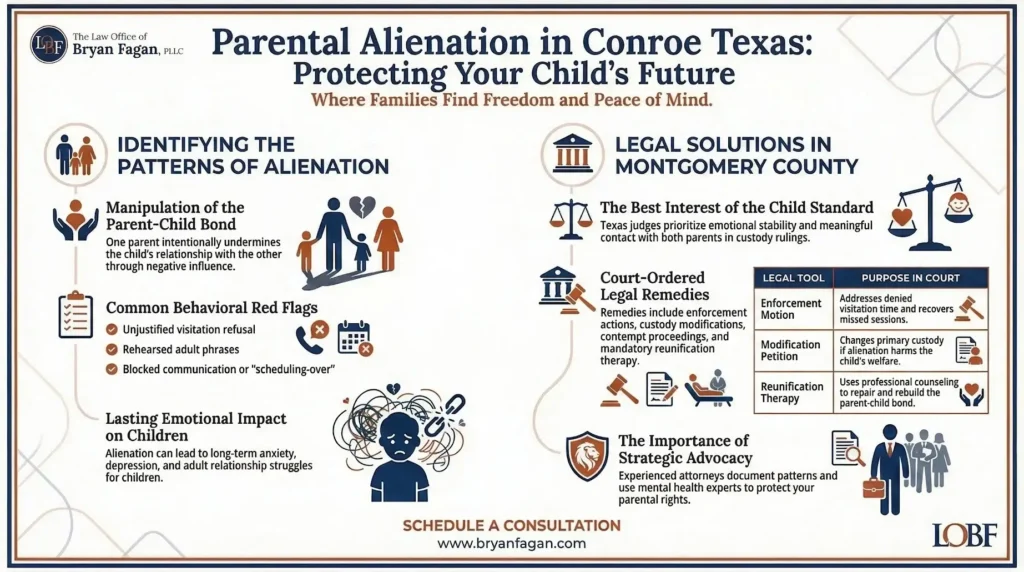
Parental Alienation in Conroe Texas often develops through subtle, repeated behaviors rather than dramatic events. In Montgomery County custody proceedings, courts are not focused on labels or clinical terminology; instead, they evaluate conduct through the “best interest of the child” standard set forth in Texas Family Code §153.002. Judges carefully assess whether a parent’s actions support or damage the child’s emotional stability and relationship with both parents.
One common sign of alienating behavior is undermining the other parent’s authority. This may include telling a child that rules at the other parent’s home do not matter or portraying that parent’s decisions as harmful or unreasonable. When courts determine conservatorship under §§153.131 and 153.134, they consider each parent’s willingness and ability to encourage a positive, ongoing relationship with the other parent. Conduct that erodes that bond can significantly influence custody outcomes.
Another red flag is involving the child in adult disputes. Sharing details about ongoing litigation, child support disagreements, or past relationship grievances places emotional burdens on children that they should not carry. Texas public policy, reflected in §153.001, favors frequent and continuing contact with fit parents, and courts are attentive to behavior that pulls children into loyalty conflicts or emotional crossfire.
Interfering with communication is also taken seriously. Blocking phone calls, discouraging text messages, failing to make the child available during scheduled contact times, or creating avoidable logistical obstacles can undermine a court-ordered possession schedule. Enforcement remedies are available under Chapter 157 of the Texas Family Code, and repeated interference may support modification under §156.101 if there has been a material and substantial change in circumstances.
“Scheduling over” court-ordered possession time—such as planning social events or extracurricular activities during the other parent’s designated time—can also create harmful pressure. Similarly, telling a child, “You don’t have to go if you don’t want to,” when a possession order is in effect shifts adult responsibility onto the child. Courts expect parents to comply with existing orders and model respect for both the law and the co-parenting relationship.
Some behaviors are more subtle but equally damaging. Statements like “I’ll be so lonely without you” or “I don’t know what happens at that house” may seem small in isolation, yet over time they can plant fear, guilt, or distrust. When these patterns accumulate, they may influence how a judge evaluates conservatorship, possession, and a parent’s ability to act in the child’s best interests.
The attorneys at The Law Office of Bryan Fagan, PLLC approach these cases with both legal precision and empathy. We recognize that custody disputes are emotionally charged, and we work to separate legitimate safety concerns—addressed under §153.004 when family violence or abuse is alleged—from conduct that improperly undermines a healthy parent-child relationship. Families seeking additional local guidance can explore school and community considerations through our resource on education and school resources in Conroe.
For a deeper understanding of how Texas courts analyze conservatorship and possession issues, including recent statutory updates, we encourage parents to review our comprehensive Texas Child Custody Guide. Our mission is simple: to educate families, protect futures, and advocate for solutions that truly serve the best interests of Texas children.

Alienation vs Safety: How to Talk About It Responsibly
In cases involving Parental Alienation in Conroe Texas, one of the most important distinctions a parent must understand is this: not every child who resists visitation is being alienated. Texas courts take both visitation interference and legitimate safety concerns seriously, and confusing the two can harm your credibility and, more importantly, place a child at risk. Under Texas Family Code §153.002, the child’s best interest is always the court’s primary consideration, and judges carefully evaluate whether a child’s resistance stems from manipulation or from genuine welfare concerns.
Children may resist visitation for valid and legally significant reasons. Exposure to family violence, abuse, or neglect triggers heightened scrutiny under §153.004, which requires courts to consider evidence of family violence when determining conservatorship and possession. Developmental challenges, anxiety following separation, or trauma-related responses may also explain changes in behavior. In these situations, courts may appoint a guardian ad litem or amicus attorney under Chapter 107 of the Texas Family Code, order psychological evaluations, or rely on mental health professionals to better understand the child’s needs. Parents seeking supportive services in the community can explore local options through our resource on medical resources in Conroe.
At the same time, when a parent makes knowingly false allegations of abuse to block court-ordered visitation, Texas courts may interpret that conduct as interference with possession under Chapter 157 and as a factor supporting modification under §156.101 if circumstances have materially and substantially changed. Judges expect parents to raise legitimate safety concerns through proper legal channels—such as filing a motion to modify or seeking temporary orders under Chapter 105—rather than unilaterally withholding possession in violation of an existing court order.
Montgomery County judges often focus on a central question: Is the child’s resistance rooted in protecting their welfare, or is it the result of one parent’s agenda? Courts evaluating conservatorship under §§153.131 and 153.134 consider which parent is more likely to encourage a healthy relationship with the other parent while still safeguarding the child’s emotional and physical safety.
Parents facing these difficult situations should document concerns neutrally and objectively. Record behavioral changes, specific statements, and relevant events without exaggeration or emotional commentary. Seek professional guidance from qualified custody evaluators or licensed mental health professionals when warning signs appear. Avoid assuming every challenge is manipulation, but also avoid dismissing genuine indicators of harm.
The legal team at The Law Office of Bryan Fagan, PLLC approaches these cases with both precision and compassion. Our role is to help families separate fear from fact, protect children from real danger, and address improper interference when it occurs. For a deeper understanding of how Texas courts evaluate conservatorship disputes and enforce possession rights, we invite you to review our comprehensive Texas Child Custody Guide. Educating families and protecting futures is not just our mission—it is the foundation of every case strategy we build.
Why This Matters: The Child’s Emotional Reality
The psychological harm from parental alienation extends far beyond missed weekends. Alienated children carry burdens no child should bear—forced to choose between parents, taught to distrust someone they love, and robbed of meaningful relationships that support healthy development.
Consider a Conroe middle schooler whose alienating parent constantly criticizes their other parent at dinner. The child learns to perform loyalty—saying what they think one parent wants to hear while suppressing their genuine feelings about the other. This creates anxiety around exchanges, emotional distress during transitions, and long-term damage to the child’s development of trust and attachment.
Texas Family Code §153.001 establishes public policy that children should have frequent and continuing contact with both parents. This isn’t about parent’s rights—it’s about the child’s life and their need for stable, loving relationships with both parents.
The goal in addressing alienation isn’t “winning” against the other parent. It’s restoring the child’s ability to love both parents without guilt, fear, or loyalty conflicts. Montgomery County courts share this goal, and they evaluate parental behavior through this lens.
Table #1: Behaviors, Impact, and Healthier Alternatives
| Alienating Behavior | Potential Impact on Child | Healthier Alternative |
|---|---|---|
| Criticizing the other parent in front of the child | Child feels torn, develops anxiety about expressing love for both parents | Keep adult frustrations between adults; speak neutrally about the co parent |
| Blocking phone calls or video chats | Child feels disconnected, may believe the targeted parent doesn’t care | Facilitate communication and protect call times |
| Scheduling activities during the other parent’s possession time | Child faces impossible choices, feels responsible for disappointing someone | Coordinate schedules in advance; respect court ordered time |
| Telling the child details about legal proceedings | Child carries adult burdens, experiences emotional distress | Shield children from custody dispute details |
| Saying “you don’t have to go if you don’t want to” | Child feels empowered to reject parent, creating long-term relationship harm | Affirm that time with both parents matters and is expected |
| Making the child feel guilty for enjoying time with the other parent | Child suppresses positive feelings, develops loyalty conflicts | Celebrate the child’s happiness regardless of where it occurred |
| Questioning the child about the other parent’s home or relationships | Child feels like a spy, loses sense of privacy and safety | Let the child share naturally without interrogation |
| Referring to the other parent by first name or negative nicknames | Child’s perception of parent as authority figure erodes | Use respectful language: “your mom” or “your dad” |
How Texas Courts Generally View Visitation Interference
Texas courts focus on the child’s best interests when evaluating claims of interference with custody or visitation orders. Under Texas Family Code §153.002, judges consider factors including each parent’s ability to encourage a positive relationship between the child and the other parent.
When one parent consistently blocks possession time, badmouths the other parent, or manipulates the child’s wishes, Montgomery County family courts view this as evidence relevant to custody decisions. Interference can support enforcement motions under Chapter 157 or modification petitions under Chapter 156, depending on the circumstances.
Texas law requires compliance with court orders. When a parent refuses to follow possession schedules, the targeted parent may file a motion for enforcement. Courts can order makeup time, impose fines, assess attorney’s fees, and in serious cases, hold the violating parent in contempt—which may include jail time.
The Texas Penal Code §25.03 makes interference with child custody a criminal offense when a parent knowingly violates a court order by taking or retaining a child. Recent changes effective September 2025 strengthen consequences for repeated violations under the “Three Strikes” law—escalating penalties from misdemeanor fines to potential felony charges after the third offense.
Montgomery County courts don’t automatically change custody based on alienation claims, but documented patterns of interference do influence decisions about the child’s welfare and each parent’s fitness.
Evidence That Helps (and Evidence That Hurts)
Texas courts require concrete documentation, not emotional accusations. What you bring to a Montgomery County courtroom matters as much as what happened.
Evidence that strengthens your case:
- Detailed exchange logs: Date, time, what happened, what was said, who was present. Note missed possessions neutrally.
- Written communication records: Texts, emails, and parenting app messages showing interference, negative comments, or scheduling manipulation.
- School and medical records: Attendance patterns, behavior reports, and therapy notes showing emotional distress tied to exchanges.
- Witness statements: Teachers, coaches, and counselors who observed behavior changes or heard concerning statements from the child.
- Parenting app histories: If you use apps like OurFamilyWizard or TalkingParents, these create documented timelines.
Evidence that damages your credibility:
- Coaching the child: If the child’s statements seem rehearsed or prompted, courts become skeptical of both the claims and your judgment.
- Obsessive recording: Constantly filming exchanges or the child’s statements can appear vindictive rather than protective.
- Angry messages: Texts written in frustration may be used against you to show conflict escalation.
- Social media posts: Venting about your custody dispute online undermines your position and may reach the child.
- Unilateral schedule changes: If you withhold the child based on your own concerns without court approval, you become the violating parent.
Montgomery County judges see these cases regularly. Present organized, neutral documentation that demonstrates patterns rather than isolated incidents.
Listen to Our Texas Family Law Podcast
Prefer listening? In this episode, we discuss parental alienation in Conroe, Texas, including warning signs, its impact on parent-child relationships, and legal options available to protect your rights.
What to Do When Your Child Refuses Visitation
When a child refuses to come for your court-ordered possession time, your response can significantly impact both your legal position and your child’s emotional well-being. In cases involving Parental Alienation in Conroe Texas, courts closely examine how each parent reacts under stress. Texas Family Code §153.002 makes clear that the child’s best interest is always the primary consideration, and judges often evaluate whether a parent demonstrates patience, maturity, and a willingness to reduce conflict—even when facing resistance.
First, stay calm and avoid interrogation. Ask gentle, age-appropriate questions about how your child is feeling without assigning blame or pressuring them for answers. Children are highly sensitive to emotional cues, and reacting with frustration can unintentionally reinforce anxiety or loyalty conflicts. Courts evaluating conservatorship under §§153.131 and 153.134 consider which parent is more likely to encourage a positive and continuing relationship with the other parent, so maintaining composure protects both your child and your credibility.
Second, document neutrally and consistently. Record the date, time, what the child said, who was present, and your efforts to facilitate the exchange. Keep your notes factual rather than emotional. If possession is denied, enforcement remedies may be available under Chapter 157 of the Texas Family Code. Clear documentation can also become critical if a modification is later sought under §156.101 based on a material and substantial change in circumstances.
Third, confirm exchanges in writing. Send a respectful text or email confirming the time and location outlined in your order. If the other parent cancels or the child refuses to attend, document that you appeared at the designated exchange location and were prepared to exercise your possession time. Practical logistics—including distance and travel planning—can also affect exchanges, and parents navigating local travel considerations may find helpful context in our community guide on transportation in Conroe.
Fourth, avoid negative talk about the other parent. Even when you feel hurt or frustrated, criticizing the other parent to your child can deepen loyalty conflicts and may be viewed unfavorably by the court. Texas public policy under §153.001 supports frequent and continuing contact with fit parents, and judges expect both parties to promote that stability whenever possible.
Fifth, seek professional support when appropriate. A licensed family therapist experienced in high-conflict custody cases can help your child process complex emotions in a healthy environment. In some situations, therapeutic records or testimony may provide important context regarding behavioral patterns affecting the child.
Finally, consult a knowledgeable family law attorney early. Waiting until patterns become entrenched can make intervention more difficult. The legal team at The Law Office of Bryan Fagan, PLLC evaluates whether enforcement, mediation, or modification is the most strategic path forward while ensuring your evidence is properly preserved and admissible. For a broader understanding of how possession and enforcement work in Texas, we encourage parents to review our detailed Texas Child Custody Guide. Our mission remains consistent: to educate families, protect futures, and advocate for solutions that place children’s long-term stability first.
Table #2: Choosing the Right Legal Tool
| Situation | Recommended Legal Tool | What It Accomplishes | What to Gather |
|---|---|---|---|
| Other parent repeatedly denies possession time | Enforcement motion (Chapter 157) | Court orders compliance, makeup time, attorney’s fees; contempt possible | Exchange logs, communication records, witness statements |
| Child’s relationship with you has seriously deteriorated due to alienation | Modification petition (Chapter 156) | Changes custody arrangements to protect child’s best interests | Mental health evaluations, school records, documented behavior patterns |
| Immediate protection needed during pending case | Temporary orders | Establishes interim structure, may order supervised exchanges | Current evidence of interference or harm |
| High conflict but no order violations | Parenting coordinator or facilitation | Neutral third party helps manage communication and compliance | Communication records showing conflict patterns |
| Child needs therapeutic intervention | Court ordered reunification therapy | Professional helps rebuild parent child relationship | Mental health expert recommendations |

Legal Options in Conroe Custody Cases
Parents navigating Parental Alienation in Conroe Texas have meaningful legal remedies available through the Montgomery County family courts, but success depends on understanding how Texas law frames the issue. Rather than treating alienation as a separate claim, courts analyze conduct under the best interest standard in Texas Family Code §153.002 and the broader public policy outlined in §153.001, which favors frequent and continuing contact with fit parents. When one parent’s behavior interferes with that policy, judges have several tools available to restore stability and protect the child’s emotional well-being.
Enforcement actions are often the first step. Under Chapter 157 of the Texas Family Code, a parent may file a motion to enforce when the other parent refuses court-ordered possession or interferes with access. If a violation is proven, courts may award make-up possession time, impose fines, order payment of attorney’s fees, and in serious cases hold the violating parent in contempt. These remedies are designed not to punish unnecessarily, but to reinforce the authority of court orders and protect the child’s right to consistent relationships.
When alienating behaviors become ongoing and materially affect the parent-child relationship, a modification may be appropriate. Chapter 156 of the Texas Family Code allows a court to modify conservatorship or possession if there has been a material and substantial change in circumstances and the requested change serves the child’s best interests under §156.101. In certain cases, this can include adjusting possession schedules or even changing which parent has the exclusive right to designate the child’s primary residence. Courts also evaluate factors outlined in §§153.131 and 153.134, including each parent’s ability to encourage a positive relationship with the other parent.
Temporary orders can provide immediate structure while a case is pending. If a parent’s conduct threatens immediate harm to the child’s welfare or significantly disrupts the parent-child bond, courts may enter temporary orders under Chapter 105 to stabilize the situation. These orders can address exchange protocols, communication guidelines, supervised visitation, or other safeguards tailored to the family’s circumstances.
Texas courts increasingly recognize that high-conflict custody cases often require more than strict enforcement. Professional interventions such as reunification therapy, parenting coordination under §153.601 and related provisions, or co-parent counseling may be ordered or agreed upon to reduce escalation and promote healthier dynamics. These solutions align with the Legislature’s emphasis on protecting children’s emotional development while minimizing unnecessary litigation.
The attorneys at The Law Office of Bryan Fagan, PLLC guide families through these options with both clarity and compassion. Our role is not only to advocate in court but also to educate parents about the legal standards and strategic pathways available to them. Families seeking local support services or court-related information can review our resource on government resources in Conroe. For a deeper explanation of enforcement, modification, and conservatorship standards in Texas, we also recommend our comprehensive Texas Child Custody Guide.
At every stage, our mission remains the same: to educate families, protect futures, and pursue solutions that genuinely serve the best interests of Texas children.
How a Conroe Custody Attorney Can Help with Parental Alienation Concerns
Addressing Parental Alienation in Conroe Texas requires translating painful experiences into effective legal strategy. A Montgomery County custody attorney brings several advantages:
Legal framework translation. Your attorney identifies which legal tools—enforcement, modification, temporary orders—fit your specific situation and presents your concerns in terms Texas courts recognize.
Evidence organization. What feels like obvious interference may need careful documentation to become admissible evidence. An attorney helps you gather communication records, witness statements, and professional observations that support your case.
Escalation reduction. Legal counsel helps you respond strategically rather than emotionally, avoiding actions that damage your credibility while protecting your rights.
Child-centered advocacy. The goal isn’t punishing the alienating parent—it’s protecting your child’s welfare and restoring your relationship. An experienced family law attorney keeps this focus central.
Why Choose The Law Office of Bryan Fagan, PLLC
The Law Office of Bryan Fagan, PLLC brings deep experience with Montgomery County custody disputes, including parental alienation cases in Conroe and throughout Texas.
Our approach centers on the child’s welfare while protecting your parental rights. We understand Montgomery County family courts, the judges who hear these cases, and the evidence that persuades them.
We communicate clearly throughout the process, explaining your legal options in plain English and helping you make informed decisions. When courtroom advocacy is necessary, we bring the preparation and skill these difficult cases require.
Our firm represents clients statewide while maintaining a strong local presence in the Conroe area. We understand the realities Conroe families face—school district schedules, travel within Montgomery County, and the practical challenges of co parenting after separation.
We cannot guarantee specific outcomes, and no ethical attorney can. What we can offer is dedicated representation focused on your child’s best interests and your relationship with them.
Checklist: Parental Alienation in Conroe Texas
Use this checklist if you’re concerned about parental alienation in your custody situation:
- [ ] Read your custody order carefully and highlight possession provisions, exchange times, and communication requirements
- [ ] Track missed possession time neutrally with dates, times, circumstances, and any communications before or after
- [ ] Keep all written communications with the other parent—texts, emails, parenting app messages
- [ ] Maintain a calm, respectful tone in all communications, even when frustrated
- [ ] Confirm exchanges in advance in writing so there’s documentation of your compliance
- [ ] Avoid discussing adult conflict with your child or asking them to carry messages
- [ ] Gather school and medical records if behavior changes correlate with exchanges or alienating behaviors
- [ ] Consider a child counselor who can provide professional perspective on your child’s emotional state
- [ ] Consult a custody attorney early before behaviors become entrenched and evidence grows stale
- [ ] Don’t withhold your child from the other parent’s possession time—you become the violating party
- [ ] Prepare organized documentation for mediation or enforcement proceedings
Conclusion
Family transitions can feel overwhelming, especially when your child’s emotional world seems to be shifting in ways you cannot control. But you are not powerless. With the right information, steady support, and a thoughtful legal strategy, it is possible to protect your relationship with your child and restore a sense of stability to your family. Small, intentional steps—clear communication, consistent routines, and early action when problems arise—can make a meaningful difference.
At The Law Office of Bryan Fagan, PLLC, we believe parents deserve clarity during uncertain times. Our mission has always been to educate families and protect futures, not just to file paperwork or argue motions. When you work with an experienced Texas Family Law Attorney who understands both the legal framework and the emotional reality of custody disputes, you gain more than representation—you gain an advocate focused on long-term solutions that serve your child’s best interests.
If you are navigating concerns about parental alienation or changes in your child’s behavior, now may be the right time to seek guidance. A conversation with a knowledgeable attorney can help you understand your options, avoid costly mistakes, and create a plan tailored to your family’s needs. You do not have to figure this out alone.
Your child’s future is still being written. With the right support, you can help ensure that it is shaped by stability, love, and opportunity—not conflict. And sometimes, the strongest step a parent can take is simply deciding to move forward with confidence.
Frequently Asked Questions
To prove parental alienation in Texas, you must show a consistent pattern of behavior that interferes with the child’s relationship with the other parent and harms the child’s emotional well-being. Texas courts evaluate these situations under the “best interest of the child” standard in Texas Family Code §153.002. Strong evidence often includes documented missed visitations, written communications showing manipulation or interference, school or counseling records reflecting emotional changes, and testimony from neutral witnesses. Courts focus on patterns—not isolated arguments—and credibility matters greatly.
There is no single “3 year rule” that applies across all areas of Texas family law. The phrase can refer to different timeframes depending on context, such as certain paternity challenges or procedural deadlines. If someone mentions a “three-year rule,” it is important to clarify which statute they are referencing. Family law deadlines vary by issue, and relying on general statements can be risky without legal guidance.
Courts look for organized, objective, and consistent documentation. Helpful evidence includes exchange logs with dates and times, text messages or emails showing interference, parenting app records, school reports, therapy notes, and statements from teachers or counselors. In some cases, a custody evaluation or Guardian ad Litem report may provide professional insight. Emotional accusations without documentation are rarely persuasive. Neutral, detailed records carry far more weight.
Texas does not recognize a traditional “homewrecker” law for suing a third party for breaking up a marriage. While some states allow claims like alienation of affection, Texas generally does not provide that cause of action. Legal remedies in Texas typically arise through divorce proceedings, property division, or custody matters rather than lawsuits against a romantic third party.
Yes. Judges in Texas focus heavily on the child’s best interest. If a parent’s behavior damages the child’s emotional stability or interferes with court-ordered possession, courts may consider that conduct when making custody or enforcement decisions. However, judges also approach alienation claims cautiously and expect credible evidence. Overusing or weaponizing the term without proof can harm a parent’s credibility.
The “six-month rule” often refers to jurisdiction under the Uniform Child Custody Jurisdiction and Enforcement Act (UCCJEA). Generally, Texas becomes a child’s “home state” if the child has lived in Texas for six consecutive months before a custody case is filed. This rule determines which state has authority to hear the case. Other six-month timeframes may apply in different legal contexts, so it is important to understand the specific statute involved.
Texas’ “Romeo and Juliet” law refers to close-in-age exceptions that may prevent severe penalties for certain consensual relationships between teenagers who are near the same age. The age of consent in Texas is 17, and these exceptions are limited. They do not apply in cases involving coercion, abuse, or significant age differences. This law is primarily criminal in nature but is sometimes mentioned in custody disputes involving older teenagers.
Recent legislative updates have strengthened enforcement tools for possession order violations. Courts have clearer authority to impose consequences for repeated, intentional interference with visitation. These reforms aim to protect children’s stability and ensure compliance with court orders. Because laws evolve, it is important to consult current statutes or speak with an experienced Texas Family Law Attorney to understand how recent changes apply to your case.
The so-called “seven-year rule” is often misunderstood. For example, Texas does not create a common-law marriage simply because a couple lived together for seven years. Common-law marriage requires proof of an agreement to be married, cohabitation in Texas, and representing to others that the couple is married. Many “rules” shared informally are myths, and family law outcomes depend on statutory requirements rather than general timelines.