
Fathers Rights Attorneys in Conroe Texas: Your Guide to Protecting Your Parental Rights

The first night your child isn’t under your roof feels different. The house is too quiet. The routine you’ve built—dinner at the table, bedtime stories, Saturday morning pancakes—suddenly pauses. If you’re searching for Fathers Rights Attorneys in Conroe Texas, you’re probably not just looking for legal information. You’re looking for reassurance that you won’t slowly fade from your child’s everyday life.
In Texas, custody decisions are not about which parent wants more time or who argues louder in court. Under Texas Family Code §153.002, judges are required to focus on one guiding principle: the best interest of the child. That standard shapes everything—from conservatorship rights to possession schedules to geographic restrictions. The law does not favor mothers over fathers. It favors stability, involvement, and a parent’s demonstrated commitment to meeting a child’s emotional and physical needs.
At The Law Office of Bryan Fagan, PLLC, we have walked alongside hundreds of fathers facing this exact moment. Founded by Bryan Joseph Fagan, a South Texas College of Law graduate and recognized authority on Texas divorce and custody law, our firm was built with a clear purpose: to empower people to reclaim freedom and peace of mind during life’s hardest transitions. Divorce can feel like losing control of your future. Our role is to restore clarity, protect your parental rights, and simplify the legal process so you can focus on what matters most—your child.
We understand the real fears fathers carry into our office. Will I get meaningful time? Can I remain a decision-maker in my child’s life? What happens if the other parent wants to move away? These are not abstract legal questions. They are deeply personal concerns rooted in love and responsibility. Texas Family Code §153.134 outlines how courts structure joint managing conservatorship, including decision-making authority and possession orders. The details matter. The wording of your decree matters. The strategy you choose early in the case matters.
This article will guide you through how Texas courts approach fathers’ rights, what practical steps you can take to strengthen your position, and how thoughtful legal advocacy protects both your relationship and your child’s long-term stability. Most importantly, you will see that you are not powerless. With experienced counsel, careful preparation, and a child-centered strategy, you can move forward with confidence instead of fear. The quiet house does not have to define your future. With the right guidance, you can protect your role, preserve your bond, and step into the next chapter with strength and peace of mind.
Key Takeaways
- Local counsel matters. A Conroe fathers rights attorney familiar with Montgomery County courts can navigate local practices efficiently and advocate effectively.
- In Texas, fathers have the same legal standing as mothers once paternity is established. The court’s focus is always the child’s well being, not parental gender.
- Paternity must be legally established before a father can seek custody, visitation rights, or decision-making authority. This applies whether through an Acknowledgment of Paternity or court adjudication.
- Conservatorship determines decision-making rights; possession and access determine your time schedule. Understanding both is essential for protecting your role in your child’s life.
- Documentation and consistent involvement are your strongest tools. Fathers who stay engaged and communicate calmly build the most compelling cases.

Your Family’s Future Starts Here
Don’t navigate your legal journey alone. Schedule a consultation now and get the clarity and support you deserve.
We offer comprehensive family law and estate planning services, including but not limited to the following:
Trust us to help you with your Family case in Conroe, Texas. Call 281-562-7344 or contact us online today at to schedule a free consultation with your Family Law Attorneys in Conroe, Texas.
Fathers Rights Attorneys in Conroe Texas: The Short Answer
Fathers Rights Attorneys in Conroe Texas play a vital role in helping fathers protect what matters most—their relationship with their children. At The Law Office of Bryan Fagan, PLLC, our legal team understands that custody disputes are not just legal matters; they are deeply personal transitions that shape your child’s future. Our mission is to educate families and protect futures by providing clear guidance rooted in the Texas Family Code and practical strategies designed to restore stability and peace of mind.
Under Texas Family Code Chapter 160, a father must first establish legal parenthood before he can assert custody or visitation rights. This can occur through a voluntary Acknowledgment of Paternity or through a court adjudication proceeding when paternity is contested. Without legal recognition as a parent, a father cannot seek conservatorship or possession under Texas law. Our firm guides fathers through this foundational step carefully and efficiently, ensuring compliance with statutory requirements and protecting long-term parental rights.
Once paternity is established, Texas Family Code §153.002 requires courts to determine conservatorship and possession based on the “best interest of the child.” Fathers have equal standing under the law to request joint managing conservatorship, which may include shared decision-making authority over education, medical care, and other significant aspects of a child’s life pursuant to §153.134. A well-structured order clearly defines these rights, including the exclusive right to designate the child’s primary residence when appropriate. Courts also apply the Expanded Standard Possession Order provisions under §153.317 when applicable, reflecting recent updates that favor meaningful, consistent parenting time when parents live within close geographic proximity.
Beyond initial custody determinations, our Conroe legal team assists fathers with enforcement and modification actions. If a parent violates an existing order, Texas Family Code Chapter 157 provides mechanisms for enforcement, including contempt proceedings and make-up visitation. When circumstances change materially and substantially—as outlined in Chapter 156—a father may seek modification of conservatorship, possession, or child support. Staying informed about these legal standards helps fathers act proactively rather than reactively.
Child support matters are also governed by updated statutory guidelines. As of September 1, 2025, the child support cap under Texas Family Code §154.125 has increased to reflect changes in net monthly resource limits. Understanding how guideline percentages are calculated—and when courts may deviate from them—can significantly affect long-term financial planning. For more information on support calculations and enforcement, parents can review our Texas Child Support Resource.
Our firm’s familiarity with Montgomery County court procedures allows us to navigate scheduling requirements, evidentiary expectations, and judicial preferences efficiently. Whether you are new to the area or considering relocation, fathers often benefit from understanding how local courts approach custody matters. Families planning a move can learn more through our resource on Moving to Conroe, Texas, which outlines important considerations for parents navigating custody within this growing community.
Experienced advocates at our Texas family law practice do far more than draft pleadings or appear in court. We build child-centered strategies that demonstrate consistent involvement, protect decision-making authority, and create enforceable possession schedules tailored to each family’s circumstances. By combining legal precision with compassionate communication, we help fathers approach custody proceedings with clarity and confidence rather than fear.
If you are seeking trusted Fathers Rights Attorneys in Conroe Texas, know that informed action today can protect your parental role for years to come. With thoughtful planning, up-to-date knowledge of the Texas Family Code, and experienced legal counsel, you can move forward knowing your rights—and your child’s best interests—remain the central focus.

What “Father’s Rights” Really Means in Texas
Under Texas law, fathers have the same legal standing as mothers once paternity is legally established. Texas Family Code §153.002 states clearly that the court shall consider the best interest of the child as the primary factor in all decisions regarding conservatorship, possession, and access.
This means Texas courts don’t start from a position favoring one parent over the other. The “best interest of the child” standard—evaluated through factors like each parent’s involvement, the child’s emotional and physical needs, stability, and parenting capability—guides every custody decision.
However, rights flow from two things: legal parenthood and court orders. A father who hasn’t established paternity has no legal standing to seek custody or visitation. A father with established paternity but no court order may struggle to enforce his time with the children.
This is why working with a fathers rights attorney early in the process matters. Once you have legal standing and a properly drafted court order, you stand on equal footing with the child’s mother in all custody matters.
Step One: Establishing Paternity (Especially if You Weren’t Married)
When a father’s paternity has not been legally established, Texas law limits his ability to seek custody, visitation, or decision-making authority. This foundational issue is often the first step addressed by Fathers Rights Attorneys in Conroe Texas, especially for unmarried fathers who want to protect their relationship with their child. No matter how present or involved a father has been, legal standing begins with formal recognition under the Texas Family Code.
Texas Family Code Chapter 160 governs the establishment of parentage. There are two primary legal pathways. The first is an Acknowledgment of Paternity (AOP), which can be signed at the hospital after a child’s birth or later through the Texas Office of the Attorney General. Once properly filed and not rescinded within the statutory timeframe, an AOP has the same legal effect as a court order establishing parentage under §160.201. The second pathway is court adjudication. If paternity is disputed or a voluntary acknowledgment is not possible, a father may file a petition to adjudicate parentage. Under Subchapter F of Chapter 160, the court may order genetic testing before issuing an order that legally recognizes the father-child relationship.
Once paternity is established, a father gains the legal authority to file a Suit Affecting the Parent-Child Relationship (SAPCR) under Chapter 102 of the Texas Family Code. This allows him to request conservatorship, possession, and access consistent with §153.002, which directs courts to determine custody based on the best interest of the child. Fathers may also seek joint managing conservatorship under §153.134, giving them the right to participate in decisions about education, healthcare, and other major aspects of their child’s life. For families living in Montgomery County, understanding the local educational landscape can be helpful when preparing custody proposals. Parents can explore community and school information through our guide to Education and School Resources in Conroe.
Establishing paternity also activates rights and responsibilities related to child support under Chapter 154 of the Texas Family Code. Recent statutory updates have increased the cap on net monthly resources used to calculate guideline child support under §154.125, reflecting the legislature’s effort to modernize financial standards. Parents who want a clearer understanding of how support is calculated and enforced can review our comprehensive Texas Child Support Guide.
At our Texas family law firm, we regularly remind fathers that emotional involvement alone does not create enforceable legal rights—formal recognition does. Without established paternity, a father lacks standing to request court-ordered possession, enforce visitation, or assert decision-making authority, regardless of his level of commitment. Taking proactive legal steps early protects not only parental rights but also long-term stability for the child.
The Law Office of Bryan Fagan, PLLC remains committed to educating families and protecting futures. By grounding every case strategy in the Texas Family Code and the practical realities of Montgomery County courts, our legal team helps fathers build a secure legal foundation that preserves their role, strengthens their voice, and safeguards their child’s best interests.
Table: Paternity Established vs Not Established
| Right or Ability | Paternity Established | Paternity Not Established |
|---|---|---|
| File for custody/visitation | ✔ Can file SAPCR | ✖ No legal standing to file |
| Decision-making authority | ✔ Can seek conservatorship rights | ✖ Cannot participate legally |
| Access to school/medical records | ✔ Protected under Texas law | ✖ May be denied access |
| Child support obligations | ✔ Formal obligation established | ✖ No formal requirement |
| Enforce possession orders | ✔ Can seek court enforcement | ✖ No order to enforce |
| Modify existing orders | ✔ Can petition for changes | ✖ No order exists |
| Common Next Step | File SAPCR for conservatorship | Establish paternity via AOP or court |

Conservatorship, Possession, and Decision-Making: How Custody Actually Works
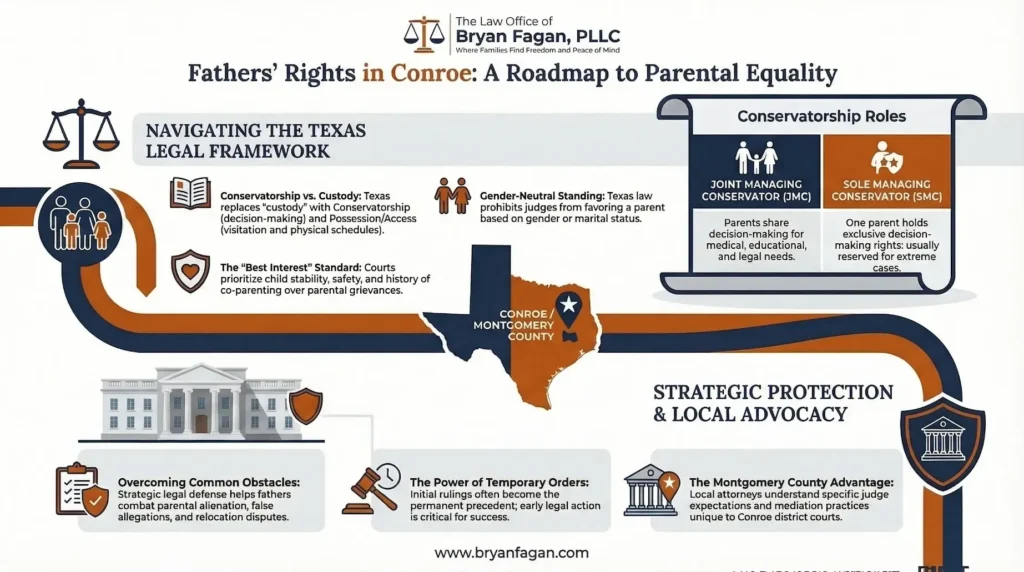
In Texas, “custody” is actually divided into two distinct concepts: conservatorship (legal rights and duties) and possession and access (your time schedule with the child). Understanding both is essential for fathers seeking to protect their role.
Conservatorship under Texas Family Code Chapter 153 determines which parent has the right and responsibility to make important decisions about the child’s life:
- Educational decisions (school enrollment, special education, tutoring)
- Medical and dental care (treatments, surgeries, mental health services)
- Religious upbringing
- Extracurricular activities
- Consent to therapy or counseling
Texas courts often appoint parents as joint managing conservators, meaning both parents share these rights and duties. However, one parent may be designated with the exclusive right to determine the child’s primary residence or make specific decisions. The exact language in your decree matters enormously.
Possession and access refers to your actual time with the child—when pickup and dropoff occur, which holidays you spend together, and how summer breaks are divided.
A father can be a joint managing conservator with substantial decision-making rights but still have limited possession time. Conversely, a possessory conservator (typically the parent with less time) still maintains certain rights. This is why having a family law attorney carefully review and draft order language is critical.
The Schedules Dads Ask About Most: SPO and Expanded Options
The Standard Possession Order (SPO) is presumed to be in the best interest of children age three and older when parents live within 100 miles of each other. It’s the baseline schedule Texas courts use for the noncustodial parent’s time.
Under the Standard Possession Order, a father typically receives:
- First, third, and fifth weekends of each month (Friday evening to Sunday evening)
- Thursday evenings during the school year
- Alternating holidays (Thanksgiving, Christmas, spring break)
- Extended summer possession (approximately 30 days)
The Expanded Standard Possession Order (ESPO) provides additional time. As of September 1, 2025, ESPO is now the default when parents live within 50 miles of each other. This schedule extends weekend time from Friday after school (rather than 6 PM) through Monday morning (when school begins).
For parents living more than 100 miles apart, the schedule adjusts to reduce midweek visits but extends summer possession to approximately 42 days. These distance-based modifications recognize the practical challenges of long commutes while preserving meaningful father-child time.
Understanding these options helps fathers in Conroe prepare realistic parenting plan proposals that courts view favorably.
Common Conroe Father Concerns (And How Texas Courts Evaluate Them)
Montgomery County fathers frequently express a deep concern about being gradually shut out of their children’s lives—whether through gatekeeping, false allegations, relocation threats, or simple lack of access to information. Fathers Rights Attorneys in Conroe Texas work with dads to ensure that these concerns are addressed through evidence, strategy, and a clear understanding of the Texas Family Code. Under §153.002, courts are required to focus on the best interest of the child, and judges evaluate documented conduct—not assumptions—when making custody determinations.
When one parent interferes with scheduled possession or blocks court-ordered visitation, Texas courts treat the issue seriously. Chapter 157 of the Texas Family Code provides enforcement remedies when an existing order is violated. Judges may award make-up parenting time, assess attorney’s fees, and in some cases impose contempt sanctions. Fathers should carefully document missed exchanges, denied visits, or repeated cancellations while maintaining calm written communication. Clear records often become persuasive evidence in enforcement proceedings.
Another common misconception is that child support and visitation are linked. They are not. Child support is governed by Chapter 154, while possession and access fall under Chapter 153. A parent who falls behind on support cannot legally be denied visitation, and a parent who is denied visitation cannot stop paying support in response. Recent statutory updates to §154.125 increased the net monthly resource cap used in guideline child support calculations, reflecting ongoing legislative adjustments to Texas family law. Parents who want a deeper explanation of how support is calculated and enforced can review our Texas Child Support Guide.
False or exaggerated allegations—particularly involving domestic violence or substance abuse—can significantly impact conservatorship decisions. Texas Family Code §153.004 requires courts to carefully examine credible evidence of family violence when determining custody arrangements. However, allegations alone are not enough. Courts expect documentation, corroboration, and reliable testimony. Fathers facing accusations should respond thoughtfully and work closely with counsel to present organized, fact-based evidence.
Relocation disputes also raise serious concerns for fathers who want consistent access to their children. When a parent seeks to move outside a court-ordered geographic restriction, the court examines whether the relocation serves the child’s best interest and whether it would impair the non-relocating parent’s ability to maintain a meaningful relationship. Transportation logistics and commute realities often become practical factors in these cases. Families navigating these concerns may benefit from reviewing local travel considerations through our guide to Transportation in Conroe.
Access to information is another area where fathers sometimes encounter resistance. Under §153.076 of the Texas Family Code, conservators have the right to receive information regarding their child’s education, medical care, and overall welfare. If report cards, medical records, or school communications are being withheld, enforcement options may be available.
At our Conroe-based family law practice, we believe fathers deserve clear answers grounded in statute, not speculation. By combining up-to-date legal knowledge with compassionate guidance, our team helps dads protect their parental role and remain actively involved in their children’s lives. The law provides tools for enforcement and modification—but using them effectively requires preparation, documentation, and experienced advocacy.
Table: Strategy Roadmap for Fathers
| Goal | Best Actions | Evidence to Gather | Common Pitfalls |
|---|---|---|---|
| More possession time | Propose SPO or ESPO; attend all scheduled visits; demonstrate consistent involvement | Calendars, photos, school attendance records, witness statements | Angry texts, social media posts, missing scheduled visits |
| Shared decision-making | Seek joint managing conservatorship; show active co-parenting on education and medical matters | School communications, doctor appointment records, emails with the other parent | Failing to notify other parent of appointments, inadequate documentation |
| Establish paternity | File AOP or petition under Chapter 160; request genetic testing if contested | Birth certificate, time spent with child, test results | Missing filing deadlines, incomplete paperwork |
| Enforce existing order | Document violations; file enforcement motion under Chapter 157 | Certified copy of order, communication logs, records of denied visits | Delay in filing, confrontational self-help instead of legal action |
| Modify existing order | Prove material change in circumstances; file modification petition | Job changes, relocation evidence, child’s changed needs, school records | Minor changes courts don’t consider material; improper service |
What Dads Can Do Now to Strengthen a Custody Case (Lawful, Child-Centered)
One of the most powerful steps a father can take during a custody dispute is to demonstrate consistent, documented involvement in his child’s life. Courts do not base decisions on promises or emotional appeals—they evaluate conduct. Fathers Rights Attorneys in Conroe Texas regularly advise clients that under Texas Family Code §153.002, every conservatorship and possession determination must serve the best interest of the child. Judges closely examine patterns of stability, reliability, and parental engagement when applying that standard.
Fathers can strengthen their position immediately by showing up consistently. Attend school programs, medical appointments, extracurricular events, and parent-teacher conferences whenever possible. Under §153.076 of the Texas Family Code, conservators are entitled to access educational and medical information, and exercising those rights demonstrates active participation. Teachers, coaches, and healthcare providers often become credible third-party witnesses who can attest to a father’s involvement and commitment.
Written communication is equally important. Keep messages respectful, factual, and focused on the child. Courts often review text messages and emails in contested cases, and written records carry far more weight than verbal conversations. Maintaining a detailed possession calendar that documents exchanges, activities, and schedule changes can provide valuable evidence if enforcement under Chapter 157 or modification under Chapter 156 becomes necessary. Courts frequently evaluate how parents complied with temporary orders when determining final conservatorship arrangements.
Strict adherence to temporary orders is critical. Judges often view behavior during the temporary phase as predictive of future compliance. If an order grants possession under the Expanded Standard Possession Order provisions of §153.317—reflecting recent statutory updates favoring extended parenting time within close geographic proximity—following that schedule precisely reinforces credibility.
Fathers should also avoid placing children in the middle of adult disputes. Texas courts consistently look unfavorably upon conduct that undermines a child’s emotional stability or interferes with the other parent’s relationship. Demonstrating maturity and a child-centered approach strengthens a father’s case under the statutory best-interest framework.
Developing a realistic parenting plan is another practical step. Consider work obligations, school schedules, and transportation logistics within Montgomery County. Local planning resources, such as those found in our guide to Government Resources in Conroe, can help parents anticipate practical considerations when proposing custody arrangements. A well-prepared plan shows the court that you are thinking ahead about stability and daily structure.
Financial responsibility also plays a role. Child support obligations under Chapter 154 of the Texas Family Code, including the updated net resource cap reflected in §154.125, should be addressed proactively. Fathers who want a clearer understanding of guideline calculations and enforcement options can review our comprehensive Texas Child Support Guide.
At our Conroe family law practice, we emphasize that preparation is not about outperforming the other parent—it is about demonstrating consistency, stability, and a genuine commitment to your child’s well-being. By combining statutory knowledge with practical action, fathers position themselves strongly in custody proceedings. Thoughtful preparation, documented involvement, and adherence to court orders send a clear message: you are focused on your child’s best interest, and you are prepared to protect your role in their life.

Enforcement and Modification: When the Order Isn’t Working
Enforcement addresses order violations; modification addresses changed circumstances. Choosing the wrong legal tool wastes time and money.
Enforcement under Texas Family Code Chapter 157 applies when someone violates an existing court order. If the child’s mother denies your scheduled visitation, fails to provide required information, or otherwise violates the decree, enforcement is the proper remedy. Courts can order make-up possession time, hold the violating party in contempt, and award attorney’s fees.
Modification under Texas Family Code Chapter 156 applies when circumstances have changed materially and substantially since the last order. Job relocations, changes in the child’s needs, or significant shifts in either parent’s situation may warrant modifying custody, possession, or support orders. However, courts resist frequent modifications based on minor disagreements.
Document everything before filing either type of motion. The strength of your evidence often determines the outcome.
How Fathers Rights Attorneys in Conroe Texas Help
A skilled Conroe fathers rights attorney provides strategic guidance, evidence preparation, and courtroom advocacy tailored to your specific situation. The benefits extend far beyond paperwork.
Selecting the correct legal path: Is your first step establishing paternity, seeking initial custody orders, enforcing an existing decree, or modifying outdated terms? An experienced attorney analyzes your situation and pursues the right approach.
Evidence gathering and preparation: Your attorney helps identify what documentation strengthens your case—school records, medical appointments, communication logs, witness statements—and presents it effectively.
Negotiation and mediation: Most cases settle before trial. An attorney positions you for favorable settlement terms while preparing for court proceedings if necessary.
Drafting enforceable orders: Vague decree language creates future conflicts. Experienced attorneys draft specific, enforceable terms covering possession schedules, decision-making authority, and information-sharing requirements.
Navigating Montgomery County procedures: From filing requirements (including new certified birth certificate documentation rules effective 2025) to local court schedules and judicial preferences, familiarity with Montgomery County family courts reduces delays and procedural errors.
Listen to Our Texas Family Law Podcast
Prefer listening? In this episode, we discuss whether fathers have equal custody rights in Texas, what the law actually says, and how courts determine parenting time based on the best interests of the child.
Why Choose The Law Office of Bryan Fagan, PLLC
Families searching for Fathers Rights Attorneys in Conroe Texas often want more than legal representation—they want guidance rooted in experience, clarity, and a genuine commitment to protecting their children’s futures. At The Law Office of Bryan Fagan, PLLC, our team brings extensive experience handling Montgomery County custody matters while remaining grounded in the statutory framework that governs Texas family law.
Under Texas Family Code §153.002, every conservatorship and possession determination must be made in the best interest of the child. That principle shapes our approach in every case. When courts consider appointing joint managing conservators under §153.134, they carefully define rights and duties regarding education, medical care, and decision-making authority. Our legal team crafts strategies that not only comply with the statute but position fathers to remain actively involved in every meaningful aspect of their child’s life. Medical decision-making, in particular, is often addressed through clearly defined rights in a decree, and local healthcare considerations may factor into a parenting plan. Families can explore community healthcare access through our guide to Medical Resources in Conroe.
Our Conroe-based family law practice maintains deep familiarity with Montgomery County procedures, courtroom expectations, and scheduling realities. Whether presenting evidence during a temporary orders hearing or negotiating a final decree, we understand how local courts evaluate documentation, compliance, and parental involvement. Courts often examine how parents follow temporary orders under Chapter 105 and how consistently they adhere to possession schedules authorized under §153.317, including the Expanded Standard Possession Order provisions that reflect recent statutory updates favoring extended parenting time when parents live within close proximity.
Clear communication is central to our philosophy. Family law statutes can feel overwhelming, particularly when navigating issues such as enforcement under Chapter 157 or modification under Chapter 156. Our team translates complex provisions into practical guidance so parents understand both their rights and their responsibilities. Financial obligations, including updated child support guidelines under §154.125 reflecting the current net resource cap, are explained in straightforward terms. Parents who want additional clarity on support calculations can review our comprehensive Texas Child Support Guide.
Strong advocacy remains at the heart of what we do. Whether resolving matters in mediation or litigating in court, we advocate firmly for fathers while maintaining professionalism and credibility before the bench. Judges consistently respond to well-prepared, child-centered presentations supported by evidence and grounded in statutory authority.
Although our firm represents clients statewide, we maintain a strong local presence in Conroe and throughout Montgomery County. That balance allows us to combine broad Texas family law experience with practical insight into local community resources and court procedures.
The attorneys at The Law Office of Bryan Fagan, PLLC handle the full spectrum of family law matters, including child custody, child support, property division, enforcement, and modification. Our mission remains consistent: educate families, protect futures, and provide the clarity and confidence parents need during life’s most challenging transitions.

Actionable Checklist: Fathers Rights Attorneys in Conroe Texas
Use this checklist to organize your approach:
- Confirm paternity status: Verify whether you’ve signed an AOP or have a court order establishing paternity. If not, this is your first legal step.
- Gather involvement documentation: Collect school records, medical appointment confirmations, photos, and calendars showing your presence in your child’s life.
- Maintain a detailed possession calendar: Track every day you spend with your child, including activities, conversations, and any schedule disruptions.
- Communicate calmly in writing: Use email or text for scheduling discussions. Keep messages factual and child-focused.
- Avoid social media commentary: Don’t post about your case, the other parent, or custody frustrations online. Courts notice.
- Prepare a realistic parenting plan: Draft a proposal accounting for your work schedule, the child’s school calendar, and practical logistics in the Conroe area.
- Identify supportive witnesses: Think about teachers, coaches, neighbors, or family members who can speak to your parenting involvement.
- Prepare for mediation: Approach mediation with a child-first mindset and willingness to find workable solutions.
- Consult an attorney early: Don’t wait until problems escalate. Early legal guidance prevents costly mistakes.
- Follow court orders exactly: Never withhold the child, skip support payments, or ignore orders hoping to address them later.
Conclusion
Divorce can feel like the ground shifting beneath your feet, especially when your role as a father feels uncertain. But uncertainty does not mean helplessness. Texas law provides a framework designed to protect children and preserve meaningful parent-child relationships—and when you understand how that framework works, you regain control of the narrative. The right strategy, steady involvement, and thoughtful legal guidance can transform a stressful transition into a structured plan for stability and growth.
At The Law Office of Bryan Fagan, PLLC, we believe families deserve more than paperwork and court dates. They deserve clarity. They deserve compassion. And they deserve a legal team that understands both the statutes in the Texas Family Code and the real-life emotions behind every custody case. When you work with an experienced Texas Family Law Attorney, you are not just preparing for hearings—you are building a foundation that protects your relationship with your child for years to come.
If you are facing a custody dispute in Conroe or Montgomery County, now is the time to ask questions, gather information, and explore your options. A consultation can help you understand where you stand, what steps to take next, and how to move forward with confidence instead of fear. The earlier you seek guidance, the more proactive and strategic your approach can be.
Your presence in your child’s life matters more than any courtroom label ever could. Take the next step with intention, stay focused on what truly matters, and remember—you are not navigating this alone.
Frequently Asked Questions
It depends on whether there is a court order in place and whether paternity has been legally established. If a custody order exists, neither parent can legally withhold the child from the other during court-ordered possession periods. Doing so can lead to enforcement actions, including contempt of court. If no order exists, the situation can be more complicated—especially for unmarried fathers who may need to formally establish paternity before asserting custody rights. Acting quickly to obtain temporary orders can prevent long-term access issues.
The biggest mistake is allowing emotion to control behavior. Angry texts, social media rants, withholding the child, or ignoring temporary orders can severely damage your credibility. Texas courts focus on the child’s best interest, and judges tend to favor the parent who remains calm, consistent, and child-focused. Another common mistake is failing to document involvement or waiting too long to seek legal guidance during the early stages of the case.
Once paternity is legally established, fathers have the same legal standing as mothers under Texas law. This includes the right to seek joint managing conservatorship (decision-making authority), possession and access (parenting time), and participation in major decisions regarding education, healthcare, and welfare. Texas courts do not favor one parent based on gender; they apply the best interest of the child standard.
There is no automatic timeframe that results in losing parental rights. Termination of parental rights requires a formal legal process and clear evidence that termination is in the child’s best interest. However, prolonged absence can negatively impact a custody case because courts evaluate historical involvement and stability. If circumstances prevented contact, it is important to document those reasons and seek court intervention promptly.
It is not impossible, and fathers are regularly named primary conservators when the facts support it. Courts examine which parent can provide stability, meet daily needs, and foster a healthy co-parenting relationship. Evidence such as consistent caregiving, involvement in school and medical decisions, and a stable home environment can strengthen a father’s request for primary custody.
Custody decisions are fact-driven. Courts may reconsider primary custody if there is credible evidence of instability, repeated interference with visitation, substance abuse, unsafe living conditions, or family violence. Judges also consider whether a parent actively supports the child’s relationship with the other parent. The focus is always on the child’s well-being rather than punishing either parent.
Judges are persuaded by conduct, not performance. Arrive prepared and on time, follow all temporary orders strictly, communicate respectfully, and remain child-centered. Provide organized documentation and propose realistic parenting plans. Demonstrating stability, maturity, and cooperation goes much further than emotional arguments.
The “7-7-7” schedule is a shared custody arrangement where a child spends seven consecutive days with one parent and then seven days with the other, repeating the cycle. Some families find it offers predictability and balance. However, it may not work for every child or work schedule. Courts evaluate whether such an arrangement promotes stability, minimizes conflict, and supports the child’s best interest before approving it.
