
Alimony and Spousal Support Attorney in Conroe: Your Complete Guide to Texas Spousal Maintenance Laws

The night the papers were served, Maria didn’t cry. She folded the laundry, packed her son’s soccer cleats for the weekend, and sat at the kitchen counter long after everyone else went to bed, staring at the numbers on a legal pad. Mortgage. Utilities. Groceries. Health insurance. She had spent fifteen years supporting her husband’s growing business while managing the home. Now she was searching online for an Alimony and Spousal Support Attorney in Conroe Texas, trying to understand one urgent question: how do I keep my life from unraveling financially?
In moments like that, fear is rarely about money alone. It’s about stability. It’s about whether you can remain in your home, protect your retirement, and create a steady environment for your children during a time that already feels uncertain. Texas law provides options—but those options are structured, limited, and often misunderstood.
At The Law Office of Bryan Fagan, PLLC, we have guided thousands of families through transitions just like Maria’s. Bryan Joseph Fagan, a South Texas College of Law graduate and recognized authority on Texas divorce and custody law, founded the firm with a clear mission: to empower people to reclaim freedom and peace of mind during life’s hardest transitions. That purpose shapes every maintenance negotiation, every courtroom presentation, and every strategy session we conduct with clients in Conroe and throughout Montgomery County.
Texas approaches spousal maintenance differently than many states. Under Chapter 8 of the Texas Family Code, courts do not automatically award long-term support. Instead, a spouse must prove eligibility and demonstrate an inability to meet “minimum reasonable needs.” That legal phrase carries weight. It means courts focus on necessities—housing, food, utilities, healthcare—not preserving the lifestyle you once enjoyed. Understanding that distinction early can prevent costly surprises and guide smarter decisions about property division, settlement strategy, and long-term planning.
Judges also examine financial documentation carefully. Pay stubs, tax returns, employment history, and credible monthly budgets matter. Courts evaluate whether a spouse made diligent efforts to earn income and whether a significant property award reduces the need for ongoing maintenance. These are not abstract rules; they are practical realities that influence whether support is granted, denied, or negotiated creatively through contractual agreements.
What many people don’t realize is how interconnected these financial decisions are. Spousal support, child support, and property division work together. A carefully structured agreement may involve retirement offsets, lump-sum buyouts, or temporary rehabilitative support designed to promote independence rather than dependency. Each solution requires both legal precision and thoughtful planning.
We believe families deserve clarity, not confusion. They deserve strategic guidance grounded in real courtroom experience. And they deserve counsel that balances firmness with compassion. Divorce is a legal process, but it is also deeply personal. When handled thoughtfully, it can become a turning point toward stability rather than a spiral into uncertainty.
In the sections that follow, we will break down how Texas spousal maintenance works, what courts in Montgomery County consider, how to prepare strong evidence, and how to avoid common mistakes that jeopardize your financial future. Most importantly, we will show you how informed, compassionate legal support can transform a moment of fear into a plan for moving forward with confidence and peace of mind.
Key Takeaways
- An experienced spousal support attorney in Conroe can help you navigate Montgomery County court procedures and build a compelling case for either seeking support or defending against excessive claims
- Texas distinguishes between court-ordered spousal maintenance under Texas Family Code Chapter 8 and contractual alimony negotiated between spouses
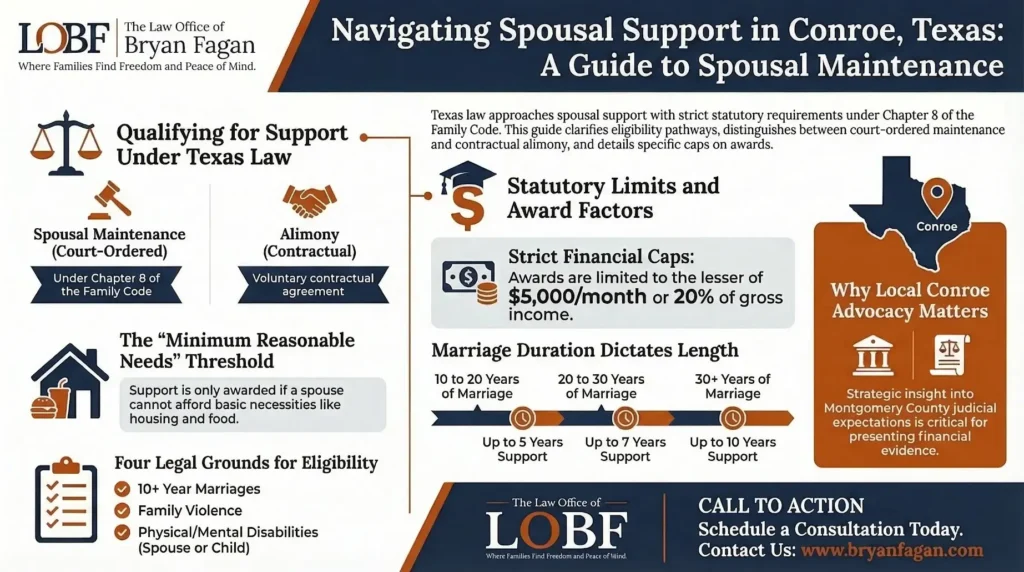
- Eligibility for court-ordered maintenance is narrow and requires meeting specific criteria, including marriage duration, disability, family violence, or caring for a child with special needs
- Courts cap spousal maintenance at $5,000 per month or 20% of the paying spouse’s gross income, whichever is less
- Temporary spousal support during divorce operates under different rules than post-divorce maintenance

Your Family’s Future Starts Here
Don’t navigate your legal journey alone. Schedule a consultation now and get the clarity and support you deserve.
We offer comprehensive family law and estate planning services, including but not limited to the following:
Trust us to help you with your Family case in Conroe, Texas. Call 281-562-7344 or contact us online today at to schedule a free consultation with your Family Law Attorneys in Conroe, Texas.
Alimony and Spousal Support Attorney in Conroe: The Short Answer
In Texas, the word “alimony” often creates confusion because it is not a single, automatic entitlement. What most people mean by alimony actually falls into three separate categories: temporary spousal support ordered while a divorce is pending, contractual alimony negotiated in a settlement agreement, and court-ordered spousal maintenance governed by Chapter 8 of the Texas Family Code. Under §8.051 of the Texas Family Code, a spouse must meet specific eligibility requirements to qualify for court-ordered maintenance, including demonstrating an inability to meet minimum reasonable needs after the division of community property. Section 8.055 further limits the amount and duration of maintenance, reinforcing that Texas favors financial independence rather than permanent dependency.
An experienced Alimony and Spousal Support Attorney in Conroe Texas can evaluate which category applies to your situation and determine whether statutory maintenance is even available. Courts in Montgomery County closely examine income documentation, employment history, property division outcomes under §7.001, and evidence of diligent efforts toward self-support. The burden of proof rests on the spouse seeking maintenance, and credible financial records are critical. Whether you are requesting support or defending against an excessive claim, thoughtful legal strategy protects your rights and helps ensure the court sees the full financial picture.
For families who are relocating or establishing roots in Montgomery County, understanding how local courts approach these issues is equally important. If you are considering making Conroe your home, our firm provides practical guidance through our resource on moving to Conroe, Texas, which addresses key considerations for families navigating transitions. Financial planning, housing decisions, and custody arrangements often intersect with spousal support discussions, and each element must be handled with care.
The attorneys at The Law Office of Bryan Fagan, PLLC remain committed to educating families and protecting futures. By combining deep knowledge of the Texas Family Code with compassionate, client-focused counsel, our team helps individuals move forward with clarity instead of confusion. If you would like to understand how maintenance interacts with other financial obligations, you can explore our comprehensive guide on Texas child support laws, which explains how courts balance support responsibilities. With experienced representation and a strategic plan, you can approach this transition with confidence and peace of mind.

“Alimony” vs “Spousal Maintenance” in Texas (Plain English)
exas courts do not automatically award “alimony” simply because a marriage is ending. In fact, Texas law uses the term “spousal maintenance,” and it is available only when strict statutory requirements are satisfied. Under Texas Family Code §8.051, a spouse must prove eligibility—such as demonstrating an inability to meet minimum reasonable needs after the division of community property under §7.001. Section 8.055 then limits both the amount and duration of court-ordered maintenance. These statutory guardrails reflect Texas’s emphasis on rehabilitation and financial independence rather than permanent support.
When meeting with an Alimony and Spousal Support Attorney in Conroe Texas, it is important to understand that Texas recognizes three distinct types of financial support. Temporary spousal support may be ordered during the divorce process to preserve stability while the case is pending. Courts often grant this short-term relief to address immediate financial concerns. Contractual alimony, by contrast, is privately negotiated between spouses and incorporated into a settlement agreement. Because it is voluntary, it offers flexibility in structure, duration, and enforcement.
The most restricted form of support is court-ordered spousal maintenance under Chapter 8 of the Texas Family Code. To obtain it, the requesting spouse must present credible financial documentation and, in most cases, demonstrate diligent efforts toward earning sufficient income. Texas courts carefully review income history, earning capacity, property division outcomes, and statutory eligibility before granting maintenance. Recent legislative updates continue to reinforce that maintenance awards are capped and time-limited except in cases involving disability or specific statutory exceptions.
Spousal support decisions rarely exist in isolation. They often intersect with custody arrangements, property division, and a child’s stability within the community. Families navigating divorce in Montgomery County may benefit from reviewing local community and academic continuity resources through our guide on education and school resources in Conroe. Understanding the broader family impact allows parents to make informed, forward-looking decisions.
At The Law Office of Bryan Fagan, PLLC, our team is committed to educating families and protecting futures. By combining precise knowledge of the Texas Family Code with compassionate, strategic counsel, we help clients move from uncertainty to clarity. If you would like to explore how financial responsibilities are balanced in Texas divorce cases, our in-depth overview of Texas child support laws provides additional guidance. With the right legal support and a thoughtful strategy, families can navigate spousal maintenance issues with confidence and peace of mind.

Who Qualifies for Spousal Maintenance in Texas?
Texas courts award spousal maintenance only when the requesting spouse satisfies the eligibility requirements set out in Chapter 8 of the Texas Family Code. Under §8.051, the burden of proof rests squarely on the spouse seeking support. A judge will not assume entitlement simply because one spouse earned more during the marriage. Instead, the court requires clear evidence that statutory criteria are met and that the requesting spouse cannot meet minimum reasonable needs after the division of community property under §7.001. Partnering with an experienced Alimony and Spousal Support Attorney in Conroe Texas ensures that your eligibility is carefully evaluated, documented, and strategically presented.
One statutory pathway involves family violence. If a spouse was convicted of or received deferred adjudication for family violence against the other spouse or a child within two years before filing for divorce, §8.051 permits the court to consider maintenance regardless of marriage length. This provision recognizes that survivors of domestic violence may face immediate financial hardship and require structured support to regain independence. Courts will review protective orders, criminal records, and sworn testimony when evaluating this ground.
Another pathway applies to long-term marriages. When a marriage lasted at least ten years and one spouse lacks sufficient property or earning capacity to meet minimum reasonable needs, the court may consider maintenance if the requesting spouse demonstrates diligent efforts toward employment or job training. Texas law emphasizes rehabilitation, and judges look for concrete steps such as job applications, enrollment in certification programs, or documented health limitations affecting employment.
Disability is also a significant factor. If a spouse has an incapacitating physical or mental disability that prevents gainful employment, §8.051 authorizes maintenance, and §8.054 allows the court to extend its duration for as long as the disability persists. Detailed medical documentation and, in some cases, expert testimony are critical in these situations.
Maintenance may also be appropriate when a custodial parent must care for a child of the marriage who has a physical or mental disability requiring substantial supervision. Even if the marriage was shorter than ten years, the court may recognize that full-time caregiving responsibilities limit employment opportunities. These determinations often intersect with conservatorship provisions under Chapter 153 of the Texas Family Code and require careful coordination of custody and financial planning.
The concept of “minimum reasonable needs” remains central to Texas spousal maintenance law. It focuses on essential living expenses such as housing, food, utilities, healthcare, and necessary transportation rather than preserving the marital lifestyle. For families in Montgomery County, reliable transportation can directly affect employment stability and possession schedules, which is why reviewing local resources such as transportation information in Conroe can support broader transition planning. Courts compare the requesting spouse’s documented monthly expenses against available post-divorce resources before determining whether maintenance is warranted.
Because spousal maintenance frequently overlaps with child support obligations, understanding how courts balance these financial responsibilities is essential. Our firm provides additional educational guidance through resources like our overview of Texas child support laws, which explains how support is calculated and prioritized under Texas law. At The Law Office of Bryan Fagan, PLLC, we remain committed to educating families and protecting futures. By combining precise knowledge of the Texas Family Code with compassionate, client-focused counsel, we help individuals move from uncertainty toward clarity, stability, and confidence.
How Courts Decide the Amount and Duration
Texas courts carefully evaluate multiple statutory factors when determining whether to award spousal maintenance and, if so, in what amount and for how long. Under Chapter 8 of the Texas Family Code, particularly §§8.052, 8.054, and 8.055, judges are directed to consider both financial need and the goal of self-sufficiency. Texas law does not treat maintenance as a lifetime entitlement. Instead, courts aim to order support for the shortest reasonable period necessary for the requesting spouse to become financially independent. Working with an experienced Alimony and Spousal Support Attorney in Conroe Texas ensures these statutory factors are properly presented and supported with credible evidence.
Section 8.052 outlines the factors courts must weigh. These include each spouse’s financial resources after property division under §7.001, the education and employment skills of both parties, and the time required for the requesting spouse to acquire sufficient education or training to earn adequate income. Judges also consider the duration of the marriage, the age and employment history of the spouse seeking support, and each party’s physical and emotional health. Contributions made by one spouse to the other’s education or career advancement may influence the court’s decision, as can any history of substance abuse affecting earning capacity or evidence that a spouse dissipated community assets during the marriage.
Health considerations often play a significant role in maintenance cases. If a spouse suffers from a medical condition that limits employment, courts require reliable documentation and may evaluate long-term prognosis when determining duration. Families in Montgomery County navigating these challenges may benefit from reviewing local healthcare access options through resources such as medical resources in Conroe, which can provide additional support during transitional periods.
Texas law places firm limits on maintenance awards. Under §8.055, spousal maintenance cannot exceed the lesser of $5,000 per month or 20 percent of the paying spouse’s average monthly gross income. Duration is governed by §8.054 and depends largely on the length of the marriage. Generally, marriages lasting 10 to 20 years allow maintenance for up to five years; marriages of 20 to 30 years may allow up to seven years; and marriages exceeding 30 years may permit up to ten years of support. Courts may extend maintenance for an indefinite period only in cases involving a spouse’s incapacitating disability or the need to care for a disabled child, provided the statutory requirements are met.
Because maintenance frequently intersects with child support obligations and broader financial planning, our firm encourages clients to review additional educational materials such as our guide to Texas child support laws, which explains how courts balance financial responsibilities under the Texas Family Code. The legal team at The Law Office of Bryan Fagan, PLLC remains committed to educating families and protecting futures by combining precise statutory knowledge with compassionate guidance. By presenting clear evidence and strategic arguments aligned with current Texas law, we help clients pursue fair outcomes that support long-term stability and peace of mind.
Temporary Spousal Support During Divorce (Temporary Orders)
Temporary spousal support addresses immediate financial needs while the divorce case proceeds. This differs fundamentally from post-divorce maintenance because courts grant it more readily to preserve stability during an uncertain time.
When one spouse files the original petition for divorce, either party can request temporary orders covering support, child custody, child support, and use of marital property. Montgomery County district courts examine current incomes, existing expenses, and each spouse’s actual needs when making these determinations.
What judges examine during temporary orders hearings:
- Current pay stubs and income documentation for both spouses
- Monthly budget showing necessary expenses
- Existing financial obligations like mortgage payments and insurance
- Child’s well being and any related expenses
- Evidence of each spouse’s actual needs
Practical preparation tips:
Create a detailed, realistic monthly budget documenting your minimum reasonable needs. Gather bank statements, tax returns, and pay stubs covering at least the past year. Document any temporary changes to income or expenses since separation.
Temporary support ends when the judge signs the final divorce decree. At that point, any ongoing support must come from either a contractual alimony agreement or court-ordered maintenance if you qualify.
The Three Support Paths
Understanding how each type of support works helps you and your divorce lawyer develop an effective legal strategy.
| Type | Who Decides | When It Applies | How Long It Lasts | Enforcement |
|---|---|---|---|---|
| Temporary Support | Court during divorce | During pending divorce case | Until final decree | Contempt of court orders |
| Contractual Alimony | Parties agree in settlement | Post-divorce as negotiated | As agreed (potentially indefinite) | Contract enforcement; contempt if merged into decree |
| Court-Ordered Maintenance | Judge post-divorce | Only when statutory eligibility met | Capped by statute based on marriage length | Wage withholding, contempt, asset liens |
Contractual alimony offers significant flexibility for creative property tradeoffs. For example, one spouse might accept a larger share of retirement accounts or the family home in exchange for waiving or reducing ongoing support payments. This collaborative process allows couples to reach agreements tailored to their unique circumstances.
Court-ordered maintenance provides stronger enforcement mechanisms but offers less flexibility. Courts impose the statutory caps regardless of the paying spouse’s actual income or the receiving spouse’s actual needs.

Common Disputes in Conroe Spousal Support Cases
Family law cases involving spousal support frequently involve disagreements that require careful documentation and skilled legal representation to resolve.
Underemployment claims arise when one party argues the other is deliberately working below their earning capacity to reduce support obligations or inflate need. Courts may impute income based on earning potential if evidence shows voluntary underemployment.
Self-employment income arguments create complexity because business interests can obscure true earning capacity. Determining actual income may require forensic accounting or analysis of business records beyond simple tax returns.
Stay-at-home parent transitions involve evaluating how quickly a spouse who left the workforce can reasonably return to gainful employment. Courts consider factors like time away from work, marketable skills, and available training programs.
Disability claims require medical documentation proving the disability prevents employment. The other party may request independent medical examinations to verify the claimed limitations.
Property tradeoffs during asset division can reduce or eliminate the need for ongoing support. If one spouse receives sufficient property to meet their needs, courts may decline to award maintenance. Skilled negotiation during equitable distribution of marital property can create fair arrangements benefiting both parties.
Enforcement and Modification (What Happens If Payments Stop?)
When spousal support payments stop, available remedies depend on the type of support originally ordered.
For court-ordered maintenance, enforcement options include wage withholding, contempt proceedings, license suspension, and liens against assets. These remedies provide meaningful pressure on a non-paying spouse.
Contractual alimony enforces as a contract unless merged into the divorce decree. If merged, contempt remedies become available. If not merged, the receiving spouse must pursue breach of contract claims, which typically move slower than enforcement through family court.
Modification possibilities:
Court-ordered maintenance may be modified if either party demonstrates a material and substantial change in circumstances. Job loss, significant income changes, or changes in the recipient’s needs may justify modification. However, modifications cannot exceed the original statutory caps.
Contractual alimony can only be modified if the agreement specifically permits modification. Many agreements contain provisions making the terms final and non-modifiable.
Remarriage of the receiving spouse automatically terminates court-ordered maintenance. Cohabitation in a relationship resembling marriage may also trigger termination under Texas Family Code provisions.
Listen to Our Texas Family Law Podcast
Prefer listening? In this episode, we discuss alimony and spousal support in Conroe, Texas, including how it works, eligibility requirements, and what factors courts consider when determining support.
Why Hiring an Alimony and Spousal Support Attorney in Conroe Matters
A spousal support attorney in Conroe can help by providing guidance through every stage of your case while protecting your interests in local courts.
Clear eligibility assessment: Before investing time and money in a contested divorce over support, you need honest evaluation of whether you qualify for maintenance or face genuine exposure to a claim.
Strong evidence presentation: Courts require documented proof of income, expenses, and need. Your attorney helps you assemble pay stubs, tax returns, budgets, and vocational assessments that demonstrate your position clearly.
Negotiation leverage: Understanding what courts actually do in Montgomery County family law cases strengthens your negotiating position. Experienced family law attorneys know what arguments succeed locally and which ones fail.
Settlement drafting: Whether you reach agreement through negotiation or the collaborative process, precise drafting prevents future disputes over enforcement and modification.
Courtroom preparation: If your case requires a contested divorce hearing, thorough preparation makes the difference between a favorable outcome and disappointment. Your attorney ensures judges hear compelling evidence supporting your position.
Enforceable orders: Poorly drafted orders create problems for years. Attention to detail during drafting prevents ambiguity that leads to future litigation.
Why Choose The Law Office of Bryan Fagan, PLLC
At The Law Office of Bryan Fagan, PLLC, our legal team brings extensive experience handling spousal maintenance and complex divorce finances across Texas. Whether you are seeking support or responding to a claim, working with an experienced Alimony and Spousal Support Attorney in Conroe Texas can make a meaningful difference in how your case is presented and resolved. Chapter 8 of the Texas Family Code governs spousal maintenance, and under §8.051, eligibility is strictly defined. Courts require proof that the requesting spouse cannot meet minimum reasonable needs after the division of community property under §7.001. Recent updates to Texas law continue to reinforce that maintenance is limited in amount and duration under §8.055 and §8.054, reflecting the Legislature’s intent to encourage financial independence while providing structured relief in appropriate cases.
Our attorneys represent individuals on both sides of support disputes. For those seeking maintenance, we help build a clear evidentiary record demonstrating statutory eligibility, diligent efforts toward self-support when required, and accurate documentation of financial need. For those facing a claim, we carefully evaluate income calculations, property division outcomes, and statutory limits to prevent excessive or unsupported obligations. Texas courts scrutinize financial documentation closely, and strategic preparation grounded in the Texas Family Code is essential.
As a firm deeply rooted in Montgomery County, we stay current on developments affecting local families and regularly guide clients through related financial and custody considerations. Divorce often intersects with broader community and governmental processes, and families may benefit from reviewing local assistance programs and services through resources such as government resources in Conroe. Understanding available support systems can provide additional stability during a transitional period.
Our approach blends technical precision with compassionate communication. We take the time to listen carefully to your concerns, explain how the Texas Family Code applies to your specific circumstances, and develop tailored strategies that protect your long-term interests. Whether you are navigating a straightforward uncontested divorce or a contested case involving significant spousal maintenance, child custody matters under Chapter 153, or complex financial holdings, our team provides steady guidance throughout the legal process.
For additional insight into how financial obligations are structured in Texas divorce cases, we encourage you to review our comprehensive guide on Texas child support laws. At every stage, The Law Office of Bryan Fagan, PLLC remains committed to educating families and protecting futures. With informed legal counsel and a clear plan, you can move forward with confidence, clarity, and peace of mind.

Checklist: Alimony and Spousal Support Attorney in Conroe
- [ ] Gather recent pay stubs, tax returns, and bank statements for both spouses
- [ ] Create a detailed monthly budget documenting minimum reasonable needs
- [ ] Document your complete employment history and education credentials
- [ ] Collect medical records and documentation if disability affects your case
- [ ] Identify all marital property and debts that may affect support negotiations
- [ ] Prepare evidence for temporary orders hearings early in the divorce process
- [ ] List contributions you made to your spouse’s education or career advancement
- [ ] Document any family violence or substance abuse relevant to your case
Conclusion
Divorce has a way of making the future feel uncertain, especially when financial stability is on the line. But uncertainty does not have to mean chaos. When you understand how Texas spousal maintenance works, how property division fits into the picture, and what courts actually look for, the fear starts to lose its grip. Knowledge brings clarity. Strategy brings confidence. And the right guidance can turn a difficult transition into a structured plan forward.
At The Law Office of Bryan Fagan, PLLC, we believe families deserve more than legal answers—they deserve reassurance, direction, and a steady hand during life’s biggest changes. Working with an experienced Texas Family Law Attorney means you are not guessing your way through Chapter 8 of the Texas Family Code or negotiating complex financial issues alone. You are making informed decisions with someone who understands both the law and the human side of what you are facing.
If you have questions about spousal maintenance, property division, or how to protect your financial future, we invite you to schedule a consultation with our team. Even a single conversation can bring perspective and peace of mind. The sooner you understand your options, the sooner you can begin building the next chapter with intention instead of worry.
Life after divorce may look different—but different does not mean diminished. With the right plan in place, it can mean stronger, steadier, and more secure than you imagined. And that is a future worth preparing for.
Frequently Asked Questions About Divorce and Spousal Support in Texas
There is no true “average” alimony amount in Texas because courts do not automatically award spousal maintenance. In fact, many divorces result in no court-ordered maintenance at all. When maintenance is awarded under Texas Family Code Chapter 8, it is capped at the lesser of $5,000 per month or 20% of the paying spouse’s average monthly gross income. Some couples negotiate contractual alimony outside of court, and those amounts vary widely depending on income, property division, and long-term financial goals.
In Texas, separate property is generally not divided in a divorce. This includes assets owned before marriage, gifts, inheritances, and certain personal injury settlements (excluding lost wages). However, the spouse claiming separate property must prove it with clear documentation. If separate funds are mixed with marital funds and cannot be traced, they may be treated as community property. Careful financial records are critical.
Several factors can prevent a court from awarding spousal maintenance. If you do not meet eligibility requirements under Chapter 8 of the Texas Family Code, you may not qualify. Receiving enough property in the divorce to meet your minimum reasonable needs can also eliminate eligibility. Courts may deny maintenance if a spouse is voluntarily unemployed or underemployed, fails to show efforts toward self-support, or cannot provide credible financial evidence.
The “6 month rule” typically refers to Texas residency requirements for filing divorce. At least one spouse must have lived in Texas for six months before filing and in the county of filing for at least 90 days. Without meeting these residency requirements, the court may not have jurisdiction to grant a divorce.
Texas law does not guarantee either spouse a specific percentage of the marital estate. Texas is a community property state, meaning assets acquired during the marriage are subject to a “just and right” division. While that often results in something close to a 50/50 split, courts can adjust the division based on earning capacity, fault, health, custody arrangements, and financial need. Gender does not determine entitlement.
Not automatically. The portion of a 401(k) earned during the marriage is typically considered community property and may be divided. However, contributions made before marriage are generally separate property if properly documented. The final division depends on what the court considers just and right or what the parties agree to in settlement. Retirement accounts are typically divided using a Qualified Domestic Relations Order (QDRO).
One of the biggest mistakes is acting out of emotion instead of strategy. This can include quitting a job, draining accounts, hiding assets, or signing agreements without fully understanding them. These actions often create long-term financial harm and can negatively impact custody outcomes. A thoughtful, informed legal plan helps protect both your financial future and your family’s stability.
Many professionals refer to the “3 C’s” as Communication, Cooperation, and Consistency. Clear communication reduces misunderstandings. Cooperation can shorten litigation and lower costs. Consistency—especially in parenting—creates stability for children. While divorce is rarely easy, focusing on these three principles can make the process more manageable and less disruptive for everyone involved.