
Divorce can be one of life’s most difficult transitions—but understanding your rights under Texas law can make it less overwhelming. When major assets like a 401(k) are on the table, the future can feel uncertain. In Texas, it's crucial to understand that any money contributed to your 401(k) during the marriage is considered community property, meaning it’s subject to a just and right division. Getting a handle on this is the very first step toward protecting your financial future.
Your Financial Future After a Texas Divorce
A divorce isn’t just the end of a personal relationship; it's the careful untangling of a shared financial life. For many Texas couples, a 401(k) retirement account is one of the most significant assets they own together. The thought of splitting years of hard-earned savings can be overwhelming, but with the right information and guidance, you can navigate this process with confidence.

Think of this guide as your roadmap. We are here to provide the clarity and reassurance you need by walking you through exactly how Texas law treats retirement accounts, breaking down complex legal concepts into clear, actionable steps so you can feel empowered.
Understanding the Path Forward
Facing a 401k divorce split is about more than just numbers on a statement; it’s about securing the retirement you've worked so hard to build. Our goal is to equip you with the knowledge to make smart, informed decisions that protect your long-term well-being.
Here’s what we’ll cover:
- Texas Community Property Rules: We’ll explain how the Texas Family Code defines what you and your spouse own jointly.
- The Role of a QDRO: This is the essential legal tool required to divide a 401(k) without incurring significant tax penalties.
- Valuation and Division: We'll break down the different methods used to determine a fair split of your retirement assets.
- Common Pitfalls: You’ll learn about the common mistakes people make that can put their financial security at risk.
Divorce is a complicated process, but understanding your rights is the key to controlling the outcome. When you learn the rules that govern how assets are divided in Texas, you trade uncertainty for a clear, actionable plan for your future.
As you begin to navigate your post-divorce financial life in Texas, strong negotiation and dispute resolution skills are invaluable. Learning how to prepare for mediation can significantly impact the outcome of your asset division. By the time you finish this guide, you’ll have the foundational knowledge needed to handle this part of your divorce with confidence.
How Texas Community Property Law Defines Your 401k
When you get married in Texas, the law views your union as a partnership. This simple concept is the foundation of our state's community property system. In a divorce, this means that nearly everything you or your spouse earned or acquired during the marriage is presumed to belong equally to both of you.
This rule applies directly to your 401(k). Every contribution made, every dollar your employer matched, and all investment gains that occurred from your wedding day until the divorce is finalized are considered community property. Under the Texas Family Code, that community portion must be divided in a "just and right" manner.
The Jar Analogy: Separate vs. Community Property in a 401(k)
To make this clearer, let’s use an analogy. Think of your 401(k) as a large glass jar.
- Your Separate Property: The money you put into that jar before you were married—plus all the growth on that specific amount over the years—is your separate property. These are your funds and are not subject to division.
- The Community Property: Every dollar contributed during the marriage, whether from your paycheck or an employer match, is added to the jar. All market growth on those marital contributions also goes in. This is the community portion, and it belongs to the marital estate.
The primary challenge in a 401(k) divorce split is accurately distinguishing between the pre-marriage funds and the marital funds once they are mixed together. This is where a precise legal strategy becomes essential.
The Powerful Presumption of Community Property
In a Texas divorce, the law begins with a powerful assumption: everything you own when you file for divorce is community property. If you want to protect the 401(k) funds you saved before getting married, the burden of proof is entirely on you.
According to the Texas Family Code § 3.003, any property possessed by either spouse during or on dissolution of marriage is presumed to be community property. Proving otherwise requires "clear and convincing evidence."
This means you must build a solid case showing exactly which portion of your 401(k) is yours alone. The process for doing this is called "tracing," and it involves meticulously documenting the account's value on your wedding date and tracking its growth separately from any money added during the marriage. You can gain a deeper understanding of these rules in our guide to community property essentials for Texas divorces.
To help clarify this crucial distinction, here is a breakdown of the components of a 401(k) in a Texas divorce.
Community Property vs Separate Property in a 401(k)
| Asset Component | Classification | Example |
|---|---|---|
| Pre-Marital Balance | Separate Property | The $50,000 in your account on the day you got married. |
| Growth on Pre-Marital Balance | Separate Property | Investment gains earned specifically on that initial $50,000. |
| Employee Contributions During Marriage | Community Property | The 3% of your salary you contributed each year while married. |
| Employer Matches During Marriage | Community Property | The 3% match your company contributed during the marriage. |
| Growth on Marital Contributions | Community Property | All investment gains earned on contributions and matches made after your wedding day. |
As you can see, simply looking at the total account balance doesn't tell the whole story. The character of each dollar—and the growth it generated—is what truly matters.
Why Expert Tracing is Non-Negotiable
Simply subtracting your wedding-day balance from the current total is not sufficient. That outdated "subtraction method" is flawed because it fails to account for how investments grow, compound, and fluctuate over time.
Today, achieving a fair split almost always requires a financial expert, such as a forensic accountant. They use sophisticated tools to perform a proper tracing analysis, examining statements, transaction records, and performance data to precisely separate the community and separate property portions of the account.
Without this detailed tracing, you run a serious risk. The court could default to the legal presumption and treat your entire 401(k) as community property, meaning you could lose a significant portion of the retirement funds you worked hard to save long before you were married. Understanding this from the start is the first step in protecting your financial future.
What Is a QDRO and Why Is It Essential
Once you and your spouse agree on how to split a 401(k), you might think it's just a matter of making a simple transfer. However, federal law places strict controls on retirement accounts, and you cannot simply withdraw money without facing serious financial penalties. This is where a specific and critical legal tool comes into play.
Think of your 401(k) as being sealed in a vault. The only key that can legally open that vault during a divorce is a Qualified Domestic Relations Order, or QDRO. This isn't just a piece of legal paperwork—it's a non-negotiable requirement under federal law, specifically the Employee Retirement Income Security Act (ERISA).
A QDRO is a special court order, signed by a judge, that directs the 401(k) plan administrator to give a portion of one spouse's retirement funds to the other spouse (the "alternate payee"). Without this official document, any attempt to divide the account is treated as a regular withdrawal, which can lead to a financial nightmare.
The Costly Mistake of Skipping the QDRO
Let's imagine you are awarded $150,000 from your spouse's 401(k) in your divorce decree. If you try to access that money without a QDRO in place, the plan administrator must treat it as an early cash-out. This would instantly trigger income taxes—potentially pushing you into a higher federal tax bracket—plus a punishing 10% early withdrawal penalty.
The QDRO is your financial shield. It is the legal document that allows you to split a 401(k) in a divorce without being penalized by taxes or the 10% penalty. A judge must sign off on the exact dollar amount or percentage going to the receiving spouse. Trying to bypass this process on a $150,000 distribution could mean facing a 37% federal tax plus a 10% penalty, resulting in a loss of over $70,000.
A QDRO makes the division of a 401(k) a tax-free transfer related to your divorce, not a premature withdrawal. Neglecting or mishandling this step is one of the biggest—and most avoidable—financial mistakes you can make in a divorce.
The infographic below illustrates the journey a 401(k) takes, from being separate property to becoming a divided asset in a Texas divorce.
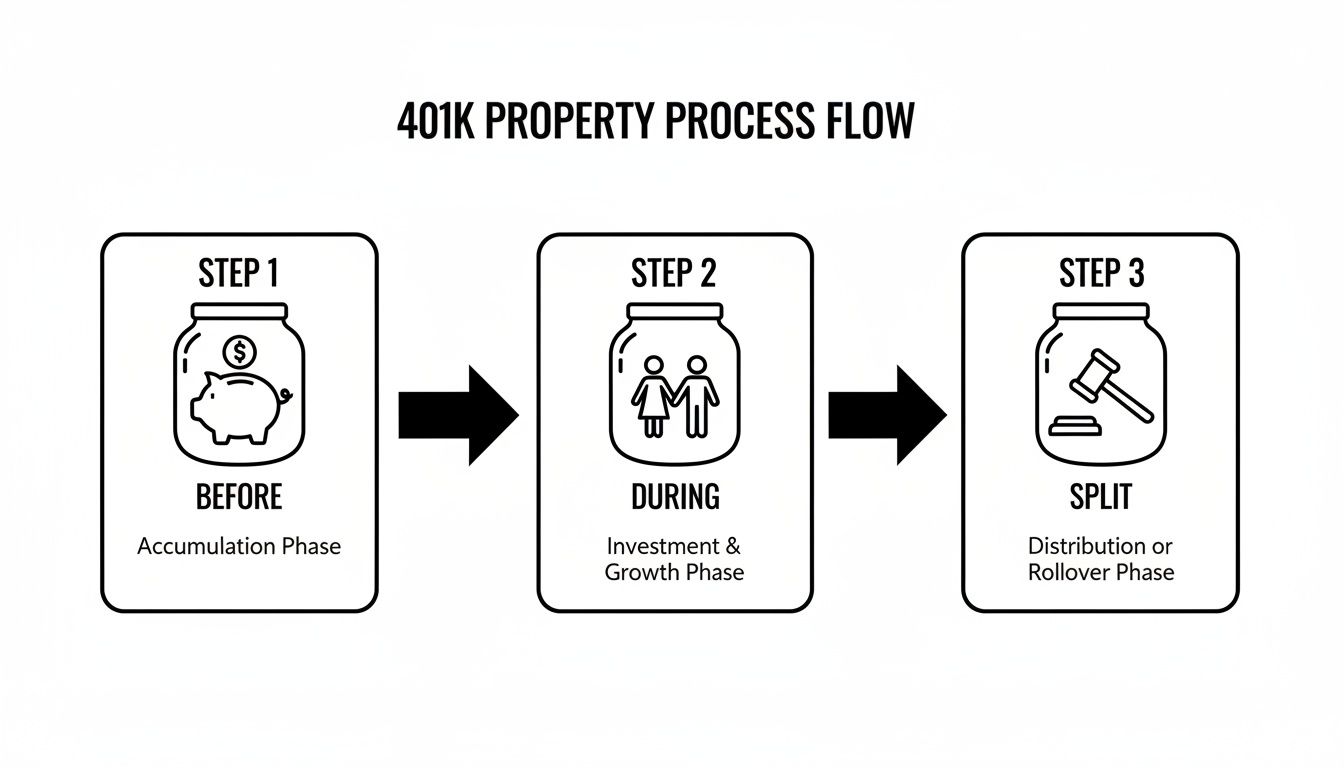
This visual helps clarify how funds saved before marriage remain separate, while contributions made during the marriage become community property that requires a court order for a fair division.
The QDRO Drafting and Approval Process
Obtaining a QDRO is a precise process that demands legal expertise. You cannot use a generic court order; every 401(k) plan has its own unique rules for what must be included in the QDRO document.
Here’s a step-by-step explanation of the process:
- Drafting the Order: An attorney drafts the QDRO, specifying the exact amount or percentage of the 401(k) to be transferred. The language must be precise, naming the plan, the employee spouse (the "participant"), the receiving spouse (the "alternate payee"), and the specific method for the division.
- Pre-Approval by the Plan Administrator: A crucial step is to send a draft of the QDRO to the 401(k) plan administrator for review before submitting it to the judge. This allows the administrator to identify any language that doesn't meet their plan's requirements, helping you avoid rejection later.
- Signature by the Judge: Once the plan administrator has approved the draft, the QDRO is submitted to the court. The judge’s signature makes it a legally binding order.
- Final Submission to the Plan Administrator: The signed QDRO is sent back to the plan administrator, who will then officially "qualify" the order and create a separate account or process the funds for the receiving spouse.
This is a highly technical process. Even a small error in wording can cause significant delays or lead to the order being rejected entirely. You can learn more about the specifics of how qualified plans like 401(k)s are divided in our detailed guide. At The Law Office of Bryan Fagan, PLLC, we handle QDROs regularly and know how to get them right, ensuring your financial interests are protected from start to finish.
Valuing and Dividing Your 401k Correctly
Determining how to split a 401(k) in a divorce is more complex than simply looking at the latest account statement. To ensure the division is truly fair, several factors must be considered. Getting these details right is key to protecting your financial future.

From selecting the right valuation date to accounting for outstanding loans, every detail matters. A strategic approach makes all the difference in ensuring the split accurately reflects the portion that is considered community property.
Choosing the Right Valuation Date
One of the most critical decisions is selecting the valuation date—the specific day used to calculate the 401(k)'s value for the split. While it may seem like a minor detail, in a volatile stock market, this can become a major point of negotiation.
An account's balance can fluctuate by thousands of dollars in just one week. If the market is rising, the non-employee spouse will likely push for a later valuation date to capture a share of those gains. If the market is declining, the employee spouse might want an earlier date to lock in a higher value before it falls. This date is typically negotiated and then finalized in the divorce decree.
Accounting for Outstanding 401k Loans
What happens if a loan was taken from the 401(k) during the marriage? This common situation must be handled correctly. In Texas, a 401(k) loan taken out while married is almost always considered a community debt.
The outstanding loan balance is typically treated as part of the community estate. This means it's often added back into the total value of the 401(k) before the account is divided, ensuring both spouses share responsibility for the debt.
For example, if a 401(k) has a balance of $200,000 but there is an outstanding loan of $20,000, the court will likely value the community portion of that account at $220,000 for division purposes. Ignoring the loan would unfairly penalize the spouse who did not take it out. Handling financial data properly is essential; it's why good cybersecurity in accounting is so important for ensuring all financial records are accurate and secure.
Options for the Receiving Spouse After the Split
Once the QDRO is approved and the funds are separated, the receiving spouse (the "alternate payee") has several important decisions to make. Each option has different tax and financial consequences, so this choice requires careful consideration. Our attorneys can walk you through the specifics of dividing retirement benefits upon divorce so you can feel confident you are making the right move for your future.
Here are the three main options:
- Rollover into an IRA: This is often the most advantageous choice. You can transfer your portion of the funds directly into an Individual Retirement Account (IRA) in your name. This "direct rollover" is a tax-free event that keeps your money growing tax-deferred and gives you complete control over your investments.
- Leave Funds in the Ex-Spouse's Plan: Some 401(k) plans allow an ex-spouse to keep their share in the original plan, held in a separate sub-account. This might be a viable option if the plan has unique investment choices or low fees, but it offers less direct control.
- Cash Out the Distribution: While it is an option, cashing out is almost always the worst choice. The money would be immediately subject to mandatory income tax withholding. Additionally, if you are under age 59½, you could still face a 10% early withdrawal penalty. This choice can significantly reduce the amount of money you actually receive.
Common Mistakes to Avoid When Splitting a 401(k) in Divorce
When dividing a 401(k) in a divorce, what you don't know can hurt you. A simple oversight can lead to costly and often irreversible errors with lasting financial consequences. We want to walk you through some of the most common pitfalls so you can proactively protect your future.
Even after your divorce is finalized, there are critical steps you must take to secure your share of the retirement assets. By understanding these potential missteps ahead of time, you can ensure the division goes as smoothly and fairly as possible, safeguarding the financial security you've worked so hard to build.

Forgetting to Update Your Beneficiary Designations
This is arguably the most critical—and most frequently overlooked—mistake. Your 401(k) beneficiary designation is a legally binding document that supersedes your will. It dictates exactly who inherits that account when you pass away.
If you named your spouse as the beneficiary years ago and forget to change it after the divorce, they could inherit your entire 401(k). It doesn't matter what your will or even the divorce decree says.
- Practical Example: John and Mary finalize their divorce. John immediately updates his will, leaving everything to his children. However, he never gets around to changing his 401(k) beneficiary, which still lists Mary. If John passes away, Mary—his ex-wife—will almost certainly receive the entire 401(k), leaving his children with little to no legal recourse.
- Actionable Guidance: The moment your divorce is final, contact your 401(k) plan administrator and request a change of beneficiary form. It's a small but vital step that ensures your assets go to the people you intend them to.
Delaying the QDRO Process
When it comes to the Qualified Domestic Relations Order (QDRO), timing is everything. Procrastinating on the drafting and submission of this document is a massive gamble. Until that QDRO is signed by the judge and fully approved by the plan administrator, the retirement account remains entirely under your ex-spouse's control.
This delay exposes your share of the money to several serious risks:
- Market Volatility: A major market downturn could significantly reduce the account's value before your portion is segregated.
- Your Ex-Spouse's Actions: Your ex could take out a loan against the 401(k) or, in a worst-case scenario, attempt to withdraw the funds entirely.
- Life Changes: If your ex-spouse dies, remarries, or retires before the QDRO is finalized, it can trigger a legal nightmare that makes claiming your rightful share incredibly difficult and expensive.
Your divorce decree does not split the 401(k). The decree alone is not enough. Only a court-signed and plan-approved QDRO has the legal power to execute the transfer. Starting this process immediately after the divorce is final is non-negotiable.
Misunderstanding the Tax Consequences
How you receive your portion of the 401(k) has major tax implications. Many people mistakenly believe they can take the money as cash without any issues, but that's a very expensive error. While a QDRO allows you to move the money without an early withdrawal penalty, taking a cash distribution is a different matter entirely.
If you opt to cash out your share, the plan administrator is legally required to withhold 20% for federal income taxes right off the top. Depending on your tax bracket, you might owe even more when you file your taxes at the end of the year.
The most prudent choice in almost every situation is to execute a direct rollover into an IRA of your own. This preserves the tax-deferred status of your money, allowing it to continue growing for your retirement. Rushing this decision can easily cost you a significant portion of your settlement.
While every divorce requires careful financial planning, certain situations bring unique complexities to a 401(k) divorce split. If you are divorcing later in life or have significant assets, a standard approach is insufficient. Your long-term security is on the line, and understanding these specific challenges is the first step toward building a strategy that truly protects you.
The Unique Challenges of a Gray Divorce
"Gray divorce"—a divorce after age 50—is becoming increasingly common. The biggest challenge here is time. When you split a nest egg that took decades to build, there is simply less time to rebuild your savings before retirement. It can feel overwhelming to see your retirement accounts divided when you are just years away from needing them.
The financial stakes are incredibly high. A 2022 study revealed that 36% of divorces in the U.S. now involve people over 50. This "silver split" trend means that halving a substantial 401(k) at age 55 or 60 can completely derail retirement plans. The impact can be particularly harsh for women, who face a post-divorce poverty rate of 27%, compared to just 11% for men over 50. You can explore more about how this demographic shift impacts retirement savings and the legal documents that can protect you.
For those facing a gray divorce, practical guidance includes strategies like:
- Creative Asset Offsets: You might negotiate to keep a larger portion of the 401(k) in exchange for your spouse receiving the equity in the family home.
- Spousal Maintenance: Securing alimony can provide a vital income stream, helping to bridge the financial gap until you can access your retirement funds.
- Maximizing Contributions: After the divorce, it's crucial to focus on rebuilding. If you're over 50, maximizing catch-up contributions to your own retirement accounts becomes a priority.
High-Net-Worth Divorces and Complex Retirement Portfolios
High-net-worth divorces present a different kind of financial puzzle, especially when multiple retirement accounts are involved. The division is rarely as simple as splitting a single 401(k) down the middle.
These cases almost always involve a broader portfolio of assets that must be meticulously valued and divided.
When significant wealth is involved, the process of tracing separate versus community property becomes a forensic exercise. Precision is not just a goal; it's a necessity to ensure a fair and equitable division.
Challenges in these divorces often arise in a few key areas:
- Multiple Retirement Accounts: Juggling the division of 401(k)s, pensions, IRAs, and executive compensation plans like stock options requires a coordinated and sophisticated strategy.
- Business Valuations: If a 401(k) is connected to a family-owned business, a professional business valuation is often necessary to determine the true value of those retirement assets.
- Forensic Accounting: This is essential. Tracing separate property contributions made decades ago often requires a forensic accountant to analyze historical financial records and prove which assets do not belong to the community estate.
In both gray and high-net-worth divorces, the standard playbook is not enough. It takes an experienced legal team to tackle these complexities with the sophisticated strategies required to protect your financial future.
If you need help navigating divorce, custody, or estate planning in Texas, contact The Law Office of Bryan Fagan today for a free consultation.
Common Questions We Hear About 401(k) Splits
Going through a 401(k) divorce split naturally brings up many specific, practical questions. Getting clear, straightforward answers can provide peace of mind and help you feel more in control. We’ve gathered some of the most common questions our clients ask to help you protect your financial future.
Can We Agree to an Unequal Split?
Yes, absolutely. While Texas law provides for a "just and right" division of community property—which often results in a 50/50 split—you and your spouse are free to negotiate a different arrangement that better suits your unique situation. This is a significant advantage of settling your divorce through mediation or the collaborative divorce process.
For instance, one spouse might take a larger share of the 401(k) in exchange for the other spouse receiving the equity in the family home. As long as you both agree to the terms and they are clearly documented in your final divorce decree, the court will almost always approve it. You will still need a QDRO to execute the transfer without incurring taxes and penalties.
How Long Until I Receive My Funds?
This timeline can vary significantly. After the judge signs the QDRO, the document must be sent to the 401(k) plan administrator for their review and approval. This step alone can take anywhere from a few weeks to several months, depending on the complexity of the retirement plan and the administrator’s workload.
Once the administrator officially approves the QDRO, they will segregate the funds for the receiving spouse (the "alternate payee"). From there, you can provide instructions to roll the money directly into your own IRA or choose another option. Patience and consistent follow-up are key during this waiting period.
What If My Ex-Spouse Refuses to Cooperate?
A signed divorce decree is a legally binding court order, not a suggestion. All parties are required to comply with its terms. If your ex-spouse is delaying or refusing to cooperate with the QDRO process—such as not signing necessary paperwork—you have legal recourse.
Your attorney can file a Motion for Enforcement with the court. This asks the judge to compel your ex-spouse to comply with the decree. In many cases, the court can even sign documents on behalf of an uncooperative party or order them to pay the attorney's fees you incurred to enforce the order.
If you need help navigating divorce, custody, or estate planning in Texas, contact The Law Office of Bryan Fagan, PLLC today for a free consultation.