Skip to content

Does an affair mean losing custody of your children? For a parent in the middle of a Texas divorce, few questions carry more fear.
Custody turns on how a parent's conduct affects the child. A judge looks for the connection between private behavior and a child's daily life: whether the conduct reached the child, changed who provided care, or created a risk that can be shown with specific evidence. Understanding that connection is what separates a strong custody position from a painful guess.
Can Infidelity Affect Custody in Texas? The Short Answer
The dividing line is a documented effect on the child. Under Texas Family Code §153.002 and the Holley v. Adams factors, the court weighs the child's needs, each parent's abilities, stability of the home, and any physical or emotional danger. An affair becomes relevant when proof ties it to one of those factors.
| Situation | Likely custody impact | Why the court cares | What it can look like |
|---|---|---|---|
| Private affair with no change to parenting or the home | Low | The affair alone doesn't show harm to the child | Messages surface, but exchanges, homework, and medical care stay on schedule |
| Partner stays overnight while the children are present | Moderate, based on the evidence | Home stability and supervision | A new partner is introduced quickly, bedtime routines slip, or children are left in that partner's care |
| Missed exchanges or neglected school or medical care linked to the affair | High | Parental abilities and acts or omissions | Pickups are missed or a medication refill lapses during time spent with the partner |
| Child exposed to sexual conduct, substance use, or violence | High | Emotional and physical danger | The child reports seeing drug use, fighting, or adult sexual conduct at the partner's home |
| Child used to carry messages or conceal the relationship | High | Emotional needs and the parent-child bond | The child is told to hide the relationship or pass information between adults |
| Affair cited only as grounds for a fault divorce | Low for custody | Divorce fault and conservatorship are separate questions | The petition alleges adultery, while the parenting schedule and daily care remain steady |
Build the custody point around records that show the child's experience: exchange logs, school attendance, medical appointments, messages to the child, and reliable witness accounts. I recommend framing the issue as “what changed for the child,” because moral outrage without that link rarely moves a Texas court.
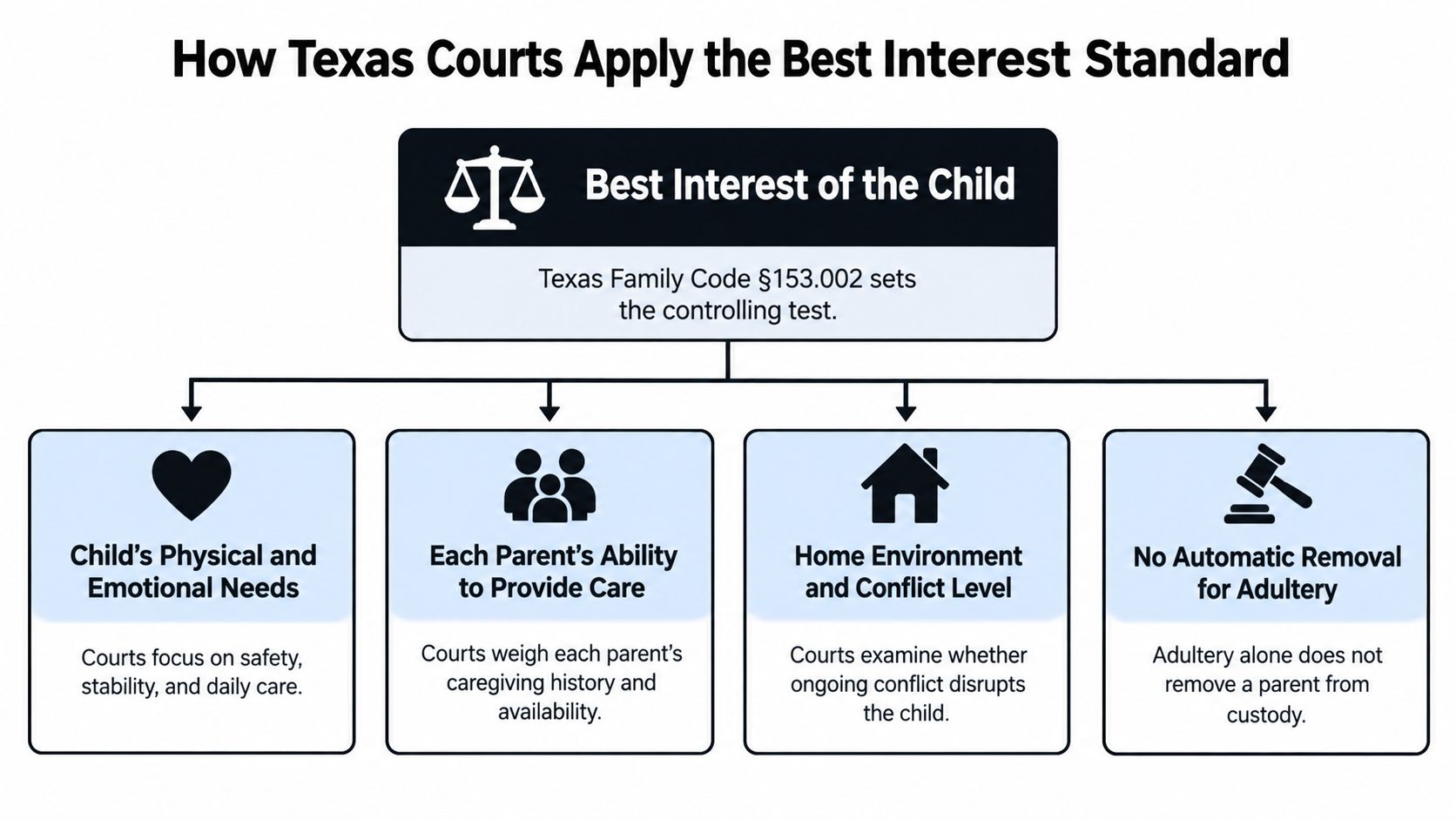
How Texas Courts Apply the Best Interest Standard
Texas Family Code §153.002 supplies the controlling test. It doesn't create a separate rule that removes a parent from custody for adultery alone. Texas courts consider whether the evidence shows that the parent's conduct affects the child's interests, and fit parents aren't displaced based just on moral disapproval. The Texas statute setting the best-interest standard is the starting point for organizing a custody argument.
The history helps explain why. Pennsylvania's Commonwealth v. Addicks introduced the best-interest principle in American custody jurisprudence in 1813; nineteenth-century courts sometimes treated adultery, particularly by mothers, as moral unfitness, even without proof that the child was harmed. By the 1960s and 1970s, custody law had moved toward a gender-neutral, nexus-based approach: marital misconduct matters chiefly when it connects to the child's welfare. That development is discussed in legal scholarship on religion and the best-interest standard.
Match the facts to the child's experience
Texas Family Code §153.131 creates a presumption that appointing both parents joint managing conservators is in the child's best interest. A parent seeking a different arrangement needs evidence that supports that request. The question isn't whether the affair proves someone is a bad spouse; it's whether the facts support a different custody arrangement for the child.
In Holley v. Adams, 544 S.W.2d 367 (Tex. 1976), the Texas Supreme Court identified factors courts consider when weighing a child's best interest. The table pairs those factors with the kind of affair-related evidence that may connect to them.
| Best-interest factor | What the court examines | How an affair can become relevant |
|---|---|---|
| Desires of the child | The child's stated wishes, weighed by age and maturity | Preferences shaped by exposure, pressure, or conflict |
| Emotional and physical needs now and later | Daily care, emotional security, and development | Missed routines, unsupervised time with a new partner, or neglected needs |
| Emotional and physical danger | Exposure to harm, violence, substances, or sexual conduct | Intoxication during parenting time, an unsafe partner, or exposure to adult sexual activity |
| Parental abilities | Capacity to supervise, provide care, and make decisions | Caregiving handed to others while the parent is away |
| Programs and plans | Available schools, counseling, and each parent's proposed plan | Relocation or schedule changes built around the relationship |
| Stability of the home | Consistent residence, routines, and household members | Frequent overnight guests, moves, or unstable transitions |
| Acts or omissions showing an improper parent-child relationship | Conduct that damages the bond or undermines the other parent | Using the child to carry messages or hide the affair |
| Excuses for acts or omissions | Whether the parent accepts responsibility | Blaming the child or the other parent for neglect |
Read the facts in three steps. First, pick the factor or factors the conduct actually touches. Second, ask whether it changed the child's daily life. Third, record the date and the effect, rather than relying on a broad accusation.
A judge weighs a household and a child's future, not the marriage.
Private conduct with no effect on parenting rarely carries the same weight as repeated absences, unsafe overnight arrangements, or intoxication during parenting time. Keep evidence organized by the issue you're asking the court to address, because the relevant showing may differ for temporary orders, possession restrictions, or final conservatorship. For a plain-language discussion of the standard, see the firm's article on the best interest of the child.
When an Affair Partner Enters the Custody Picture
A new partner does not make a parent unsafe by itself. The court's concern is narrower and more practical: what changed for the child after that person entered the home. The Texas Family Code's conservatorship provisions focus on child-centered considerations, including serious abuse-related evidence where applicable.
Translate the relationship into facts a judge can weigh. Has the partner moved in, and how quickly? Are overnight stays happening while the child is present? Did the child meet the partner in a planned, age-appropriate way, or learn about the relationship during an argument? Look at household safety, substance use, adult conflict in front of the child, school transportation the next morning, caregiving coverage, and whether either parent blocks calls, messages, or possession time.
Consider a parent whose partner begins staying over on weekends two months into the relationship. The useful questions reach past when the romance started and whether the other parent objects. The judge will care who handled bedtime, who got the child to school, whether supervision stayed consistent, and whether the child seemed settled, anxious, or caught in the middle.
A different problem arises if a nonparent asks for conservatorship or access. Treat that as a separate legal posture from a two-parent dispute and organize proof around the person's actual role in the child's life. Between parents, the same child-centered questions decide how much weight the new relationship carries.
How Infidelity Reaches the Child Through Conflict
Often, the affair affects a child indirectly. The relationship triggers arguments, the arguments spill into the home, and the child starts handling adult responsibilities. Routines, finances, and household stability may then suffer.

A qualitative study of young adults exposed to parental infidelity identified recurring experiences including family conflict, inadequate support, parental role reversal, financial difficulties, and family separation, with participants reporting emotional and psychological effects. Those findings don't mean every affair harms every child or decide a Texas custody case. They help explain why a court may focus on observable effects rather than the affair alone. The study of young adults' experiences of parental infidelity describes those reported patterns.
Say Marco and Jess are separating after an affair comes to light. Their son, Ethan, starts carrying messages between them because each parent asks him to relay schedule changes or comments about the other parent. He misses school days, and his grades begin to slip as the conflict spreads into his routine.
A court would need more than a general claim that Ethan is upset. Attendance records, teacher emails, and a parenting calendar can help show when the disruption started and who was responsible for his care. Neutral communications about exchanges, lawfully obtained observations from a pediatrician or therapist, and records showing who managed ordinary routines may add context.
Here's a short explanation of how conflict can affect children and why parents should keep them out of adult disputes.
A sustained pattern affecting the child's functioning or safety is more meaningful than one disputed incident or a broad claim of wrongdoing. Don't coach a child, ask the child to take sides, or expose them to litigation details. That can intensify the harm and damage a parent's credibility.
Divorce Fault and Custody Are Separate Questions
Proving adultery for a fault-based divorce doesn't automatically prove that the other parent should lose custody or have visitation restricted. Texas Family Code Chapter 6 allows a court to grant a divorce in favor of one spouse when the other committed adultery, while conservatorship remains governed by the best-interest standard. The Texas Courts material discussing adultery and fault-based divorce addresses that distinction.
Suppose a parent had a private affair but continued providing reliable care. That conduct may support a fault allegation, but it doesn't, by itself, establish that the parent shouldn't share conservatorship. By contrast, an affair involving intoxicated driving with the children in the car or prolonged absences raises direct parenting concerns.
Start by identifying whether you're pursuing fault, custody, or both, then match the evidence to each issue. The evidence needed to show adultery isn't necessarily the evidence needed to show risk to the child. A decision to pursue Divorce on fault grounds should be deliberate; asserting fault aggressively can raise conflict and affect how the other parent responds in the custody dispute. The firm's overview of fault divorce in Texas provides additional context.
When Conduct Leads to Restricted Possession or Modification
A custody order can be changed when the legal requirements are met, but a past affair alone doesn't automatically justify a restriction or modification. Under Texas Family Code §153.193, a court may restrict or deny possession if the evidence shows that possession would endanger the child's physical or emotional welfare. That makes the nature of the risk, not the relationship label, central.
Build a focused request
- Identify the conduct and date. Describe what happened, when it occurred, and who was present.
- Show the effect on the child. Use records of missed exchanges, supervision gaps, school or medical disruption, or unsafe conditions.
- Ask for a proportionate order. Depending on the evidence, a narrower solution such as daytime-only visits or a sobriety condition may address the risk better than a request to end possession altogether.
Modification has a separate test. Under §156.101, a parent generally must show a material and substantial change in circumstances. A single past affair usually won't meet that test unless its effects on the child continue. Section 156.102 can impose a waiting period on some modification requests, so timing should be checked before filing.
For example, a parent with an existing custody order learns that the other parent's partner has behaved unsafely at exchanges over a period of six months. Dated incident notes and neutral communications may help establish a pattern. The same concern is harder to prove if it's supported only by an undocumented allegation. Custody & Support Modifications addresses changes to existing custody, visitation, and support orders.
When a child may be at immediate risk, waiting for another routine exchange may not be the right response. Ask a lawyer whether temporary relief is available and which evidence supports the narrowest effective protection.
Building Evidence and Protecting Your Custody Position
Evidence should show what happened to the child. The best-interest factors Texas courts apply to conservatorship, drawn from Holley v. Adams, focus on the child's needs, stability, and daily care, so each record you gather should connect to a specific effect on the child's routine, safety, or wellbeing. Start with documents that establish dates, caregiving, and the child's routine. Keep originals where possible, preserve complete conversations, and leave screenshots and documents unaltered.
| Evidence type | What it can show | Common pitfall |
|---|---|---|
| Parenting-time calendar with exchanges | Missed or late exchanges and who handled caregiving | Vague entries without dates or times |
| School attendance, grades, and teacher emails | A decline in attendance or performance tied to home disruption | Assuming a connection without a timeline |
| Medical and counseling records obtained lawfully | Missed appointments and the child's reported distress | Obtaining records without proper authority |
| Neutral written communication about exchanges | Co-parenting conflict and stability | Showing angry messages out of context |
| Witness testimony from teachers, caregivers, or relatives | Firsthand observations of the child's daily care | Relying on witnesses who repeat rumors |
| Photos, texts, or posts about the affair | Whether the partner's conduct reached the child | Exposing the child or invading privacy |
| Professional observation by a therapist or custody evaluator | Parent-child interaction and the child's functioning | Expecting one session to decide the case |
A parenting-time calendar can be especially useful when it records the planned exchange, what occurred, who cared for the child, and any immediate effect on the child's routine. School records may show a change over time, though a single grade or absence says little on its own. Put them beside a clear timeline so the pattern is visible.
Medical and counseling records must be obtained lawfully, and providers should never be pressured to take sides. If a custody evaluation is underway, prepare for the process thoughtfully, including by reviewing the firm's guidance on preparing for a child custody evaluation.
If you're responding to an accusation
- Ask for specifics. Request the dates, conduct, and claimed effect on the child.
- Show your own caregiving record. Gather calendars, school communications, appointment records, and other documents that reflect your involvement.
- Answer calmly and factually. Explain relevant context in writing. Avoid counteraccusations unless you have reliable facts to support them.
If outside fact-finding may be appropriate, understand the legal and privacy limits before acting. For example, a parent considering professional private detective services should discuss lawful evidence gathering with counsel first. Don't trespass, access another person's accounts, or record private conversations without legal advice.
A practical plan for this week
- Match your records to the relief you filed for. The choice between fault grounds and custody relief determines which evidence matters, so let the pleading guide what you gather.
- Start a parenting-time log. Write down dates, exchanges, caregiving, and child-centered effects as they happen.
- Shield the child. Keep litigation details away from the child, and never ask them to take sides.
- Keep a new partner's role measured. Preserve familiar routines and avoid putting the partner in the middle of exchanges or caregiving decisions.
- Follow temporary orders exactly. Don't unilaterally change possession because you're upset or concerned. If you believe the order creates a safety problem, get legal advice about the appropriate process.
- Track deadlines. An ignored court case can be dismissed for want of prosecution, so respond to every filing and calendar every setting and response date.
- Get advice before signing. A proposed agreement may shape your child's routine for a long time. Child Custody representation addresses custody and conservatorship matters, including high-conflict disputes.
A single unverified incident rarely gives a court a complete picture. A documented pattern tied to the child's safety, stability, or care carries far more weight than a collection of moral accusations. The Law Office of Bryan Fagan, PLLC handles Texas family-law matters, including custody and conservatorship disputes, and can help you assess what evidence fits your situation.
If you need help with divorce, custody, or estate planning in Texas, contact The Law Office of Bryan Fagan today for a free consultation. Visit Law Office of Bryan Fagan, PLLC to learn about family-law guidance and discuss your circumstances with the firm.