
Facing a separation or divorce is one of life’s most difficult transitions, and the decisions you must make about your children’s future can feel overwhelming. It’s a deeply personal and often stressful journey, but understanding your rights under Texas law can make it less intimidating. In Texas, what most people call “shared custody” is legally known as Joint Managing Conservatorship.
This is the state’s preferred outcome for a very good reason—it’s designed to keep both parents deeply involved in their child’s life, which is almost always what’s best for the kids.
The legal jargon can be confusing, but you don’t have to navigate this alone. This guide is here to provide clear, step-by-step explanations and practical guidance. The road through a custody case can be paved with emotional uncertainty, but our goal is to arm you with the knowledge you need to build a positive future for your family and feel supported along the way.

It can be helpful to shift your perspective. Instead of thinking about “losing time,” view a shared custody arrangement as building a new, stable foundation for your children—one where both parents continue to play a crucial role. This mindset puts cooperation and mutual respect at the forefront, which are the cornerstones of a successful co-parenting relationship. For those looking to create a truly harmonious transition, understanding the principles of conscious uncoupling can provide an incredible framework for separating respectfully.
What to Expect From This Guide
As we go through this guide together, we’ll walk you step-by-step through the most important aspects of shared custody in Texas. You’ll come away with a solid grasp of your rights, responsibilities, and the practical steps you can take.
We’re going to cover:
- How Texas law defines your parental rights and duties under a Joint Managing Conservatorship.
- What different parenting schedules (legally called “possession orders”) can look like.
- How every court decision is driven by the “best interest of the child” standard.
This legal standard, laid out in the Texas Family Code, is the North Star for every custody case. It commands judges to put a child’s physical and emotional well-being above all else. Once you understand what that means in a real-world context, you’ll be much better prepared to advocate for an arrangement that truly helps your children thrive. Let’s get you ready to move forward with confidence.
Understanding Joint Managing Conservatorship in Texas
When Texas courts address shared custody, you’ll hear the legal term Joint Managing Conservatorship (JMC) used frequently. While it may sound like dense legal jargon, the core idea is straightforward and powerful. The law begins with the presumption that keeping both parents deeply involved in their child’s life is what’s best for the child. Because of this, JMC is the default arrangement for nearly every custody case in Texas.
However, it’s critical to understand that JMC isn’t just about splitting holidays or figuring out weekend schedules. It’s much deeper than that. It’s about sharing the fundamental rights and responsibilities that come with being a parent. Think of it as a court-ordered partnership where both parents are legally required to work together on the major decisions that will shape their child’s future.
This concept of shared authority is a cornerstone of Texas family law. It’s designed to give children stability and a sense of continuity, ensuring that even after a divorce or separation, both parents retain a voice in the major areas of their child’s life.
Under a JMC order, parents are legally expected to collaborate on significant life decisions for their children. This model prevents one parent from unilaterally making major changes to a child’s upbringing without the other’s input. For a closer look at what this means in practice, you can learn more about what joint custody means in Texas in our detailed article.
So, what kinds of decisions are we talking about? Typically, parents must confer on key areas like:
- Educational Decisions: This goes beyond just picking a school. It includes everything from agreeing on a school district to deciding if a child needs tutoring or specialized educational programs.
- Medical and Dental Care: Both parents usually have the right to consent to non-emergency medical treatments and can access all of their child’s health records.
- Psychological and Psychiatric Treatment: Decisions about whether a child should see a therapist or receive mental health support are almost always made jointly.
- Religious Upbringing: Parents share the right to guide their child’s religious or moral education.
According to the Texas Family Code § 153.131, the court will appoint parents as joint managing conservators unless it finds that this arrangement would not be in the child’s best interest. A history of family violence is one of the most significant reasons a court would deviate from this standard.
The Role of the Primary Conservator
Even when custody is “shared,” the arrangement isn’t always a perfect 50/50 split in every aspect. In a JMC, one parent is usually designated as the primary managing conservator. This parent has the exclusive right to determine the child’s residence, although it’s typically restricted to a specific geographic area (like a certain county or school district) defined in the court order.
The other parent is known as the non-primary joint managing conservator. While they don’t determine the child’s main residence, they possess all other shared rights and have a court-ordered possession schedule outlining when they will have the child. It’s important to remember this “primary” label isn’t about one parent being “better” than the other; it’s about establishing a stable home base for the child.
To make these roles clearer, here’s a look at how responsibilities typically break down in a Joint Managing Conservatorship.
Typical Roles in a Joint Managing Conservatorship
| Responsibility | Primary Conservator | Non-Primary Conservator |
|---|---|---|
| Child’s Residence | Has the exclusive right to determine the child’s primary residence (within a geographic restriction). | Follows the primary’s decision on residence. |
| Child Support | Typically receives child support payments. | Typically pays child support. |
| Major Decisions | Must consult with the other parent on education, medical, and religious decisions. | Must be consulted on education, medical, and religious decisions. |
| Possession Schedule | Has the child according to the court-ordered schedule (often the majority of the time). | Has possession of the child according to the court-ordered schedule. |
| Access to Records | Full access to medical, dental, and educational records. | Full access to medical, dental, and educational records. |
| Emergency Decisions | Can consent to emergency medical treatment. | Can consent to emergency medical treatment when the child is in their care. |
This table provides a general overview, but the specific details of your order can be customized to fit your family’s unique situation.
It’s also interesting to see how the legal ideal of joint conservatorship plays out in reality. While the law presumes JMC is best, the actual physical time with the child often isn’t split equally. In Texas, fathers who are non-primary parents typically receive about 33% of parenting time, which is very close to the national average of 35%. This statistic highlights that even when legal rights and responsibilities are shared, the day-to-day schedule often results in one parent having more physical time with the child.
The Best Interest of the Child: What It Really Means
In any Texas custody case, every single decision a judge makes hinges on one core principle: the best interest of the child. It sounds straightforward, but this phrase is a complex legal standard that serves as the foundation for every conservatorship appointment and possession order.
This standard requires the court to look past the parents’ desires and focus entirely on what will create a safe, stable, and positive environment for a child’s physical, emotional, and developmental health. It’s not just a vague idea; it’s a specific framework laid out in the Texas Family Code.
To determine what’s in a child’s best interest, judges use a set of criteria known as the “Holley Factors.” These factors originated from a landmark Texas Supreme Court case and now act as a roadmap for the court to assess each family’s unique situation. Understanding them is key because they show you exactly what a judge prioritizes, helping you shift your perspective from what you want to demonstrating how you can provide the nurturing home your child needs.
Breaking Down the Holley Factors
The Holley Factors aren’t a simple checklist where you score points against the other parent. Instead, think of them as a comprehensive set of lenses a judge uses to get a complete picture of the child’s life. While the list is extensive, some of the most critical factors include:
- The child’s emotional and physical needs, both now and in the future. This often involves looking at who has historically been the primary caregiver and is most attuned to the child’s day-to-day life.
- Any potential for emotional or physical danger to the child, now or in the future. The court’s primary duty is to protect a child from harm, whether from neglect, abuse, or exposure to constant parental conflict.
- The parental abilities of each individual seeking custody. This is an evaluation of each parent’s capacity to provide a safe, stable, and loving environment.
- The stability of the home each parent can offer. Consistency in a child’s school, community, and daily routines is highly valued by judges.
- The child’s own wishes, but only if the child is mature enough to express a preference (usually around age 12 or older). It’s important to remember this is just one factor among many and is rarely the sole deciding factor.
Practical guidance: Proving you can co-parent effectively is a powerful way to show you are acting in your child’s best interest. For example, using a shared co-parenting app for civil discussions about schedules and doctor’s visits—instead of sending angry texts—provides the judge with tangible evidence that you prioritize your child’s well-being over personal conflict.
“The court’s primary consideration in determining the issues of conservatorship and possession of and access to the child shall be the best interest of the child.” – Texas Family Code § 153.002
This statute makes it crystal clear: every piece of evidence, every witness testimony, and every argument presented is viewed through this single, all-important lens.
How the Court Views Parental Behavior
A judge’s decision is heavily influenced by how each parent has acted in the past and is likely to act in the future. Recent trends in shared custody in Texas show that courts are increasingly open to joint decision-making and near-equal parenting time, but only when it genuinely serves the child’s best interests.
Judges pay close attention to who has been the proven primary caregiver—the parent who handles parent-teacher conferences, homework battles, and sick-day doctor visits. They value calm, business-like communication and penalize parents who create or escalate conflict. If you want to dive deeper into these trends, you can find more information about the chances of getting 50/50 custody in Texas.
Of course, certain red flags can prevent a 50/50 schedule. A history of substance abuse, family violence, or a significant geographic distance between the parents are all major barriers. The court’s job is to create an order that provides stability and safety, and anything that threatens that will be taken very seriously. By understanding what the court is looking for, you can present your case in a way that truly advocates for a future that supports your child.
Building Your Parenting Schedule: Possession Orders Explained
Once a court establishes a Joint Managing Conservatorship, the next critical question is a practical one: Who has the children, and when? In Texas family law, this is answered in a formal document called a Possession Order. Think of it as the playbook for your new family dynamic. It’s the calendar that provides much-needed predictability, clearly laying out when your child will be with each parent.
Getting this part right is absolutely essential. This schedule will dictate your holidays, summers, and weekly routines for years to come. It’s the roadmap for your co-parenting journey, and its sole purpose is to ensure your child maintains a strong, consistent, and loving relationship with both of you.
The Standard Possession Order (SPO)
The default starting point for most Texas families is the Standard Possession Order (SPO). The Texas Family Code presumes the SPO is in a child’s best interest, making it the most common schedule issued by courts. It’s specifically designed for parents who live less than 100 miles apart.
The SPO creates a clear, reliable schedule that gives one parent the right to determine the child’s primary residence while ensuring the other parent receives consistent, meaningful time.
Typically, the non-primary parent’s possession under the SPO includes:
- The first, third, and fifth weekends of any given month.
- Alternating major holidays, like Thanksgiving and Christmas.
- A 30-day period during the summer break.
This framework gives children a routine they can rely on. But what if you live closer and want a schedule that is more balanced? For a deeper dive into how these schedules are created and enforced, you can review our detailed guide on possession orders in Texas family law.
The Expanded Standard Possession Order (ESPO)
Texas lawmakers recognized the immense value of having both parents deeply involved in a child’s day-to-day life. That’s why they created the Expanded Standard Possession Order (ESPO). For parents living 50 miles or less from each other, this is often the preferred option. It’s designed to bring the possession schedule much closer to a true 50/50 split.
So, what makes it “expanded”? A few key adjustments give the non-primary parent significantly more time:
- Weekend Possession: Instead of starting on Friday evening, weekends begin when school lets out on Thursday and end when school resumes on Monday morning.
- Holiday Possession: Holiday periods are often stretched to begin right after school dismisses and end right before it resumes.
These changes might sound minor, but they make a world of difference. They allow the non-primary parent to handle school drop-offs, help with homework, and be part of the ordinary weekday rhythm of their child’s life. The ESPO reflects a modern approach to co-parenting, aiming to make both houses feel like home.
Below is a simple breakdown of how the parenting time differs between these two common schedules.
Standard vs Expanded Possession Order Comparison
| Time Period | Standard Possession Order (SPO) | Expanded Standard Possession Order (ESPO) |
|---|---|---|
| Weekends | Begins Friday when school is out, ends Sunday evening. | Begins Thursday when school is out, ends Monday when school resumes. |
| Holidays | Possession typically begins and ends on the holiday itself or the evening before. | Possession often begins when school dismisses for the holiday and ends when it resumes. |
| Parenting Time | Closer to a 70/30 split over the year. | Much closer to a 50/50 split, promoting more equal involvement. |
As you can see, the ESPO offers a significant increase in parenting time, helping both parents stay actively engaged in the small but important moments of their child’s life.
Customizing Your Schedule
While the SPO and ESPO are the state’s templates, they are not set in stone. Texas law encourages parents to collaborate and create a custom possession schedule that truly fits their family’s needs. If you and your co-parent can agree on a plan—whether it’s a week-on/week-off rotation or a 2-2-5-5 schedule—a judge will almost always approve it, as long as it is in the child’s best interest.
Crafting a personalized schedule requires excellent communication and a mutual commitment to flexibility. As you work through the details, practical tools can be a lifesaver. You may want to check out a complete guide to coparenting calendars to find apps and strategies that help you and your co-parent stay organized and focused on what’s best for your child.
Ultimately, the best schedule is the one that provides your child with stability while respecting the realities of both parents’ lives.
One of the biggest myths we hear from parents is that a 50/50 custody schedule automatically eliminates any child support obligation. While it seems logical, that’s not how Texas law works. The court’s primary duty is to ensure the child’s needs are met and that they experience a reasonably similar standard of living in both homes, regardless of the possession schedule.
The truth is, child support and parenting time are two separate, though related, issues. Texas has a standard formula for calculating child support, which is based primarily on the non-primary parent’s monthly net resources. Even with a perfectly split 50/50 schedule, a judge can—and often will—order one parent to pay child support, especially if there’s a significant income gap between them.
This timeline illustrates how possession schedules have evolved in Texas, moving from a one-size-fits-all model toward more balanced, shared arrangements.
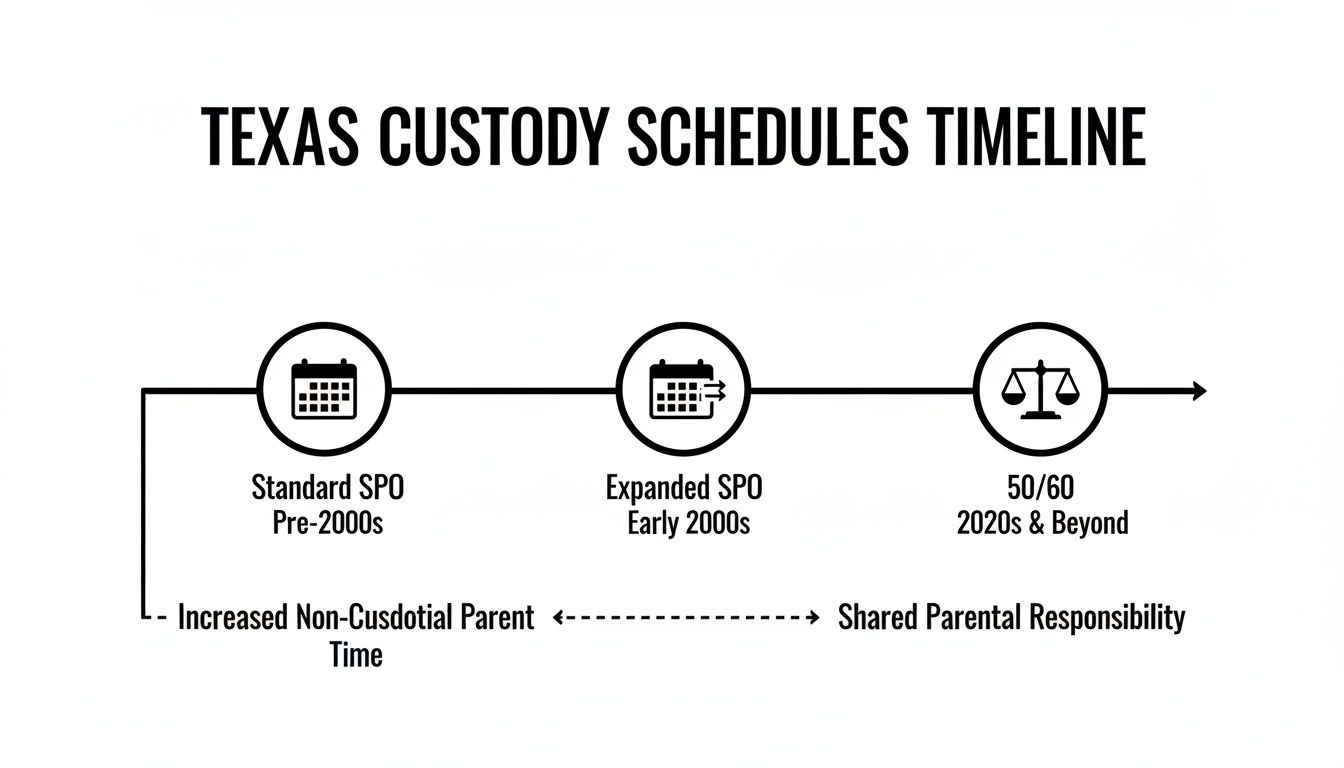
As you can see, the progression from the older Standard Possession Order (SPO) to the more modern Expanded SPO and true 50/50 schedules reflects the state’s growing understanding of how beneficial shared parenting is for children.
Why Child Support Still Exists in 50/50 Arrangements
At its core, child support is about ensuring a child’s financial stability. Consider this: if one parent earns substantially more than the other, their financial support is needed to maintain a consistent quality of life for the child across both households. Without it, a child might bounce between two drastically different worlds—one home where needs are met with ease and another where providing the basics is a constant struggle. The court’s goal is to minimize that disparity.
According to the Texas Family Code, child support is calculated as a percentage of the paying parent’s net income. The court can deviate from this guideline amount if evidence shows it is in the child’s best interest.
For example, even with equal time, one parent might be shouldering significant costs like health insurance premiums or specialized tutoring. A child support order helps balance these financial duties so one parent isn’t carrying an unfair portion of the burden.
Let’s walk through a common situation to see how this plays out in a real-world scenario.
- Parent A has $8,000 per month in net resources.
- Parent B has $4,000 per month in net resources.
- They have agreed on a 50/50 possession schedule for their one child.
Even though they have equal time, there’s a clear income gap. A Texas court will almost certainly order Parent A, the higher earner, to pay child support to Parent B. The standard guideline amount for one child is 20% of the paying parent’s net resources.
In this scenario, the baseline calculation would be: $8,000 x 0.20 = $1,600 per month.
However, because they share possession equally, the judge has the flexibility to adjust this amount. The court might use an “offset” calculation, determining what each parent would pay and then ordering the higher earner to pay the difference. For example, if Parent B’s guideline obligation would have been $800 ($4,000 x 0.20), the final order might be for Parent A to pay Parent B $800 per month ($1,600 – $800). This approach helps level the financial playing field and ensures the child has similar resources available in each home.
Understanding this financial reality from the beginning is vital for setting realistic expectations. A shared custody arrangement in Texas is about sharing time and responsibility, and financial support is a crucial part of that shared duty.
Can We Change Our Custody Order Later On?
Life is not static, and what works for your family right after a divorce may not be the best fit a few years down the road. Children get older, parents change jobs or relocate, and circumstances evolve. The Texas legal system understands this. Your custody order is not carved in stone; there is a clear, established process for updating it to match your family’s new reality, while always keeping your child’s well-being as the central focus.
The idea of returning to court might sound exhausting, but the process is designed to be adaptive. The law provides a pathway to adjust your possession schedule, modify child support, or change conservatorship rights when there’s a valid reason. The key is knowing what the court requires and how the process works.
The Legal Standard: A “Material and Substantial Change”
Before a court will consider modifying your custody order, you must first prove that there has been a material and substantial change in circumstances since the last order was signed. This is the legal threshold you have to meet. It exists for a good reason—it prevents parents from returning to court over every minor disagreement and ensures that orders are only changed when something significant has happened.
So, what qualifies as “material and substantial”? It depends on the specific facts of your situation, but here are some common examples that often meet the standard:
- A Parent Relocates: One parent plans a long-distance move that makes the current possession schedule unworkable.
- Significant Changes in Income: A parent is laid off from a long-term job or receives a major promotion that dramatically changes their financial situation, impacting child support.
- A Child’s Needs Evolve: As children grow, their needs and preferences change. A teenager who wants to be heavily involved in extracurriculars near one parent’s home could be a valid reason for a modification.
- Shifts in a Parent’s Lifestyle: A parent’s new work schedule, remarriage, or a change in their living situation that negatively affects the child could justify re-evaluating the order.
Proving this change is the first and most critical step. Without it, your request to modify will not proceed.
The Step-by-Step Modification Process
Once you are confident that a significant change has occurred, the process for requesting a modification generally follows a set path. While every case is unique, the basic steps are fairly consistent.
- File a Petition to Modify: The process begins when one parent files a formal “Petition to Modify the Parent-Child Relationship” with the same court that issued the original custody order. This legal document explains the changes you are requesting and, crucially, details the material and substantial change that makes them necessary.
- Serve the Other Parent: The other parent must be officially notified that you have filed the lawsuit. This is called “service,” and it ensures they have a fair opportunity to respond.
- Attempt Mediation: In Texas, most courts will order you and the other parent to try mediation before you can have a final trial. This is a valuable opportunity to sit down with a neutral third-party mediator to see if you can work out an agreement, which is almost always less stressful and costly than a courtroom battle.
- Attend a Court Hearing: If you cannot reach an agreement in mediation, your case will be set for a hearing. Both parents will present evidence and testimony to the judge, who will then decide if a modification is justified and, most importantly, if it is in the child’s best interest.
The legal system provides this structure to ensure that any adjustments to your order are made thoughtfully and with your child’s stability as the primary goal. You can find a more in-depth exploration of this topic by reading our guide on modifying a child custody order in Texas.
Modifying an order can feel complicated, but it’s an essential tool for ensuring your custody plan continues to serve your child as your family’s life unfolds.
When you’re trying to understand the details of shared custody, it’s completely normal to have a long list of questions. The specifics of Texas family law can feel overwhelming, but getting clear answers is the first step toward moving forward with confidence. Let’s address some of the most common questions we hear from parents in your situation.
Can My Child Decide Which Parent to Live With?
This is one of the most frequent questions we receive, especially from parents of teenagers. The short answer is: to an extent. Once a child in Texas turns 12 years old, the law allows them to speak with the judge in private to state their preference on where they would like to live.
However, and this is a critical point, that preference is not the final word. A judge will listen carefully to what a child has to say and take it into consideration. But their desire is just one piece of a much larger puzzle. The judge’s ultimate decision will always be based on the child’s overall best interest, not just their wish.
What Is a Right of First Refusal Clause?
A “right of first refusal” is a practical and increasingly common provision that can be included in Texas custody orders. Simply put, it requires you to offer the other parent the opportunity to watch your child before you hire a babysitter or ask another relative or friend for help.
Typically, this clause applies when you need childcare for a specific length of time, such as more than four hours or overnight. The goal is to maximize the time the child spends with their parents, which can strengthen the co-parenting relationship and keep both of you deeply involved in day-to-day life.
Does Joint Conservatorship Always Mean 50/50 Time?
No, and this is a major point of confusion for many parents. Joint Managing Conservatorship is about sharing the rights and responsibilities of parenthood—such as making decisions together about your child’s school or medical care. It does not automatically mean an equal 50/50 split of physical time.
While a schedule like the Expanded Standard Possession Order (ESPO) gets very close to a 50/50 time split, a true week-on, week-off schedule is not the default in Texas. Achieving a true 50/50 plan usually requires both parents to agree to it, or for one parent to convince a judge that it is specifically in the child’s best interest.
How Do We Handle Disagreements on Big Decisions?
Your custody order should serve as your rulebook for resolving disagreements. In most cases, the order will require parents to confer with each other before making major decisions regarding education or non-emergency healthcare.
To avoid a stalemate, a well-drafted order will often give one parent the final say—the tie-breaking vote—in certain areas if you cannot agree. For example, the primary parent might have the exclusive right to decide which school the child attends within their designated geographic area. Defining these tie-breaker rules clearly from the start is vital for preventing future conflicts and keeping your child’s life running smoothly.
If you need help navigating divorce, custody, or estate planning in Texas, contact The Law Office of Bryan Fagan, PLLC today for a free consultation.