
Planning for what happens after you’re gone is one of the most profound acts of care you can offer your family. But when you start looking into wills and trusts in Texas, the legal jargon can feel like a roadblock, making it easy to feel overwhelmed and put this crucial task off for another day.
These are two of the most powerful tools in estate planning, but they work in very different ways. A will is a set of instructions for what to do after you pass away. A trust, on the other hand, is a tool for managing your assets both during your life and after. Understanding their differences is the first real step toward protecting your family’s future with confidence and peace of mind.
Your Guide to Wills and Trusts in Texas
Thinking about the future brings up a lot of questions, but creating a plan is an act of responsibility and love for the people who matter most. Too many Texans delay estate planning because the terms seem confusing or the process feels intimidating. Our goal is to cut through the noise and explain wills and trusts in Texas with the clarity and compassion you need to make confident decisions.

Think of this guide as your personal roadmap. We’ll walk you through the essentials, breaking down these legal instruments into simple, practical terms so you feel supported and understood every step of the way.
What You Will Learn
This guide is built to give you real-world knowledge, turning complicated legal choices into clear, manageable steps. We’ll cover the key areas you need to understand to build a solid foundation for your family’s financial security.
Here’s what we’ll cover:
- The Basics of a Texas Will: We’ll explain exactly what a will is, why it’s a foundational document for almost every Texan, and what the Texas Estates Code requires to make it legally valid.
- Understanding Trusts: You will learn how a trust—especially a revocable living trust—actually works to hold and protect your assets, maintain your family’s privacy, and help your estate avoid the often long and public probate process.
- Making the Right Choice: We’ll put wills and trusts side-by-side, using relatable scenarios to help you figure out which tool is the right fit for your family’s unique situation and financial goals.
At The Law Office of Bryan Fagan, we believe that an informed client is an empowered one. This guide is the start of that journey.
What Is a Will and Why Do You Need One in Texas?
Thinking about a will can feel heavy. It’s a topic most of us would rather avoid, but it’s genuinely one of the most powerful and direct ways to protect your family’s future. Think of it as your personal instruction manual for what happens after you’re gone, ensuring your wishes are honored and your loved ones are cared for.
In Texas, this document is legally known as a Last Will and Testament. It's your final, legally binding word on who receives your property, who you trust to manage your estate, and—most importantly for parents—who will raise your children.
If you die without a will (known as dying "intestate"), you aren’t just leaving a void; you are handing these deeply personal decisions over to the State of Texas. The state’s intestacy laws will dictate how your assets are divided using a rigid, one-size-fits-all formula that almost certainly won’t match your wishes or your family’s unique needs. A will ensures your voice is heard, preventing family disputes, confusion, and expensive legal messes down the road.
Key Roles Defined in a Texas Will
A will isn't just about giving away your property. It's about appointing people you trust to handle critical responsibilities. Understanding these roles will help you see how it all works.
- Executor: This is the person or institution you name to be in charge of carrying out your will’s instructions. Think of them as the captain of your estate. Their job, as defined by the Texas Estates Code, is to gather your assets, pay any final debts, and ensure the remaining property gets to the right people.
- Beneficiaries: These are the people, charities, or organizations you choose to inherit your property. You can be as specific as you want, whether it's leaving your home to your children or a prized possession to a dear friend.
- Guardian: For any parent with minor children, this is arguably the most important decision you'll make in your will. You name the person you trust to raise your children if both you and their other parent are gone. Without this designation, a court will make this choice for you.
Disturbing new data shows that only about 24% of Americans have a will, and the numbers are even lower for parents with young kids. This leaves far too many families exposed to state intestacy laws, where a judge—not you—makes the final call on who gets what and who raises your children. In Texas, our community property laws add another layer of complexity, making a clear, well-drafted will absolutely essential to avoid costly and painful court battles. You can explore the latest findings on estate planning laws to see how these trends affect Texas families.
Formal Requirements for a Valid Texas Will
For a will to hold up in a Texas court, it must follow specific rules laid out in the Texas Estates Code. These formalities aren't just red tape; they exist to protect your final wishes from fraud or claims that you were pressured into signing.
A valid Texas will must be:
- In writing.
- Signed by you (the testator), or by another person signing on your behalf, in your presence, and under your direction.
- Attested to by two credible witnesses who are at least 14 years old, who sign the will in your presence.
These rules are strict for a reason—they ensure the integrity of your final wishes. Working with an experienced lawyer is the best way to guarantee every detail is handled correctly, giving you and your family true peace of mind. A will is a foundational tool for every Texan, ensuring your legacy is one of care and clarity, not chaos and conflict.
If you need help navigating divorce, custody, or estate planning in Texas, contact The Law Office of Bryan Fagan today for a free consultation.
How a Trust Can Protect Your Assets and Privacy
Think of a will as your instruction manual for what happens after you’re gone. A trust, on the other hand, is more like a private, secure container you build for your assets during your lifetime. This container can hold your home, investments, bank accounts, and almost anything else of value. For most Texas families we work with, the go-to option is a revocable living trust.
Why? Because it puts you in complete control. As the creator of the trust (the grantor), you also act as the trustee. This means you manage everything inside that container. You can add or remove assets, change who gets what, or even decide to dissolve the trust entirely. It gives you powerful protection without forcing you to give up control of your life's work.
Bypassing Probate for Privacy and Speed
One of the biggest reasons people choose a trust is to avoid probate. When you pass away, assets passed down through a will have to go through probate court. This is a public, court-supervised process that can drag on for months—sometimes longer—all while racking up legal costs. And because it's a public court proceeding, your will becomes a public record for anyone to read.
A trust, however, is a completely private document. The transfer of your assets to your beneficiaries happens directly, on your terms, without any court involvement. This keeps your family’s financial affairs out of the public eye and usually gets assets into your loved ones’ hands much faster and with far less stress.
This privacy is often a deciding factor for people weighing wills and trusts in Texas. For families with complex assets, or even just those who value discretion, keeping personal finances private is a huge relief. To see just how complicated probate can get with property, check out our guide on probate and real estate in Texas.
Appointing a Successor for Seamless Management
A trust also offers a critical layer of protection if you ever become unable to manage your own affairs. Inside your trust document, you’ll name a successor trustee—someone you handpick to step in and manage the trust assets if you become incapacitated due to illness or injury.
This simple designation ensures your bills get paid and your finances are handled by someone you trust, all without the need for a court-appointed guardianship. A guardianship is an intrusive, expensive, and public legal proceeding that most families want to avoid. Your successor trustee has a fiduciary duty—a legal duty to act in your best interest—giving you and your family invaluable peace of mind.
Choosing this person is a big decision. Recent data shows that when picking a trustee, 65% of people prioritize trustworthiness above all else, while only 23% put financial expertise first. And in a state with unique community property laws like Texas, it makes sense that nearly 45% prefer a family member who understands the family dynamics. For blended families, a well-chosen trustee can be the key to preventing inheritance fights and making sure your wishes are followed to the letter. You can discover more insights about estate planning statistics on justvanilla.com to see how others are thinking about these roles. To get a practical sense of what your successor will need to do, an external guide on selling a house in a trust after death can also be incredibly helpful in preparing them for their duties.
Choosing Between a Will and a Trust in Texas
Deciding on the right estate plan can feel like standing at a crossroads. Should you go with a will, or is a trust the better path for your family? There’s no single right answer for every Texan; the best choice depends entirely on your unique family dynamics, your assets, and what you hope to achieve.
Our job is to help you understand the practical differences so you can see which tool aligns with your vision. We'll look at key factors like avoiding probate, ensuring privacy, managing costs, and protecting your family during unexpected life events.
Comparing Wills and Trusts Side-by-Side
Let's break down the core differences in a way that’s easy to understand. Think of a will as a letter of instruction you write to the court for after you’re gone. A trust, on the other hand, is like a private rulebook you create to hold and manage your assets—both now and in the future—without court involvement.
This table breaks down the key differences between a will and a living trust to help you determine which is the right fit for your estate planning needs in Texas.
Comparing Wills and Trusts in Texas at a Glance
| Feature | Last Will and Testament | Revocable Living Trust |
|---|---|---|
| Probate | Required; public court process. | Avoids probate; private administration. |
| Privacy | Becomes a public record. | Remains a private document. |
| Upfront Cost | Lower cost to create. | Higher cost to set up and fund. |
| Long-Term Cost | Can lead to high probate fees. | Can save significant money by avoiding probate. |
| Takes Effect | Only upon death. | Immediately upon signing and funding. |
| Incapacity | Offers no protection. | Manages assets if you become unable to. |
| Asset Control | You control assets until death. | You control assets as the trustee while you're able. |
| Guardianship | Can name guardians for minor children. | Cannot name guardians; requires a will for this. |
While a trust has clear advantages for privacy and probate avoidance, a will is still the only document that can name a guardian for your minor children. Often, the most effective estate plans use both documents working together.
The flowchart below illustrates a key decision point when using a trust—who controls the assets.
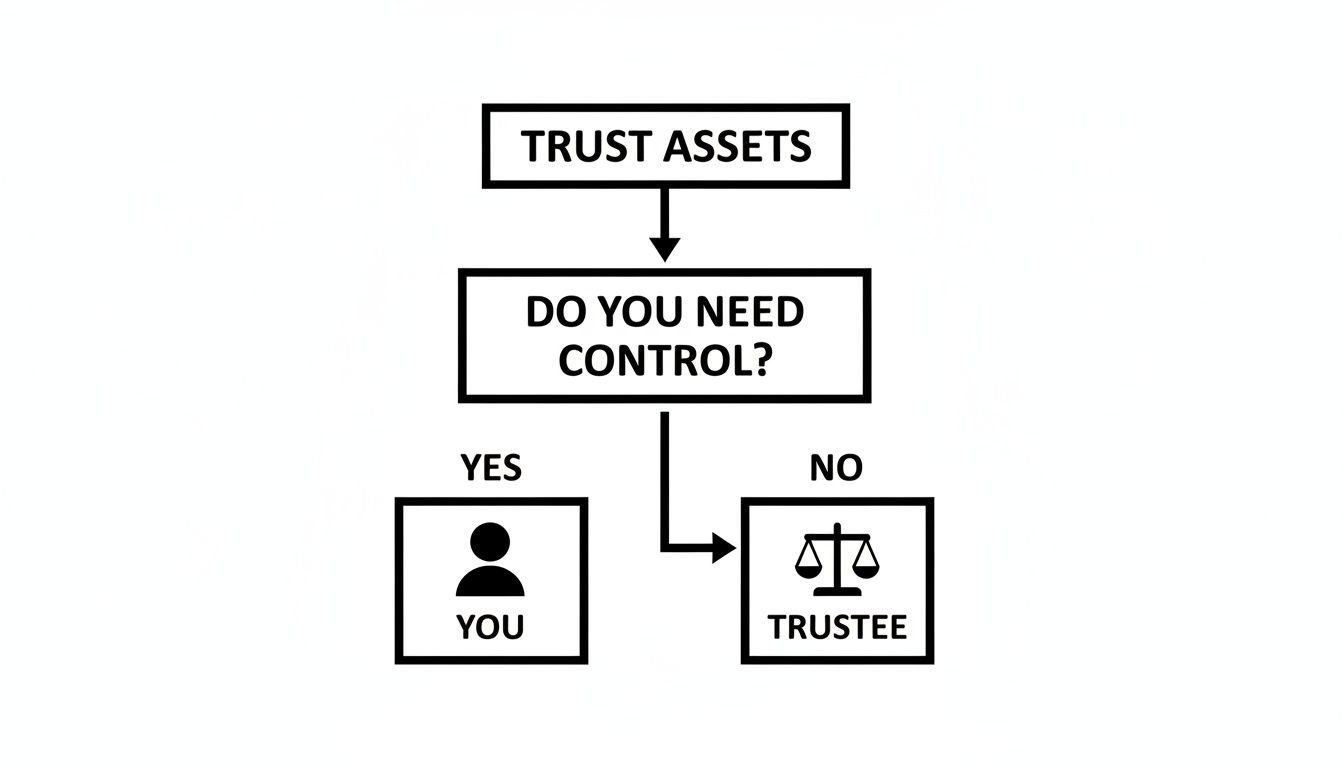
As you can see, with a revocable living trust, you typically keep full control as the trustee. But you also appoint a successor trustee to take over if needed, providing a seamless transition of management without court interference.
Key Factors to Consider
When choosing between wills and trusts in Texas, several critical factors come into play. Each one can have a significant impact on your family’s experience after you’re gone.
- Probate Avoidance: This is perhaps the most significant distinction. A will must go through probate court. A properly funded living trust does not.
- Privacy: Because probate is a public process, a will becomes a public record for anyone to see. A trust remains a private document, keeping your family’s financial affairs confidential.
- Cost: A will generally has a lower upfront cost to create. A trust is more expensive to set up and fund, but it can save your family substantial money later by avoiding probate fees.
- Incapacity Protection: A will only takes effect after your death and offers no protection if you become incapacitated. A trust allows your chosen successor trustee to step in and manage your finances if you become unable to do so yourself, avoiding a costly guardianship proceeding.
While Texas has a more streamlined probate process than many states, it still often takes months—or even years—and exposes your family’s assets to public view. A living trust shines by avoiding probate entirely, allowing for a much faster and private distribution of assets.
Although trusts have higher initial setup costs, they often slash long-term expenses by dodging probate fees, which can consume 3-7% of an estate's total value. This is especially important for Texans with properties in multiple states or those with oil and mineral interests, as a trust can simplify management without needing separate probate proceedings in each jurisdiction. Discover more insights about trust vs. will in Texas on kazilawfirm.com.
Scenarios to Help You Decide
Legal concepts are always clearer with real-world examples. Let's look at how these tools apply to different Texas families.
Scenario 1: The Young Couple with Straightforward Assets
A young couple in Houston with a home, some savings, and two small children might find that a will is the perfect starting point. Their primary concern is naming guardians for their children, which is a key function of a will. Since their assets are not overly complex, the simplicity and lower upfront cost of a will make it an excellent choice for now.
Scenario 2: The Blended Family in Dallas
Consider a blended family in Dallas where one spouse has children from a prior marriage. A revocable living trust is often the ideal solution here. The trust allows them to provide for the surviving spouse while ensuring that specific assets are preserved and will ultimately pass to the children from the previous relationship, avoiding potential conflicts over inheritance down the road.
Scenario 3: The Austin Business Owner
An entrepreneur in Austin who owns a successful business needs a plan for continuity. A trust is essential. It can hold ownership of the business and name a successor trustee specifically chosen for their business acumen. This ensures the company continues to operate smoothly without interruption, even if the owner passes away suddenly, protecting the business, its employees, and the owner’s family from the chaos of a business stuck in probate.
Each of these scenarios highlights how your personal circumstances—your family structure, asset complexity, and long-term goals—are the most important factors in choosing between a will and a trust. The right plan is the one that gives you the most confidence that your loved ones will be cared for exactly as you intend.
If you need help navigating divorce, custody, or estate planning in Texas, contact The Law Office of Bryan Fagan today for a free consultation.
How Wills and Trusts Work for Real Texas Families
Legal documents can feel abstract. The real power of wills and trusts in Texas only becomes clear when you see how they solve actual problems for families just like yours. Every family’s situation is unique, and a good estate plan is built to protect that specific story with clarity and foresight.

Let's move past the legal definitions and look at a couple of common scenarios we handle every day at The Law Office of Bryan Fagan. These examples show how the right tool can address your family’s specific needs with care and precision.
Scenario 1: The Blended Family
Meet Sarah and David. They’re a couple in their 50s living in a quiet Fort Worth suburb. It's a second marriage for both of them, and David has two adult children from his first marriage. Together, they’ve built a great life, combining their assets into a home they own jointly and a shared investment portfolio.
Their biggest worry? Making sure everyone is treated fairly when one of them passes away. David wants to provide for Sarah for the rest of her life, but he also needs to ensure his own children eventually receive their inheritance. A simple will could create problems, potentially sparking conflict or forcing his kids to wait years to inherit anything.
The Solution: A Revocable Living Trust
Working with their attorney, Sarah and David create a revocable living trust. They then transfer title of their home and their investment accounts into this trust. The trust document contains very specific instructions:
- If David dies first, Sarah has the legal right to live in the home for the rest of her life. She will also receive income from the trust's investments.
- The trust names David’s children as the ultimate beneficiaries.
- Once Sarah passes away, all the remaining trust assets—including the house—are distributed directly to David’s children, just as he intended.
This trust skillfully navigates complicated Texas community property laws, helps prevent future disputes between a stepparent and stepchildren, and makes sure David's wishes are honored without uprooting Sarah from her home. It’s a solution designed to provide for everyone with dignity.
Scenario 2: The Family with Minor Children
Now, let's look at Maria and Javier, a young Houston couple with two kids under the age of 10. Like most young parents, their main concern isn’t managing vast wealth—it’s protecting their children if the unthinkable happens. Who would raise their kids? And who would manage the life insurance policy and savings they’ve worked so hard to set aside for them?
They understand that without a plan in place, a judge who doesn't know them or their family would be the one making these intensely personal decisions. That thought is what keeps them up at night.
The Solution: A Will with a Testamentary Trust
For Maria and Javier, a will is the most important legal document they can create. It accomplishes two critical goals:
- Naming a Guardian: A will is the only legal document in Texas where they can name the guardian they want to raise their children. They chose Maria’s sister, who shares their values and loves the kids as her own.
- Creating a Trust for the Children: Their will also establishes a testamentary trust. This type of trust only comes into existence after they pass away, and its job is to hold and manage the assets for their children. They name a trusted family member as the trustee, who will manage the funds responsibly until the kids reach an age they've specified, like 25.
This plan guarantees their children are cared for by the person they trust and that their financial resources are protected and used for their well-being. It transforms their parental love into a legally binding plan.
These examples show that whether you need a will or a trust, the goal is always the same: protecting what matters most to you.
If you need help navigating divorce, custody, or estate planning in Texas, contact The Law Office of Bryan Fagan today for a free consultation.
How to Create Your Texas Estate Plan
Taking the first step to create an estate plan is often the hardest part. It's a task that feels enormous, but it’s really just a series of clear, manageable steps. We want to give you a straightforward roadmap to get you started, so you can feel confident you’re securing your family’s future.
This isn’t just about filling out legal documents. It's about making sure your wishes are clearly understood and legally protected, giving you and your family a genuine sense of security.
Your Initial Steps to a Solid Plan
The first phase is all about getting organized. This isn’t just about crunching numbers; it’s about painting a clear picture of your life for your attorney, which will make your first meeting incredibly productive.
- Gather Your Information: Start by making a simple list of your key assets (like real estate, bank accounts, investments) and any debts (mortgages, car loans). You’ll also want to note your family structure, including the full names and birth dates of your spouse, children, and anyone else you plan to include in your will or trust.
- Reflect on Your Wishes: Think about who you want to receive your property (your beneficiaries). If you have minor children, who would you trust to raise them as their legal guardian? There are no right or wrong answers here—only what feels right for you and your family.
This initial groundwork lays the foundation for creating effective wills and trusts in Texas. The details you gather now help ensure nothing is overlooked later. For instance, the person you name as an executor will have very specific legal responsibilities. You can learn more about the duties of an executor of a will in Texas in our detailed guide.
Why Professional Guidance Is Essential
The last and most important step is to talk with an experienced Texas estate planning attorney. While DIY kits and online forms might seem like a cheap and easy fix, they are full of potential pitfalls. One small mistake or a single poorly worded sentence can lead to costly legal errors, invalidate the entire document, or create the exact family disputes you were trying to prevent.
Professional legal guidance is the only way to ensure your documents are legally sound, fully compliant with the Texas Estates Code, and truly reflect your unique intentions. An attorney can help you navigate complex issues like community property, blended family dynamics, and asset protection.
At The Law Office of Bryan Fagan, we make this process as straightforward and reassuring as possible. Let us help you find the deep sense of security that comes from knowing you have a solid plan in place.
If you need help navigating divorce, custody, or estate planning in Texas, contact The Law Office of Bryan Fagan today for a free consultation.
Frequently Asked Questions About Wills and Trusts
Diving into estate planning often brings up a lot of questions. To help clear things up, we've put together some of the most common questions we hear from Texans about wills and trusts in Texas. Our goal is to give you quick, straightforward answers so you can move forward with confidence.
Can I Have Both a Will and a Trust in Texas?
Yes, you absolutely can. In fact, using both is a common and highly effective estate planning strategy. Most well-designed plans that feature a living trust will also include a special kind of will known as a "pour-over will."
Think of this will as a legal safety net. Its primary job is to "pour" any assets you didn't manage to place into your trust during your lifetime into that trust when you pass away. This ensures every one of your assets is handled under a single, cohesive plan according to the rules you already set up in your trust.
What Happens If I Die in Texas Without a Will?
If you pass away without a valid will, the legal term is dying "intestate." When that happens, the State of Texas steps in to distribute your property, but it does so based on a rigid, one-size-fits-all legal formula defined in the Texas Estates Code.
These intestacy laws give no consideration to your personal wishes, the unique dynamics of your family, or your relationships. A court will simply divide your assets among your legal relatives based on a predetermined hierarchy. For blended families or unmarried partners, this can lead to outcomes that are the exact opposite of what you would have wanted.
You can get a better sense of how the court process works by reading our overview of what happens when you probate a will in Texas. Creating a will is the only way to make sure your specific intentions are legally binding and honored.
How Often Should I Update My Will or Trust?
A great rule of thumb is to sit down and review your estate plan every 3-5 years. Even more importantly, you should always revisit your documents right after any significant life event occurs.
Key events that should trigger an immediate review include:
- Marriage or divorce
- The birth or adoption of a new child
- A major change in your financial picture (either an increase or decrease in wealth)
- The death of a beneficiary or someone you named as an executor or trustee
- Moving to a different state
Keeping your plan up-to-date ensures it continues to reflect your life and your wishes accurately, so it works exactly as you intend when it's needed most.
Is a Living Trust Expensive to Set Up in Texas?
A revocable living trust definitely has higher upfront costs when compared to a simple will. That’s because it’s a more complex legal instrument. The process involves not only drafting the trust document itself but also formally transferring the legal title of your assets into it, a step known as "funding" the trust.
However, it’s crucial to look at the long-term picture. While a will is cheaper to create on the front end, it has to go through the probate process—which can be both expensive and time-consuming for your heirs. By avoiding probate, a trust can ultimately save your family a significant amount of money and stress down the road. For heirs who inherit physical assets, understanding the logistics of tasks like selling inherited jewelry can also be a valuable part of settling an estate.
If you need help navigating divorce, custody, or estate planning in Texas, contact The Law Office of Bryan Fagan today for a free consultation.


