
Navigating your rights as a father in Texas can feel overwhelming, especially when you're worried about your relationship with your child. It's a common misconception that courts automatically favor mothers, but that simply isn't true. Texas law is built on a gender-neutral foundation, focused entirely on what is in the best interest of the child.
Understanding your rights under Texas law is the first step toward securing your role in your child's life. The system starts with the belief that having both parents actively involved is almost always what's best for a child. This guide will walk you through the essential principles, step-by-step, to help you feel supported, understood, and prepared for the road ahead.
Understanding Your Foundational Rights as a Texas Father

Let's be clear: the Texas Family Code is impartial. Your gender does not put you at a legal disadvantage. Your rights as a father are tied directly to your legal status as a parent and your commitment to your child’s well-being. Think of it like building a house—before you can put up walls or a roof, you must pour a solid foundation. If you skip that step, everything else will be unstable.
The Foundation: Establishing Legal Paternity
For a father who is married to the child's mother, the law automatically presumes you are the child's legal parent. However, for unmarried fathers, establishing legal paternity is the absolute, non-negotiable first step. It is the concrete foundation upon which all your other rights—custody, visitation, and decision-making—are built.
Until you are legally recognized as the father, you have no enforceable rights in court. This is the single most critical action you can take to protect your relationship with your child.
The Framework: Conservatorship and Possession
Once paternity is established, you can begin building the framework of your parental rights. In Texas family law, this framework consists of two core concepts:
- Conservatorship: This is your legal authority to make important decisions for your child. It covers choices about their education, non-emergency healthcare, and religious upbringing.
- Possession and Access: This is the legal term for your parenting time, often called a visitation schedule. It lays out the specific days and times the child will be in your care.
A key principle in the Texas Family Code § 153.131 is the court's starting presumption that appointing both parents as Joint Managing Conservators is in the child’s best interest. This means the court begins with the assumption that you and the mother should share the rights and duties of raising your child.
This legal presumption is a powerful tool for fathers. It means you don't start your case on the defensive. Instead, the burden of proof is on the other parent to convince a judge that sharing parental duties would be detrimental to the child.
This belief in shared parenting is so fundamental that in November 2021, Texas became the first state to explicitly protect parental rights in its constitution. With approximately 70% of Texans voting in favor, the amendment confirms a parent's fundamental right to direct the care, custody, and control of their child. You can read more about the analysis of this parental rights amendment and its ongoing impact.
Knowing these foundational concepts allows you to move forward with confidence, armed with the knowledge that the law is structured to support your involvement.
How to Legally Establish Paternity in Texas
For any father in Texas, the most important step to protect your rights is becoming a legal parent. This one action transforms you from a biological father into a legal father with real, enforceable standing in court. Without it, you have no legal basis to ask a judge for custody, visitation, or a say in your child's life.
In Texas, there are two primary pathways to make your fatherhood official.
The Acknowledgment of Paternity (AOP) Pathway
The most common method for unmarried parents is signing a Voluntary Acknowledgment of Paternity (AOP). This is a legal form, often presented at the hospital shortly after a child is born, that both parents can sign to establish the father's legal status.
Do not let the simplicity of this form mislead you—signing an AOP is a serious legal act with lasting consequences. It is not just a piece of paper to get your name on the birth certificate; it carries the same legal weight as a court order. Once signed and filed with the Texas Vital Statistics Unit, you are legally the child's father, with all the associated rights and responsibilities.
For example, if you and the mother are in complete agreement about parentage, the AOP is often the simplest route, avoiding the time and cost of going to court. However, you must understand exactly what you are signing.
- Your Rights: The AOP gives you the right to go to court and ask for a formal order on conservatorship (decision-making) and possession (visitation).
- Your Responsibilities: It also creates a legal obligation for you to financially support your child through child support and medical support.
- It’s Hard to Undo: You have a very short 60-day window to rescind an AOP after signing it. Beyond that, overturning it requires going to court and proving you were a victim of fraud, duress, or a significant mistake of fact.
Before you sign an AOP, you must be 100% certain you are the biological father. If there is any doubt in your mind, you have an absolute right to request a DNA test first. Signing the form waives your right to genetic testing and can lock you into permanent legal and financial obligations.
The Court Order Pathway (Petition to Adjudicate Parentage)
What if the mother refuses to sign an AOP, or you have serious doubts about your biological connection to the child? In this scenario, you turn to the court system by filing a Petition to Adjudicate Parentage.
This formal lawsuit asks a judge to step in and legally determine who the child's parents are. For many unmarried fathers, filing this petition is the necessary first move to secure their rights. We explore this topic in depth in our article on the rights of fathers with children born out of wedlock in Texas.
Filing this petition initiates a legal process that generally follows these steps:
- Filing the Petition: Your attorney drafts and files the lawsuit in the appropriate county court, officially opening the case.
- Serving the Mother: The child's mother must be formally notified that the lawsuit has been filed.
- Requesting Genetic Testing: The court will almost always order a DNA test (a simple cheek swab) to confirm or rule out biological parentage.
- The Court Order: If the DNA test confirms you're the father, the judge will sign an order that legally declares you the parent. This order is the final, official word on your legal status.
This court order achieves the same goal as an AOP but through the judicial system. A significant advantage is that the same lawsuit can be used to establish custody (conservatorship), a visitation schedule, and child support all at once. This creates a clear, comprehensive, and enforceable plan for your role in your child's life, ensuring your rights are not left to chance.
Once you’ve established legal paternity, the next phase of your case focuses on your time and authority as a father. While Texas family law uses specific terminology, understanding it is key to protecting your rights. Let’s break down the concepts so you feel prepared, not lost in legal jargon.
The two main terms you must know are conservatorship and possession and access. Think of it this way: conservatorship is your job title as a parent—it defines your legal rights and duties. Possession and access is your work schedule—it spells out exactly when you have your child.
Conservatorship: Your Parental Rights And Duties
In Texas, what most people call "custody" is legally known as conservatorship. This term refers to who has the authority to make major decisions for your child. The good news for dads is that Texas law starts with a strong presumption that both parents should be named Joint Managing Conservators (JMCs).
This means the judge begins with the belief that you and the mother should share the rights and responsibilities of raising your child. It places the burden on the other parent to prove why sharing those duties would not be in the child's best interest. As a JMC, you typically share the right to:
- Make decisions about your child’s education and healthcare.
- Access all medical, dental, psychological, and educational records.
- Consent to emergency medical treatment.
- Guide the moral and religious upbringing of your child.
While most parents are named JMCs, the court usually designates one parent as the "primary" conservator. This parent has the exclusive right to decide where the child lives, though this is often restricted to a specific geographic area. For fathers facing these decisions, a solid legal approach is essential, drawing on principles similar to those discussed in articles like Mastering Legal Strategy in Divorce Cases.
In rare situations where a joint arrangement would be unsafe due to family violence, substance abuse, or other serious issues, a court might name one parent as the Sole Managing Conservator (SMC).
Possession And Access: Your Parenting Time
Possession and access is the court-ordered schedule that details when each parent has the child. The default schedule in Texas, defined in the Texas Family Code, is called the Standard Possession Order (SPO).
The SPO is designed to give both parents consistent, predictable time with their children. Before you can obtain a possession order, you must first be the child's legal father. This infographic shows the two paths that lead to that status.
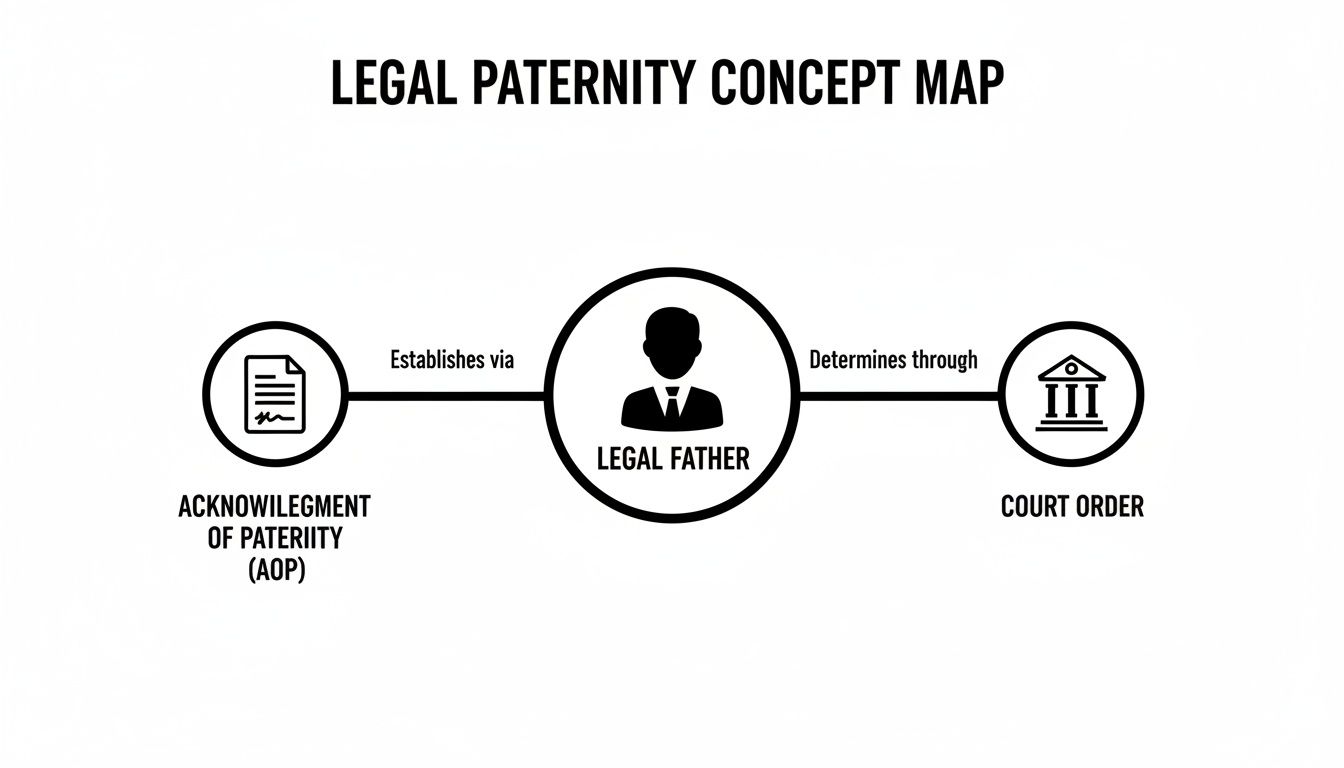
As you can see, whether you sign an Acknowledgment of Paternity or go through a court process, the destination is the same: becoming the legal father. That legal status is the foundation for securing your rights to a possession schedule.
The SPO itself varies based on how far apart the parents live.
Parents Living Under 100 Miles Apart: The non-primary parent typically has possession on the first, third, and fifth weekends of a month, along with alternating major holidays and a significant portion of the summer.
Parents Living Over 100 Miles Apart: The schedule adjusts for travel. The non-primary parent often gets every spring break and a longer, continuous block of summer possession time to make visits more meaningful.
A major update to Texas law in 2021 (Senate Bill 1936) was a game-changer for fathers. This "50-Mile Rule" established the Expanded Standard Possession Order as the new default for parents living within 50 miles of each other. This schedule can give fathers possession of their children more than 40% of the year—a major step toward more equal parenting time.
To see exactly how these two schedules differ, here’s a side-by-side comparison. Understanding these differences helps you know what to advocate for.
Standard Possession vs Expanded Standard Possession Order
| Possession Element | Standard Possession Order (SPO) | Expanded Standard Possession Order (Expanded SPO) |
|---|---|---|
| Weekday Possession | No regularly scheduled weekday possession. | Possession of the child every Thursday during the school year, from when school is dismissed until school resumes on Friday morning. |
| Weekend Possession | Possession begins at 6:00 PM on Friday and ends at 6:00 PM on Sunday. | Possession begins when school is dismissed on Thursday (for the first, third, and fifth weekends) and ends when school resumes on Monday morning. |
| Holiday Possession | Exchanges for holidays like Thanksgiving and Christmas often occur at 6:00 PM. | Holiday possession begins when school is dismissed for the holiday break and ends when school resumes after the break. |
As the table illustrates, the Expanded SPO provides the non-primary parent significantly more time by including Thursdays and extending weekends through the start of school on Monday. It essentially creates a long weekend during each possession period.
Grasping the distinction between conservatorship and possession empowers you to argue more effectively for the largest possible role in your child’s life. For a deeper look, our guide on possession orders explained for Texas family law breaks it down even further.
Understanding Your Financial Responsibilities

Being a father is about more than emotional support and time spent together; it also involves financial responsibility to ensure your child has everything they need to thrive. For many dads, the topic of child support brings up anxiety and uncertainty.
The good news is that the Texas system is not arbitrary or punitive. It is a predictable process based on a clear formula laid out in the Texas Family Code. Once you understand how it works, you can approach your financial future with more confidence.
How Texas Calculates Child Support
Texas courts do not pick a number out of thin air. Child support is calculated by applying a specific percentage to your net monthly resources. This isn't your take-home pay; it's a specific legal figure calculated according to state law.
First, the court totals your gross monthly income from all sources. This includes:
- Wages, salary, commissions, and bonuses
- Self-employment income
- Rental income
- Dividends, interest, and royalties
From this total, the court subtracts federal income taxes (based on a single filer with one exemption), Social Security and Medicare taxes, and the amount you pay for the children's health insurance. The remaining figure is your net monthly resources—the number used in the child support formula.
A critical principle to remember is that child support and visitation are entirely separate legal duties. A parent cannot legally withhold court-ordered possession time because child support is unpaid. Likewise, a parent cannot stop paying child support because they are being denied visitation. These are two distinct obligations, and violating one does not excuse violating the other.
The Guideline Percentages And The Income Cap
Once your net monthly resources are determined, the court applies a standard percentage based on the number of children in the case. These guideline percentages are:
- 20% for one child
- 25% for two children
- 30% for three children
- 35% for four children
- 40% for five or more children
It's important to know that Texas law places a ceiling on the income used for this calculation. For years, that cap was $9,200 in net monthly resources. However, a major change is coming.
Effective September 1, 2025, a new law increases the child support net resources cap to approximately $11,700 per month. This represents a 27% increase—the largest in over two decades. For a high-earning father with one child, this means the maximum guideline support could be as high as $2,340 per month (20% of $11,700).
Medical And Dental Support Obligations
Your financial duties extend beyond the monthly child support payment. Texas courts also require parents to provide for their children's health needs by ordering one or both to maintain medical and dental insurance.
Typically, the parent who can obtain quality health insurance at a reasonable cost through their employer will be ordered to carry the policy. The cost of these insurance premiums is often factored into the overall support calculation, helping ensure the financial responsibility is shared fairly between both parents. Our child support overview for Texas families covers this in greater detail.
Modifying and Enforcing Your Court Orders
Receiving a final custody order can feel like crossing a finish line. But life is dynamic, and what worked perfectly last year may be impractical today. A court order isn’t set in stone. As your family’s life evolves, Texas law provides a clear process to ensure your court orders can adapt to new realities.
The law also gives you the power to ensure those orders are followed. Whether you need to adjust a schedule or hold the other parent accountable, knowing how to address issues after the judge signs the order is just as crucial as getting the order itself.
When Can You Modify a Court Order?
You can’t go back to court simply because you’ve changed your mind. To have a judge consider changing a possession schedule or child support, you must first prove that there has been a material and substantial change in circumstances.
Think of this as the legal key to unlock the courthouse door for a modification. The change cannot be a minor inconvenience; it must be a significant event that makes the current order unworkable or no longer in your child’s best interest.
What counts as a “material and substantial change”? Common examples include:
- A major job change or layoff that dramatically affects your income or work schedule.
- One parent relocating to another city or state, making the current possession schedule impossible.
- Your child’s evolving needs as they get older, such as a desire to join sports teams that conflict with the schedule.
- The other parent voluntarily giving you care of the child for a long period, outside the court order.
- Clear evidence of a dangerous environment at the other parent's home, like substance abuse or neglect.
If a judge agrees that a material and substantial change has occurred, the court will then determine what new arrangement is in the child's best interest. This could mean a new possession schedule, a different child support amount, or even changing which parent has the right to decide where the child lives.
Enforcing Your Right to Possession
What happens when the other parent simply refuses to follow the order? It’s an incredibly frustrating experience—you arrive for your weekend, ready to see your child, only to be denied. This is where your father rights in Texas are strongest. A court order is not a suggestion; it is a command.
When another party violates a court order, you do not have to plead or argue. You have the right to take them back to court and ask a judge to enforce your order. This process is one of the most powerful tools in Texas family law.
If the other parent is denying your court-ordered possession time, you can file a Petition for Enforcement. This legal action brings the other parent back before the judge to answer for violating the order. The penalties for being found in violation are serious and can include:
- Ordering make-up possession time to repay you for every period you were denied.
- Forcing the other parent to pay your attorney's fees and all court costs.
- Finding the parent in contempt of court, which can lead to significant fines and even jail time for repeated or egregious violations.
Nothing is more important than your time with your child. An enforcement action makes it clear that your rights as a father are not optional and must be respected.
If you need help navigating divorce, custody, or estate planning in Texas, contact The Law Office of Bryan Fagan today for a free consultation.
Frequently Asked Questions About Fathers' Rights
As a father facing the Texas family court system, you likely have many questions. It’s completely normal to feel confused, worried, or even a little scared. We understand. This section provides direct, clear answers to some of the most common questions we hear from Texas fathers.
Can My Child's Mother Move Out of State With Our Kids?
This is one of the biggest fears we hear from dads. The short answer is: not without the court's permission or your agreement. Most Texas custody orders include a geographic restriction, also known as a domicile restriction.
Think of it as a boundary for your child's primary home. This provision usually limits the child’s residence to the county where the case was filed and its surrounding counties. If the mother is the primary parent and wants to move the children outside that designated area, she must return to court and get a judge’s approval first.
If she attempts to move without permission, you can immediately file a motion to enforce the geographic restriction. A judge can order her to bring the child back. This restriction is a powerful protection designed to keep your child’s life stable and safeguard your relationship with them.
What if I Am Not on the Birth Certificate?
Being left off the birth certificate is a common hurdle for unmarried fathers, but it is not a dead end. Your name not being on that document simply means your status as the legal father hasn't been officially recognized yet. It does not eliminate your ability to secure your father rights in Texas.
You can, and should, take action by filing a Petition to Adjudicate Parentage. This lawsuit asks a judge to legally establish you as the father. The process typically involves a court-ordered DNA test to confirm the biological link. Once that order is signed, you have the same legal rights and responsibilities as a father who was on the birth certificate from day one.
Can a Father Get 50/50 Custody in Texas?
Yes, fathers in Texas absolutely can and do get 50/50 possession schedules. While Texas law does not presume a 50/50 split is the starting point, judges have full authority to order it if they are convinced it is in the child's best interest.
More common is the Expanded Standard Possession Order (SPO). For parents living within 50 miles of each other, this is the default schedule. It expands the non-primary parent's first, third, and fifth weekends to run from when school lets out on Thursday until school resumes on Monday morning. This schedule results in a split closer to 45/55 and is a significant step toward more equal parenting time.
To obtain a true 50/50 schedule, you will need to demonstrate to the judge why it is a practical and positive arrangement for your children. Factors that strengthen your case include:
- Living in close proximity to the other parent.
- Demonstrating a cooperative co-parenting relationship.
- Proving a history of deep involvement in your child’s daily life.
What Is Parental Alienation and What Can I Do About It?
Parental alienation is a destructive pattern where one parent intentionally tries to damage a child's relationship with the other parent. This goes beyond simple disagreements and can involve making false accusations, constantly disparaging you in front of the child, or interfering with your calls and visits.
Texas courts take this behavior very seriously because it is recognized as a form of emotional harm to the child. If you suspect this is happening, you must act.
Parental alienation is not just a co-parenting dispute; it is a form of emotional abuse against the child. The court's primary duty is to protect the child's best interest, and shielding them from this harm is a top priority.
First, document everything. Keep a detailed log with dates, times, specific actions or statements, and any witnesses. Next, you need to file a motion with the court to bring the issue to the judge's attention. A judge can order several remedies, such as:
- Appointing a mental health professional to evaluate the family.
- Ordering counseling for the child or parents.
- Modifying the custody order and, in severe cases, even changing which parent has the right to designate the child's residence.
Can I Stop Paying Child Support if She Is Denying My Visitation?
No. This is a critical point that can land fathers in serious legal trouble. In Texas, your duty to pay child support and your right to see your child are two completely separate legal issues.
Withholding child support because the mother is violating the possession order is illegal and will backfire. A judge will view it as you refusing to meet your own court-ordered obligations, which undermines your credibility when you ask the court to enforce your rights.
The correct approach is to continue paying your child support on time and as ordered. Simultaneously, you should file a Petition for Enforcement to hold the mother accountable for denying your possession time. This strategy keeps you in compliance with the law and allows the judge to focus squarely on the other parent's wrongful actions.
Navigating these complex questions on your own can be overwhelming. Having a knowledgeable advocate in your corner can make all the difference, ensuring your rights are protected at every turn.
If you need help navigating divorce, custody, or estate planning in Texas, contact The Law Office of Bryan Fagan today for a free consultation.


