
Divorce can feel especially heavy when you're sitting in a Houston Heights home filled with years of shared decisions, memories, renovations, and financial questions you never expected to untangle. When considering a divorce lawyer near Houston Heights, you're probably not looking for abstract legal theory. You want to know what happens next, what matters most, and how to protect your children, property, and peace of mind.
Texas law gives you a path forward. The key is understanding how Harris County courts handle divorce, how local real estate issues can affect property division, and how to choose a lawyer who knows the difference between a straightforward case and one that can turn expensive if it isn't managed carefully from the start.
Understanding the Texas Divorce Process
A Houston Heights divorce often starts with one immediate question. What happens to the house while the case is pending, especially if it has substantial equity, renovation value, or a dispute over who paid for improvements? That question matters early because the Texas divorce process is not just paperwork. It sets the rules that protect property, income, parenting time, and day-to-day stability while the case moves through Harris County.
The first step is identifying the kind of case you have. Some divorces are resolved by agreement. Others need active court involvement because the spouses disagree about children, support, fault, or property. In Heights cases, the property issues can be more complicated than people expect. A historic home, a refinance during the marriage, separate funds used for remodeling, or a small business tied to the family budget can all change strategy from the start.
The basic path in Texas
For many spouses, the legal basis for divorce is insupportability, which is Texas's no-fault ground. It means the marriage cannot continue because of conflict that cannot be resolved. Some cases also involve fault allegations, such as adultery or cruelty, because fault can affect negotiation posture and, in some cases, the court's view of a just and right property division.
The process usually follows this sequence.
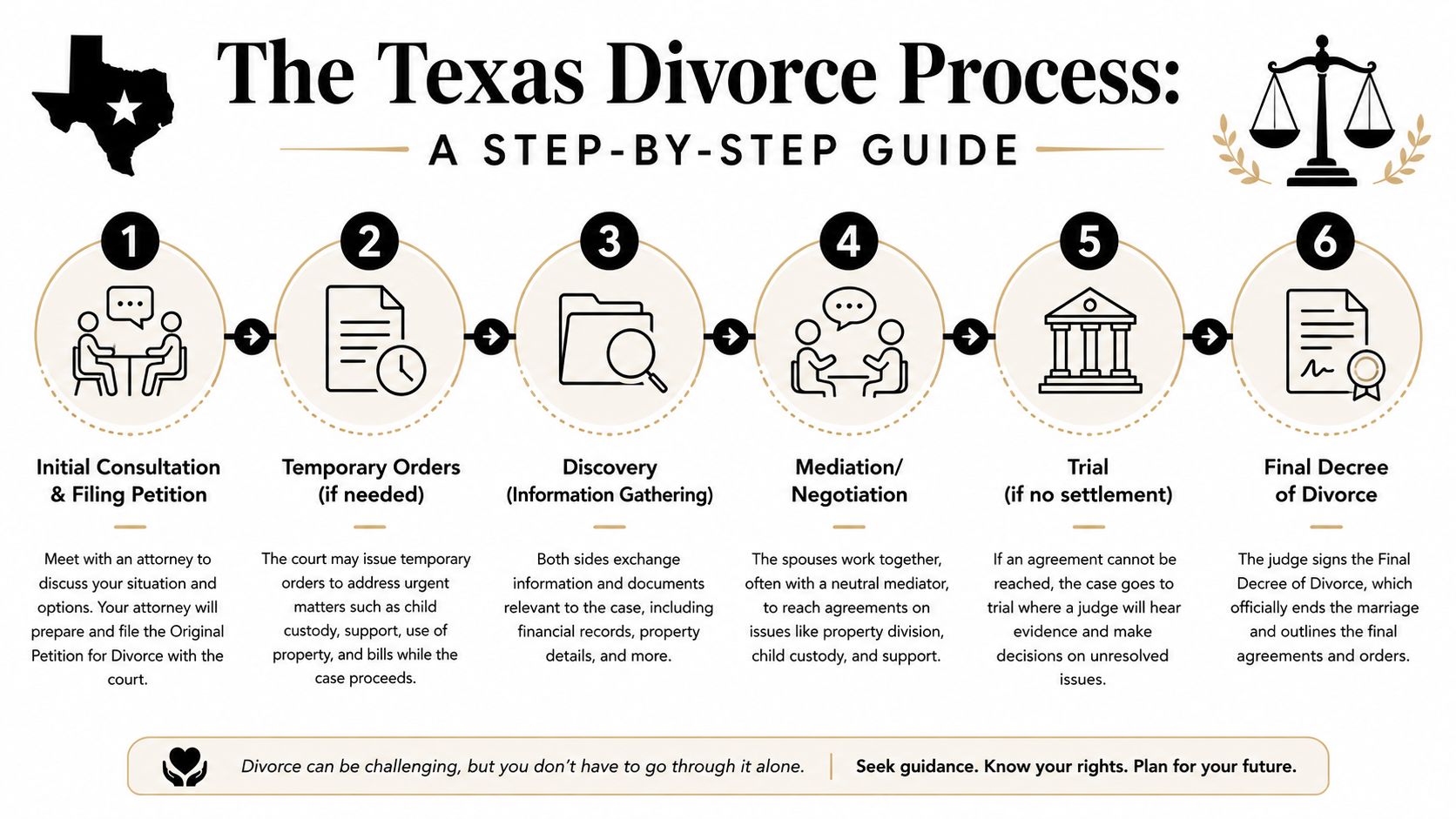
- A petition is filed to open the case.
- The other spouse is served or signs a waiver.
- Temporary issues are addressed if rules are needed while the case is pending.
- Information is exchanged about finances, property, and parenting.
- Negotiation or mediation takes place if settlement is possible.
- A final decree is entered by agreement or after trial.
Temporary orders often shape the rest of the case. In Harris County, those orders may address who stays in the house, who pays the mortgage, whether either spouse can sell or borrow against property, how bills are handled, and what the parenting schedule looks like. In a Houston Heights case involving a valuable home, that stage can be especially important. A poorly handled temporary arrangement can create payment problems, missed maintenance, or a later dispute about reimbursement and possession.
If you are comparing case paths, this guide on how to choose a divorce lawyer is useful alongside a more specific look at Contested Divorce.
Practical rule: Once you know whether the real dispute is the house, the children, monthly cash flow, or all three, you can make better decisions about documents, communication, and settlement options.
Uncontested vs contested divorce
An uncontested divorce works when both spouses agree on all material terms. That includes property division, debt allocation, and, if children are involved, conservatorship, possession, and support. These cases are usually more efficient, but only if the agreement is complete and drafted with care.
A contested divorce means there is a real dispute that has not been resolved. Sometimes it is narrow. One spouse wants to keep the Heights home and the other wants it sold. Sometimes it spreads across several issues at once, including tracing a separate property claim, valuing a business interest, dividing retirement accounts, or deciding whether one spouse should receive a larger share under the Texas just-and-right standard.
Polite communication does not make a case uncontested. Signed agreement does. If one spouse agrees to divorce but disputes equity in the home, reimbursement for renovations, or how to divide retirement funds, the case is contested until those points are resolved.
That distinction matters because the court process, timeline, and cost usually turn on the disputed issues, not on how civil the parties are. In my experience, Heights cases often look simple at first because the main asset is "just the house." Then the details come out. Title history, premarital ownership, refinance documents, insurance claims, contractor payments, and neighborhood appreciation can all affect how that property is characterized and divided. Under Texas law, the goal is not always a clean fifty-fifty split. The court must reach a division it considers just and right under the facts of that marriage.
How to Choose Your Houston Heights Divorce Lawyer
You may be sitting at your kitchen table in the Heights, looking at a house that has been remodeled over time, trying to figure out whether to fight for it, sell it, or protect a separate property claim tied to it. The lawyer you hire will shape that decision early. In this part of Houston, that matters more than many people expect because a divorce involving an older, high-value home often turns on details a generic approach misses.
Houston has no shortage of divorce lawyers. The harder question is who has the right kind of experience for your case.
A good fit is usually a lawyer who regularly handles family law matters in Harris County, knows how local judges and courts expect cases to be presented, and can spot the property issues that tend to arise in Houston Heights divorces. Historic homes, layered renovations, refinance history, reimbursement claims, and sharply increased market value can all affect settlement strategy. Those facts also matter under the Texas just-and-right standard, which does not require an equal split in every case.
What experience matters most
Start with practice focus. If a lawyer handles divorce work every week, that usually shows in the questions asked during the first meeting. The discussion should get specific quickly.
For example, if you mention a Heights home that one spouse owned before marriage but both spouses later improved with community funds, the lawyer should immediately ask about the purchase date, deed history, loan refinances, major renovation records, insurance payouts, and who paid for what. If a lawyer stays at the level of general promises, that is a warning sign.
Courtroom experience matters too, even in cases that may settle. Many Harris County divorces do resolve by agreement, but productive settlement usually comes from careful preparation, not optimism alone. A lawyer should be able to explain what would happen if the other side refuses to be reasonable, how temporary orders may influence a party's negotiating position, and when an appraisal, business valuation, or tracing analysis may be worth the cost.
Credentials help, but judgment matters more.
A useful starting point is this guide on how to choose a divorce lawyer for a Texas family law case. Then test what you read against the lawyer's actual advice in consultation.
Questions to ask as you compare lawyers
Ask direct questions, and listen for direct answers.
- How often do you handle divorce cases in Harris County family courts?
- Have you handled cases involving older or high-value homes in Houston Heights?
- What would you want to review first in my case?
- Do you see any separate property, reimbursement, or valuation issues right away?
- Who will do the day-to-day work on my file?
- At what point would you recommend experts, and how do you decide whether the cost is justified?
- What is your approach if settlement talks start before full financial information is exchanged?
Those questions get past branding and into case management. They also show whether the lawyer understands the trade-offs. For some clients, early negotiated resolution makes sense. For others, especially where the home or a business interest is not being valued fairly, early settlement can lock in a bad result.
A Houston Heights example
Consider a couple divorcing after years in the Heights. They own an older home with substantial improvements, one spouse claims part of the property started as separate property, and both disagree about how much the renovations changed the home's value. On paper, it may look like a standard divorce with one major asset. In practice, it can require title review, financial tracing, appraisal work, and a clear argument about what division would be just and right under the facts.
That is why lawyer selection is not just about personality fit. It is about whether the lawyer can identify the pressure points early, gather the right records, and explain your next decisions in plain language. A lawyer who handles these cases well should be able to tell you what matters now, what can wait, and what is likely to drive cost, timing, and outcome.
Dividing Property and Assets in Houston Heights
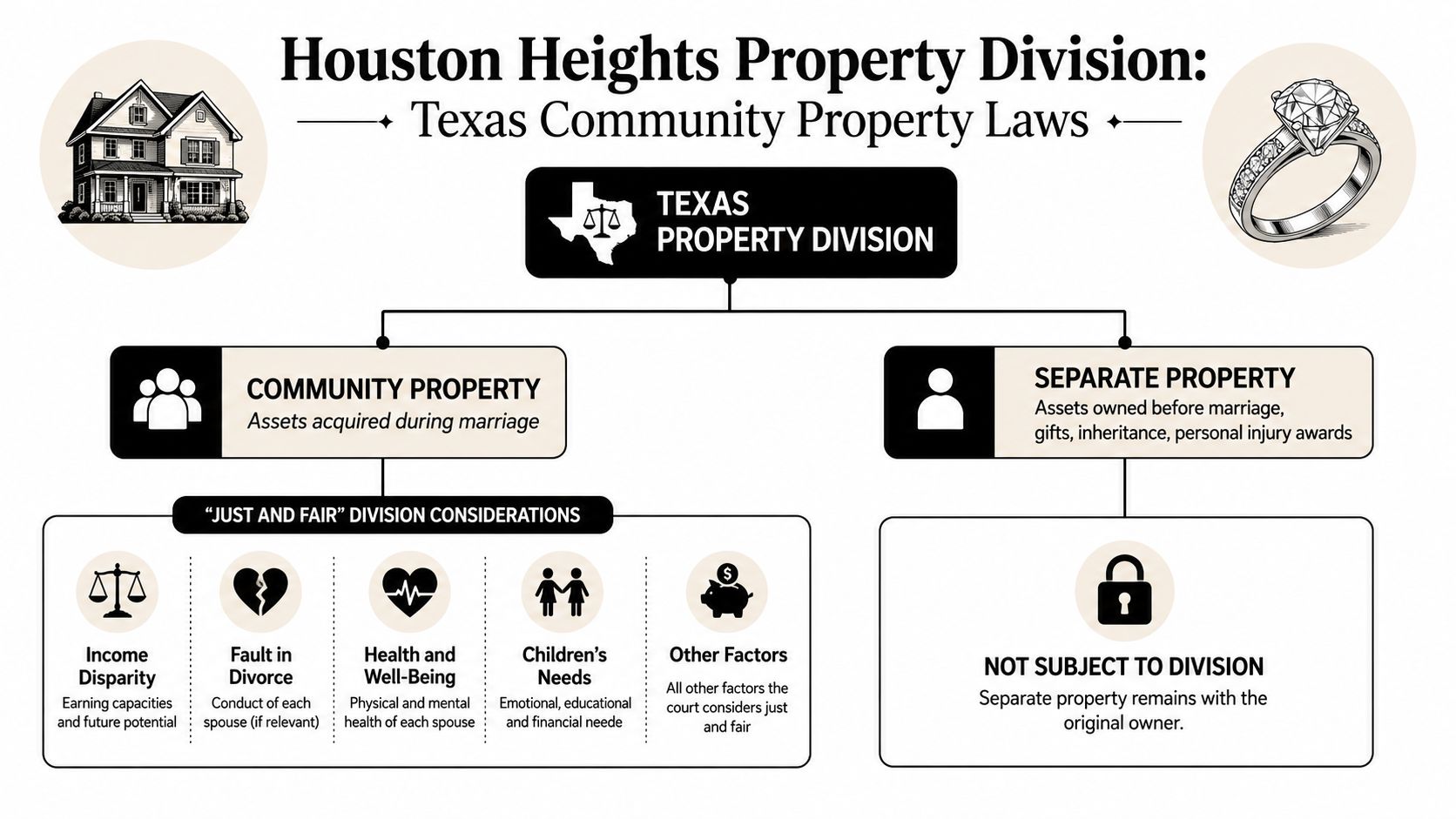
Property division is where many Houston Heights divorces become more complicated than they first appear. Texas follows a community property system, but that does not mean every asset is split down the middle.
Under Texas Family Code § 7.001, the court divides community property in a manner that is just and right. That standard gives the court room to reach an unequal division when the facts support it. Texas law also distinguishes between community property and separate property, and separate property is not divided if it is clearly proven. This summary of Texas property division rules outlines the legal framework, including the stages of identifying assets and debts, classifying property, valuing assets, and implementing the final division.
Why Houston Heights real estate needs careful analysis
Generic divorce content often skips over the local problem that matters most here. Houston Heights includes historic homes, older structures, and properties that don't always fit neat valuation assumptions. That's a serious issue in divorce because local content often fails to address how historic district status and older home structures complicate valuation and division for Houston Heights homeowners, as described in this Houston Heights family law discussion.
A renovated bungalow can raise several legal questions at once:
- When was the property acquired: Before marriage, during marriage, or partly through a refinance or title change?
- What paid for renovations: Community funds, separate funds, or a combination?
- What caused the increase in value: Market appreciation, neighborhood demand, major improvements, or specialized restoration work?
- What needs separate valuation: The land, the structure, custom fixtures, or business-use portions of the property.
Texas courts can award more than half of the community estate to one spouse in some cases. The same Houston Heights source above notes that courts applying the just-and-right standard may award a larger share, including ranges such as 55 to 70 percent, when factors like fault or earning disparities justify it.
A practical example
Take a couple who bought a 1920s bungalow before one spouse inherited separate funds from a parent. During the marriage, they used both marital income and some inherited money to restore original millwork, replace systems, and expand the kitchen. By the time they divorce, they disagree on almost everything.
One spouse says the house is partly separate because inherited funds were used. The other says the value increase came from years of joint effort, mortgage payments, and renovation management during the marriage. Both may have legitimate arguments, but neither argument proves itself.
A disciplined property analysis matters. The legal work usually follows four steps:
- Identify the asset and related debt
- Classify the interests as community or separate
- Value the property accurately
- Negotiate or litigate a division that can be implemented
For a deeper look at protecting financial interests, this guide on Texas property division and asset protection in divorce is worth reading.
A short video can also help frame the issues before you meet with counsel.
Historic homes often create two disputes at once. One dispute is about ownership. The other is about value. They need separate analysis.
Child Custody and Support in the Houston Area
When children are involved, most parents care less about legal vocabulary than about daily life. They want to know where the children will sleep, who makes school and medical decisions, and how to build a stable routine without constant conflict.
Texas courts focus on the best interest of the child. In practice, that means the court looks closely at stability, parenting history, decision-making, communication, and the child's day-to-day needs. The legal terms can sound cold, but the underlying questions are practical.
The three parts parents should understand
Conservatorship addresses decision-making rights and duties. Parents may share many responsibilities even when the children primarily live with one parent.
Possession and access refers to the parenting schedule. This is the calendar that tells each parent when the children will be with them, including school weeks, weekends, holidays, and summer time.
Child support addresses financial support for the children. The details depend on the family's facts and the governing orders in the case.
A common structure is a Standard Possession Order or another customized schedule that gives children predictability. For example, parents might agree that one parent has the right to designate the child's primary residence while both share major decision-making. That arrangement can work well when both parents stay child-focused and use the order as a framework instead of a weapon.
What works better than fighting over labels
Parents sometimes get stuck on words like "full custody" when the more useful discussion is about function. Who gets the child to school? Who can reliably handle medical appointments? How far apart do the parents live? What schedule supports homework, sports, and rest?
Try to evaluate a parenting plan through the child's week, not through the parents' frustration.
- School stability matters: Orders should support attendance, homework completion, and transportation reliability.
- Communication needs structure: Shared calendars, written confirmations, and clear pickup terms prevent avoidable disputes.
- Children need consistency: A workable plan usually beats an idealized plan that neither parent can follow.
- Long-term planning helps: Families going through divorce often benefit from reviewing related issues such as guardianship and estate planning for families, especially when they need to update beneficiary choices and decision-making documents.
This article on child custody essentials for Texas families is a helpful follow-up if you're trying to understand how parenting orders function in everyday life.
Children usually do better when parents stop arguing about "winning" custody and start building a schedule they can both actually carry out.
Typical Divorce Costs and Timelines in Harris County
Most clients ask two questions early. How much will this cost, and how long will this take?
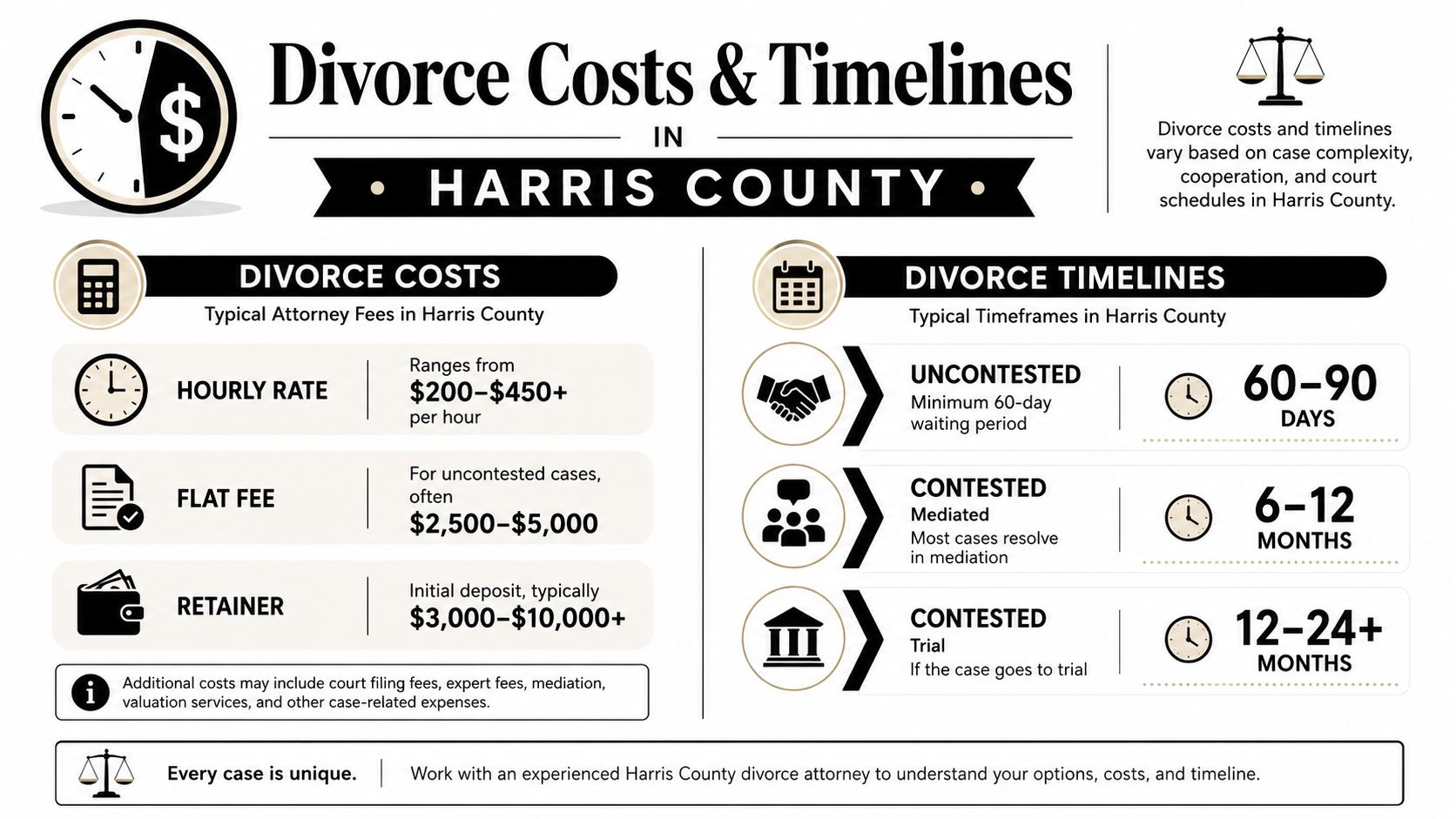
The honest answer is that the final cost and timeline depend heavily on conflict level, the number of unresolved issues, and whether the case requires extensive financial work. Houston-area pricing gives a useful starting point. In Houston, divorce lawyer rates range from $130 to $415 per hour, and total case costs typically average $3,000 to $15,600, while uncontested divorces are often around $1,000 to $3,000 with legal counsel or as little as $300 if handled independently, according to this Houston divorce cost overview. The same source notes that cases for Houston Heights residents are handled at the Harris County Family District Courts, 201 Caroline Street, which are open Monday through Friday from 8:00 A.M. to 5:00 P.M.
What increases cost
A simple case usually costs less because fewer issues require attorney time. A case gets more expensive when one or both spouses do any of the following:
- Fight over multiple issues: Property, custody, support, and temporary orders all require separate work.
- Delay document production: Missing records create more hearings, more drafting, and more follow-up.
- Dispute complex assets: Businesses, retirement accounts, reimbursement claims, and unusual real estate add layers.
- Use court as the first option: Litigation has its place, but avoidable hearings tend to raise fees fast.
What usually slows a case down
The biggest delay factor is unresolved disagreement. If spouses can exchange information promptly and negotiate from a shared set of facts, the case often moves much more efficiently. If one side hides the ball, changes positions often, or fights over every small point, the case stretches.
Houston Heights cases can also slow down when the marital estate includes an older home with valuation disputes. The issue usually isn't just "what is the house worth?" It's also whether part of the value is separate, whether reimbursement claims exist, and whether a buyout is realistic.
A practical way to control both time and cost is to prepare early:
- Gather account statements and a list of debts.
- List all real estate and note how and when it was acquired.
- Separate urgent issues from emotional grievances.
- Decide where you can compromise and where you can't.
Your Guide to a Productive Consultation
A consultation works best when you treat it like a strategy session, not a rescue call. You don't need a perfect file folder or a polished legal summary. You do need enough information to help the lawyer spot the issues quickly.
What to bring if you can
Bring what you have. If documents are missing, bring a written list.
Useful items often include recent account statements, tax returns, mortgage information, retirement account information, a rough household budget, and a timeline of major events. If children are involved, bring a proposed weekly schedule and a list of school or medical concerns. If the case may involve fault, preserve relevant communications and discuss them privately with counsel before sending anything to anyone else.
Questions that make a consultation more useful
The right questions reveal whether the lawyer sees your case clearly and communicates plainly.
| Category | Question to Ask |
|---|---|
| Experience | Have you handled divorce cases in Harris County involving issues like mine? |
| Strategy | Based on what I've told you, what are the first legal and practical steps you would take? |
| Property | What documents will matter most for identifying community and separate property? |
| Children | If custody is disputed, what facts are likely to matter most in my case? |
| Communication | Who will be my main point of contact, and how are updates typically provided? |
| Resolution | Do you see this case as one that should be negotiated early, mediated after more information, or prepared for trial? |
| Fees | How do you bill, and what actions tend to increase the cost of a case like mine? |
| Expectations | What mistakes should I avoid in the next few weeks? |
Bring your questions in writing. People under stress forget details, and the consultation should leave you with clarity, not more confusion.
How to judge the meeting
Pay attention to whether the lawyer listens carefully and answers directly. You should leave understanding your risks, your immediate to-do list, and the difference between a likely outcome and a hopeful one.
Be cautious if the lawyer makes sweeping promises, dismisses the details of your property, or avoids discussing process. Good legal advice is usually calm, specific, and realistic.
Take the Next Step with Confidence
A divorce in Houston Heights can involve more than ending a marriage. It can mean protecting your parenting role, sorting out a valuable home, proving separate property, and making decisions that affect your finances for years. The process becomes more manageable when you understand how Texas law works and when you get legal advice that matches the facts of your case.
If you need help navigating divorce, custody, or estate planning in Texas, contact The Law Office of Bryan Fagan today for a free consultation.
If you're ready to talk through your options with Law Office of Bryan Fagan, PLLC, schedule a free consultation and get guidance suited to your family, your property issues, and your next steps in Harris County.