
A CPS call often comes in the middle of ordinary life. You're getting ready for work, helping with homework, or answering a school message, and suddenly someone says they need to talk about your child. Most parents feel the same mix of shock, anger, and fear.
That fear is understandable. A CPS investigation can affect your home, your parenting time, and in serious cases your parental rights. But panic leads to mistakes. Clear information, quick legal guidance, and disciplined decisions give you a much stronger position in Harris County.
That Knock on the Door Understanding Your First Contact with CPS
For many Houston Heights parents, first contact doesn't look dramatic. A caseworker may call and sound polite. They may say they just want to “clear something up” or “take a quick look around.” A parent who has nothing to hide often thinks the fastest way to make this disappear is to answer everything right away.
That instinct is understandable, but it can hurt you.
CPS workers are gathering information from the first moment they contact you. They are assessing your words, your home, your reactions, and whether they believe there is immediate risk. If the report is false, your urgency to explain can still create inconsistencies, and inconsistencies are often treated as warning signs.
What the first day usually feels like
A common example is a parent in Houston Heights getting a call after a child repeats something at school that was taken out of context. By afternoon, the parent is answering questions while trying to remember exact dates, discipline details, and who was home over the weekend. The parent starts talking more and more, hoping cooperation will fix everything.
Sometimes it does not.
Practical rule: In the first 24 hours, your job is not to persuade CPS that you're a good parent. Your job is to avoid avoidable mistakes and get legal advice.
A calm response works better than an emotional one. Ask for the caseworker's name, contact information, and the general nature of the allegation. Then slow the process down. If you need a starting point, review what your rights are when CPS comes to your house.
What helps and what does not
What helps is staying polite, taking notes, preserving records, and speaking with counsel before making major decisions.
What does not help is arguing at the door, letting relatives speak for you, handing over documents casually, or assuming an innocent family has nothing to fear from an investigation. Even a weak allegation can become a serious case if the early contact goes badly.
What Triggers a CPS Investigation in Texas
Texas law gives CPS authority to investigate reports involving alleged abuse or neglect. In practice, many investigations begin because someone reports a concern to the agency, and CPS decides it falls within its jurisdiction. That does not mean the report is true. It means the agency has decided to look into it.
Under Texas Family Code Chapter 261, reports can involve physical abuse, neglect, emotional harm, inadequate supervision, or other facts that the agency believes may put a child at risk. CPS is not limited to dramatic situations. It may investigate conditions in the home, supervision questions, medical care concerns, or allegations tied to a custody fight.
How reports start in real life
Many parents expect CPS involvement only in extreme cases. That's not how it works. A teacher, doctor, neighbor, co-parent, or extended family member can trigger an investigation. Sometimes the report comes from a misunderstanding.
For example, a child arrives at school tired and says there was yelling at home. A teacher reports it. Or a doctor notices an injury and cannot immediately rule out abuse. In both situations, CPS may open a case even if the parent did nothing wrong.
Here is the practical distinction:
- A false allegation means the report is untrue.
- A legitimate CPS concern means the agency believes the facts, if true, could amount to abuse or neglect under Texas law.
- An investigation is the agency's attempt to sort those two things out.
Why context matters in Houston Heights
Houston Heights families often include grandparents, step-parents, and other relatives living under one roof. That can create confusion about who supervises a child, who handles discipline, and who should speak to CPS. In some homes, an elderly relative may also need care. Separate legal issues, such as Probate, involve probate administration and estate settlement in Texas, but those issues should not be casually mixed into a CPS interview without legal advice because family stress can easily be misread.
A CPS investigator is not arriving to validate your intentions. The investigator is comparing allegations to observations, records, and statements.
The legal frame parents should remember
CPS does not need to prove the case at first contact. The worker only needs enough concern to investigate. That is why parents should focus on accuracy, not speed. If there is a custody dispute, a school report, or a doctor's concern behind the allegation, your response should be organized and deliberate.
The question is not only “Why did this happen?” The better question is “What facts is CPS trying to confirm, and how do we respond without making the situation worse?”
The Texas CPS Investigation Timeline Step by Step
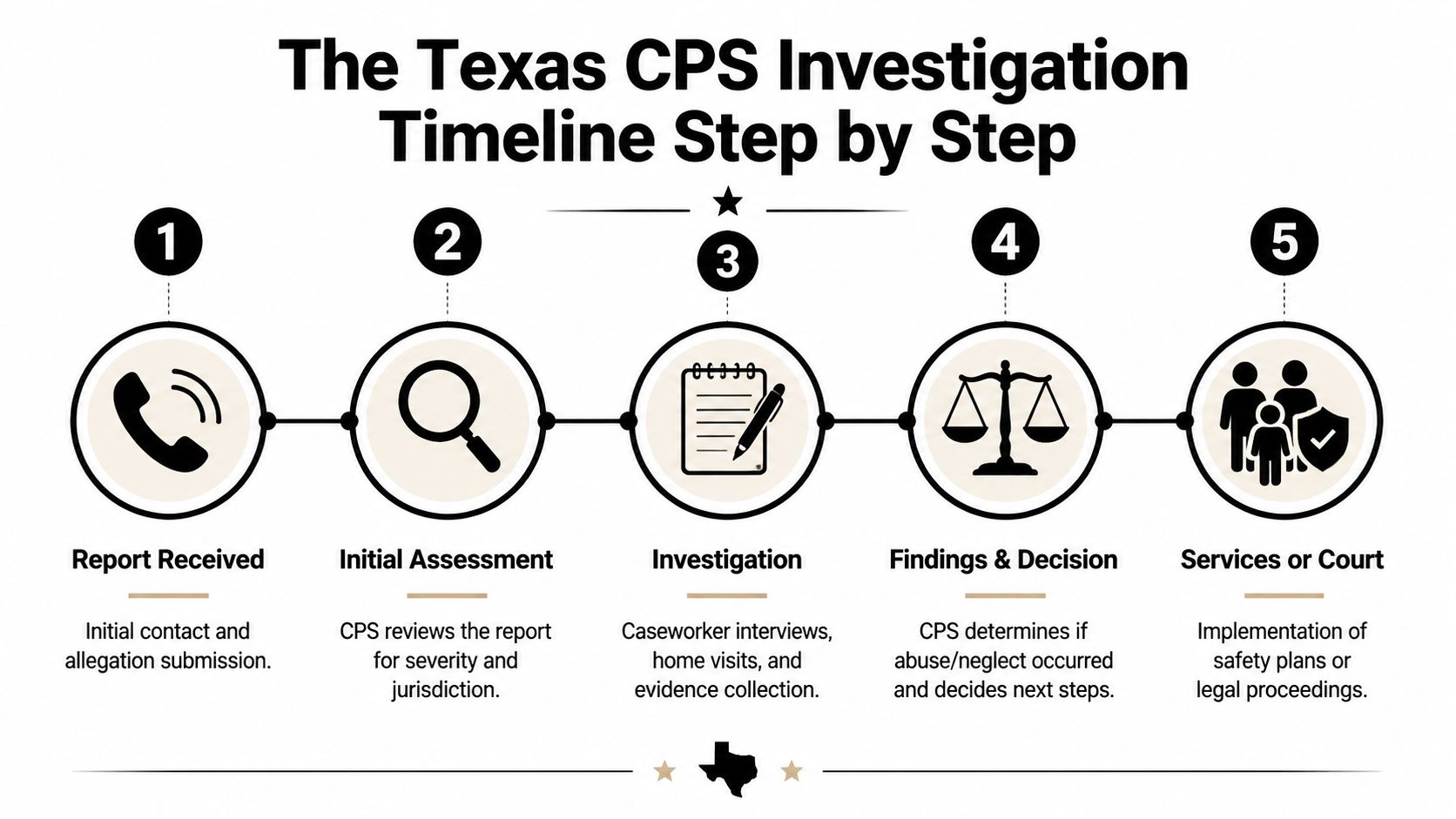
The process feels less chaotic when you know the sequence. Texas CPS cases usually move from intake to investigation, then to findings, services, or court action depending on what the agency claims it discovered. The legal framework often involves Texas Family Code Chapter 261 for investigation and later court proceedings under Title 5 of the Family Code if the case escalates.
Here is the visual roadmap many parents need at the start:
If you want a fuller overview of the process, this guide on what happens in a CPS investigation in Texas is a useful companion.
The five stages most families experience
Report received
Someone makes a report, and CPS decides whether the allegation falls within its authority.Initial assessment
The agency evaluates urgency, the type of allegation, and whether a child may face immediate danger.Investigation
This usually includes interviews, attempts to inspect the home, contact with schools or medical providers, and requests for records.Findings and decision
CPS decides whether it believes abuse or neglect occurred and whether the case should close, continue with services, or move toward court.Services or court involvement
If CPS thinks the family needs monitoring or intervention, it may propose a safety plan, ask for services, or seek court orders.
Where parents usually make avoidable mistakes
The investigation stage is where most damage happens. Parents often talk too freely, let other relatives give informal statements, or sign documents they haven't reviewed. A “temporary” agreement can affect where the child stays, who can supervise contact, and what CPS later tells the judge.
A safer approach looks like this:
| Stage | What CPS may do | Better parent response |
|---|---|---|
| Early contact | Ask broad questions | Keep answers limited and factual |
| Home visit request | Seek entry and observations | Confirm whether they have a court order |
| Child interviews | Talk to children separately | Get legal advice immediately |
| Safety plan discussion | Ask for signatures | Review every term before agreeing |
| Case update | Describe concerns vaguely | Request specifics and document them |
The timeline matters because delay helps CPS, not you
One of the most important risks is drift. Families wait, hoping the matter will resolve on its own, while the case file grows. Notes accumulate. School staff and relatives get contacted. By the time a parent seeks counsel, the agency has already framed the story.
That is why the earliest stage matters the most. The timeline is not just administrative. It shapes what evidence exists, what options remain, and whether the case stays investigative or becomes a court fight.
Your Immediate Rights When CPS Contacts You
Parents often think asserting rights will make them look guilty. In CPS cases, the opposite is often true. A careful, legally informed response protects your family from misunderstanding, pressure, and unnecessary escalation.
A Texas CPS defense attorney serves as a constitutional and statutory check against agency overreach, helping ensure CPS complies with Texas Family Code Chapter 261 and constitutional limits on home entry, questioning, and removal decisions, as discussed in this analysis of the role of a CPS defense attorney in Texas family law.
Here are the core rights parents need to remember immediately:
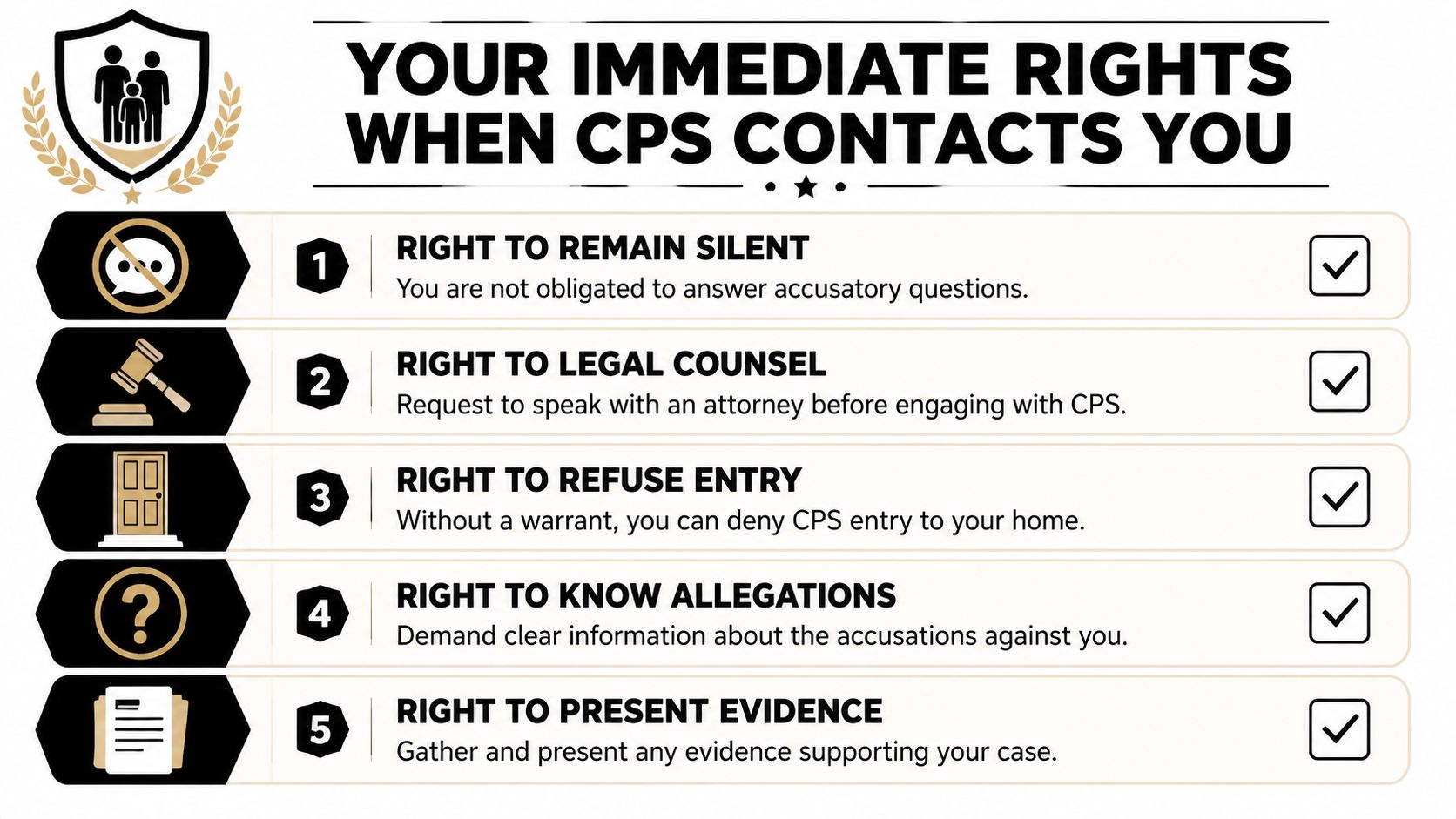
Five rights that matter right away
- Right to remain silent. You don't have to answer accusatory questions on demand.
- Right to legal counsel. You can tell CPS you want an attorney before any substantive discussion.
- Right to refuse entry without proper authority. If the worker does not have a court order or warrant, you can decline entry.
- Right to know the allegations. You should ask what conduct is being investigated.
- Right to review documents before signing. This includes safety plans, medical releases, and placement papers.
Many families also need to understand the role of relatives in a CPS case. Questions involving Grandparent's Rights can affect custody and visitation rights for grandparents, especially when grandparents are part of the household or a possible placement option.
Words you can actually use
Parents ask for exact language. Keep it respectful and simple.
“I want to cooperate appropriately, but I'm not answering questions without my attorney.”
“If you do not have a court order, I'm not consenting to entry today.”
“I'm not signing anything until counsel reviews it.”
Those statements are not hostile. They are disciplined.
This short video also helps explain the immediate posture parents should take when CPS contacts them:
Trade-offs parents need to understand
Being polite is good. Being casual is dangerous.
If you speak too much, you may lock yourself into facts that need correction later. If you let CPS into the home without thinking it through, the worker may make observations unrelated to the original allegation. If you sign a safety plan because it “sounds temporary,” you may be handing the agency an advantage it did not previously have.
The strongest immediate response is calm, documented, and lawyer-guided.
How a Houston Heights CPS Lawyer Defends Your Family
A Houston Heights CPS lawyer does more than show up in court. The right attorney controls the flow of information, challenges overreach, and helps you make decisions that fit both the facts and the law. That can change the direction of the case early.
Families often ask whether hiring counsel makes them look defensive. It doesn't. It shows that the parent understands the stakes.

What legal representation changes in practice
An attorney can take over communications with CPS, prepare you for interviews, and evaluate whether requests from the agency are legally required or strategically unwise. That includes proposed service plans, drug test requests, and demands for broad releases of information.
The attorney also builds your evidence file. That may include medical records, school records, witness statements, custody orders, text messages, or proof that another adult made a false report during a dispute.
For parents dealing with active intervention, how to get your child back from CPS in Texas explains key reunification issues.
What works and what does not
What works:
- Early intervention so the case is shaped before the file hardens.
- Prepared communication instead of improvised explanations.
- Targeted evidence that addresses the actual allegation.
- Careful review of service plans before any signature.
What does not work:
- Over-explaining in hopes the worker will “understand.”
- Agreeing to every request just to seem cooperative.
- Treating the case as informal because no one has gone to court yet.
- Waiting until removal to seek help.
Key point: The best defense in a CPS case is usually built before the first major hearing, not during it.
Data from Texas family law practice shows that families who consult experienced CPS attorneys early achieve positive outcomes like case closure or reunification in over 65% of cases, compared to less than 30% for those without representation, and without counsel parents often waive rights in ways that can contribute to termination proceedings within 12–18 months, according to this Houston CPS attorney resource.
In practical terms, that gap makes sense. Parents without counsel often answer questions they should postpone, consent to steps they do not understand, and miss the chance to challenge weak allegations early.
One available option for families needing formal representation is Child Protective Services Defense, which addresses defense for families facing CPS investigations and allegations.
Choosing the Right Attorney for Your Harris County CPS Case
Not every family lawyer is built for CPS litigation. Harris County CPS cases move quickly, involve strict court expectations, and often turn on details that a general practice attorney may miss. You need someone who understands both the legal framework and the local pressure points.
What to ask in a consultation
Use the consultation to test fit, not just availability.
Ask questions like these:
- How much of your work involves CPS cases rather than general divorce matters?
- How do you handle the first contact with CPS when the investigation is still informal?
- What is your approach to safety plans and service plans?
- How do you prepare clients for Harris County hearings?
- Have you worked with cases involving military relocation or multigenerational households?
Those last two issues matter in Houston Heights. Homes with multiple generations under one roof can create factual confusion about care and supervision. Military families face another layer of complexity involving deployment, relocation, and long-distance custody schedules.
Why local experience matters
The Law Office of Bryan Fagan, PLLC has over 100 years of combined legal experience, with senior attorneys including Carl Ritter, who has over 35 years of experience and is recognized as a fearless advocate in CPS matters, and Byron Shaw, who has 24 years of experience. The firm serves Houston Heights and the broader Houston area from 3707 Cypress Creek Parkway Suite 400, Houston, TX 77068, and more detail appears in this profile on expert legal advice for navigating a CPS attorney matter in Houston.
Local nuance matters too. The same source notes that 38% of CPS investigations in neighborhoods with high military residency involve false allegations from relocation or custody stress. A lawyer who already understands that pattern starts from a more realistic view of what may be happening in your case.
For families comparing firms online, even practical resources outside family law can help you evaluate whether a firm communicates clearly and educates the public well. For example, Digital Skyrocket discusses how law firms present information online, which can help you judge whether a firm's educational content is clear, specific, and useful before you ever call.
Choose the lawyer who gives direct answers, explains trade-offs, and treats the early stage of the case as seriously as the courtroom stage.
Frequently Asked Questions About Houston CPS Cases
Can I talk to CPS without a lawyer in Houston Heights
You can, but it is often a mistake. A common and dangerous misconception is that parents must answer all CPS questions. Data shows 42% of parents believe this, which often leads to self-incrimination, while Texas law allows a parent to refuse to answer questions without an attorney present, as explained by Texas Law Help's CPS guidance.
The practical answer is simple: pause the conversation and get counsel.
What if I already spoke to CPS before getting legal help
Do not panic. Many parents speak before they realize the risk. The next step is to stop giving casual follow-up statements, gather any texts, emails, records, or notes that clarify what you meant, and have an attorney assess what was said and what needs to be corrected through proper channels.
A bad first conversation can be managed. A series of bad conversations is much harder to fix.
Can CPS force me to take a drug test on the spot
CPS may ask. Whether you should comply immediately depends on the legal posture of the case and the surrounding facts. Do not treat a request as routine. A drug test can create issues about timing, scope, and interpretation. Get legal advice before agreeing when possible.
Can CPS take my child at the first visit
In some circumstances, CPS may seek emergency action if the agency claims a child faces immediate danger. But many first visits do not result in removal. The important point is this: the way you handle the first contact can influence whether the matter stays investigative or escalates.
Should I sign a safety plan just to show cooperation
Not without understanding every term. Safety plans can affect where your child stays, who may supervise contact, and what CPS later expects from you. Parents often sign them too quickly because the word “temporary” sounds harmless. It may not be.
Should grandparents or relatives talk to CPS for me
Usually not without coordination. Relatives can become important witnesses or placement options, but unprepared statements from family members often create contradictions. If relatives are involved, their role should be planned carefully.
If you need help navigating divorce, custody, or estate planning in Texas, contact Law Office of Bryan Fagan, PLLC today for a free consultation. If CPS has contacted your family in Houston Heights or Harris County, getting specific legal guidance quickly can help you protect your rights, respond strategically, and make informed decisions about what happens next.