
When CPS removes your child, the shock is immediate. You may not know where your child is sleeping tonight, what the next hearing means, or whether one wrong move could make things worse. In Texas, that fear is real, but so is the legal process. You are not powerless, and the steps you take now can matter far more than most parents realize.
Parents searching for how to get your child back from CPS in Texas usually find the same short list: cooperate, follow the service plan, stay calm. That advice isn't wrong, but it isn't enough. A CPS case is a legal case. Judges decide these cases based on evidence, credibility, safety, and whether the issues that led to removal have been addressed in a way the court can verify.
Texas law also builds in an early checkpoint. Under Texas Family Code § 262.201, the court must hold an adversary hearing within 14 days after the child is taken. That short window means the first days after removal are not a waiting period. They are your first chance to start rebuilding your case.
The First 48 Hours Immediate Actions After a CPS Removal
The first mistake many parents make is treating the removal like a misunderstanding that will clear itself up. It usually won't. Once CPS has removed a child, the case has moved into court, and the court process starts fast.

Call a lawyer before you try to explain everything yourself
You may feel an urge to call the caseworker repeatedly, send long texts, or defend yourself to anyone who will listen. Slow down. Your words can become part of the record. A Texas family law attorney who handles CPS cases can help you focus on what the judge will care about, not just what feels unfair.
That early legal help matters because the first court setting arrives quickly. The 14-day adversary hearing is the first formal chance to challenge the removal and show that your home is safe or can be made safe.
Practical rule: In the first two days, your job is not to win every argument with CPS. Your job is to stop making unforced errors and start creating proof.
Start a written case file today
Do this even if you feel overwhelmed. Open a notebook, a folder on your phone, or both. Keep everything.
Include:
- Names and roles: Write down every caseworker, supervisor, foster placement contact, CASA volunteer, attorney ad litem, and court coordinator you deal with.
- Dates and times: Log each call, visit, drug test request, hearing notice, and visitation instruction.
- Documents: Save safety plans, notices, service referrals, text messages, and emails.
- Your own timeline: Write a calm, factual account of what happened before removal while your memory is fresh.
This record helps your attorney spot inconsistencies, prepare for hearings, and show the court that you are organized and engaged.
Focus on three immediate needs
In most cases, parents need to stabilize the basics before the first hearing:
Communication
Respond to CPS and your lawyer promptly. If you miss a call, return it. If you don't understand an instruction, ask for it in writing.Access to records
Ask your attorney what documents can be obtained quickly, such as medical records, school records, lease documents, prescriptions, or counseling attendance records.Safe alternatives
If there is a relative or close family friend who may be appropriate for placement, tell your attorney early. Courts often want practical safety options, not just promises that things will improve.
Show the court stability, not panic
Parents sometimes think the judge wants perfection. The judge doesn't. The court wants evidence that the child can be safe. That can mean showing sobriety, stable housing, reliable supervision, compliance with treatment, or a safer support system than CPS initially saw.
A common example is a parent who spends the first week arguing about how unfair CPS was, but brings no documents to court. Another parent spends that same week gathering prescription records, enrolling in counseling, cleaning and photographing the home, and identifying a grandparent who can help. The second parent is already building a path back.
Understanding the Texas CPS Process and Timeline
A CPS case can feel like it is happening to you instead of with you. The court, the caseworker, the child's attorney, and your own lawyer are all working on different schedules. Once you understand when each decision gets made, the case becomes easier to handle strategically.
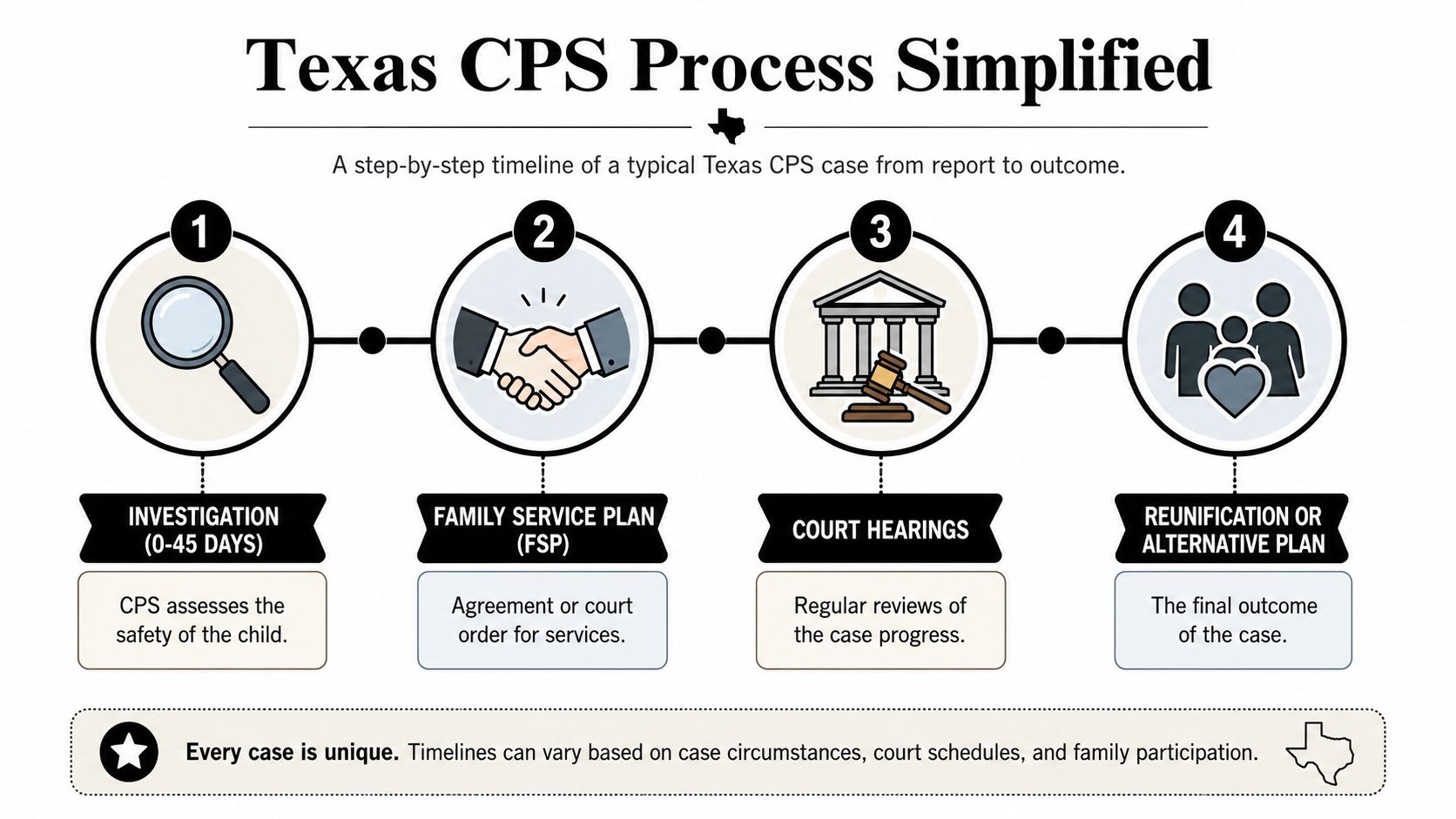
Near the start of the case, it helps to picture the path ahead:
Who is involved in your case
Several people can influence whether your child comes home, how fast that happens, and what proof the court expects from you.
| Person | What they do | What to watch |
|---|---|---|
| CPS caseworker | Gathers information, monitors compliance, reports to the court | Their notes often shape the court's early view of the case |
| Supervisor | Reviews the caseworker's decisions | Important when communication breaks down |
| Attorney ad litem for the child | Represents the child's legal interests | May support or question reunification based on the evidence |
| Judge | Issues orders and decides placement, services, and final outcomes | Cares most about verified facts and safety |
| Your attorney | Protects your rights and presents your evidence | Helps turn progress into courtroom proof |
Texas DFPS explains that it tries to protect children while also helping families provide safe care at home when possible. It also pursues other permanent placements when return home is not safe. That tension runs through the whole case. Reunification stays on the table, but it is never the only outcome the court is considering.
The stages most parents will encounter
Most Texas CPS cases follow a predictable court sequence, even when the facts are messy. After an emergency removal, DFPS must file a SAPCR, ask for temporary managing conservatorship, and appear in court quickly. TexasLawHelp's explanation of the CPS removal process outlines the early removal stage and notes that a parent can request a full evidentiary hearing if the court is not hearing evidence at that point.
The first hearings matter, but many parents make a mistake here. They treat the 14-day hearing like the whole case. It is not. In many cases, the hearing after that is where the record starts to harden. By then, the judge is asking whether the parent followed orders, whether the home conditions changed, whether services started, and whether return is becoming realistic.
That is where timing becomes a legal issue, not just a scheduling issue.
A short video overview can help some parents absorb the process visually before a court date.
Why the timeline matters after the 14-day hearing
After the initial emergency stage, the case usually becomes less about arguing over what CPS did on day one and more about proving what is true now. That shift gives parents real opportunities if they use the timeline correctly.
For example, if drug use is one of the concerns, a single clean test right before a hearing rarely carries the same weight as a documented pattern of clean tests over weeks or months. If housing was unstable, a new lease signed yesterday helps less than a lease, utility records, home photos, and consistent residence over time. Judges look for patterns because patterns suggest safety will last.
This is also the point where your lawyer should be preparing for the hearings that come after removal, not just reacting to CPS reports. Good case preparation often includes organizing treatment records, school records, visitation history, text messages, medical records, witness testimony, and any proof that the original safety concern has been reduced or removed. Parents who understand that timeline early are in a better position to present evidence at status hearings, permanency hearings, and trial if the case reaches that point.
In practical terms, every month matters. Missed visits, missed tests, and half-finished services give CPS material to use against you later. Consistent attendance, clean records, and documented stability give your lawyer something concrete to put in front of the judge.
The timeline is also about trust
Judges do not return children based on promises. They return children based on a record of safe conduct over time. That is one reason rebuilding credibility matters in these cases. The same basic principle shows up in Soul Shoppe's trust-building framework. Trust is rebuilt through repeated, observable actions. In a CPS case, that means showing up, following court orders, telling the truth early, and documenting change instead of just talking about it.
If you are trying to understand how to get your child back from CPS in Texas, focus on the hearings after the 14-day stage as pressure points. Those hearings often determine whether the court sees a parent who is still explaining the past, or a parent who is building a documented case for the child's safe return.
Your Service Plan The Official Roadmap to Reunification
By the time parents reach this stage, many are exhausted, angry, and tempted to treat the service plan like busywork. That reaction is common. It is also dangerous.
In Texas CPS cases, the service plan often becomes the court's working measure of whether the child can return home safely. After the 14-day hearing, this is one of the main pressure points in the case. If you complete the plan in a way the judge can verify, you create a record that supports reunification. If you ignore parts of it, complete services halfway, or fail to document your progress, CPS will use those gaps later.
Read the plan like a legal document
Do not skim it. Read every requirement line by line with your lawyer.
A service plan may include counseling, drug testing, treatment, parenting classes, psychological evaluation, stable housing, employment verification, and supervised visitation. Some tasks are reasonable. Some are poorly worded, expensive, duplicative, or disconnected from the allegation that brought CPS into your life. That distinction matters.
Parents make a serious mistake when they assume every item must be accepted without question. The court expects compliance with court orders, but you still have the right to raise problems early. If a requirement is unclear, impossible to schedule, unaffordable, or unrelated to the safety concern, ask your attorney to address it before noncompliance becomes part of the record.
Completion matters. Proof matters just as much.
Judges do not see your effort unless it is documented.
Treat every service as something you may need to prove at a status hearing, permanency hearing, or trial. Keep your own file. Do not assume CPS, the provider, or your caseworker will maintain a complete and accurate record for you.
Useful documents usually include:
- Certificates of completion for classes, treatment phases, and counseling programs
- Attendance records such as sign-in sheets, appointment logs, and discharge paperwork
- Drug test results and any paperwork showing a missed test was caused by scheduling or notice problems
- Housing records including lease documents, utility bills, repair receipts, and photographs
- Employment records such as pay stubs, offer letters, and work schedules
- Visitation records showing consistent attendance, appropriate interaction, and any positive supervisor notes
That file does more than show effort. It gives your lawyer exhibits that can be used to answer the court's real question, whether the original danger to the child has been reduced.
Use the plan to show change tied to the allegation
Generic progress does not carry much weight. Relevant progress does.
If the case began with allegations of drug use, negative tests and treatment attendance carry more value than finishing a parenting class alone. If the issue was unsafe housing, proof of repairs, utilities, sleeping arrangements, and food in the home matters more than broad statements about doing better. If supervision was the concern, the court will want to see childcare plans, work schedules, and reliable adult support.
This is also where credibility starts to return. Parents who admit a problem and show concrete correction usually stand in a stronger position than parents who insist nothing was wrong while completing services with visible resentment. Outside the legal process, some parents find Soul Shoppe's trust-building framework useful for understanding how repeated, observable actions rebuild confidence over time.
A bad service plan should be challenged early
Some plans set parents up to fail. I see this when services are too far away, referrals are delayed, providers have waitlists, or the parent is ordered to complete overlapping programs that serve the same purpose. I also see plans that require a parent to start services without giving clear referral information.
Do not ignore those problems and hope the judge will understand later. Put the issue on the record.
That may mean asking your attorney to request a status hearing, seeking a clarification from CPS, documenting every failed attempt to enroll, or showing that you were willing to comply but could not get access to the service. Courts usually respond better to parents who can show, "I called six times, asked for a referral update, and kept screenshots," than to parents who say, "I couldn't get it done."
What helps and what hurts
Parents usually get better results when they:
- Start services quickly
- Keep copies of every document
- Tell their lawyer about provider problems right away
- Maintain steady visitation
- Show insight into the safety concern, even if they disagree with parts of CPS's version
Parents lose ground when they:
- Skip the services they find insulting
- Miss tests or visits out of frustration
- Wait for CPS to gather records for them
- Assume partial compliance will be treated as enough
- Focus on arguing with the investigator instead of building proof for the judge
One more point matters here. If parental rights have already been terminated in your case or a prior case, the service plan may no longer be the path back that it would be in a standard reunification case. At that stage, the legal options change sharply, and timing becomes even more important. Parents in that position need case-specific legal advice immediately, because the question is no longer just how to comply. The question becomes whether any procedural or post-judgment remedy still exists under Texas law.
For parents still in an active reunification case, the service plan is not just paperwork. It is one of the clearest records the court will use to decide whether your child can come home safely.
Building Your Case Evidence and Courtroom Strategy
Parents lose ground when they assume the file speaks for itself. It often doesn't. If you want the court to return your child, your progress has to be visible, organized, and legally useful.

Build evidence that answers the court's real concern
Judges usually care less about whether you are offended by CPS and more about whether the risk has been reduced. Your evidence should track that concern directly.
If the allegation involved substance use, useful evidence might include treatment attendance, counseling letters, and clean test results. If the problem was home conditions, bring updated photographs, repair receipts, and testimony from people who have seen the home. If supervision was the issue, show childcare arrangements, work schedules, and support from responsible relatives.
Many cases pivot on this. Generic statements like "I'm doing better" don't carry much weight. Specific records do.
The strongest evidence usually comes from third parties
Your own testimony matters, but outside professionals often carry more credibility. Ask your attorney whether it makes sense to gather:
- Therapist or counselor letters describing attendance and engagement
- Program records from parenting, anger management, or treatment providers
- Employment verification from an employer or supervisor
- Landlord records showing stable housing
- Support letters from relatives, pastors, sponsors, or other adults with direct knowledge
Keep those documents current. A letter from months ago may show effort, but a recent update shows continued stability.
Use hearings as leverage, not just checkpoints
Many parents think the first hearing is the only meaningful fight. That's a mistake. After the initial removal hearing, the legal advantage often depends on how well you can challenge DFPS's ongoing position.
TexasLawHelp notes that parents can request a full evidentiary hearing in appropriate circumstances, and that matters because it gives your attorney a setting to present your documents, witnesses, and competing narrative. The goal is not to complain louder than CPS. It is to give the judge admissible reasons to question whether continued separation is still necessary.
A CPS case gets stronger for a parent when the file stops being only CPS's story.
A simple example shows the difference. One parent attends counseling but never gets attendance records, never asks the therapist for a summary letter, and never updates counsel. Another parent does the same counseling, but also provides a provider letter, a clean testing record, proof of work, and photos of a ready bedroom. Both may be trying. Only one has built a courtroom record.
Common Pitfalls That Can Derail Your CPS Case
Most parents don't lose ground because of one dramatic event. They lose ground through smaller mistakes that pile up and start to look like instability, avoidance, or lack of insight.
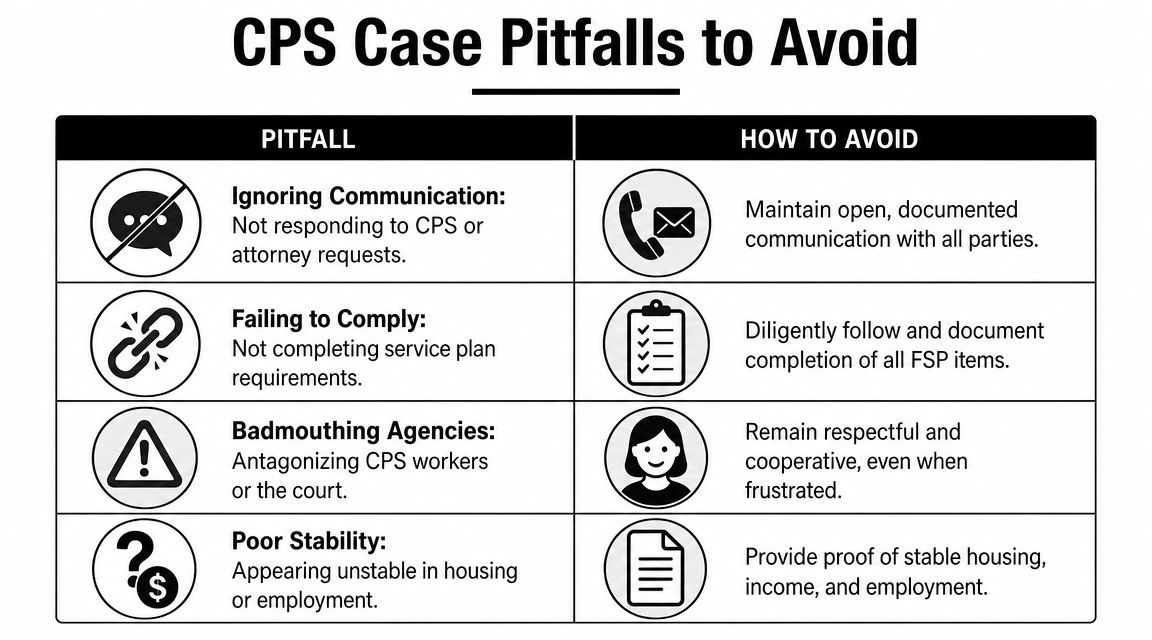
Four mistakes that show up again and again
A parent misses a drug test because of work and assumes one miss won't matter. CPS may record that as noncompliance. Another parent vents on Facebook about the judge, the foster parent, and the caseworker. Screenshots show up later. A third gets angry during a visit exchange and argues in front of staff. That moment can end up in a report.
Those situations feel human. In court, they can still hurt you.
Watch for these patterns:
- Silence: Ignoring calls, texts, or emails from CPS, providers, or your attorney
- Half-compliance: Doing some services while avoiding others
- Public venting: Posting about the case, the child, the allegations, or the other parties online
- Disorganization: Losing documents, forgetting dates, arriving late, or showing up unprepared
The discipline that helps most
Under Texas guidance discussed here, emergency removals are reviewed quickly, and one of the biggest practical pitfalls is missing hearings or failing to create written proof of progress. That point is simple but important. You cannot fix what the judge cannot see.
Try this approach instead:
| Risky choice | Better choice |
|---|---|
| Arguing emotionally with the caseworker | Follow up calmly in writing and copy your attorney when appropriate |
| Assuming a missed class can be explained later | Notify the provider, reschedule, and keep proof |
| Talking about the case on social media | Stay silent online and discuss concerns only with your lawyer or trusted support |
| Bringing loose papers to court | Keep a dated folder, binder, or digital file by category |
Stay steady even when the system doesn't feel fair. In CPS court, steadiness reads as safety.
If you slip up, don't disappear. Tell your lawyer quickly. A missed appointment with an immediate makeup session and documentation is very different from a missed appointment followed by silence.
When Reunification Fails What Happens Next
A parent can do many things right and still reach the point where CPS asks the court to terminate parental rights. That is the hardest stage of the case, and it requires a different legal approach. The question is no longer whether you are working services. The question becomes whether CPS can prove, with admissible evidence, that termination is legally justified and in the child's best interest.
After the 14 day hearing, many parents are told to keep cooperating and hope for the best. Hope is not a trial strategy. Once termination is in play, the pressure shifts to the evidence, the court record, and the deadlines your lawyer must protect.
If termination is on the table, the strategy changes
At this stage, each decision carries more weight. Your attorney may need to challenge hearsay, force CPS to identify exactly which statutory grounds it is relying on, test whether the agency made reasonable efforts toward a safe return, develop relative placement evidence, and preserve issues for appeal. Those are legal pressure points, not just paperwork issues.
Parents usually ask the right questions once the case turns serious:
- Does CPS still have to prove its case at trial?
- Which witnesses and records matter most?
- Can a relative placement keep termination from happening, or only change where the child lives?
- What options exist if my rights have already been terminated?
Those answers depend on the record. A parent who has made progress but cannot prove it in a way the judge can rely on is in a much weaker position than a parent whose treatment records, housing proof, clean testing history, visitation records, and witness testimony are organized and ready.
Reinstatement of parental rights may be a separate path
Some parents are reading this after termination has already happened. Texas law does allow reinstatement of parental rights in limited CPS cases, and Texas Law Help explains the basic requirements and procedure for reinstatement after termination.
That option is narrow. It is not automatic, and it does not apply in every case. The court will look closely at the child's current status, the time that has passed, and whether reinstatement would serve the child's best interest. Still, parents should know this path exists, because many articles stop at termination as if nothing can be done after that.
If rights have already been terminated, the legal task changes. You are no longer working a service plan for reunification. You and your lawyer are evaluating eligibility, collecting post-termination records, and examining whether your conduct since termination shows lasting stability rather than a short period of improvement.
What realistic planning looks like
Realistic planning does not mean giving up. It means focusing on what the court can act on.
That may include:
- preserving contact with approved relatives or caregivers where allowed
- keeping proof of housing, employment, treatment, and sobriety over time
- following every remaining court order
- asking a lawyer for a candid assessment of trial, appeal, and reinstatement options
- making decisions that help the child's long-term stability, even when those decisions are emotionally hard
Courts look for durability. Short-term compliance near trial often carries less weight than a long period of stable conduct. Judges have seen last-minute improvement before. What stands out is documented change that holds up under stress, supervision, and time.
If your case is still active, build a record that shows the child can return to a safe and stable home, not just a promising week or month. If your rights were already terminated, get legal advice before assuming the case is over forever.
If you need help handling a CPS case in Texas, contact Law Office of Bryan Fagan, PLLC for a free consultation. Our team helps parents understand court orders, prepare for hearings, address service-plan problems, and evaluate the legal options available at each stage of a child-removal case.