
A CPS call usually comes at the worst possible moment. You're making dinner, getting ready for work, helping with homework, or trying to get a child to bed, and suddenly someone says they need to talk to you about your child's safety. Most parents feel the same things right away: panic, anger, confusion, and the urge to either explain everything immediately or shut the door completely.
Both reactions are understandable. Neither is usually the best move.
When parents search for what happens in a CPS investigation in Texas, they often find broad descriptions of the process but not enough guidance about what to do in real time. That gap matters. The first conversation, the first request to come inside, the first demand for records, and the first interview request can shape the rest of the case.
Texas law gives Child Protective Services real authority to investigate reports of abuse or neglect under Texas Family Code Chapter 261, including the duty to investigate certain reports under Texas Family Code § 261.301. But an investigation is not the same thing as proof. A report triggered a process. It did not decide guilt.
If you're in the middle of this right now, slow down and focus on the next correct step. Keep notes. Stay polite. Don't guess. Don't volunteer more than necessary. If your family is under intense emotional pressure, outside support can help you stay steady. For some parents, that may include counseling support like this guide to Vernon therapy options while they work through the stress and fear that often comes with an investigation.
The Most Stressful Phone Call a Parent Can Receive
A parent often remembers the exact words. “I'm with CPS.” After that, the conversation can feel blurry.
One mother may get a call saying someone reported unsafe supervision. Another parent may find an investigator at the door asking to see the home and talk to the children. A father in the middle of a custody dispute may immediately suspect the report was made by the other parent. A grandparent who helps with childcare may suddenly get dragged into interviews and background questions they never expected.
What matters first is this: a CPS investigation is serious, but it is not the end of the story.
What parents usually get wrong in the first hour
Many parents make one of two mistakes.
Some go into full confession mode. They talk too much, try to be “helpful,” guess at dates, explain old arguments, discuss unrelated family history, or hand over documents without understanding why they were requested. Others go the opposite direction. They become hostile, refuse to engage at all, slam doors, or treat the investigator like an enemy from the first second.
Neither approach serves you well.
Practical rule: Calm, limited, respectful communication usually protects you better than either panic or confrontation.
A better starting point
Think of the first contact as the beginning of a legal and factual review. The investigator is gathering information. You should be doing the same. You need to know:
- Who contacted you
- Which agency they work for
- What allegation is being investigated
- Whether they want an interview, home access, records, or all three
- Whether they have a court order
That shift matters. It moves you from fear to decision-making.
The emotional part is real
Parents under investigation often lose sleep, replay every parenting choice, and worry that one awkward answer could cost them their child. Those fears are real. So is the need for a careful response. If the allegation is false, you still need to handle it correctly. If there is a real issue in the home, you need to address it quickly and intelligently instead of talking yourself into a worse position.
A CPS case is stressful because it touches the most important part of your life. That's exactly why you shouldn't handle it impulsively.
How a CPS Investigation Begins in Texas
A Texas CPS case starts with a report. That report may come from a teacher, doctor, counselor, neighbor, relative, former partner, or someone who stays anonymous. Once the report reaches the Department of Family and Protective Services, DFPS decides whether the information should be screened into a formal investigation.
Not every call becomes a case.
According to a Texas CPS investigation overview, DFPS investigators screen in about 60% to 65% of reports for investigation, and historically Texas has used a broad intake standard. In 2007, CPS screened in about 82% of referrals, compared with a 58% average for the rest of the states. Of the completed investigations, about 25% were confirmed, close to the 26% average elsewhere. That means many reports move into investigation, but only a minority end in a confirmed finding, as explained in this Texas CPS investigation overview.
What “screened in” actually means
A report that gets screened in is one DFPS decides meets the threshold for further review under the child abuse and neglect reporting framework in Texas Family Code Chapter 261. It does not mean CPS has already decided the report is true.
That distinction is important. Parents often hear “we're investigating” and assume someone already proved something. That's not how the intake process works.
Who might have made the report
You may never know exactly who called. Sometimes parents are certain they know. Sometimes they're wrong.
Common possibilities include:
- School staff who noticed injuries, absences, hygiene issues, or troubling statements
- Medical professionals who observed signs they believed required a report
- Counselors or therapists who received information they believed raised safety concerns
- Family members or neighbors who believed a child was at risk
- A co-parent during a custody conflict
False reports do happen. Misunderstandings happen too. But once the report meets intake criteria, CPS has a duty to act on it.
What happens between the hotline call and your first contact
After intake, the report is assigned for investigation. The timing of contact depends on the allegations and how urgent CPS believes the situation may be. An investigator may call first. In other cases, they may show up at a home, school, or another location tied to the child.
A parent should assume the investigator is already starting to build a factual record before the first full conversation. That's why your early choices matter.
Here is the practical sequence most parents should keep in mind:
| Stage | What it usually means for you |
|---|---|
| Intake | Someone made a report to DFPS |
| Screening decision | DFPS decides whether the report fits investigation criteria |
| Assignment | A caseworker or investigator receives the case |
| Initial outreach | You may get a call, visit, or notice of requested interviews |
The key takeaway
If CPS contacted you, don't waste energy arguing that “someone must have lied” as your only strategy. The better response is to deal with the process that now exists. Learn the allegation. Protect your rights. Gather your own documents. Stay organized from day one.
Your First Interaction With the CPS Investigator
The first contact sets the tone. It doesn't decide the entire case, but it can affect how quickly the situation escalates and how much information CPS collects before you've had time to think.
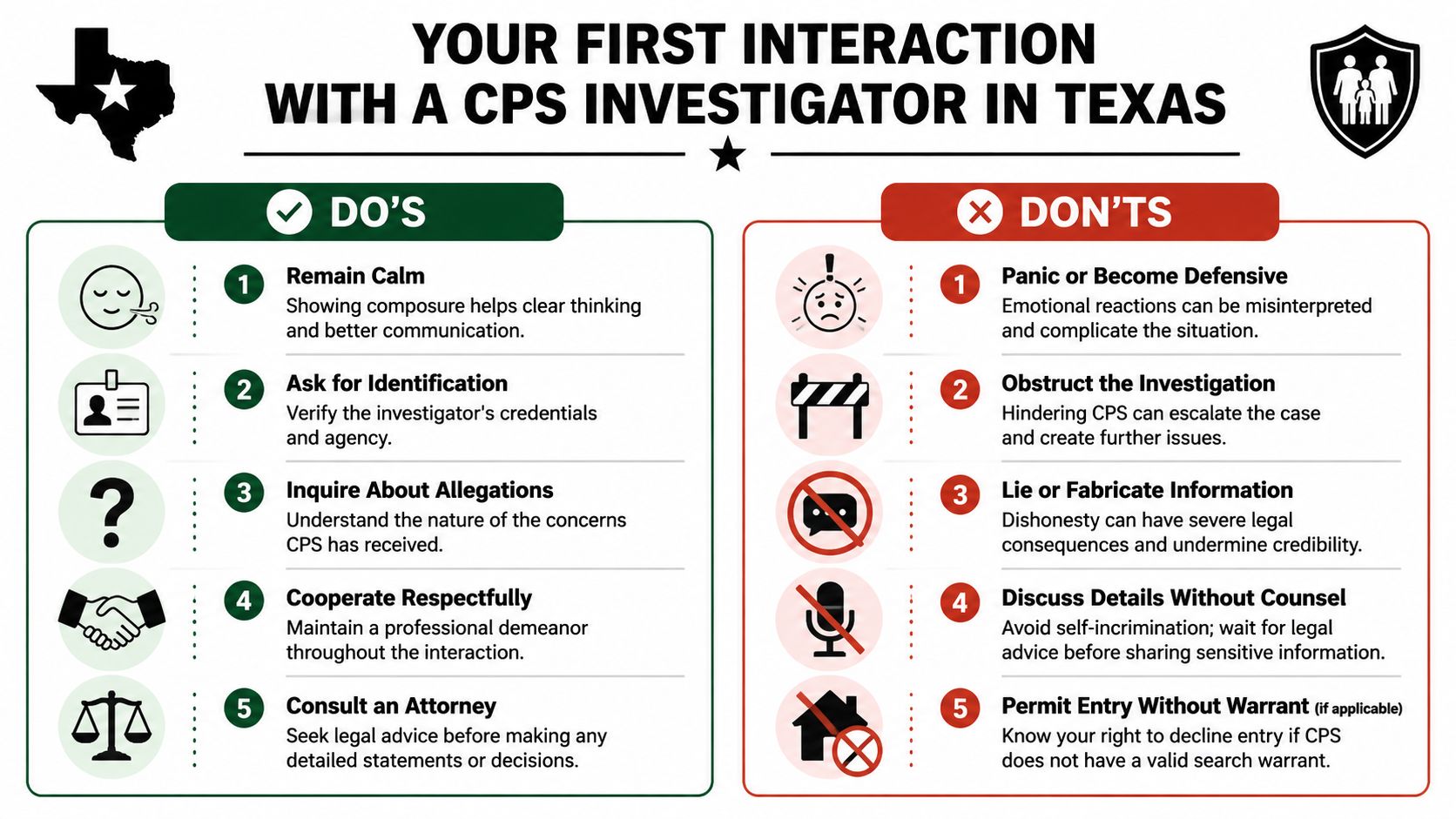
If an investigator calls or appears at your door, stay calm enough to slow the conversation down.
What to do at the door or on the phone
Start with the basics. You need identifying information and a clear statement of purpose.
Use simple questions like these:
- “May I have your full name and agency information?”
- “What allegation are you investigating?”
- “Are you asking to speak with me, see my home, interview my child, or all of the above?”
- “Do you have a court order?”
Those questions are respectful. They also create structure.
Scripts that help
Parents often freeze because they don't know how to sound cooperative without surrendering control. These scripts help:
“I want to cooperate, but I'd like to speak with an attorney before I answer detailed questions.”
“I'm not refusing to communicate. I'm asking for clarification about what you're requesting and whether you have a court order.”
“I'm willing to schedule a time to continue this after I get legal advice.”
These statements do two things. They lower the emotional temperature and protect you from impulsive disclosures.
What works and what usually backfires
Here is the comparison I give parents most often:
| Better approach | Usually backfires |
|---|---|
| Speak politely | Arguing at the door |
| Ask for specifics | Guessing about allegations |
| Take notes | Relying on memory |
| Ask whether there is a court order | Letting fear control the interaction |
| Request counsel before detailed questioning | Giving a long unscripted statement |
Entry into your home
One of the most common pressure points is home access. Parents feel trapped. They worry that if they say no, CPS will think they're hiding something. They worry that if they say yes, every messy room or imperfect corner will be used against them.
You can ask whether the investigator has a court order authorizing entry. If they don't, pause before consenting. That doesn't mean you should be rude or obstructive. It means you should make a decision instead of reacting out of fear.
A calm response might be:
- If you want time first: “I'd like to speak with an attorney before allowing entry.”
- If you choose limited cooperation: “I can speak with you outside for now.”
- If there is a true emergency: the legal analysis changes quickly, and you need counsel immediately
Don't try to “sound innocent”
Parents hurt themselves when they over-explain. They say things like:
- “I only yelled because my ex has been driving me crazy.”
- “I had a drink, but I wasn't drunk.”
- “The bruise probably happened when he fell, or maybe when his brother pushed him, I'm not sure.”
That kind of talking fills gaps with uncertainty and gives the investigator language that may appear in notes later.
A better approach is to answer what you know, correct obvious falsehoods, and stop there.
If they want to speak to your child immediately
Many parents often experience the most panic at this point. Don't start coaching your child in front of the investigator. Don't tell your child what to say. Don't become physically obstructive.
Instead:
- Ask where and how the interview is requested
- Ask whether the interview is voluntary or court-ordered
- State that you want legal advice right away
- Document the request, the time, and the investigator's response
Politeness helps. Passivity does not. You can be firm without making the situation worse.
The Investigation Timeline and What CPS Examines
Once a case is opened, parents usually want to know two things. How long will this last, and what exactly is CPS looking for?
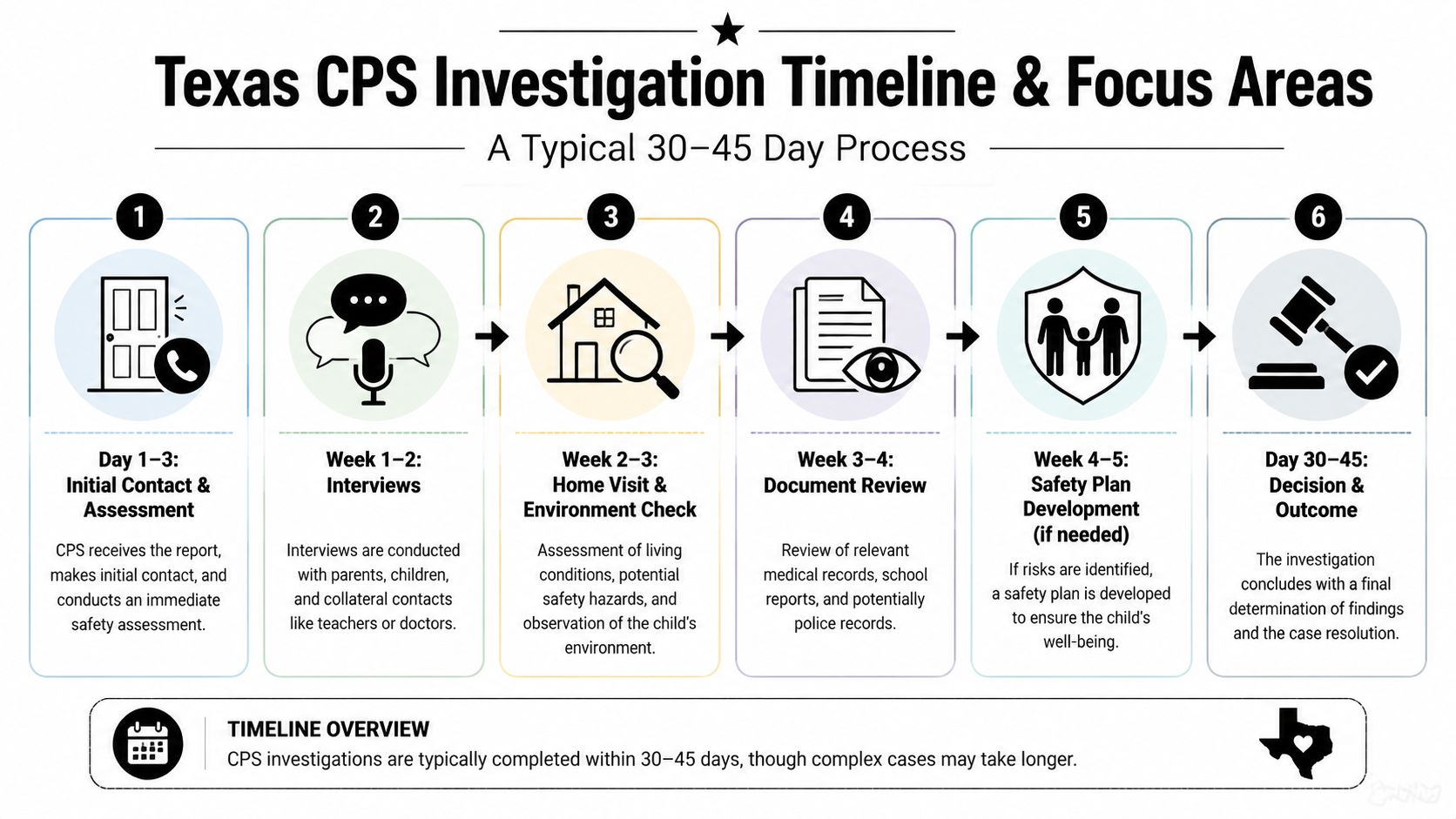
Texas guidance says the investigation phase should be completed within 45 days from intake, with a possible 45-day extension and a maximum of 90 days absent higher-level approval, while another Texas practice guide says CPS typically has 30 days to complete an investigation once assigned. During that period, investigators interview the child and parents, inspect the home, and gather outside records as part of a structured review, as described by Texas Law Help's explanation of the investigation phase.
The core question is safety and risk
A CPS investigator is not supposed to rely on a single conversation or a gut feeling. DFPS describes the job as determining whether the child is safe, whether abuse or neglect occurred, and whether there is a reasonable likelihood of future abuse or neglect. DFPS also explains that investigators may interview family members and collateral sources, inspect the home, seek records, and build a broader record through multiple inputs in this DFPS investigations overview.
That matters because parents often think, “If I sounded convincing, I should be fine.” But the investigator is looking beyond your statement.
What they usually examine
The investigation commonly involves several tracks moving at once.
Interviews
CPS may try to interview:
- The child
- Each parent or caregiver
- Adults living in the home
- Other people with relevant knowledge, such as teachers or medical providers
Consistency matters here. Not rehearsed consistency. Real consistency grounded in accurate facts.
The home environment
The home visit is not about whether your house looks magazine-ready. It is about whether the investigator sees conditions that suggest danger, neglect, lack of supervision, or access to hazards.
Typical concerns include:
| Home issue | Why CPS may care |
|---|---|
| Exposed medication or substances | Child access and poisoning risk |
| Weapons within reach | Immediate safety concern |
| Unsafe sleep setups for small children | Injury or supervision concerns |
| Severe filth or dangerous clutter | Health and hazard concerns |
| Lack of food or utilities | Basic care concerns |
If the allegation involves younger children, practical home safety becomes especially important. Parents sometimes focus on defending themselves verbally while overlooking obvious environmental concerns. Even simple fixes can matter. If sleeping arrangements are part of the concern, resources on safe children's sleeping arrangements can help you evaluate whether your setup creates avoidable questions.
Records and background information
Investigators may request school records, medical records, mental health information, and other documents. They may also review criminal history involving adults in the home. If substance use is raised, parents should understand how those requests can develop. Our discussion of Texas CPS drug testing procedures helps explain one common pressure point.
What parents should do during the timeline
This is the stage where organization beats emotion.
- Create a case file with dates, names, business cards, and every request made by CPS.
- Gather key documents such as medical records, school notes, prescriptions, counseling confirmations, or proof of services already in place.
- Fix obvious safety issues immediately if they exist. Don't wait for a second visit.
- Keep communication brief and accurate. If you don't know, say you don't know.
- Avoid contacting collateral witnesses to pressure them. That can create new problems.
A strong response during an investigation is usually boring. Clean records, prompt documentation, safer conditions, and careful communication carry more weight than dramatic denials.
Real trade-offs parents face
Some parents want to hand over everything at once to show they have “nothing to hide.” Others want to provide nothing at all. Both positions can be risky.
If you provide broad releases without thinking, you may expose unrelated information that complicates the case. If you refuse every request, CPS may decide to seek court involvement. The better path is selective, informed cooperation guided by counsel when the requests become broad, invasive, or unclear.
Know Your Rights When Dealing With Texas CPS
This is the part most parents need and often don't get. DFPS materials explain what investigators may ask to do, but they often don't walk parents through what they can say in response. Yet that real-time decision making is where cases turn.
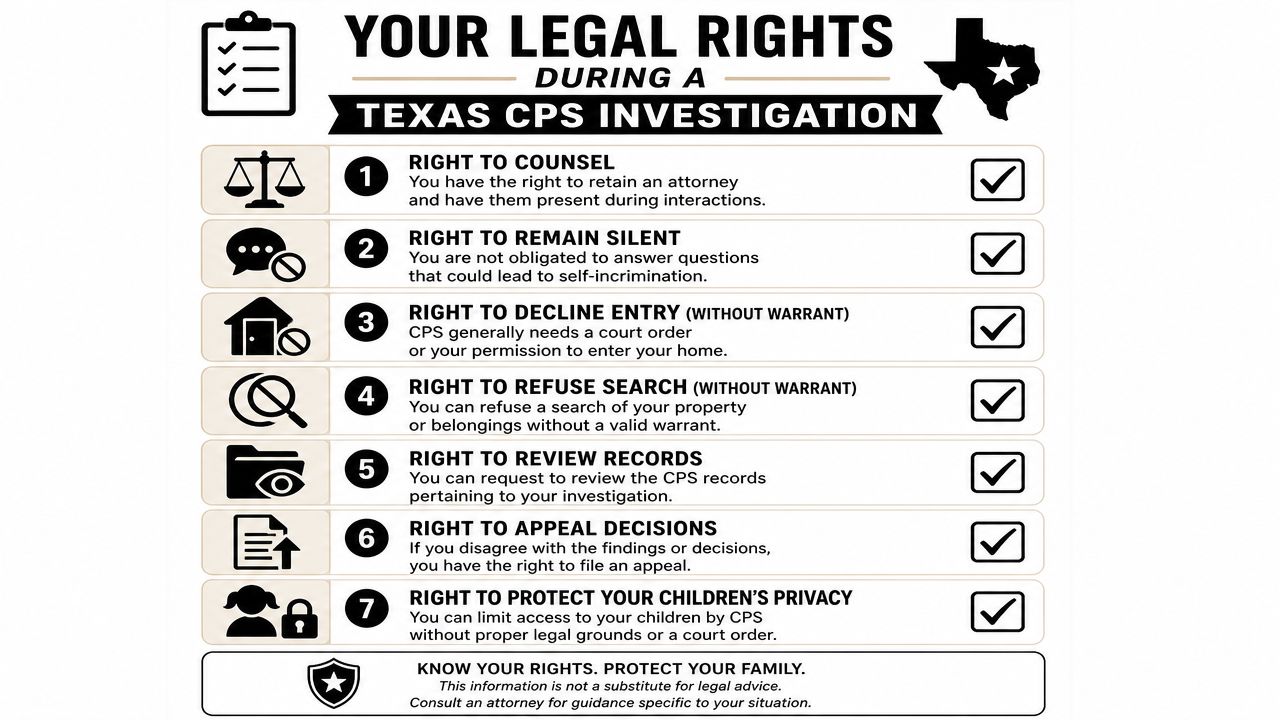
DFPS states that investigators may ask to interview the child, inspect the home, request records, and seek a court order if a parent does not cooperate. The practical gap is that many parents still don't understand when they may ask for counsel, seek clarification, or push back on vague requests, as reflected in the DFPS parent guide to investigations.
The rights that matter most in practice
Parents often hear “you have rights,” but what they need is a usable list.
You can ask for an attorney
You do not have to manage this alone. You can tell CPS you want counsel before a detailed interview, before signing releases, and before agreeing to a safety plan.
You can ask whether a request is voluntary
This question is powerful because it forces clarity.
Try this: “Is this something you're requesting voluntarily, or are you saying there is a court order requiring it?”
That question can change the conversation immediately.
You can decline consent in some situations
When CPS asks to enter your home, search areas of the home, or obtain broad access to records, consent matters. The legal analysis can become fact-specific very quickly, especially if law enforcement is also involved, but a parent doesn't lose all rights merely because CPS appeared.
You can avoid self-incriminating statements
A CPS investigation can overlap with a criminal investigation. If allegations involve injuries, sexual abuse, drug use, or domestic violence, statements to CPS can create criminal exposure.
Key point: If a question could expose you to criminal risk, do not answer casually just because the setting feels “civil” rather than criminal.
Requests that deserve extra caution
Some requests sound routine but carry real consequences.
- Drug testing requests can become central evidence
- Medical releases may be drafted broadly
- Safety plans may limit contact with your child
- Written statements may lock you into wording that doesn't fully reflect your position
Before agreeing, ask:
| Request | What to ask first |
|---|---|
| Drug test | “Is this voluntary or court-ordered?” |
| Medical release | “Which records are you seeking and for what period?” |
| Home inspection | “Do you have a court order authorizing entry?” |
| Child interview | “Where, when, and under what authority?” |
| Safety plan | “May I review this with counsel before signing?” |
For a more focused discussion of these issues, including home-entry concerns, see our article on your rights when CPS comes to your house.
What asserting your rights should sound like
A lot of parents worry that asserting rights will make them look guilty. Tone matters. The content often doesn't hurt nearly as much as the delivery.
Good phrasing includes:
- “I want to cooperate appropriately, but I need to understand the scope of your request.”
- “I'm not comfortable signing this before legal review.”
- “Please put that request in writing.”
Bad phrasing usually includes insults, threats, profanity, or accusations that the worker is “kidnapping” children before anything has happened.
Rights are strongest when paired with credibility
If you assert rights while lying, destroying evidence, hiding a child, or coaching witnesses, you damage your own position. The best use of your rights is disciplined and honest. Be firm. Be measured. Be accurate. Let the investigator see that you understand the process and expect it to be handled lawfully.
Possible Outcomes of a Texas CPS Investigation
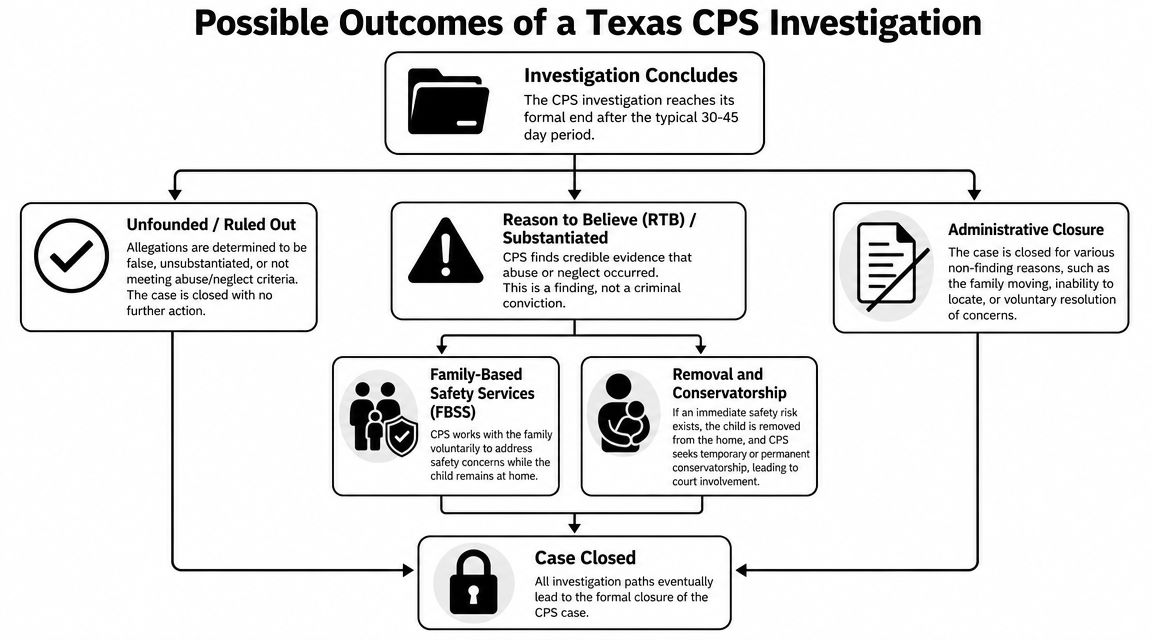
At the end of the investigation, CPS must decide what the evidence supports. Parents often assume there are only two outcomes: case closed or child removed. In reality, there are several possible paths, and the practical difference between them matters.
When the case closes without a finding against you
One common outcome is a finding that does not support the allegation. Parents often hear terms like ruled out or unfounded in everyday discussion. In practical terms, CPS is not proceeding on the basis that abuse or neglect was established.
That is often the result parents are hoping for, but you should still keep your records, notes, and copies of communications.
When CPS says there is reason to believe
Another outcome is a Reason to Believe finding. In plain English, CPS is saying it believes the evidence supports abuse or neglect. That is a serious administrative finding, even though it is not the same as a criminal conviction.
Once CPS reaches that kind of finding, the case may move in one of two directions:
Family-Based Safety Services
Sometimes CPS pursues services while the child remains at home or remains with family under a safety framework. This is often called Family-Based Safety Services, or FBSS.
Parents need to think carefully here. Voluntary services can help in some cases. In others, they can expand supervision and create new opportunities for conflict if terms are vague or unrealistic.
Court action
If CPS believes the child cannot remain safely in the current arrangement, the agency may file a lawsuit and ask a court for protective orders. That may involve requests about possession, access, services, placement, or conservatorship.
If you want a closer look at emergency action standards, our article on whether CPS can remove your child without a court order in Texas addresses a common question parents ask at this stage.
Other practical outcomes
Not every investigation ends with a clean factual resolution. Sometimes CPS cannot gather enough reliable information to reach a firm conclusion. Sometimes administrative closure occurs because the situation changed, the family relocated, or the allegation no longer supports an active investigation posture.
The labels matter, but so do the consequences.
| Outcome type | What it may mean for your family |
|---|---|
| Case closed with no supported allegation | No further active intervention in the investigation |
| Reason to Believe finding | Services, monitoring, or court involvement may follow |
| Inconclusive or unable to determine type result | The case may close, but concerns may linger |
| Administrative closure | The matter ends for procedural or practical reasons |
If CPS proposes “voluntary” services after the investigation, treat that as an important legal decision, not a casual favor you should accept on the spot.
The most feared outcome, removal
Removal is what most parents fear first, and for good reason. But not every investigation leads there. When CPS seeks removal, the legal and factual stakes rise sharply. The agency must persuade a court, or in narrow emergency settings act first and justify the action quickly afterward, that the child faces a level of danger requiring intervention.
At that point, every document, statement, text message, and witness can matter. What looked like a routine investigation can become a court case very fast.
Why You Should Speak to a Family Law Attorney Immediately
The most expensive mistake in a CPS case is usually made early, before a parent understands what the investigator is asking for and what that decision may trigger later.
I tell parents this often. You do not hire a lawyer only for court. You get legal advice early so you can answer questions carefully, protect your credibility, and avoid agreeing to terms that create bigger problems at home.
Early counsel changes the case in practical ways:
- Communication becomes controlled instead of reactive
- Requests get reviewed before you hand over records, submit to testing, or agree to interviews
- Your evidence gets organized so CPS sees the full picture, not just the allegation
- Safety plans get evaluated before you sign limits on where you live or when you can see your child
- Court preparation starts early if the case begins moving toward removal or formal oversight
That kind of structure matters when emotions are high. A frightened parent may talk too much, argue with the investigator, or sign a broad release just to look cooperative. Those choices can follow the case for weeks or months.
A family law attorney also looks past the investigation itself. A CPS allegation can affect existing custody orders, visitation, divorce cases, and future modification requests. Legal advice should account for all of that, not just the next phone call from CPS. The Law Office of Bryan Fagan, PLLC handles Texas family law and CPS-related matters, and parents in this position should speak with counsel as soon as possible.
If CPS has contacted you, do not wait for the situation to get clearer on its own. Get legal advice early, ask what you should say yes to, what you can decline, and what documents you should start gathering today.