Yes, CPS can take your child without notice in Texas, but only in emergency situations where the agency believes your child faces an immediate danger to physical health or safety. Texas also removed far fewer children after the law tightened that standard, dropping from nearly 20,000 removals in 2017 to 9,623 in 2022.
If you're reading this right after a visit from CPS, you're probably dealing with panic, anger, and a hundred questions at once. The most important thing to know is that an emergency removal is not supposed to be a shortcut around your rights. Texas law allows it only in a narrow set of circumstances, and once it happens, the court process moves fast.
A parent in this position usually doesn't need abstract legal theory first. You need to know what just happened, why CPS says it happened, what the next day or two will look like, and what you should do before your first hearing. That is where good decisions begin.
The Unimaginable Moment Your Child Is Taken
A CPS emergency removal often begins with confusion. Someone is at the door. They identify themselves, say they have concerns, and within a short time your child is leaving with a caseworker, a police officer, or a relative approved by the agency. For most parents, that moment doesn't feel legal. It feels unreal.

In practice, many parents make the same mistake in those first minutes. They assume that if CPS acted without notice, then CPS must have unlimited authority. That isn't true. Even in a crisis, the agency still has to justify what it did very quickly in court.
What this moment usually feels like
One parent is trying to ask questions. Another is calling family. Someone starts arguing with the caseworker. Sometimes a parent keeps talking because they think explaining more will fix the problem on the spot. Usually, it doesn't.
What helps more is getting focused.
- Ask for names: Write down the full name of every caseworker, officer, and supervisor involved.
- Ask where your child is going: If CPS won't give full details immediately, ask whether the child is being placed with kin, in foster care, or at a temporary location.
- Ask what the allegation is: You may not get every detail, but you should ask what CPS says created the emergency.
- Stay physically calm: Do not block the door, grab your child, or escalate the scene.
Practical rule: The first goal is not to win the argument at your doorway. The first goal is to avoid making your legal position worse before the judge hears the case.
The question behind the fear
When parents search for Can CPS take your child without notice Texas, they usually mean more than one thing. They want to know whether CPS can act first and explain later, whether a judge has already signed something, and whether the child can come home quickly if the removal was wrong.
Those are fair questions. They also point to the core issue in Texas law: immediate danger. If that danger isn't there, CPS is supposed to use the ordinary court process instead of taking your child first and litigating later.
When Texas Law Allows Emergency Child Removal
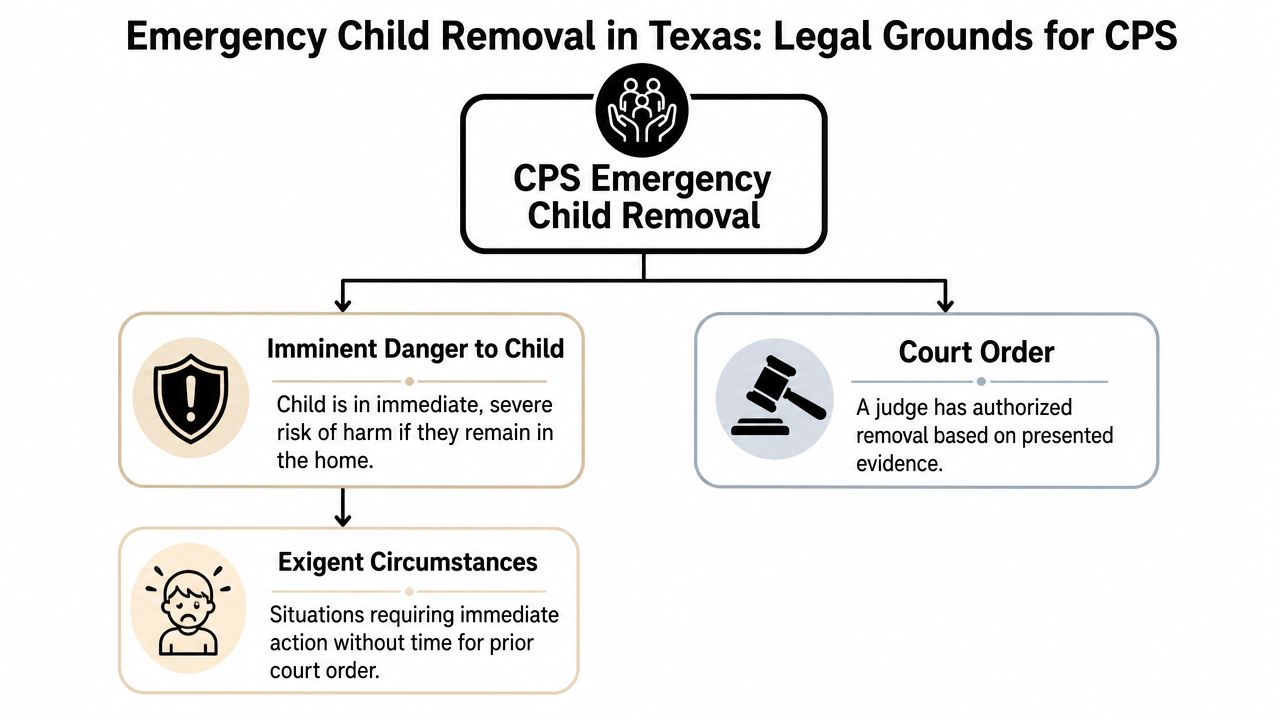
Texas law does not let CPS remove a child on a whim. The normal path is a court order. Notice is given. Evidence is presented. A judge decides whether removal is necessary. The no-notice exception exists for emergencies.
Under Texas family law guidance, DFPS can remove a child without prior notice or a pre-removal court order only when the agency believes the child faces imminent danger to physical health or safety. If DFPS uses that emergency-removal process, it must then file a SAPCR, ask to be appointed temporary managing conservator, and get an initial hearing by the next business day, as explained by Texas Law Help's overview of the CPS removal process.
What imminent danger means in real life
The phrase sounds technical, but the idea is simple. CPS must believe the danger is immediate enough that waiting for a regular court order would put the child at risk.
Consider this: If there is time to call the court first, gather papers, and schedule an ordinary hearing, that usually weighs against emergency removal. If waiting itself is what creates the danger, CPS may try to remove without notice.
That is the "why" behind the rule. Texas is trying to balance two serious concerns:
- Protecting children from immediate harm
- Protecting families from unnecessary government intrusion
A broad standard lets the state step in too easily. A narrow standard risks waiting too long in a real emergency. Texas has moved toward the narrower approach.
Why the legal standard matters so much
Texas saw a major decline in removals after lawmakers tightened the neglect standard. According to the Family Freedom Project's discussion of Texas removal trends and HB 567, the state removed nearly 20,000 children in 2017, and by 2022 that number had dropped to 9,623. That same discussion notes a drop from just over 16,000 removals in 2021 to 9,623 in 2022, linked to HB 567, which shifted the focus to an immediate danger of harm rather than a broader substantial risk standard.
That change matters for parents because words like "risk" and "danger" are not the same. A house can have problems. A parent can make a poor decision. A family can be under stress. None of that automatically means a child must be removed without notice.
Emergency removal is supposed to address a crisis that cannot safely wait, not simply a household problem that needs services, supervision, or a court hearing.
What usually does not work for parents
Parents often respond by arguing the whole case immediately. They try to prove they are good parents in a ten-minute confrontation. That rarely changes the agency's decision at the scene.
A better approach is to understand the legal issue. The question is not whether you are a perfect parent. The immediate question is whether there was a legally sufficient emergency to justify removal without notice under the Texas Family Code.
The First 48 Hours What to Expect
Once CPS removes a child on an emergency basis, the timeline becomes urgent. Parents are often told very little at the scene, then suddenly receive legal papers, hearing information, and placement details in a rush. The speed is unsettling, but it also serves an important purpose. Texas does not allow the agency to hold a child indefinitely without judicial review.
The immediate sequence
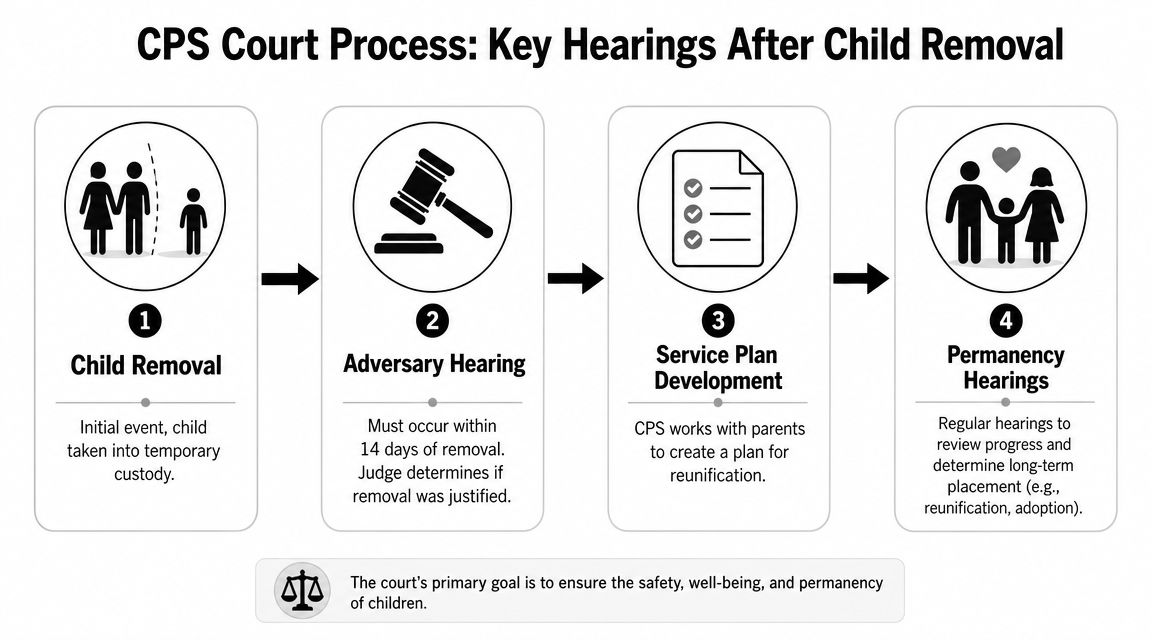
The first major event after removal is paperwork. DFPS must open a court case by filing a Suit Affecting the Parent-Child Relationship, often called a SAPCR, and ask the court to appoint the agency as temporary managing conservator.
The next step is the initial hearing. Under the emergency-removal process described in Texas family law guidance, DFPS must obtain that hearing by the next business day after removing the child without a court order.
Here is the basic roadmap:
| Timeframe | Event | What It Means for You |
|---|---|---|
| Same day as removal | CPS takes the child under claimed emergency circumstances | Focus on getting names, allegations, placement information, and legal help |
| By the next business day | DFPS files a SAPCR and seeks temporary managing conservatorship | The case becomes a formal court matter |
| Initial hearing | A judge reviews the emergency basis for removal | This is the first court check on CPS's actions |
| Shortly after | You receive notice, instructions, and often service-related demands | What you do and say now can affect later hearings |
What the first hearing is really about
Parents sometimes believe the first hearing is the full trial. It isn't. The court is looking at whether CPS had enough basis to remove first and ask questions later, and whether temporary state custody should continue.
That means the judge will not usually resolve every dispute in one setting. The court will focus on immediate safety, temporary placement, and what should happen while the case continues.
This hearing still matters enormously. Judges form early impressions. Caseworkers make representations. The record starts taking shape.
If you miss the first hearing because you are overwhelmed, disorganized, or waiting to "see what happens," you give away ground that is hard to recover later.
What you should expect emotionally and practically
The first two days are usually chaotic. Parents are trying to find the child, notify family members, manage work, and answer calls from CPS. At the same time, they are being asked to absorb legal terms that are largely unknown.
Two practical points help here:
- Keep one notebook or one phone note for the case. Put every date, call, contact name, and instruction in one place.
- Separate facts from reactions. "Caseworker arrived at 6:20 p.m." is a fact. "They hate me" is a reaction. Facts help your lawyer. Reactions can distract you from what matters.
Parents who do best in this window are not always the calmest. They are the ones who become organized quickly.
Immediate Actions Every Parent Should Take
The hours after an emergency removal are not the time to improvise. Some choices help. Some choices create damage that follows you into court. If you want the shortest path back toward reunification, your first moves need to be deliberate.
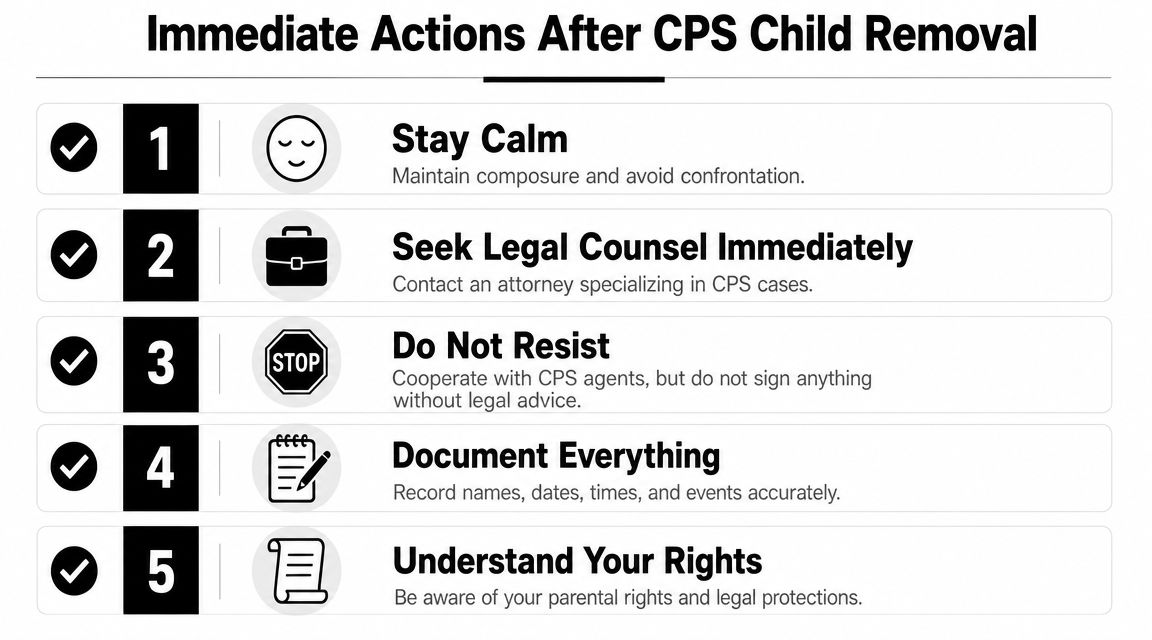
Five non-negotiable steps
Get a lawyer involved immediately.
A CPS case starts moving before most parents understand the rules. You need someone who can review the petition, contact the caseworker, prepare for the hearing, and tell you what not to say.Write down everything while it's fresh.
Record the time CPS arrived, who was present, what was said, whether law enforcement was there, whether you were asked to sign anything, and where your child was taken.Identify safe relatives fast.
Courts often want to know whether there is a family placement option. Make a short list of relatives or close family friends who are stable, reachable, and willing to be considered.Preserve documents and physical evidence.
Save text messages, voicemails, photos of the home, medical paperwork, school communications, and anything else tied to the allegation.Control your communication.
Do not vent on social media. Do not send angry texts to the other parent, relatives, or the caseworker. Assume anything you write may later be read in court.
A lot of parents also need to hear what not to do.
- Don't sign quickly: If CPS asks you to sign paperwork, read it carefully and get legal advice first when possible.
- Don't argue with everyone involved: A loud, escalating scene can become part of the agency's narrative about the home environment.
- Don't coach witnesses: Telling relatives or children what to say can backfire badly.
- Don't treat the case like a misunderstanding that will clear itself up: It might. But you should not rely on that.
Here is a short video that helps frame the urgency of a CPS case in Texas:
What works better than defensiveness
The most effective parents usually do three things at once. They stay polite. They stop volunteering unnecessary information. They start building a record.
If the issue involves the home, photograph the current condition. If the issue involves a medical misunderstanding, gather provider information. If the issue involves another adult in the home, be honest with your lawyer about that person's role and history.
Your case is not won by saying, "This is ridiculous." It is strengthened by producing records, witnesses, and a safe plan that the court can evaluate.
If you're trying to understand related custody issues while a CPS matter is unfolding, our Texas child custody resources can help you see how these cases intersect.
The Court Hearings and Your Legal Defense
After the emergency phase, the case shifts from crisis response to courtroom strategy. Many parents then realize that what happened at the door was only the beginning. The legal fight is about whether CPS can continue to keep your child out of the home and under what conditions reunification can happen.
The early hearing that shapes the case
One of the most important hearings comes soon after removal: the adversary hearing. In Texas practice, this is often the parent's first meaningful chance to challenge the state's version of events, present evidence, and push for the child's return or for a less restrictive arrangement.
The practical question becomes narrower than many parents expect. The judge is not deciding whether you love your child. The judge is deciding whether there is a continuing safety issue that justifies ongoing CPS custody.
That is why early preparation matters. A legal defense is not just denial. It is a structured response to the specific allegation.
What a real defense can look like
A strong defense depends on the facts, but it often includes one or more of these themes:
- The emergency claim was overstated: CPS acted on incomplete, stale, or exaggerated information.
- The allegation is false: The report was wrong, misinterpreted, or made by someone with a motive to distort events.
- The concern has already been addressed: The condition that worried CPS no longer exists, or a protective adult has stepped in.
- There is a less drastic alternative: A relative placement, temporary supervision arrangement, or separation from a problematic adult may protect the child without prolonged state custody.
The legal system responds better to proof than outrage. Judges want details. Who was there? What records exist? What changed after the incident? What safety measures are in place now?
Service plans and the long game
If the child is not returned early, the court may order or approve a service plan. This usually lays out tasks CPS says the parent must complete. Examples may include evaluations, classes, counseling, stable housing steps, or limits involving certain people in the household.
Parents often make one of two mistakes here. Some sign and comply with everything without understanding how the plan affects the case. Others reject the entire plan out of frustration. Neither response is always wise.
What works better is a strategic review of each requirement:
| Issue | Risk if you ignore it | Better approach |
|---|---|---|
| A service requirement seems unfair | CPS may argue you are not cooperating | Review it with counsel and object in the proper forum if needed |
| A task is reasonable but unclear | Missed deadlines and confusion | Get the requirement in writing and track completion |
| A safety concern involves another adult | Court may see ongoing instability | Create a concrete boundary plan and document it |
| You believe CPS is misrepresenting facts | The record may harden against you | Gather records and witness testimony early |
Courts often look less at whether a parent is upset by CPS involvement and more at whether the parent can respond with stable, child-focused decisions under pressure.
For many families, the case also affects broader conservatorship and possession issues. If you need context on how Texas courts evaluate parenting arrangements, our guide to custody and visitation in Texas family cases is a useful starting point.
Why the early record matters later
The argument you make in the first hearings often shapes the rest of the case. If you admit facts carelessly, delay action, or fail to present available relatives and records, CPS may treat that silence as confirmation. If you respond quickly with documents, witness support, and a credible safety plan, the court has another path to consider.
That is the key connection many parents miss. Reunification is not built only at the end of the case. It starts with the record created in the first days.
Why You Need an Experienced Attorney on Your Side
A CPS case is not an ordinary disagreement. The state has investigators, agency lawyers, internal procedures, and the authority to ask a judge to keep your child out of your home. Parents usually walk into that system scared, sleep-deprived, and unsure what they are allowed to say.
That imbalance is the reason legal representation matters so much. A lawyer can evaluate whether the claimed emergency met the legal standard, prepare you for hearings, identify weaknesses in CPS's evidence, and help you avoid statements that damage your case.
What a lawyer actually does in a CPS crisis
An experienced Texas family law attorney doesn't just appear in court and argue. The work starts earlier and is more practical than many people realize.
- Review the petition and affidavits: The legal basis for removal has to be tested carefully.
- Prepare your evidence: Photos, records, witness names, and placement options need to be organized quickly.
- Address service plans intelligently: Some requirements may be reasonable. Others may need clarification or challenge.
- Help you communicate safely: Every conversation with CPS, the other parent, and relatives can affect the case.
Some parents try to wait until "things settle down" before hiring counsel. That usually gives CPS a head start in shaping the narrative. For assistance, a Texas family law firm such as Law Office of Bryan Fagan, PLLC handles family law matters that include custody disputes and CPS-related litigation.
The real value is not just courtroom skill
A good attorney helps you make better decisions when you are under maximum stress. That includes telling you when to speak, when to stay silent, which documents matter, and how to present a judge with a realistic plan for your child's safe return.
If CPS has contacted you or has already removed your child, waiting is usually the worst strategy. Fast, disciplined action gives you the best chance to protect your rights and move toward reunification.
If you need help navigating divorce, custody, or estate planning in Texas, contact The Law Office of Bryan Fagan today for a free consultation.