
Uncontested Divorce Paperwork Texas is usually the last thing on a parent’s mind when a marriage reaches its end. The moment often comes quietly—two people sitting across from each other, realizing the arguing has stopped and the decision has already been made. There is relief in knowing you agree on the major issues, but also anxiety about what comes next. You want the process to be clean, respectful, and final, without creating new stress for your children or reopening wounds you’ve worked hard to close.
What many families don’t realize is that Uncontested Divorce Paperwork Texas is not just a formality—it is the legal framework that governs your family’s life after divorce. Texas judges are required under Texas Family Code §153.002 to prioritize the best interest of the child, even in agreed cases. If the paperwork is rushed, vague, or incomplete, families can find themselves back in court, dealing with confusion, enforcement issues, or conflict they thought they had avoided.
At The Law Office of Bryan Fagan, PLLC, this is where our purpose comes into focus. Led by Bryan Joseph Fagan, a South Texas College of Law graduate and trusted authority on Texas divorce and custody law, our Houston-based firm exists to empower families to reclaim peace of mind during difficult transitions. Through compassionate counsel, clear education, and legally precise solutions, we help parents transform agreement into lasting stability. As you continue reading, you’ll learn why uncontested divorce paperwork in Texas matters more than most people expect—and how the right guidance can help your family move forward with clarity and confidence.
Key Takeaways
- An uncontested divorce requires full agreement before filing. Under Texas law, both spouses must agree on all issues—property division, child custody, child support, and spousal support—before paperwork is submitted. Without complete agreement, the case becomes contested.
- Core documents include the Original Petition for Divorce, Waiver of Service, and Final Decree of Divorce. Texas courts require specific forms even in the simplest uncontested cases; generic or out-of-state forms will be rejected.
- Cases involving minor children require additional documentation. Parenting plans, child support orders, income withholding orders, and medical support provisions must all be included in your divorce papers.
- Texas requires a mandatory 60-day waiting period. Under Texas Family Code Section 6.702, your divorce cannot be finalized until at least 60 days after the Original Petition for Divorce is filed.
- Incomplete or vague paperwork leads to future legal problems. Assets and debts left out of your Final Decree remain community property, potentially requiring expensive post-divorce litigation to resolve.

Your Family’s Future Starts Here
Don’t navigate your legal journey alone. Schedule a consultation now and get the clarity and support you deserve.
Uncontested Divorce Paperwork Texas: The Big Picture
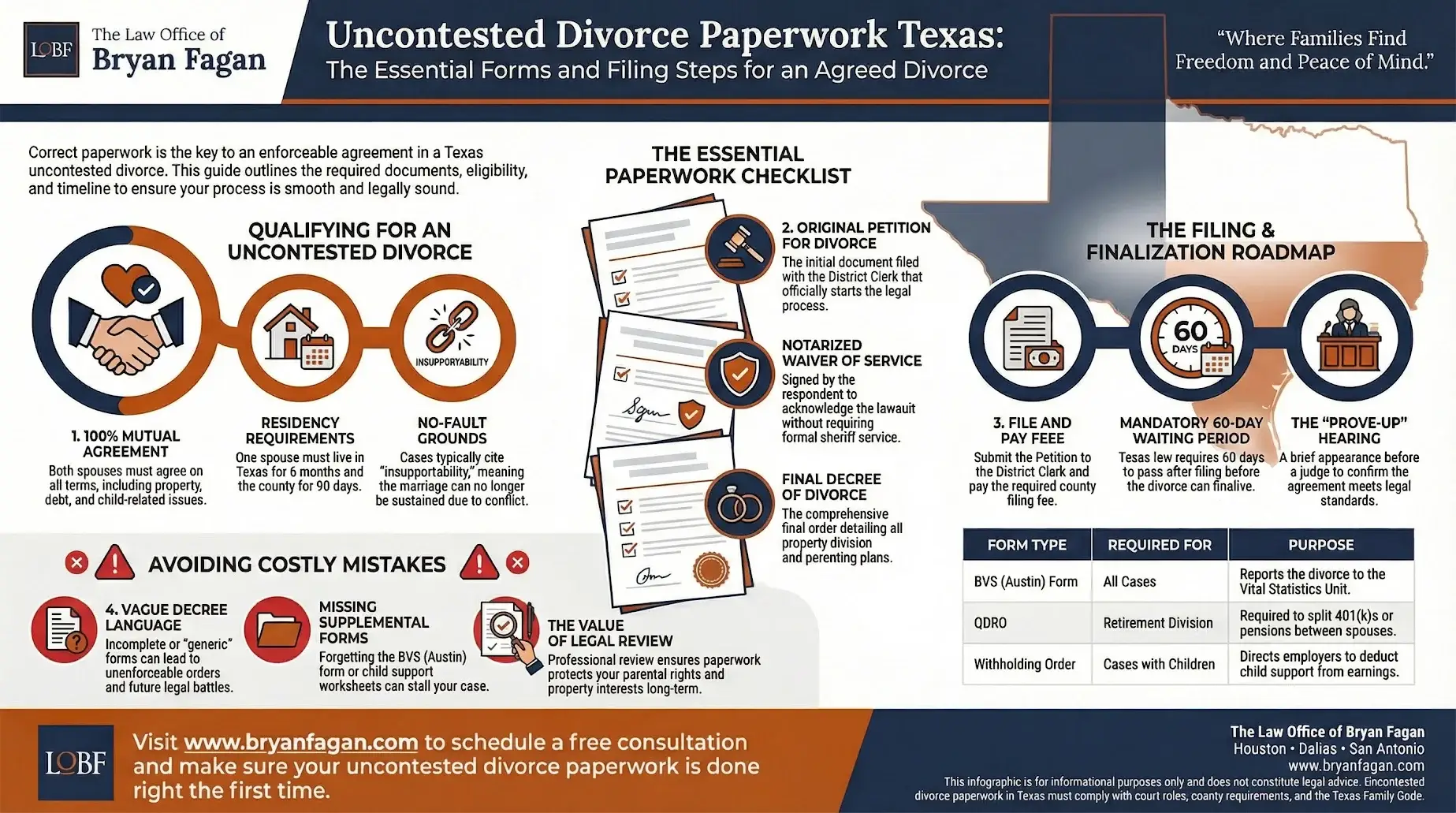
When spouses resolve every major issue before filing, Uncontested Divorce Paperwork Texas cases can move forward with significantly less stress, expense, and delay. In an uncontested divorce, both parties agree in advance on property and debt division, spousal maintenance when applicable, and—if children are involved—conservatorship, possession schedules, and child support. Texas Family Code §6.001 establishes the legal grounds for divorce, but the “uncontested” nature of a case is defined by the absence of disputes rather than a separate statutory category. Families who take this cooperative approach often benefit from a smoother, more predictable court process.
Agreement alone, however, does not finalize a divorce. Texas law imposes strict procedural requirements that apply even when both spouses are fully aligned. Under Texas Family Code §6.702, most divorces are subject to a mandatory 60-day waiting period from the date the Original Petition for Divorce is filed, with limited exceptions such as cases involving qualifying family violence. Courts also scrutinize agreements involving children to ensure compliance with the “best interest of the child” standard found throughout Chapters 153 and 154 of the Texas Family Code, which have been updated in recent years to reflect changes such as increased child support guideline caps and evolving custody considerations.
This is why accurate and complete paperwork is critical. The Final Decree of Divorce is not a technicality—it is the document that transforms a private agreement into a binding court order enforceable by law. Judges rely on this decree to confirm that property division is clear, child-related provisions meet statutory requirements, and the overall agreement is fair and workable. Even when spouses agree on every detail, mistakes or omissions in the paperwork can result in clerk rejections, judicial delays at the prove-up hearing, or costly enforcement problems years later.
Families navigating this process benefit from education and precision at every step. Common mistakes are explained in Texas Divorce Paperwork: What Everyone Gets Wrong, while additional guidance is available through the firm’s broader Texas divorce resources. By combining compassionate guidance with up-to-date legal insight, the attorneys at the Law Office of Bryan Fagan, PLLC help Texas families move forward with confidence—ensuring that uncontested divorces are not only amicable, but legally sound and built to protect their futures.

Required Uncontested Divorce Paperwork Texas
Every uncontested divorce in Texas depends on properly prepared documents filed in the correct order, and understanding how each piece fits together is essential in Uncontested Divorce Paperwork Texas cases. When paperwork is incomplete or filed incorrectly, even cooperative divorces can be delayed or rejected by the court. Texas courts rely on these core documents to confirm jurisdiction, fairness, and enforceability, which is why education and careful preparation play such a critical role in keeping a divorce truly uncontested.
The process begins with the Original Petition for Divorce, which formally opens the case. This document is filed by the spouse initiating the divorce in the district court of a county that meets Texas residency requirements. Texas Family Code §6.301 requires that at least one spouse has lived in Texas for a minimum of six months and in the county of filing for at least 90 days. The petition identifies the parties, states the grounds for divorce—most commonly “insupportability” under Texas Family Code §6.001—and outlines the relief requested regarding property division, spousal maintenance, and, when applicable, children. Although it does not finalize any decisions, the petition sets the legal framework for everything that follows.
Many Texas counties also require a Civil Case Information Sheet for administrative purposes. This form allows the clerk’s office to track the case type, identify the parties, and categorize the relief requested. While it does not affect the substance of the divorce, missing or inaccurate information on this form can still slow the filing process, particularly in busy urban courts.
In uncontested cases, the Waiver of Service is often what keeps the divorce moving efficiently. Under Texas Rules of Civil Procedure Rule 119, the responding spouse may sign a notarized waiver acknowledging receipt of the petition and giving up the right to formal service by a constable or process server. Filing a valid waiver eliminates service delays and allows the case to move directly toward finalization, an approach often recommended when spouses are committed to cooperation. Practical strategies for maintaining this level of cooperation are discussed in Top Tips for Keeping the Divorce Uncontested in Texas.
The Final Decree of Divorce is the most important document in the entire process because it converts private agreements into enforceable court orders. Texas Family Code §7.001 requires the court to approve a “just and right” division of community property, which means every asset and debt must be clearly and specifically awarded in the decree. Vague language invites future disputes and enforcement problems, while precise descriptions protect both parties and reduce the likelihood of post-divorce litigation. Once the judge signs the Final Decree, it becomes immediately enforceable, allowing either party to seek court enforcement if its terms are violated. Additional guidance on drafting and reviewing these documents is available through the firm’s comprehensive Texas divorce resources, where families can learn how careful preparation supports a smoother, more secure future.
Uncontested Divorce Paperwork Texas When Children Are Involved
When your divorce involves minor children, Texas courts require significantly more detailed paperwork to protect the children’s interests and ensure clarity about parental responsibilities.
Parenting Plan Provisions
Your Final Decree must include comprehensive parenting plan provisions under Texas Family Code Chapter 153. This includes designation of conservatorship—typically joint managing conservatorship as the presumed standard under Section 153.131—along with rights and duties assigned to each parent.
The possession and access schedule must be clearly spelled out. Many Texas divorces use the Standard Possession Order found in Sections 153.312 through 153.317, but your agreement can create a different schedule if both parents agree and the court finds it serves the child’s best interest.
Child Support Order Language
Child support calculations follow the guidelines in Texas Family Code Sections 154.125 through 154.130. For one child, the non-custodial parent typically pays 20% of net monthly resources. Your decree must specify the exact monthly amount, payment frequency, and how payments are made.
Income Withholding Order
Texas Family Code Section 158.001 makes income withholding orders mandatory in child support cases. This order directs the paying parent’s employer to withhold child support directly from wages. You will file Form 14-1 from the Office of the Attorney General of Texas along with your other divorce documents.
Medical and Dental Support
Sections 154.181 and 154.182 require provisions for children’s health insurance and unreimbursed medical expenses. Your decree must specify which parent provides insurance, how premiums are allocated based on income, and how out-of-pocket medical costs are divided.
Courts scrutinize child-related provisions carefully. The judge at your final hearing will ask questions to ensure the agreement serves the child’s best interest under Section 153.002. Vague or incomplete child support provisions often result in the judge requiring corrections before signing your decree.
Uncontested Divorce Paperwork Texas When Property or Retirement Is Involved
Property division in a Texas divorce requires careful drafting and legally precise documentation, especially in Uncontested Divorce Paperwork Texas cases where spouses expect their agreement to be honored without future conflict. Even when both parties agree on how assets and debts should be divided, Texas Family Code §7.001 requires the court to approve a “just and right” division of the marital estate. That standard means judges must be able to clearly understand and enforce the terms of your agreement, which is only possible when the paperwork accurately reflects each asset, obligation, and transfer.
When real estate is involved, precision is essential. Texas courts require Final Decrees of Divorce to include the full legal description of any real property being awarded, such as the metes and bounds or lot and block description taken directly from the deed. Street addresses alone are not sufficient. Errors or omissions in these descriptions can prevent title companies from completing transfers and may require corrective deeds or additional court orders later, creating delays and unnecessary expense that proper drafting can avoid.
The same level of detail is required for vehicles and debts. Vehicles should be identified by year, make, model, and VIN, while debts must be listed by creditor name and account number. Clear allocation language helps ensure enforceability if one party fails to comply and reduces the likelihood of post-divorce disputes. The attorneys at the Law Office of Bryan Fagan, PLLC routinely counsel families on how thorough documentation protects them long after the divorce is finalized, a theme echoed throughout the firm’s Texas divorce education resources.
Retirement accounts require even greater care. Dividing 401(k) plans, pensions, and similar accounts must comply with Texas Family Code §7.003 and typically requires a Qualified Domestic Relations Order (QDRO). The Final Decree must clearly state the division formula or percentage awarded to each spouse, but the process does not end there. Most plan administrators require a separate QDRO to be approved and filed after the divorce is final, and each administrator has its own strict requirements. Decrees that lack proper QDRO language are frequently rejected, leading to costly post-divorce corrections and delays that could have been avoided with careful initial drafting.
This attention to detail mirrors a broader legal reality: paperwork errors can have consequences far beyond divorce. Issues surrounding incomplete or poorly prepared legal documents are also explored in What Happens If You Die Without a Living Will Paperwork in Place, which highlights how missing documentation can leave families exposed during already difficult times. By blending practical legal guidance with compassionate education, the Bryan Fagan law firm helps Texas families protect their futures by ensuring that uncontested divorces are not only cooperative, but legally sound and enforceable for years to come.

Common Mistakes in Uncontested Divorce Paperwork Texas
Even spouses with complete agreements encounter delays when their paperwork contains errors. Understanding common mistakes helps you avoid them.
Using Generic or Out-of-State Forms
Texas has specific requirements for divorce forms. Generic forms found online or documents designed for other states often lack required provisions or use incorrect terminology. The eFileTexas system and county clerk’s offices reject non-compliant filings.
Omitting Assets or Debts
Property and debts not addressed in your Final Decree remain community property even after divorce. This creates confusion about ownership and may require post-divorce litigation to resolve. List everything—every bank account, every credit card, every vehicle.
Vague Enforcement Language
Your decree should include specific enforcement provisions. What happens if your spouse fails to transfer a vehicle title within 30 days? Without clear remedies spelled out, enforcing your decree becomes more difficult and expensive.
Incorrect Legal Descriptions
Wrong property addresses, outdated legal descriptions, or missing parcel numbers can invalidate real property transfers. Always verify legal descriptions against current deeds.
Missing Signatures or Notarization
Waivers of Service must be notarized. Affidavits for prove-up hearings must be properly executed. Missing signatures halt your case until corrections are made.
Statistics suggest that self-represented divorces experience rejection and amendment rates of 20% to 30%. Each rejection extends your timeline by weeks and adds frustration to an already emotional process.
Filing and Submitting Uncontested Divorce Paperwork in Texas
Texas requires e-filing through eFileTexas.gov in most counties. The process begins when you submit your Original Petition for Divorce and Civil Case Information Sheet.
Filing Fees and Court Costs
Court fees vary by county, typically ranging from $300 to $400. Harris County charges approximately $320, while Travis County charges around $300. Fee waivers are available for those who cannot afford filing costs—you must submit a separate affidavit of inability to pay.
County-Specific Requirements
Some Texas counties have local rules requiring additional forms or standing orders. Check with your county clerk’s office or review local court rules before filing.
Service Requirements
If your spouse signs a Waiver of Service, you file it along with your other documents. If formal service is necessary, you will pay additional fees—typically around $100—for a constable or process server.
Prove-Up Hearing
Most uncontested divorces require a brief prove-up hearing where at least one spouse appears before the judge. The judge confirms the agreement is voluntary and, if children are involved, serves the child’s best interest. Some counties allow telephonic hearings or affidavits in lieu of in-person appearances for cases without minor children.
After the judge signs your Final Decree, you obtain certified copies from the clerk’s office (approximately $1 per page) for banks, the DMV, and the Texas Vital Statistics Unit for your divorce records.
How Long Uncontested Divorce Paperwork Takes to Be Approved
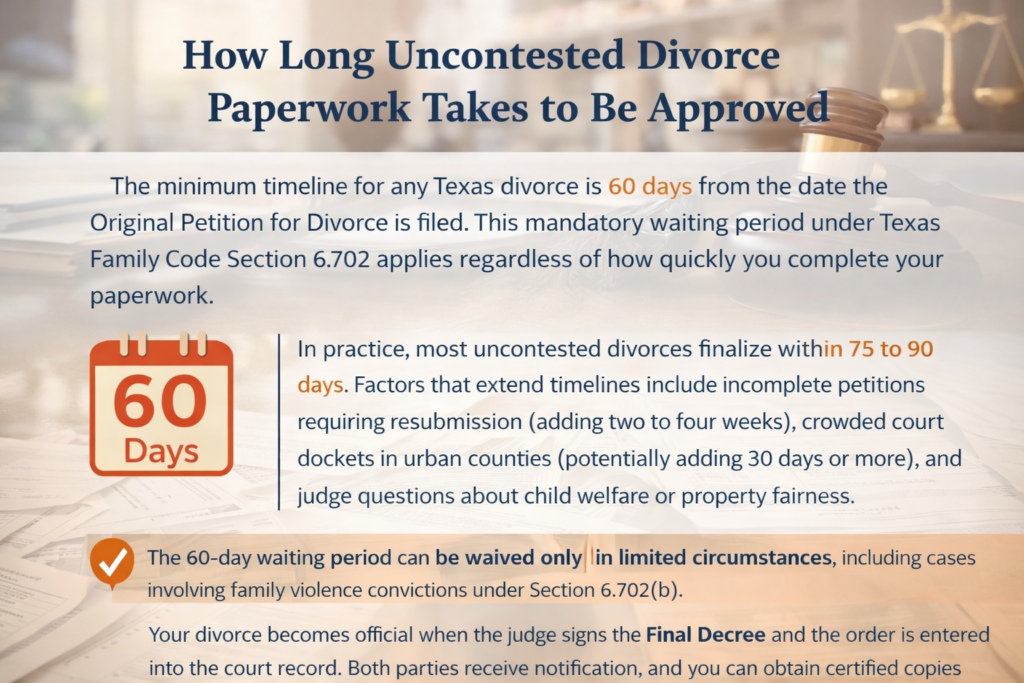
Under Texas law, timing is one of the most common points of confusion for families completing Uncontested Divorce Paperwork Texas, especially when everything else feels ready to move forward. Texas Family Code §6.702 establishes a mandatory 60-day waiting period that begins on the date the Original Petition for Divorce is filed, and this requirement applies regardless of how quickly spouses reach agreement or submit their paperwork. The waiting period exists to provide a cooling-off window and to ensure that courts have adequate time to review agreements for fairness and legal compliance.
In real-world practice, most uncontested divorces are finalized within 75 to 90 days rather than exactly 60. Delays often occur when petitions are incomplete and must be corrected and refiled, which can add several weeks, or when crowded court dockets in larger Texas counties push prove-up hearings further out. Judges may also request clarification if property divisions appear unclear or if child-related provisions raise concerns under the “best interest of the child” standard found throughout Chapters 153 and 154 of the Texas Family Code, which have been updated in recent years to reflect higher child support guideline caps and evolving custody considerations.
The 60-day waiting period can be waived, but only in limited circumstances. Texas Family Code §6.702(b) allows an exception when there has been a qualifying conviction or active protective order involving family violence. Outside of these narrow situations, courts strictly enforce the waiting period, even in cases where both spouses are fully aligned and eager to finalize their divorce.
A divorce becomes legally effective only when the judge signs the Final Decree of Divorce and the order is entered into the court record. Once that occurs, both parties can obtain certified copies to update financial accounts, estate planning documents, and identification. Guidance on managing this process correctly is outlined in How to Handle Uncontested Divorce Paperwork in Texas the Right Way, while additional education is available through the firm’s broader Texas divorce resources. By combining practical legal insight with compassionate support, the attorneys at the Law Office of Bryan Fagan, PLLC help Texas families move through uncontested divorces with clarity, confidence, and peace of mind about what comes next.
Can You Complete Uncontested Divorce Paperwork Texas Without a Lawyer?
Self-preparation is possible in straightforward cases. Spouses without minor children, significant property, or retirement accounts to divide can often use free resources like the TexasLawHelp.org divorce toolkit to prepare their own documents.
Statistics suggest approximately 25% of Texas divorces are filed pro se (without attorney representation), and success rates are highest in truly simple cases. When property, retirement, or children are involved, error rates increase significantly.
Risks of Self-Preparation
Unenforceable decree language is a common problem. Retirement provisions that fail to comply with QDRO requirements, property descriptions that do not match deed records, and child support calculations that deviate from guidelines without proper findings can all create problems.
The cost of fixing these issues after divorce—through modifications, enforcement actions, or new court filings—often exceeds what proper legal guidance would have cost initially.
Limited-Scope Legal Review
Many Texas divorce attorneys offer limited-scope representation, reviewing documents you have prepared for a flat fee ranging from $500 to $1,500. This hybrid approach provides professional review without full-service costs.
Recognizing when attorney assistance is essential protects your interests. If your situation involves business assets, professional retirement accounts, disputes about specific property items, or concerns about your spouse’s voluntary agreement, professional guidance is worth the investment.
How a Texas Divorce Attorney Ensures Uncontested Divorce Paperwork Is Done Right
Working with experienced Texas counsel is often the difference between a smooth, enforceable divorce and years of avoidable frustration, particularly in Uncontested Divorce Paperwork Texas cases where spouses expect their agreement to carry lasting legal weight. While Texas Family Code §7.001 requires courts to approve a “just and right” division of property and Texas Family Code §6.702 governs mandatory waiting periods, it is the precision of the Final Decree of Divorce that determines whether your agreement functions as intended. Attorneys draft decrees using Texas Family Code–compliant language that judges routinely approve, ensuring that what you agreed to privately becomes a clear, enforceable court order.
Careful drafting matters because small omissions can have major consequences. Issues such as missing Qualified Domestic Relations Order (QDRO) language for retirement accounts under Texas Family Code §7.003, vague property descriptions, or weak enforcement provisions often go unnoticed in self-prepared documents. These errors may not surface until years later, when one party fails to comply and the decree proves difficult—or impossible—to enforce. By identifying these problems early, a knowledgeable divorce attorney helps protect clients from costly post-divorce litigation and uncertainty.
Child-related provisions demand even closer attention. Texas courts must ensure that possession schedules, child support, and medical support comply with the “best interest of the child” standard found throughout Chapters 153 and 154 of the Texas Family Code, which have been updated in recent years to reflect higher child support guideline caps and evolving custody standards. Attorneys ensure that possession schedules meet statutory requirements, child support calculations align with current guidelines, and medical support provisions satisfy today’s legal expectations, reducing the risk of judicial rejection or later modification disputes.
Proper paperwork also streamlines the procedural side of divorce. Legal teams coordinate e-filing, waiver execution, and prove-up hearing preparation, resulting in significantly higher first-pass approval rates than self-prepared filings. Families who want a clearer picture of how representation affects timing can explore How Long Does an Uncontested Divorce Take in Texas? What to Consider for Your Situation, along with other practical guidance available through the firm’s comprehensive Texas divorce resources. Understanding Uncontested Divorce Paperwork Texas begins with recognizing that careful documentation is what transforms agreement into lasting legal protection, a principle the Bryan Fagan legal team emphasizes in every uncontested case they handle.

Why Choose The Law Office of Bryan Fagan, PLLC
With decades of experience guiding families through divorce, the legal team at the Law Office of Bryan Fagan, PLLC brings clarity and confidence to Uncontested Divorce Paperwork Texas cases across the state. Our attorneys prepare detailed, judge-ready Final Decrees of Divorce that comply with Texas Family Code §7.001, which requires courts to approve a “just and right” division of community property, as well as Texas Family Code §6.702, which governs mandatory waiting periods and procedural safeguards. By drafting documents that reflect current statutory requirements and recent updates to Texas family law, we help ensure that agreed divorces move through the court system efficiently and without unnecessary setbacks.
Understanding that cost and transparency matter during this transition, our firm offers flat-fee and cost-conscious representation options designed to keep expenses manageable. We take the time to explain each step of the divorce process in plain language, from filing the Original Petition for Divorce under Texas Family Code §6.301 to finalizing child-related provisions that must meet the “best interest of the child” standard found throughout Chapters 153 and 154 of the Texas Family Code. This educational, compassionate approach allows clients to make informed decisions while avoiding the confusion and stress that often accompany self-prepared paperwork.
Because divorce procedures can vary by county, our statewide practice is equipped to handle e-filing, coordinate with local courts, and confirm that all documents meet county-specific requirements. Families seeking a broader overview of what to expect can review The Divorce Process in Texas, along with additional guidance available through the firm’s extensive Texas divorce education resources. By blending practical legal guidance with genuine empathy, the Bryan Fagan legal team remains focused on one goal: helping Texas families finalize uncontested divorces cleanly, confidently, and with a solid foundation for the future.
Checklist: Uncontested Divorce Paperwork Texas
- Confirm all divorce terms are fully agreed upon before preparing any documents
- Gather financial, property, and child information including account numbers, legal descriptions, and income verification
- Use Texas-specific forms only from approved sources or attorney-prepared documents
- Include complete descriptions of all assets, debts, and property—leave nothing out
- Prepare child-related documents including parenting plan, child support order, and income withholding order if applicable
- Review paperwork carefully before filing to catch errors and omissions
- Consult a Texas divorce attorney before final submission for professional review
Conclusion
Divorce is rarely about just ending a marriage—it’s about shaping what life looks like afterward. When the process is handled with care, clarity, and intention, it can become a turning point rather than a setback. Thoughtful uncontested divorce paperwork creates structure where there was uncertainty and replaces fear with predictability, giving families room to breathe and move forward with confidence.
If you’re standing at that crossroads now, know that you don’t have to figure it out alone. Working with an experienced Texas family law attorney can help ensure that your agreement truly protects your family and holds up long after the ink dries. At The Law Office of Bryan Fagan, PLLC, our focus is on educating families, simplifying complex legal decisions, and helping you protect what matters most—your peace of mind and your future.
Sometimes the most powerful step isn’t rushing to be “done,” but taking a moment to do things the right way. If you have questions, concerns, or just want reassurance that you’re on the right path, a conversation with the right legal team can make all the difference. We’re here when you’re ready to take that next step forward.
Frequently Asked Questions About Uncontested Divorce in Texas
While the paperwork itself can often be prepared and filed within a few days, Texas law requires a mandatory 60-day waiting period from the date the Original Petition for Divorce is filed before a judge can finalize the divorce. In real-world terms, most uncontested divorces are completed within 75 to 120 days, depending on county procedures, court availability, and whether any corrections are needed.
In many counties, at least one spouse must attend a brief prove-up hearing so the judge can confirm the agreement is voluntary and legally sound. Some courts allow affidavit prove-ups or remote appearances in simple cases without children, but this varies by county and judge. It’s always best to confirm local court requirements before assuming a court appearance can be avoided.
Court filing fees typically range from $300 to $400, depending on the county. Additional costs may include service fees or attorney fees if you choose legal assistance. For those who qualify, Texas courts offer fee waivers through an affidavit of inability to pay court costs.
Yes, Texas allows individuals to file for divorce without an attorney, particularly in straightforward uncontested cases. However, self-prepared paperwork often has higher rejection rates and can overlook important legal details, especially when children, property, or retirement accounts are involved. Many people choose limited-scope legal review to reduce risk while controlling costs.
A judge may refuse to sign an uncontested divorce decree if the paperwork is incomplete, unclear, or legally non-compliant. In cases involving children, the court must ensure the agreement meets the “best interest of the child” standard under Texas Family Code §153.002. Judges may also deny a decree if they suspect coercion or find that required provisions are missing.
The 10-10-10 rule is not a legal requirement but a decision-making tool. It asks how you will feel about a decision in 10 days, 10 months, and 10 years. Many people use this approach during divorce to evaluate whether short-term emotional relief could lead to long-term regret.
Although uncontested divorces are usually faster and less expensive, they carry risks if agreements are rushed or poorly documented. Common issues include vague property division, improper retirement account language, and agreements that don’t account for future changes. Without careful drafting, problems can surface long after the divorce is finalized.
The fastest lawful approach is to prepare accurate, Texas-specific paperwork, file promptly through the e-filing system, use a notarized waiver of service when appropriate, and schedule a prove-up as soon as the court allows—keeping in mind the mandatory 60-day waiting period. Avoiding filing errors is key to preventing delays.
Avoid hiding assets, making major financial changes without agreement, relying on generic or out-of-state forms, or signing documents you don’t fully understand. When children are involved, avoid sudden schedule changes or informal agreements that aren’t reflected in the court order. Clear, legally sound paperwork helps protect everyone involved.