
Divorce can be one of life’s most difficult transitions—but understanding your rights under Texas law can make it less overwhelming. When you're facing a divorce, one of the biggest questions is almost always, "What happens to the house?" For many couples, it's not just a building; it's a home filled with memories and is usually their most valuable asset. The answer starts with understanding a fundamental Texas legal concept: community property.
Your House and Texas Community Property Law
Going through a divorce feels chaotic enough without adding the stress of figuring out your home. The key to getting through this is knowing your rights, and that begins with understanding how the state sees your property under the Texas Family Code.
At its core, Texas law presumes that anything you or your spouse acquired while you were married is community property. As outlined in Texas Family Code § 3.002, this means it belongs to both of you and must be divided in a "just and right" manner during the divorce.
On the other hand, separate property is yours alone. It generally includes things like:
- Anything you owned outright before you got married.
- Property you received as a personal gift or inheritance during the marriage.
- Certain personal injury awards you received while married (though not for lost wages).
When the Lines Get Blurry
It sounds simple, but with a house, it rarely is. This is where things can get complicated.
Let's say you owned the house before you were married. That makes it your separate property, right? Well, maybe. If you used money from a joint checking account—which is community property—to pay the mortgage, renovate the bathroom, or put on a new roof, you've mixed funds.
This mixing of funds, or "commingling," creates a community interest in your separate property. Suddenly, the marital estate has a right to be reimbursed for the value it added. The house is no longer 100% yours; it's a mixed asset, and the community's share of the value has to be sorted out and divided fairly.
I've seen this trip up countless couples. The process of tracking these contributions is complex. To dig deeper into how this works, you should understand why tracing matters for a house bought before marriage in a Texas divorce.
Because real estate is often the biggest piece of the financial pie, it becomes a major focus. While Texas aims for a "just and right" division of community property, it's important to remember that other places handle it differently. Some states use "equitable distribution," where a fair split might not be an equal 50/50 split. They look at a lot of different factors to decide what's fair. This just goes to show why knowing the specific Texas rules is so critical for your case.
Our goal here is to give you that foundational knowledge. Armed with this information, you can feel more prepared and in control as you face the decisions ahead.
Three Paths for Your Marital Home
Once you’ve figured out how Texas law views your house—as community or separate property—the real decision-making begins. What actually happens to the house? This is often the most emotionally charged part of the entire process. It’s not just a line item on a spreadsheet; it’s where your kids grew up, where you made memories. There's no one-size-fits-all answer. The right path for you will depend on your finances, your kids' needs, and what you both want for the future.
In my experience guiding Texans through divorce, it almost always boils down to three main options: sell the house and split the money, have one person buy the other out, or keep owning it together for a while.
The first step is always classification, as this flowchart shows. It's the foundation for any discussion about dividing the asset.
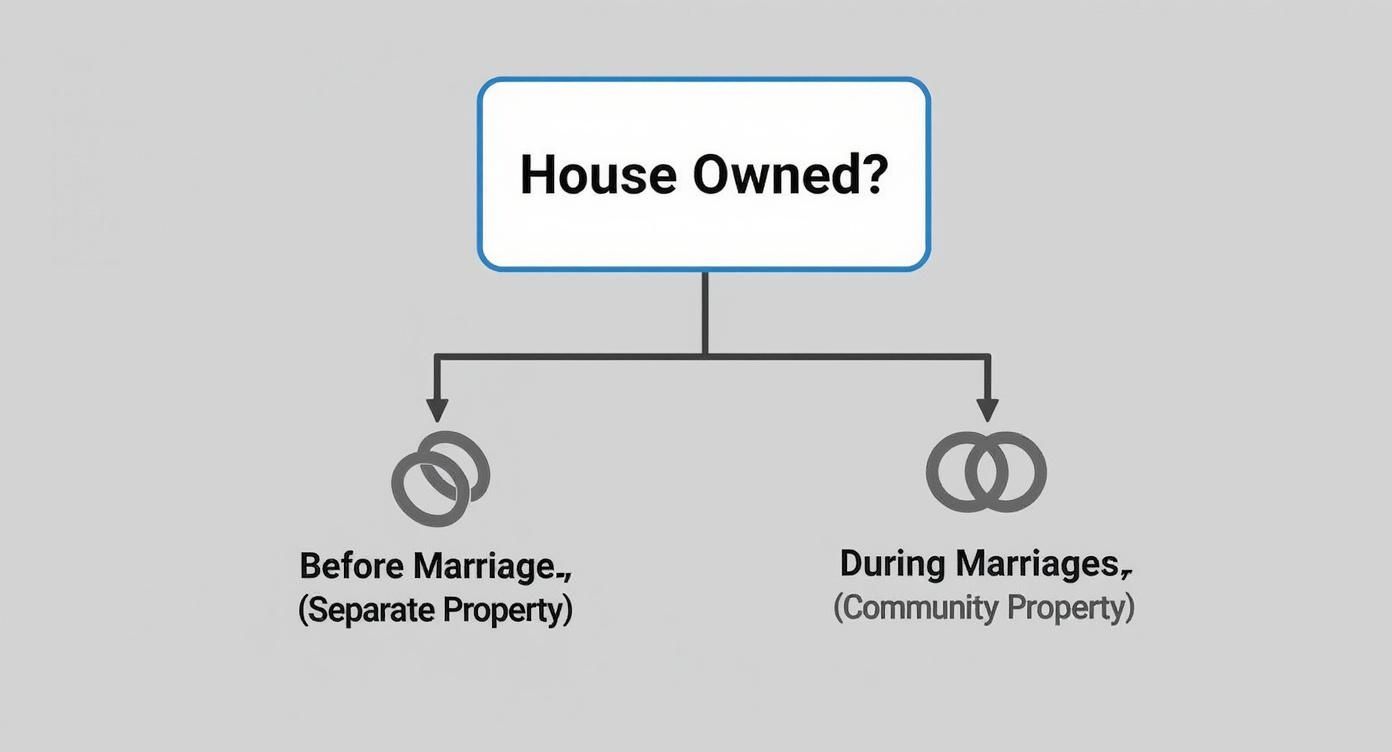
As you can see, Texas law puts a lot of weight on when the home was purchased. With that established, let's dig into the three practical choices you have for your community property home.
Option 1: Sell the House and Split the Proceeds
For many couples, selling the house is the cleanest break. It allows both of you to cash out your equity and start fresh, without being financially tied to one another. Think of it as a hard reset.
When you sell, the process is straightforward. You first pay off the mortgage and any other liens (like a home equity loan), cover the closing costs, and then whatever is left—the net proceeds—gets divided according to your divorce agreement.
This is often the go-to choice when neither person can realistically afford the house on their own, or when both are simply ready for a new chapter. It can be tough saying goodbye to the family home, but the finality it brings is often a huge relief.
Option 2: One Spouse Buys Out the Other
What if one of you really wants to stay? A buyout is a very common solution, especially if you have kids and want to keep their lives as stable as possible. In a buyout, one spouse essentially "buys" the other's share of the house's equity.
Here’s a practical example. Let's say your home is valued at $500,000 and you still owe $300,000 on the mortgage. That leaves $200,000 in community equity. To buy out your spouse, you’d need to get them their half, which is $100,000.
But a buyout is about more than just finding the cash. You also have to prove you can carry the financial load solo. This almost always means the spouse keeping the house must refinance the mortgage into their name alone, which gets the other person off the loan for good.
This isn't a small hurdle. You'll need the income and credit score to qualify for a new loan by yourself. The $100,000 for your spouse can sometimes be rolled into the new loan through a cash-out refinance, or you might trade other assets, like a portion of a retirement account, to cover it.
Option 3: Co-Own the Home After the Divorce
It’s less common, but some couples choose to continue owning the home together even after the divorce is final. This is usually done for the kids' sake, to keep them in their home and school district until they reach a certain milestone. It’s sometimes called a "deferred sale" or, in certain custody arrangements, "nesting."
If you go this route, you need an iron-clad agreement spelled out in your divorce decree. It has to be incredibly detailed, covering things like:
- Who pays the mortgage, property taxes, insurance, and for repairs (and in what percentages).
- A specific trigger for selling the house (e.g., when the youngest child turns 18 or on June 1, 2030).
- How the proceeds will be divided when the house is finally sold down the road.
This path can work wonders for providing short-term stability, but it requires a ton of cooperation and open communication. You have to be honest with yourself: is staying financially entangled with your ex a healthy long-term plan?
Comparing Your Options for the Marital Home
Each path has its own set of financial and emotional trade-offs. This table breaks down the key considerations to help you think through what might work best for your situation.
| Option | Best For… | Key Financial Consideration | Potential Emotional Impact |
|---|---|---|---|
| Sell the Home | Couples who want a clean financial break, can't afford the home individually, or are both ready to move on. | You get immediate access to your share of the equity, but you'll lose any future appreciation on the home. Don't forget to factor in closing costs (typically 5-6% of the sale price). | Provides closure and a fresh start. Can be difficult to let go of memories, but eliminates a major source of potential conflict. |
| Buyout | Couples where one spouse wants to maintain stability for the children and has the financial means to take over the mortgage and pay out the other spouse's equity. | The staying spouse must qualify for a mortgage refinance alone. The leaving spouse gets their equity but loses the family home. The buyout amount might be negotiated based on other asset trades. | The staying spouse and kids get to keep the home, which provides stability. The leaving spouse may feel a sense of loss or disconnection from their former life. |
| Co-Ownership | Couples with a high degree of mutual trust and communication who are prioritizing their children's stability for a set period. Often used until a child graduates high school. | Requires a detailed legal agreement on all expenses and a future sale date. You remain financially entangled, and both of your credit scores are tied to the mortgage until it's refinanced or sold. | Can be great for kids in the short term. However, it can delay emotional closure and create new opportunities for conflict if communication breaks down. |
Ultimately, the best decision is the one that sets both of you up for a stable and successful future, even if it looks different from the one you originally planned.
Calculating Your Home's Value and Equity
Before you can even begin to talk about who gets what, you need a number. A real, objective number. Splitting a house in a Texas divorce boils down to one thing first and foremost: an accurate valuation. You can't fairly negotiate a buyout, agree on a sales price, or let a judge make a ruling without knowing exactly what the house is worth and how much equity you’ve built together.
This figure becomes the bedrock for every decision that follows. Getting it right is non-negotiable for achieving the "just and right" division required by Texas law. It's about taking the emotion out of the equation and replacing it with a hard number you can both work from.

CMA vs. Professional Appraisal: What's the Right Call?
To figure out your home's Fair Market Value (FMV), you have two main paths. Each has its place, and choosing the right one depends on your situation.
-
Comparative Market Analysis (CMA): Think of a CMA as a highly educated estimate from a real estate agent. They'll pull data on recent sales of similar homes in your area—your "comps"—to predict what your house would likely sell for today. It's often free or low-cost and serves as a fantastic starting point for initial, friendly negotiations. If you want to understand the nuts and bolts, it helps to know how to perform a comparative market analysis.
-
Professional Appraisal: This is the heavyweight option. A licensed appraiser provides a formal, legally defensible valuation after a thorough inspection of your property. It costs a few hundred dollars, but this detailed report is the gold standard in court. If you and your spouse can't agree on a value, or if one of you plans to refinance the mortgage for a buyout, an appraisal is almost always required.
My advice? If the divorce is amicable and you trust the agent, a CMA might be all you need. But if there’s even a hint of disagreement, spring for the professional appraisal. The unbiased, third-party valuation it provides can shut down arguments before they even start.
The Simple Math for Calculating Your Equity
Once you have that FMV, the rest is just simple arithmetic. Your home equity is the actual value you own, separate from what you still owe the bank.
Here’s the formula:
Fair Market Value (FMV) – Remaining Mortgage Balance = Total Equity
That final number is the value of the community property asset that needs to be divided. It’s the figure that will drive every conversation about the house from this point forward.
A Real-World Example: Putting It All Together
Let's look at how this plays out for a real couple. We'll call them Maria and David. To keep things clean and avoid any back-and-forth, they decide to split the cost of a professional appraiser.
Here are their numbers:
- The appraisal comes back with a Fair Market Value of $500,000.
- A quick call to their lender confirms their remaining mortgage balance is $300,000.
Plugging those numbers into our formula is easy:
$500,000 (FMV) – $300,000 (Mortgage) = $200,000 (Total Equity)
This $200,000 is the community equity in their home. In Texas, community property is divided in a "just and right" manner, which usually means a 50/50 split. So, each spouse has a claim to $100,000 of that equity.
Suddenly, Maria and David aren't arguing in the abstract. They have a concrete number. If Maria wants to keep the house and buy David out, she now knows the target: she needs to come up with his $100,000 share. If they sell, they know that after the $300,000 mortgage and selling costs are paid, they'll be splitting what’s left of that $200,000.
Arming yourself with these key numbers transforms a messy, emotional fight into a much more manageable financial negotiation. You're no longer guessing—you're working with facts.
https://www.youtube.com/embed/uWcXtpNK4GE
Let's talk about the trickiest part of dividing a house: the mortgage. It’s a common and costly mistake to think that if your name is off the deed, you're free from the loan. That couldn't be further from the truth.
Think of it this way: the deed is about ownership, but the mortgage is a completely separate contract with your lender about debt. Until that mortgage is paid off or refinanced, both of you are legally on the hook for every single payment, no matter what your divorce decree says. A judge can't just order a lender to drop your name from the loan.
This is exactly why, in almost every buyout situation, the spouse who stays must refinance the mortgage into their name alone. It's the only clean way to cut the financial cord and remove the other spouse's liability for good.
Qualifying for a Refinance on Your Own
Getting a new mortgage by yourself is a whole different ballgame than when you qualified as a couple. Lenders will put your personal finances under a microscope, and you'll have to meet their qualifications single-handedly.
They’ll dig into a few key areas:
- Your Credit Score: A solid score is non-negotiable for getting a decent interest rate.
- Debt-to-Income (DTI) Ratio: This is a big one. They'll look at all your monthly debts (car payments, credit cards, plus the new mortgage) and measure it against your gross monthly income.
- Stable Income: You'll need to prove you have a reliable income stream that can comfortably cover the new, larger house payment on its own.
My advice? Get pre-approved for a refinance as soon as you start discussing a buyout. It gives you a reality check on what you can actually afford and tells you if keeping the house is even on the table. Knowing these numbers early on prevents a lot of heartache and wasted time down the road. Really understanding how a mortgage is handled in a Texas divorce is a critical first step.
What if Refinancing Isn't an Option?
So, what happens if the spouse who wants the house can't qualify for a new loan? This is a common roadblock, but in Texas, it doesn’t automatically mean you have to sell. We have a unique legal tool that can be a real game-changer.
An Owelty Lien is a specialized lien that helps equalize the division of property in a divorce. It basically allows the spouse keeping the house to tap into the home's equity to pay out the other spouse's share, often making refinancing much easier.
Here’s a practical breakdown of how it works. An Owelty Lien creates a secured debt against the house for the exact amount of equity owed to the departing spouse. The spouse who is staying then refinances the original mortgage plus the Owelty Lien amount.
The magic here is that lenders treat this as a "rate-and-term" refinance, not a "cash-out" refinance. This is a huge advantage because rate-and-term loans usually have better interest rates and less strict qualification rules, making a buyout possible when it seemed out of reach.
For an Owelty Lien to be valid, it has to be drafted perfectly into your Final Decree of Divorce and officially filed in the county property records. This isn't a DIY project; it's a specific legal tool that requires a skilled family law attorney to make sure it's done right and protects everyone involved.
Deciding Who Stays in the House During the Divorce
That stretch of time between filing for divorce and the day it’s finally over can be incredibly unsettling. You're in a strange sort of limbo, and one of the first, most pressing questions is always, "So, who stays in the house right now?"
In Texas, you don't have to figure this out on your own. A court can step in and issue what are known as Temporary Orders. Think of these as the official ground rules for you and your spouse to follow while the divorce is pending.
These orders are all about creating stability in a chaotic time, particularly when you have kids. A judge, guided by the Texas Family Code, can grant one spouse exclusive use and possession of the family home. In plain English, that means one of you gets to live there, and the other has to move out until the divorce is final.
The Role of Temporary Orders
When a judge makes this call, their number one priority is keeping things as stable and peaceful as possible. This is especially true when children are caught in the middle.
Let's imagine a common scenario: one parent has always been the primary caregiver, getting the kids ready for school, managing homework, and shuttling them to activities. A judge will almost certainly grant that parent temporary use of the home. It’s not about rewarding one parent or punishing the other; it’s about minimizing the disruption to the children's lives. The goal is to let them stay in their own beds, in their familiar neighborhood, and at their same school during a very difficult period.
Once that decision is made, the person leaving has the tough job of moving. Using a detailed moving house checklist can be a huge help in keeping that process organized.
Who Pays the Bills During This Period?
This is the next big question. It’s a common myth that whoever stays in the house automatically has to pay for everything. That's rarely how it works.
Temporary Orders get very specific about financial duties.
A judge will spell out exactly who is on the hook for the mortgage, utilities, homeowner's insurance, and property taxes. This isn't a random decision; the court looks closely at each spouse's income and ability to pay.
It's actually quite common for the higher-earning spouse to be ordered to keep paying the mortgage, even if they're the one who moved out. Why? Because the court wants to protect the house—a major community asset—from being lost to foreclosure while you're sorting things out.
And don't worry, those payments aren't just money down the drain. The court keeps track. The spouse who covers these costs during the divorce will likely receive a credit for those contributions when the property is finally divided. You're preserving a shared asset, and the court recognizes that financially when it's time to settle up.
Finalizing the Division with Proper Legal Documents
You’ve navigated the tough conversations and made the big decisions about the house. That's a huge step. But don't pop the champagne just yet—nothing is final until it’s in writing and filed with the court. A verbal agreement or a handshake means absolutely nothing in the eyes of the law, and it leaves you wide open to future conflicts.
This final stage is all about translating your hard-won negotiations into solid, enforceable legal documents. It’s what secures your financial future and prevents that dreaded "he said, she said" scenario down the road.

The cornerstone of this whole process is the Final Decree of Divorce. Think of it as the ultimate rulebook for your split. It’s not just a piece of paper; it’s a court order that legally closes this chapter and gives you the clarity you need to move forward.
The Role of the Final Decree of Divorce
Your divorce decree needs to be ironclad. There can’t be any gray areas or wiggle room when it comes to the house. It must spell out exactly what’s happening—whether you’re selling it, one person is buying the other out, or you're attempting to co-own it for a period.
For example, let's say you've decided to sell the home. A well-drafted decree should answer questions like:
- How soon does the house have to be listed? 30 days? 60 days?
- How will we agree on a real estate agent and a list price?
- What’s the plan for dividing the proceeds after the mortgage and closing costs are paid?
If one of you is buying out the other, the decree must be just as specific. It should state the exact buyout amount, the deadline for that payment, and, crucially, a firm date by which the spouse keeping the house must refinance the mortgage into their name alone. Getting these details right from the start prevents a world of headaches later.
Essential Supporting Documents for Property Transfer
The decree lays out the plan, but you need other legal instruments to actually make it happen. Without the right follow-up paperwork, the property title and the mortgage could remain in both your names, leaving you financially entangled and vulnerable.
In Texas, there are two key documents you’ll almost certainly need:
-
Special Warranty Deed: This is the document that officially transfers ownership. It moves the title from both of your names into the name of the spouse who is keeping the house. Once it’s signed, notarized, and filed with the county clerk, the ownership change is official. We break this down further in our guide on getting the deed to your house after a Texas divorce.
-
Deed of Trust to Secure Assumption: This one is a lifesaver if you're the one moving out but your name is still on the mortgage. It gives you the legal right to take back the property (foreclose) if your ex-spouse stops making the mortgage payments. It’s a powerful tool to protect your credit and ensure the terms of the decree are followed.
These documents are not optional extras; they are the essential final steps. They work together to give you the legal finality you need, ensuring the property's title is clean and that you are protected from any lingering financial ties to your former home. Getting the paperwork right is the last, most critical step to securing your independent financial future.
Common Questions About Dividing a Home in Texas
Going through a divorce brings up a ton of questions, especially when it comes to your home. It’s completely normal to feel overwhelmed—you're untangling complex legal and financial threads during a really emotional time. Let's walk through some of the most common questions we hear from our clients to give you some clarity right away.
What Happens If My Name Isn't on the Deed?
In Texas, the name on the deed doesn't tell the whole story. What really matters is whether the house is considered community property. If the home was bought or paid for during your marriage using money earned by either of you, Texas law generally views it as belonging to the marital estate.
A judge won't just look at the deed. They'll dig into when the property was purchased and where the money for the mortgage, taxes, and upkeep came from. So, even if your name isn’t on the title, if community funds were used, you likely have a claim to a share of the home's equity.
Can I Force My Spouse to Sell the House?
The short answer is yes, you can. If you and your spouse are at a complete standstill and can't agree on what to do with the house, you can ask the court to step in. A judge has the authority to order the home to be sold, and this happens quite often.
This is a very common solution when neither person can afford to buy the other out, or when selling is the only practical way to split the equity fairly. The court's main objective is a "just and right" division of your assets, and sometimes forcing a sale is the most straightforward path to get there.
What Are the Tax Implications of Selling?
This is a big one, and timing is everything. Federal tax law offers a pretty significant break on capital gains when you sell your primary residence, but the rules change depending on your marital status.
- An individual can typically exclude up to $250,000 in gains.
- A married couple filing a joint return can exclude up to $500,000.
Selling the house while you're still legally married could let you double your tax exclusion. If you wait until after the divorce is final, you'll each be limited to the individual $250,000 exclusion. It's crucial to talk this over with your attorney and a tax professional to figure out the smartest financial move for your situation.
Who Pays the Mortgage While the Divorce Is Pending?
This isn't something you have to guess about. The court will establish Temporary Orders at the beginning of the case that spell out exactly who is responsible for the mortgage, insurance, and other household bills while you wait for the divorce to be finalized.
Don't assume the person living in the house automatically pays everything. The judge will look at each spouse's income and ability to pay to make the decision. Often, the spouse who makes these payments gets credited for them in the final property settlement, since they're preserving the value of a major community asset.
If you need help navigating divorce, custody, or estate planning in Texas, contact The Law Office of Bryan Fagan today for a free consultation.