
Have you ever had one of those evenings where life feels heavier than usual—maybe you’re standing in the kitchen after the kids have gone to bed, staring at a half-empty cup of coffee, wondering how you’re supposed to hold everything together when so much is changing at once? For many Texas families, especially those with a loved one in uniform, these quiet moments carry the weight of uncertainty, unanswered questions, and the fear of what the next deployment or court date might bring. It’s in moments like these that understanding the Texas Custody and Servicemembers Civil Relief Act becomes more than a legal issue—it becomes a source of protection, clarity, and hope.
At The Law Office of Bryan Fagan, PLLC, we see families in these exact moments. A mother whose spouse just received unexpected deployment orders. A father trying to make sense of custody rights from halfway across the world. A servicemember who wants nothing more than to stay connected with their child despite the miles. Led by Bryan Joseph Fagan, a South Texas College of Law graduate and recognized authority in Texas divorce and custody law, our Houston-based team has walked alongside thousands of parents navigating the emotional and logistical challenges of family transitions—always guided by one mission: empowering people to reclaim peace of mind during life’s hardest seasons.
Under Texas Family Code §153.002, judges must prioritize the child’s best interest, but for military families, that question intersects with unique realities—deployment cycles, PCS orders, and the protective shield of the SCRA. In this article, you’ll gain a clear understanding of how Texas courts apply these laws, what rights servicemembers have during custody cases, and how thoughtful planning can bring stability during periods of upheaval.
If you’re searching for answers, reassurance, or simply a clearer path forward, know this: you’re not alone, and the next steps don’t have to feel overwhelming. Let’s take a closer look at how the law protects military families—together.
Key Takeaways
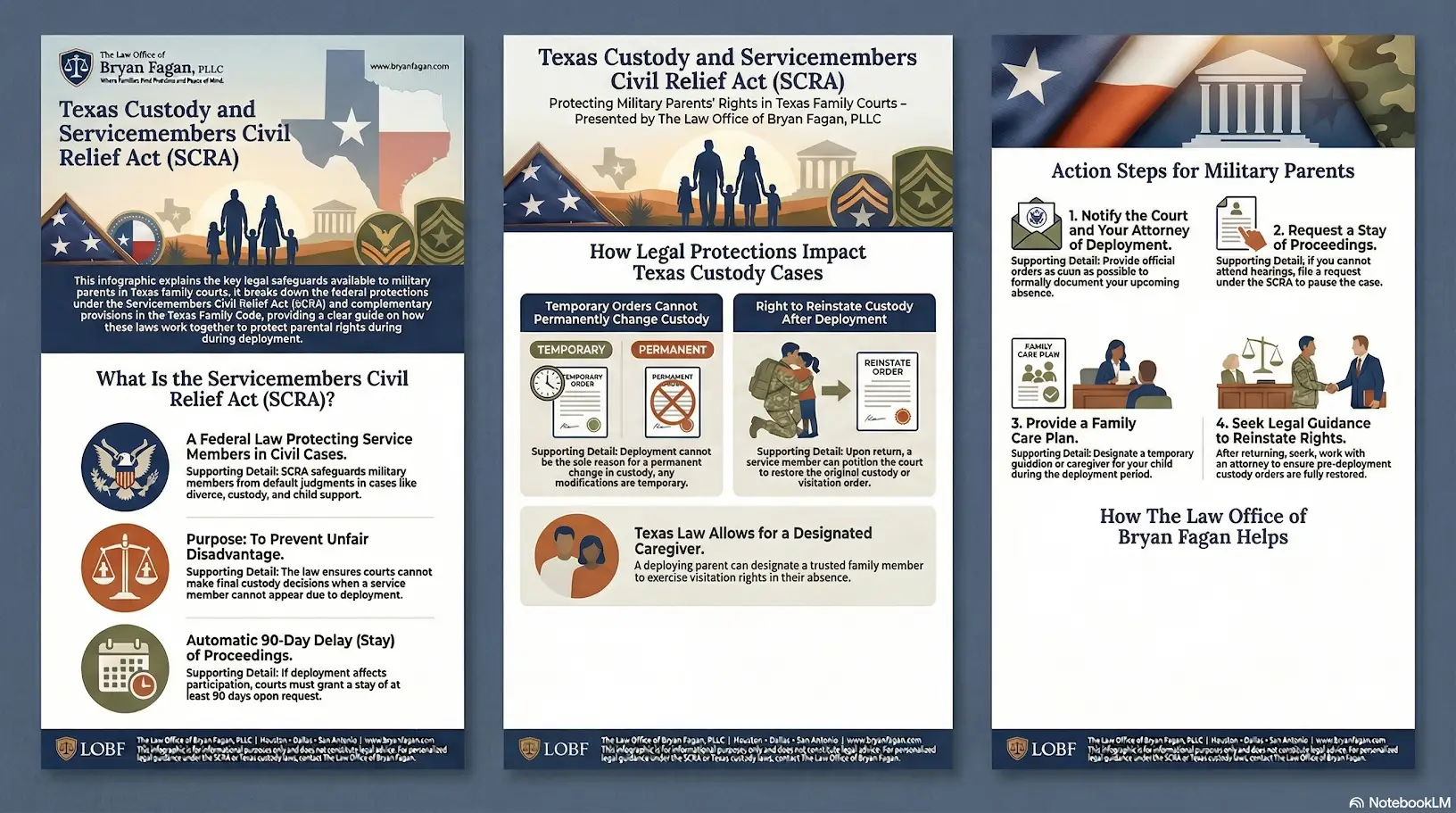
- The Servicemembers Civil Relief Act (SCRA) provides essential protections for military parents, including safeguards against custody modifications due to deployment.
- Temporary adjustments to custody orders can be made during deployment to ensure stability for children, with automatic reinstatement of original arrangements upon the service member’s return.
- Virtual visitation is a critical tool for maintaining parent-child relationships during deployment, facilitating emotional connections and effective co-parenting despite geographical separation.

Your Family’s Future Starts Here
Don’t navigate your legal journey alone. Schedule a consultation now and get the clarity and support you deserve.
Overview of the Servicemembers Civil Relief Act (SCRA)
Enacted in 2003, the Servicemembers Civil Relief Act strengthened and modernized the protections first established under the Soldiers’ and Sailors’ Civil Relief Act of 1940. For today’s military families, the Texas Custody and Servicemembers Civil Relief Act provides essential safeguards for active-duty servicemembers, reservists, and National Guard members whose duties can interrupt their ability to participate fully in civil proceedings. These protections help ensure that a parent’s military service does not unfairly jeopardize their rights or their relationship with their child.
Under the SCRA, servicemembers receive important procedural protections, including relief from default judgments and delays in civil cases when military responsibilities prevent timely participation. Texas law further reinforces these protections through updated provisions of the Texas Family Code—most notably §153.002, which prioritizes the best interests of the child, and §§153.701–153.709, which outline how courts must address deployment-related absences. Texas courts are prohibited from using deployment alone as grounds for permanently modifying custody, reinforcing the state’s commitment to fairness and family stability.
Together, these federal and state protections help safeguard parental rights, reduce stress on military families, and ensure that custody decisions are based on accurate information rather than assumptions about military service. Families can explore these rights in greater detail by visiting the firm’s dedicated SCRA page, the Servicemembers Civil Relief Act Resource. Additional insights into related military family issues are available through the Military Family Law Services page.
For military parents preparing for deployment or facing custody uncertainty, having a knowledgeable Texas family law team can make all the difference. Turning to experienced advocates who understand the Texas Custody and Servicemembers Civil Relief Act empowers families to move forward with clarity and confidence, knowing their rights—and their children’s well-being—are fully protected.
Legal Protections Under the SCRA for Military Parents
The Servicemembers Civil Relief Act offers vital federal protections for military parents, especially when custody issues arise during deployment or active-duty service. Within the framework of the Texas Custody and Servicemembers Civil Relief Act, these safeguards help ensure that a parent’s military obligations do not unfairly influence custody decisions. The SCRA allows military parents to request delays in civil proceedings, prevents default judgments when service makes court attendance impossible, and shields them from certain financial pressures that could otherwise affect their legal standing at home.
Texas law strengthens these federal protections through key updates to the Texas Family Code. Sections §153.002 and §§153.701–153.709 emphasize that custody decisions must prioritize the best interest of the child, not the deployment status of a parent. Under §153.702, Texas courts cannot use deployment alone as grounds to permanently modify custody, and §153.704 requires the reinstatement of previous custody orders when a servicemember returns—unless doing so would jeopardize the child’s safety or well-being. Together, these laws protect military parents from unjust custody modifications while recognizing the unique demands of service life.
Military families facing deployment can learn more about navigating these challenges through the firm’s resource on Challenges Facing Military Families During Deployment and additional guidance found in our Military Family Law Services section. With the right support, parents can approach deployment with greater clarity and confidence, knowing their rights—and their children’s stability—are protected under both federal law and the Texas Family Code.

Impact of Military Service on Child Custody Cases
Military service can significantly affect child custody arrangements, often complicating jurisdiction and custody matters due to frequent relocations and geographic constraints. For military divorced parents, these child custody issues necessitate specialized legal knowledge to navigate the complexities of state custody laws and family law issues, as military service materially affects custody.
Maintaining consistency in caregiving during a deployed parent’s absence is crucial for the child’s emotional well-being. Designating a trusted individual to retain custody helps maintain stability, allowing the child to remain in a familiar environment. This approach ensures that the child’s needs are met while respecting the military parent’s service commitments, especially for the non custodial parent.
Requesting Court Delays Under the SCRA
The SCRA provides a vital mechanism for service members to request court delays, ensuring their military duties do not interfere with custody arrangements. Under the SCRA, service members are entitled to an automatic stay of civil actions if they are unable to attend due to military obligations. Judges can also grant additional delay if circumstances warrant further delays.
These delays are crucial for military parents who might otherwise be unable to participate in custody proceedings. Invoking SCRA rights ensures military parents’ voices are heard in court, preventing default judgments that could unfairly alter custody arrangements. This legal protection helps safeguard the best interests of both the parent and the child.
Modifying Child Custody Orders for Deployed Parents
When a military parent is deployed, a temporary order for custody can be requested with the following conditions:
- They adjust custody arrangements without requiring proof of a substantial change in circumstances.
- These temporary orders expire once the deployed parent returns home.
- Upon expiration, the original custody arrangements are reinstated.
Texas courts prioritize the best interests of the child, which may involve:
- Granting temporary custody to the noncustodial parent during deployment.
- Temporarily adjusting child support terms to reflect changes in the deploying parent’s income.
- Temporarily adjusting visitation terms to reflect changes in the deploying parent’s availability.
Consulting an attorney skilled in military divorce helps parents create flexible custody agreements accommodating military relocation and deployment.
The Role of Virtual Visitation During Deployment
Virtual visitation plays a crucial role in maintaining parent-child relationships during deployment. Structured virtual visitation schedules, such as video calls and messages, help deployed parents preserve their emotional connection with their children. This consistent interaction is particularly beneficial for younger children, providing them with a sense of stability and continuity.
Virtual parenting options also support effective co-parenting communication, enabling both parents and the other parent to collaborate on important decisions despite the physical distance. In one notable case, a deployed parent secured a favorable custody modification by demonstrating their continued involvement through virtual communication.
These examples underscore the importance of leveraging technology to bridge the gap during deployment.
Working with a Family Law Lawyer Experienced in Military Issues
Navigating the legal landscape of military custody issues requires the expertise of a family law lawyer experienced in military matters. Military OneSource and legal assistance offices on military installations offer valuable resources for military families dealing with custody issues. These offices provide specific services to help service members navigate family law, ensuring their legal rights are protected.
Working with a lawyer who understands the unique challenges faced by military families is crucial for achieving the best outcomes in custody proceedings. These legal professionals can request SCRA protections and court delays on behalf of military parents, ensuring that their service does not unfairly impact custody arrangements.
Leveraging these resources helps military families effectively navigate custody disputes.
Client Success Stories: Protecting Military Parental Rights
Judges across Texas consistently acknowledge the dedication military parents show to their children, and this understanding often leads courts to support parenting plans that emphasize cooperation, stability, and the child’s best interests. Under the Texas Custody and Servicemembers Civil Relief Act, servicemembers benefit from protections that ensure their military duties are not used against them in custody proceedings. These principles align with the Texas Family Code—particularly §153.002, which prioritizes a child’s welfare, and the updated military-specific provisions in §§153.701–153.709 that prevent deployment from becoming an unfair barrier to maintaining parental rights.
The attorneys at The Law Office of Bryan Fagan, PLLC have repeatedly used these protections to advocate for military families facing difficult transitions. Through strategic planning, thorough documentation, and a deep understanding of both federal law and the Texas Family Code, the firm has helped parents secure meaningful parenting time, fair conservatorship arrangements, and solutions tailored to the realities of military life. These outcomes reflect how skilled legal advocacy can shape a child-focused result even when deployment or active-duty service complicates parenting schedules. Families exploring related issues may also find value in the firm’s resource on whether wives can be deployed, which offers additional insight into how military service intersects with parenting.
Success stories like these underscore the importance of working with a legal team that understands both the emotional weight and legal complexity of military custody matters. By combining compassion, clarity, and legal precision, the firm helps parents protect their rights and their children’s futures—even in the face of deployment, relocation, or rapidly changing family circumstances. For more guidance on serving your children’s needs while navigating military life, the firm’s Military Family Law Services page provides additional resources and support.

How Texas Courts Handle Deployment and Visitation
Texas courts handle deployment-related custody and visitation issues with the child’s best interests at the forefront, as required by Texas Family Code §153.002 and the updated military provisions in §§153.701–153.709. Under the Texas Custody and Servicemembers Civil Relief Act, judges may issue temporary orders during a parent’s deployment to maintain stability and ensure the child’s physical and emotional needs are met. These temporary adjustments are intentionally reversible so that, upon the servicemember’s return, the original custody arrangement is reinstated unless the court finds that doing so would endanger the child’s well-being.
Because deployment is a duty, not voluntary abandonment, Texas law makes it clear that military service alone does not qualify as a “material and substantial change in circumstances” sufficient to justify permanently modifying custody. This approach prevents unfair disruptions to parental rights while acknowledging the realities of military life. Courts strive to preserve parent–child relationships through structured communication, electronic visitation, and carefully crafted temporary schedules designed to provide consistency for the child throughout the deployment period.
These protections often become especially important during divorce or co-parenting disputes involving servicemembers. Families seeking a deeper understanding of how military and civilian divorce differ can review our article on whether military divorces work the same as civilian divorces. Additional guidance is available through the firm’s Military Family Law Services page, which offers practical tools and compassionate support. With a clear understanding of how the Texas Custody and Servicemembers Civil Relief Act operates, military parents can move forward with confidence knowing that both federal protections and the Texas Family Code work together to safeguard their rights and their children’s stability.

Preparing for Deployment: Reviewing Existing Custody Orders
Preparing for deployment is one of the most important times for military parents to revisit their custody arrangements, especially under the Texas Custody and Servicemembers Civil Relief Act. Texas Family Code §§153.701–153.709 provide clear guidance on how deployment affects conservatorship, possession, and decision-making, emphasizing that a parent’s military service should not jeopardize their relationship with their child. Before leaving, parents should review their existing orders to ensure they comply with current Texas law and consider updating them with deployment-specific provisions that clarify communication expectations, temporary caretaking arrangements, and how possession will resume once the servicemember returns.
Texas law recognizes the unique challenges deployment creates, allowing parents to seek temporary orders tailored to the child’s needs during a servicemember’s absence. Under Texas Family Code §153.702, courts may issue temporary modifications based solely on deployment without requiring the usual “material and substantial change” showing, and §153.704 ensures that prior custody arrangements are reinstated after the parent returns unless doing so would harm the child’s well-being. If both parents agree on temporary adjustments, these changes can often be made without the need for a formal hearing, promoting cooperation and minimizing disruption for the child.
Incorporating well-crafted deployment clauses into custody agreements can significantly ease transitions before, during, and after deployment. These provisions can address everything from virtual visitation schedules to temporary delegation of rights and ensure that both parents understand their responsibilities. Families who want to explore related issues—such as healthcare coverage for military children or how benefits interact with custody orders—may find additional support in the firm’s Military Health Insurance Guide and broader resources on our Military Family Law Services. With thoughtful planning and knowledgeable legal guidance, military parents can enter deployment with the reassurance that their rights—and their children’s stability—are fully protected.
Designating a Trusted Person for Temporary Custody
Designating a trusted person for temporary custody during a servicemember’s deployment is a key strategy for maintaining stability for the child. The SCRA supports visitation rights by allowing a deployed service member to delegate those rights to a designated person. This ensures that the child’s routine remains stable and their emotional needs are met during the parent’s absence.
Advance planning for temporary custody can help prevent disputes and ensure the child’s needs are consistently met during a parent’s absence. Establishing a temporary custody plan allows military parents to maintain their connection with the child through adjusted visitation rights, smoothing the transition back to parenting post-deployment.
Seeking Legal Assistance for Military Custody Issues
Seeking knowledgeable legal support is especially important for military families navigating custody, visitation, or child support concerns under the Texas Custody and Servicemembers Civil Relief Act. Because deployment, PCS orders, and active-duty demands create circumstances that civilian families often never encounter, working with a Texas family law attorney experienced in military cases ensures that your rights are fully protected. The Texas Family Code—particularly §§153.701–153.709 governing military duty and conservatorship, and §153.002 outlining the child’s best interest standard—provides important safeguards, but those protections work best when guided by an advocate who understands how federal and state law interact.
A legal team familiar with the SCRA and Texas custody law can also help military parents manage the financial aspects that often accompany custody and deployment, including child support obligations. Under the Texas Family Code Chapter 154, support orders must reflect accurate income calculations, which can be complex for servicemembers due to BAH, BAS, incentive pay, and deployment-related allowances. Families who want to learn more about how support is calculated can explore our Texas Child Support Resource, which breaks down guidelines in a clear, easy-to-understand format.
Military families deserve accessible, responsive guidance, especially when facing urgent decisions or unexpected deployment schedules. By reaching out for help early, servicemembers and their co-parents can navigate challenges more confidently, protect their parental rights, and ensure their children’s needs remain the priority. With compassionate support and strategic legal planning, families can move forward knowing they are backed by experienced advocates committed to securing the best possible outcome for their children and their future.
Conclusion:
When you’re living through custody challenges—especially those shaped by military service, deployment, or unexpected life transitions—it’s easy to feel like you’re being pulled in two directions at once. But the heart of all of this is simple: you want stability for your child, clarity for your future, and the peace of knowing that the law is there to protect your family, not complicate it. The good news is that when you understand your rights and how Texas law and the Servicemembers Civil Relief Act work together, the path forward becomes far less overwhelming.
If reading this sparked a few “I really need to look into that” moments, you’re not alone. Most parents—military or civilian—don’t realize how many tools, protections, and proactive steps are available until someone explains them in a way that actually makes sense. That’s exactly why our team at The Law Office of Bryan Fagan, PLLC does what we do. We’re here to guide, steady, and support Texas families through some of life’s toughest seasons with the compassion and clarity you deserve.
And if you’re still thinking through what this means for your own situation, that’s completely okay. Some decisions take time. Some just need the right conversation. So whenever you’re ready, know that you can sit down with a Texas family law attorney who understands military life, understands the law, and most importantly—understands the human side of what you’re going through.
Your next step doesn’t have to be dramatic. It can simply be reaching out, asking a question, or getting the reassurance you’ve been needing. Whatever comes next, you don’t have to navigate it alone.
Frequently Asked Questions About Military Service, the SCRA, and Child Custody in Texas
The Servicemembers Civil Relief Act (SCRA) is a federal law that protects active-duty military parents from being unfairly disadvantaged in civil court proceedings, including child custody cases. It doesn’t decide custody outcomes—that’s handled under the Texas Family Code—but it does ensure deployed or active-duty parents have enough time to participate in hearings and are not penalized for missing deadlines due to military service. Think of it as a shield that prevents your service from being used against you during litigation.
Yes. Child custody disputes fall under civil law, not criminal law. In Texas, custody (legally called “conservatorship”) is handled in family court as part of a divorce or a Suit Affecting the Parent–Child Relationship (SAPCR). Because custody is a civil matter, the SCRA’s protections can apply when a military parent needs additional time or scheduling accommodations due to deployment or training.
No—joining the military does not automatically put your custody rights at risk. Texas law prohibits courts from making permanent custody decisions solely based on a parent’s military deployment or service. Judges focus on the child’s best interest, not assumptions about military life. However, because service can involve relocation or extended absences, it’s wise to work with an experienced family law attorney to create a plan that safeguards your relationship with your child.
One of the most damaging mistakes is letting conflict overshadow the child’s needs. Courts pay close attention to whether parents can communicate respectfully, follow orders, and support the child’s relationship with the other parent. Behaviors like withholding visitation, making hostile comments, or involving the child in adult disputes can seriously hurt your case. Staying child-focused and level-headed is one of the biggest advantages you can give yourself.
Anything that signals poor judgment, instability, or unwillingness to co-parent tends to raise concerns. This can include violating court orders, inconsistent parenting time, substance abuse, exposing the child to unsafe people, or openly undermining the other parent. Judges want to see reliable, responsible parenting and a commitment to the child’s emotional well-being.
SCRA protections primarily apply to the servicemember, not directly to their dependents. However, the benefits indirectly help children and spouses by ensuring the military parent can meaningfully participate in court proceedings. For example, if a hearing is postponed due to deployment, the child’s custody order isn’t unfairly altered in their absence. It’s the military parent who asserts these protections, but the family feels the impact.
There isn’t a default winner in Texas custody cases. Modern Texas courts recognize the importance of both parents in a child’s life. Many cases result in joint conservatorship, meaning both parents share rights and responsibilities—even if the child primarily lives with one parent. The outcome depends on each parent’s involvement, stability, and ability to meet the child’s needs. Having a strong legal advocate helps ensure your voice is fully heard.
Parents have powerful civil rights, including the right to seek custody or visitation, the right to be heard before any restriction of those rights, and the right to due process in court. Texas recognizes that, when safe and appropriate, children benefit from having both parents actively involved in their lives. If you’re a servicemember, the SCRA adds an extra layer of protection to ensure your military obligations don’t prevent you from exercising these rights.