
Divorce can be one of life’s most difficult transitions—but understanding your rights under Texas law can make it less overwhelming. When you own a business, getting divorced isn’t just about dividing up the house and the bank accounts. It involves the complex, often contentious process of figuring out exactly what that business is worth so it can be divided fairly. This is a critical step that untangles your shared life from your livelihood, ensuring the value built during the marriage is properly distributed. It’s frequently one of the most difficult hurdles in a high-asset divorce.
Why Business Valuation in a Texas Divorce is So Challenging
Facing a divorce is overwhelming enough. Throw a business into the mix, and the financial stakes—and the stress—can skyrocket. We’re not just talking about number-crunching here; we’re talking about securing a fair future for you and your family. In Texas, a community property state, the law starts with the assumption that any assets acquired or value gained during the marriage belongs to both spouses.
This core principle, laid out in the Texas Family Code § 3.002, means the business’s growth throughout your marriage is considered part of the marital estate. As such, it’s subject to a “just and right” division by the court.
The Intersection of Business and Personal Finances
For many entrepreneurs, the line between business and personal finances is blurry at best. A business is so much more than an asset on a balance sheet—it often represents years of shared sacrifice, late nights, and big dreams. That deep emotional investment can make looking at it objectively incredibly difficult.
The valuation process requires a deep dive into complex financial records, where personal expenses might be co-mingled with business costs and vice versa. Untangling this financial web is complicated, and it’s made even more so by the general challenges of finance and divorce, especially when significant assets are involved.
Getting this right is crucial for a few key reasons:
- Ensuring Fairness: A precise valuation is the only way to prevent one spouse from being shortchanged or unfairly burdened.
- Informing Negotiations: It provides a solid, data-backed foundation for settlement talks, which can dramatically reduce conflict.
- Court Compliance: If your case goes to trial, judges rely on defensible expert analysis to make their decisions. A sloppy valuation won’t hold up.
The goal is to determine the business’s intrinsic value—what a willing buyer would realistically pay a willing seller in today’s market. This number becomes a cornerstone of your property division strategy, influencing everything from who keeps the business to potential buyouts and other settlement options.
Navigating this path demands more than just legal skill; it requires a clear grasp of the financial principles at play. This guide is designed to arm you with that knowledge, helping you protect your interests and work toward a just outcome with confidence.
How Experts Determine a Business’s Value
When a business is part of a Texas divorce, it’s often one of the most significant—and complicated—assets on the table. Figuring out its true value isn’t just a matter of looking at a bank statement. It’s a deep dive into the company’s health, its potential, and its place in the market.
Getting this number right is absolutely critical. An overvaluation could leave the business-owning spouse paying an unfair share, while an undervaluation could shortchange the other spouse, jeopardizing their financial future. This isn’t just about numbers on a spreadsheet; it’s about ensuring a fair and equitable division of what you’ve both built.
The Three Lenses of Business Valuation
When an expert steps in to value a business, they don’t just pull a number out of thin air. They typically look at the company through three different lenses, or what we call “approaches.” Each one tells a different story about the business’s worth, and often, the final valuation is a blend of all three.
1. The Asset-Based Approach: What’s It Worth on Paper?
Think of this as the most straightforward method. At its core, the asset-based approach calculates the business’s value by subtracting its total liabilities from the fair market value of its assets. It’s a balance sheet calculation: Assets – Liabilities = Value.
This approach works well for businesses that are heavy on tangible assets, like real estate holding companies or manufacturing firms with a lot of expensive equipment. However, it often falls short for service-based businesses—think consulting firms or medical practices—where the real value isn’t in desks and computers, but in reputation, client lists, and earning potential.
2. The Market Approach: What Are Similar Businesses Selling For?
The market approach is a lot like valuing a house. You look at what similar homes in the neighborhood have recently sold for to get a sense of what your own property is worth. In the business world, a valuation expert will look for “comps”—comparable businesses that have recently been sold.
This method is most reliable when there’s a healthy market of similar businesses being bought and sold, providing plenty of good data. For a common business like a local restaurant or a small retail shop, this can be a great way to ground the valuation in real-world numbers. But for a highly specialized or unique business, finding good comps can be next to impossible, making this approach less useful. We often see this method used to value professional practices, such as in our guide to Valuing a Medical Practice During a Texas Divorce.
3. The Income Approach: What’s Its Earning Power?
For many businesses, especially profitable service-based ones, the income approach is king. This method focuses on the future, not the past. It asks: “How much income is this business expected to generate in the years to come?”
Experts use techniques like the Capitalization of Earnings Method or the Discounted Cash Flow (DCF) Method. Don’t let the jargon intimidate you. They are essentially sophisticated ways of forecasting future profits and then calculating what that future income stream is worth in today’s dollars. This approach is powerful because it captures the intangible value of the business—its goodwill, brand reputation, and loyal customer base—that the other methods might miss.
To help clarify how these methods differ, let’s break them down side-by-side.
Comparing Business Valuation Methods
Each valuation approach offers a unique perspective on a business’s worth. Here’s a quick summary of the three main methods, what they focus on, and when they are typically the go-to choice in a Texas divorce.
| Valuation Method | What It Measures | Best Used For |
|---|---|---|
| Asset-Based Approach | The net value of the company’s tangible and intangible assets minus its liabilities. | Businesses with significant physical assets, like real estate firms, manufacturing companies, or asset-heavy holding companies. |
| Market Approach | The value of the business based on the selling price of comparable businesses in the same industry. | Common business types where there is a lot of sales data available, such as restaurants, retail stores, or franchises. |
| Income Approach | The business’s ability to generate future income, calculated in today’s dollars. | Profitable, service-based businesses where value is tied to cash flow and goodwill, like professional practices, consulting firms, or tech companies. |
Ultimately, there’s no single “right” way to value a business. A skilled valuation expert will rarely rely on just one method. Instead, they’ll likely use a combination of these approaches, weighing each one based on the specific type of business and the available data to arrive at a well-reasoned, defensible conclusion about its true value.
The Critical Role of a Business Valuation Expert

When a business is a key asset in your divorce, simply taking its “book value” or your spouse’s word for what it’s worth is a massive financial gamble. The truth is, the numbers on a tax return or a basic profit-and-loss statement almost never tell the whole story.
This is precisely why a neutral, credentialed business valuation expert or forensic accountant is one of the most vital members of your divorce team. Think of them as financial detectives. Their entire job is to dig much deeper than the surface-level figures to uncover the business’s true, defensible value.
They’ll meticulously pour over financial statements, tax returns, bank records, and other crucial documents to piece together an accurate, complete picture of the company’s financial health. An expert’s analysis provides the objective, evidence-based foundation you need for fair negotiations—or for a judge to make a sound decision. Without one, you’re flying blind through one of the most complex financial parts of your divorce.
Going Beyond the Balance Sheet
One of the first things a valuation expert does is what’s called “normalizing” income. It’s incredibly common for small business owners to run personal expenses through the company. While this might be standard practice for them, it can artificially tank the business’s stated profits.
A forensic accountant is trained to spot these personal expenses and add them back to the business’s income, ensuring the valuation reflects the true earning power of the company.
Some common “add-backs” they look for include:
- Personal Vehicle Payments: A car lease or loan for a family SUV paid for by the business.
- Family Salaries: Payments made to a child or relative who does little to no actual work for the company.
- Personal Travel and Meals: Family vacations or dinners disguised as “business trips” or “client meetings.”
- Home Office Expenses: Writing off a chunk of the mortgage or household utilities that is completely out of proportion to actual business use.
By adjusting for these items, the expert calculates a far more accurate profit margin, which is the bedrock of any income-based valuation.
Finding the Right Expert for Your Case
Not just any accountant is cut out for valuing a business in a divorce. The court gives serious weight to the opinions of professionals who hold specific, recognized credentials in this field. When you and your attorney are looking for an expert, you need to find someone with designations like:
- CVA (Certified Valuation Analyst)
- ABV (Accredited in Business Valuation)
- ASA (Accredited Senior Appraiser)
These certifications aren’t just letters after a name; they prove the professional has specialized training and real-world experience in the complex methods required to value a business, especially within the often-contentious setting of a divorce. Hiring a properly credentialed expert means their report and testimony will be credible and hold up under scrutiny in court.
A business valuation is only as reliable as the expert conducting it. Hiring a qualified professional is not just an expense—it’s an investment in securing a fair and just division of your marital estate.
Beyond the traditional methods, new innovations are also helping professionals in this detailed work. For instance, a sophisticated AI tool for business valuation reports can assist experts in processing huge amounts of financial data efficiently to generate comprehensive analyses.
Ultimately, the right expert brings clarity and authority to the table. They transform a confusing and emotional issue into a clear, data-driven number that everyone can use to work toward a fair resolution.
When a business is one of the most significant assets in your marital estate, it’s almost guaranteed that disagreements will pop up. The process of figuring out what a business is worth during a divorce is rarely a straight line, and you should expect some conflict along the way.
But these aren’t just minor squabbles. The outcome of these disputes can swing the final valuation dramatically, which in turn affects your financial future for years. Knowing where the landmines are is the first step in protecting yourself.
The Valuation Date Dilemma
One of the most common fights is over the valuation date. Think of it like this: should the business be valued based on a snapshot taken the day you separated, or one taken closer to your final trial date, which could be months or even years down the road?
Texas law doesn’t give a single, black-and-white answer; the right date really depends on the unique facts of your case.
- Arguing for the Date of Separation: If the spouse running the business put in a ton of work after you separated and the company grew because of it, they’ll likely argue for an earlier valuation date. Their goal is to claim that post-separation growth as their own separate property.
- Arguing for the Date of Trial: On the flip side, what if the business took a nosedive after separation due to a bad market or simple mismanagement? The other spouse will probably push for a later valuation date to reflect its current, lower value.
An experienced family law attorney will know how to build a case for the valuation date that most accurately captures the business’s value as a community asset and protects your financial interests.
The Goodwill Argument: Personal vs. Enterprise
Goodwill is that invisible value a business has—its good name, loyal customers, and brand recognition. In a Texas divorce, the courts draw a very sharp line between two types of goodwill:
- Personal Goodwill: This is the value that’s tied directly to one person’s unique skills, reputation, or personal relationships. Think of a famous surgeon or a highly sought-after graphic designer whose clients follow them anywhere. This kind of goodwill is usually considered separate property and is not divisible.
- Enterprise Goodwill: This value belongs to the business itself, separate from any single individual. It’s the reason customers keep coming back even if the founder retires. Enterprise goodwill is a community asset that can be divided.
Disputes erupt when one spouse tries to claim that most of the business’s value is wrapped up in their personal goodwill, trying to keep that value out of the marital pot. A forensic accountant is essential here; they can dig into the business operations to figure out how much of that goodwill is truly personal and how much belongs to the company.
Uncovering Devaluation Tactics
It’s an unfortunate reality, but sometimes the spouse who controls the business might try to make it look less valuable on paper during the divorce. Their hope is that a lower valuation means a smaller buyout or settlement payment.
A classic move is to deliberately delay signing a big new client contract or to prepay a bunch of large, non-essential expenses right before the valuation date. This makes the company’s short-term profits look way worse than they actually are, painting a false financial picture.
Good attorneys and forensic accountants are trained to sniff out these kinds of games. By demanding and poring over years’ worth of financial records, they can spot strange spending or delayed income. This allows them to present the court with an adjusted, more accurate picture of the company’s real value. This is critical because Texas courts want a fair valuation that protects the non-owner spouse. You can also see how a buy-sell agreement can impact a business valuation in our detailed article on the topic.
Tracing Separate vs. Community Property Within a Business
In Texas family law, few principles are more fundamental than the distinction between separate and community property. Getting this right is absolutely essential when valuing a business in a divorce, especially if the business was up and running before the marriage began.
The Texas Family Code § 3.001 lays it out clearly: separate property is anything a spouse owned before marriage, or received during the marriage as a gift or inheritance. So, on paper, that business you started before you said “I do” should remain yours. But in the real world, it’s almost never that simple.
When Separate and Community Funds Intertwine
Even if a business starts as one spouse’s separate property, it rarely stays completely walled off over the years of a marriage. The marital estate—what we call the “community”—almost always invests time, effort, and money into that business. These contributions give the community a legitimate financial claim to a piece of the business’s value.
This is where a legal concept called reimbursement comes into play. If community funds, like cash from a joint savings account, were used to grow the separate property business, the community estate has a right to be paid back for those contributions.
This happens all the time. Common scenarios include:
- Using marital savings to buy new equipment or fund an expansion.
- The non-owner spouse working for the business without getting paid a fair market salary.
- Using community funds to pay down a business loan that existed before the marriage.
This concept map shows how disputes over the valuation date, the type of goodwill, and even deliberate devaluation tactics are all tangled together.
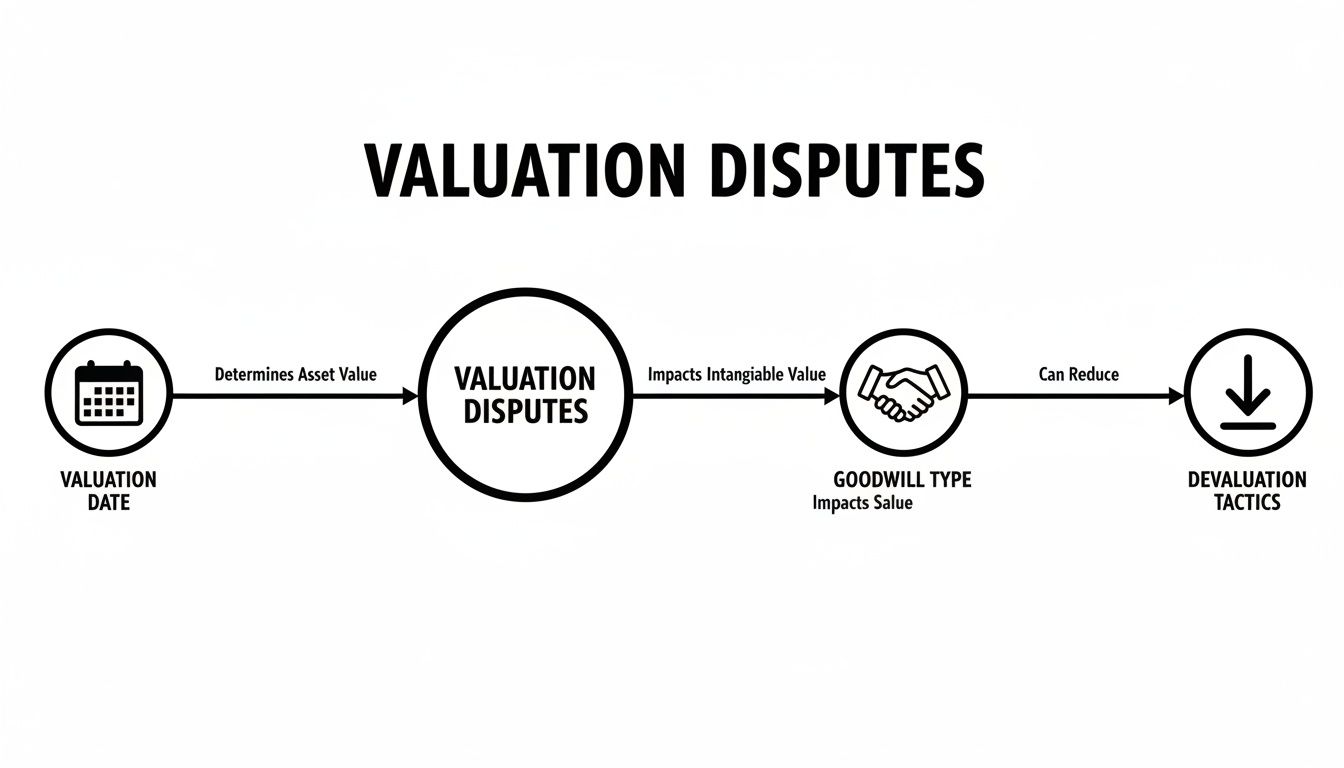
As the visual makes clear, you can’t look at these issues in isolation. They are all interconnected pieces of the puzzle that have to be analyzed together to get to a fair and accurate business valuation.
The Power of Tracing in Divorce
So, how do you sort out this financial tangle? Through a process called tracing. Your legal team will bring in a forensic accountant to conduct a detailed investigation that follows the money, document by document, to prove what’s separate and what’s community.
This is painstaking work that demands a crystal-clear paper trail. The experts will dig through years of bank statements, loan documents, and business records to pinpoint exactly when and how community money was funneled into the separate property business.
For example, let’s say you inherited a small bakery from your parents (that’s your separate property). During your marriage, you and your spouse used $50,000 from your joint checking account to buy a new industrial oven. Through tracing, an expert can prove that this community investment directly led to the bakery’s increased profits and value. The community would then have a reimbursement claim for that $50,000 and potentially a share of the growth it helped create.
Proving Your Claim Requires Evidence
Here’s the catch: Texas law presumes that any property acquired during a marriage belongs to the community. The burden of proof falls squarely on the person claiming an asset is separate. To succeed, you have to provide “clear and convincing evidence” to overcome that presumption.
This high legal standard makes meticulous record-keeping absolutely critical. Without the bank statements, deeds, or other financial documents to prove the business was separate to begin with and to trace its path, a court is very likely to treat the entire business—or at least a huge chunk of its value—as part of the marital estate up for division.
This tracing process is one of the most technical and high-stakes parts of valuing a business for divorce. It’s not something you should ever try to handle on your own. A skilled family law attorney and a sharp forensic accountant are your essential allies in protecting your separate property rights while ensuring the community is fairly compensated for its contributions.
Practical Options for Dividing the Business Asset

After the painstaking work of valuing a business, you’ve reached the final, critical step: figuring out how to actually divide it. This is where the numbers on a valuation report become real-world decisions that will shape your financial future for years to come. Moving from the theoretical value to a practical solution requires careful thought and strategic negotiation.
The goal is to untangle your financial lives fairly and sustainably. Fortunately, Texas law gives us a lot of flexibility to get creative in a settlement. The most common paths involve one spouse keeping the business while the other receives assets of equal value to their share.
Common Division Strategies
Once you have a solid valuation number in hand, there are several practical ways to handle the business in your divorce decree. The right choice really depends on your specific financial picture, the liquidity of the business, and what you both want your post-divorce lives to look like.
Here are the most common solutions we help clients work through:
- Asset Offset Buyout: This is often the cleanest and simplest option. The spouse who keeps the business “buys out” the other’s share by trading other marital assets. For example, if your spouse’s community property share of the business is valued at $250,000, you might offer them the family home or a slice of a retirement account worth the same amount.
- Structured Payout: What if there aren’t enough other assets for a clean trade? A structured payout can be a great alternative. The business-owning spouse makes a series of payments over a set period. This requires a promissory note and careful legal drafting to make sure the payments are secure.
- Selling the Business: In some situations, neither spouse can afford a buyout, or maybe you both just want a clean break. Selling the business to a third party and splitting the cash proceeds is the most straightforward, though often emotionally tough, solution.
Every business division carries unique tax consequences. A buyout might trigger capital gains taxes, while a structured payout could have different implications. It is essential to consult with your attorney and a financial advisor to understand how each option will impact your bottom line.
Dividing a business is one of the biggest financial transactions you will ever be a part of. With a business often being the largest part of the marital estate in high-net-worth cases, Texas community property law makes this process incredibly important, requiring careful work to ensure a just and right outcome.
Making the right call requires a clear-eyed view of your complete financial picture and a focus on the future. Our guide for the business owner navigating a divorce offers more insight into this complex journey. We’re here to help you weigh the pros and cons of each option, empowering you to negotiate a settlement that secures your financial stability for years to come.
Frequently Asked Questions About Business Valuation in Divorce
When you’re facing a divorce that involves a business, the questions can feel endless. It’s completely normal to feel overwhelmed. Here, we’ve gathered some of the most common, practical questions we hear from clients to give you the clear, direct answers you need to feel more grounded as you move forward.
How Much Does a Business Valuation Cost and How Long Does It Take?
This is one of the first questions everyone asks, and the honest answer is: it depends. The price tag and timeline for a professional valuation hinge on the business’s size, complexity, and how clean the financial records are. For a small, straightforward local shop, you might be looking at a few thousand dollars.
But for a larger company with multiple locations, tangled revenue streams, or sloppy bookkeeping, the cost can easily jump into the tens of thousands. The process itself isn’t quick, either. A thorough expert needs time to dig through years of financial documents, so expect it to take anywhere from several weeks to a few months.
What If My Spouse Will Not Provide Financial Documents?
It’s a frustratingly common scenario: your spouse stonewalls, refusing to hand over the financial records needed for the valuation. Don’t panic. Your attorney has powerful legal tools to deal with this.
We can file a motion to compel with the court. This is a formal request asking a judge to order your spouse to produce the documents. If they still refuse, they can face serious legal penalties. We also have the power to issue subpoenas to get the records directly from third parties like the company’s bank, its CPA, or even major suppliers.
Under Texas law, both spouses have a legal duty to exchange all relevant financial information in a divorce. Refusing to cooperate isn’t a strategy; it’s a legal problem the court will step in to solve and ensure a fair process.
Can We Just Use Our Regular CPA for the Valuation?
While it might seem like a smart way to save some money, using your regular family or business CPA for a divorce valuation is strongly advised against. Think about it from the court’s perspective: a CPA with a prior relationship with one or both of you isn’t truly a neutral party. Their opinion can be easily challenged as biased.
What you need is a neutral, third-party expert who specializes in this exact field. Look for professionals with specific credentials like a Certified Valuation Analyst (CVA) or someone who is Accredited in Business Valuation (ABV). These experts are trained to perform valuations that can withstand the intense scrutiny of a courtroom battle, and their testimony carries far more weight during negotiations and at trial.
If you need help navigating divorce, custody, or estate planning in Texas, contact The Law Office of Bryan Fagan today for a free consultation.