
Becoming a central figure in your stepchild’s life is a profound experience. You’re there for the scraped knees, the homework struggles, and the bedtime stories. In every way that matters, you are a parent. However, navigating the legal landscape can be overwhelming when you realize that in the eyes of Texas law, your role isn’t automatically recognized.
This can be a tough reality for so many dedicated stepfathers. The powerful bond you’ve built and the day-to-day care you provide don’t automatically grant you the legal authority to make critical decisions. But understanding your rights and options under Texas law can empower you to protect your family and solidify your role.
The Reality for Stepfathers in Texas Family Law
It can be an unsettling feeling to invest your heart, time, and resources into raising your stepchild, only to find that the Texas Family Code doesn’t view that emotional commitment as legal authority. This creates a disconnect between your role in the family and your actual legal standing. Without a court order, the law essentially views you as a “legal stranger” to the child.
This means you cannot:
- Consent to medical or dental treatment, even in an emergency.
- Make decisions about their schooling or enroll them in a new school.
- Access their official records, like report cards or medical files.
This can put you in an incredibly difficult position, especially when you’re the one at the doctor’s office or sitting in on a parent-teacher conference. To give you a clearer picture, here’s a breakdown of what your legal standing looks like without any formal court intervention.
A Stepfather’s Legal Standing Without a Court Order
| Area of Responsibility | Legal Authority Without Court Order | How to Gain Legal Authority |
|---|---|---|
| Medical Decisions | None. Cannot consent to medical, dental, or psychological care. | Medical Power of Attorney (limited), Stepparent Adoption, or Conservatorship Order. |
| Educational Decisions | None. Cannot enroll in school, access records, or make educational choices. | Authorization Agreement for Nonparent Adult, Stepparent Adoption, or Conservatorship Order. |
| Financial Support | No legal obligation. Your financial support is voluntary. | Stepparent Adoption creates a legal duty of support. |
| Inheritance | None. The child does not automatically inherit from you. | Must be specifically named in a will or estate plan. |
| Custody/Possession | None. No legal right to custody or visitation if you and the child’s mother separate. | Stepparent Adoption or Conservatorship Order. |
This table highlights the gap between being a parental figure and having the legal rights to back it up.
The Legal Disconnect in Modern Families
Stepfamilies are a beautiful and common part of our society, but the law is often slow to catch up. A staggering 15% of men in the U.S. are stepdads, yet the legal system generally treats them as strangers to their stepchildren, denying automatic rights to custody or medical decision-making without court action.
This is a gap Texas families need to be aware of, as most stepfamilies involve a biological mother and a stepfather who must take proactive legal steps to secure their role. You can learn more about these family dynamics and the statistics that shape them.
The good news is you are not stuck. Texas law offers clear pathways to formalize your relationship and get the legal rights you need to protect your stepchild.
Your Path Forward to Securing Parental Rights
You have two primary legal solutions to consider: stepparent adoption and obtaining a conservatorship order.
Adoption is the most complete and permanent option. It legally makes you the child’s parent, giving you all the same rights and responsibilities as a biological parent. However, this is a major legal move that requires terminating the other biological parent’s rights.
A different route is seeking conservatorship through what’s called a Suit Affecting the Parent-Child Relationship (SAPCR). This allows a court to grant you specific rights—like making certain decisions or having possession of the child—without completely terminating the other parent’s rights.
Understanding these options is the first step toward securing your role. Whether through adoption or conservatorship, taking legal action provides the stability and security that both you and your stepchild deserve, ensuring you can be there for them in every capacity.
We know this can all feel complicated, but it’s a journey worth taking. By understanding where you stand legally and exploring the available solutions, you can bridge the gap between being a loving stepfather and having the legal authority of a recognized guardian. This guide will walk you through it.
What It Means to Be a Legal Parent in Texas

To understand why a stepfather’s role is so different in the eyes of the law, we first need to explain what it actually means to be a “legal parent” in Texas. It’s a common and understandable mistake to think that marrying a child’s mother automatically makes you a legal parent, too. The legal reality, however, is much more specific.
Under the Texas Family Code, a legal parent has a powerful set of rights and duties called conservatorship. This isn’t just a title; it’s the legal authority to make fundamental decisions that shape a child’s entire life. A legal parent, or conservator, can make critical calls that a stepparent simply cannot. This legal distinction isn’t meant to downplay the incredible bond you have with your stepchild; it just highlights that the law is built to protect the rights of biological parents until a court officially says otherwise.
The Bundle of Rights Known as Conservatorship
Think of conservatorship like a bundle of sticks. Each stick represents a specific right or responsibility for a child. In Texas, this bundle is automatically given to biological or adoptive parents, and it’s the core of what it means to have parental authority.
A legal parent, or conservator, typically has the right to:
- Decide where the child lives. This is the power to designate the child’s primary residence.
- Consent to medical and dental care. This covers everything from routine check-ups and braces to emergency surgery and therapy.
- Make decisions about their education. This includes enrolling them in school, agreeing to special programs, and handling disciplinary issues.
- Access the child’s records. This means you can review their medical, dental, and school files.
Without a court order, a stepfather holds none of these “sticks.” You can be the most dedicated, loving, and involved father figure in a child’s life, but you still lack the legal standing to act for them in these crucial areas.
Consider this common scenario: your stepchild takes a bad fall at the park, and you rush them to the ER. The hospital staff asks for your consent to start treatment, but legally, you cannot give it. They must try to track down a biological parent, potentially delaying critical care. This is where the gap between your role and your rights becomes painfully clear.
The Legal Standing of a Stepfather
Legally speaking, stepparents start with zero inherent authority. You cannot make binding decisions on schooling or healthcare, no matter how involved you are. This is a critical point, especially when you consider that census data shows 18.2 million children live in homes without their biological father, highlighting the vital role loving stepdads often fill.
Despite this deep involvement, a stepfather’s legal status is essentially that of a stranger until a court takes formal action. You can learn more about these family dynamics in national studies. This lack of legal authority is precisely why being proactive is so important for blended families. Waiting for a crisis to expose these limitations can be heartbreaking for everyone, especially the child.
Why Marriage Does Not Grant Parental Rights
So, why doesn’t marrying the child’s mother automatically change anything? It’s because Texas law is built on the biological or adoptive parent-child relationship. Your marriage to your spouse is a legally separate relationship from their parent-child relationship.
The law is designed to prioritize the rights of the existing legal parents. Unless and until those rights are formally changed—either terminated, shared, or modified through a court process—they stay exclusively with the biological parents. Gaining these rights isn’t something that just happens when you say “I do.” It requires a deliberate legal process, like an adoption or a conservatorship order, to formally give you the authority you need to fully protect and provide for your stepchild.
Securing Permanent Rights Through Stepparent Adoption
For many stepdads, the goal isn’t just about having temporary authority. It’s about building a permanent, legally recognized family. If you’re looking for the strongest, most lasting legal bond you can have with your stepchild, stepparent adoption is the definitive path. This legal process goes beyond just giving you rights; it completely transforms your relationship, putting you on the exact same legal footing as a biological parent.
Adoption is a huge step, both emotionally and legally. It gives you every single right and responsibility that comes with being a parent, from making medical and school decisions to the legal duty of financial support. It also means your stepchild has the right to inherit from you, just like a biological child. This is the ultimate level of security and permanence for your family. But getting there involves a formal legal journey with some very specific, non-negotiable steps. Understanding this path is the first move toward making your role as a parent official in the eyes of the law.
The First and Most Critical Step: Termination of Parental Rights
Before an adoption can proceed, the legal rights of the other biological parent (usually the biological father) must be terminated. This is often the biggest hurdle in the entire process, and it’s a step the courts take incredibly seriously. The law is built to protect the parent-child relationship, so ending that bond is a major legal event.
This can happen in one of two ways:
- Voluntary Relinquishment: In the best-case scenario, the other biological parent agrees that the adoption is what’s best for the child. They can sign a legal document called an Affidavit of Relinquishment of Parental Rights, voluntarily giving up their legal connection to the child. This is often the path taken when the other parent has been out of the picture for a long time or agrees that you’re the right person to step into that parental role.
- Involuntary Termination: When the other parent refuses to consent, you must ask the court to terminate their rights against their will. This is a much higher legal mountain to climb. Under the Texas Family Code § 161.001, a court can involuntarily terminate a parent’s rights if there’s clear and convincing evidence of specific grounds, like endangerment, abandonment, or failing to support the child for a certain period. On top of that, the court must also find that termination is in the best interest of the child.
This step is frequently the most emotionally charged and legally tricky part of the journey. Having an experienced family law attorney in your corner is absolutely essential to navigate it successfully.
The Formal Adoption Process Step by Step
Once the other parent’s rights are officially terminated, you can finally move forward with the formal adoption petition. While every family’s situation is unique, the process generally follows a clear set of legal steps.
Here’s a practical, step-by-step guide to what you can expect:
- Filing the Petition for Adoption: You and your spouse will file a formal lawsuit with the court, known as a Petition for Adoption. This document officially declares your intent to adopt the child and lays out why it’s in the child’s best interest.
- The Social Study and Home Visit: Texas law requires a social study to be done by a qualified professional. This includes interviews with you, your spouse, and the child (if they’re old enough), along with a home visit. The purpose is to ensure you can provide a safe, stable, and loving home.
- The Final Adoption Hearing: After the social study is done and all the legal boxes are checked, the court will schedule a final hearing. This is usually a happy, celebratory moment where the judge reviews everything, asks a few questions, and signs the final Decree of Adoption.
This final decree legally forges the parent-child relationship between you and your child. It’s a powerful, life-changing document that solidifies your family and gives you the peace of mind that your bond is legally protected forever.
The road to adoption can feel long, but it ends with a legally secure family. For a deeper dive into the details, you can learn more from the common questions we answer in our guide on Texas adoption FAQs. Ultimately, adoption provides the definitive answer to the question, “do stepfathers have parental rights?” by making you a parent in every sense of the word.
Gaining Rights Without Adoption Using Conservatorship
Stepparent adoption is a wonderful, permanent solution, but it isn’t the right fit for every family. Sometimes the other biological parent is still involved, or perhaps the legal hurdles to terminate their parental rights are simply too high to clear.
If you find yourself in that situation, please know that you are not out of options. There’s another powerful legal path in Texas that allows you to secure significant, court-ordered rights without the finality of adoption. It’s called seeking conservatorship. This legal process allows a Texas court to formally recognize the crucial role you play in your stepchild’s life and grant you specific rights and responsibilities. It’s a way to protect the bond you’ve built and ensure you can legally be there for your stepchild, especially when it matters most.
The Key to the Courthouse Door: Standing
Before you can ask a judge for anything, you must prove you have the right to be in court in the first place. In the legal world, this is called having standing. You can’t just walk into a courthouse and file a lawsuit about someone else’s child; you have to show the court you have a significant, established connection that justifies your involvement.
For dedicated stepfathers, the Texas Family Code provides a clear path.
Under Texas Family Code § 102.003(a)(11), a person has standing to file for conservatorship if they have had “actual care, control, and possession of the child for at least six months.”
This provision opens the door for so many stepdads. If your stepchild has been living under your roof with you and your spouse, and you’ve been a hands-on parent in their daily life for six months or more, you almost certainly meet this requirement. This gives you the legal key to file a case and formally ask a judge to grant you rights. If you’re curious about how this works for other relatives, we’ve covered that in our article about aunts and uncles seeking custody in Texas.
Filing a Suit Affecting the Parent-Child Relationship (SAPCR)
Once you’ve established standing, the next step is to file a Suit Affecting the Parent-Child Relationship, which is commonly called a SAPCR (pronounced “sap-sir”). This is the formal lawsuit you file to ask the court to name you a conservator of your stepchild.
In this suit, you are not trying to terminate the other parent’s rights. That’s a huge difference from adoption. Instead, you’re asking the judge to add you to the legal framework of the child’s life, giving you a defined set of rights alongside the biological parents. The court’s one and only guiding star throughout this entire process will be the best interest of the child. You and your attorney will need to build a case showing that granting you conservatorship rights would provide the child with stability, emotional support, and overall well-being.
This flowchart helps visualize the decision-making process when considering adoption, which always hinges on the other biological parent’s rights.
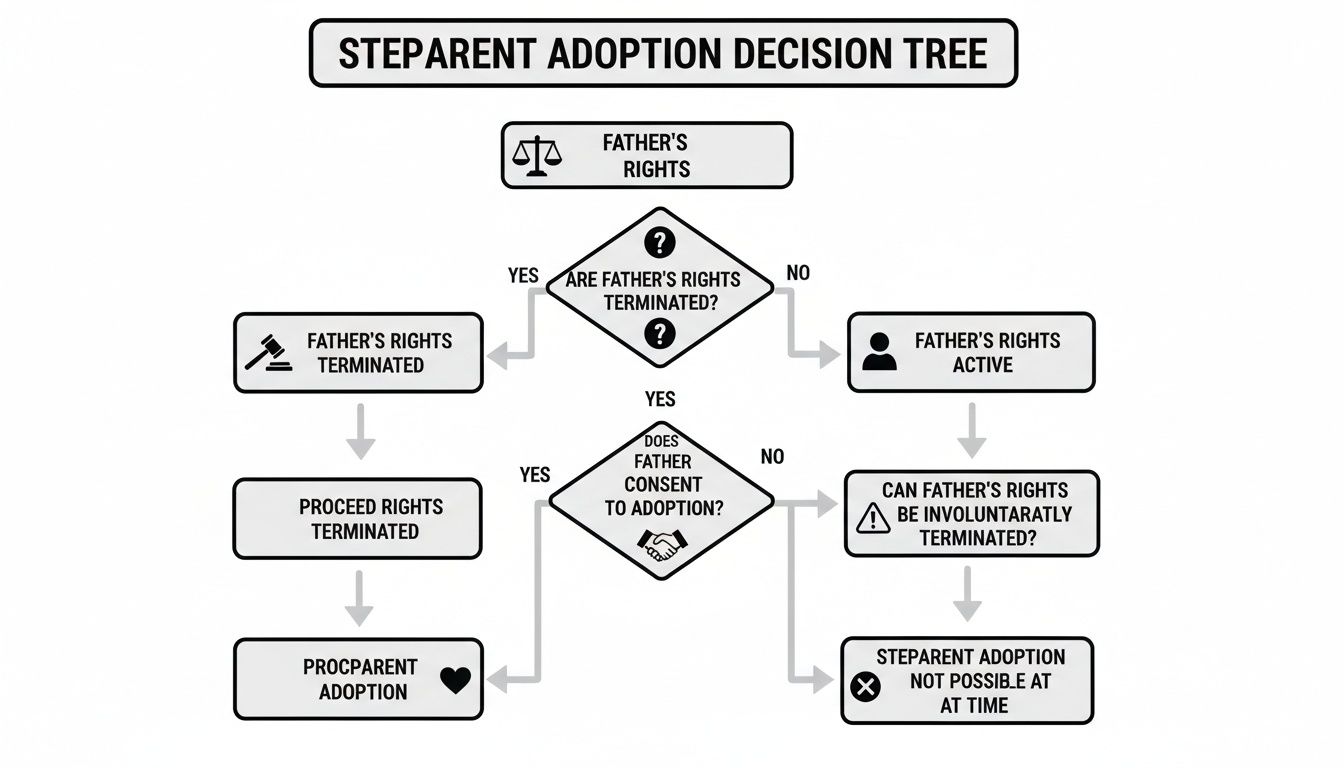
As you can see, the status of the biological father’s rights is the first and most critical fork in the road when deciding which legal path to take.
Managing Conservator vs. Possessory Conservator: What to Expect
When a court names someone a conservator, it assigns them one of two main roles. Understanding the difference is crucial for setting realistic expectations for your SAPCR case.
- Managing Conservator: This role comes with the big decision-making powers. A managing conservator typically has the right to decide where the child lives and make major choices about their education, medical care, and general upbringing.
- Possessory Conservator: This role is more about the right to have possession of and access to the child (what most people call visitation). A possessory conservator may also be given the right to make certain decisions for the child while they’re in their care.
In most cases where both biological parents are still in the picture, a court will name them as Joint Managing Conservators. A dedicated stepfather who files a SAPCR is more likely to be named a Possessory Conservator with specific rights. This can be a huge victory. You could be granted legal rights to visitation and the ability to consent to medical treatment—significant protections for your relationship.
When you’re weighing your options, it can be helpful to see them side-by-side.
Comparing Legal Pathways for Stepfathers in Texas
| Legal Pathway | Outcome for Stepfather | Impact on Biological Father’s Rights | Best For Situations Where… |
|---|---|---|---|
| Stepparent Adoption | Becomes a full legal parent with all rights. | Rights must be terminated (voluntarily or involuntarily). | The biological father is absent, unknown, or agrees to terminate his rights. |
| Conservatorship (SAPCR) | Granted specific, court-ordered rights (e.g., possession, medical consent). | Rights remain intact; stepfather is added to the legal framework. | The biological father is still involved, and you need legal authority to protect your bond. |
Ultimately, seeking conservatorship is an excellent strategy when adoption just isn’t on the table. It provides a formal, court-ordered acknowledgment of your vital role and grants you the legal authority you need to protect and care for the child you love.
Protecting Your Bond with Stepchildren After a Divorce

It’s a fear that keeps many dedicated stepfathers up at night: what happens to your relationship with your stepchildren if you and your spouse get divorced? This is a painful question, but it’s one you must confront. The emotional ties you’ve built are real and powerful, but without legal protection, those ties can be severed in an instant.
The hard truth is that without a formal court order—like an adoption decree or a conservatorship order—your connection to your stepchild has no legal standing after a divorce. Your ex-spouse could, legally, prevent you from having any contact. They could move away, change phone numbers, and you would have no legal recourse to enforce visitation. This difficult reality is precisely why it’s so critical to establish your legal rights during the marriage, while everyone is on the same team. Waiting until a divorce is on the horizon often makes the process far more contentious and challenging.
How Existing Court Orders Protect You Post-Divorce
If you took the proactive step of becoming a legal parent through adoption, your rights are secure. A divorce does not change your status as a legal parent. You would be treated exactly like a biological parent in any custody proceedings, with the same rights to seek conservatorship and possession of your child.
Likewise, if you were named a conservator in a Suit Affecting the Parent-Child Relationship (SAPCR) during the marriage, that order remains in effect. A conservatorship order is a powerful tool because it is legally enforceable.
An existing conservatorship order means you can go back to court to enforce your visitation rights if your ex-spouse tries to cut off contact. It provides a legal foundation to protect your relationship, ensuring you remain a consistent presence in your stepchild’s life.
This legal backing is invaluable. It transforms your role from a purely emotional connection into a legally protected right. Having these conversations and taking action during the marriage is the single best way to safeguard your bond. We know that navigating the complexities of co-parenting after a divorce can be tough, and having a court order provides the structure needed for success.
Can You File a Lawsuit After a Divorce?
What if you never got a court order and are now facing a separation? Is it too late? The short answer is no, it’s not impossible, but it is significantly more difficult.
You would still need to meet the standing requirements we talked about earlier, primarily proving you had actual care, control, and possession of the child for at least six months. This allows you to file a SAPCR even after the divorce has been initiated. However, the emotional landscape is now completely different. Instead of presenting a unified front with your spouse, you may be facing an adversarial situation where they actively oppose you gaining rights. A court will have to weigh your involvement against the biological parent’s wishes, and the entire process can become more complicated and emotionally taxing.
Here are the key challenges you might face:
- Increased Conflict: Filing a lawsuit against your ex-spouse during a divorce can escalate tensions.
- Proving Best Interest: The court’s focus remains on the child’s best interest. You will need to present compelling evidence that maintaining your relationship is vital for the child’s well-being, even over the objection of their biological parent.
- Emotional Strain: This path can place a significant emotional burden on you, your ex-spouse, and, most importantly, the children caught in the middle.
While challenging, it is a path worth considering if you believe your continued presence is essential for your stepchild’s stability and happiness. Protecting that bond is paramount, but being proactive is always the better strategy.
Common Questions We Hear About a Stepfather’s Rights
When you’re navigating the world of blended families, the legal side of things can feel like a maze. It’s completely normal to have a ton of specific, practical questions about what you can and can’t do as a stepfather. To help clear things up, we’ve pulled together some of the most common questions we get from dedicated stepdads just like you.
Can I Authorize Medical Treatment for My Stepchild in an Emergency?
This is a scenario no one wants to imagine, but every stepparent worries about. The short answer is, without a specific court order or a signed authorization from a biological parent, your hands are likely tied when it comes to consenting to major medical treatment.
Texas law does have a provision allowing certain relatives, including a stepparent who has the child in their care, to consent to treatment if a parent can’t be reached. However, this can be a legal gray area and is open to being challenged. The absolute best way to ensure you have the undisputed authority to act in a crisis is to either secure a court order granting you conservatorship rights or have a formal Authorization Agreement for a Nonparent Relative signed and ready to go.
The Biological Father Isn’t on the Birth Certificate. Does That Make Adoption Easier?
It can definitely streamline the process, but it doesn’t quite make it a slam dunk. If no father is legally established—meaning no one has been court-ordered as the father and no one fits the legal definition of a “presumed” father—then you might only need the biological mother’s consent to move forward with the adoption.
But things can get more complicated. If there’s a “presumed” father out there (for instance, a man who was married to the mother around the time of the child’s birth) or if someone steps up to claim paternity, his rights have to be legally dealt with and terminated by a judge. The court’s primary focus, always and without exception, will be on the best interest of the child. A family law attorney who knows the ins and outs of Texas law can help you figure out the exact steps for your unique situation.
If I Divorce Their Mother, Do I Have to Pay Child Support for My Stepchildren?
Generally, the answer here is no. As a stepparent, you don’t have a legal duty to financially support a stepchild. That obligation falls squarely on the biological parents. In the eyes of the law, any financial support you provided during the marriage is considered voluntary.
The huge exception to this rule is if you have legally adopted your stepchild. The moment that Decree of Adoption is signed, you are their parent in every legal sense of the word. That means you have all the same rights and responsibilities as a biological parent, which absolutely includes the legal duty to pay child support if you and your spouse divorce and you are not the primary parent.
Can I Include My Stepchildren in My Will?
Yes, you can, and if you want to provide for them after you’re gone, you absolutely should. You can name your stepchildren as beneficiaries in your will, a trust, or on life insurance policies just like you would any other loved one.
Here’s the critical part: unless they are legally adopted, your stepchildren do not have the same automatic inheritance rights as a biological child would if you passed away without a will (which is called dying “intestate”). The only way to guarantee your assets go where you want them to and that the children you love are taken care of is through proper estate planning.
This really underscores why creating a formal estate plan is so important. It ensures your final wishes are clearly spelled out and legally binding, protecting everyone you consider family.
If you need help navigating divorce, custody, or estate planning in Texas, contact The Law Office of Bryan Fagan, PLLC today for a free consultation.