If you live in The Heights, you may already feel the tension between pride and worry. Your home may have been in the family for years, or it may be the place where you're raising children now. Either way, you want to protect it, protect the people you love, and avoid leaving a legal mess behind.
That concern is reasonable. Estate planning can feel heavy because it asks you to think about illness, death, money, and family dynamics at the same time. A good trust plan makes those conversations easier. It gives your family instructions, structure, and breathing room when they need it most.
Planning Your Family's Future in Houston Heights
A Heights family often starts with a simple goal. Keep the house in the family if possible. Make sure a spouse can stay financially secure. Leave something organized for the children instead of forcing them to sort through paperwork during grief.
That sounds simple, but in practice, the details matter. A historic home may carry emotional value far beyond its market value. A parent may be “asset rich” because the property has appreciated, yet still be short on accessible cash for taxes, maintenance, or care needs. That's where trust planning becomes more than paperwork. It becomes a way to match legal tools to real life.

Consider a common situation. A couple owns a Heights bungalow that has risen in value faster than their available savings. Verified reporting notes that Houston's median home price rose 6.2% in the last 12 months, and Heights properties have appreciated faster because of historic zoning protections, a trend that can create liquidity problems if planning doesn't keep pace with property value growth (Chron coverage of Houston estate planning concerns). If that couple becomes incapacitated or passes away without a coordinated plan, their family may face pressure to sell a property they hoped to keep.
Practical rule: A valuable home doesn't automatically mean a well-planned estate. Real estate value and available cash are two different issues.
Families who want a broader perspective on legacy planning often look at educational resources such as Everglow Prosperity estate planning, because the basic concerns are universal. You want your wishes honored, your loved ones protected, and your assets transferred with as little confusion as possible.
In Texas, that often means looking carefully at wills, trusts, powers of attorney, and beneficiary designations together, not in isolation. The right plan can reduce conflict, create management rules for property, and give a trusted person authority to act when you're no longer able to do it yourself.
What a Trust Attorney Does Beyond Just Drafting Documents
Many people think a Houston Heights trust attorney only writes trust papers and asks where to sign. In reality, the role is much broader. A trust attorney helps you identify risks, choose the right structure, and make sure the plan works outside the conference room.
The strategist and the drafter
A trust starts with goals, not forms. You may want to keep a home available for a surviving spouse, protect a child who isn't ready to manage money, or reduce the chance of family conflict. The attorney's first job is to understand what you're trying to accomplish and what assets are involved.
Then comes drafting. This is where legal language matters. The trust has to clearly identify the parties, state how assets should be managed, and explain when beneficiaries receive distributions. A vague document invites confusion later.
For readers comparing legal tools, Estate Planning involves wills, trusts, and estate plans to protect assets and wishes. A trust attorney helps decide whether a trust belongs in that plan and what type of trust fits your circumstances.
The counselor and the administrator
Some of the hardest estate planning questions aren't legal. They're personal. Should one child serve as trustee? Should a beneficiary receive funds all at once or in stages? How do you protect a loved one without creating resentment among siblings?
That counseling role matters because a technically valid plan can still fail a family if it ignores human dynamics.
A trust attorney may also guide the people carrying out the plan after death or incapacity. Trustees often need help reading the document, handling notices, maintaining records, and understanding their fiduciary duties. In Texas, those duties are serious. A trustee must act in the interest of the beneficiaries and follow the trust terms carefully.
The strongest trust documents are written with administration in mind. If a trustee can't follow the instructions in real life, the plan needs more work.
Texas law also intersects with family law in ways people don't always expect. Under Texas Family Code § 7.001, a court divides community property in a manner that is “just and right,” which doesn't require an equal split. Courts can award disproportionate shares such as 55%, 60%, or even 70% to one spouse when the facts justify it (Texas property division guide discussing Family Code § 7.001). If you're divorced, remarried, or worried about separate versus community property, your trust plan should account for that history rather than pretend it doesn't exist.
Common Types of Trusts for Texas Families
The right trust depends on what you're trying to protect. One family wants flexibility. Another wants stronger asset protection. A third needs to provide for a loved one with a disability without interfering with benefit eligibility.

Revocable living trust
A revocable living trust is often the easiest starting point to understand. You create it during your lifetime, you usually serve as your own trustee at first, and you can amend or revoke it while you have capacity.
For a Heights homeowner, this can be useful when the goal is orderly management and smoother transfer of assets. If the trust holds the home and other selected assets properly, your successor trustee may be able to manage those assets without the same probate hurdles a will alone can create.
A simple comparison helps:
| Trust type | Best fit | Main tradeoff |
|---|---|---|
| Revocable living trust | Families who want flexibility and continuity of management | Less asset protection than an irrevocable structure |
| Irrevocable trust | Families seeking stronger protection or long-term planning objectives | Harder to change once created |
| Special needs trust | Families supporting a disabled beneficiary | Requires careful drafting and administration |
If you're weighing whether a trust or a will fits your situation better, this discussion of trust vs will in Texas can help frame the issue.
Irrevocable trust
An irrevocable trust usually involves giving up some control in exchange for stronger separation between you and the assets transferred into it. That can matter in long-term planning, especially when a family is trying to protect wealth across generations or address Medicaid-related concerns without relying on a last-minute fix.
For Heights residents, the property aspect matters. A house may appreciate on paper while the owner remains cash constrained. If planning doesn't address liquidity, the estate may hold a highly valuable property but still struggle with administration costs, maintenance, taxes, or beneficiary buyouts.
A trust should answer two questions at once. Who gets the asset, and who pays the bills while that asset is being preserved or transferred?
Special needs trust
A special needs trust is designed to support a person with disabilities without carelessly disrupting government benefits. Parents often worry about leaving money directly to a child or dependent who needs public assistance. A properly structured trust can provide support while preserving eligibility concerns that direct ownership might complicate.
This kind of planning needs precision. In Houston-area trust disputes and estate administration, matters may be handled in Probate Court 2, Probate Court 3, and Probate Court 4, which reflects the complexity of the local probate system and why careful trust drafting matters before conflict begins (Houston Heights probate court overview).
Contested matters can involve allegations about coercion, forgery, outdated documents, or conflicting estate instructions. Families rarely expect that kind of dispute when they're signing papers. They often discover the risk only after a death, when it's too late to clarify intent.
The Step-by-Step Process of Creating and Funding a Trust
Trust planning feels more manageable when you break it into steps. The legal work has a sequence, and each step has a purpose.

Step one through step three
Clarify your goals
Start with the people and assets that matter most. Who needs protection? What property do you own? Is the main concern incapacity planning, probate avoidance, a child with special needs, or preserving a house?Review what you own
This includes real estate, bank accounts, investment accounts, business interests, and beneficiary-driven assets. If you're in the middle of divorce or sorting out marital claims, that asset review has to be especially careful. Issues involving Property Division can include division of community property, debts, and complex assets, and those characterizations affect what should or shouldn't go into a trust.Draft the trust agreement
The document should identify the settlor, trustee, successor trustee, beneficiaries, and management terms. Texas trust validity and administration questions often connect to the Texas Estates Code and Texas trust law principles, so the drafting has to align with state requirements and the practical realities of the assets involved.
A separate but related concern is probate exposure. If you're unsure which assets may still require court involvement, this article on what assets must go through probate in Texas helps identify where a trust can and can't solve the problem by itself.
To see the process in motion, this short video gives a useful visual overview:
Step four and the part people miss
Sign and execute the documents properly
The trust document usually needs signatures, and related deeds, assignments, and powers of attorney may require notarization. Execution mistakes can create unnecessary challenges later.Fund the trust
This is the step many people skip. An unfunded trust is like building a safe and never putting anything inside it. The document may exist, but if the house deed, financial accounts, or other assets never move into the trust or otherwise coordinate with it, the plan may not do what you intended.
Common funding actions include:
- Real estate transfers: Deeding the home into the trust when appropriate.
- Account coordination: Updating ownership or beneficiary designations where allowed.
- Personal property assignments: Moving designated non-real-estate assets into the trust framework.
- Ongoing review: Revisiting the plan after marriage, divorce, births, deaths, moves, or major asset changes.
Important: Signing the trust is the beginning of the plan's effectiveness, not the end.
Why a Houston Heights Attorney Is Critical for Your Estate
A local lawyer doesn't just know Texas law in the abstract. A local lawyer understands how the facts of life in The Heights shape the legal plan.
Local property reality matters
The Heights has a distinct mix of older homes, renovated properties, and families who may have substantial value tied up in a single house. That creates a planning issue many generic estate discussions miss. A family can hold a valuable piece of property and still lack enough liquid funds to handle taxes, upkeep, or the practical costs that come with administration.
A Houston Heights trust attorney should account for that tension directly. If the plan says “keep the house,” it also needs to answer who pays for roof repairs, insurance, and maintenance while the trust is being administered. If several beneficiaries inherit one property, the trust should deal with occupancy, sale rights, and buyout terms before conflict starts.
Court knowledge matters too
Trusts don't exist in a vacuum. When disputes arise, they enter a court system with local procedures, judges, and expectations. A lawyer who regularly works in Harris County probate matters is better positioned to spot avoidable problems early and draft with administration in mind.
That matters because trust litigation often turns on details. Was the instrument properly executed? Did someone exert coercion or duress? Is there an older competing document? Has the trustee followed fiduciary duties? These aren't theoretical questions. They are the kinds of disputes that reach probate court when planning is unclear or incomplete.
If you'd like a practical overview of that court process, this article on what to expect during the Texas probate process gives helpful context.
Physical presence and accessibility
For many families, local access matters as much as legal knowledge. The Law Office of Bryan Fagan, PLLC operates a dedicated office in The Heights neighborhood of Houston, Texas, with the specific contact number 281-245-1776, establishing a physical presence to serve clients seeking trust and estate planning (local office information).
The firm also brings more than 100 years of combined legal experience across its team and handles estate planning matters such as trusts, wills, and guardianships as part of its broader Texas family law and estate planning work. For a resident who may also be dealing with remarriage, blended-family concerns, or prior divorce issues, that overlap matters because estate planning and family law often intersect in very practical ways.
A good local attorney doesn't just draft around assets. The attorney drafts around your actual life in Houston Heights.
How to Choose the Right Attorney and Understand the Costs
Choosing a lawyer for trust work shouldn't feel mysterious. You can ask direct questions, compare qualifications, and insist on clear explanations.
What qualifications to look for
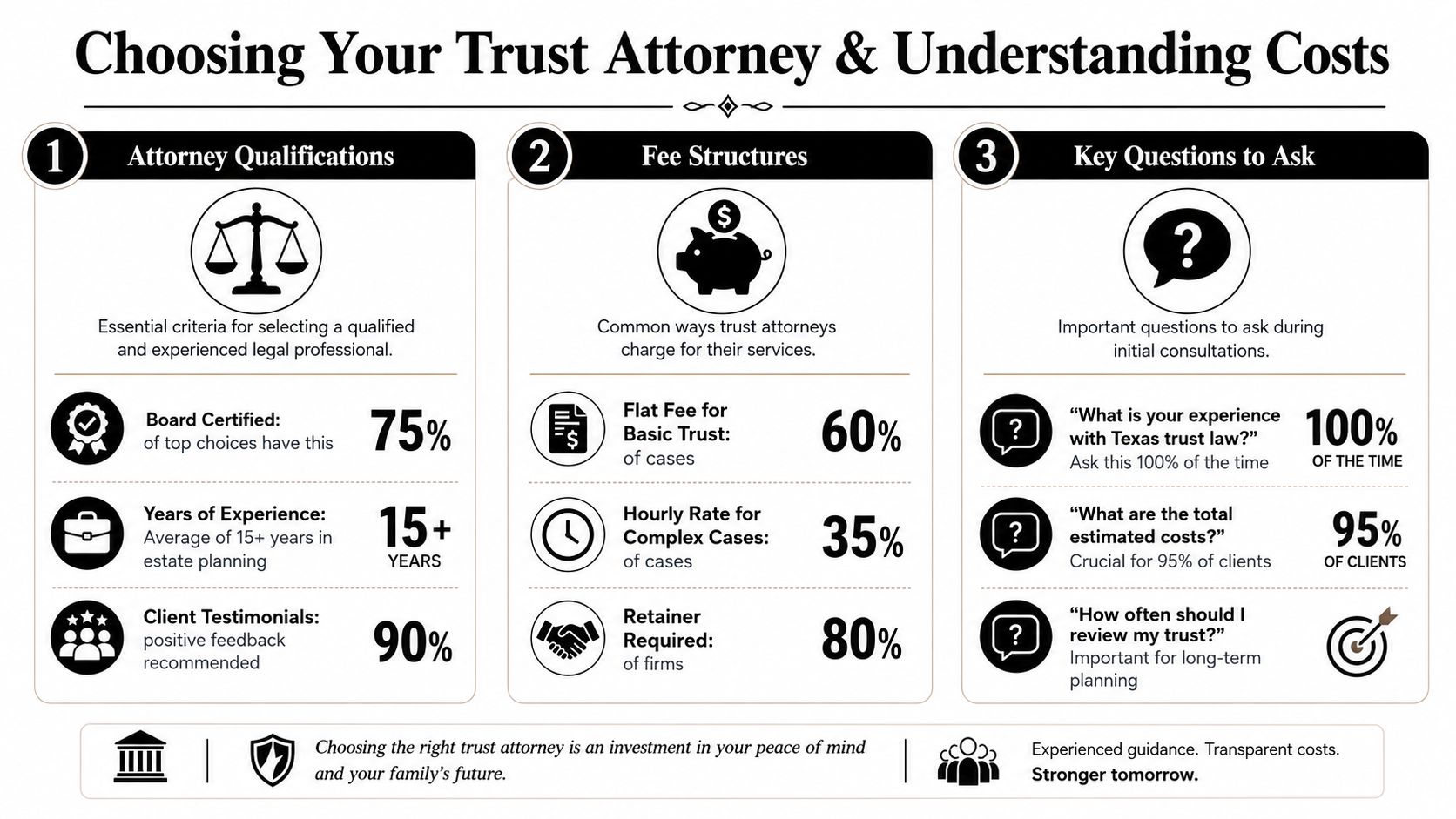
In Texas, one of the strongest credentials for this kind of work is Board Certification in Estate Planning and Probate Law by the Texas Board of Legal Specialization. Verified guidance identifies that credential as the highest benchmark for trust attorneys handling complex fiduciary litigation and Harris County probate matters (Texas trust litigation discussion).
When you speak with an attorney, ask questions like these:
- Relevant experience: Have you handled trust plans involving homes, blended families, or liquidity concerns similar to mine?
- Litigation awareness: If a dispute develops later, do you understand how these cases are argued and defended in probate court?
- Funding help: Will you explain what must be retitled or coordinated after the trust is signed?
- Review process: How should the plan be updated after life changes?
What the costs can look like
Cost questions are fair, and you should ask them early. Verified Houston benchmark data indicates that initial trust setup and review costs range from $1,000 to $3,000, while ongoing annual trust management fees typically fall between $1,500 and $3,500, and annual trustee fees are commonly 0.5% to 2% of total trust assets (Houston trust cost benchmarks).
For example, that same benchmark notes trustee fees of $2,500 to $10,000 for a $500,000 trust in the example provided at the source. It also states that additional administrative expenses may include court fees ranging from $700 to $1,500 and notary fees from $5 to $120 per document, with total trust administration expenses potentially exceeding $5,000 annually for moderate-complexity estates when legal, accounting, and tax preparation costs are combined.
Cost matters, but so does fit. A cheaper plan that isn't funded, isn't updated, or doesn't address your real risks can become the expensive option later.
Not every family needs the same level of planning. Some need a straightforward revocable trust and deed work. Others need a more detailed structure because of second marriages, vulnerable beneficiaries, or hard-to-divide real estate. The right attorney should explain why a recommendation fits your facts, not pressure you into the biggest package.
Take the First Step to Secure Your Legacy
Individuals don't start this process because they're excited about legal documents. They start because they love their family and want to spare them confusion, conflict, and avoidable court problems later.
If you're a Heights resident with a home that's grown in value, a family that depends on you, or questions about how a trust fits with divorce history, remarriage, or future care needs, planning now can make a meaningful difference. The right trust can create structure. It can protect a vulnerable loved one. It can also address directly the gap between property value and cash flow, which is one of the most overlooked estate planning issues in this neighborhood.
You don't need to solve every detail on your own. You need a clear conversation, a realistic review of your assets, and a plan that works in Texas.
If you need help navigating divorce, custody, or estate planning in Texas, contact Law Office of Bryan Fagan, PLLC today for a free consultation.