Watching someone you love struggle with bills, medications, appointments, or basic decisions can shake a family. You may be noticing missed payments, confusion about routine tasks, or growing disagreement among relatives about what should happen next. If that sounds familiar, looking for a Houston Heights guardianship lawyer isn't overreacting. It's often the first careful step toward protecting someone vulnerable while preserving as much dignity as possible.
Texas guardianship law can feel intimidating at first because it mixes medical evidence, court procedure, and family dynamics. But once you break it down, the path becomes much easier to understand.
When You Worry About a Loved One's Ability to Cope
A common situation often develops subtly. An adult daughter stops by her father's home in Houston Heights and notices unopened mail on the kitchen counter, food spoiling in the refrigerator, and a stack of checks written twice for the same bill. He insists he's fine. At the same time, he forgets doctor appointments and gets upset when anyone offers help.
That moment leaves families in a hard place. You want to respect your loved one's independence, but you also can't ignore signs that daily life may no longer be manageable. For many people, the search for legal guidance begins right there, in the gap between concern and certainty.
If you're in that position, you're not alone. Families often start by asking whether they need full guardianship, a temporary solution, or something less restrictive. A practical first read is this guide on guardianship for an elderly parent, especially if your concerns involve memory issues, health care decisions, or financial vulnerability.
The most important first step isn't winning a case. It's figuring out what level of protection your loved one actually needs.
A thoughtful lawyer helps you slow down, gather facts, and avoid unnecessary conflict. In many cases, the legal system isn't trying to punish a struggling adult. It's trying to create a structure that protects that person's safety, finances, and remaining rights.
Understanding Guardianship Under Texas Law
Under the Texas Estates Code, guardianship is a court-supervised relationship in which one person receives legal authority to make certain decisions for another person who can't manage those decisions safely on their own. Courts don't treat this lightly. Guardianship can limit important rights, so judges are supposed to use the least restrictive option that fits the situation.
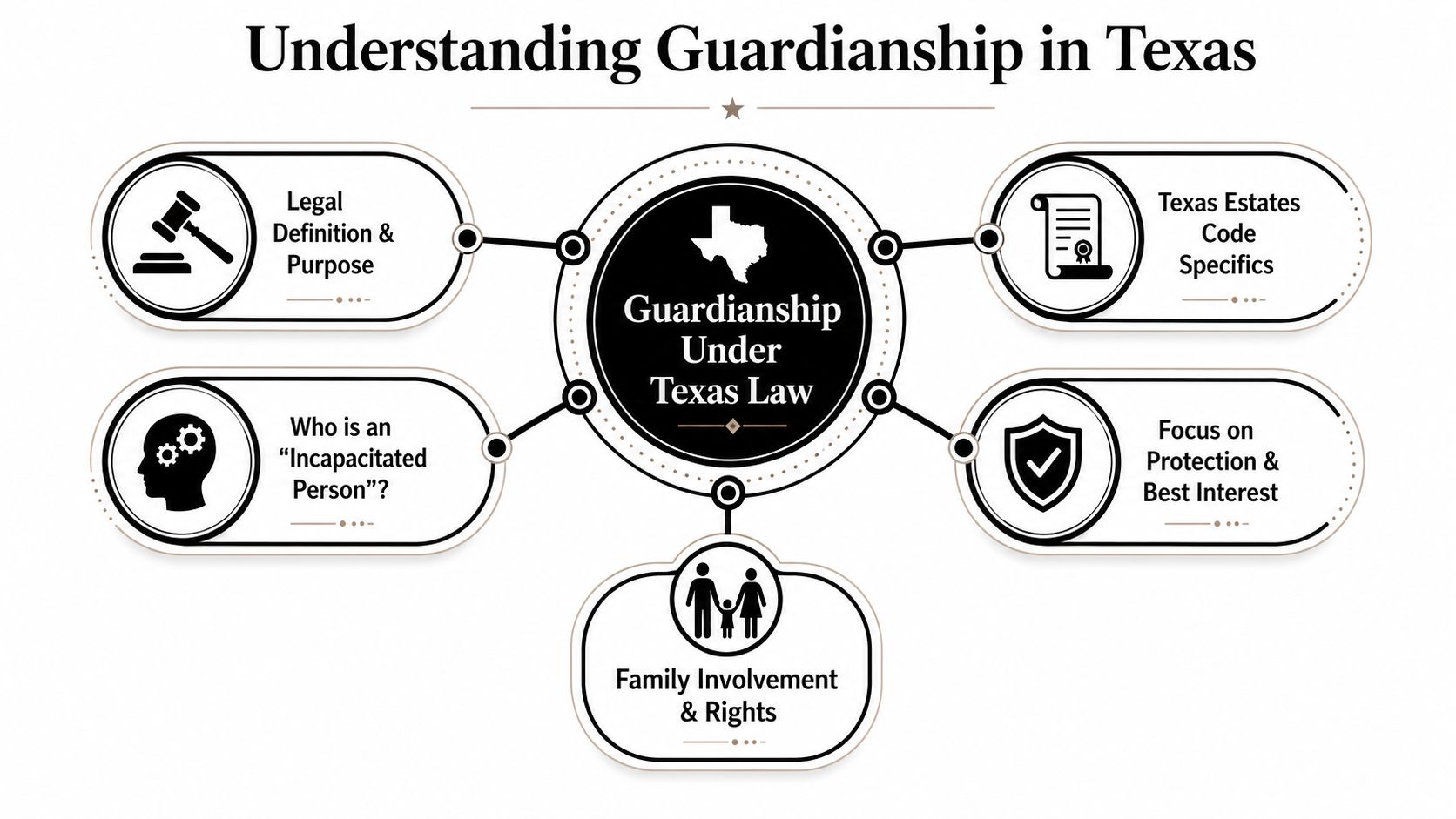
Two different jobs a guardian may hold
Texas usually separates guardianship into two categories.
| Type | What it covers | Everyday example |
|---|---|---|
| Guardian of the Person | Personal care decisions | Choosing medical care, housing, and daily support |
| Guardian of the Estate | Financial management | Paying bills, protecting income, handling property |
A simple way to think about it is this. One role manages the person's life and care. The other manages the person's money and property. Some people need both. Others need only one.
If your mother can still say where she wants to live and what medical treatment she prefers, but she can't track accounts or recognize financial scams, the court may focus on estate issues. If your spouse can no longer understand medical decisions or maintain personal safety, the court may need to address personal authority. Texas courts can also tailor a limited guardianship instead of removing broad rights unnecessarily.
Why courts look for the least restrictive fit
Judges generally want evidence that guardianship is necessary and appropriately narrow under the Texas Estates Code. That's one reason families often compare guardianship with other legal tools. If you're sorting out legal terminology, this explanation of the difference between guardianship and conservatorship in Texas can help clear up a common point of confusion.
Some families encounter guardianship questions while also dealing with Probate, which involves probate administration and estate settlement in Texas. The overlap matters because incapacity, death, estate management, and family authority often raise connected legal issues even though they are different proceedings.
Practical rule: Guardianship should match the person's actual limitations, not the family's frustration level.
That distinction matters. A Houston Heights guardianship lawyer should be able to explain not just how to file, but why a particular scope of guardianship makes legal sense.
A Harris County guardianship case often starts in a living room, not a courtroom. A daughter notices unpaid bills stacked on the counter. A son learns his father signed a suspicious contract. The family knows help is needed, but the court process feels intimidating because every step seems tied to a rule, a deadline, or a hearing.
It helps to treat the case like a checklist with court supervision at each stage. Guardianship is one path, but it is also the most restrictive one, which is why careful lawyers often look at the facts early and ask whether a less restrictive planning tool could solve the problem before asking a judge to step in.
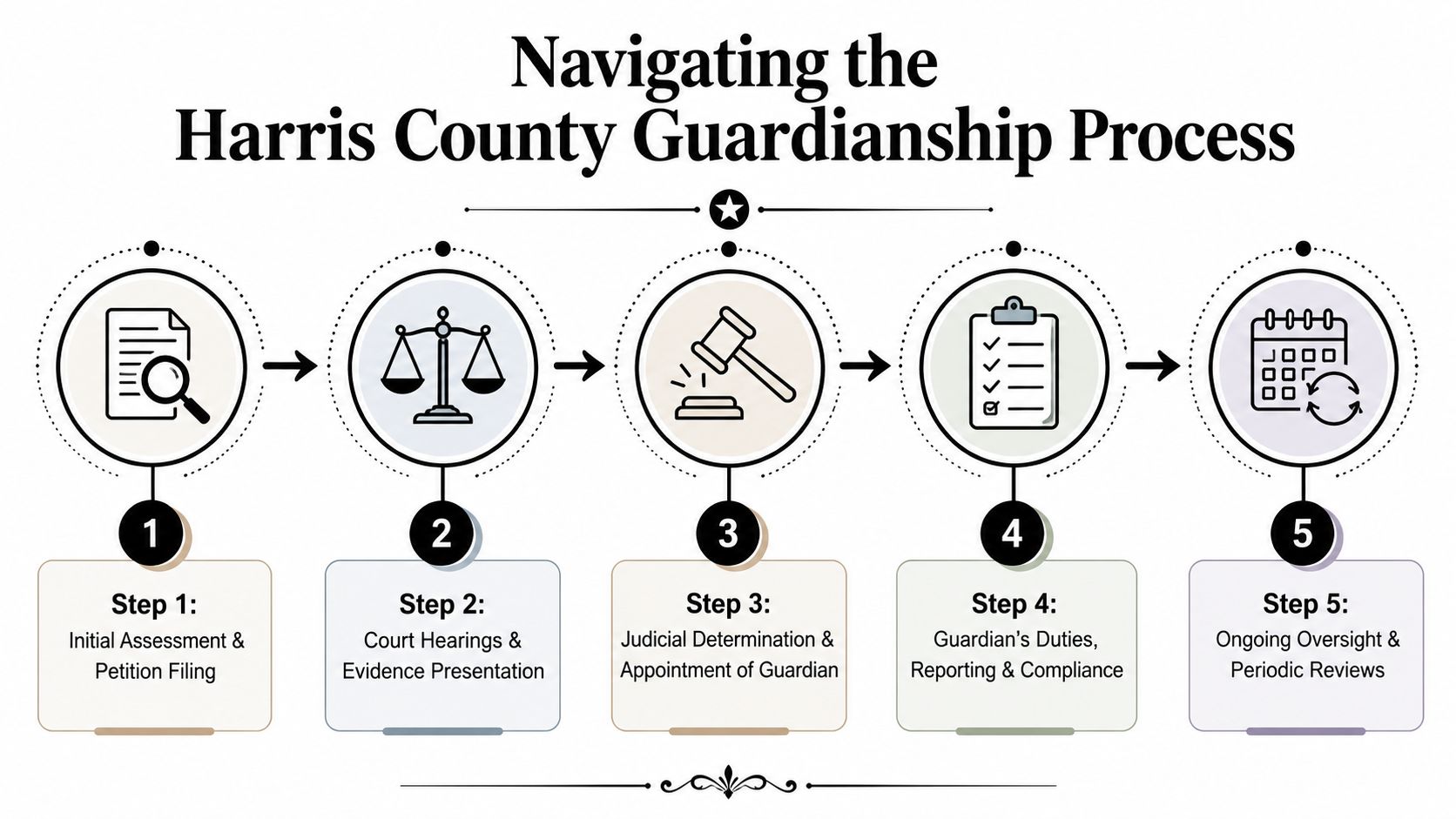
Step one starts before anything is filed
The first phase is evidence gathering. Families usually need medical information, contact details for close relatives, and a clear explanation of which decisions the proposed ward can no longer make safely. Courts do not grant authority based on worry alone. They want proof tied to specific problems.
One document often drives the timing of the case. The Physician's Certificate of Medical Examination, or PCME, must meet Harris County and Texas guardianship requirements. The Harris County Clerk's probate courts page provides local court information and filing resources, and those local procedures matter because even a strong case can be delayed by paperwork errors.
Families are often surprised by how detailed this stage is. The court may want names and addresses of relatives, information about the proposed ward's assets, and facts showing why the requested guardianship fits the actual need. A guardianship application works like a blueprint. If the blueprint is vague, the court has little reason to approve construction.
After filing, the court adds safeguards
Once the application is filed, the case enters a review process designed to protect the proposed ward. The court issues required notices, and it usually appoints an attorney ad litem to represent the proposed ward's interests. In some cases, a court investigator or guardian ad litem may also become involved, depending on the issues in dispute.
That structure can feel frustrating to families who believe the need is obvious. But the court is not there to ratify family consensus. It is deciding whether one adult should receive legal authority over another adult's personal decisions, finances, or both.
Applicants also need to be ready for practical requirements such as training, background checks, and follow-up filings. If you want a fuller explanation of the paperwork sequence, this guide to filing for guardianship in Texas with forms, fees, and hearings walks through the process in more detail.
A short video may also help if you prefer hearing the process explained aloud.
Timing and cost in real life
Families usually ask two questions right away. How long will this take. How much will it cost.
The honest answer is that it depends on whether the case is contested, how quickly the medical evidence is completed, whether relatives agree, and how broad the requested powers are. A straightforward case can move much faster than one involving sibling conflict, disputed incapacity, or complicated finances.
Costs usually come from several different places at once:
- Court filing fees
- Medical evaluations and updated physician paperwork
- Attorney fees
- Attorney ad litem or investigator fees ordered by the court
- Bond costs, if a bond is required
- Ongoing reporting costs after appointment
That last point matters. Guardianship is rarely a one-time legal event. It often continues with annual reports, accountings, and continued court oversight. For many families, that is the moment the bigger picture becomes clear. The critical decision is not only whether you can start a guardianship. It is whether guardianship is the right long-term structure compared with planning tools that may avoid court involvement in the first place.
What happens at the hearing
At the hearing, the judge reviews the application, medical evidence, the attorney ad litem's position, and any objections raised by family members or other interested persons. If the legal standard is met, the judge may appoint a guardian and define the scope of authority instead of granting every power requested.
Texas also treats these cases as formal legal proceedings, not simple family filings. TexasLawHelp's guardianship overview explains that courts generally require representation by a licensed attorney in guardianship matters because the case affects another person's rights. That requirement reflects the stakes. Guardianship can protect a vulnerable adult, but it also removes decision-making authority, sometimes in major areas of life.
Court supervision starts at the beginning because the court's job is to protect the proposed ward's rights while addressing the family's safety concerns.
Are There Alternatives to Guardianship
Not every family needs to go to court. In fact, one of the most important conversations a lawyer can have with a family is whether guardianship can be avoided altogether.
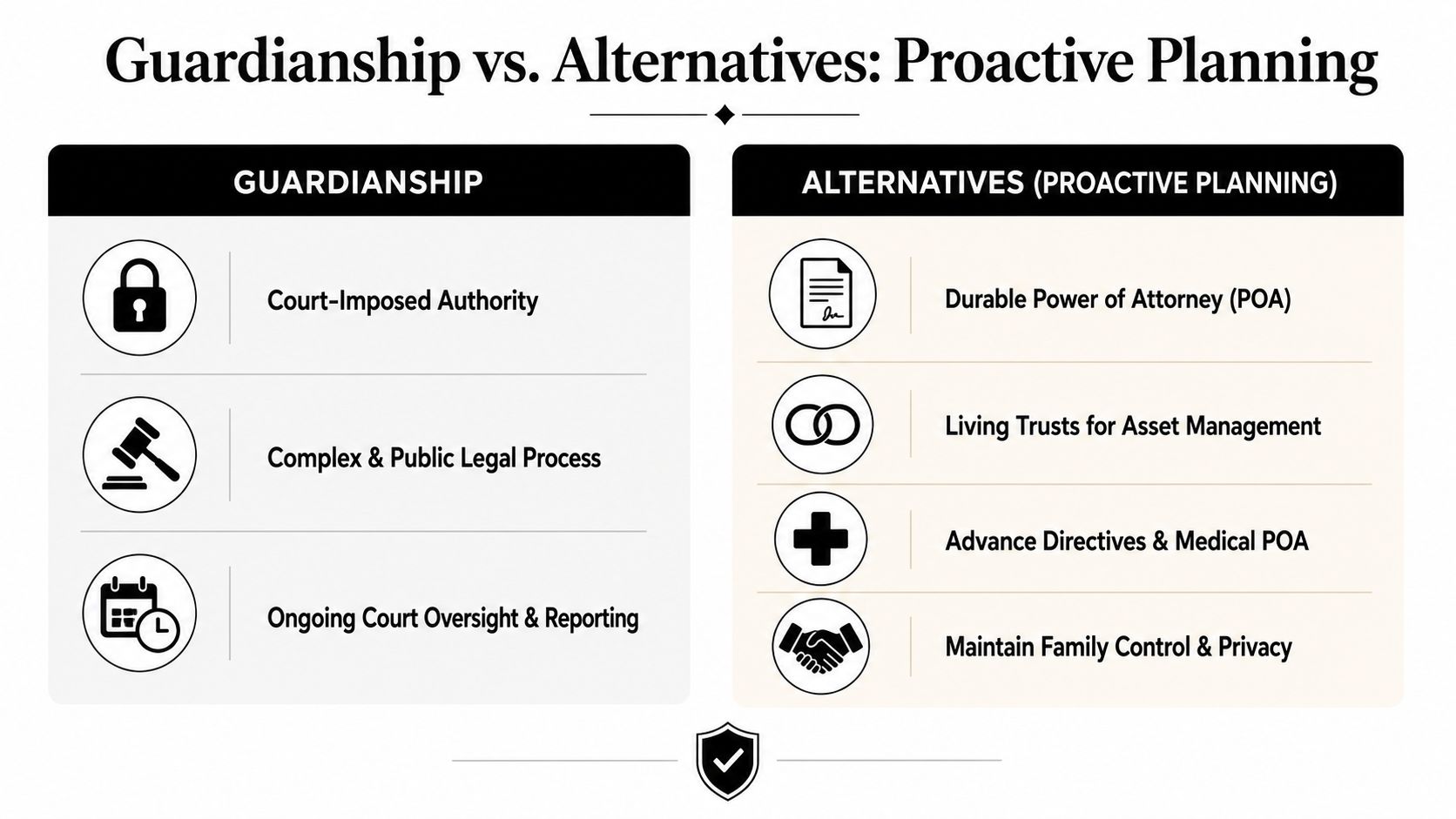
Why planning ahead changes everything
Guardianship is powerful, but it's also public, court-driven, and ongoing. A properly signed Medical Power of Attorney or Statutory Durable Power of Attorney can often allow a trusted person to step in without asking a judge for formal appointment.
Many online discussions focus only on starting guardianship and skip this planning issue. Yet a Houston legal resource notes that Medical and Durable Powers of Attorney can prevent the need for court intervention and may save families an average of $10,000 to $15,000 in legal fees and months of delay when they are properly executed, according to this explanation of alternatives to guardianship in Houston.
That doesn't mean powers of attorney solve every case. They only work when the documents were properly prepared before incapacity creates a crisis, and when the available authority is broad enough for the problem at hand.
A side by side comparison
| Issue | Guardianship | Power of Attorney planning |
|---|---|---|
| How authority begins | Court appointment | Private legal document |
| Privacy | Court filing creates public record for filed medical certificate | Usually handled outside a court case |
| Oversight | Ongoing judicial supervision | No regular probate court supervision in the same way |
| Timing | Can take months | Works only if signed in advance |
One more detail matters. In Texas, the physician's certificate filed in a guardianship case becomes public record once submitted, as noted in this Texas guardianship filing discussion. For some families, privacy alone is a strong reason to plan before a crisis.
Families usually feel more in control when they plan early. They keep decision-making closer to home and farther from the courthouse.
When guardianship still becomes necessary
Sometimes the person never signed valid planning documents. Sometimes relatives accuse the agent under a power of attorney of abuse or mismanagement. Sometimes a bank, care facility, or family conflict exposes limits in the paperwork. In those situations, guardianship may still be the right answer.
A careful attorney should treat guardianship as a last option when lesser tools won't protect the person. That approach often saves time, money, and stress while respecting the individual's autonomy.
How to Choose the Right Houston Heights Guardianship Lawyer
You may be sitting at a kitchen table with a stack of medical notes, bank statements, and unanswered questions, trying to figure out whether court involvement is necessary. The lawyer you choose should bring order to that moment. A good guardianship attorney explains what must happen, what may be avoided, and what the process is likely to cost your family in time, money, and stress.
That last point matters.
Some lawyers begin with the petition. A careful lawyer begins with the problem. If a valid power of attorney, medical directive, or another less restrictive tool can protect your loved one, you should hear that early. Guardianship is sometimes the right answer, but it should be treated as the final option, not the starting assumption.
Questions worth asking in the first meeting
Bring a written list of questions and a short timeline of what has happened so far. Families under stress often remember the big events and forget the smaller facts that shape a legal case.
Ask questions that show how the lawyer thinks, not just what the lawyer charges:
- How often do you handle guardianship cases in Harris County probate court? Local practice matters because probate courts expect detailed filings, proper notice, and strict follow-through.
- How do you decide whether guardianship is necessary at all? You want an attorney who will discuss powers of attorney and other planning options before recommending a court case.
- What tends to slow a case down? The answer will tell you whether the lawyer understands medical evidence, service issues, court scheduling, and family conflict.
- Who will keep me updated? Guardianship cases involve deadlines, evaluations, and court requirements. You need to know whether updates come from the attorney, a paralegal, or no one unless you ask.
- What happens if a relative objects? Even a case that starts with family agreement can change quickly.
Those questions help you separate a form filer from a counselor. In guardianship matters, that difference is large.
Ask for a plain explanation of cost and timing
A guardianship case works a bit like building a file for court one layer at a time. Filing is only one layer. Medical evidence, service, attorney ad litem involvement, hearings, and post-appointment duties can all affect the total cost.
A reliable lawyer should explain fees in categories you can understand, including attorney time, court costs, medical evaluations, and any ad litem fees that may apply. The lawyer should also tell you what tends to make a case move faster and what tends to increase expense. Contested matters usually cost more and take longer because the court has to sort through competing evidence and family disagreement.
If the answer sounds vague, keep asking. You are not being difficult. You are doing what a responsible proposed guardian should do.
What confidence looks like in a consultation
Confidence in this setting is usually quiet. It sounds like clear answers, careful questions, and realistic expectations.
Look for these signs:
- The lawyer explains the process in steps. You should leave knowing what happens first, what documents are needed, and what decisions the court will make.
- The lawyer respects the proposed ward. Guardianship removes rights, so the discussion should reflect dignity and caution, not convenience.
- The lawyer can handle tension without feeding it. Family strain is common in these cases. Calm communication matters.
- The lawyer talks about protection and limits. A thoughtful attorney will explain that guardianship can be customized and that the court may grant only the authority that is needed.
- The lawyer gives you a practical next step. That may be gathering records, scheduling a medical evaluation, reviewing existing estate planning documents, or deciding that a guardianship filing should wait.
One final measure is simple. After the meeting, you should feel better informed, even if the road ahead still looks hard. The right Houston Heights guardianship lawyer helps your family make careful decisions with a full understanding of both court action and the alternatives that may avoid it.
Our Approach to Guardianship at The Law Office of Bryan Fagan
Guardianship cases rarely arrive in isolation. A family may already be dealing with divorce, conflict between adult children, concerns about a minor grandchild, or questions about estate planning documents that were never signed. That broader context matters.

Why family law experience matters in guardianship cases
Texas family law firms serving Houston Heights often handle guardianship alongside divorce, custody, and CPS-related matters. Some local firms report 20+ years of combined experience in Texas family courts across these connected areas, as noted in this Houston guardianship and family law overview.
That overlap isn't accidental. A guardianship dispute may involve siblings who already distrust one another because of prior caregiving disagreements. A case involving a minor may connect to custody or support issues. A parent with diminished capacity may become part of a larger family conflict that includes Divorce, which is Texas divorce representation for contested, uncontested, and high-conflict cases.
A broader legal lens helps families make better choices
A lawyer with experience across family law and estate planning can spot issues that a narrower approach might miss. For example, if a grandparent has been caring for a child while also declining cognitively, the family may need to think about more than guardianship. They may need to address decision-making for the elder, living arrangements for the child, and authority over finances at the same time.
That kind of legal problem isn't solved by one form. It takes coordinated analysis.
The Law Office of Bryan Fagan, PLLC handles Texas family law, divorce, and estate planning matters, including guardianship-related issues that intersect with those areas. For families, that means one option is a firm that can address the larger picture rather than treating the guardianship petition as the only question.
Good guardianship counsel doesn't just ask, "Can we file?" It asks, "What problem are we really solving for this family?"
When families understand the full picture, they often make steadier decisions and avoid unnecessary conflict.
Common Questions About a Guardian's Duties and Disputes
A lot of families feel a sense of relief once the judge signs the appointment order. Then the next concern sets in. What does the guardian have to do now, and what happens if relatives start arguing over every decision?
Guardianship is not a one-time court event. It is an ongoing court-supervised role. A useful way to view it is this: appointment gives a guardian authority, but that authority keeps working only if the guardian follows the court's rules, meets reporting deadlines, and acts in the ward's best interest.
What must a guardian do right after appointment
After appointment, a guardian must formally qualify before acting. As noted earlier in this article, Texas law gives a short window to complete that step, including the oath and any required bond. Missing that deadline can put the appointment at risk.
Once qualification is complete, the clerk can issue Letters of Guardianship. Those letters work like current proof of authority. Banks, care facilities, and other institutions often ask to see them before they will accept the guardian's instructions.
That is one reason families should not treat guardianship as a set-it-and-forget-it process. Even after the court approves the case, paperwork still matters.
What ongoing reporting does the court expect
Harris County expects guardians to keep the court informed. A guardian of the estate may need to file an annual account, and a guardian of the person may have ongoing reporting duties about the ward's condition and care. The court's instructions to guardians explain the filing requirements and deadlines in practical terms, including the timing tied to the guardian's qualification date, in the Harris County guardian instructions.
These reports are not minor formalities. They let the court confirm that money is being handled properly, living arrangements remain appropriate, and the guardian is carrying out the job the court assigned.
If a guardian falls behind, the court can require explanations, set hearings, or consider removal. That can be stressful and expensive, especially when better recordkeeping from the start could have prevented the problem.
What if family members keep fighting
Disputes usually center on three questions. Does the proposed ward need a guardian? Is the proposed guardian trustworthy? Is there a less restrictive option that would solve the problem?
That third question matters more than many families expect. Guardianship should solve a real safety or decision-making problem, not become a shortcut for family frustration. In some cases, a valid power of attorney, medical power of attorney, trust arrangement, or supported decision-making plan may address the concern with less conflict, less cost, and less court involvement. That is why a careful lawyer looks at alternatives before treating guardianship as the automatic answer.
When a fight does reach the courthouse, judges focus on evidence. Medical records, financial records, witness testimony, and proof of past caregiving usually carry more weight than accusations traded at family gatherings.
That same focus on legal proof appears in other family law matters. For example, Paternity Actions involve establishing legal rights and responsibilities through evidence and court orders, not assumptions based on family history. Guardianship works the same way. The court wants verifiable facts and a workable plan for the vulnerable person's care.
If you are serving as guardian, keep organized records from day one. If you are concerned about how a guardian is acting, gather documents, stay specific, and bring the court concrete facts rather than general suspicions.